


KP-231 · Water & Climate
Why a Plant Needs Water: Four Uses, and What the Leaves Do with the Night’s Dew
A plant needs water for four things: minerals and nutrients, cooling, hydrogen for building sugar, and firmness. Root water from the soil serves all four and is the only water that brings minerals; dew on the leaves serves mainly hydrogen and cooling. A covered PQNK field with a standing crop receives water from both directions every clear night.
Read or listen to the full paper ↓Abstract
A plant needs water for four things: to bring minerals and nutrients up from the soil, to keep itself cool, to supply the hydrogen it builds into sugar, and to keep its cells firm.
Water reaches the plant from two directions. Root water comes up from the soil and is the only water that carries minerals. Leaf water settles on the leaves as dew on clear nights; it brings no minerals, but serves the plant mainly for hydrogen and cooling, and keeps the leaf cells full through the early hours of the day.
A PQNK field, with its soil covered and its crop standing, receives water from both directions every clear night. The paper follows KP-229, on how bare soil heats the land, and KP-230, on how much dew the mulch catches.
Full Paper
If you use “Listen”, the text of the page may be sent to your browser or operating system’s speech provider, such as Apple, Google or Microsoft, depending on the voice your device uses. Pedaver does not process, transmit or store any audio.
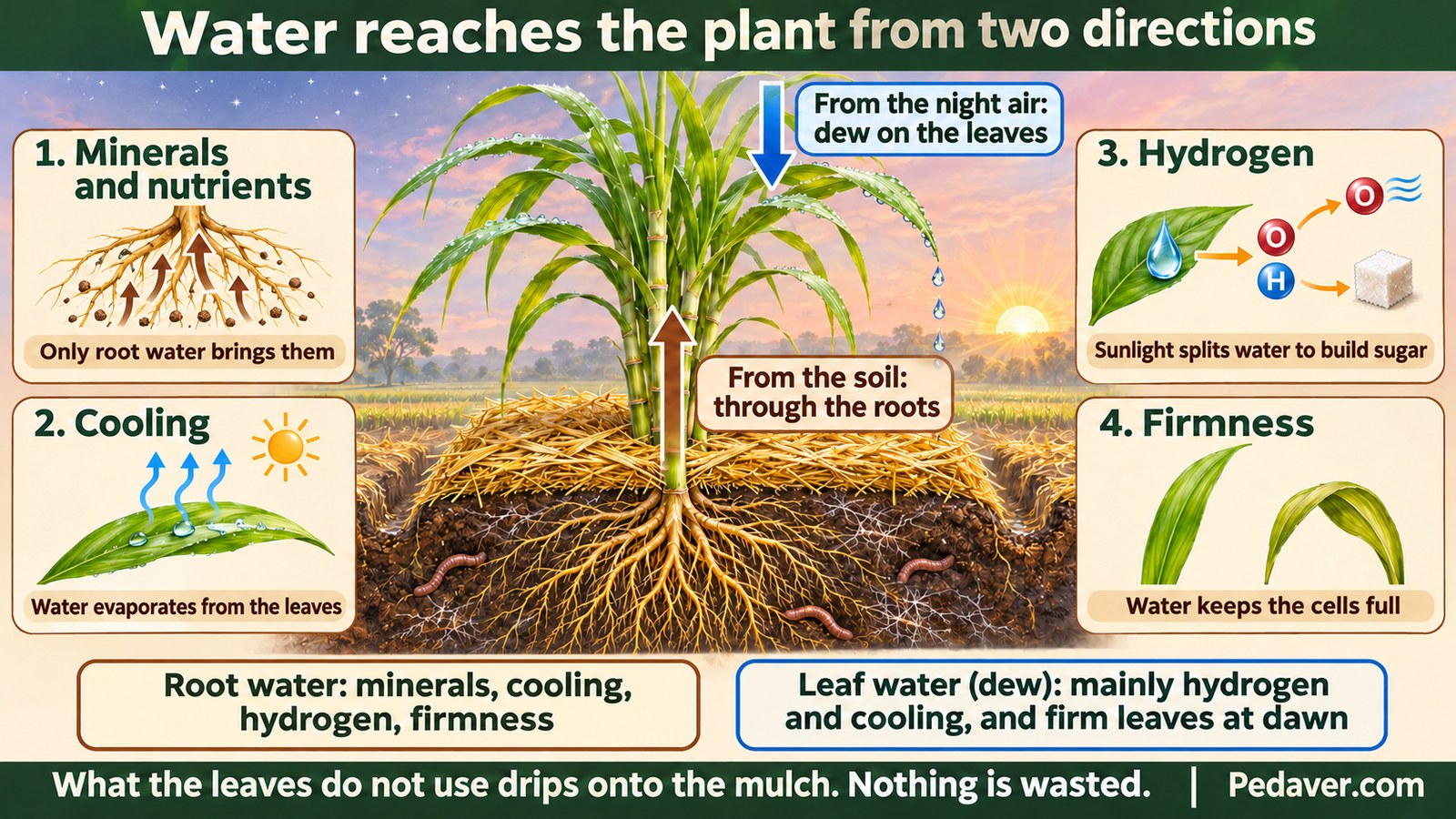
Root water feeds the plant. Leaf water refreshes it. Mulched soil and a standing crop catch both, every clear night.
1. Water That Arrives from Two Directions
Most farmers think of a crop’s water as coming from one direction only: up from the soil, after rain or irrigation. A plant standing in the open receives water from a second direction as well. On clear, calm nights its leaves lose heat to the sky, cool below the dew point of the air around them, and collect dew, just as the mulch does on the ground below.
KP-230 showed that a rice straw mulch can catch about 0.25 mm of dew on a typical night, about 1,000 litres on a fully mulched acre. That figure counts only the mulch. A full crop adds a second, vertical surface above it: several square metres of leaf for every square metre of ground, each leaf collecting its own dew. Dew on a standing crop is not easily weighed, but it adds to the night’s water, and it reaches the plant where the plant can use it at once.
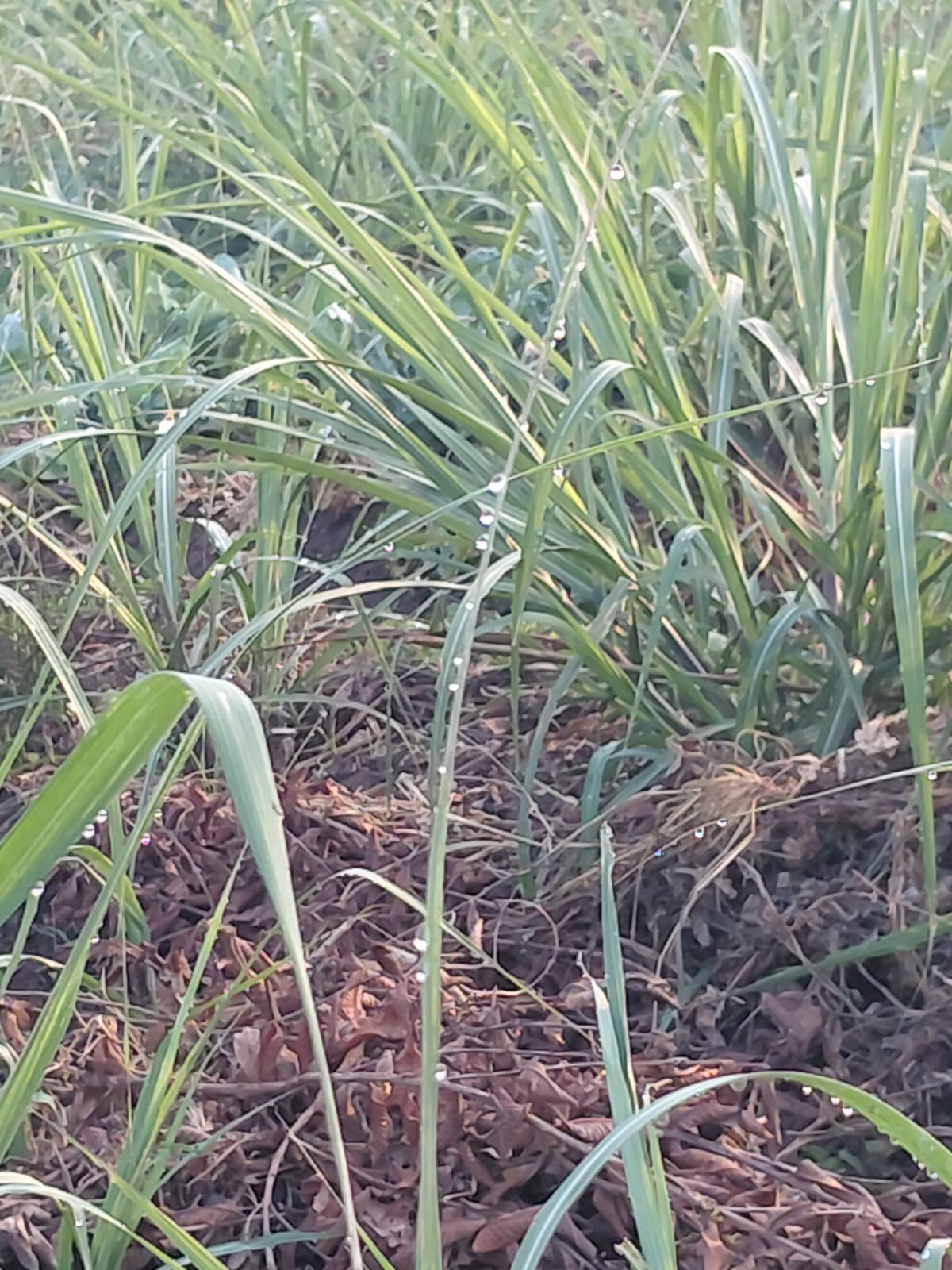
Figure 2. Dew on PQNK sugarcane leaves at dawn, with moist mulch on the bed below. Photograph: Vasudha Sardar.
Vasudha Sardar, who took this photograph on her PQNK sugarcane, called the night’s dew a butterfly effect: too small to notice in a single night, but very large over a season.
2. The Four Uses of Water in a Plant
Minerals and nutrients. Water drawn from the soil carries dissolved minerals and nutrients into the roots and up through the stem to every leaf, flower and fruit. Without this flow of water, the minerals the living soil prepares cannot reach the plant.
Cooling. Most of the water a plant takes up, well over nine-tenths of it, leaves again through the pores of its leaves as vapour. As it evaporates it carries heat away, just as sweat cools the body. A leaf in the sun without this cooling would overheat.
Hydrogen. In the leaf, sunlight splits water. The oxygen of the water is released into the air we breathe. The hydrogen joins the carbon the leaf takes from the air, and together they build sugar, the plant’s food and the starting point of every part of its body.
Firmness. Water fills the plant’s cells and keeps them firm, the way air keeps a tyre firm. This is why a plant short of water wilts, and why new leaves, shoots and roots can grow only while their cells are full.
3. Root Water: The Only Water That Brings Minerals
Root water serves all four uses, and it is the only water that can serve the first. Minerals are in the soil, not in the air, so only water that passes through the soil can carry them to the plant. This is why the soil remains the main supply, and why its condition matters so much.
In a living, covered PQNK soil, the hardpan is broken, rain soaks in where it falls, and the soil life prepares minerals and delivers them to the roots in a form the plant can take up. The roots go deep, and the soil holds its moisture under the mulch. In a bare, ploughed soil, rain runs off, the surface bakes, and the roots stay shallow. The plant may have water around it and still be short of the minerals that water should bring.
4. Leaf Water: For Hydrogen and Cooling
Dew on the leaves brings no minerals. It serves the plant in the other ways, mainly for hydrogen and for cooling:
It slows the morning’s water loss. While a leaf is wet at dawn, it loses very little water of its own. The plant starts the day with its cells full instead of drawing at once on the soil.
It cools the leaf. As the dew evaporates in the first sun, it carries heat away from the leaf, the same cooling the plant would otherwise pay for with its own water.
Part of it is taken in. Many plants take dew in directly through the leaf surface and its fine hairs. Scientists call this foliar water uptake. Water taken in this way can be split in the leaf for hydrogen, and it helps keep the leaf cells firm.
What the leaves do not use drips down onto the mulch and joins the soil’s share. Nothing is wasted.

| Use of water | Root water (from the soil) | Leaf water (dew) |
|---|---|---|
| Minerals and nutrients | Yes: carries them up from the soil | No: brings no minerals |
| Cooling | Yes: evaporates through the leaves by day | Yes: evaporates from the leaf in the first sun |
| Hydrogen | Yes | Yes: the part taken in by the leaf |
| Firmness | Yes | Yes: keeps leaf cells full at dawn |
5. What This Means for the Farmer
Root water and leaf water work together. The root water from a living, covered soil feeds the plant and brings its minerals. The leaf water from the night air eases the plant’s daily stress and comes free every clear night. A PQNK field is laid out to receive both.
Keep the soil covered. A thick organic mulch of about six inches (15 cm) keeps the soil cool, holds its moisture, and catches the dew that drips from the leaves.
Never burn or remove crop residue. Every stalk and leaf left on the bed becomes mulch and another surface for the night’s dew.
Keep the crop standing and full. A full, healthy canopy is the vertical half of the field’s dew catch.
Together with rain taken into an open, living soil, this is one reason mature PQNK beds need no irrigation at all where rainfall is 16 inches (400 mm) a year or more (PQNK book, Chapter 26).
Conclusion
A plant needs water to bring up its minerals, to keep cool, to build its sugar from hydrogen, and to keep its cells firm. Root water serves all four and is the only water that brings minerals. Leaf water serves the plant mainly for hydrogen and for cooling, and keeps its cells full at dawn. A bare field loses both: its rain runs off and its dew is gone by mid-morning. A covered PQNK field with a standing crop takes water from the soil and from the air, night after night.
PQNK Principle: The soil waters the root, the night air waters the leaf. Cover the soil and keep the crop standing, and the field receives both.
Related PQNK Sources
1. KP-230: How Much Water Does Mulch Catch from the Night Air? https://pedaver.com/papers/how-much-water-does-mulch-catch-from-the-night-air/
2. KP-229: The Hot Field: How Naked Soil and Hardpan Break the Weather. https://pedaver.com/papers/the-hot-field-naked-soil-hardpan-and-erratic-weather/
3. KP-228: Ask PQNK Field Answers 3 (moisture from the air). https://pedaver.com/papers/ask-pqnk-field-answers-3/
4. KP-217: The PQNK Water System: Receive, Retain, Use. https://pedaver.com/papers/the-pqnk-water-system/
5. PQNK Book, Chapter 5: The Natural Water System; Chapter 26: Soil Moisture Management; Chapter 27: Organic Mulch. https://pedaver.com/books/natural-ecosystem-science/
6. KE-058: Dew Is the Second Best Source of Water: Dew on PQNK Sugarcane Leaves (Vasudha Sardar). https://pedaver.com/field-evidence/
7. Berry, Z. C., Emery, N. C., Gotsch, S. G. and Goldsmith, G. R. (2019). Foliar water uptake: processes, pathways, and integration into plant water budgets. Plant, Cell & Environment 42: 410 to 423.
8. Ask PQNK: https://pedaver.com/ask, or on WhatsApp at https://wa.me/923437506442
About This Paper
- Crop
- Sugarcane
- Problem
- Evaporation / Moisture Loss · Bare / Exposed Soil · Drought / Water Scarcity · High Irrigation Cost / Dependency
- Science
- Water · Plants
- Evidence
- Scientific Mechanism
- Authority
- Current / Approved PQNK Knowledge
Related PQNK Science
Key Takeaways
- The four uses of water in a plant: minerals and nutrients, cooling, hydrogen and firmness.
- Well over nine-tenths of the water a plant takes up leaves again through its leaves as vapour, cooling the plant.
- In the leaf, sunlight splits water: the oxygen goes into the air, and the hydrogen joins carbon from the air to build sugar.
- Water keeps the cells firm; a plant short of water wilts, and new growth needs full cells.
- Root water serves all four uses and is the only water that brings minerals, so a living, covered soil remains the main supply.
- Dew on the leaves slows the morning’s water loss, cools the leaf as it evaporates, and is partly taken in through the leaf surface.
- A full crop adds several square metres of leaf for every square metre of ground, a vertical surface for the night’s dew.
- What the leaves do not use drips onto the mulch and joins the soil’s share; nothing is wasted.
Related Crops
Related Knowledge
same problem
How Much Water Does Mulch Catch from the Night Air? Dew on a PQNK Bed Covered with Rice Straw
A worked example on one square metre of rice straw mulch shows how much water a PQNK bed catches from the night air: a typical dew night gives about 0.25 mm, about 1,000 litres on a fully mulched acre. The mulch keeps this water and passes it slowly to the soil, while bare soil loses it within hours of sunrise.
same problem
Harvesting Without Irrigation
Crop water requirement is not the same as irrigation requirement. Three field clips show organic residue capturing humidity and dew and keeping the soil beneath it moist and soft, on a roller-compacted road and in the Cholistan Desert, while exposed soil beside it dries and hardens. Receive the rain, store it in the profile, protect it with cover and let roots reach it: on mature PQNK beds at 400 mm or more of annual rainfall, no irrigation is needed.
same problem
The PQNK Water System: Receive, Retain, Use
The PQNK water work in one account: break the hardpan once so the field receives the rain where it falls, retain it under permanent mulch in a living soil that also gathers dew and humidity, and use that water before adding any. Irrigation becomes a small furrow supplement, given only on the soil-ball test and never above a 4-inch (10 cm) head; a kilogram of wheat takes 154 litres of irrigation water under PQNK in transition against 1,175 under flood, and mature beds at 400 mm (16 inches) or more of rain need none.
same problem
Farming Beyond the Calendar
Explains why changing weather has made the fixed sowing calendar unreliable and why PQNK does not depend on weather forecasts. Permanent raised beds under continuous organic mulch hold soil temperature and the moisture-air balance, so healthy plants withstand heat, cold, drought, intense and excessive rainfall and an erratic monsoon; a 1-2% ethanol foliar spray relieves ambient temperature stress, and the sowing decision is made from the condition of the field.