

KP-214 · Water & Climate
Harvesting Without Irrigation
Crop water requirement is not the same as irrigation requirement. Three field clips show organic residue capturing humidity and dew and keeping the soil beneath it moist and soft, on a roller-compacted road and in the Cholistan Desert, while exposed soil beside it dries and hardens. Receive the rain, store it in the profile, protect it with cover and let roots reach it: on mature PQNK beds at 400 mm or more of annual rainfall, no irrigation is needed.
Read or listen to the full paper ↓Abstract
Agriculture commonly treats crop water requirement and irrigation requirement as though they were the same. They are not. Plants require water, but irrigation is only one possible source.
The Pedaver video “Harvesting without Irrigation” shows this in three field clips: sugarcane residue holding moisture in the soil beneath it on a roller-compacted road that is otherwise rock hard; a heap of residue in the Cholistan Desert, lifted after five to six months, with moist, soft soil beneath it while the land around it is dry and hard; and soil with and without mulch compared side by side.
Organic cover captures humidity and dew and keeps the soil beneath it moist. When the hardpan is corrected so that rain infiltrates, the soil profile stores it, permanent cover cuts evaporation and roots explore a larger volume of soil, dependence on irrigation falls sharply.
Under PQNK, water is given only when the soil-ball test shows a need, run slowly in the furrow and never above a 4-inch head; in transition two or three such flows may be needed. On mature PQNK beds where annual rainfall is 400 mm or more, rain, dew, humidity and capillary rise carry the crop through its production cycle without irrigation.
Full Paper
If you use “Listen”, the text of the page may be sent to your browser or operating system’s speech provider, such as Apple, Google or Microsoft, depending on the voice your device uses. Pedaver does not process, transmit or store any audio.
1. The Question Is Not Whether Plants Need Water
Every crop needs water. The more useful question is where that water comes from and how efficiently the production system captures, stores, conserves and supplies it to roots.
Conventional production often begins with an irrigation schedule: a crop is expected to receive water at prescribed intervals through flood, furrow, sprinkler or drip systems. PQNK begins one step earlier. It asks how much naturally available water the soil system can receive and retain before additional irrigation is considered.
PQNK does not attempt to grow plants without water. It attempts to grow them with the water that nature already provides before deciding how much additional irrigation is actually necessary.
2. What the Field Video Shows
The Pedaver video “Harvesting without Irrigation” brings together three field clips. In the first, sugarcane residue lies on a rough road that has been compacted with a roller so that vehicles can use it. When the residue is pulled aside, the soil beneath it is moist and soft enough to open by hand, while the uncovered road beside it is as hard as rock. In the second, recorded on the road from Chishtian in Bahawalnagar towards Haroonabad, in a sandy, low-rainfall part of the Cholistan Desert, a heap of residue had been left in an open place in January or February. When it was lifted five to six months later, the ground beneath it was moist and soft, while the surrounding land was so dry and hard that a metal key could not open it. The third clip compares soil with and without mulch side by side.
In each case the only difference is the cover. Residue on the surface captures humidity and dew, slows the loss of whatever moisture enters the soil, and keeps the soil beneath it soft and alive, while exposed soil beside it dries and hardens.
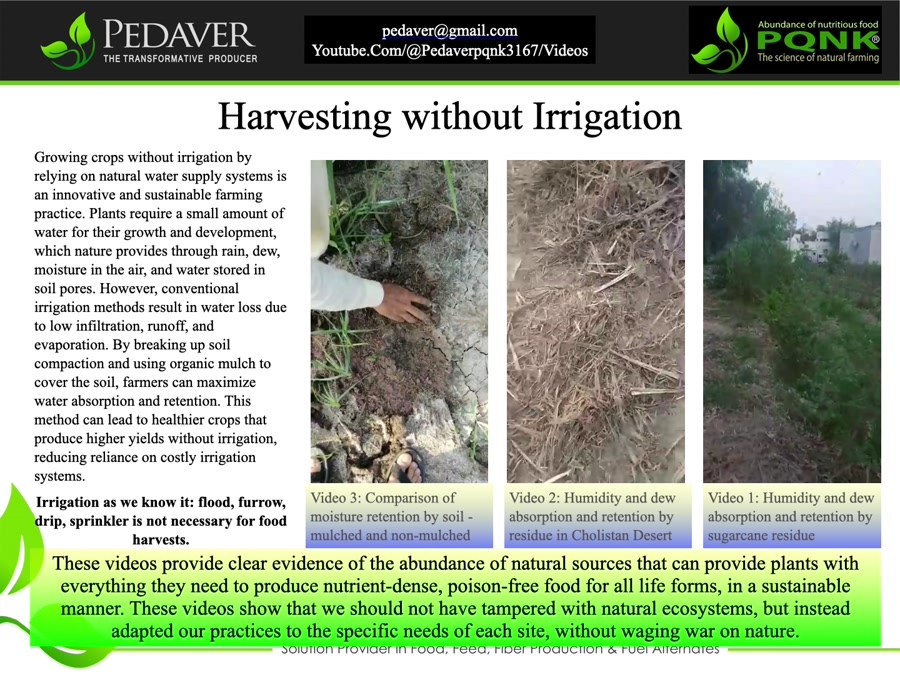
Figure 1. From the Pedaver video “Harvesting without Irrigation”: humidity and dew absorbed and retained by sugarcane residue (Video 1) and by residue in the Cholistan Desert (Video 2), and moisture retention by soil with and without mulch (Video 3).
3. Crop Water Requirement Is Not the Same as Irrigation Requirement
This distinction is fundamental. Crop water requirement describes the water used by the plant and lost through the soil-plant-atmosphere system. Irrigation requirement is the additional water that must be supplied when rainfall, stored soil moisture and other naturally available sources do not meet that need.
A production system can therefore reduce irrigation requirement without reducing the plant’s biological need for water. It does so by increasing effective rainfall, increasing accessible soil-water storage, reducing avoidable evaporation and enabling roots to use a larger volume of the soil profile.
4. First Receive the Rain
The first condition is infiltration. Rain cannot become useful stored soil moisture if it is prevented from entering the profile. A compacted hardpan or plough pan restricts both roots and downward water movement. Under PQNK, where such a restrictive layer exists, it is corrected once as part of transition. It is corrected with one subsoiler pass to about 22 inches, followed by permanent protection of the soil rather than repeated deep cultivation.
Once the restriction is removed, rainfall has access to a deeper soil volume, and the land receives water where it falls.
5. Then Keep the Water in the Soil System
Infiltration alone is not enough. Water that enters bare, hot soil can be lost rapidly through direct evaporation. Permanent organic mulch changes the surface energy and moisture environment. It shields the soil from direct solar radiation and wind, reduces direct evaporation, moderates soil temperature and protects the physical structure at the surface.
The video demonstrates the practical difference between protected and exposed soil. Moisture persisting beneath residue is not water created by mulch. It is water that entered the system and was conserved more effectively because the soil surface was protected.
6. Atmospheric Moisture Is Part of the Water Cycle
The video also shows organic residues taking up humidity and dew in a dry environment, and the soil beneath them staying moist. Dew and condensation are real components of the local water cycle. A covered surface can intercept such moisture and slow its immediate loss.
How much atmospheric moisture a field receives varies with humidity, night temperature, wind, residue and season. On a covered PQNK bed it is not lost: it joins rain and capillary rise from the moist profile below as part of the water that carries the crop. This is why, on mature PQNK beds where annual rainfall is 400 mm or more, rain, dew, humidity and capillary rise together are enough.
7. Roots Turn Stored Water Into Accessible Water
Water stored below the reach of roots is of little immediate value to the crop. This is why hardpan correction and the end of repeated soil disturbance are central to the water argument. Roots that can move deeper and laterally through a larger soil volume gain access to a larger reservoir of stored moisture.
Retained roots, biological activity, aggregation and continuous pore development also help preserve the pathways through which water and air move. The objective is not merely a wet soil. It is a moist, aerated and biologically functioning root zone.
8. Irrigation Becomes a Supplement, Not an Automatic Operation
This changes the logic of irrigation. Under PQNK, irrigation is not applied simply because a calendar says that the crop is due for water. Soil Moisture Management asks whether the root zone actually requires additional water. Field assessment, including the PQNK soil-ball test, is used to judge moisture need.
Where rainfall and stored soil moisture are sufficient, irrigation can be delayed or omitted. Where they are insufficient, water is run slowly through the furrow according to need, never above a 4-inch head, without inundating the production bed. Water demand on a PQNK field is a sign of soil that has not yet matured: in transition, two or three furrow flows may be needed when the ball test fails; mature beds at 400 mm or more of annual rainfall need none. The aim is neither “maximum irrigation” nor “zero irrigation” as an ideology. The aim is sufficient water with persistent root-zone aeration and minimum unnecessary loss.
Receive the rain → store it in the soil profile → protect it with cover → give roots access to it → irrigate only when the soil-moisture condition requires additional water.
9. When Can a Crop Be Harvested Without Irrigation?
A crop completes its cycle without irrigation when the water naturally available to its roots carries it through the critical stages of growth. On a mature PQNK bed that is the normal state: where annual rainfall is 400 mm or more, rain, dew, humidity and capillary rise supply the crop, and no irrigation is needed.
The relevant conditions include rainfall amount and distribution, the amount of water already stored in the soil profile, soil depth and texture, removal of restrictive compaction, rooting depth, mulch cover, temperature, humidity, evaporative demand, crop species, crop duration and the condition of the soil biological system.
The PQNK statement is therefore that continuous dependence on irrigation is not an inherent requirement of food production. It is a sign of a soil that cannot yet receive, store and supply the water that nature provides. As the soil matures under PQNK, irrigation falls to a few furrow flows in transition and then to none.
10. The Water Sequence Across Three PQNK Knowledge Papers
This paper completes a connected water argument developed across recent PQNK Knowledge Papers. “Rain Where It Falls” (KP-212) establishes the principle that water management should begin by restoring the landscape’s capacity to receive rainfall. “When 13 Inches of Rain Falls in Eight Hours” provides field evidence of rapid infiltration where hardpan had been corrected. The present paper follows the water after entry into the soil and asks how it can be stored, protected and made available to roots before irrigation is added.
RECEIVE THE RAIN → RETAIN THE RAIN → USE THE STORED WATER BEFORE ADDING IRRIGATION
Conclusion
The field video supports an important change in agricultural thinking. The plant needs water; it does not inherently need a particular irrigation method. Irrigation becomes necessary when the soil-water system cannot supply enough naturally available moisture to the crop.
PQNK therefore works on the causes of irrigation dependence: restricted infiltration, shallow rooting, exposed soil, high evaporation, repeated structural disturbance and failure to retain water where it falls. Correct the hardpan where necessary, protect the soil permanently, retain biological structure, allow roots to explore the profile, conserve moisture and then check by the soil-ball test whether additional water is needed.
That sequence reduces irrigation dramatically during transition and, once the beds have matured at 400 mm or more of annual rainfall, makes irrigation unnecessary. The achievement is not growing plants without water. It is allowing the soil system to capture and use water before agriculture replaces that natural function with pumping.
The plant requires water. Irrigation is only one way of supplying it.
Field Evidence and Source Note
Field evidence: the Pedaver video “Harvesting without Irrigation” (https://youtu.be/EsgsgFdRqEA), with three clips: humidity and dew absorption and retention by sugarcane residue on a roller-compacted road; the same by a residue heap left five to six months in the Cholistan Desert near Chishtian and Haroonabad; and a comparison of moisture retention by mulched and unmulched soil.
Pedaver/PQNK interpretation: infiltration, soil-water storage, surface protection, rooting and Soil Moisture Management are discussed within the established PQNK production framework.
Related PQNK Sources
1. PQNK Knowledge Paper KP-212: Rain Where It Falls. https://pedaver.com/papers/rain-where-it-falls/
2. PQNK Knowledge Paper KP-213: When 13 Inches of Rain Falls in Eight Hours. https://pedaver.com/papers/when-13-inches-of-rain-falls-in-eight-hours/
3. PQNK Book, Chapter 5: The Natural Water System. https://pedaver.com/books/natural-ecosystem-science/the-natural-water-system/
4. PQNK Book, Chapter 26: Soil Moisture Management. https://pedaver.com/books/natural-ecosystem-science/soil-moisture-management/
About This Paper
- Problem
- Drought / Water Scarcity · High Irrigation Cost / Dependency · Poor Water Infiltration · Hardpan · Bare / Exposed Soil · High Crop Water Demand
- Science
- Water · Soil · Climate
- Evidence
- Field Observation
- Authority
- Current / Approved PQNK Knowledge
Related PQNK Science
Key Takeaways
- Crop water requirement is not the same as irrigation requirement: the plant needs water, not a particular irrigation method.
- Organic residue captures humidity and dew and keeps the soil beneath it moist and soft, even in the Cholistan Desert, while exposed soil beside it dries and hardens.
- The sequence is: receive the rain, store it in the soil profile, protect it with cover, give roots access to it, and irrigate only when the soil-ball test shows a need.
- In transition, a few slow furrow flows (never above a 4-inch head) may be needed; water demand is a sign of soil that has not yet matured.
- On mature PQNK beds at 400 mm or more of annual rainfall, rain, dew, humidity and capillary rise carry the crop without irrigation.
Related Knowledge
same problem
Rain Where It Falls: Restoring the Soil Before Building More Water Storage
Rajendra Singh’s Rajasthan story shows that slowing runoff lets water enter the ground and restore wells and rivers. PQNK moves that principle upstream into the field itself: correct the hardpan, stop disturbing the soil, keep the surface covered, and let every acre receive and hold the rain where it falls, so that agricultural water demand stays within what the landscape renews.
same problem
The PQNK Water System: Receive, Retain, Use
The PQNK water work in one account: break the hardpan once so the field receives the rain where it falls, retain it under permanent mulch in a living soil that also gathers dew and humidity, and use that water before adding any. Irrigation becomes a small furrow supplement, given only on the soil-ball test and never above a 4-inch (10 cm) head; a kilogram of wheat takes 154 litres of irrigation water under PQNK in transition against 1,175 under flood, and mature beds at 400 mm (16 inches) or more of rain need none.
same problem
How Much Water Does One Irrigation Use?
Calculated for one acre of 220 by 198 feet: one 4-inch flood irrigation puts 411,161 litres on the field, while the furrows of a PQNK permanent bed hold 71,953 litres at a 4-inch head, less than one-fifth of a flood. Across a season PQNK in transition uses 5.5 to 16.2 percent of flood water and one-tenth to one-third of drip, mulch keeps evaporation minimal so applications are fewer, and mature beds at 400 mm or more of rainfall need no irrigation.
same problem
Farming Beyond the Calendar
Explains why changing weather has made the fixed sowing calendar unreliable and why PQNK does not depend on weather forecasts. Permanent raised beds under continuous organic mulch hold soil temperature and the moisture-air balance, so healthy plants withstand heat, cold, drought, intense and excessive rainfall and an erratic monsoon; a 1-2% ethanol foliar spray relieves ambient temperature stress, and the sowing decision is made from the condition of the field.