

KP-206 · Water & Climate
Farming Beyond the Calendar
Explains why changing weather has made the fixed sowing calendar unreliable and why PQNK does not depend on weather forecasts. Permanent raised beds under continuous organic mulch hold soil temperature and the moisture-air balance, so healthy plants withstand heat, cold, drought, intense and excessive rainfall and an erratic monsoon; a 1-2% ethanol foliar spray relieves ambient temperature stress, and the sowing decision is made from the condition of the field.
Read or listen to the full paper ↓Abstract
Changing weather has made the traditional fixed sowing calendar unreliable. A crop sown on the date that worked for a previous generation may now meet a heatwave at flowering, a dry interval after germination, excessive rain during establishment or conditions that favour a new pest cycle. No single date can be prescribed for a whole province when temperature, rainfall, soil moisture, variety, irrigation access and field condition vary, even within one district. The Production Manager replaces the rigid calendar with a field-based sowing window, and the decision comes from the condition of the field, not from a forecast.
PQNK does not depend on weather forecasts. Seasonal and short-range forecasts can indicate probabilities, but none can predict the exact rainfall or temperature a particular field will receive, and a production system that must wait on a forecast stays exposed to every event the forecast misses. PQNK builds the protection into the field: a permanent raised bed under continuous organic mulch keeps soil temperature moderate and holds the balance of moisture and air in the root zone, so a healthy plant can withstand ambient temperature extremes that would stress a crop in bare, compacted or inundated soil. Conventional fields, by contrast, amplify weather damage: tillage, bare soil, compaction and flood irrigation turn a short dry spell into drought and a heavy shower into runoff or waterlogging.
The protection comes from four non-negotiable rules applied together: no inundation, no soil disturbance after conversion, continuous organic mulch and biodiversity. Mulch shades and insulates the soil and reduces evaporation; permanent pores, root channels and Soil Moisture Management, guided by the ball test, make more of the water that arrives usable; raised beds keep the root zone aerated while furrows receive supplementary flow and drain excess water; and biodiversity and crop-in-crop or crop-after-crop sequencing spread biological and economic risk. When ambient temperature rises above or falls below the crop's comfortable range, a foliar spray of 1-2% ethanol solution relieves the plant of temperature stress, supporting a crop that is already protected at the root.
Before sowing, the Production Manager evaluates the crop's safe temperature range, actual seed-zone moisture, the sensitive stages of the crop and variety, bed, mulch and drainage readiness, SIPP or VIPP calibration and operator competence, and the capacity for supplementary furrow irrigation; where uncertainty is high, planting can be phased within the window. Precision machinery and trained operators are part of resilience, and transitional fields need closer observation because recovery cannot be promised by a fixed number of seasons. The durable response to a changing climate is to convert fields to PQNK, so that natural processes again regulate temperature, water, nutrient cycling and biological protection.
Revision R1 (28 September 2026): the ethanol foliar-spray strength has been standardised across Pedaver material at 1-2% food-grade ethanol in clean water (about 10-20 ml per litre), used against ambient heat or cold stress and sprayed in the cooler part of the day; stronger solutions can scorch leaves. The PDF opens with a revision note; the original text follows unchanged.
Full Paper
If you use “Listen”, the text of the page may be sent to your browser or operating system’s speech provider, such as Apple, Google or Microsoft, depending on the voice your device uses. Pedaver does not process, transmit or store any audio.
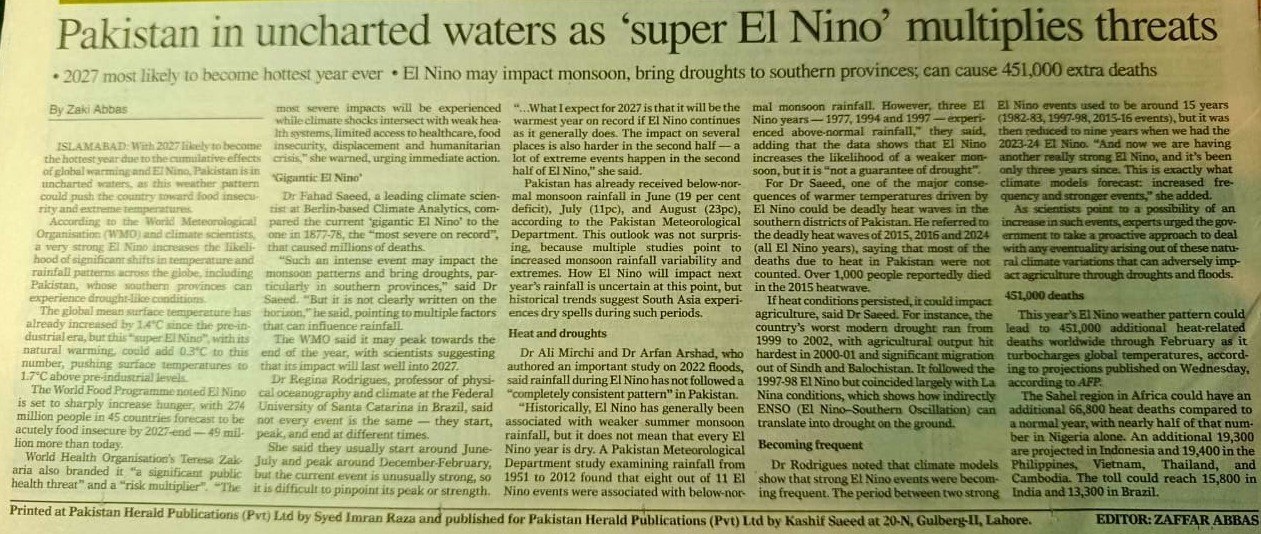
Dawn, September 2026: “Pakistan in uncharted waters as ‘super El Nino’ multiplies threats.” A forecast can announce the threat; the condition of the field decides how the crop withstands it.
Changing weather has made the traditional fixed sowing calendar unreliable. No forecast can protect a crop growing in bare, disturbed, compacted or inundated soil, and PQNK does not depend on one. PQNK is the only complete production-system solution designed to reduce the field-level effects of heat, drought, erratic rainfall and excessive rain by restoring the soil’s natural capacity to regulate temperature, water, air and biological activity.
1. The Farmer’s Concern Is Justified
Farmers plan months ahead, but the weather now changes faster than customary calendars can accommodate. A crop sown on the date that worked for the previous generation may meet a heatwave during flowering, an unexpected dry interval after germination, excessive rain during establishment or warm conditions that favour a new pest cycle.
The natural response is to ask experts for the correct sowing date. Expert guidance is valuable, but a single date cannot be prescribed for an entire province, much less for the whole country. Temperature, rainfall, soil moisture, elevation, crop variety, irrigation access and field condition differ between locations. Even within one district, a dry sandy field and a compacted heavy field may not become ready at the same time.
The Production Manager must therefore replace the rigid calendar with a field-based sowing window. The decision comes from the condition of the field, not from a forecast.
2. Why PQNK Does Not Depend on Forecasts
Seasonal climate forecasts can indicate an increased probability of unusual heat, above- or below-normal rainfall, or an El Niño or La Niña influence. None of them can predict the exact rainfall or temperature a particular field will receive, or guarantee that a crop will escape every damaging event. A production system that must wait on a forecast remains exposed to every event the forecast misses.
PQNK therefore builds its protection into the field itself. A permanent raised bed under continuous organic mulch keeps soil temperature moderate and holds the balance of moisture and air in the root zone. In that condition the crop is safe: a healthy plant can withstand extremes of ambient temperature that would stress a crop rooted in bare, compacted or inundated soil. A new sowing date cannot correct compacted soil, weak infiltration, high evaporation or poor aeration; the PQNK field corrects them permanently.
Agriculture cannot control the weather. It can control the condition in which the crop receives the weather.
3. Why Conventional Fields Amplify Weather Damage
Weather becomes disastrous when the production system has already removed the field’s natural protection. Repeated tillage breaks aggregates and biological networks. Bare soil absorbs extreme heat and loses moisture rapidly. Compaction restricts rooting and infiltration. Flood irrigation displaces air and creates repeated cycles of saturation and stress. Simplified cropping reduces biological buffering.
Under these conditions, both too little and too much rain become dangerous. A short dry period becomes drought because the field stores little moisture. A heavy shower becomes runoff or waterlogging because the soil cannot accept water rapidly. High temperature becomes root-zone heat because the soil surface is exposed. A weather shock that a living ecosystem could moderate becomes a crop emergency.
4. The PQNK Resilience Architecture
PQNK does not claim to stop El Niño, heatwaves, drought or excessive rainfall. It changes the physical and biological condition of the field so that the crop is less exposed to their effects. This protection comes from the simultaneous application of four non-negotiable rules: no inundation, no soil disturbance after conversion, continuous organic mulch and biodiversity.
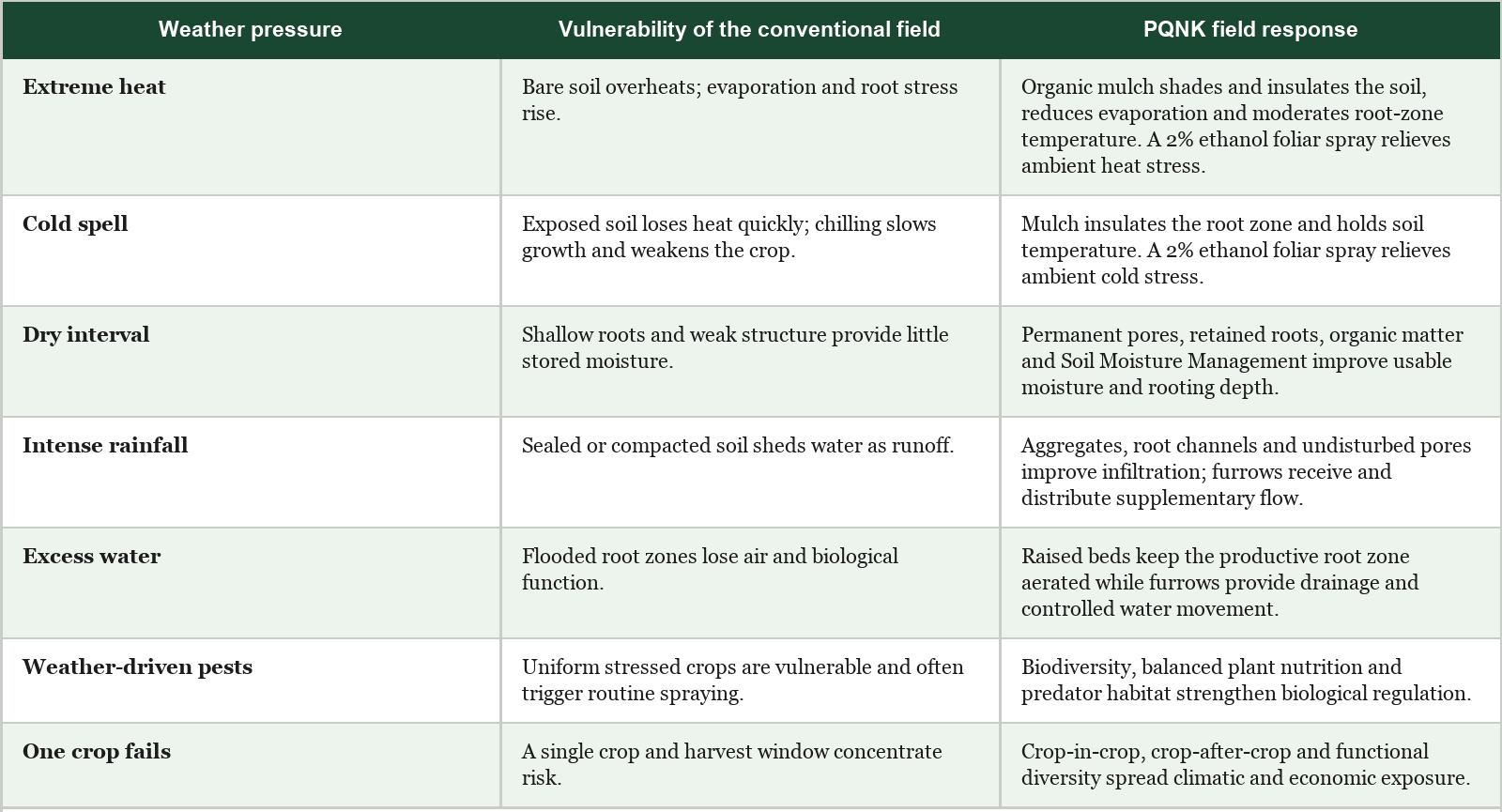
| Weather pressure | Vulnerability of the conventional field | PQNK field response |
|---|---|---|
| Extreme heat | Bare soil overheats; evaporation and root stress rise. | Organic mulch shades and insulates the soil, reduces evaporation and moderates root-zone temperature. A 2% ethanol foliar spray relieves ambient heat stress. |
| Cold spell | Exposed soil loses heat quickly; chilling slows growth and weakens the crop. | Mulch insulates the root zone and holds soil temperature. A 2% ethanol foliar spray relieves ambient cold stress. |
| Dry interval | Shallow roots and weak structure provide little stored moisture. | Permanent pores, retained roots, organic matter and Soil Moisture Management improve usable moisture and rooting depth. |
| Intense rainfall | Sealed or compacted soil sheds water as runoff. | Aggregates, root channels and undisturbed pores improve infiltration; furrows receive and distribute supplementary flow. |
| Excess water | Flooded root zones lose air and biological function. | Raised beds keep the productive root zone aerated while furrows provide drainage and controlled water movement. |
| Weather-driven pests | Uniform stressed crops are vulnerable and often trigger routine spraying. | Biodiversity, balanced plant nutrition and predator habitat strengthen biological regulation. |
| One crop fails | A single crop and harvest window concentrate risk. | Crop-in-crop, crop-after-crop and functional diversity spread climatic and economic exposure. |
5. How PQNK Moderates the Major Weather Threats
Heat and cold
Continuous organic mulch intercepts solar radiation before it reaches the soil. It reduces direct heating, slows evaporation and moderates temperature fluctuations around roots and soil organisms. A protected, moist and aerated root zone allows the plant to maintain transpiration and physiological cooling longer than a crop rooted in hot, dry and compacted soil.
When the ambient temperature rises above or falls below the crop’s comfortable range, a foliar spray of 2% ethanol solution relieves the plant of temperature stress. The spray supports a crop that is already protected at the root; it does not replace the mulch-covered bed.
Drought and delayed rainfall
PQNK does not create rainfall. It increases the usefulness of the water that arrives from rain, atmospheric moisture and supplementary irrigation. Undisturbed aggregates, permanent root channels and biological activity improve infiltration and storage. Deep rooting gives the crop access to a larger soil volume. Mulch reduces unproductive surface evaporation, while the ball test guides irrigation from actual field moisture rather than a rigid interval.
Excessive rainfall
Heavy rain is most damaging where the surface has sealed, the plough pan or hardpan blocks downward movement, or the root zone is already saturated. During PQNK conversion, the restrictive layer is corrected where necessary. Permanent beds then remain undisturbed. Water can enter through pores and root channels, while the furrow provides a lower pathway for movement and drainage. The crop remains on the aerated bed instead of standing in inundated soil.
Erratic monsoon
An erratic monsoon may combine dry periods, sudden intense rain, high humidity and unusual pest pressure within the same season. No single input can manage this combination. PQNK responds as a system: mulch protects against heat and splash; the bed-furrow architecture manages excess water; Soil Moisture Management addresses dry intervals; and biodiversity supports biological stability.
6. The Field-Based Sowing Protocol
PQNK does not wait for a calendar date or a forecast; the sowing decision is made from the field. Before sowing, the Production Manager should evaluate:
• the crop’s safe soil- and air-temperature range during germination and early growth;
• actual moisture within the intended seed zone, confirmed in the field rather than assumed from rainfall;
• the sensitive stages of the selected crop and variety;
• whether the permanent beds, mulch, furrows and drainage pathways are ready;
• the availability and calibration of the SIPP or VIPP and the competence of the operator; and
• the farm’s capacity to provide supplementary furrow irrigation if nature does not supply sufficient moisture.
Where uncertainty is high, the entire acreage should not necessarily be exposed to one date. Planting may be phased within the suitable window, provided the crop, machinery programme and market plan allow it. Diversity and crop-in-crop can further reduce the risk of one event damaging the whole farm’s income.
7. Precision Machinery Is Part of Climate Resilience
A resilient field can still be damaged by poor machinery operation. The Production Manager must be master of the machinery and its correct use. The operator must place seed at the intended depth and spacing without reopening or destroying the permanent bed. Tractor wheels must remain in the designated furrow lanes. Mulch should be moved only as much as necessary for precise establishment and then continue protecting the soil.
Operator training is therefore not a secondary service. In PQNK, the operator is the gunman: the machinery may be correctly designed, but the result depends upon the person aiming and using it.
8. Transition Requires Additional Vigilance
A field does not acquire full resilience merely by adopting the PQNK name. During transition, soil structure, rooting depth, biological regulation and water behaviour are still recovering. Early crops require closer observation, timely supplementary water where justified and careful use of transitional protection when a verified threshold is crossed.
The speed of recovery cannot be promised by a fixed number of seasons. It depends upon the field’s starting condition, compaction, salinity, drainage, organic cover, crop sequence, weather and management discipline. Maturity must be established from field evidence.
9. From Weather Prediction to Production Resilience
Weather services have their place in public safety and planning, but a farm cannot be protected by prediction. Every forecast leaves some events unannounced, and every warning that does arrive still meets the field in whatever condition it is in.
The nation cannot protect agriculture by repeatedly changing sowing dates while leaving the underlying soil system degraded. Nor can every new climatic warning be answered by another purchased product. The durable response is to rebuild the field so that natural processes again perform temperature regulation, water absorption, moisture conservation, nutrient cycling and biological protection.
10. Conclusion
PQNK is the only complete solution that addresses weather risk at the level where the crop experiences it: the soil-root-water-air system. It does not promise immunity from extreme events, and it does not depend on forecasting. It converts a vulnerable field into a more buffered living production system.
Weather cannot be controlled. The condition of the soil, the timing of operations and the resilience of the production system can be.
The immediate requirement is therefore to convert fields to PQNK. A forecast can only announce a hazard. A PQNK field, with mulch-covered beds holding soil temperature and the moisture–air balance, gives the crop the capacity to withstand the hazards that no forecast can precisely predict.
Sources and Evidence Basis
PQNK field framework and governing principles: four non-negotiable rules, permanent raised beds, Soil Moisture Management and the ball test: Pedaver / PQNK knowledge system.
Author’s field experience with PQNK conversion, precision establishment (SIPP/VIPP) and transitional crop management in Pakistan.
Zaki Abbas, “Pakistan in uncharted waters as ‘super El Nino’ multiplies threats,” Dawn, September 2026.
2% ethanol foliar spray for ambient heat and cold stress: PQNK field practice.
About This Paper
- Problem
- Erratic / Unpredictable Weather Patterns · Heat Stress on Crop · Cold / Frost Damage · Drought / Water Scarcity · Waterlogging · Runoff · Poor Water Infiltration · Bare / Exposed Soil · Evaporation / Moisture Loss
- Science
- Climate · Water · Soil · Production Architecture · Transition
- Evidence
- Scientific Mechanism
- Authority
- Current / Approved PQNK Knowledge
Related PQNK Science
Key Takeaways
- A fixed sowing calendar no longer matches changing weather; the Production Manager works from a field-based sowing window decided by the condition of the field.
- PQNK does not depend on weather forecasts: no forecast can predict what a particular field will receive, and a system that waits on forecasts stays exposed to every event they miss.
- Permanent raised beds under continuous organic mulch hold soil temperature and the moisture-air balance, so healthy plants can withstand ambient temperature extremes.
- A 1-2% ethanol foliar spray relieves plant stress when ambient temperature rises above or falls below the crop's comfortable range; it supports, and does not replace, the mulch-covered bed.
- Conventional fields amplify weather damage because tillage, bare soil, compaction and flood irrigation have already removed the field's natural protection.
- Raised beds keep the root zone aerated in excess water, while furrows drain surplus water and carry supplementary flow in dry intervals.
- Precision machinery and trained operators are part of climate resilience, and transitional fields need closer observation until maturity is shown by field evidence.
Related Knowledge
same problem
Rain Where It Falls: Restoring the Soil Before Building More Water Storage
Rajendra Singh’s Rajasthan story shows that slowing runoff lets water enter the ground and restore wells and rivers. PQNK moves that principle upstream into the field itself: correct the hardpan, stop disturbing the soil, keep the surface covered, and let every acre receive and hold the rain where it falls, so that agricultural water demand stays within what the landscape renews.
same problem
Harvesting Without Irrigation
Crop water requirement is not the same as irrigation requirement. Three field clips show organic residue capturing humidity and dew and keeping the soil beneath it moist and soft, on a roller-compacted road and in the Cholistan Desert, while exposed soil beside it dries and hardens. Receive the rain, store it in the profile, protect it with cover and let roots reach it: on mature PQNK beds at 400 mm or more of annual rainfall, no irrigation is needed.
same problem
When 13 Inches of Rain Falls in Eight Hours
After 13 inches of rain in eight hours, the PQNK orchard beds of Jaskaran Singh in Fazilka district, Indian Punjab, had taken the water into the soil and could be walked on in slippers, while neighbouring conventional orchards and fields stood under water, and so did a strip of his own orchard where the hardpan had not been broken. The paper explains why hardpan is a water barrier as well as a root barrier, and why the soil is the first reservoir.
same problem
The PQNK Water System: Receive, Retain, Use
The PQNK water work in one account: break the hardpan once so the field receives the rain where it falls, retain it under permanent mulch in a living soil that also gathers dew and humidity, and use that water before adding any. Irrigation becomes a small furrow supplement, given only on the soil-ball test and never above a 4-inch (10 cm) head; a kilogram of wheat takes 154 litres of irrigation water under PQNK in transition against 1,175 under flood, and mature beds at 400 mm (16 inches) or more of rain need none.