

KP-217 · Water & Climate
The PQNK Water System: Receive, Retain, Use
The PQNK water work in one account: break the hardpan once so the field receives the rain where it falls, retain it under permanent mulch in a living soil that also gathers dew and humidity, and use that water before adding any. Irrigation becomes a small furrow supplement, given only on the soil-ball test and never above a 4-inch (10 cm) head; a kilogram of wheat takes 154 litres of irrigation water under PQNK in transition against 1,175 under flood, and mature beds at 400 mm (16 inches) or more of rain need none.
Read or listen to the full paper ↓Abstract
This paper brings together the PQNK water work published on pedaver.com into one account. Conventional farming has broken the field’s water cycle: tillage and machinery create a hardpan that stops rain from entering the soil, bare soil loses what does enter to the sun, and flood irrigation fills the shallow layer above the hardpan, drowns the soil life and evaporates from the whole surface.
PQNK restores the cycle in three steps. It receives the rain, by breaking the hardpan once and never rebuilding it, so that water enters the soil instead of standing on it: 13 inches (330 mm) of rain in eight hours soaked into a PQNK orchard while its neighbours stood under water. It retains the water, under permanent organic mulch and in a living soil that also draws in dew and humidity, as a PQNK grower’s dawn photographs of dew-laden sugarcane and moist soil beneath the mulch show. And it uses that water before adding any.
Irrigation becomes a small supplement, given only when the soil-ball test shows a need, run through the furrow and never above a 4-inch (10 cm) head. One furrow application holds 71,953 litres per acre against 411,161 litres for a flood; per kilogram of produce, wheat takes 154 litres of irrigation water under PQNK in transition, 587 under drip and 1,175 under flood. PQNK fields use 77 to 92 percent less irrigation water than local flood irrigation, and mature beds where annual rainfall is 400 mm (16 inches) or more need no irrigation at all.
Full Paper
If you use “Listen”, the text of the page may be sent to your browser or operating system’s speech provider, such as Apple, Google or Microsoft, depending on the voice your device uses. Pedaver does not process, transmit or store any audio.
The water crisis on our farms is a soil crisis, not a rainfall crisis. Restore the soil, and the land receives the rain where it falls, retains it under cover, and returns it to the crop.
1. How the Field’s Water Cycle Was Broken
In a forest the soil receives the rain where it falls. Roots, fungi and earthworms keep it open, the litter on its surface shades it, and the water it takes in is held in the profile and returned slowly to plants, springs and aquifers. Conventional agriculture has reversed each of these conditions. Repeated tillage and heavy machinery have pressed a hardpan below the working depth, a compacted layer that water and roots cannot pass. Bare soil exposed to the sun passes 70 °C in summer and loses its moisture to the air. Flood irrigation then fills the shallow layer above the hardpan, displaces the air that soil life depends on and leaves water standing on the surface to evaporate. The result is the double failure farmers know well: heavy rain becomes standing water and runoff, a short dry spell becomes drought, and groundwater falls year after year as pumping replaces the rain the land no longer receives (KP-171, KP-212).
2. Receive the Rain
The first step is to let the rain in. Where a hardpan exists, it is broken once, with one subsoiler pass to about 22 inches (56 cm), and the opened field is given a deep water wash; where soil pH is 8 or above, about 8 kg of sulfuric acid per acre is applied with the wash water, once. Permanent raised beds are then shaped (bed top 42 inches (107 cm), furrow 18 inches (46 cm)), tractor traffic is confined to the furrows, and the soil is never disturbed again. A cover crop such as Jantar opens the soil further with its roots, and its foliage becomes the mulch.
The difference is visible in a single storm. When 13 inches (330 mm) of rain fell in eight hours on the Kinnow orchard of Jaskaran Singh in Fazilka district, Indian Punjab, his PQNK beds had taken the water into the soil within a short time and could be walked on in slippers, while the neighbouring conventional orchards and fields stood under water. A strip of his own orchard, where beds had been shaped but the hardpan had not been broken, was still holding water: the same rain, the same orchard, and the hardpan the only difference (KP-213). Hardpan is a water barrier as well as a root barrier, and the soil pore beneath the raindrop is the first place to harvest the rain.
3. Retain It: Mulch, Living Soil, Dew and Humidity
Water that enters bare soil is soon lost again to the sun and wind. Permanent organic mulch stops that loss. It shades and insulates the soil: in hot summer, bare soil passes 70 °C while the soil under mulch stays at 30 to 33 °C, and in winter the protected root zone stays at about 10 to 20 °C (Chapter 38). Under the mulch, evaporation from the surface is minimal and the moisture stays in the root zone.
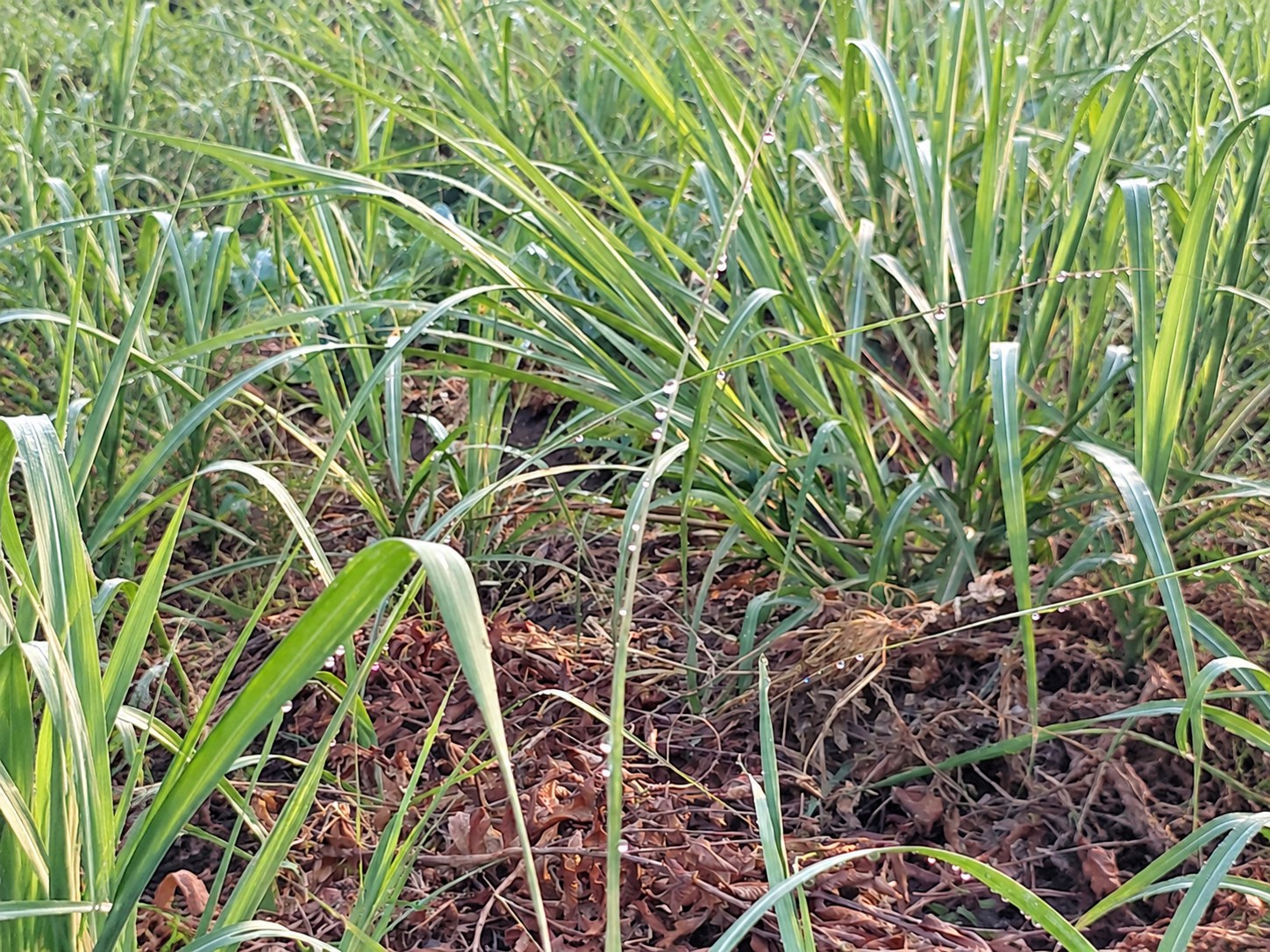
Figure 1. Dawn in Vasudha Sardar’s PQNK sugarcane: dew beads along the leaves, and the leaf mulch beneath is wet with it. Photo: Vasudha Sardar.
A living, covered soil does more than hold the water it is given; it gathers water from the air. Mulch and leaves take up humidity and condense dew through the night, and the cool, moist profile draws water upward by capillary rise. On a roller-compacted road, soil lying under sugarcane residue stays moist and soft enough to dig by hand while the open road beside it is rock hard; in the Cholistan Desert, ground left under a heap of residue for five to six months is found moist and soft while the land around it is dry and hard (KP-214). Vasudha Sardar, a PQNK farmer, sees the same in her sugarcane at dawn: almost every plant shedding dew from every leaf, and the whole mulch wet with it. Lifting the mulch, she finds the soil beneath moist and sweet-smelling, with white fungal growth in it, the beneficial fungi of a living soil (Figures 1 and 2; video: https://youtu.be/Vf8L--0XZII).
In such a soil the moisture settles into the balance PQNK describes as the 30/70 rule: roughly 30 percent of the pore space holding water and 70 percent holding air. This is a field observation from PQNK practice, not a laboratory calculation. It is the working target only during transition and in extreme conditions, when supplementary water is run through the furrows; on a mature, mulch-covered bed the balance regulates itself (KP-148, Chapter 26).
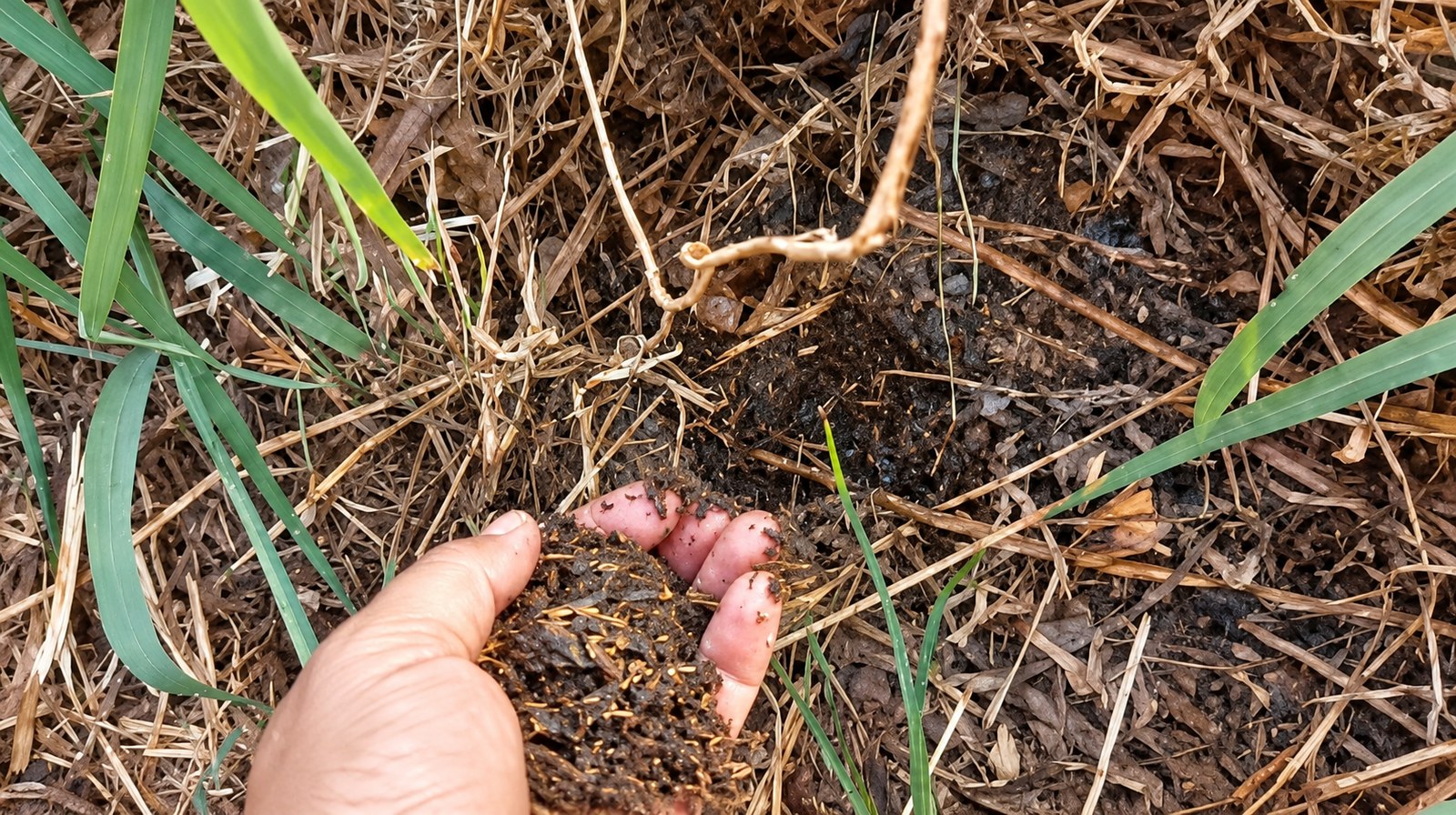
Figure 2. Lifted from beneath the mulch: dark, moist, crumbly soil, kept damp by the dew that runs off the leaves into the mulch. From Vasudha Sardar’s field video.
4. Use It, Measured
Irrigation, where it is still needed, is given to the furrow, never to the bed. The difference in volume can be calculated exactly for one acre of 220 by 198 feet (67 by 60 metres) (KP-216). One flood irrigation of 4 acre-inches (water 4 inches, or 10 cm, deep over the acre) puts 411,161 litres on the field, an average that includes the water standing on the surface, the water absorbed by the upper 6 to 8 inches (15 to 20 cm) above the hardpan, and evaporation from a fully flooded surface. On the PQNK bed the furrow bottom is compacted by traffic, so water moves sideways into the beds, pore by pore; at a 4-inch (10 cm) head the furrows of one acre hold 71,953 litres, less than one-fifth of a flood, and open water covers only about one-fifth of the field.

| One application, one acre | Litres | Share of one flood |
|---|---|---|
| Flood irrigation, 4 acre-inches | 411,161 | 100% |
| PQNK furrow flow, 4-inch (10 cm) head | 71,953 | 17.5% |
| Water saved per application | 339,208 | 82.5% |
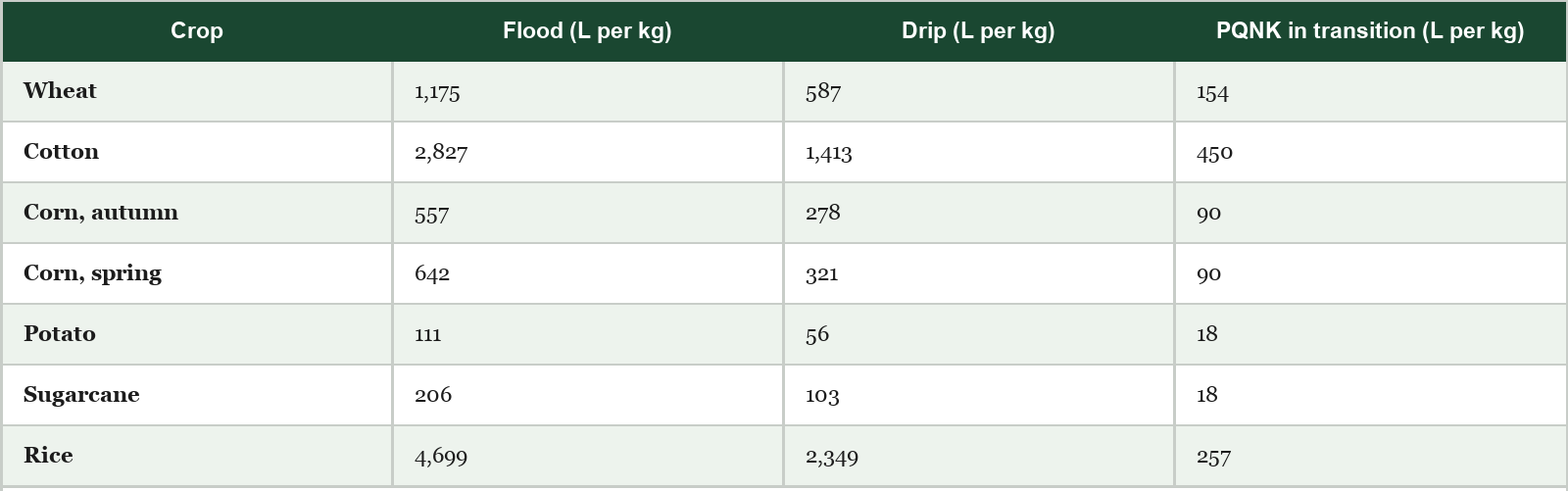
Across a season, with yields held equal, PQNK in transition uses between one-tenth and one-third of the water of drip irrigation (taken at the Punjab Government figure of a 50 percent saving over flood), without pipes, emitters or filters. Wheat produces 6.5 kg of grain per cubic metre of irrigation water under PQNK, against 1.7 kg under drip and 0.85 kg under flood (KP-216). Put the other way round, as litres of irrigation water used for each kilogram of produce: a kilogram of wheat takes about 1,175 litres under flood, 587 litres under drip and 154 litres under PQNK in transition (KP-216), and on a mature bed, none. The table gives the same figure for each crop.
| Crop | Flood (L per kg) | Drip (L per kg) | PQNK in transition (L per kg) |
|---|---|---|---|
| Wheat | 1,175 | 587 | 154 |
| Cotton | 2,827 | 1,413 | 450 |
| Corn, autumn | 557 | 278 | 90 |
| Corn, spring | 642 | 321 | 90 |
| Potato | 111 | 56 | 18 |
| Sugarcane | 206 | 103 | 18 |
| Rice | 4,699 | 2,349 | 257 |
Litres of irrigation water per kilogram of produce, with the same yield under all three methods (KP-216). On mature PQNK beds where annual rainfall is 400 mm (16 inches) or more, no irrigation water is used.
5. Irrigation as a Supplement
Under PQNK, water is never given by the calendar. It is given only when the soil-ball test shows that the root zone needs it, run slowly through the furrow and never above a 4-inch (10 cm) head. Because the mulch keeps evaporation minimal, applications are not only smaller but far less frequent. In the first few crop cycles, while the soil is in transition, a few furrow flows may be needed; how many depends on the crop, on how far the bed has matured and on the thickness of its mulch. Water demand on a PQNK field is a sign of soil that is still maturing. Once the soil system matures, rain, dew, humidity and capillary rise meet the crop’s needs, and on mature beds where annual rainfall is 400 mm (16 inches) or more, no irrigation is needed.
6. Special Conditions
Saline and high-TDS water. The harm from salty water lies in the salt that accumulates in the root zone, and that accumulation is set by the volume of water applied as well as its concentration. Because PQNK applies a small fraction of the water of flood irrigation, it adds a correspondingly small fraction of the salt, even from the same tube well, while the open, living soil keeps the root zone buffered (KP-054, KP-128).
Frost and cold. Irrigation is never increased to fight a frost: cold stress is an air and leaf-surface event, added water cannot be drawn into a plant that is barely transpiring, and it displaces the air from the soil. The mulched, living soil moderates temperature swings and keeps roots active through the cold (KP-155).
Heat and erratic weather. A mulched, undisturbed bed holds soil temperature and the balance of moisture and air in the root zone, so the crop withstands heatwaves, dry spells and heavy rain that would damage a bare, compacted or flooded field; the sowing decision is made from the condition of the field, not from a forecast (KP-055, KP-206).
7. Beyond the Farm: Floods, Aquifers and Storage
A field that receives the rain where it falls is part of the region’s water system. Every acre with its hardpan broken and its surface covered takes in rain that would otherwise run off, and sends part of it down towards the groundwater. Conventional water planning begins after the rain has already become runoff, with ponds, reservoirs and dams. PQNK moves the first intervention upstream: the first reservoir is living, porous, covered soil, the second is the deeper profile and the aquifer, and storage works then deal only with the genuine surplus (KP-212). Restoring the soil of farmland, which covers far more of the country than forest, is also the larger lever for climate and for the water vapour that drives the weather (KP-172).
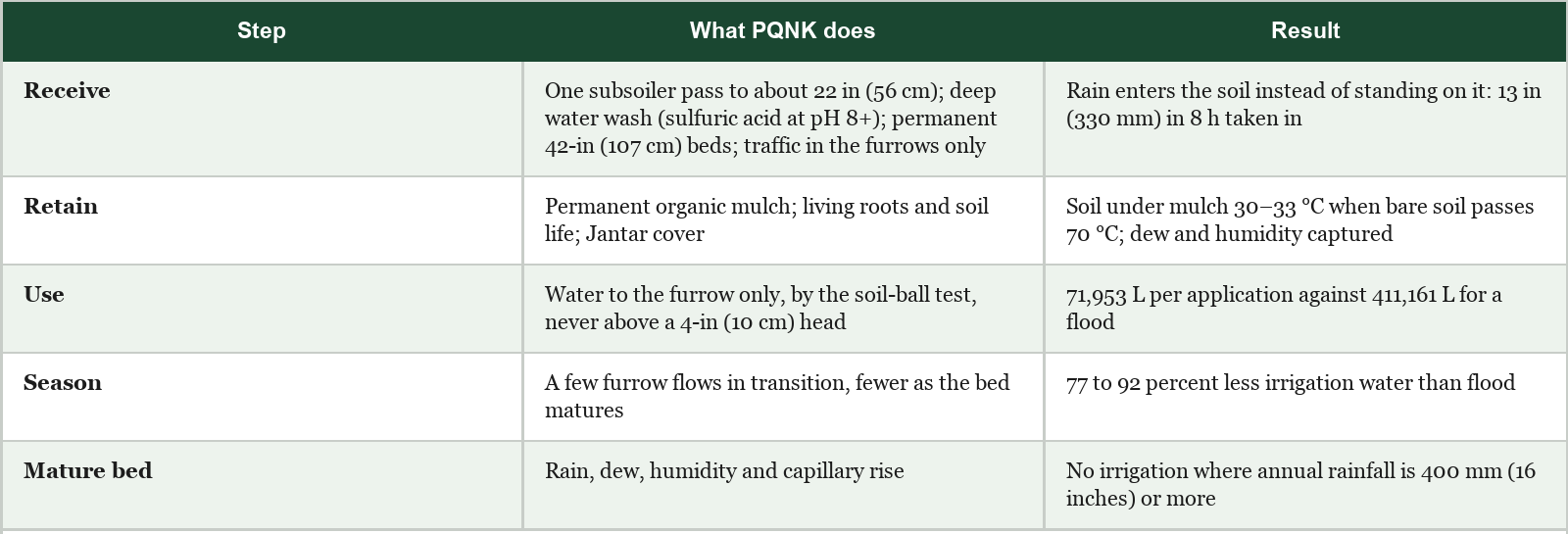
8. The PQNK Water System at a Glance
| Step | What PQNK does | Result |
|---|---|---|
| Receive | One subsoiler pass to about 22 in (56 cm); deep water wash (sulfuric acid at pH 8+); permanent 42-in (107 cm) beds; traffic in the furrows only | Rain enters the soil instead of standing on it: 13 in (330 mm) in 8 h taken in |
| Retain | Permanent organic mulch; living roots and soil life; Jantar cover | Soil under mulch 30–33 °C when bare soil passes 70 °C; dew and humidity captured |
| Use | Water to the furrow only, by the soil-ball test, never above a 4-in (10 cm) head | 71,953 L per application against 411,161 L for a flood |
| Season | A few furrow flows in transition, fewer as the bed matures | 77 to 92 percent less irrigation water than flood |
| Mature bed | Rain, dew, humidity and capillary rise | No irrigation where annual rainfall is 400 mm (16 inches) or more |
Conclusion
The PQNK water system is not a new irrigation method. It is the restoration of the water cycle that a living soil runs by itself: receive the rain where it falls, retain it under cover, and let the crop use it before any water is added. Irrigation then becomes what it should always have been, a small supplement during the years in which the soil matures, and on a mature bed, nothing at all.
PQNK Principle: Receive the rain, retain the rain, use the stored water before adding irrigation.
The PQNK Water Papers and Chapters Drawn Together Here
1. PQNK Book, Chapter 5: The Natural Water System. https://pedaver.com/books/natural-ecosystem-science/the-natural-water-system/
2. PQNK Book, Chapter 26: Soil Moisture Management. https://pedaver.com/books/natural-ecosystem-science/soil-moisture-management/
3. KP-212: Rain Where It Falls. https://pedaver.com/papers/rain-where-it-falls/
4. KP-213: When 13 Inches of Rain Falls in Eight Hours. https://pedaver.com/papers/when-13-inches-of-rain-falls-in-eight-hours/
5. KP-214: Harvesting Without Irrigation. https://pedaver.com/papers/harvesting-without-irrigation/
6. KP-216: How Much Water Does One Irrigation Use? https://pedaver.com/papers/how-much-water-does-one-irrigation-use/
7. KP-148: Soil Moisture Management in PQNK Organic Farming: The 30/70 Rule.
8. KP-054: Managing Saline Irrigation Water and Soil Reclamation Through PQNK; KP-128: Can High-TDS Water Be Used to Rehabilitate Saline Soils?
9. KP-155: PQNK Advisory Note: Frost, Cold Weather & Irrigation Management.
10. KP-171: The Hidden Crisis: How Industrial Agriculture Has Broken Earth’s Water Cycle; KP-172: The Greatest Climate Solution Is Not More Trees.
11. Knowledge Exchange KE-037: Dew forms on sugarcane leaves, dampening the mulch and soil in a PQNK field (Vasudha Sardar). https://youtu.be/Vf8L--0XZII
About This Paper
- Problem
- High Irrigation Cost / Dependency · High Crop Water Demand · Drought / Water Scarcity · Hardpan · Bare / Exposed Soil · Soil Temperature Extremes
- Science
- Water · Soil · Climate
- Evidence
- Scientific Mechanism
- Authority
- Current / Approved PQNK Knowledge
Related PQNK Science
Key Takeaways
- Receive: break the hardpan once (about 22 inches, 56 cm) and never rebuild it, so rain enters the soil where it falls.
- Retain: permanent organic mulch keeps the soil at 30 to 33 °C when bare soil passes 70 °C, and a living, covered soil gathers dew and humidity every night.
- Use: water only to the furrow, only on the soil-ball test, never above a 4-inch (10 cm) head: 71,953 litres per acre against 411,161 for a flood.
- Litres of irrigation water per kg of wheat: 154 under PQNK in transition, 587 under drip, 1,175 under flood; on mature beds, none.
- Mature PQNK beds where annual rainfall is 400 mm (16 inches) or more need no irrigation; water demand is a sign of soil still maturing.
Related Knowledge
same problem
Harvesting Without Irrigation
Crop water requirement is not the same as irrigation requirement. Three field clips show organic residue capturing humidity and dew and keeping the soil beneath it moist and soft, on a roller-compacted road and in the Cholistan Desert, while exposed soil beside it dries and hardens. Receive the rain, store it in the profile, protect it with cover and let roots reach it: on mature PQNK beds at 400 mm or more of annual rainfall, no irrigation is needed.
same problem
How Much Water Does One Irrigation Use?
Calculated for one acre of 220 by 198 feet: one 4-inch flood irrigation puts 411,161 litres on the field, while the furrows of a PQNK permanent bed hold 71,953 litres at a 4-inch head, less than one-fifth of a flood. Across a season PQNK in transition uses 5.5 to 16.2 percent of flood water and one-tenth to one-third of drip, mulch keeps evaporation minimal so applications are fewer, and mature beds at 400 mm or more of rainfall need no irrigation.
same problem
Rain Where It Falls: Restoring the Soil Before Building More Water Storage
Rajendra Singh’s Rajasthan story shows that slowing runoff lets water enter the ground and restore wells and rivers. PQNK moves that principle upstream into the field itself: correct the hardpan, stop disturbing the soil, keep the surface covered, and let every acre receive and hold the rain where it falls, so that agricultural water demand stays within what the landscape renews.
same problem
Farming Beyond the Calendar
Explains why changing weather has made the fixed sowing calendar unreliable and why PQNK does not depend on weather forecasts. Permanent raised beds under continuous organic mulch hold soil temperature and the moisture-air balance, so healthy plants withstand heat, cold, drought, intense and excessive rainfall and an erratic monsoon; a 1-2% ethanol foliar spray relieves ambient temperature stress, and the sowing decision is made from the condition of the field.