


KP-230 · Water & Climate
How Much Water Does Mulch Catch from the Night Air? Dew on a PQNK Bed Covered with Rice Straw
A worked example on one square metre of rice straw mulch shows how much water a PQNK bed catches from the night air: a typical dew night gives about 0.25 mm, about 1,000 litres on a fully mulched acre. The mulch keeps this water and passes it slowly to the soil, while bare soil loses it within hours of sunrise.
Read or listen to the full paper ↓Abstract
On clear, calm nights the ground cools and moisture from the air settles on every cold surface as dew. On a PQNK bed that surface is the mulch.
A worked example: one square metre of rice straw mulch, six inches (15 cm) thick, that is 0.250 kg heavier at dawn than at dusk has caught 250 millilitres of water, equal to 0.25 mm of rain. Across an acre fully under mulch that is about 1,000 litres in one night, or about 700 litres where only the bed tops are mulched. The figures are an example of how the arithmetic works, using a typical dew night.
Over a season of dew nights this adds up to a gentle, steady rain without clouds. Mulch keeps the water and passes it slowly to the soil, catches moisture rising from the soil beneath, and holds humidity; bare soil loses its night moisture by morning.
Full Paper
If you use “Listen”, the text of the page may be sent to your browser or operating system’s speech provider, such as Apple, Google or Microsoft, depending on the voice your device uses. Pedaver does not process, transmit or store any audio.
A quarter of a millimetre of dew a night sounds like nothing. Under mulch it is about 1,000 litres an acre, every clear night, delivered without a pump, a pipe or a bill.
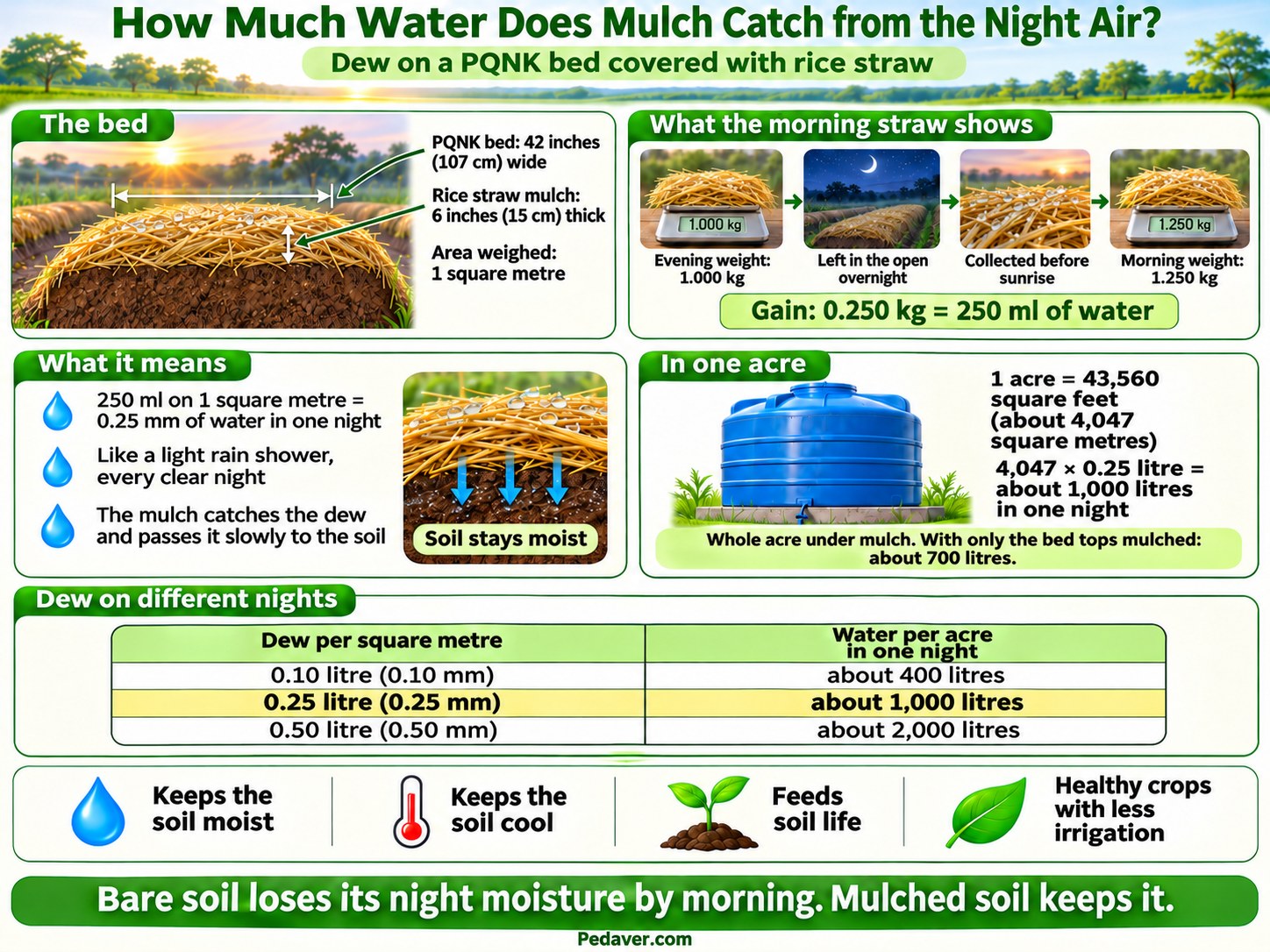
Figure 1. How much water mulch catches from the night air: a worked example on a PQNK bed covered with rice straw. The weights are example figures.
1. Water That Arrives Without Rain
PQNK counts four sources of water for a crop: rain, dew, humidity in the air, and irrigation only where the soil truly needs it (PQNK book, Chapters 5 and 26). Rain is the one everyone sees. Dew is the one almost everyone overlooks, because it comes at night and is gone by mid-morning on a bare field.
Dew forms when a surface loses heat to the clear night sky and cools below the temperature at which the air around it can hold all its moisture. The extra moisture settles on the cold surface as tiny drops. Straw, leaves and grass cool quickly at night, so they collect dew well. A thick, loose layer of rice straw offers millions of such surfaces on every square metre of bed.
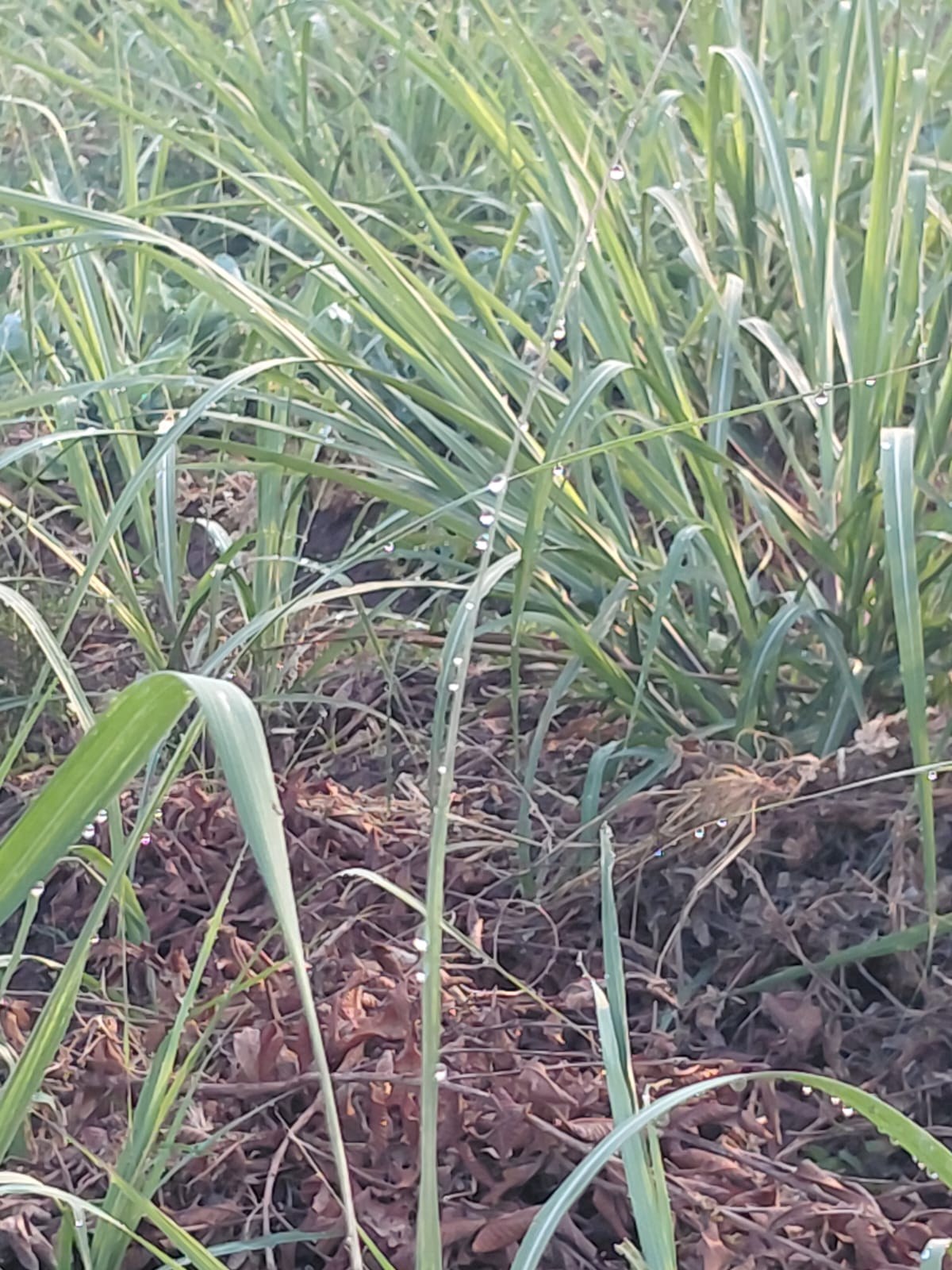
Figure 2. Dew on PQNK sugarcane leaves at dawn, with moist mulch on the bed below. Photograph: Vasudha Sardar.
Vasudha Sardar’s photograph above shows what this looks like on a PQNK field: drops of dew lining the sugarcane leaves in the early morning, and the mulch beneath them dark with moisture. The same night air that wets the leaves wets the straw (Knowledge Exchange KE-058).
2. A Worked Example on One Square Metre
The infographic and the video that goes with it work through one square metre of a PQNK bed: a bed 42 inches (107 cm) wide, covered with rice straw six inches (15 cm) thick.
Evening. The straw on one square metre weighs 1.000 kg.
Night. The bed stays in the open under a clear sky, and dew settles on the straw.
Before sunrise. The same straw now weighs 1.250 kg.
The gain. The difference is 0.250 kg. Water weighs one kilogram a litre, so the straw has caught 250 millilitres of water.
Water spread over one square metre is easy to turn into rainfall: one litre on one square metre is a layer 1 mm deep. So 250 millilitres is 0.25 mm, the same as a light rain shower, received in one night.
A real six-inch layer of rice straw on a square metre weighs more than one kilogram, but that does not change the answer. Only the gain matters, and the gain is the water.
3. From One Square Metre to One Acre
One acre is 43,560 square feet, about 4,047 square metres. At 0.25 litre on each square metre:
4,047 × 0.25 litre = about 1,000 litres of water, in one night.
That figure assumes the whole acre is under mulch. A PQNK field is laid out as 42-inch beds with 18-inch furrows, so the bed tops are 42 of every 60 inches, or 70 percent of the field. Where only the bed tops are mulched, the night’s catch is about 700 litres an acre.
4. Dew on Different Nights
Not every night gives the same dew. Clear, calm, humid nights give the most; cloudy or windy nights give little. A good dew night gives about 0.1 to 0.3 mm, and even the heaviest dew rarely goes far beyond half a millimetre in a night.

| Dew on the mulch | Per square metre | Per acre, in one night |
|---|---|---|
| A light dew night | 0.10 litre (0.10 mm) | about 400 litres |
| A typical dew night | 0.25 litre (0.25 mm) | about 1,000 litres |
| A heavy dew night | 0.50 litre (0.50 mm) | about 2,000 litres |
What makes dew matter is not one night but many. Sixty typical dew nights in a dry season add up to about 0.6 inch (15 mm) of water, roughly 60,000 litres an acre, arriving in small amounts every night, exactly when the crop’s roots are short of water and with no runoff at all.
5. Why Mulch Keeps It and Bare Soil Loses It
On bare soil, dew is gone by mid-morning. The first sun heats the naked surface and the dew rises back into the air within an hour or two. Little of it ever reaches the roots.
Under mulch, the water stays. The straw shades the soil and keeps it cool, so the dew held in the straw is not driven off at sunrise. It drips and soaks down slowly, and the soil beneath stays moist through the day.
Mulch also catches water rising from below. At night, moisture rising from the warmer soil condenses on the underside of the cool straw and returns to the soil instead of escaping. Weighing the straw does not count this water, so the soil’s real gain can be more than the example shows.
The straw holds humidity as well as dew. Dry straw takes up moisture from humid air even on nights with little visible dew, and gives it back to the soil beneath it.
This is the night half of the temperature shield described in Chapter 27: by day the mulch keeps the soil close to 30°C (86°F) when bare soil bakes; by night it catches the air’s moisture and keeps it.
6. What This Means for the Farmer
The dew on a mulched bed is free water that the farmer does not pump, pay for or schedule. Together with rain taken into an open, living soil and the humidity held by the mulch, it is one reason mature PQNK beds need no irrigation at all where rainfall is 16 inches (400 mm) a year or more (PQNK book, Chapter 26).
To catch it, keep every bed covered with a thick organic mulch of about six inches, never burn or remove crop residue, and never leave the soil bare. A field that is ploughed and left naked turns away this water every single night; a covered field takes it in.
Watch the video of this example: https://youtu.be/5C1uvvEUi04
Conclusion
Dew is quiet water. It falls without clouds, at night, a fraction of a millimetre at a time, and on bare soil it is gone before anyone notices it. On a PQNK bed covered with rice straw, a typical dew night gives about 0.25 mm, about 1,000 litres on a fully mulched acre, and the mulch keeps it and passes it slowly to the soil. Night after night, that water keeps the root zone moist, keeps the soil cool, and feeds the life within it. Bare soil loses its night moisture by morning. Mulched soil keeps it.
PQNK Principle: Cover the soil, and the night air waters your field.
Related PQNK Sources
1. Video: How much water can mulch catch from the night air? https://youtu.be/5C1uvvEUi04
2. PQNK Book, Chapter 5: The Natural Water System; Chapter 26: Soil Moisture Management; Chapter 27: Organic Mulch. https://pedaver.com/books/natural-ecosystem-science/
3. KP-217: The PQNK Water System: Receive, Retain, Use. https://pedaver.com/papers/the-pqnk-water-system/
4. KP-052: Creating On-Farm Micro Water Cycles. https://pedaver.com/papers/creating-on-farm-micro-water-cycles/
5. KP-228: Ask PQNK Field Answers 3 (moisture from the air). https://pedaver.com/papers/ask-pqnk-field-answers-3/
6. KE-058: Dew Is the Second Best Source of Water: Dew on PQNK Sugarcane Leaves (Vasudha Sardar). https://pedaver.com/field-evidence/
7. Ask PQNK: https://pedaver.com/ask, or on WhatsApp at https://wa.me/923437506442
About This Paper
- Crop
- Rice · Sugarcane
- Problem
- Evaporation / Moisture Loss · Bare / Exposed Soil · Drought / Water Scarcity · High Irrigation Cost / Dependency · Low Soil Water-Holding Capacity (Field Capacity)
- Science
- Water · Soil · Climate
- Evidence
- Scientific Mechanism
- Authority
- Current / Approved PQNK Knowledge
Related PQNK Science
Key Takeaways
- Dew forms when surfaces lose heat to the clear night sky; loose rice straw offers millions of cold surfaces on every square metre.
- Example: a gain of 0.250 kg on one square metre of straw is 250 ml of water, the same as 0.25 mm of rain.
- One acre is about 4,047 square metres, so a typical dew night gives about 1,000 litres on a fully mulched acre, or about 700 litres where only the bed tops are mulched.
- Dew nights vary: about 400 litres an acre on a light night, 1,000 on a typical night and 2,000 on a heavy one.
- Sixty typical dew nights in a dry season add up to about 0.6 inch (15 mm), roughly 60,000 litres an acre, with no runoff.
- Bare soil loses its dew by mid-morning; under mulch the water stays and soaks down slowly.
- Mulch also catches moisture rising from the soil at night and holds humidity, so the soil can gain more than the weighing shows.
- Dew is one reason mature PQNK beds need no irrigation where rainfall is 16 inches (400 mm) a year or more.
Related Crops
Related Knowledge
same problem
The PQNK Water System: Receive, Retain, Use
The PQNK water work in one account: break the hardpan once so the field receives the rain where it falls, retain it under permanent mulch in a living soil that also gathers dew and humidity, and use that water before adding any. Irrigation becomes a small furrow supplement, given only on the soil-ball test and never above a 4-inch (10 cm) head; a kilogram of wheat takes 154 litres of irrigation water under PQNK in transition against 1,175 under flood, and mature beds at 400 mm (16 inches) or more of rain need none.
same problem
Farming Beyond the Calendar
Explains why changing weather has made the fixed sowing calendar unreliable and why PQNK does not depend on weather forecasts. Permanent raised beds under continuous organic mulch hold soil temperature and the moisture-air balance, so healthy plants withstand heat, cold, drought, intense and excessive rainfall and an erratic monsoon; a 1-2% ethanol foliar spray relieves ambient temperature stress, and the sowing decision is made from the condition of the field.
same problem
The Hot Field: How Naked Soil and Hardpan Break the Weather, and How Covered Soil Mends It
The weather is not only getting hotter; it is losing its rhythm. This paper shows how naked, ploughed soil becomes a heat island (above 70°C when the air is 50°C, against about 30°C under mulch), how the hardpan shuts out rain and turns the water cycle short and violent, how pumped groundwater and the plough add water and carbon dioxide to the air, and how covered, unploughed PQNK soil reverses all of them.
same problem
Creating On-Farm "Micro-Water Cycles": Landscape Design to Maximize Rain, Dew, and Humidity Capture at the Microclimate Level
This foundational document argues that irrigation dependency is a design failure, not a water-supply problem, and backs the claim with per-crop data: PQNK sugarcane and rice show an 88-93% reduction in externally supplied irrigation water compared to conventional production. It lays out the landscape design, contour work, and mulch management that let a farm meet its own water needs from rainfall, dew, and humidity alone.