KP-225 · Nutrition & Food Quality
The Chain of Devastation: From the Seed Bag to the Hospital Bed, and Where PQNK Breaks It
A short podcast clip names a trap in eight links: seed that needs NPK and urea, a fertilised plant whose own resistance falls, insects, pesticide, a family that eats the crop and falls ill, then medicines, hospital and insurance, and back to the seed. In ACI agriculture each link is a purchase that makes the next one necessary. PQNK breaks the chain at the soil: a living soil feeds the crop without fertiliser, the plant keeps its resistance, pests stay below 2 percent where every step is followed, nothing is sprayed, and the family eats whole food.
Read or listen to the full paper ↓Abstract
A short video clip from an Indian podcast, shared under the heading “We Are in an Invisible Trap”, describes in forty seconds a chain that every farming family will recognise. First the farmer is given seed. To grow it he must add NPK and urea. Fertilised this way, the plant’s own resistance falls and insects arrive. For the insects he is sold a pesticide. The family eats the crop and falls ill. Then come medicines, then the hospital, and for the hospital, insurance.
This paper sets out that chain link by link, explains why in ACI (Ancient Conventional Industrial) agriculture each link makes the next one necessary, and shows where PQNK breaks it.
The break comes at the first link that matters: the soil. A living PQNK soil feeds the crop without purchased fertiliser, so the plant keeps its own resistance, pests stay below 2 percent where every step is followed, no spray is needed, and the family eats whole food. Remove the first links and the rest of the chain has nothing left to hold.
Full Paper
If you use “Listen”, the text of the page may be sent to your browser or operating system’s speech provider, such as Apple, Google or Microsoft, depending on the voice your device uses. Pedaver does not process, transmit or store any audio.
The chain begins the day the soil’s work is handed over to a bag. It ends the day the soil is given its work back.
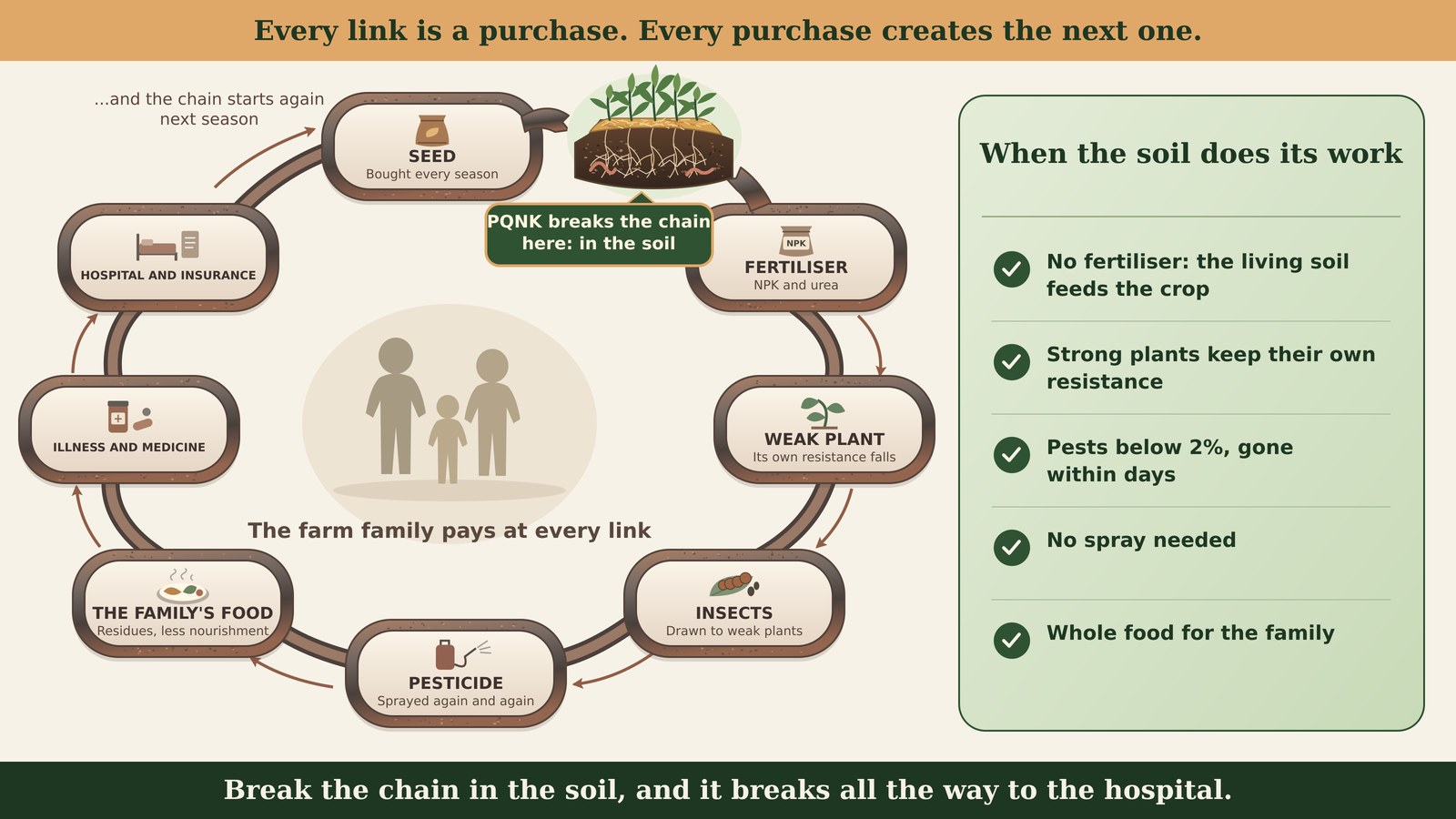
Figure 1. The chain of devastation: every link is a purchase that creates the next one. PQNK breaks the chain at the soil.
1. A Chain Named in Forty Seconds
The speaker in the clip does not use scientific language. He speaks as a farmer would, and that is why the chain is so easy to follow. In his words, set out in order:
Seed. “First you are given seeds.”
Fertiliser. “Now to grow the seeds, you have to add NPK, urea. This is what the company gives.”
Weakness. “When you add it, its internal resistance decreases.”
Insects. Insects and worms come onto the crop.
Pesticide. “So for that they give keetnashak” (insect-killer).
Illness. “Then you eat that product. So you fall ill.”
Medicine. The same companies, he says, make the pharmaceuticals, “so they give you medicines”.
Insurance. “Then if you want hospitalisation, you need insurance,” and he says that too is held by the same people.
At the end the clip returns to its first words, “First you are given seeds”, and the chain starts again. That is its real lesson: it is not a line with an end, but a circle that the farm family pays to go around every season.
2. Why Each Link Makes the Next One Necessary
Each link of the chain is a purchase, and each purchase creates the need for the next one. This is what makes the chain so hard to leave once a farm is inside it.
From seed to fertiliser. The seed sold in the ACI system is bred and chosen to respond to soluble fertiliser. It is sold together with a package of practice that begins with the plough and the fertiliser bag. A soil that has been ploughed, flooded and left bare for years has lost the life that once fed the crop, so without the bag the crop fails. The farmer is not free to stop.
From fertiliser to weakness. Urea and other soluble nitrogen push the plant into fast, soft, watery growth. The sap carries nitrogen that the plant has not yet built into its own proteins. The crop looks dark green and lush, but its tissue is weak, and a weak plant is exactly what insects look for. Pests are scavengers of weak plants, not random attackers (KP-173; PQNK book, Chapter 58).
From weakness to pesticide. Once insects arrive the farmer is told to spray. The spray kills the insects, and also the spiders, wasps, birds’ food and soil life that kept them in check. Insects that survive breed resistance, so the next season needs a stronger spray or more rounds of the same one (KP-154). The treadmill turns faster every year.
From pesticide to the plate. The crop reaches the family’s kitchen and the market carrying what was sprayed on it. It was also grown in a soil whose life had been destroyed, so it carries less of the minerals and nourishment that a living soil passes to food (PQNK book, Chapter 59; KP-222).
From the plate to the hospital. A people fed for decades on such food carries the burden in its health. Hospitals, clinics and health spending have grown far faster than population (KP-179). For the family the cost comes as medicines, then treatment, then the hospital, and the savings of a whole season can go in one illness.
At every one of these links the farm family pays. It is paid only once, at harvest, and from that one payment it must buy its way around the whole chain again.
3. Who Stands at Both Ends of the Chain
The speaker says that the same companies stand at both ends: the ones that sell the seed and the spray also sell the medicine. In part this is a matter of public record. Bayer, which bought Monsanto in 2018, sells seed, crop-protection chemicals and pharmaceuticals under one corporate name. Ownership of hospitals and of health insurance differs from country to country, and this paper does not depend on it.
The chain does not need a single owner to work. Each link is a sale created by the link before it, and each sale is someone’s income. As long as the soil is dead, every link stays necessary. That is why the answer does not lie in changing the brand of seed, fertiliser or spray, or in buying the organic version of each input. It lies in the soil.
4. Where PQNK Breaks the Chain
PQNK (Paedar Qudratti Nizam Kashatqari, the Pristine Organic Farming System) does not fight each link one by one. It removes the reason for the first ones, and the rest lose their hold.
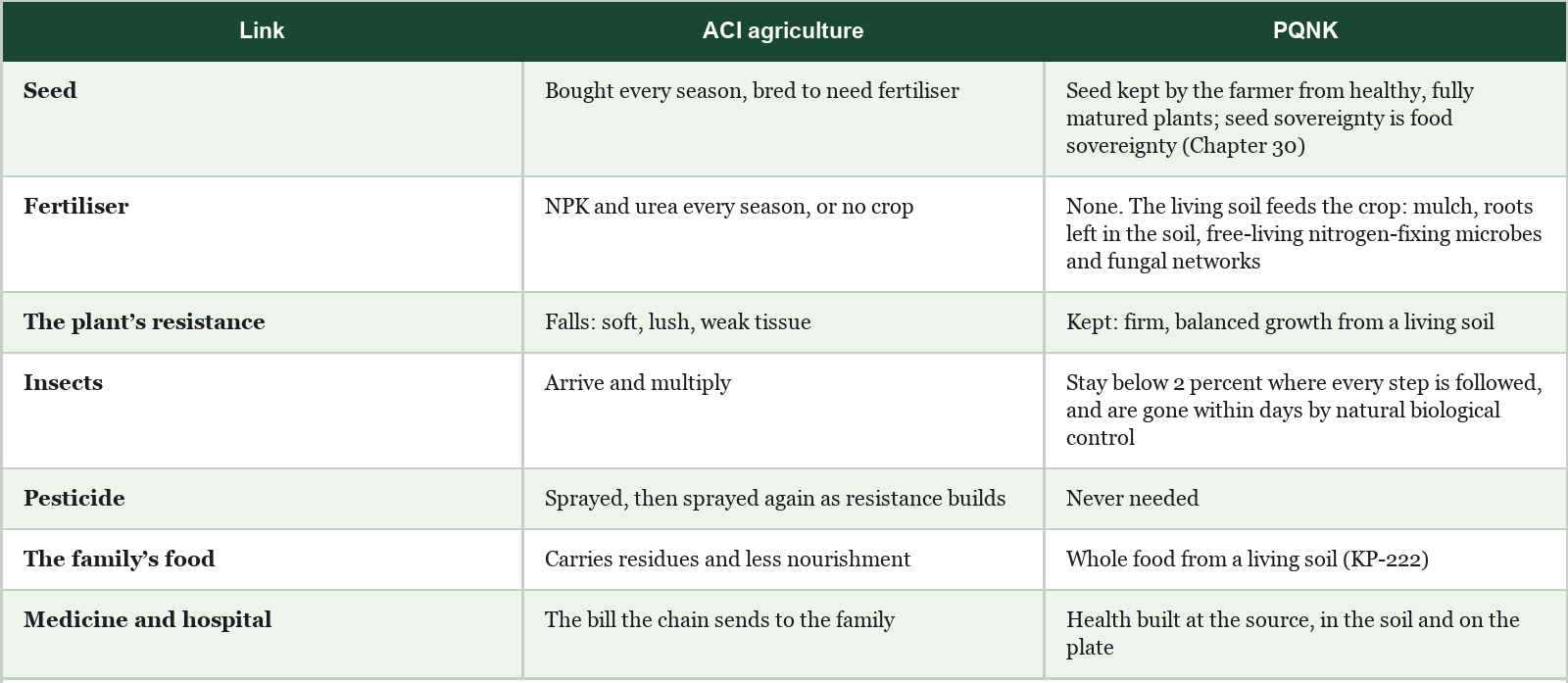
| Link | ACI agriculture | PQNK |
|---|---|---|
| Seed | Bought every season, bred to need fertiliser | Seed kept by the farmer from healthy, fully matured plants; seed sovereignty is food sovereignty (Chapter 30) |
| Fertiliser | NPK and urea every season, or no crop | None. The living soil feeds the crop: mulch, roots left in the soil, free-living nitrogen-fixing microbes and fungal networks |
| The plant’s resistance | Falls: soft, lush, weak tissue | Kept: firm, balanced growth from a living soil |
| Insects | Arrive and multiply | Stay below 2 percent where every step is followed, and are gone within days by natural biological control |
| Pesticide | Sprayed, then sprayed again as resistance builds | Never needed |
| The family’s food | Carries residues and less nourishment | Whole food from a living soil (KP-222) |
| Medicine and hospital | The bill the chain sends to the family | Health built at the source, in the soil and on the plate |
The first break is in the soil. After one correction, PQNK soil is never ploughed, never flooded and never left bare. Permanent raised beds under a continuous organic mulch, with roots left in the soil, rebuild the soil’s life every season. A mature PQNK soil grows the same crop season after season with no fertiliser at all.
The second break follows by itself. A plant fed by a living soil grows at nature’s pace, with firm tissue and its own defences intact. It is not the weak plant that insects seek. Where every step is followed, pests in a PQNK field stay below 2 percent and are gone within days through natural biological control (PQNK book, Chapters 6 and 58). There is nothing to spray.
The third break is at the table. Food from a living soil carries no spray and carries the full nourishment of that soil. A family that eats it does not begin the walk from the plate to the pharmacy.
The seed link breaks too. A PQNK farmer can keep his own seed from healthy, fully matured plants, cleaned, dried and stored with care. He is no longer obliged to return to the seed counter each season.
5. What the Farmer Can Do
No farmer can leave the chain by buying a better product. He leaves it by restoring his soil, following the eight steps of Chapter 23 in order:
1. Design the farm.
2. Probe for the hardpan and break it once with a subsoiler, to about 22 inches.
3. Wash the soil; where the pH is above 8, add about 8 kg of sulphuric acid per acre with the wash water.
4. Form permanent raised beds.
5. Grow a Jantar cover crop, leaving its roots in the soil and using its biomass as the first mulch.
6. Plant through the mulch.
7. Water only when the ball test shows the soil is dry.
8. Harvest without disturbing the soil.
From then on, never plough again and never leave the soil bare. Each season the soil does more of the work that the bag, the spray and in the end the pharmacy were doing before. Questions can be sent at any time to Ask PQNK, on WhatsApp or at pedaver.com/ask.
Conclusion
The speaker in the clip called it an invisible trap. Seen link by link it is not invisible at all: seed that needs fertiliser, fertiliser that weakens the plant, a weak plant that calls the insects, insects that call the spray, spray and empty food that reach the family, and illness that calls the medicine and the hospital. Every link is paid for by the farm family and the consumer. ACI agriculture keeps the chain turning because its soil is dead. PQNK breaks it where it begins, by giving the soil its work back. Once the soil feeds the crop, the crop protects itself, the family eats whole food, and the chain has nothing left to hold.
PQNK Principle: Break the chain in the soil, and it breaks all the way to the hospital.
Related PQNK Sources
1. PQNK Book, Chapter 6: Nature’s Pest Protection; Chapter 12: Captured Science; Chapter 23: The Eight-Step Transition Protocol; Chapter 30: The Seed Is Potential. The Soil Is the Production System.; Chapter 58: Pest Ecology, The Collapse of Biological Balance; Chapter 59: Nutrition-Dense Food. https://pedaver.com/books/natural-ecosystem-science/
2. KP-173: Reading Roots, Sap, and Pest Risk. https://pedaver.com/papers/field-diagnostic-guide-roots-sap-and-pests/
3. KP-154: Two Pathways to “Pest Resistance”. https://pedaver.com/papers/two-pathways-to-pest-resistance/
4. KP-207: Chemical Fertiliser Dependency Through the PQNK Lens. https://pedaver.com/papers/chemical-fertiliser-dependency-pqnk/
5. KP-177: The Broken Chain: Restoring the Symbiosis Between Food, Body, and Ecosystem. https://pedaver.com/papers/the-broken-chain-food-body-ecosystem-symbiosis/
6. KP-179: The Nutritional Roots of Healthcare Expansion and the PQNK Solution. https://pedaver.com/papers/the-nutritional-roots-of-healthcare-expansion/
7. KP-222: Whole Food from a Living Soil. https://pedaver.com/papers/whole-food-from-a-living-soil/
8. Ask PQNK: https://pedaver.com/ask, or on WhatsApp at https://wa.me/923437506442
About This Paper
- Problem
- External Input Dependency · High Input / Production Cost · Preventive/Prophylactic Over-Application of Inputs (Fertilizer/Nitrogen) · General Pest Pressure · Pesticide Resistance · Contamination / Residue / Food Safety Risk · Declining Nutrient Density in Food · Diet-Related Health / Food Security Concern · Seed Sourcing / Genetic Vulnerability · General Soil Fertility / Land Degradation
- Science
- Crop Protection · Nutrition · Food Quality · Soil · Transition
- Evidence
- Philosophical/Framework Argument
- Authority
- Current / Approved PQNK Knowledge
Related PQNK Science
Key Takeaways
- The chain has eight links: seed, fertiliser, a weakened plant, insects, pesticide, the family’s food, illness and medicine, hospital and insurance; then it starts again with seed.
- Each link is a purchase that creates the need for the next one, and the farm family pays at every link but is paid only once, at harvest.
- Urea and other soluble nitrogen push the plant into soft, watery growth; pests are scavengers of weak plants, and spraying breeds resistance, so the treadmill turns faster each year.
- The chain does not need a single owner to work; as long as the soil is dead, every link stays necessary, so changing brands or buying organic inputs does not end it.
- PQNK breaks the chain in the soil: no fertiliser, a plant that keeps its own resistance, pests below 2 percent and gone within days where every step is followed, no spray, and whole food for the family.
- A farmer leaves the chain by restoring his soil through the eight steps of Chapter 23 in order, then never ploughing again and never leaving the soil bare.
Related Knowledge
same problem
Chemical Fertiliser Dependency Through the PQNK Lens
An evidence-qualified review of the article “Chemical Fertilizer Industry”. It keeps the article's warning about soil degradation, nutrient pollution and biological decline, disciplines its headline numbers, and argues that fertiliser dependency is a symptom of a damaged production system (tillage, flooding, bare soil and simplified biology) that PQNK removes by restoring aerated, covered, living soil, reaching zero purchased fertiliser and pesticide at maturity.
same problem
Why the World Needs PQNK
A case for large-scale PQNK adoption addressed to five constituencies: farmers, governments, environmentalists, health professionals and poverty-alleviation institutions. Because agriculture sits where soil, water, biodiversity, food, farm economics and human health meet, restoring the farm as a living ecosystem benefits all of them at once.
same problem
Grain First: PQNK and the Coming Food Crisis
A practising PQNK farmer asked whether staple grains will matter more in the years ahead, and whether farmers should favour wheat, maize and rice or vegetables and fruit. Erratic weather, degraded soil and scarce water are squeezing the world’s food supply, and ACI agriculture depends on exactly what is failing. PQNK soil takes in heavy rain, holds moisture through heat and drought and grows without purchased inputs. The strategy for the next ten years: convert the land to PQNK, grow grain first, and keep a reserve of grain in your own store.
same problem
From Philosophy to Form: Vandana Shiva’s Movement and the PQNK Pristine Organic System
Vandana Shiva’s movement asks who controls agriculture; PQNK asks how a field must be worked so that nature can produce again. This paper sets out what the two share, against input dependency and for the farmer’s own seed and freedom, and where they differ: one works at the level of policy, law and culture, the other defines in the soil the exact, ordered steps that return a degraded field to natural ecosystem function. By PQNK’s test, organic farming that still ploughs, floods or leaves soil bare is a step away from chemicals but not yet the natural system.