
KP-223 · PQNK Philosophy, Framework & Economics
From Philosophy to Form: Vandana Shiva’s Movement and the PQNK Pristine Organic System
Vandana Shiva’s movement asks who controls agriculture; PQNK asks how a field must be worked so that nature can produce again. This paper sets out what the two share, against input dependency and for the farmer’s own seed and freedom, and where they differ: one works at the level of policy, law and culture, the other defines in the soil the exact, ordered steps that return a degraded field to natural ecosystem function. By PQNK’s test, organic farming that still ploughs, floods or leaves soil bare is a step away from chemicals but not yet the natural system.
Read or listen to the full paper ↓Abstract
Readers who meet PQNK for the first time often place it beside the best-known voice for ecological farming in South Asia: Dr Vandana Shiva and the Navdanya movement she founded in India in 1987. Both stand against the dependency that ACI (Ancient Conventional Industrial) agriculture creates, both defend the farmer’s own seed, and both speak of the farmer’s freedom.
Yet they work at different levels and answer different questions. Vandana Shiva’s movement works at the level of power, policy and culture: who owns seed, knowledge and land, and who decides how food is grown. PQNK works at the level of the field: a fixed, eight-step protocol of subsoiling once, washing high-pH soil, permanent raised beds, permanent mulch and soil moisture management that returns a degraded soil to the way natural ecosystems produce.
The paper states the distinction clearly and respectfully. One is a philosophy and a movement; the other is the form that philosophy takes in the soil. They are not rivals, and a farmer is best served by understanding both.
Full Paper
If you use “Listen”, the text of the page may be sent to your browser or operating system’s speech provider, such as Apple, Google or Microsoft, depending on the voice your device uses. Pedaver does not process, transmit or store any audio.
Vandana Shiva’s movement asks who controls agriculture. PQNK asks how a field must be worked so that nature can produce again. Both questions matter, and they are not the same question.
1. Two Responses to One Crisis
The crisis is shared across the world: soils losing their life and structure, water tables falling, food losing its nourishment, and farmers paying more every season for fertiliser, spray and fuel. Two responses from the same region have taken very different shapes.
Vandana Shiva, a physicist by training and one of the most widely known environmental thinkers of our time, built a movement. Through Navdanya she has championed community seed banks, biodiversity and organic farming, and has challenged patents on seed and the concentration of power in the food system, in India and in international forums. Her writing, from Staying Alive onward, joins ecology, the place of women in farming, and justice into one argument.
Asif Sharif built a production system. Beginning in 1973 with farm machinery and continuing through more than five decades of work in the field, he developed PQNK (Paedar Qudratti Nizam Kashatqari, the Pristine Organic Farming System): a complete, sequential method for producing food on farmland the way a natural ecosystem produces, with its own machines, its own bed design and its own rules for water, mulch and seed. It is practised today by farmers in Pakistan, India and other countries, and it is set out in full in the book PQNK: The Natural Ecosystem Science of Production Agriculture.
2. Where They Stand Together
The common ground is real, and it should be stated first.
Against dependency. Both hold that ACI agriculture has made the farmer a buyer of inputs rather than a producer, and both aim to end that dependency.
For the farmer’s own seed. Navdanya’s seed banks keep traditional varieties alive in farmers’ hands. PQNK selects open-pollinated seed that the farmer can save and sow again, as KP-109 explains.
For freedom. Vandana Shiva writes of food sovereignty; PQNK speaks of Agricultural Swaraj, the farmer as the independent manager of a living ecosystem (KP-221).
For living soil and biodiversity. Both see the soil as alive and diversity as strength, not as a problem to be cleared.
3. Where They Differ: Two Levels of the Same Problem
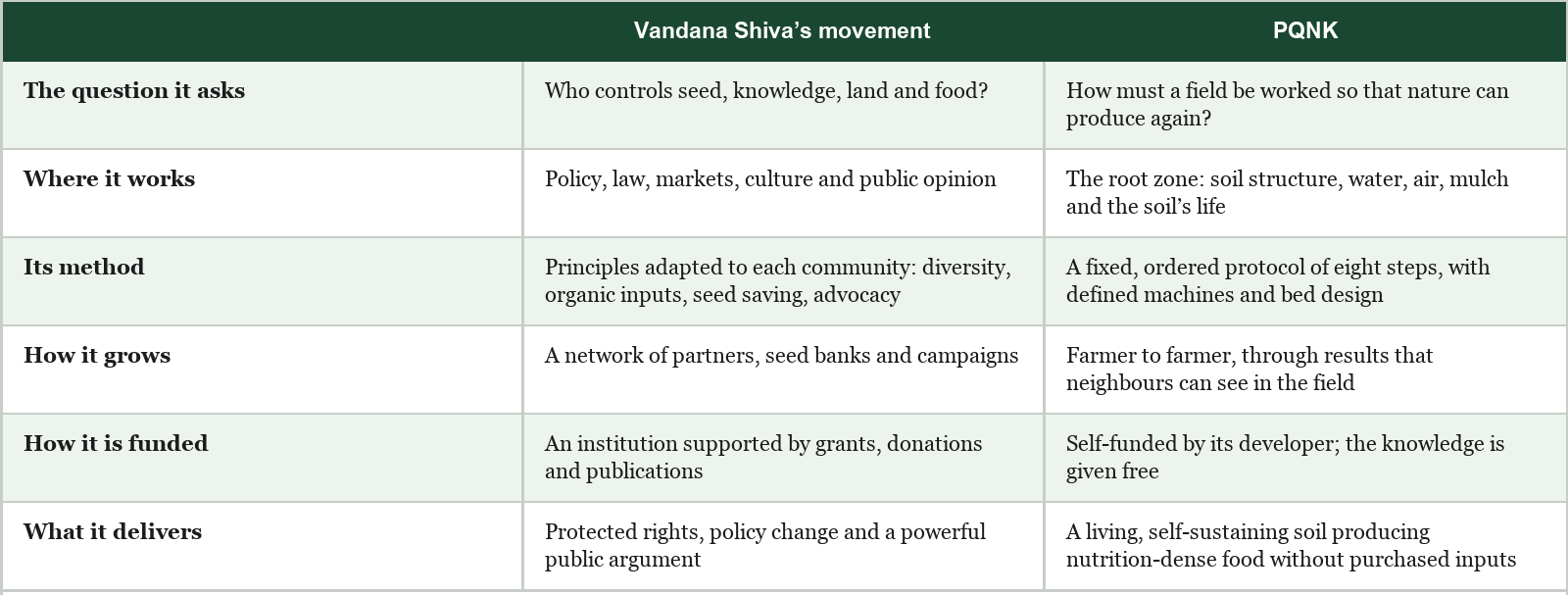
The difference is one of level and of question. The table sets it out.
| Vandana Shiva’s movement | PQNK | |
|---|---|---|
| The question it asks | Who controls seed, knowledge, land and food? | How must a field be worked so that nature can produce again? |
| Where it works | Policy, law, markets, culture and public opinion | The root zone: soil structure, water, air, mulch and the soil’s life |
| Its method | Principles adapted to each community: diversity, organic inputs, seed saving, advocacy | A fixed, ordered protocol of eight steps, with defined machines and bed design |
| How it grows | A network of partners, seed banks and campaigns | Farmer to farmer, through results that neighbours can see in the field |
| How it is funded | An institution supported by grants, donations and publications | Self-funded by its developer; the knowledge is given free |
| What it delivers | Protected rights, policy change and a powerful public argument | A living, self-sustaining soil producing nutrition-dense food without purchased inputs |
Neither column is a criticism of the other. A movement that changes laws and opinion is not expected to specify the depth at which a subsoiler must run. A production system that specifies it is not expected to argue patent law in international forums.
4. The Agronomic Distinction
This is where the distinction matters most for a farmer. Organic farming, in the general sense, means farming without synthetic chemicals and feeding the soil with compost, manure and green manure. PQNK goes further and is more exact, because removing chemicals is not enough to restore how a natural ecosystem works. PQNK sets one test that any production process must pass:
Any production process that inundates soil with water, disturbs soil through tillage, or leaves soil bare without organic mulch cover does not qualify as natural ecosystem science for production agriculture.
By this test, organic farming as it is commonly practised, which still ploughs the soil, still floods rice and still leaves fields bare between crops, is a step away from chemicals but not yet a return to the natural system. PQNK addresses what the principle of adding organic matter alone does not reach:
The hardpan. Years of ploughing and flooding press a hard layer below the surface that roots and water cannot pass. PQNK breaks it once, with a subsoiler, and never ploughs again.
Soil chemistry. Where the pH is above 8, the soil is washed first so that minerals become available and the soil’s life can return.
Permanent raised beds. The beds are formed once and never rebuilt. Crops are watered by soil moisture management, never by flooding, so the root zone stays moist and full of air.
Permanent mulch. Every residue stays on the surface as mulch; the soil is never left bare. Under it the soil stays far cooler in summer, holds its moisture, and its life works all year.
Built-in protection. A living soil and a diverse field keep the natural protectors of the crop, such as Bt bacteria, predatory insects, spiders and birds, so pests stay in balance without spray.
These steps follow the eight-step conversion in Chapter Twenty-Three of the PQNK book, in order, from field design to harvest without resetting the soil.
5. Two Models, Two Kinds of Strength
The way each is organised and funded shapes what each does best. An institution with partners, funding and a public platform can reach governments, courts and the media, and can protect the space in which farmers make their own choices. That is the strength of Vandana Shiva’s movement, and it has changed the global conversation about seed and food.
PQNK was built differently. It has never been funded by grants or by companies, so no sponsor has ever shaped its rules. It has spread from farmer to farmer because its results are visible in the field: lower costs, less water, healthier crops and soil that improves every season. Its knowledge is given free, through more than two hundred Knowledge Papers, the field evidence of practising farmers, and the complete book, all open at pedaver.com. Its strength is that it does not bend: the test in Section 4 is the same for every farm, every crop and every country.
6. Why the Distinction Matters
Today almost everyone, from global agrochemical companies to governments, calls their programmes regenerative or sustainable. In that noise, a farmer needs a clear standard. A movement can say what agriculture should be for. A production system must say exactly what to do on Monday morning in the field, and must be judged by what the field then produces.
Vandana Shiva’s movement helps open the space in which farmers are free to choose a different path. PQNK defines that path in the soil, step by step, so that the choice leads to a living field and not only to a changed label. The two are not rivals. They answer different questions, and a farmer is best served by understanding both.
Conclusion
Vandana Shiva gave the world a powerful argument for seed, biodiversity and the farmer’s sovereignty. PQNK gives that argument its form in the field: a complete natural ecosystem science of production agriculture, with one clear test and eight ordered steps. Philosophy shows where to go. Form shows how to get there. Where they meet, the farmer is both free and productive.
PQNK Principle: Freedom for the farmer begins in the soil. A field that is never ploughed, never flooded and never left bare produces without purchased inputs, and a farmer who needs no inputs is free.
Related PQNK Sources
1. PQNK Book, Chapter 23: The Eight-Step Transition Protocol; Chapter 12: Captured Science. https://pedaver.com/books/natural-ecosystem-science/
2. KP-221: PQNK and Agricultural Swaraj: Restoring the Farmer’s Freedom. https://pedaver.com/papers/pqnk-and-agricultural-swaraj/
3. KP-075: Rethinking Agricultural Systems: The PQNK Framework. https://pedaver.com/papers/rethinking-agricultural-systems-the-pqnk-framework/
4. KP-111: The Missing Synthesis: Positioning PQNK Among a Century of Fragmented Regenerative Science. https://pedaver.com/papers/the-missing-synthesis/
5. KP-109: Every Seed Is a Promise to the Next Generation. https://pedaver.com/papers/every-seed-is-a-promise/
6. Shiva, V. Staying Alive: Women, Ecology and Development (1988); Navdanya, navdanya.org.
About This Paper
- Problem
- External Input Dependency · High Input / Production Cost · Macro / Policy-Level Externalities · Seed Sourcing / Genetic Vulnerability
- Science
- Transition · Soil
- Evidence
- Philosophical/Framework Argument
- Authority
- Current / Approved PQNK Knowledge
Related PQNK Science
Key Takeaways
- Vandana Shiva’s movement asks who controls seed, knowledge, land and food; PQNK asks how a field must be worked so that nature can produce again.
- Both oppose input dependency and defend the farmer’s own seed and freedom: food sovereignty in her words, Agricultural Swaraj in PQNK’s.
- Any production process that inundates soil, disturbs it through tillage or leaves it bare without organic mulch does not qualify as natural ecosystem science for production agriculture.
- Organic farming as commonly practised, which still ploughs, floods and leaves soil bare, is a step away from chemicals but not yet a return to the natural system.
- PQNK is self-funded and gives its knowledge free, so no sponsor shapes its rules; it spreads farmer to farmer through results visible in the field.
Related Knowledge
same problem
Chemical Fertiliser Dependency Through the PQNK Lens
An evidence-qualified review of the article “Chemical Fertilizer Industry”. It keeps the article's warning about soil degradation, nutrient pollution and biological decline, disciplines its headline numbers, and argues that fertiliser dependency is a symptom of a damaged production system (tillage, flooding, bare soil and simplified biology) that PQNK removes by restoring aerated, covered, living soil, reaching zero purchased fertiliser and pesticide at maturity.
same problem
Why the World Needs PQNK
A case for large-scale PQNK adoption addressed to five constituencies: farmers, governments, environmentalists, health professionals and poverty-alleviation institutions. Because agriculture sits where soil, water, biodiversity, food, farm economics and human health meet, restoring the farm as a living ecosystem benefits all of them at once.
same problem
PQNK and Agricultural Swaraj: Restoring the Farmer’s Freedom
An essay on the farmer’s freedom. Drawing on Gandhi’s Gram Swaraj and Gramodyog, it argues that the farmer should not have to buy, season after season, what a living soil gives for free: PQNK moves the farmer from a financially vulnerable purchaser of inputs to the independent manager of a living ecosystem, and lays the foundation for village enterprise, work for women, and prosperity without dependence.
same problem
Restoring Earth's Operating System: The PQNK Framework for Regenerative Agriculture
A comprehensive policy and investment brief that models global agriculture's degenerative trajectory against a PQNK-led alternative, laying out true-cost economics, a five-year implementation roadmap with quarterly KPIs, and specific financial instruments, from transition bonds to farmer cooperative financing, meant to move PQNK from pilot to planetary scale.