
KP-209 · PQNK Philosophy, Framework & Economics
Why the World Needs PQNK
A case for large-scale PQNK adoption addressed to five constituencies: farmers, governments, environmentalists, health professionals and poverty-alleviation institutions. Because agriculture sits where soil, water, biodiversity, food, farm economics and human health meet, restoring the farm as a living ecosystem benefits all of them at once.
Read or listen to the full paper ↓Abstract
Production agriculture sits at the meeting point of soil, plants, microorganisms, insects, animals, water, atmosphere and human society. When it is managed against the natural ecosystem the damage spreads far beyond the crop; brought back into alignment, the benefits spread as widely. PQNK restores those conditions through its four governing rules: no inundation, no soil disturbance, permanent organic cover and encouraged biodiversity.
For farmers, PQNK replaces repeated field reconstruction and recurring purchased inputs with permanent beds, retained roots and residues, Soil Moisture Management and biological function; its field experience is higher and more stable yields once the system matures, recorded farm by farm. For governments, PQNK is not a laboratory concept awaiting proof: it began in 2009 with rice on raised beds and has since moved into farmer practice, so the task is large-scale adaptation and adoption, with measurement as a record of implementation rather than a test of nature.
For environmentalists, permanent cover, undisturbed soil, aeration and biodiversity work beneath the crop canopy on soil carbon, structure and farmland habitat. For health professionals, PQNK reduces occupational pesticide exposure, and a mature PQNK field applies no agrochemical, so its food carries no chemical residue. For poverty alleviation, PQNK lowers the structural cost and risk of producing food before the farmer falls into debt.
These five agendas meet in the same acre. Responsible promotion means training farmers in the four rules and the transition protocol, and adapting engineering to local tractors, soils and climates without abandoning the governing ecological principles.
Full Paper
If you use “Listen”, the text of the page may be sent to your browser or operating system’s speech provider, such as Apple, Google or Microsoft, depending on the voice your device uses. Pedaver does not process, transmit or store any audio.
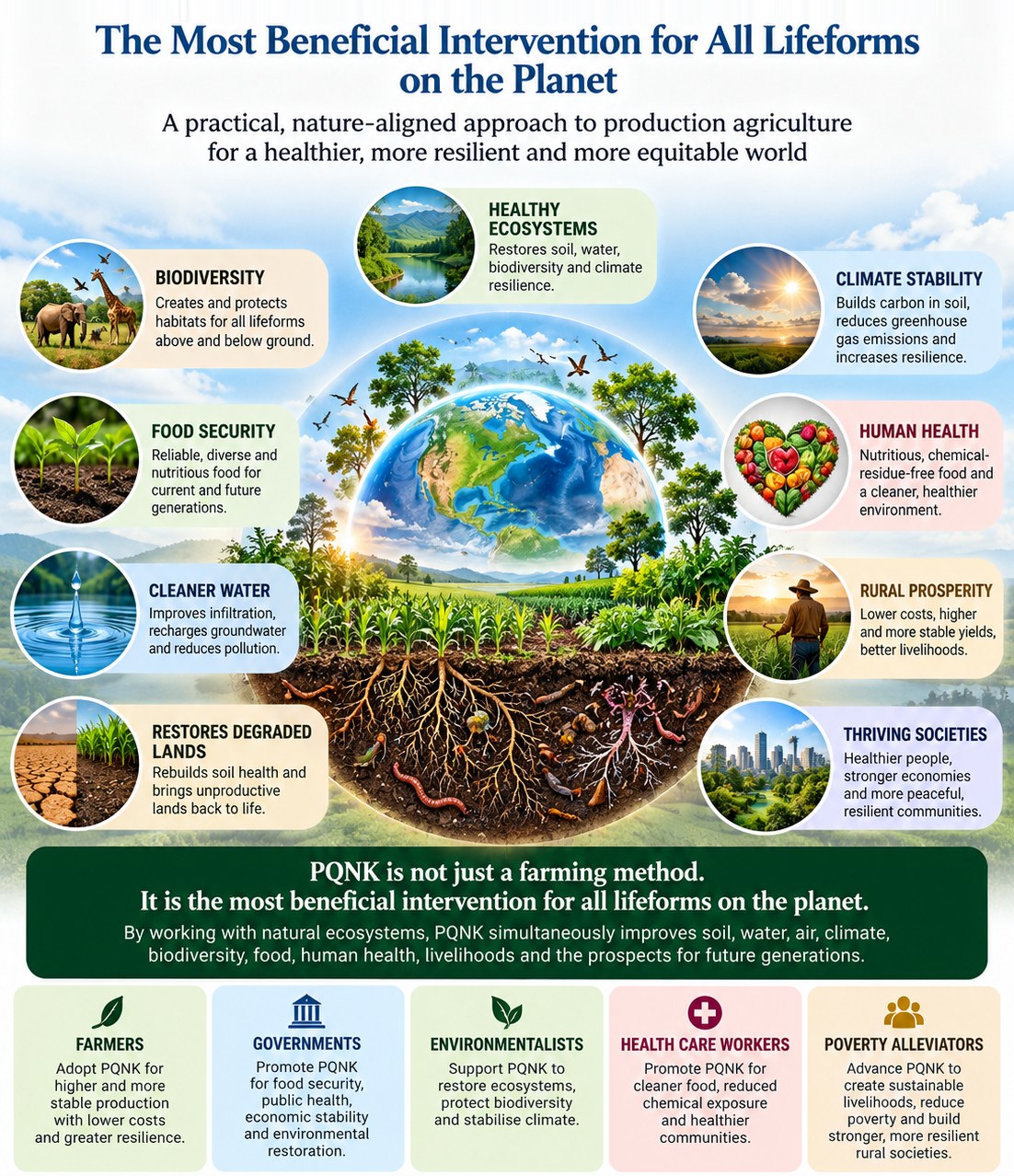
PQNK asks a simple question: if productive soil is a living ecosystem, why should agriculture depend on repeatedly disturbing, flooding, exposing and chemically substituting for that ecosystem?
1. PQNK: an intervention whose benefits extend across life
The significance of PQNK reaches far beyond the farm. Production agriculture occupies the meeting point of soil, plants, microorganisms, insects, animals, water, atmosphere and human society. When agriculture is managed against the natural ecosystem, the consequences therefore spread far beyond the crop. When it is brought back into alignment with that ecosystem, the benefits can spread just as widely.
For this reason, PQNK can be described as an exceptionally far-reaching intervention for life on Earth. Its purpose is not to favour one species at the expense of another, but to restore the biological conditions in which many forms of life can function together: living soil instead of repeatedly disturbed soil; habitat and food webs instead of biological simplification; infiltration and aeration instead of inundation; permanent cover instead of exposed ground; and production based increasingly on biological relationships rather than recurring chemical substitution.
The phrase “most beneficial intervention for all lifeforms” expresses the scale of the proposition, but it should be understood as a systems claim rather than a comparative scientific ranking against every possible human intervention. PQNK acts at a uniquely important junction because agriculture manages enormous areas of the Earth’s biologically productive land and directly connects ecosystems with food, water, climate, livelihoods and human health.
Its beneficiaries are therefore not farmers alone. Soil organisms gain habitat. Pollinators, predators and other farmland biodiversity gain refuge and food. Livestock and wildlife benefit from a less chemically dependent landscape. Water systems benefit when soil can absorb and retain water more effectively. People benefit through the prospect of safer production, resilient food systems and stronger rural economies. Future generations inherit land whose productive biological capital has been rebuilt rather than consumed.
2. One agricultural decision, many public consequences
Agriculture is usually discussed as though it were only the farmer’s business. It is not. The way food is produced determines how soil is treated, how much irrigation water is withdrawn, how much purchased fertiliser and pesticide enters the production system, how much biological diversity remains on farmland, what risks agricultural workers face, how resilient farms are to climatic stress, and how much of the value of a crop remains with the producer.
That is why PQNK cannot be considered only as a cultivation technique. Its four governing principles are system principles: no inundation, no soil disturbance, permanent organic cover and encouraged biodiversity. Together they are intended to restore the soil as the biological engine of production rather than treating it as an inert medium to which water, fertiliser and pesticides must continually be added.
The case for PQNK is therefore broader than yield. It concerns the farmer, the public treasury, water security, environmental restoration, food quality, occupational exposure, rural livelihoods and the long-term productive capacity of agricultural land.
3. Why every farmer needs to adopt PQNK
The farmer carries the immediate economic risk of agriculture. Seed, fertiliser, pesticide, diesel, machinery, irrigation and labour are paid for before the harvest is known. A system that can reduce unnecessary purchased inputs, preserve permanent field architecture and progressively rebuild biological function deserves serious attention wherever farming is practised.
PQNK replaces repeated field reconstruction with permanent raised beds and controlled traffic. Roots and crop residues remain in the system. Soil Moisture Management aims to keep the root zone moist and aerated rather than inundated. Crop-after-crop and crop-in-crop production seek to keep living roots and photosynthesis working for more of the year. During transition, the farmer observes and supplements only where the recovering system demonstrates a need.
This does not mean that every crop, soil and climate will deliver the same result, or that transition is risk-free. Evidence from the wider conservation and regenerative-agriculture literature shows that reduced disturbance, soil cover, crop diversity and improved soil biological management can improve soil health, carbon storage, biodiversity and resilience. PQNK’s field experience is higher and more stable yields once the system matures. The size of the gain still varies with place, crop, management and transition stage, so results should be recorded farm by farm rather than promised as an identical yield or income for every farmer.
The practical proposition remains powerful: stop paying repeatedly to recreate conditions that a functioning soil ecosystem can increasingly provide for itself.
4. Why governments should promote large-scale adoption of PQNK
Governments do not need another agricultural philosophy waiting in a laboratory for proof of concept. The ecological foundation on which PQNK is built has already been operating in nature for hundreds of millions of years. Long before ploughs, fertiliser factories, pesticides or irrigation departments existed, natural ecosystems maintained soil cover, recycled organic matter, supported immense biodiversity, managed water through living soil and sustained plant production without annual mechanical reconstruction of the land.
PQNK did not invent these processes. Pedaver’s work has been to identify the major practices introduced through Ancient, Conventional and Industrial agriculture that conflict with those natural processes, remove those contradictions, and develop a practical production system that allows agriculture to function in line with the natural ecosystem. Its four governing principles are therefore not arbitrary prescriptions: no inundation, no soil disturbance, permanent organic cover and encouraged biodiversity.
PQNK began in 2009 with rice grown on raised beds, where the first step was simply to stop inundating the soil. In the years that followed, other crops and the remaining steps of the system were added and tested before PQNK was made public, and it has since moved beyond concept into farmer practice. Pedaver’s experience now extends across a large practitioner base, crops and farming conditions. The question for government is therefore not whether nature’s operating principles need to be rediscovered or re-proved. The task is large-scale adaptation and adoption: enabling farmers to convert fields correctly, providing access to suitable machinery and training, adapting bed geometry and crop protocols to local conditions, and building the institutional capacity required for widespread implementation.
Measurement remains important, but its purpose must be understood correctly. Governments should measure water use, production cost, yield, soil condition, food value, environmental outcomes and farmer income as PQNK expands. That is not a test of whether the natural ecosystem works. It is performance measurement: documenting how effectively PQNK has been implemented in a particular crop, soil, climate and farming environment, identifying mistakes in implementation, and quantifying the public benefits achieved.
This distinction matters. If a PQNK field performs poorly, the first question should not be whether nature has failed. The field should be examined to determine whether the transition protocol, soil moisture management, permanent cover, biodiversity, field engineering and other relevant PQNK requirements were correctly established and managed. Local adaptation is necessary because tractors, soils, rainfall, temperatures, crops and farm sizes differ. The governing ecological principles do not change.
Governments face irrigation shortages, groundwater decline, soil degradation, dependence on purchased agrochemicals, rising production costs, food-security pressures, climate stress and rural poverty. These problems are normally divided among ministries and programmes. On the farm they converge in the same production system. Large-scale PQNK adoption therefore offers governments the opportunity to address several national problems through one change at their biological source: how agricultural land itself is managed.
5. Why environmentalists should look beneath the crop canopy
Environmental discussion often treats agriculture primarily as a source of emissions, habitat loss, nutrient leakage and chemical pollution. PQNK begins one level deeper: with the condition of the soil ecosystem that produces the crop.
Permanent cover protects the surface. No disturbance protects soil structure and fungal networks. Avoiding inundation preserves aeration. Biodiversity increases the number of biological relationships operating above and below ground. Retained roots and residues return carbon to the soil food web rather than repeatedly exposing organic matter to accelerated loss.
These mechanisms are consistent with a growing scientific literature showing that conservation and regenerative practices can improve soil organic carbon, microbial biomass, aggregation, water relations and farmland biodiversity. But environmental claims must remain measurable. Carbon sequestration, biodiversity recovery and water effects vary by soil, climate, starting condition and management. PQNK should therefore invite environmental scientists into the field, not ask them to accept slogans.
6. Why health professionals should care about how food is produced
Health begins before food reaches the kitchen. Farmers and agricultural workers can be directly exposed to pesticides during mixing, application, transport and disposal. The World Health Organization recognises that pesticides can cause acute and chronic health effects depending on the substance and exposure, and it specifically identifies occupationally exposed people as a high-risk group.
PQNK’s long-term objective is to restore biological pest regulation and plant nutrition sufficiently to eliminate routine dependence on agrochemicals. During transition, intervention is based on observation and necessity rather than scheduled chemical use. Reducing unnecessary pesticide exposure is therefore a legitimate occupational and public-health objective.
On a mature PQNK field no agrochemical is applied, so its food carries no chemical residue. Traces are possible only in rare cases during transition, where a crop had to be protected after pest pressure crossed the 10 percent threshold.
Laboratory tests should be done to validate PQNK produce against conventionally grown produce, comparing nutrition density and diversity. This is precisely why PQNK needs a validation system. Health professionals should support the question and the measurement: can a production system simultaneously reduce hazardous exposure and improve measurable food value?
7. Why poverty alleviation must begin with the cost of producing food
Rural poverty is often addressed after farm income has already been lost: through subsidies, credit, debt relief, food support or income-transfer programmes. PQNK asks whether part of the problem can be attacked earlier, inside the economics of production itself.
A small farmer is especially vulnerable to purchased-input dependency because the expenditure occurs before the crop is sold. When a production system requires repeated tillage, high seed rates, routine fertiliser, pesticides and frequent irrigation, the farmer must finance the crop before knowing the harvest price. Debt and production risk become linked.
PQNK attempts to reverse that structure by reducing recurring operations and allowing biological capital to accumulate in the field. Permanent beds are not rebuilt every season. Residues become mulch. Retained roots become biological infrastructure. Nutrient cycling and pest regulation are progressively transferred back to the living system. Seed rates can fall sharply in crops where precision placement allows it, while multiple or intercropped production can increase the productive use of land where climate, water and markets permit.
None of this abolishes market risk, weather risk or the need for management. It does, however, change the poverty question from “How do we compensate the farmer after production becomes uneconomic?” to “How do we reduce the structural cost and risk of producing food in the first place?”
8. One system, five constituencies
The farmer sees production cost, crop performance and risk. Government sees water, food security, imports, rural stability and public expenditure. The environmentalist sees soil, biodiversity, carbon, water and pollution. The health professional sees occupational exposure and the quality and safety of food. The poverty-alleviation institution sees household income, debt, vulnerability and access to affordable food.
These are not five unrelated agendas. They meet in the same acre.
That is the central reason PQNK deserves attention beyond the farming community. A change in the management of one acre can influence several outcomes at the same time because soil, water, plants, biodiversity, food, farm economics and human health are parts of one connected system.
9. What responsible promotion of PQNK should mean
Promoting PQNK does not mean replacing one package of compulsory inputs with another package carrying a different label. PQNK is not an input package. It is a return to the governing processes of the natural ecosystem, translated into a practical production-agriculture system.
Responsible promotion means creating opportunities for farmers to see the system operating, training them in the four principles and transition protocol, and adapting engineering details to local tractors, soils, rainfall, temperatures and crops without abandoning the governing ecological principles.
The wider evidence base supports large-scale adoption of systems built around soil cover, reduced disturbance, biodiversity and biological soil function. It also warns that outcomes depend on context and that transitions can involve trade-offs. PQNK should welcome that standard of scrutiny.
Measurement is not a trial of nature. It is the record of how successfully we have brought production agriculture back into alignment with it.
PQNK’s reach is unusually broad because restoring the agricultural ecosystem benefits not one isolated target, but the interconnected living system: soil biology, plants, insects, animals, water, atmosphere, farmers, consumers and future generations.
10. The proposition
The twentieth-century agricultural question was largely: How can we increase production by supplying the crop with more external inputs?
The PQNK question is different: How much of the work can a functioning natural ecosystem perform if we stop repeatedly destroying the conditions it requires?
That question matters to every farmer because it concerns the cost and resilience of production. It matters to every government because food, water and rural economies are national infrastructure. It matters to environmentalists because agricultural land occupies an enormous part of the human-managed biosphere. It matters to health professionals because food production affects both occupational exposure and the food system. And it matters to anyone working against poverty because the economics of food production begin with the farmer.
PQNK therefore should not be presented as a new chemical, machine or laboratory invention awaiting proof of concept. Its foundation is the natural ecosystem itself. The task now is to make the system widely available, teach the transition process correctly, adapt its engineering to local conditions, document performance, and enable farmers to adopt it at scale.
As adoption expands and its results are documented across more crops and regions, the central question becomes how quickly farmers can be supported through the transition, and why any society would continue paying for the degradation that the change can prevent.
PQNK in one sentence: Restore the farm as a living ecosystem, measure what it delivers, and progressively replace recurring external dependency with biological function.
Selected Evidence and Context
1. FAO Agroecology Knowledge Hub (2026). Regenerative agriculture: connecting soil carbon storage, biodiversity, and profit. Large multi-farm study reporting higher soil carbon and biodiversity under more regenerative management, with profitability broadly similar overall and context-dependent yield responses.
2. FAO Agroecology Knowledge Hub (2026). Sustainable farming systems integrating soil health, water-use efficiency and crop productivity for climate resilience. Review of integrated practices including conservation tillage, cover cropping and mulching, with reported improvements in soil structure, soil organic carbon and water-use efficiency across settings.
3. Nature Communications (2024). Conservation agriculture improves soil health and sustains crop yields after long-term warming. Long-term experiment reporting improved soil-health indicators and maintained crop production under conservation agriculture during experimental warming.
4. Nature Food (2024). Root–soil–microbiome management is key to the success of regenerative agriculture. Highlights the importance of soil health, roots and the microbiome in regenerative agricultural systems.
5. Scientific Data (2024). Evidence library of meta-analytical literature assessing the sustainability of agriculture. Evidence library covering hundreds of meta-analyses and impacts including soil health, pollution, water, nutrient cycling, biodiversity, climate mitigation and productivity.
6. World Health Organization. Pesticide residues in food; pesticide-management guidance. WHO notes that pesticides can have acute and chronic health effects depending on exposure and that occupationally exposed people are among those at greatest risk.
7. World Health Organization (2021). Food systems delivering better health. Frames human health, ecosystem health and food systems as interconnected and calls for transformation across food production and consumption.
Editorial note: The external literature listed here supports the ecological and public-interest mechanisms discussed in this paper. PQNK-specific performance figures should continue to be documented from PQNK farms as records of implementation and outcomes, not as a prerequisite for accepting the natural ecosystem principles on which PQNK is based.
About This Paper
- Problem
- External Input Dependency · High Input / Production Cost · Macro / Policy-Level Externalities · Biodiversity Loss · Contamination / Residue / Food Safety Risk · Diet-Related Health / Food Security Concern · General Soil Fertility / Land Degradation · Groundwater / Aquifer Depletion
- Science
- Soil · Water · Biodiversity · Climate · Food Quality · Transition
- Evidence
- Philosophical/Framework Argument
- Authority
- Current / Approved PQNK Knowledge
Related PQNK Science
Key Takeaways
- Agriculture connects soil, water, biodiversity, food, farm economics and human health, so restoring the farm ecosystem benefits all of them together.
- PQNK began in 2009 with rice on raised beds, where the first step was simply to stop inundating the soil; other crops and steps were added and tested before it was made public.
- The government task is large-scale adaptation and adoption; measurement records how well PQNK is implemented, not whether nature works.
- A mature PQNK field applies no agrochemical; traces are possible only in rare transition cases after the 10 percent pest threshold.
- PQNK field experience is higher and more stable yields once the system matures, with the size of the gain varying by place, crop and management.
- Poverty alleviation can begin inside the economics of production, by reducing recurring input costs and risk before the harvest.
Related Knowledge
same problem
Chemical Fertiliser Dependency Through the PQNK Lens
An evidence-qualified review of the article “Chemical Fertilizer Industry”. It keeps the article's warning about soil degradation, nutrient pollution and biological decline, disciplines its headline numbers, and argues that fertiliser dependency is a symptom of a damaged production system (tillage, flooding, bare soil and simplified biology) that PQNK removes by restoring aerated, covered, living soil, reaching zero purchased fertiliser and pesticide at maturity.
same problem
The Global Cost of Agricultural Degradation & the PQNK Restoration Dividend
The visible price of food does not represent its full cost. Earlier versions of this Knowledge Paper attempted to combine several external estimates into a single $1.9 trillion annual cost and a $2.8 trillion restoration opportunity; source verification showed those figures combined studies with different scopes and could not be defended as one additive model, so Pedaver withdraws that composite calculation. The corrected analysis uses independently sourced estimates, FAO's ~$12 trillion/year hidden agrifood-system costs, UNCCD's ~$878 billion/year cost of inaction on land degradation, FAO's ~$400 billion/year soil-loss figure, within their own stated boundaries, and explicitly does not add them together.
same problem
The Earth Has Not Stopped Working: A Production-Agriculture Response to Environmental Fatalism, and What PQNK Restores
A widely shared social-media message, built on Lovelock's Gaia Hypothesis, ends in resignation: the planet will correct a stressed system with floods and extinctions, and all we can do is await nature's revenge. This paper accepts that we are not separate from nature but rejects the fatalism. Drawing on more than fifty years in production agriculture, it argues the core error was redesigning natural systems before understanding them, that agriculture is the clearest case, and that a degraded field is a suppressed system rather than an extinguished one, so the answer is not to fear nature's revenge but to stop fighting nature and learn again to produce with it.
same problem
Restoring Earth's Operating System: The PQNK Framework for Regenerative Agriculture
A comprehensive policy and investment brief that models global agriculture's degenerative trajectory against a PQNK-led alternative, laying out true-cost economics, a five-year implementation roadmap with quarterly KPIs, and specific financial instruments, from transition bonds to farmer cooperative financing, meant to move PQNK from pilot to planetary scale.