
KP-224 · Water & Climate
Grain First: PQNK and the Coming Food Crisis
A practising PQNK farmer asked whether staple grains will matter more in the years ahead, and whether farmers should favour wheat, maize and rice or vegetables and fruit. Erratic weather, degraded soil and scarce water are squeezing the world’s food supply, and ACI agriculture depends on exactly what is failing. PQNK soil takes in heavy rain, holds moisture through heat and drought and grows without purchased inputs. The strategy for the next ten years: convert the land to PQNK, grow grain first, and keep a reserve of grain in your own store.
Read or listen to the full paper ↓Abstract
A practising PQNK farmer asked how the future of food security and the grain market should be seen, whether staple grains will gain in importance and value in the years ahead, and whether farmers should give more attention to wheat, maize and rice or to vegetables and fruit.
The world’s population is still growing while the three foundations of farming, a stable climate, a living soil and enough water, are all weakening, and the cost and supply of fertiliser and spray have become uncertain. ACI (Ancient Conventional Industrial) agriculture depends on exactly the things that are failing.
PQNK does not: its soil takes in heavy rain, holds moisture through heat and drought, grows the same crop season after season without purchased inputs, and keeps pests below 2 percent where every step is followed. The farmer’s best strategy for the next ten years is therefore clear: convert the land to PQNK, grow grain first, and keep a reserve of grain in his own store.
Full Paper
If you use “Listen”, the text of the page may be sent to your browser or operating system’s speech provider, such as Apple, Google or Microsoft, depending on the voice your device uses. Pedaver does not process, transmit or store any audio.
In a food crisis, the strongest farmer is the one whose crop depends on nothing he must buy, and whose store holds his own grain.
1. A Farmer’s Question
The question came in a farmers’ WhatsApp group. How should we see the future of food security and the global grain market? With a growing population, a changing climate and fears of falling harvests, will basic grains become more important and more valuable between 2027 and 2030? Should farmers put more of their land under wheat, maize and rice, or under vegetables and fruit? And what is the best strategy for a farmer over the next ten years?
These are the right questions. Every farming family, and every nation that feeds itself, will have to answer them. The answer begins with the pressures now acting on the world’s food, and with what each kind of farming can do against them.
2. Three Pressures on the World’s Food
The world has about 8 billion people today, and the United Nations projects close to 9.7 billion by 2050. More people will need more grain. At the same time, the three foundations on which farming stands are weakening:
Erratic weather. Extreme heat, untimely rain, floods and droughts now arrive in the same year on the same farm. A crop that once ripened on a reliable calendar now faces a heat wave at flowering or a cloudburst at harvest.
Degraded soil. Decades of ploughing, chemical fertiliser, spray and bare ground have destroyed the life and structure of farm soils across the world. A dead soil cannot hold water, cannot feed the crop, and yields less every year for the same expense.
Scarce water. Groundwater tables are falling in the major grain regions of the world, and river and canal water has become less certain from season to season.
On top of these, the cost of fertiliser, spray and fuel has risen and their supply can stop without warning. When the war in Ukraine disrupted the trade in grain and fertiliser in 2022, several countries restricted the export of their own food to protect their people. In a crisis, every nation feeds itself first.
3. What This Means for Grain
No one can predict exact prices. Markets rise and fall with each season, and a farmer should not plan his life on a forecast. But the direction is clear. As weather becomes less reliable, soils weaker and water scarcer, staple grain will matter more in the years ahead, not less. Grain is the food that can be stored, carried and traded across seasons and borders; it is the first thing a family, a market or a government reaches for when supply is uncertain.
The strongest farmer in such a time is not the one who guesses the market correctly. It is the one whose cost of production is lowest, whose crop does not fail when the weather turns, and who holds his own grain when others must buy. That farmer gains whichever way prices move.
4. Why ACI Agriculture Cannot Answer These Pressures
ACI agriculture runs on the plough, on purchased fertiliser and spray, and on heavy irrigation. Each of the three pressures strikes at one of these supports, and so ACI farming grows more fragile exactly as the pressures grow stronger.
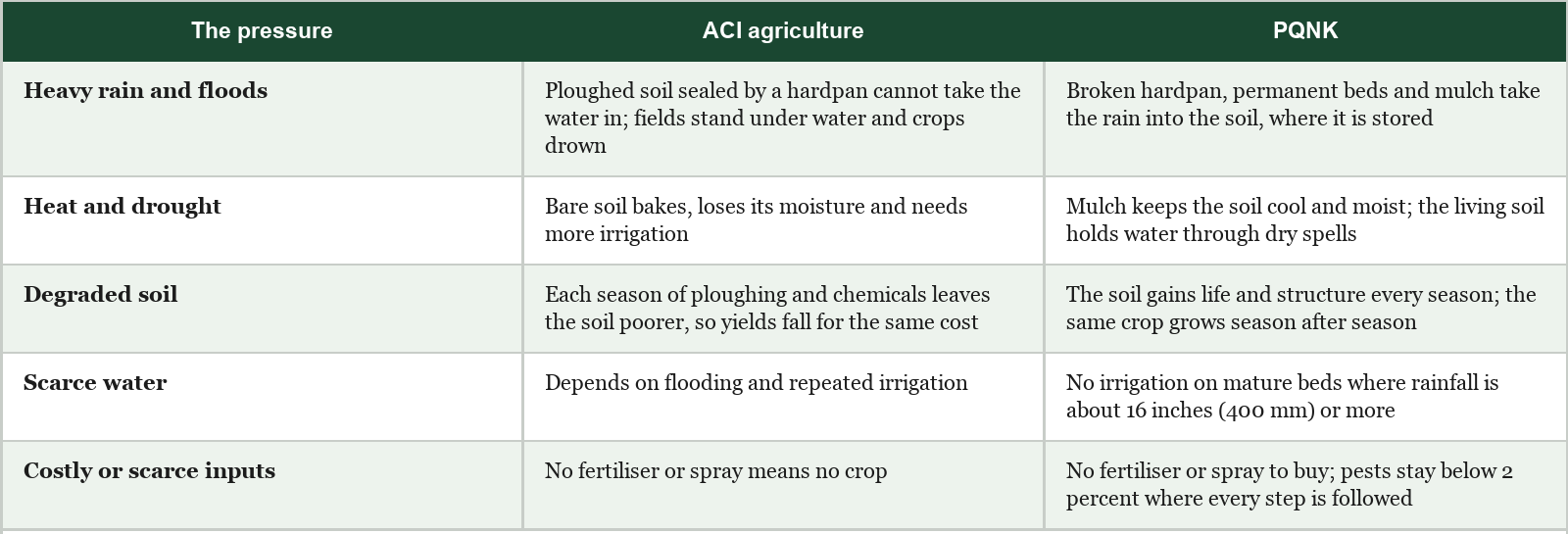
| The pressure | ACI agriculture | PQNK |
|---|---|---|
| Heavy rain and floods | Ploughed soil sealed by a hardpan cannot take the water in; fields stand under water and crops drown | Broken hardpan, permanent beds and mulch take the rain into the soil, where it is stored |
| Heat and drought | Bare soil bakes, loses its moisture and needs more irrigation | Mulch keeps the soil cool and moist; the living soil holds water through dry spells |
| Degraded soil | Each season of ploughing and chemicals leaves the soil poorer, so yields fall for the same cost | The soil gains life and structure every season; the same crop grows season after season |
| Scarce water | Depends on flooding and repeated irrigation | No irrigation on mature beds where rainfall is about 16 inches (400 mm) or more |
| Costly or scarce inputs | No fertiliser or spray means no crop | No fertiliser or spray to buy; pests stay below 2 percent where every step is followed |
5. How PQNK Answers Each Pressure
PQNK (Paedar Qudratti Nizam Kashatqari, the Pristine Organic Farming System) works the field the way natural ecosystems have produced for four hundred million years: the soil is never ploughed after one correction, never flooded, and never left bare. Each of these rules answers one of the pressures directly.
Against erratic weather. Permanent raised beds under a continuous organic mulch shield the soil from heat and from the force of rain. Where the hardpan has been broken once with a subsoiler, the soil takes water in at a rate that ploughed land cannot approach. In Fazilka district, Indian Punjab, 13 inches (330 mm) of rain fell in eight hours; the PQNK beds had taken it in and could be walked on, while the conventional land beside them stood under water (KP-213). The rain that floods an ACI field becomes stored moisture in a PQNK field.
Against degraded soil. PQNK rebuilds the soil’s life and structure every season instead of using it up. Mature PQNK soil grows the same crop season after season with no fertiliser and no spray, and where every step is followed, pests stay below 2 percent and are gone within days.
Against water scarcity. PQNK waters the crop by soil moisture management, drawing first on rain, dew, the humidity of the air and capillary rise. Mature PQNK beds need no irrigation where rainfall is about 16 inches (400 mm) or more. Rice, the thirstiest grain of all, shows the scale of the saving: on large acreages across many farms, mature PQNK Basmati yields at least 20 percent more than conventional Basmati of the same variety, with about 92 percent less irrigation water (PQNK book, Chapter 33).
Against costly and uncertain inputs. A PQNK farmer buys no fertiliser and no spray. When their prices rise or their supply stops, his crop does not stop. His cost of production is the lowest in the market, which is the greatest strength a farmer can have in a crisis.
6. Grain First
For these reasons the advice to the farmer is plain: grain first.
Staple grains first. Give most of the land to the staple grains of the region: wheat, rice and maize, and wherever they are the staple, sorghum and millets. Grain can be stored for a year or more; vegetables and fruit spoil within days or weeks, and their prices fall sharply at the peak of the season.
Keep a reserve. Every farming household should hold at least one year’s grain for the family and its livestock. Store the surplus clean, dry and safe, and sell it when the time is right, not when the harvest forces it.
Vegetables and fruit in their place. Grow them on part of the land, for the family’s nutrition and for cash income through the year, but do not let them take the place of grain.
Grow it in living soil. Grain from a PQNK field is whole food, carrying the minerals and nourishment that a living soil passes to the crop (KP-222). In a crisis, the quality of the grain matters as much as its quantity.
7. A Ten-Year Strategy for the Farmer
1. Bring all the land into PQNK, step by step, following the eight steps of Chapter 23 in order: design the farm; probe and break the hardpan once with a subsoiler, to about 22 inches; wash the soil where the pH is above 8; form permanent raised beds; grow a Jantar cover crop, leaving its roots in the soil and using its biomass as the first mulch; plant through the mulch; water only when the ball test shows the soil is dry; and harvest without disturbing the soil.
2. Once the beds are made, never plough again and never leave the soil bare.
3. Grow grain first, and keep a reserve in your own store.
4. Keep the cost of production as low as possible. Low cost is the strongest protection against any market.
5. Share the knowledge with neighbouring farmers. A village of living soils is safer than one living field. Questions can be sent at any time to Ask PQNK, on WhatsApp or at pedaver.com/ask.
Conclusion
The coming years will test every farm and every nation on how much food it can grow from its own soil, with its own water, without depending on what it must buy. ACI agriculture is weakest exactly where that test is hardest. PQNK is strongest there: its soil takes in the flood, holds water through the drought, grows without purchased inputs and improves every season. For the farmer who asked, and for every farmer facing the same decade, the strategy is one sentence long: build a living soil, grow grain first, and keep your own reserve.
PQNK Principle: The farmer who builds his soil today will own the food security of tomorrow.
Related PQNK Sources
1. PQNK Book, Chapter 47: Food Security, Food Sovereignty, and Economy; Chapter 23: The Eight-Step Transition Protocol; Chapter 25: Hardpan; Chapter 33: Rice as Proof of Concept; Chapter 45: Water, Floods, and Aquifer Replenishment. https://pedaver.com/books/natural-ecosystem-science/
2. KP-213: When 13 Inches of Rain Falls in Eight Hours. https://pedaver.com/papers/when-13-inches-of-rain-falls-in-eight-hours/
3. KP-209: Why the World Needs PQNK. https://pedaver.com/papers/why-the-world-needs-pqnk/
4. KP-222: Whole Food from a Living Soil: Able Bodies and Clear, Conscious Minds. https://pedaver.com/papers/whole-food-from-a-living-soil/
5. United Nations, World Population Prospects 2024.
6. Ask PQNK: https://pedaver.com/ask, or on WhatsApp at https://wa.me/923437506442
About This Paper
- Crop
- Wheat · Rice · Maize (Corn) · Grains (crop group)
- Problem
- Diet-Related Health / Food Security Concern · Erratic / Unpredictable Weather Patterns · Drought / Water Scarcity · Flooding · General Soil Fertility / Land Degradation · High Input / Production Cost · External Input Dependency · Price Volatility / Market Glut · Groundwater / Aquifer Depletion · Heat Stress on Crop
- Science
- Climate · Water · Soil · Transition
- Evidence
- Philosophical/Framework Argument
- Authority
- Current / Approved PQNK Knowledge
Related PQNK Science
Key Takeaways
- No one can predict exact grain prices, but as weather, soil and water weaken, staple grain will matter more in the years ahead, not less.
- The strongest farmer in a crisis is the one with the lowest cost of production, a crop that does not fail when the weather turns, and his own grain in store.
- ACI agriculture depends on the plough, purchased inputs and heavy irrigation, so it grows more fragile exactly as the pressures grow stronger.
- PQNK soil took in 13 inches of rain in eight hours, needs no irrigation on mature beds where rainfall is about 16 inches (400 mm) or more, and grows without fertiliser or spray.
- Grain first: give most of the land to staple grains, keep at least one year’s grain for the household and livestock, and grow vegetables and fruit on part of the land.
- Over ten years: convert all the land through the eight PQNK steps in order, never plough again, never leave the soil bare, and keep costs as low as possible.
Related Knowledge
same problem
Why the World Needs PQNK
A case for large-scale PQNK adoption addressed to five constituencies: farmers, governments, environmentalists, health professionals and poverty-alleviation institutions. Because agriculture sits where soil, water, biodiversity, food, farm economics and human health meet, restoring the farm as a living ecosystem benefits all of them at once.
same problem
Chemical Fertiliser Dependency Through the PQNK Lens
An evidence-qualified review of the article “Chemical Fertilizer Industry”. It keeps the article's warning about soil degradation, nutrient pollution and biological decline, disciplines its headline numbers, and argues that fertiliser dependency is a symptom of a damaged production system (tillage, flooding, bare soil and simplified biology) that PQNK removes by restoring aerated, covered, living soil, reaching zero purchased fertiliser and pesticide at maturity.
same problem
The Farmers' Crisis Will Not Be Solved by Another Support Price: Why Pakistan's Farmers Must Reduce Cost, Improve Quality and Build Independence Through PQNK
A nationwide farmers' association's press conference voiced real distress over diesel, fertiliser, wheat and sugarcane policy, and the danger that one failed crop leaves a farmer unable to finance the next. This paper argues that distress is real but the standard remedy, another support price or subsidy, cannot be the permanent foundation of farm viability, because it exchanges biological dependence for political dependence. PQNK reframes the question: since a farmer cannot control the market price, government policy, rainfall or the exchange rate, his strongest and most durable defence is progressively lowering his own cost of production by restoring the soil's biological functions, while building resilience to climate shocks and competing through demonstrable produce quality.
same problem
The Global Wheat Crisis Is a Warning: Food Security Cannot Depend on a Production System That Is Failing
The renewed wheat-exporting crisis is usually explained by heat, war, energy costs and disrupted shipping, but this paper argues it exposes a deeper, fourth dependency few are naming: a production model whose own functioning requires stable climate, cheap energy, manufactured fertiliser and uninterrupted supply chains. It argues Pakistan's food security depends less on securing the next shipment of wheat than on rebuilding the biological productive capacity of its own soil.