
KP-207 · Soil Science & PQNK System
Chemical Fertiliser Dependency Through the PQNK Lens
An evidence-qualified review of the article “Chemical Fertilizer Industry”. It keeps the article's warning about soil degradation, nutrient pollution and biological decline, disciplines its headline numbers, and argues that fertiliser dependency is a symptom of a damaged production system (tillage, flooding, bare soil and simplified biology) that PQNK removes by restoring aerated, covered, living soil, reaching zero purchased fertiliser and pesticide at maturity.
Read or listen to the full paper ↓Abstract
The article Chemical Fertilizer Industry assembles an important warning about soil degradation, nutrient pollution, biological decline, water demand, greenhouse-gas emissions and human exposure. Its central concern is justified: agriculture cannot indefinitely compensate for a deteriorating soil ecosystem by increasing soluble nutrient inputs. However, several headline figures are presented without sufficient boundaries, and several global problems are attributed too directly to fertiliser alone. Soil erosion, salinity, aquatic dead zones and chronic disease have multiple interacting causes. A scientifically defensible response must preserve the warning while separating established evidence, association, extrapolation and advocacy.
Through the PQNK lens, the deeper problem is not the fertiliser bag by itself. Fertiliser dependency develops when tillage destroys structure and fungal continuity, flooding displaces soil air, bare soil overheats and loses moisture, crop residue is removed, roots are terminated and biodiversity is simplified. Chemical nutrients then substitute for biological functions that the production system has disabled. Removing the bag without rebuilding those functions can reduce yield; keeping the bag while leaving the damaged architecture unchanged preserves dependency.
The paper contrasts two nutrient pathways: biological delivery, which is demand-led through roots, microorganisms and mycorrhizal networks in an aerated rhizosphere, and bag application, which creates a concentration event that invites loss, soft growth and further purchases. Water determines the outcome: PQNK Soil Moisture Management keeps the root zone at roughly 30 percent water to 70 percent air, verified by the soil-ball test, with supplementary furrow irrigation no deeper than half the furrow and no flooding.
PQNK restores the functions the input-centred system displaced through its four rules and permanent engineering: the hardpan fractured once, permanent raised beds with traffic confined to the furrows, continuous mulch, precision placement and retained roots and residues. Transition is protected rather than abrupt: a deep water wash, a cover crop, about 4 kg NP with furrow water only against a verified deficiency, and pest intervention only above the 10 percent threshold. At maturity, zero purchased fertiliser and pesticide are evidence that the field has regained the capacity to produce. The policy question therefore shifts from securing fertiliser supply to financing the machinery, skills and risk protection that end dependency.
Full Paper
If you use “Listen”, the text of the page may be sent to your browser or operating system’s speech provider, such as Apple, Google or Microsoft, depending on the voice your device uses. Pedaver does not process, transmit or store any audio.
Chemical fertiliser is not an isolated input problem. It is the visible expression of a production system that has replaced aerated soil, living roots, microbial partnerships and natural moisture regulation with tillage, flooding and purchased chemistry.
1. The Article Raises the Right Alarm
The article correctly directs attention away from the short-term greening response produced by soluble nutrients and toward the accumulated condition of soil, water and biological systems. It also recognises the dependency trap: as biological function weakens, a farmer becomes more reliant on purchased nutrients, while a smaller proportion of each application may be recovered by the crop. The remainder can be immobilised, volatilised, leached, lost through runoff or converted into reactive nitrogen compounds. Excess nitrogen and phosphorus in water are established contributors to eutrophication, harmful algal blooms and oxygen-depleted zones [4,5]. Nitrogen fertilisation also contributes to nitrous oxide emissions, a powerful greenhouse gas [8].
The article is also right to emphasise microorganisms. Soil organisms do not merely occupy the root zone; they build aggregates, cycle carbon, fix nitrogen, solubilise mineral nutrients, extend root access through mycorrhizal networks, suppress pathogens and create the pore system through which air and water move. Long-term mineral fertilisation can alter microbial biomass and community composition, although the direction and magnitude vary with nutrient, dose, soil, climate and management [9,10]. The defensible conclusion is not that every fertiliser granule kills every microorganism. It is that concentrated nutrient application can change the economic relationship between plants and their biological partners, particularly when combined with tillage, bare soil and flooding.
2. The Numbers Must Be Used Responsibly
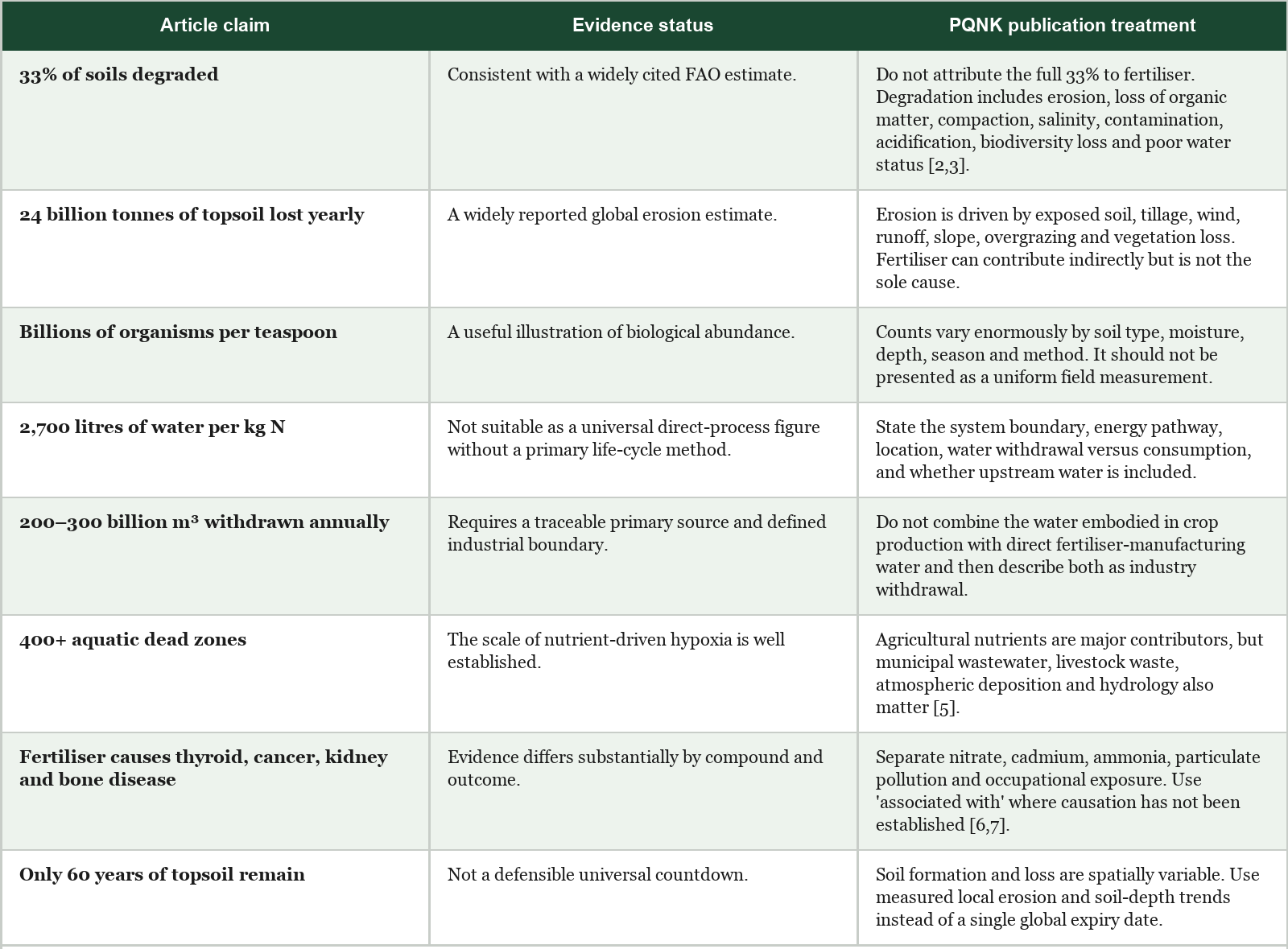
Large numbers attract attention, but a Knowledge Paper must distinguish a credible global estimate from a causal claim. The table below identifies the most important qualifications needed before the article’s headline figures are repeated in policy, education or advocacy.
| Article claim | Evidence status | PQNK publication treatment |
|---|---|---|
| 33% of soils degraded | Consistent with a widely cited FAO estimate. | Do not attribute the full 33% to fertiliser. Degradation includes erosion, loss of organic matter, compaction, salinity, contamination, acidification, biodiversity loss and poor water status [2,3]. |
| 24 billion tonnes of topsoil lost yearly | A widely reported global erosion estimate. | Erosion is driven by exposed soil, tillage, wind, runoff, slope, overgrazing and vegetation loss. Fertiliser can contribute indirectly but is not the sole cause. |
| Billions of organisms per teaspoon | A useful illustration of biological abundance. | Counts vary enormously by soil type, moisture, depth, season and method. It should not be presented as a uniform field measurement. |
| 2,700 litres of water per kg N | Not suitable as a universal direct-process figure without a primary life-cycle method. | State the system boundary, energy pathway, location, water withdrawal versus consumption, and whether upstream water is included. |
| 200–300 billion m³ withdrawn annually | Requires a traceable primary source and defined industrial boundary. | Do not combine the water embodied in crop production with direct fertiliser-manufacturing water and then describe both as industry withdrawal. |
| 400+ aquatic dead zones | The scale of nutrient-driven hypoxia is well established. | Agricultural nutrients are major contributors, but municipal wastewater, livestock waste, atmospheric deposition and hydrology also matter [5]. |
| Fertiliser causes thyroid, cancer, kidney and bone disease | Evidence differs substantially by compound and outcome. | Separate nitrate, cadmium, ammonia, particulate pollution and occupational exposure. Use 'associated with' where causation has not been established [6,7]. |
| Only 60 years of topsoil remain | Not a defensible universal countdown. | Soil formation and loss are spatially variable. Use measured local erosion and soil-depth trends instead of a single global expiry date. |
3. Fertiliser Dependency Is a System Outcome
The article describes chemical fertiliser as a harmful input added to an otherwise neutral field. PQNK begins one level deeper. The field is a production system whose physical, biological and moisture functions determine whether nutrients can be accessed and regulated. When these functions are intact, plant nutrition is not delivered by a bag. Roots release carbon compounds, microorganisms mobilise nutrients, mycorrhizae extend the effective root network, pore continuity supplies oxygen, and transpiration draws water and dissolved minerals toward the plant.
The conventional sequence progressively disables that system. Repeated tillage breaks aggregates, severs fungal networks and creates the same compacted layer described as the plough pan or hardpan. Flood irrigation fills pore space, excludes air and dilutes the soil solution. Bare soil is exposed to extreme temperature and evaporation. Crop residue is removed or burnt, depriving organisms of carbon and protection. Dense monoculture reduces the range of roots and exudates available to the soil food web. Once the biological delivery pathway is weakened, soluble nutrients become necessary to sustain the crop established by the damaged system.
This is why the causal statement must be precise. Chemical fertiliser contributes to degradation, particularly when over-applied or used in an already disturbed and poorly aerated soil. But it also functions as the conventional system’s compensation for damage created by tillage, inundation, bare soil and loss of biodiversity. Removing the bag without rebuilding those functions can reduce yield. Keeping the bag while leaving the damaged architecture unchanged preserves dependency.
4. Two Nutrient Pathways
4.1 Biological delivery is demand-led
In an active rhizosphere, plant roots and microorganisms exchange carbon, water and nutrients through regulated biological relationships. Microbes transform minerals from sustainable forms into plant-available forms; mycorrhizal fungi explore soil volumes that roots alone cannot reach; and root activity responds to growth stage, moisture, temperature and transpiration. This pathway is distributed through the soil profile and powered primarily by sunlight captured by plants.
4.2 Bag application creates a concentration event
A soluble fertiliser application introduces a high local concentration of salts. The crop may respond quickly, especially to nitrogen, but the event is not equivalent to biological nutrient exchange. Root tips must regulate water and ion entry under the new osmotic conditions. Nitrogen can drive excessive vegetative growth, softer tissues and greater attraction for sucking pests. Nutrients supplied beyond immediate plant demand become vulnerable to loss or transformation. The farmer then purchases pesticides and additional irrigation to manage consequences created by the same input-centred sequence.
4.3 Water determines the outcome
Water is the carrier of dissolved minerals, but water without air is not productive moisture. PQNK Soil Moisture Management maintains a moist, aerated root zone, roughly 30 percent water to 70 percent air in the pore space (the 30/70 rule), verified in the field through the soil-ball test. Irrigation is supplementary and moves slowly through the furrows, never deeper than half their depth (no more than a 4-inch head in the 8-inch furrow). Flooding is prohibited because it replaces air, disrupts biological activity and creates a temporary dilution event. The relevant measure is therefore not water applied per acre alone, but how effectively the soil system converts available moisture into plant function and harvested food.
5. Why the Article’s Proposed Solution Stops Short
The article recommends precision fertiliser application, nitrification inhibitors, compost, manure, biofertilisers, cover crops, no-till and crop rotation. Some of these measures can reduce pollution or improve soil condition. However, the package does not define a complete production system, and several recommendations merely replace one purchased product with another. Precision application can reduce waste while preserving dependency. Inhibitors slow particular chemical transformations but do not rebuild soil structure. Compost and manure can be useful materials, yet dependence on transported organic inputs is neither universally scalable nor necessary once the field produces and retains its own biomass.
The article uses the external term regenerative agriculture. PQNK does not use that expression as a substitute for its own science and engineering. PQNK is defined by an integrated Permanent Agricultural Architecture, Biological Production Platform, Service Corridors, controlled traffic, permanent cover, crop-after-crop or crop-in-crop sequencing, precision placement, Soil Moisture Management and Production Stewardship. Its standard is not a percentage reduction in chemical use. Its maturity standard is zero purchased fertiliser and pesticide while maintaining or increasing yield and continuously improving soil function.
6. The PQNK Production System
PQNK restores the functions that the input-centred system has displaced. Four non-negotiable rules govern the field:
• No inundation or flooding. Water remains supplementary and the root zone remains aerated.
• No disturbance or tillage. The soil architecture, root channels and fungal continuity are preserved.
• The soil remains covered with organic mulch. Residue becomes protection, carbon supply and future soil structure.
• Biodiversity is encouraged. Diverse roots, organisms and crop sequences strengthen regulation and resilience.
These rules are implemented through engineering rather than aspiration. The hardpan is fractured once to a working depth of approximately 22 inches. Permanent raised beds are formed with a 42-inch bed top and 18-inch furrow at the top, narrowing to an 8-inch base at an 8-inch depth, on a 60-inch bed-to-bed centreline. Tractor wheels remain in the furrow Service Corridors. The Slit Insertion Precision Planter places seed through mulch without disturbing the surrounding soil. Crop roots and residues remain after harvest, allowing each season to build Field Memory rather than erase it.
The result is a Biological Production Platform in which air, moisture, roots, microbes, mycorrhizae and minerals work as one system. Crop nutrition is no longer treated as three numbers printed on a bag. In PQNK’s working account of a harvested crop, approximately 95.917% is carbon, hydrogen and oxygen drawn from air and water, and roughly 4% is nitrogen drawn from the atmosphere through biological fixation. The net mineral export from the soil’s geological reserve in the harvested produce is approximately 0.083%. That figure is not the total mineral content of the plant; it is an illustrative estimate of the minerals that leave the field when produce is sold, under PQNK recycling of roots and residues. Minerals remain essential, but the conventional emphasis on purchased minerals treats a small net draw on a vast reserve as if it were the whole production process.
7. Transition Engineering Protects the Farmer
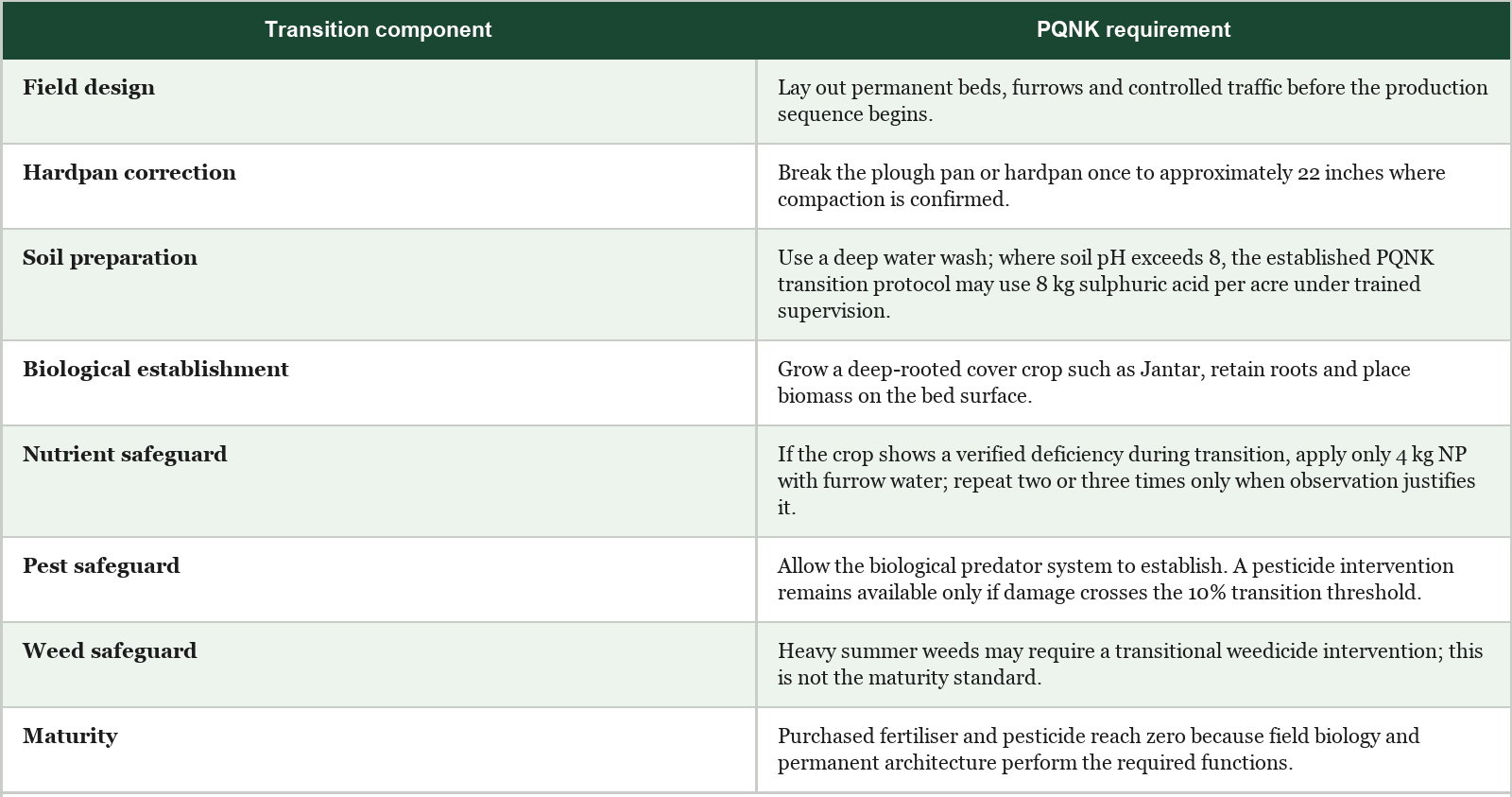
The article is correct that farmers should not be told simply to stop fertiliser overnight. A damaged field cannot instantly perform the functions that have been suppressed for decades. PQNK therefore separates transition from maturity. Transition Engineering restores the physical platform, establishes living cover and activates biological delivery while protecting the crop against an avoidable failure.
| Transition component | PQNK requirement |
|---|---|
| Field design | Lay out permanent beds, furrows and controlled traffic before the production sequence begins. |
| Hardpan correction | Break the plough pan or hardpan once to approximately 22 inches where compaction is confirmed. |
| Soil preparation | Use a deep water wash; where soil pH exceeds 8, the established PQNK transition protocol may use 8 kg sulphuric acid per acre under trained supervision. |
| Biological establishment | Grow a deep-rooted cover crop such as Jantar, retain roots and place biomass on the bed surface. |
| Nutrient safeguard | If the crop shows a verified deficiency during transition, apply only 4 kg NP with furrow water; repeat two or three times only when observation justifies it. |
| Pest safeguard | Allow the biological predator system to establish. A pesticide intervention remains available only if damage crosses the 10% transition threshold. |
| Weed safeguard | Heavy summer weeds may require a transitional weedicide intervention; this is not the maturity standard. |
| Maturity | Purchased fertiliser and pesticide reach zero because field biology and permanent architecture perform the required functions. |
8. Food and Health Claims Require a Soil System Explanation
The article lists thyroid disease, cancer, kidney disease and bone damage. These cannot be responsibly presented as a single direct consequence of fertiliser use. Nitrate in drinking water, cadmium in food, ammonia and particulates in air, and occupational exposure are different pathways with different evidence. Methemoglobinaemia from excessive nitrate exposure in infants is established. Nitrate may interfere with thyroid iodine uptake, but evidence for individual chronic diseases depends on dose, duration and population [6,7]. Cadmium toxicity to kidneys and bones is well established, while attribution to fertiliser requires evidence that phosphate inputs caused the relevant soil and food-chain exposure.
PQNK adds a question that the article largely misses: what nutritional product does the soil system create? A crop supplied through a narrow soluble NPK pathway may achieve weight and visual yield without assembling the same range and density of minerals, secondary metabolites and protective compounds produced by a biologically complete root environment. Human health is therefore connected not only to residues and contamination, but also to the nutritional density and diversity that agricultural production either enables or suppresses. PQNK therefore judges a harvest by its mineral density, bioactive compounds, storage quality and food performance, not by its yield alone.
9. The Policy Question Is Dependency
Fertiliser policy normally asks how to secure supply, lower prices, improve application efficiency or target subsidies. Those questions assume that permanent dependence is unavoidable. PQNK changes the policy question: what infrastructure, machinery, knowledge and risk protection would allow farmers to restore autonomous biological production? The investment priority then shifts from recurring input subsidy to durable capability.
That capability requires locally available subsoilers, raised-bed shapers, residue-management equipment and precision planters; trained Production Managers who are masters of the machinery and its correct use; rural service entrepreneurs accountable for maintenance; and transitional risk protection for smallholders who cannot absorb a failed crop.
The objective is not to criminalise fertiliser or blame farmers who depend on it. Farmers apply fertiliser because the prevailing production system, research advice, machinery and credit structure were designed around it. Responsibility lies in demonstrating and enabling a production architecture that makes recurring chemical purchase unnecessary. Once that alternative is visible, measurable and serviceable, farmers can leave dependency through evidence rather than ideology.
10. Conclusion
The Chemical Fertilizer Industry article performs a useful service by assembling the environmental and health risks surrounding fertiliser-dependent agriculture. Its warning should be retained, but its numbers must be disciplined. Global soil degradation cannot be assigned to one input. Water-footprint claims require transparent boundaries. Disease associations must not be converted into blanket causation. The scientifically stronger case is also the more important one: chemical fertiliser operates within a production system whose tillage, flooding, bare soil, compaction and biological simplification create both inefficiency and dependency.
PQNK does not answer this crisis by replacing chemical fertiliser with a catalogue of organic products. It restores the Permanent Agricultural Architecture and Biological Production Platform through which nature already manages air, water, carbon, roots, organisms and minerals. Transition Engineering protects the farmer while those functions recover. At maturity, zero purchased fertiliser and pesticide are not an imposed prohibition; they are evidence that the field has regained the capacity to produce.
The real choice is therefore not chemical versus organic input. It is recurring dependency versus a living, self-renewing production system.
References
1. OneAlif Community. Chemical Fertilizer Industry. 2026. https://www.community.onealif.com/agri-and-water/chemical-fertilizer (accessed 29 September 2026).
2. Food and Agriculture Organization of the United Nations. Global Symposium on Soil Erosion: Key Messages. FAO, Rome, 2019.
3. FAO and Intergovernmental Technical Panel on Soils. Status of the World’s Soil Resources. FAO, Rome, 2015.
4. United Nations Environment Programme. Facts about Sustainable Nutrient Management and the Triple Planetary Crisis. UNEP, 2024.
5. United Nations Environment Programme. Nutrient Management: The Issue. Global Partnership on Nutrient Management.
6. World Health Organization. Nitrate and Nitrite in Drinking-water: Background Document for Development of WHO Guidelines for Drinking-water Quality. WHO, Geneva.
7. World Health Organization. Nitrate and Nitrite Chemical Fact Sheet. WHO Guidelines for Drinking-water Quality.
8. United Nations Environment Programme and Food and Agriculture Organization. Global Nitrous Oxide Assessment. UNEP, 2024.
9. Geisseler, D. and Scow, K. M. Long-term effects of mineral fertilizers on soil microorganisms: A review. Soil Biology and Biochemistry 75 (2014): 54–63.
10. Treseder, K. K. A meta-analysis of mycorrhizal responses to nitrogen, phosphorus, and atmospheric CO2 in field studies. New Phytologist 164 (2004): 347–355.
11. Pedaver. PQNK: The Natural Ecosystem Science of Production Agriculture. PQNK protocols and Knowledge Exchange series. Pedaver, Pakistan, 2026.
About This Paper
- Problem
- External Input Dependency · High Input / Production Cost · General Soil Fertility / Land Degradation · Soil Biology / Microbiome Decline · Soil Organic Matter / Carbon Loss · Tillage Damage to Soil Biology / Structure · Preventive/Prophylactic Over-Application of Inputs (Fertilizer/Nitrogen) · Contamination / Residue / Food Safety Risk · Declining Nutrient Density in Food · Macro / Policy-Level Externalities
- Science
- Soil · Nutrition · Water · Food Quality · Transition
- Evidence
- External Scientific Evidence
- Authority
- Current / Approved PQNK Knowledge
Related PQNK Science
Key Takeaways
- The article's warning is justified, but its headline numbers need boundaries: soil degradation, erosion, dead zones and disease have several interacting causes, not fertiliser alone.
- Fertiliser dependency is a system outcome: tillage, flooding, bare soil, residue removal and simplified biology disable the biological nutrient pathway that the bag then replaces.
- Biological nutrient delivery is demand-led through roots, microbes and mycorrhizae; a soluble fertiliser application is a concentration event that invites losses, soft growth and pest attraction.
- Water decides the outcome: PQNK keeps the root zone moist and aerated at roughly 30 percent water to 70 percent air, with supplementary furrow irrigation and no flooding.
- The 0.083% figure is the net mineral export in harvested produce under PQNK recycling, not the total mineral content of the plant; most plant mass is built from air and water.
- Transition is engineered, not abrupt: about 4 kg NP only against a verified deficiency and pest intervention only above the 10 percent threshold, until maturity brings purchased inputs to zero.
- Health claims must separate nitrate, cadmium, ammonia and occupational exposure; PQNK adds the question of the nutritional density the soil system produces.
Related Knowledge
same problem
Why the World Needs PQNK
A case for large-scale PQNK adoption addressed to five constituencies: farmers, governments, environmentalists, health professionals and poverty-alleviation institutions. Because agriculture sits where soil, water, biodiversity, food, farm economics and human health meet, restoring the farm as a living ecosystem benefits all of them at once.
same problem
The Earth Has Not Stopped Working: A Production-Agriculture Response to Environmental Fatalism, and What PQNK Restores
A widely shared social-media message, built on Lovelock's Gaia Hypothesis, ends in resignation: the planet will correct a stressed system with floods and extinctions, and all we can do is await nature's revenge. This paper accepts that we are not separate from nature but rejects the fatalism. Drawing on more than fifty years in production agriculture, it argues the core error was redesigning natural systems before understanding them, that agriculture is the clearest case, and that a degraded field is a suppressed system rather than an extinguished one, so the answer is not to fear nature's revenge but to stop fighting nature and learn again to produce with it.
same problem
Wheat Hybrid and Organic Wheat Through the PQNK Lens
A PQNK response to a widely circulated review comparing hybrid and organic wheat, arguing that hybrid describes genetics while organic describes a production standard, so the two are not opposite categories that can be compared directly. Applies PQNK's seed-is-potential, soil-is-the-production-system framework to modern wheat breeding, chemical dependence, organic certification, water management and the health claims made against modern wheat.
same problem
The Global Cost of Agricultural Degradation & the PQNK Restoration Dividend
The visible price of food does not represent its full cost. Earlier versions of this Knowledge Paper attempted to combine several external estimates into a single $1.9 trillion annual cost and a $2.8 trillion restoration opportunity; source verification showed those figures combined studies with different scopes and could not be defended as one additive model, so Pedaver withdraws that composite calculation. The corrected analysis uses independently sourced estimates, FAO's ~$12 trillion/year hidden agrifood-system costs, UNCCD's ~$878 billion/year cost of inaction on land degradation, FAO's ~$400 billion/year soil-loss figure, within their own stated boundaries, and explicitly does not add them together.