


KP-235 · Crop-Specific Guides
Shade for Turmeric: Trees in PQNK Alleys Against Summer Heat
A farmer whose turmeric was damaged by a long hot, dry spell asked which trees to plant for shade and later timber income. The PQNK answer: living, mulched soil first, then the alley cropping model, two beds of mixed fruit and timber trees after every three crop beds, laid out north to south.
Read or listen to the full paper ↓Abstract
Turmeric is planted in March and April and harvested at the end of October or in November, when the cold dries its leaves, so it stands in the field through the hottest months. A farmer on the Ghaggar flood plain in Sirsa, Haryana, India, lost much of his turmeric to a long spell of high temperature without rain and asked which timber trees to plant to shade the crop without harming its yield or quality.
Heat damage begins in bare, hot soil. The first protection is a permanent bed under at least 5 to 6 inches of organic mulch, where the soil stays cool, water and air stay in the right proportion, and the living soil makes its own micro-environment around the plants.
The second is the PQNK alley cropping model: after every three crop beds, two beds of mixed fruit and timber trees, running north to south. The tree lines make the farm cooler and more humid, break hot winds and earn an income around the year, while their moving shade relieves the crop without ever leaving it in shade all day.
Full Paper
If you use “Listen”, the text of the page may be sent to your browser or operating system’s speech provider, such as Apple, Google or Microsoft, depending on the voice your device uses. Pedaver does not process, transmit or store any audio.
The trees cool the farm from above. The covered, living soil keeps the roots cool from below. Together they protect the crop far better than either can alone.
1. The Farmer’s Question
A farmer with a small farm on the flood plain of the Ghaggar river in Sirsa district, Haryana, India, wrote to us. He had changed the texture of his heavy clay soil by adding rice husk ash and lighter topsoil from other fields. The farm became fertile and productive, and he irrigates it both in furrows and by drip. He grows turmeric and chillies with good results.
In 2026, high temperatures lasted for long periods without rain, and his turmeric crop was badly damaged. Knowing that such a season can come again at any time, he planned to plant timber trees, so that the turmeric would be protected from excessive heat and sunlight in summer, with an additional income from the timber after some years. He asked which tree species to grow so that they protect the turmeric without any adverse effect on its production and quality.
The question is local, but the problem is not. Heat waves and long dry spells now strike farms in every warm region of the world, and many crops that stand through the summer face the same risk.
2. Why Turmeric Suffers in a Hot Summer
Turmeric spends its whole life in the field across the hot season. It is planted in March and April, grows through the summer and the monsoon, and is harvested at the end of October or in November, when the cold of the season dries its leaves. Its rhizomes form and swell in the top layer of the soil.
In a conventional field the soil surface is bare or thinly covered. In a long spell of high temperature and no rain, bare soil heats up far above the air, dries out quickly, and the root zone of the crop becomes hot and dry. The leaves scorch, but the damage starts below, where the rhizomes are. So the first question is not which tree to plant, but what state the soil is in.
3. The Soil Comes First
On PQNK, weather does far less damage. The beds are permanent, never tilled, and always covered with organic mulch, at least 5 to 6 inches (13 to 15 cm) of rice straw, wheat straw, leaves or crop residue. Under this cover the soil stays cool, and water and air in it stay consistently in the right proportion. The plants stay healthy, and the living soil makes its own micro-environment around them, so they get through long, hot, dry spells without difficulty.
The mulch may touch the stems of the plants. It causes no harm, just as leaf litter on the floor of a forest does not harm the plants growing through it.
This is why the farmer’s work of improving his soil is so valuable. A soil that is covered and alive is the first and largest protection against heat. Trees add to it; they cannot replace it.
4. The PQNK Alley Cropping Model
PQNK uses an alley cropping model that brings trees into the field without taking the field away from crops:
• After every three crop beds, two beds are planted with mixed trees.
• The trees give an income stream around the year, alongside the field crops.
• The tree lines make the larger environment of the farm more humid and cooler.
• They act as a windbreak against hot, dry winds.
• Tree beds and crop beds alike stay permanent and covered with organic mulch.
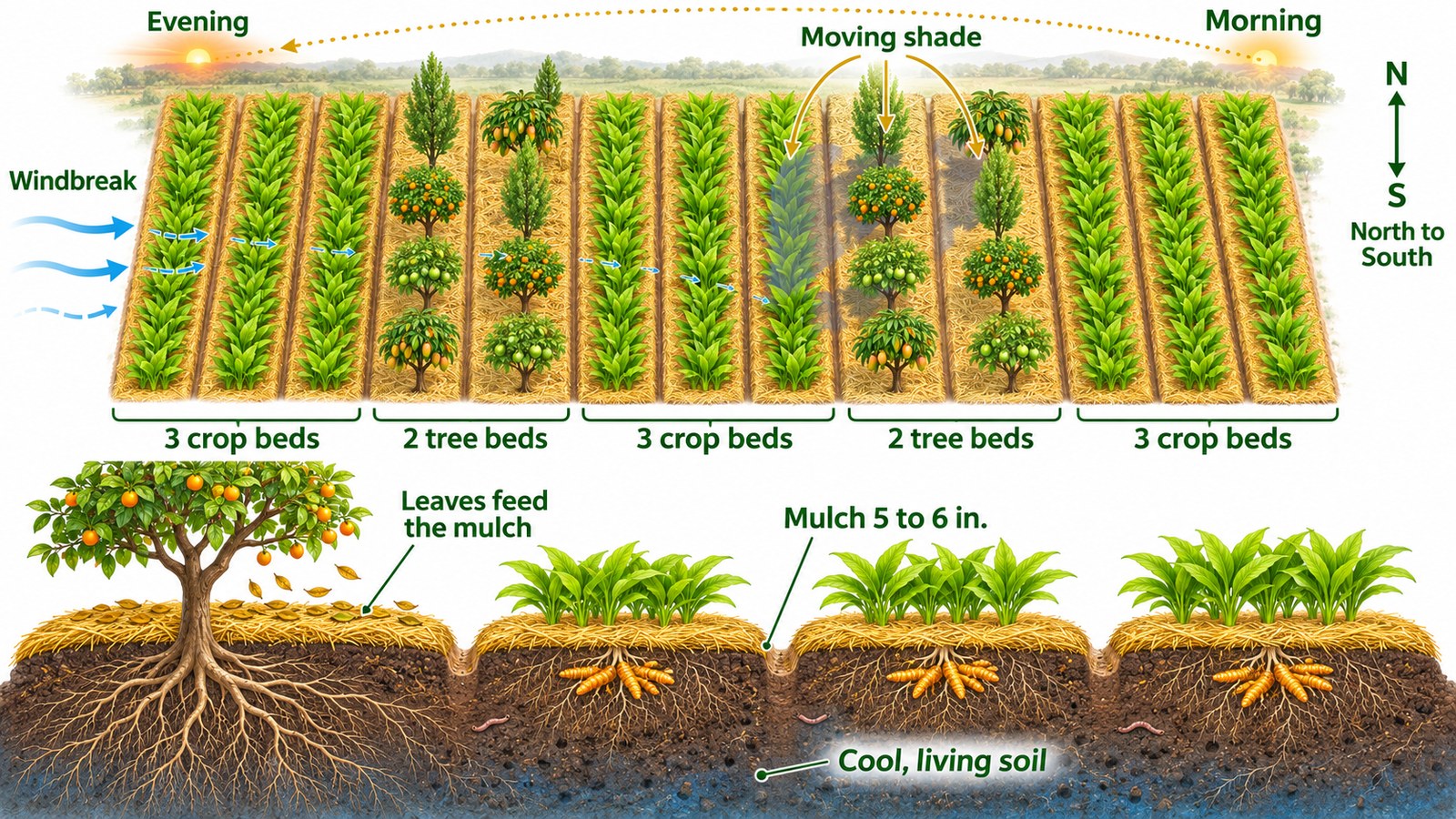
Our design paper Fruit Tree Alleys and Filler Crops on PQNK (KP-017) gives a complete layout of fruit-tree beds alternating with crop beds. Turmeric is one of the crops it grows between the tree rows, along with chillies, ginger, garlic, onion and many others.
5. Run the Rows North to South
The direction of the beds and tree rows matters as much as the choice of trees. The sun moves from east to west through the day. If tree rows run east to west, their shadow falls on the same neighbouring beds hour after hour, and the crop on that side stays in shade for most of the day.
When the rows run north to south, the shadow of each tree line sweeps across the alley as the sun crosses the sky. No crop at the lower level is shaded all day long, and every bed receives its share of direct sunlight. In the hottest weeks the passing shade gives turmeric relief from the scorching sun, without taking away the light the crop needs to grow and fill its rhizomes (KP-104).
6. Choosing the Trees
Turmeric grows well in the filtered, moving shade of trees. The aim is therefore not dense shade, but tree lines that cool the farm, break the wind and earn an income, while light still reaches the crop.
In the tree beds, mix fruit trees and timber trees, so that something earns in every season while the timber grows:
• Fruit trees: the KP-017 layout uses mango, guava, citrus, date palm, fig and grapes. In a hot, dry summer climate like that of Sirsa, citrus (such as kinnow and lemon), guava and mango suit well.
• Timber trees: poplar, Melia dubia (Malabar neem) and shisham grow well in the plains of northern India and Pakistan and have a ready market for their timber.
PQNK gives first place to trees that feed the soil: deep-rooted trees that add leaves and organic matter to the mulch continuously. Their leaf fall becomes part of the cover on the beds.
As the trees grow, prune their lower branches, so the canopy stays high and light reaches the crop beds. When the canopy becomes thick, after four or five years, prune it to keep the shade filtered. The prunings go back onto the beds as mulch.
7. What the Farmer Gains
• A crop that comes through heat waves and long dry spells, because its roots sit in cool, moist, living soil.
• A cooler, more humid farm, sheltered from hot winds.
• Fruit income every season from the tree beds, and timber income after some years.
• More organic matter for the mulch, from leaf fall and prunings, every year.
Conclusion
A turmeric crop damaged by summer heat is a warning that can be answered. The answer does not begin with the tree. It begins with the soil: permanent beds, never tilled, under a thick organic mulch, where the soil stays cool and alive and makes its own micro-environment. On that foundation, the PQNK alley cropping model adds two beds of mixed fruit and timber trees after every three crop beds, laid out north to south, so the moving shade relieves the crop without ever leaving it in shade all day. The trees cool the farm from above, and the living soil keeps the roots cool from below.
PQNK Principle: Protect the soil first, then let the trees protect the farm.
Related PQNK Sources
1. KP-017: Fruit Tree Alleys and Filler Crops on PQNK. https://pedaver.com/papers/fruit-tree-alleys-and-filler-crops-on-pqnk/
2. KP-104: The Farm You Only Have to Build Once: How PQNK Converts a Conventional Field into a Permanent, No-Till System. https://pedaver.com/papers/farm-design-and-conversion-to-pqnk/
3. Chilli on PQNK: crop page. https://pedaver.com/crops/chilli/
4. Ask PQNK: https://pedaver.com/ask, or on WhatsApp at https://wa.me/923437506442
About This Paper
- Crop
- Turmeric · Chilli · Citrus · Guava · Mango
- Problem
- Heat Stress on Crop · Soil Temperature Extremes · Bare / Exposed Soil · Drought / Water Scarcity
- Science
- Climate · Production Architecture · Soil
- Evidence
- Field Observation
- Authority
- Current / Approved PQNK Knowledge
Related PQNK Science
Key Takeaways
- Turmeric stands in the field from March or April to October or November, through the whole hot season.
- Heat damage starts below, in bare, hot, dry soil, before the leaves scorch.
- Permanent beds under 5 to 6 inches (13 to 15 cm) of organic mulch keep the soil cool and alive; the mulch may touch the stems.
- PQNK alley cropping: after every three crop beds, two beds of mixed trees, for income around the year, a cooler and more humid farm, and a windbreak.
- Rows run north to south, so the shade of each tree line sweeps across the alley and no bed stays in shade all day.
- Mix fruit trees (citrus, guava, mango) with timber trees (poplar, Melia dubia, shisham), and favour deep-rooted trees whose leaves feed the mulch.
- Prune lower branches to keep the canopy high, and thin a thick canopy after four or five years; prunings go back onto the beds as mulch.
Related Knowledge
same problem
The Hot Field: How Naked Soil and Hardpan Break the Weather, and How Covered Soil Mends It
The weather is not only getting hotter; it is losing its rhythm. This paper shows how naked, ploughed soil becomes a heat island (above 70°C when the air is 50°C, against about 30°C under mulch), how the hardpan shuts out rain and turns the water cycle short and violent, how pumped groundwater and the plough add water and carbon dioxide to the air, and how covered, unploughed PQNK soil reverses all of them.
same problem
Farming Beyond the Calendar
Explains why changing weather has made the fixed sowing calendar unreliable and why PQNK does not depend on weather forecasts. Permanent raised beds under continuous organic mulch hold soil temperature and the moisture-air balance, so healthy plants withstand heat, cold, drought, intense and excessive rainfall and an erratic monsoon; a 1-2% ethanol foliar spray relieves ambient temperature stress, and the sowing decision is made from the condition of the field.
same problem
The PQNK Water System: Receive, Retain, Use
The PQNK water work in one account: break the hardpan once so the field receives the rain where it falls, retain it under permanent mulch in a living soil that also gathers dew and humidity, and use that water before adding any. Irrigation becomes a small furrow supplement, given only on the soil-ball test and never above a 4-inch (10 cm) head; a kilogram of wheat takes 154 litres of irrigation water under PQNK in transition against 1,175 under flood, and mature beds at 400 mm (16 inches) or more of rain need none.
same problem
How Much Water Does Mulch Catch from the Night Air? Dew on a PQNK Bed Covered with Rice Straw
A worked example on one square metre of rice straw mulch shows how much water a PQNK bed catches from the night air: a typical dew night gives about 0.25 mm, about 1,000 litres on a fully mulched acre. The mulch keeps this water and passes it slowly to the soil, while bare soil loses it within hours of sunrise.