


KP-229 · Water & Climate
The Hot Field: How Naked Soil and Hardpan Break the Weather, and How Covered Soil Mends It
The weather is not only getting hotter; it is losing its rhythm. This paper shows how naked, ploughed soil becomes a heat island (above 70°C when the air is 50°C, against about 30°C under mulch), how the hardpan shuts out rain and turns the water cycle short and violent, how pumped groundwater and the plough add water and carbon dioxide to the air, and how covered, unploughed PQNK soil reverses all of them.
Read or listen to the full paper ↓Abstract
Floods in deserts, fires in wet forests, heatwaves that stay for weeks and sudden cold: the weather has lost its rhythm. The usual explanation looks to the sky and the poles; this paper looks at the ground.
In hot regions such as Punjab, when the air reaches 50°C (122°F), naked soil passes 70°C (158°F), while soil under organic mulch stays close to 30°C (86°F), about 40°C cooler. Ploughed, uncovered farmland is one of the largest man-made heat surfaces on Earth, and it strengthens heatwaves from below.
A plough and tillage hardpan stops rain from soaking in, so water runs off to the flood or is lost from the hot crust, and the land dries and heats again within days. Pumped groundwater adds water to the air that had been locked underground, and ploughing sends soil carbon into the air as carbon dioxide.
The carbon story and the water story belong together: both come from the plough and the naked field, and both are reversed by an unploughed, covered, living soil, which the farmer can start on from the next crop.
Full Paper
If you use “Listen”, the text of the page may be sent to your browser or operating system’s speech provider, such as Apple, Google or Microsoft, depending on the voice your device uses. Pedaver does not process, transmit or store any audio.
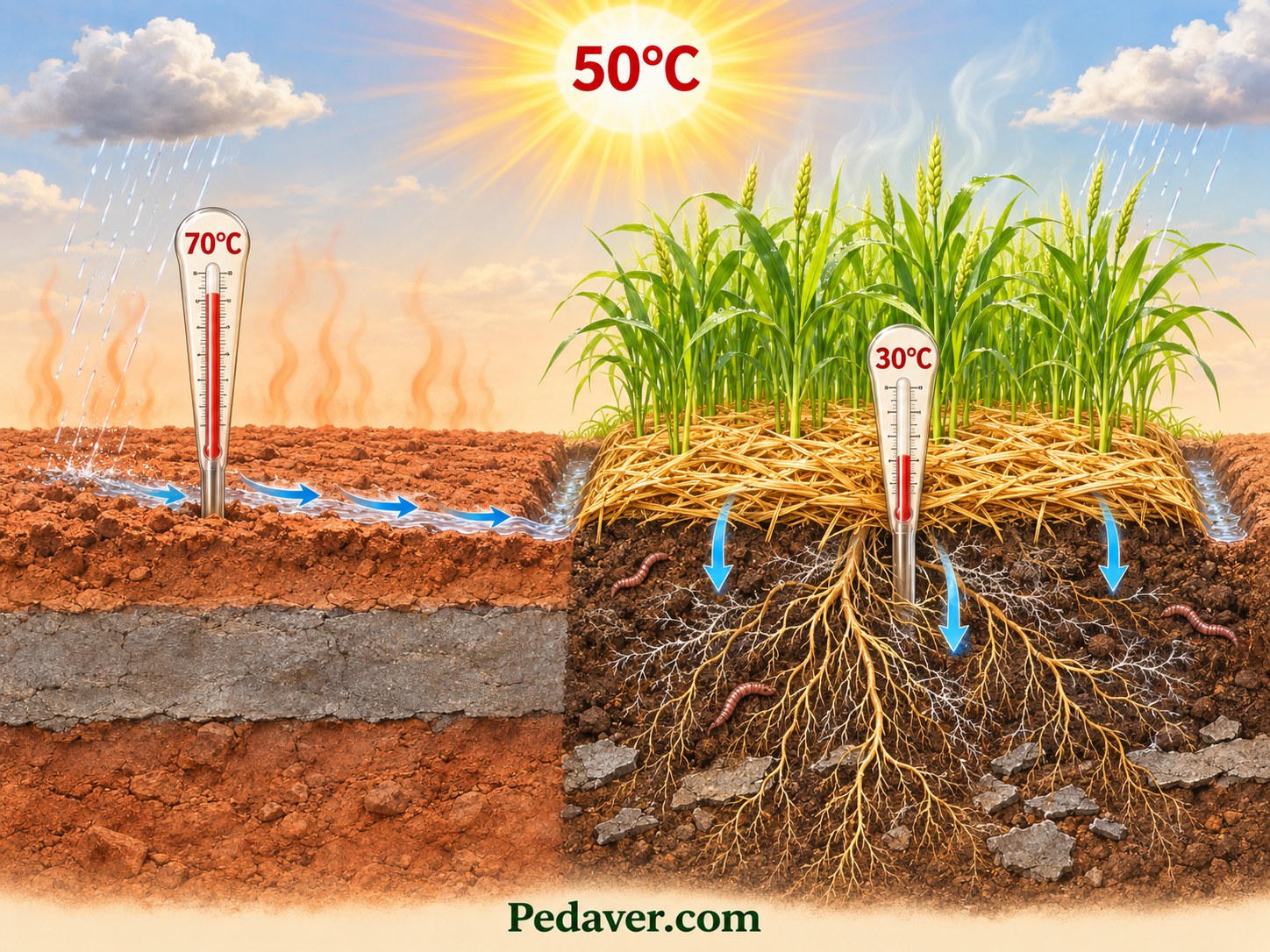
When the air is 50°C, naked soil passes 70°C. Soil under organic mulch stays close to 30°C. That 40-degree difference, repeated across the world’s farmland, is a hand on the weather.
1. Weather That Has Lost Its Rhythm
A short science video now circulating on social media puts the public feeling well. Weather, it says, is not just getting hotter; it is getting stuck. Hot places stay hot for longer, cold arrives suddenly, wet places flood and dry places burn. It explains this through the jet stream, the fast river of air high above the Earth that is driven by the difference between hot and cold air. When that difference changes, the river slows and wobbles, and weather systems get locked in place. Its own words on farming are simple: farmers can no longer predict the rain.
The video looks to the Arctic for the cause. Its central point, though, applies just as much to the land: if the Earth warmed evenly, the weather would not go wild. It is uneven heating, and water carried in the air, that drive the weather. Both are shaped every day by how the world treats its farmland, and that part of the story is almost never told.
2. The Hot Field: Naked Soil as a Heat Island
A city is called a heat island because its roads and roofs soak up the sun and give the heat back to the air. A ploughed, uncovered field does the same, and there is far more farmland than city. In ACI (Ancient Conventional Industrial) agriculture the soil is ploughed, burnt or cleared of residue, and left naked between crops and often between the rows of a growing crop.
PQNK field readings in Punjab show how large the effect is. When the air reaches 50°C (122°F), naked soil passes 70°C (158°F). Under organic mulch, the soil stays close to 30°C (86°F): about 40°C (72°F) cooler, on the same day, in the same sun (PQNK book, Chapters 27 and 38). In milder climates the gap is smaller, but the pattern is the same everywhere: naked soil is the hottest surface in the landscape.
That heat does not stay in the field. It rises into the air above, and each hot field joins the next. A region of ploughed, dry farmland behaves like a giant hot plate under the sky. It warms the air, pushes up the daytime peak, and helps a heatwave settle and stay. Dry, hot ground feeds the heat above it, and the hotter air dries the ground further. This is how a heat dome is strengthened from below.
A covered field behaves in the opposite way. Mulch shades the soil, and a living crop on moist soil cools itself and the air around it by releasing water through its leaves, as a person cools by sweating. The field becomes a cool island instead of a hot one.
3. The Hardpan: Rain That Cannot Get In
Repeated ploughing, heavy machines and flood irrigation press a hard layer into the soil a few inches below the surface: the plough and tillage hardpan (PQNK book, Chapter 25). Above it lies a loose, dead layer that crusts in the sun. Together they turn a sponge into a pavement.
When the rain comes, it cannot get in. Water stands on the field, runs off into streams and rivers, and becomes the flood downstream. What should have been stored in the soil for the dry months leaves the farm within days.
When the rain stops, the land dries fast. The little water held above the hardpan is lost quickly from the hot crust. Within days the field is dry and hot again, and the next heat builds on bare, thirsty ground.
The water cycle becomes short and violent. Instead of rain soaking in and returning to the air slowly, through roots and leaves, over weeks, water rushes off the land or is driven off it in a burst. The rhythm of the small water cycle, the local loop of moisture that returns as dew and nearby rain, is broken (KP-051, KP-052).
Where the hardpan is broken and the soil is alive and covered, the difference is dramatic. On one PQNK orchard, 13 inches (330 mm) of rain fell in eight hours and soaked into the beds, while the conventional land beside them stood under water (KP-213; PQNK book, Chapter 45).
4. Groundwater Pumped into the Sky
Across the dry and hot farming regions of the world, the shortfall of a dead soil is made up with groundwater. Water that lay locked deep underground for centuries is pumped up and spread over fields that cannot hold it. Much of it is lost from naked soil and standing water before any crop can use it. In this way irrigated agriculture lifts vast amounts of underground water into the air every year, while the aquifers below fall.
Water vapour is the largest single contributor to the greenhouse effect, larger than carbon dioxide (Schmidt et al., 2010). Water lifted by the pump and by the hot field adds to the air’s load of vapour and heat. When that wetter, hotter air meets cooler air, it can release its water all at once: the cloudburst, the flash flood, a season’s rain in a day.
5. The Carbon Dioxide Story, Told Whole
Carbon dioxide is part of this story, and PQNK does not shy away from it. What is usually left out is where much of it came from, and where it can go back. Soil is the largest store of carbon on land. Every time soil is ploughed, air rushes in, the organic matter that holds the soil together is burnt off by microbes, and its carbon leaves as carbon dioxide. Since farming began, the world’s cultivated soils have lost about 116 billion tonnes of carbon to the air by one widely cited estimate (Sanderman et al., 2017). The plough is a chimney.
The same soil, left unploughed and covered, works the other way. A growing plant draws carbon dioxide from the air, and between 20 and 40 percent of the carbon it captures, depending on plant type and growth stage, goes below ground into roots and the soil life around them. In a PQNK field the roots stay in the soil after harvest and the mulch stays on top, so that carbon is not burnt off again. Across the world’s 3.7 billion acres (1.5 billion hectares) of arable land, PQNK at the standing-forest rate would take up about 5.8 billion tonnes of carbon dioxide a year, before counting the emissions it stops (PQNK book, Chapter 46).
So the carbon story and the water story are not rivals. A wetter, hotter atmosphere traps more heat over land and sea alike, and carbon dioxide adds to it. Both come from the same practice, the plough and the naked field, and both are reversed by the same practice: an unploughed, covered, living soil. The water story is simply the part that was left untold, and the part a farmer can change from the next crop.
6. Two Fields Under the Same Sun
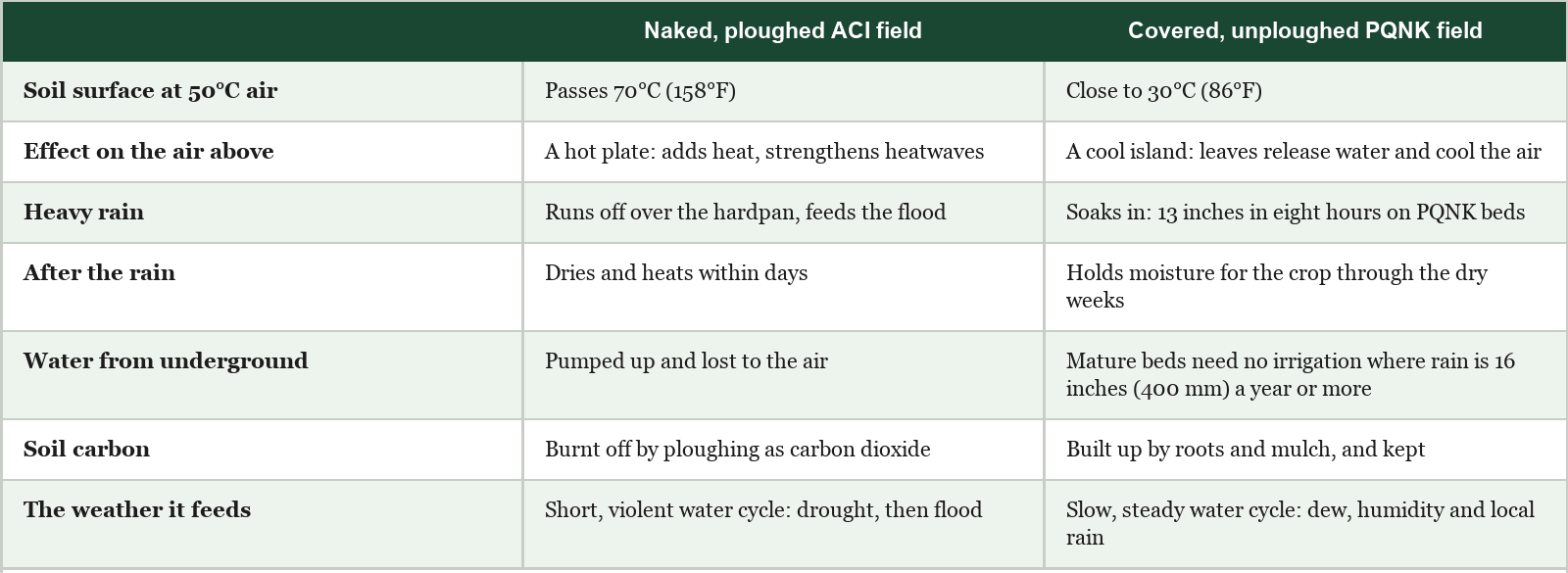
| Naked, ploughed ACI field | Covered, unploughed PQNK field | |
|---|---|---|
| Soil surface at 50°C air | Passes 70°C (158°F) | Close to 30°C (86°F) |
| Effect on the air above | A hot plate: adds heat, strengthens heatwaves | A cool island: leaves release water and cool the air |
| Heavy rain | Runs off over the hardpan, feeds the flood | Soaks in: 13 inches in eight hours on PQNK beds |
| After the rain | Dries and heats within days | Holds moisture for the crop through the dry weeks |
| Water from underground | Pumped up and lost to the air | Mature beds need no irrigation where rain is 16 inches (400 mm) a year or more |
| Soil carbon | Burnt off by ploughing as carbon dioxide | Built up by roots and mulch, and kept |
| The weather it feeds | Short, violent water cycle: drought, then flood | Slow, steady water cycle: dew, humidity and local rain |
7. What the Farmer Can Do
No farmer can steer the jet stream. Every farmer can decide whether his own field is a hot plate or a cool island. A PQNK conversion follows eight steps, done once and in order (PQNK book, Chapter 23):
1. Design the farm.
2. Probe for the hardpan and break it once with a subsoiler, to about 22 inches.
3. Wash the soil where the pH is above 8.
4. Form permanent raised beds.
5. Grow a Jantar cover crop, leaving its roots in the soil and using its biomass as the first mulch.
6. Plant through the mulch.
7. Water only when the ball test shows the soil is dry.
8. Harvest without disturbing the soil.
From then on, never plough again and never leave the soil bare. Each season the soil takes in more rain, stays cooler, holds more carbon and gives back its moisture slowly, as nature intended. Questions can be sent at any time to Ask PQNK, on WhatsApp or at pedaver.com/ask.
Conclusion
The weather has lost its rhythm, and the land beneath it is part of the reason. Ploughed, naked soil turns the world’s farmland into a heat surface that passes 70°C in hot regions; a hardpan shuts the rain out and turns a slow water cycle into a violent one; pumped groundwater is lifted into the sky; and the plough sends the soil’s carbon into the air. These are not separate problems. They are one practice, and they have one answer. Covered, unploughed, living soil stays 40°C cooler, takes in 13 inches of rain in eight hours, needs no irrigation once mature where rain is 16 inches a year or more, and draws carbon back into the ground. The farmer cannot change the ocean or the poles. He can change his field, starting with the next crop, and every field that changes gives the weather back a little of its rhythm.
PQNK Principle: Heal the soil and you cool the sky. A covered field gives the rain a home and the weather its rhythm.
Sources and Related PQNK Papers
1. PQNK Book, Chapter 5: The Natural Water System; Chapter 23: The Eight-Step Transition Protocol; Chapter 25: Hardpan; Chapter 26: Soil Moisture Management; Chapter 27: Organic Mulch; Chapter 38: Potato, Circular Production; Chapter 45: Water, Floods, and Aquifer Replenishment; Chapter 46: Climate, Carbon, and Atmospheric Water. https://pedaver.com/books/natural-ecosystem-science/
2. KP-051: Restoring Earth’s Hydrological Cycle to Mitigate Erratic Weather. https://pedaver.com/papers/restoring-earths-hydrological-cycle-to-mitigate-erratic-weather/
3. KP-052: Creating On-Farm Micro Water Cycles. https://pedaver.com/papers/creating-on-farm-micro-water-cycles/
4. KP-170: When a Natural Climate Cycle Meets a Broken Planet. https://pedaver.com/papers/when-a-natural-climate-cycle-meets-a-broken-planet/
5. KP-172: The Greatest Climate Solution Is Not More Trees: It Is Changing How We Farm. https://pedaver.com/papers/the-greatest-climate-solution/
6. KP-213: When 13 Inches of Rain Falls in Eight Hours. https://pedaver.com/papers/when-13-inches-of-rain-falls-in-eight-hours/
7. Schmidt, G. A., Ruedy, R. A., Miller, R. L. and Lacis, A. A. (2010). Attribution of the present-day total greenhouse effect. J. Geophys. Res. 115, D20106.
8. Sanderman, J., Hengl, T. and Fiske, G. J. (2017). Soil carbon debt of 12,000 years of human land use. Proceedings of the National Academy of Sciences 114 (36), 9575-9580.
9. Ask PQNK: https://pedaver.com/ask, or on WhatsApp at https://wa.me/923437506442
About This Paper
- Problem
- Erratic / Unpredictable Weather Patterns · Bare / Exposed Soil · Soil Temperature Extremes · Hardpan · Poor Water Infiltration · Runoff · Flooding · Drought / Water Scarcity · Groundwater / Aquifer Depletion · Soil Organic Matter / Carbon Loss · Tillage Damage to Soil Biology / Structure · Heat Stress on Crop · Evaporation / Moisture Loss
- Science
- Climate · Water · Soil
- Evidence
- Scientific Mechanism
- Authority
- Current / Approved PQNK Knowledge
Related PQNK Science
Key Takeaways
- Weather is not only getting hotter but getting stuck; uneven heating and water carried in the air drive it, and both are shaped by how farmland is treated.
- When the air is 50°C, naked soil passes 70°C while soil under organic mulch stays close to 30°C, about 40°C cooler (PQNK field readings, Punjab).
- A region of ploughed, dry farmland acts like a hot plate that strengthens heat domes; a covered field with a living crop is a cool island.
- The hardpan shuts out rain: water runs off to the flood, the land dries and heats within days, and the small water cycle is broken.
- On one PQNK orchard 13 inches (330 mm) of rain soaked in within eight hours while the conventional land beside it stood under water.
- Water vapour is the largest contributor to the greenhouse effect; pumped groundwater and hot fields add to the air’s load of vapour and heat.
- Ploughing has sent about 116 billion tonnes of soil carbon into the air; PQNK sends 20 to 40 percent of the plant’s carbon below ground and keeps it there.
- The eight PQNK conversion steps, then never ploughing and never leaving the soil bare, turn a hot field into a cool one.
Related Knowledge
same problem
Farming Beyond the Calendar
Explains why changing weather has made the fixed sowing calendar unreliable and why PQNK does not depend on weather forecasts. Permanent raised beds under continuous organic mulch hold soil temperature and the moisture-air balance, so healthy plants withstand heat, cold, drought, intense and excessive rainfall and an erratic monsoon; a 1-2% ethanol foliar spray relieves ambient temperature stress, and the sowing decision is made from the condition of the field.
same problem
Rain Where It Falls: Restoring the Soil Before Building More Water Storage
Rajendra Singh’s Rajasthan story shows that slowing runoff lets water enter the ground and restore wells and rivers. PQNK moves that principle upstream into the field itself: correct the hardpan, stop disturbing the soil, keep the surface covered, and let every acre receive and hold the rain where it falls, so that agricultural water demand stays within what the landscape renews.
same problem
Grain First: PQNK and the Coming Food Crisis
A practising PQNK farmer asked whether staple grains will matter more in the years ahead, and whether farmers should favour wheat, maize and rice or vegetables and fruit. Erratic weather, degraded soil and scarce water are squeezing the world’s food supply, and ACI agriculture depends on exactly what is failing. PQNK soil takes in heavy rain, holds moisture through heat and drought and grows without purchased inputs. The strategy for the next ten years: convert the land to PQNK, grow grain first, and keep a reserve of grain in your own store.
same problem
The Hidden Crisis: How Industrial Agriculture Has Broken Earth's Water Cycle
A quantified case that industrial agriculture has driven global groundwater tables from 20-30 feet to over 300 feet deep, creating a roughly $200 billion annual crisis addressable through a costed $15 billion, 24-month PQNK rollout plan.