

KP-218 · Plant Physiology & Production Systems
Why PQNK Sugarcane Tillers From the Inside
On a PQNK sugarcane plot where the mother shoot is cut early, new tillers rise from inside the stool; on a conventional plot where it is left, tillers spread from the outside. The reason is apical dominance: auxin from the mother shoot’s tip, reinforced by strigolactones, holds the central buds dormant, and cutting it lets cytokinins and sugars from roots in living soil release them together, giving a uniform stool of tillers of one age.
Read or listen to the full paper ↓Abstract
A PQNK grower, Vasudha Sardar, keeps two sugarcane plots side by side. On the PQNK plot, where the mother shoot of each stool is cut early, new tillers come up from inside the stool. On the conventional plot, where the mother shoot is left, new tillers appear on the outside, and the soil of the two plots is strikingly different.
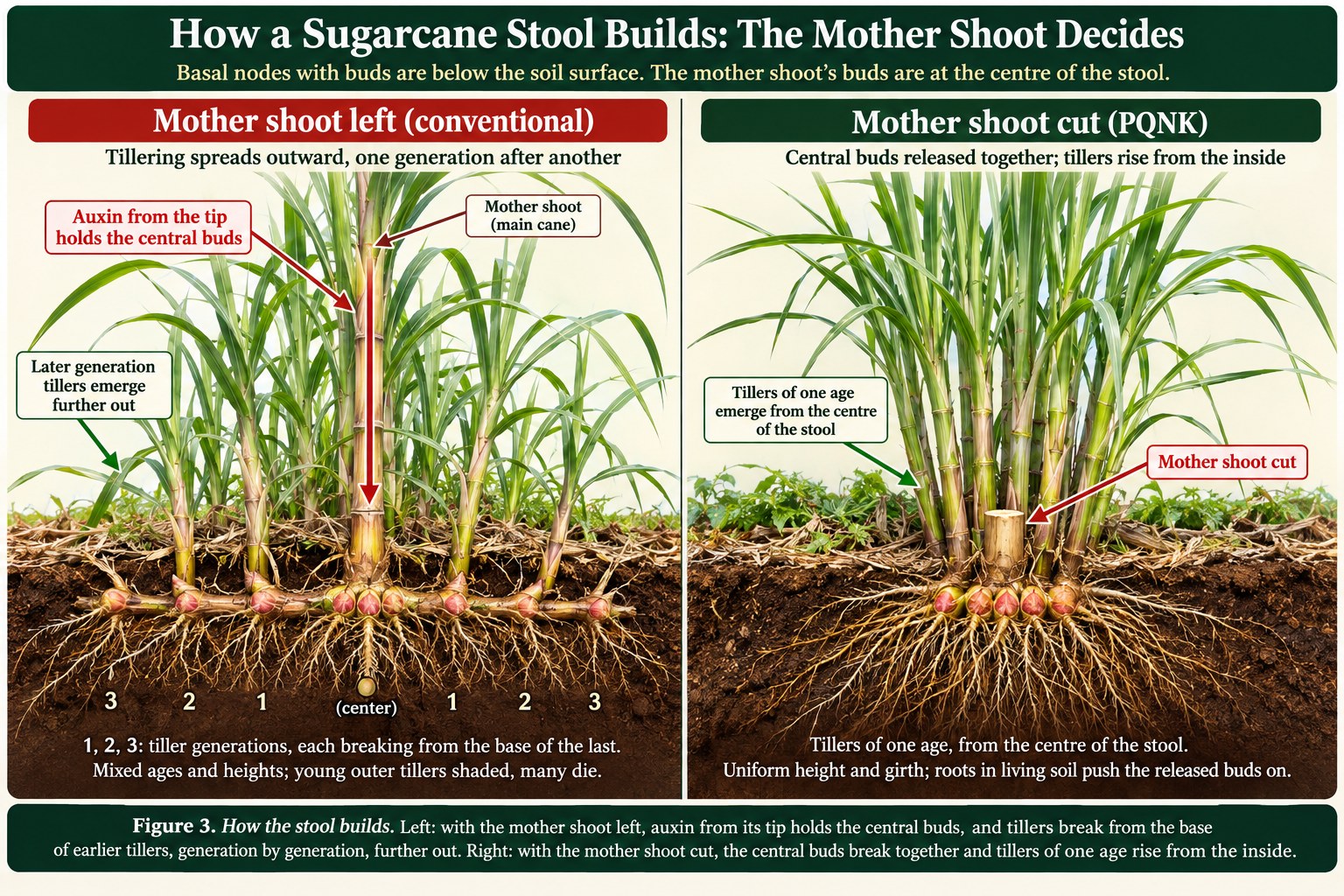
Tillers grow from buds on the short underground nodes at the base of a shoot, and the mother shoot’s own buds sit at the centre of the stool. While the mother shoot grows, auxin flowing down from its tip, reinforced by strigolactones, holds those central buds dormant, so tillering spreads outward one generation at a time, with tillers of mixed ages, many of which never become millable canes.
Cutting the mother shoot within a few weeks of emergence, once several secondary tillers have leaf area, removes that hold: the central buds break together, pushed by cytokinins and sugars from a root system that, in cool, moist, living soil, is vigorous. The result is a compact stool of tillers of one age, uniform in height and girth, standing over the root zone on the centre of the 42-inch bed, with no earthing up.
Full Paper
If you use “Listen”, the text of the page may be sent to your browser or operating system’s speech provider, such as Apple, Google or Microsoft, depending on the voice your device uses. Pedaver does not process, transmit or store any audio.
Cut the mother shoot and the stool fills from the centre, with tillers of one age rising together over the root zone. Leave it, and tillering creeps outward, one uneven generation after another.
1. The Field Observation
Vasudha Sardar grows sugarcane on two plots: one under PQNK, on permanent beds with organic mulch, where the mother shoot of every stool is cut early, and one under conventional management, where the mother shoot is left to grow. Walking both plots, she noticed that the new tillers on the PQNK canes were coming from inside the stool, while on the conventional canes, and on any stool whose mother shoot had not been cut, the new tillers were coming from the outside. She also saw a great difference in the soil. Her question was simple: what is the significance of this?
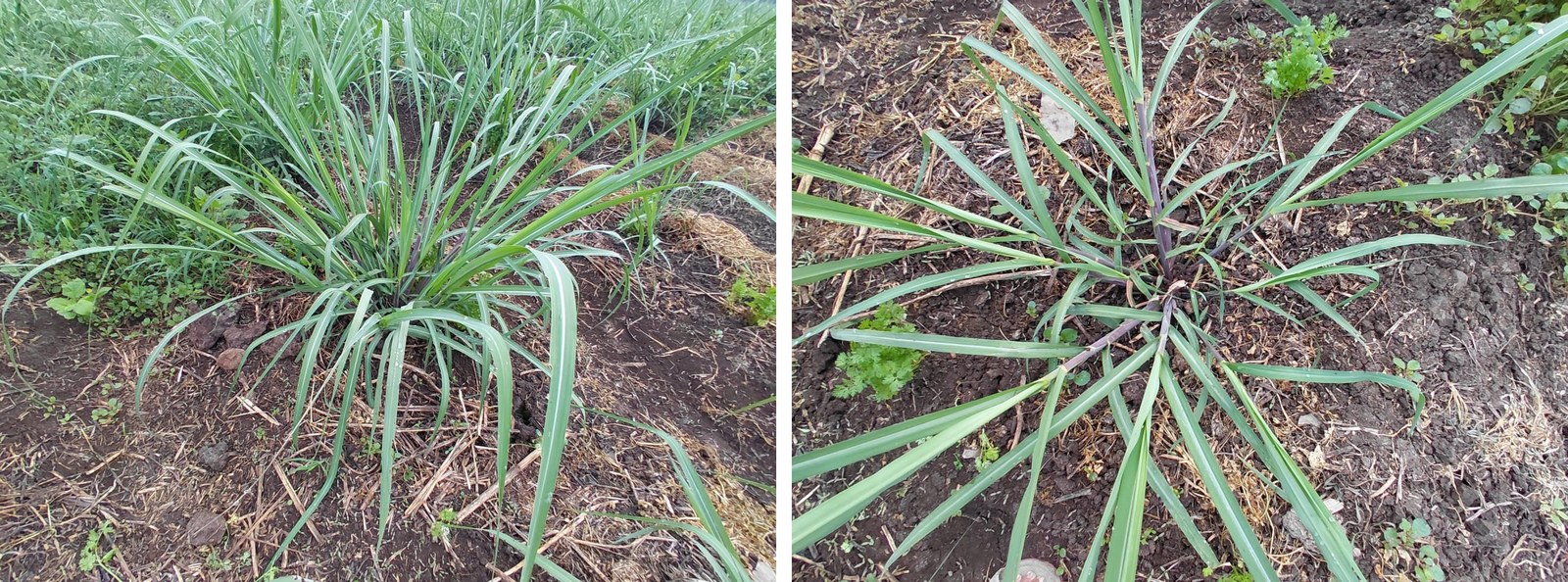
Figure 1. PQNK sugarcane, mother shoot cut: new tillers rise from the centre of the stool in a compact clump, on dark, moist, mulched soil with living green cover. Photos: Vasudha Sardar.
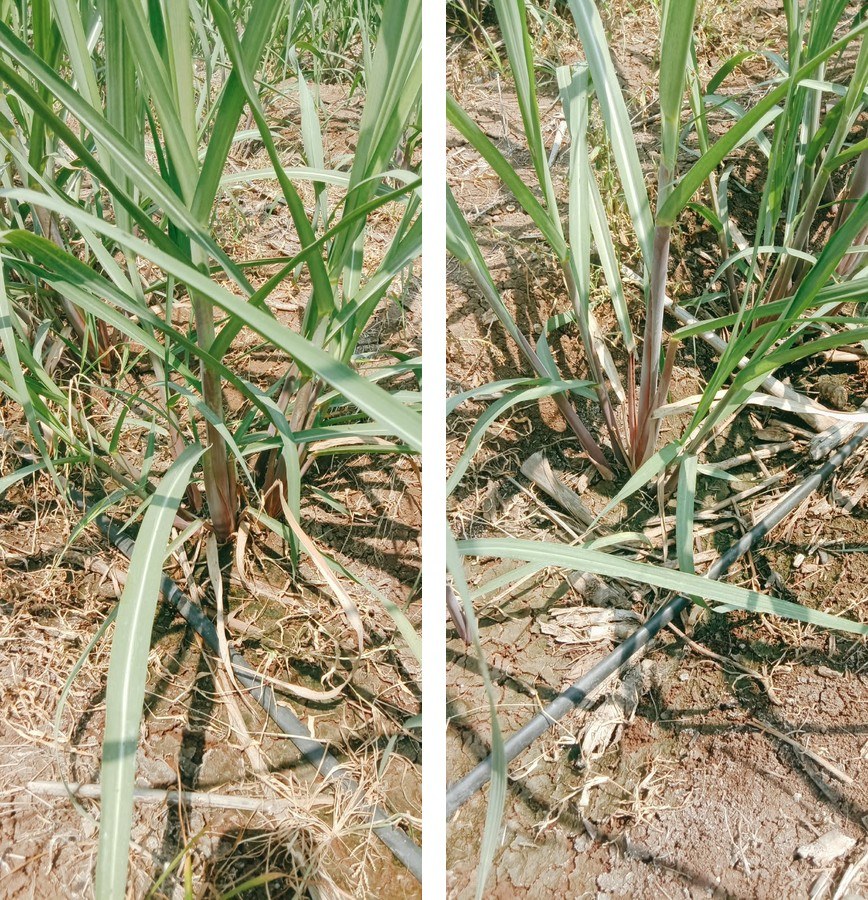
Figure 2. Conventional sugarcane, mother shoot not cut: the mother shoot stands at the centre and tillers spread from the outside, on pale, dry, crusted soil with the drip line on the surface. Photos: Vasudha Sardar.
2. How a Sugarcane Stool Is Built
3. Apical Dominance: Why Buds Wait
The growing tip of a shoot produces auxin, a plant hormone that moves down the stem. While it flows, the buds below the tip are held dormant. This is apical dominance. Auxin does not act alone. It raises the production of strigolactones, hormones that keep buds closed, and it lowers the supply of cytokinins, the hormones that the roots send up to make buds grow. The growing tip also draws the plant’s sugars to itself, so the buds below are short of the energy they need to start. Whether a bud breaks depends on this balance: auxin and strigolactones hold it back; cytokinins and sugar push it forward.
4. When the Mother Shoot Is Left: Tillering From the Outside
As long as the mother shoot keeps growing, its tip holds the buds closest to it, the basal buds at the centre of the stool, under the strongest control. Tillers break slowly, and each new tiller sets up its own small zone of dominance, so the next tiller breaks from the base of the previous one, further out. The stool spreads outward, one generation after another, and ends up with tillers of different ages and heights: the oldest at the centre, the youngest at the edge, shaded by the taller ones within. Many of these late outer tillers don’t become millable cane or even die before they become canes. Conventional practice responds by piling soil around the stool, earthing up, to suppress them. The result is an uneven stand: one dominant cane with weaker followers.
5. When the Mother Shoot Is Cut: Tillering From the Inside
Cutting the mother shoot removes the source of the auxin signal at the centre of the stool. With the hold released, the buds at the base of the mother shoot, right at the centre, break together, pushed by the cytokinins coming up from the roots and by the sugars that the cut shoot no longer takes. The new tillers rise from inside the stool, all of nearly the same age, in a compact clump, exactly as Vasudha’s PQNK photos show. Because they start together, they grow to the same height and girth and mature together, as Chapter Thirty-Seven and KP-211 describe: instead of one dominant cane with weaker, uneven followers, the released tillers develop as a uniform population of millable canes. Because they stand over the centre of the permanent 42-inch bed, above the root zone, the stool is firmly anchored and needs no earthing up.
Timing matters. The leader is not allowed to grow to maturity: within a few weeks of emergence, once several secondary tillers have developed enough leaf area for photosynthesis, it is removed (KP-211). By then the plant has the leaf area to feed the buds that are about to be released.
6. The Soil Behind the Stool
The second thing Vasudha saw explains the first. The PQNK soil is dark, moist and crumbly, covered with mulch and living green cover. It is biologically active, it stays cool, about 30 to 33°C under mulch in summer heat against 70°C or more on bare soil (Chapter Thirty-Eight), and it holds water, including the dew that settles on the mulch overnight. The conventional soil is pale, dry and crusted, bare to the sun, with the drip line lying on its surface: it is losing organic matter, and it heats and dries even under drip irrigation.
Bud release depends on the roots. A vigorous root system in cool, moist, living soil supplies the cytokinins, water and minerals that push the released buds on quickly and strongly, and it keeps feeding every tiller that follows. A root system in hot, dry, degraded soil cannot. The shape of the stool and the colour of the soil are two views of the same thing: when the soil is alive, the plant responds to good management as it is designed to.
7. What This Means for the Farmer
The PQNK sugarcane sequence stays as set out in KP-211 and Chapter Thirty-Seven: one-time hardpan correction, centre planting on the permanent 42-inch bed, unrestricted rooting, no earthing up, early removal of the leader to manage apical dominance, uniform tiller development, and selective or circular harvesting where practicable. This paper adds the reason behind the step the farmer sees: when the mother shoot is cut at the right time, new tillers rise from the inside of the stool, and that is the sign that apical dominance has been broken and the stool is building as it should. Keep the bed mulched, give water only when the soil-ball test shows a need and never above a 4-inch head, and let the living soil carry the tillers on.
Conclusion
Vasudha’s two plots show apical dominance at work in the field. Where the mother shoot is left, its tip holds the central buds, and the stool spreads unevenly from the outside. Where it is cut, the central buds are released together, and a uniform stool rises from the inside, driven by roots in living soil. The difference in the soil is not a side issue: it is what makes the difference in the plant.
PQNK Principle: Break the leader’s hold early and keep the soil alive. The stool will fill from the centre, with canes of one age.
Scientific Background
1. Domagalska, M. A. and Leyser, O. (2011). Signal integration in the control of shoot branching. Nature Reviews Molecular Cell Biology 12, 211–221.
2. Mason, M. G., Ross, J. J., Babst, B. A., Wienclaw, B. N. and Beveridge, C. A. (2014). Sugar demand, not auxin, is the initial regulator of apical dominance. Proceedings of the National Academy of Sciences 111, 6092–6097.
3. Barbier, F. F., Dun, E. A., Kerr, S. C., Chabikwa, T. G. and Beveridge, C. A. (2019). An update on the signals controlling shoot branching. Trends in Plant Science 24, 220–236.
Related PQNK Sources
1. PQNK Knowledge Paper KP-211: Why PQNK Sugarcane Does Not Need Earthing Up. https://pedaver.com/papers/why-pqnk-sugarcane-does-not-need-earthing-up/
2. PQNK Book, Chapter 37: Sugarcane. https://pedaver.com/books/natural-ecosystem-science/sugarcane/
3. PQNK Book, Chapter 38: Potato (mulch and soil temperature). https://pedaver.com/books/natural-ecosystem-science/potato/
About This Paper
- Crop
- Sugarcane
- Problem
- Poor Tillering · Inconsistent / Uneven Crop Uniformity · Hormonal Growth Imbalance (Vegetative/Reproductive) · Bare / Exposed Soil · Soil Temperature Extremes
- Science
- Plants · Soil
- Evidence
- Scientific Mechanism
- Authority
- Current / Approved PQNK Knowledge
Related PQNK Science
Key Takeaways
- Sugarcane tillers grow from buds on the short underground nodes at the base of a shoot; the mother shoot’s buds sit at the centre of the stool.
- Apical dominance: auxin from the growing tip, reinforced by strigolactones, holds buds dormant; cytokinins from the roots and sugar push them to grow.
- Mother shoot left: tillering creeps outward, generation by generation, giving mixed ages and many tillers that never become millable canes.
- Mother shoot cut early (KP-211): the central buds break together, giving a compact, uniform stool of tillers of one age that needs no earthing up.
- Roots in cool, moist, living soil drive bud release; the shape of the stool and the colour of the soil are two views of the same thing.
Related Crops
Related Knowledge
same problem
Understanding Mulch: Types, Functions, and Selection
A practical selection guide to PQNK's three mulch types, live, dead/organic, and plastic, setting out the priority order for choosing between them, the seed-specific adjustments (broadleaf vs narrowleaf, small vs large seed) that determine mulch texture and depth, and the narrow, deliberately transitional case for plastic mulch.
same problem
Farming Beyond the Calendar
Explains why changing weather has made the fixed sowing calendar unreliable and why PQNK does not depend on weather forecasts. Permanent raised beds under continuous organic mulch hold soil temperature and the moisture-air balance, so healthy plants withstand heat, cold, drought, intense and excessive rainfall and an erratic monsoon; a 1-2% ethanol foliar spray relieves ambient temperature stress, and the sowing decision is made from the condition of the field.
same problem
Harvesting Without Irrigation
Crop water requirement is not the same as irrigation requirement. Three field clips show organic residue capturing humidity and dew and keeping the soil beneath it moist and soft, on a roller-compacted road and in the Cholistan Desert, while exposed soil beside it dries and hardens. Receive the rain, store it in the profile, protect it with cover and let roots reach it: on mature PQNK beds at 400 mm or more of annual rainfall, no irrigation is needed.
same problem
PQNK Knowledge Paper: The Twofold Art of Pruning as Compensatory Grazing
With grazing animals absent, plants read the lack of browsing pressure as a sign their foliage isn't wanted and pour energy into ever more vegetative growth instead of fruit. This paper sets out a two-phase pruning protocol, formative and reproductive, standing in for that missing herd, with a detailed crop-by-crop benchmark table and a full sugarcane case study covering two distinct harvest strategies.