

KP-219 · Plant Physiology & Production Systems
Plants Respond to Disturbance
In nature plants are browsed, trampled, clipped and broken, and they answer by branching, flowering and setting more seed. PQNK uses the same response on purpose: rolling potato and peanut with a light drum, cutting the sugarcane mother shoot, pruning the leader tiller of wheat and rice, topping rapeseed and other branching crops, and 3D pruning of cucurbit vines. Checking the dominant growing point breaks apical dominance, and in a living soil the plant turns its energy into more branches, tillers, flowers and yield.
Read or listen to the full paper ↓Abstract
PQNK fields show that a crop can yield more after a well-timed physical check to its growth: potato and peanut after careful rolling, sugarcane after the mother shoot is cut, wheat, rice, rapeseed and other crops after the leader is pruned, and cucurbit vines under 3D pruning. In natural ecosystems, browsing, trampling, clipping and breakage are regulatory steps that plants have answered for hundreds of millions of years, and a plant has never produced for humans alone.
The mechanism is apical dominance: the dominant growing point holds the buds below it dormant through auxin, and when it is checked, cytokinins from the roots and the plant’s sugars release those buds into new branches, tillers, flowers and storage organs. In a living PQNK soil the roots are vigorous, so the response is strong.
In practice: potato is rolled with an empty 220-litre metal drum of about 20 kg in the third week after germination, and peanut when the plants start pegging into the soil; the sugarcane mother shoot is removed within a few weeks of emergence; the wheat leader tiller is pruned at 1.5 inches (4 cm) and rice is clipped at 6 to 8 inches (15 to 20 cm); rapeseed is topped at about 12 inches (30 cm); cucurbit runners are tipped when their fruit reaches marble size. Never remove more than 30 percent of the living foliage at one time.
Full Paper
If you use “Listen”, the text of the page may be sent to your browser or operating system’s speech provider, such as Apple, Google or Microsoft, depending on the voice your device uses. Pedaver does not process, transmit or store any audio.
In nature, plants are browsed, trampled, clipped and broken, and they answer by branching, flowering and setting more seed. PQNK uses the same response on purpose: check the dominant growing point at the right stage, and the plant redirects its energy into more productive shoots.
1. The Question Raised by the Field
PQNK farmers have observed it again and again. Potato and peanut crops that are trampled at the right stage give a better yield. Sugarcane stools whose mother shoot is cut early fill with uniform tillers. Wheat, rapeseed and other crops whose leader is pruned branch and tiller more strongly. Cucurbit vines managed by 3D pruning branch, flower and set more fruit. The question is why a plant that is checked, cut or pressed down should respond by producing more.
2. In Nature, Disturbance Is a Regulator, Not an Injury
Plants did not evolve in protected fields. In natural ecosystems they are browsed by animals, stamped and trampled, clipped and broken, and fed upon by insects. These are not stresses but regulatory steps (KP-062). A plant deliberately grows more biomass than it needs: its surplus feeds insects, predators and the soil through leaf drop and root turnover, and a substantial share of the carbon it fixes, 20 to 40 percent depending on the plant type and its growth stage, is allocated below ground to roots, soil life and organic matter (KP-195). The plant does not produce for humans alone. When part of it is removed or pressed down, it does not simply lose that part: it reorganises its growth, and very often toward more branches, flowers and seed.
3. Why a Check Changes Growth: Apical Dominance
A plant is a central-leader system, like a tree: the main shoot is the trunk and every branch or tiller is a limb (KP-073). The highest growing point produces auxin, a hormone that flows down the stem and holds the buds below it dormant; this is apical dominance. Auxin raises strigolactones, which keep buds closed, and lowers the cytokinins that the roots send up to make buds grow, while the growing tip draws the plant’s sugars to itself (KP-218). When the leader is pinched, cut or bent down, that hold is released. Cytokinins from the roots and the plant’s sugars reach the waiting buds, and lateral shoots, tillers and reproductive nodes break; below ground, root branching increases as well (KP-025).
A check does not create energy. It redistributes it, from vertical escape growth into a broader, more productive structure. That is why the response depends on the soil. In a living PQNK soil, with a broken hardpan, permanent cover and an active root zone, the roots are vigorous and supply the cytokinins, water and minerals that carry the released buds through to harvest.
4. Potato and Peanut: Careful Trampling
In potato and peanut, PQNK fields have shown a better yield after the crop is carefully trampled. Pressing the stems down checks their upright growth in the same way as removing a leader: each bent stem loses its dominant tip position, the plant stops racing upward, and its energy turns to the organs that make the harvest. In potato that is the underground stems that form tubers. In peanut it is the branches that carry the flowers close to the soil, where the pegs enter the ground and the pods form.
When the potato plants reach the third week after germination, an empty 220-litre metal drum weighing about 20 kg is rolled over the crop; this helps tuber formation and bulking (Figure 1).
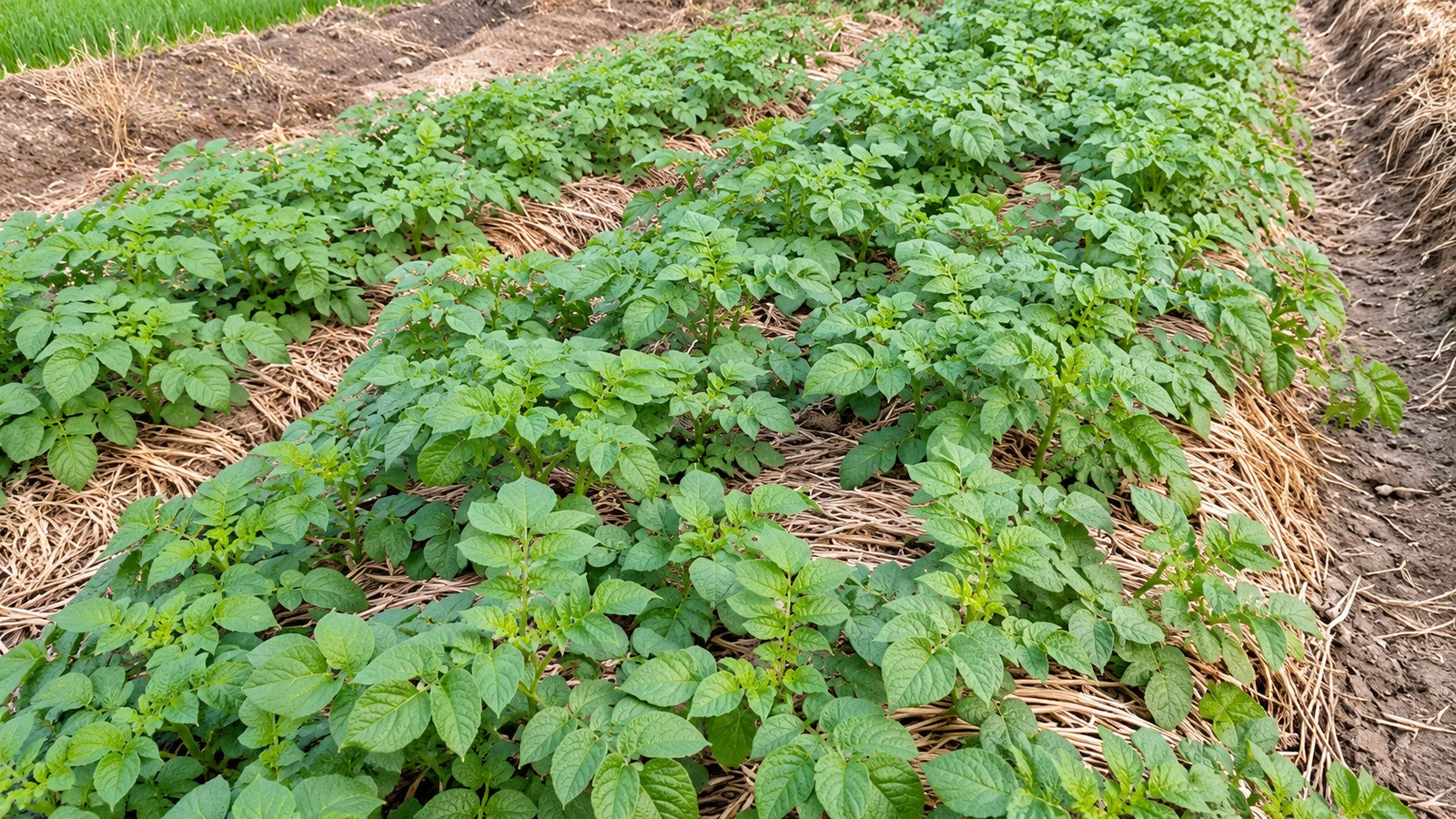
Figure 1. PQNK potato on mulch-covered permanent beds, at the stage when the crop is rolled: about the third week after germination.
Peanut is rolled in the same way when the plants start pegging into the soil (Figure 2). The drum is light and is pulled by hand along the bed, pressing the stems down without compacting the mulched soil beneath, so the PQNK rule holds: no tractor or heavy load ever crosses the permanent bed.
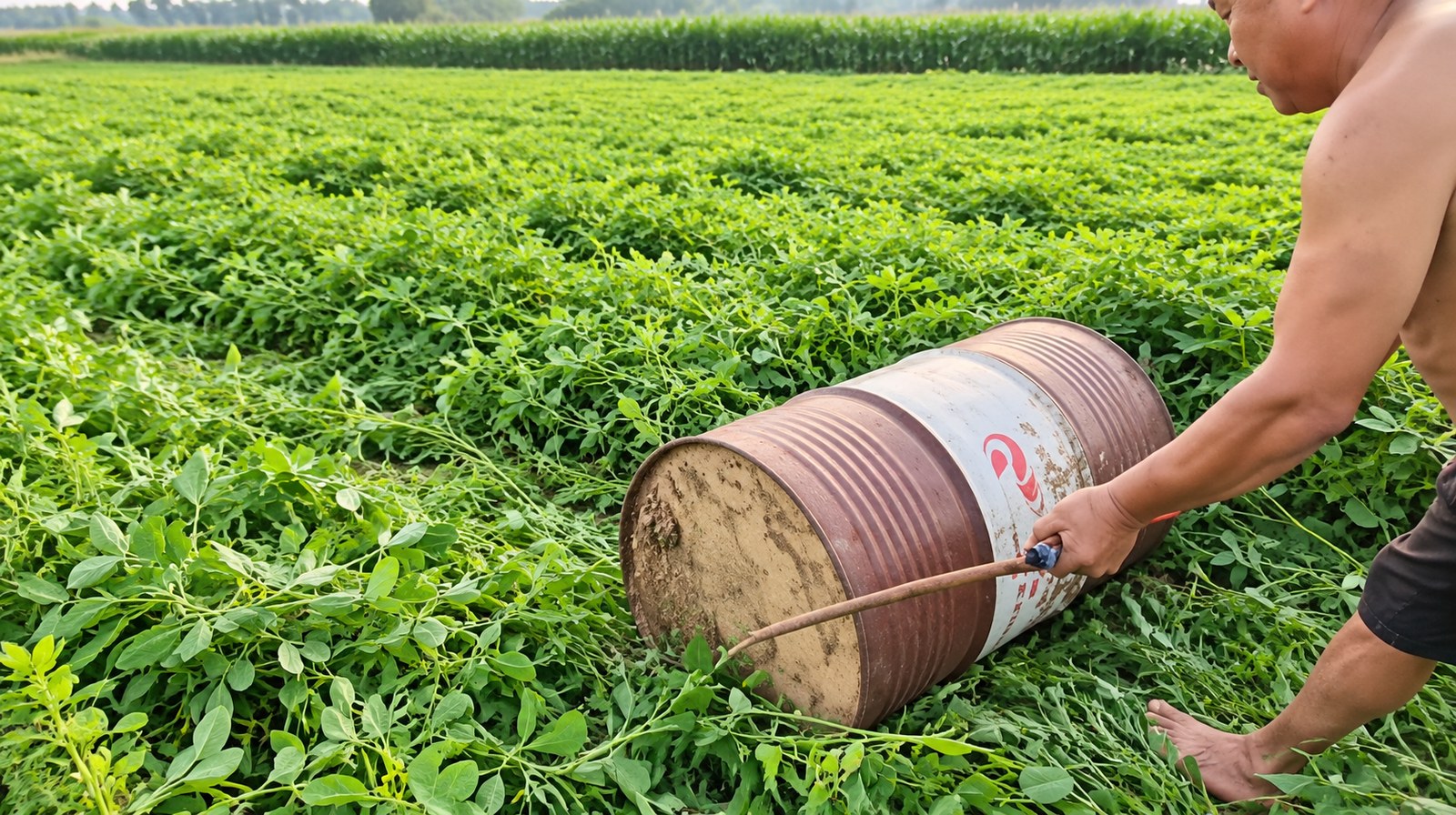
Figure 2. A PQNK peanut crop being rolled with an empty 220-litre metal drum weighing about 20 kg: this is how PQNK trampling is done.
5. Sugarcane: Cutting the Mother Shoot
In sugarcane the mother shoot is removed early to break apical dominance: within a few weeks of emergence, once several secondary tillers have developed enough leaf area for photosynthesis (KP-211, Chapter Thirty-Seven). The buds at the base of the mother shoot, at the centre of the stool, are released together, and new tillers rise from the inside, all of one age, growing to the same height and girth and maturing together on the centre of the permanent bed, with no earthing up (KP-218).
6. Wheat and Rice: Pruning the Leader Tiller
Pruning the leader tiller releases the buds at the crown. On a PQNK bed the plant answers with more tillers, each with the root zone and space to fill a spike (Chapter Thirty-Four). In wheat the leader is pruned at 1.5 inches (4 cm) at the prescribed growth stages, so that the plant becomes a well-structured system of strong, uniform, productive tillers rather than a chaotic bush (KP-073).
Rice is managed in the same way as the other cereal grasses. When the plants are 6 to 8 inches (15 to 20 cm) tall, the top 10 to 15 percent of the foliage is clipped; this breaks apical dominance and stimulates tillering into a dense, productive stand (KP-072).
7. Rapeseed and Other Branching Crops: Topping the Leader
In rapeseed, the leader shoot is chopped off when the plants reach about 12 inches (30 cm) in height. Removing the leader breaks its apical dominance: the plant stays shorter and sturdier and puts out additional side branches, each carrying its own flowers and pods (KP-215). The same principle applies to crops such as chilli, where the leader is pinched at 10 to 12 inches (25 to 30 cm) to activate lateral shoots and reproductive nodes (KP-025).
The same principle applies to other branching crops. Peppers and eggplants are pinched when the plants are 6 to 8 inches (15 to 20 cm) tall to encourage bushiness, and vining crops such as tomato and cucumber are pinched at the main growing tip when they have four to five sets of true leaves (KP-072).
8. Cucurbits: 3D Pruning of the Vines
Cucurbit vines are managed in three dimensions. In the early runner stage, at five to six leaves, the primary runners are guided away from the plant crown along open paths between plants and pinned lightly to the mulch. Secondary branches are pruned only where they grow into the path of a primary runner or shade the centre of the plant or a developing fruit; the aim is light and air, not a set length. Once a fruit on a runner reaches marble size, the growing tip of that runner is cut, halting its vegetative advance and directing its energy into the fruit (KP-012).
9. The PQNK Principle: A Controlled Biological Response
Every one of these practices does the same thing: it checks the dominant growing point at the right moment so that the plant spends its energy on productive structure instead of upward escape. Timing is part of the practice. A check given while the plant is young and its roots are active is answered with new shoots, tillers and flowers; the same check given late, after the plant has committed its growth, cannot be answered in time. And the soil is part of the practice: the response is only as strong as the root system that supplies it, which is why PQNK applies these practices on a permanent, covered, living bed whose soil is never disturbed. One golden rule governs every check: never remove more than 30 percent of the living foliage at one time, and take the oldest, lowest, most shaded leaves first. A check is meant to imitate a sustainable grazing, not a catastrophe (KP-072).
10. In Practice
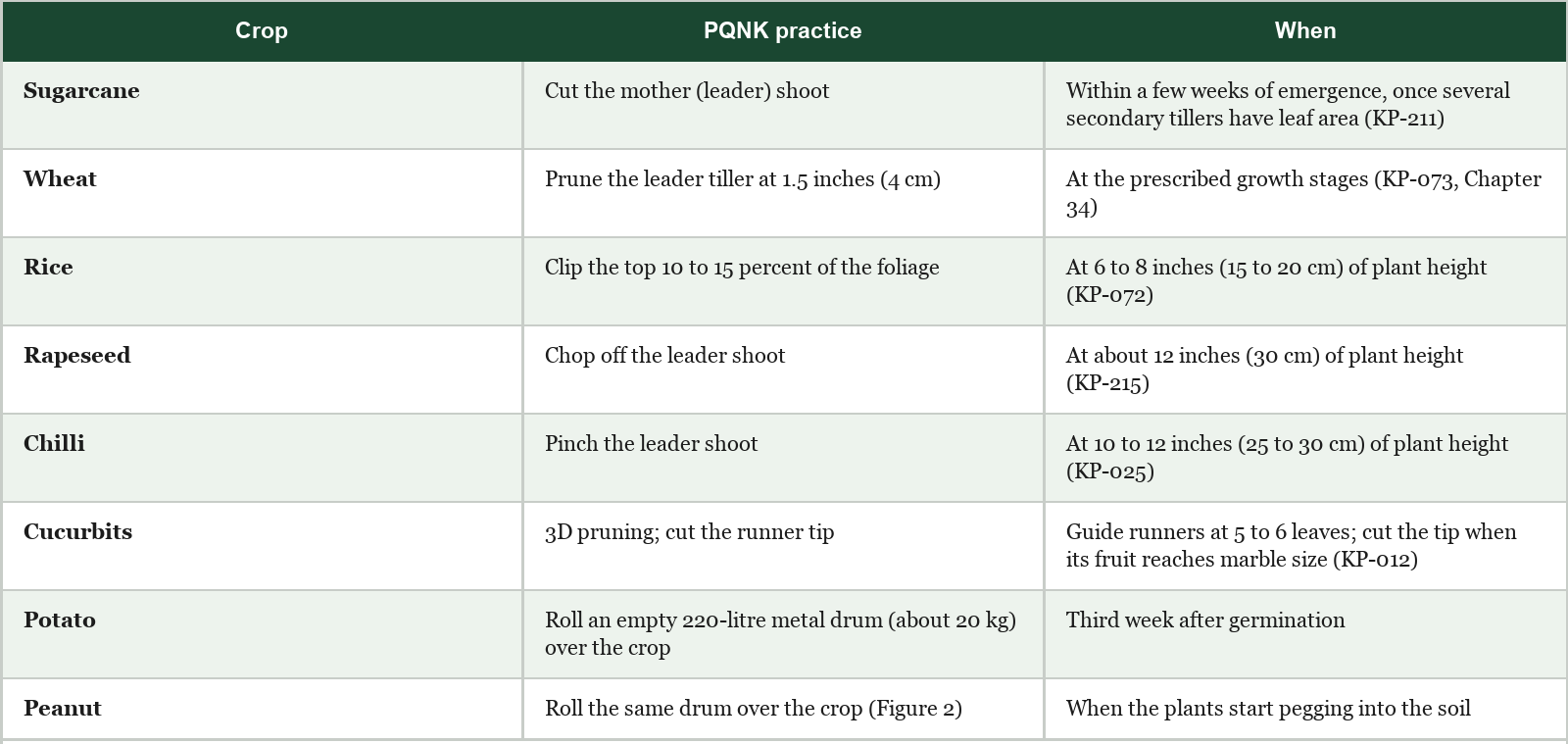
| Crop | PQNK practice | When |
|---|---|---|
| Sugarcane | Cut the mother (leader) shoot | Within a few weeks of emergence, once several secondary tillers have leaf area (KP-211) |
| Wheat | Prune the leader tiller at 1.5 inches (4 cm) | At the prescribed growth stages (KP-073, Chapter 34) |
| Rice | Clip the top 10 to 15 percent of the foliage | At 6 to 8 inches (15 to 20 cm) of plant height (KP-072) |
| Rapeseed | Chop off the leader shoot | At about 12 inches (30 cm) of plant height (KP-215) |
| Chilli | Pinch the leader shoot | At 10 to 12 inches (25 to 30 cm) of plant height (KP-025) |
| Cucurbits | 3D pruning; cut the runner tip | Guide runners at 5 to 6 leaves; cut the tip when its fruit reaches marble size (KP-012) |
| Potato | Roll an empty 220-litre metal drum (about 20 kg) over the crop | Third week after germination |
| Peanut | Roll the same drum over the crop (Figure 2) | When the plants start pegging into the soil |
Conclusion
Plants have always lived with browsing, trampling, clipping and breakage, and they answer these checks by branching, flowering and reproducing. PQNK does not fight that response; it uses it. By checking the dominant growing point at the right stage, in a living soil whose roots can carry the plant’s answer through to harvest, the farmer turns a natural regulator into more branches, more tillers, more flowers and a better yield.
PQNK Principle: Check the leader at the right stage, keep the soil alive, and let the plant do what it has always done: answer disturbance with more growth.
Related PQNK Sources
1. KP-062: Above-Soil Ecosystems in PQNK. https://pedaver.com/papers/above-soil-ecosystems-in-pqnk/
2. KP-195: The Plant Does Not Produce for Humans Alone. https://pedaver.com/papers/the-plant-does-not-produce-for-humans-alone/
3. KP-073: The Philosophy of the Central Leader. https://pedaver.com/papers/the-philosophy-of-the-central-leader/
4. KP-025: Chilli Production Under PQNK. https://pedaver.com/papers/chilli-production-under-pqnk/
5. KP-215: Rapeseed, Frost and the Sowing Window. https://pedaver.com/papers/rapeseed-frost-and-the-sowing-window/
6. KP-211: Why PQNK Sugarcane Does Not Need Earthing Up. https://pedaver.com/papers/why-pqnk-sugarcane-does-not-need-earthing-up/
7. KP-218: Why PQNK Sugarcane Tillers From the Inside. https://pedaver.com/papers/why-pqnk-sugarcane-tillers-from-the-inside/
8. KP-012: Watermelon Cultivation Under PQNK. https://pedaver.com/papers/watermelon-cultivation-under-pqnk/
9. PQNK Book, Chapter 34: Wheat; Chapter 37: Sugarcane. https://pedaver.com/books/natural-ecosystem-science/
About This Paper
- Crop
- Potato · Sugarcane
- Problem
- Poor Tillering · Excess Vegetative Growth (at expense of yield/flowering) · Hormonal Growth Imbalance (Vegetative/Reproductive) · Inconsistent / Uneven Crop Uniformity
- Science
- Plants
- Evidence
- Scientific Mechanism
- Authority
- Current / Approved PQNK Knowledge
Related PQNK Science
Key Takeaways
- In nature, browsing, trampling, clipping and breakage are regulatory steps, not injuries; plants answer them with more branches, flowers and seed.
- Checking the dominant growing point breaks apical dominance: cytokinins from the roots and the plant’s sugars release the buds below.
- Potato: roll an empty 220-litre metal drum (about 20 kg) over the crop in the third week after germination; peanut: when the plants start pegging into the soil.
- Sugarcane mother shoot removed early (KP-211); wheat leader tiller pruned at 1.5 inches (4 cm); rice clipped at 6 to 8 inches (15 to 20 cm); rapeseed topped at about 12 inches (30 cm).
- Golden rule: never remove more than 30 percent of the living foliage at one time, oldest and lowest leaves first; the response is strong only in a living soil.
Related Crops
Related Knowledge
same problem
Why PQNK Sugarcane Tillers From the Inside
On a PQNK sugarcane plot where the mother shoot is cut early, new tillers rise from inside the stool; on a conventional plot where it is left, tillers spread from the outside. The reason is apical dominance: auxin from the mother shoot’s tip, reinforced by strigolactones, holds the central buds dormant, and cutting it lets cytokinins and sugars from roots in living soil release them together, giving a uniform stool of tillers of one age.
same problem
PQNK Knowledge Paper: The Twofold Art of Pruning as Compensatory Grazing
With grazing animals absent, plants read the lack of browsing pressure as a sign their foliage isn't wanted and pour energy into ever more vegetative growth instead of fruit. This paper sets out a two-phase pruning protocol, formative and reproductive, standing in for that missing herd, with a detailed crop-by-crop benchmark table and a full sugarcane case study covering two distinct harvest strategies.
same problem
Achieving High Yields in Potato Cultivation within Mature PQNK Systems
A short field advisory for farmers whose PQNK soil has matured to the point where potato plants grow vigorous vines but underperform on tubers, explaining the hormonal mechanism behind excess vegetative growth and giving two concrete practices, wider plant spacing and a timed mechanical vine-pressing pass, to redirect that energy into yield.
same problem
Channeling Plant Energy: A PQNK Guide to Managing Vegetative Growth for Regenerative Production
With no grazing animals left to signal plants that their surplus foliage is being used, PQNK farmers must manually replicate that missing pressure. This guide sets out four directives, stamping, grazing, pruning and pinching, and bruising, with a crop-by-crop protocol for redirecting a plant's vegetative surplus into reproductive yield.