

KP-213 · Water & Climate
When 13 Inches of Rain Falls in Eight Hours
After 13 inches of rain in eight hours, the PQNK orchard beds of Jaskaran Singh in Fazilka district, Indian Punjab, had taken the water into the soil and could be walked on in slippers, while neighbouring conventional orchards and fields stood under water, and so did a strip of his own orchard where the hardpan had not been broken. The paper explains why hardpan is a water barrier as well as a root barrier, and why the soil is the first reservoir.
Read or listen to the full paper ↓Abstract
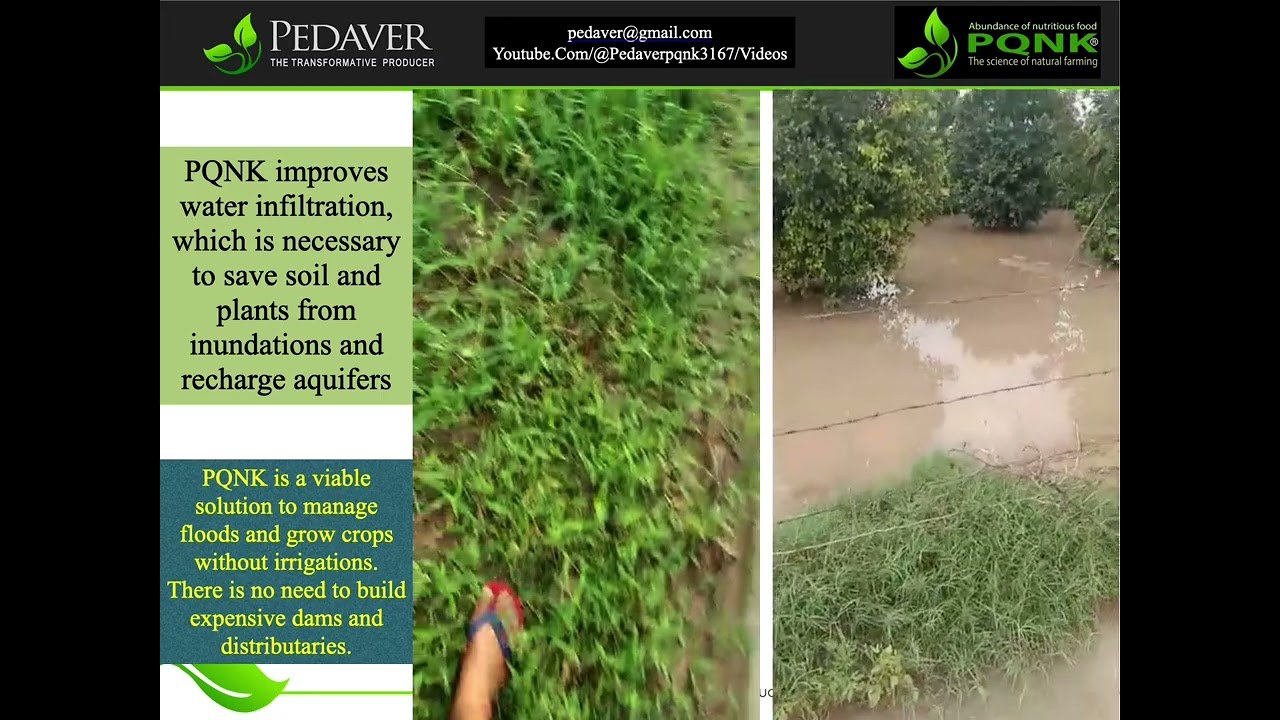
Thirteen inches (330 mm) of rain fell in eight hours. A field video recorded by Jaskaran Singh, a PQNK farmer in Fazilka district, Indian Punjab, shows that on his PQNK beds, where the hardpan had been broken, the water had gone into the soil and the beds could be walked on in slippers, while the neighbouring conventionally managed orchards and fields stood under water.
Within his own orchard, a strip where beds had been shaped but the hardpan had not been broken was still holding water. Because that strip had the same rain in the same orchard, the comparison points directly at the hardpan as the barrier.
Hardpan is therefore not only a restriction on roots. It is also a barrier to water: a field capped by a compacted layer fills quickly and behaves like a shallow container. PQNK corrects the hardpan once, with one subsoiler pass to about 22 inches, and then protects the profile with no repeated disturbance, permanent cover, retained roots and residues, and machinery traffic confined to the furrows.
The soil is the first reservoir. Before building more places to store runoff, PQNK restores the land’s ability to receive the rain where it falls; storage and flood-management works then deal only with the genuine surplus.
Full Paper
If you use “Listen”, the text of the page may be sent to your browser or operating system’s speech provider, such as Apple, Google or Microsoft, depending on the voice your device uses. Pedaver does not process, transmit or store any audio.
1. The Field Observation
Thirteen inches of rain fell in eight hours on the farm of Jaskaran Singh in Fazilka district, Indian Punjab. He had made PQNK permanent raised beds in his orchard and broken the hardpan. When he walked his field after the storm, the water on the PQNK beds had soaked into the soil within a short time; the beds were firm and covered, and he walked on them in slippers. Across the boundary, the neighbouring orchards and fields still stood under water. Within his own orchard there was a second comparison: a strip where beds had been shaped but the hardpan had not yet been broken was still holding water.
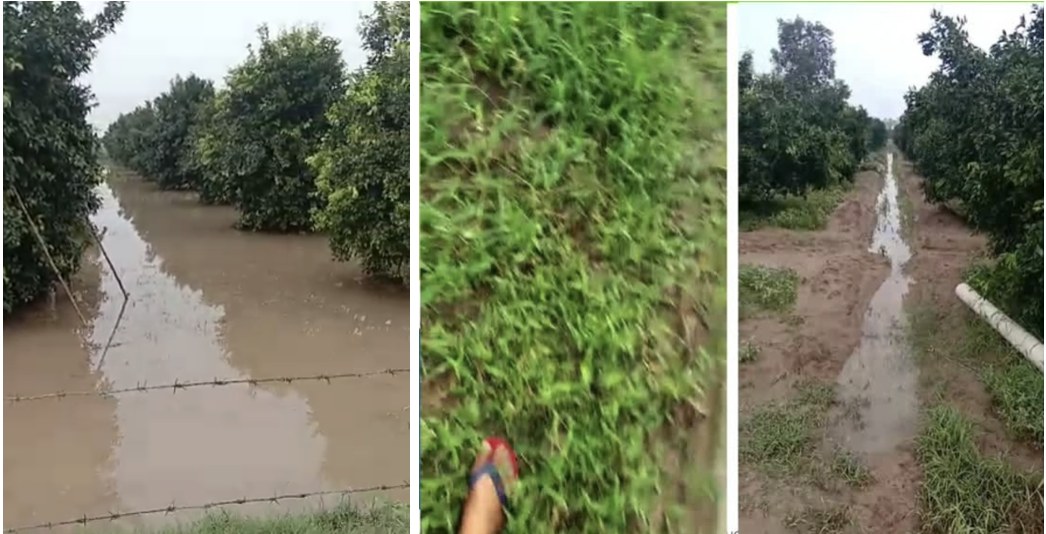
Figure 1. After 13 inches of rain in eight hours: a conventional, flood-irrigated orchard under water (left) and PQNK beds in Jaskaran Singh’s orchard, firm enough to walk on in slippers, with water only in the furrow between the beds (right). Stills from his field video, Fazilka district, Indian Punjab.
The rain was the same. The visible difference was the land’s capacity to receive it.
2. Hardpan Is Also a Water Problem
Hardpan, or plough pan, is the compacted subsurface layer formed progressively below the normal working depth of repeated tillage and machinery traffic. In PQNK these are not treated as two different phenomena. The same restrictive layer that limits root penetration can also restrict the downward movement of water.
When intense rainfall reaches a field whose effective soil depth is capped by a dense subsurface layer, the upper soil can fill rapidly. Once its immediate storage and transmission capacity is exceeded, water has fewer pathways downward. Ponding, lateral movement and runoff become more likely. The field begins to behave like a shallow container.
Breaking the hardpan therefore has consequences beyond root growth. It reconnects the cultivated surface with a deeper soil profile and creates the opportunity for rainfall to move downward rather than being confined near the surface.
3. Breaking the Layer Is Only the Beginning
PQNK does not regard subsoiling as a recurring cultivation operation. Where a restrictive hardpan exists, it is corrected once, with one subsoiler pass to about 22 inches. The objective is not to replace shallow tillage with repeated deep tillage. It is to remove the inherited physical restriction and then stop rebuilding it.
After correction, the soil is protected through the wider PQNK system: no repeated soil disturbance, permanent biological cover, retained roots and residues, biodiversity, and controlled machinery traffic in the furrows rather than across the protected production bed. Roots, organisms, aggregation and pore continuity are then allowed to develop without being repeatedly reset.
4. From Rainfall to Infiltration
The hydrological sequence can be understood simply. Rain first reaches the land surface. If the surface is protected and the soil profile beneath it contains connected pore space without a restrictive hardpan, water has more opportunity to enter and move through the profile. Some is retained as soil moisture. Some becomes available to roots. Some may move below the active root zone, and, where geology permits, a portion may eventually contribute to groundwater recharge.
Infiltration is the first step and groundwater recharge the last. Water that enters the profile first becomes soil moisture held for the roots; what moves below the root zone continues downward towards the groundwater, as the depth of the soil and the geology allow. The field shows the first step plainly: on the PQNK beds the water left the surface and entered the soil.
5. The Landscape Is the First Reservoir
Conventional water planning often begins after rainfall has already become runoff. Water is collected in ponds, reservoirs and dams. These structures can have legitimate purposes, but they operate downstream of the first hydrological opportunity: the soil directly beneath the point where the raindrop lands.
PQNK moves the first intervention upstream. Before asking how much runoff can be captured, it asks how much rainfall can be received by the land itself. A field with restored infiltration capacity distributes water entry across the treated surface rather than waiting for water to concentrate at a few collection points.
“The first opportunity to harvest rain is the soil pore beneath the point where each raindrop lands.”
6. A Reservoir Captures Runoff. Receptive Soil Can Prevent Some Runoff From Forming.
The distinction is fundamental. A reservoir receives water after rainfall has concentrated and begun moving across the landscape. A receptive soil begins receiving water before that stage. The two approaches are not mutually exclusive, but the sequence matters. Restoring the land’s capacity to absorb rainfall should come before assuming that every excess-water problem must be solved by larger downstream storage.
Under very intense rainfall, even healthy soil can reach its infiltration or storage limit, and runoff can still occur. PQNK therefore does not claim that hardpan correction makes flooding impossible. It increases the opportunity for rainfall to enter and be retained within the soil profile before water becomes surface runoff.
7. Why the Comparison Matters for Agriculture
Agricultural hardpan creates a double penalty. During dry periods it restricts roots from exploring deeper moisture and a larger volume of soil. During intense rainfall it restricts downward water movement. The same layer can therefore contribute to both drought vulnerability and waterlogging.
Correcting the restriction and then preserving the soil profile changes that relationship. Deeper rooting increases the volume from which plants can obtain moisture and nutrients. Better-connected pore space increases the opportunity for rainfall to enter the profile. Permanent surface cover further protects the soil from direct raindrop impact, reduces crusting and unnecessary evaporation, and helps preserve the biological and physical structure through which water moves.
8. What This Field Evidence Shows
The video is valuable because it records a real field under an unusually severe rainfall event rather than a laboratory column or a small infiltration ring. It shows crop-scale and field-scale behavior under practical management.
It shows that after 13 inches of rain in eight hours, the PQNK beds with the hardpan broken had taken the water into the soil, while the conventional land next to them, and the strip of the same orchard where the hardpan had not yet been broken, still held water on the surface. Because the strip with unbroken hardpan sits in the same orchard, under the same rain, the comparison points directly at the hardpan as the barrier.
9. Connection With “Rain Where It Falls”
This field evidence is a practical companion to the PQNK Knowledge Paper “Rain Where It Falls: Restoring the Soil Before Building More Water Storage” (KP-212). That paper develops the landscape-scale argument that rainfall management should begin by restoring the soil’s capacity to receive water where it falls. The present video shows what that principle can look like during an extreme event.
The broader objective is not to remove every dam or pond. It is to correct the order of intervention: first restore the soil and the landscape as the place where rain is received; then decide what genuine surplus runoff remains and what additional storage or flood-management infrastructure is actually required.
Conclusion
Thirteen inches of rain in eight hours is an extreme test of any agricultural landscape. The farmer-recorded comparison shows that land condition can profoundly alter what happens next. Where the hardpan had been properly broken and the soil profile was being managed under PQNK, water infiltrated far more effectively than in the conventional comparison visible in the footage.
The lesson is larger than one storm. Hardpan is not merely an agronomic problem beneath the roots. It is a hydrological barrier. Restoring the continuity of the soil profile, and then protecting that continuity from renewed disturbance and compaction, allows the land itself to become the first place in which rainfall is received, stored and cycled.
PQNK Principle: Before building more places to store runoff, restore the land’s ability to receive the rain.
Field Evidence and Source Note
Field evidence: video “PQNK improves water infiltration”, recorded by Jaskaran Singh, PQNK farmer, Fazilka district, Indian Punjab, after 13 inches of rain in eight hours. It compares his PQNK orchard beds with the neighbouring conventionally managed orchards and fields, and with a strip of his own orchard where the hardpan had not been broken.
Pedaver/PQNK interpretation: hardpan correction, permanently protected soil, biological cover and controlled traffic in the furrows are discussed within the established PQNK production framework.
Related PQNK Sources
1. PQNK Knowledge Paper KP-212: Rain Where It Falls. https://pedaver.com/papers/rain-where-it-falls/
2. PQNK Book, Chapter 5: The Natural Water System. https://pedaver.com/books/natural-ecosystem-science/the-natural-water-system/
3. PQNK Book, Chapter 25: Hardpan. https://pedaver.com/books/natural-ecosystem-science/hardpan/
4. PQNK Book, Chapter 26: Soil Moisture Management. https://pedaver.com/books/natural-ecosystem-science/soil-moisture-management/
About This Paper
- Crop
- Fruit Trees (crop group)
- Problem
- Hardpan · Poor Water Infiltration · Waterlogging · Flooding · Runoff · Soil Compaction (General)
- Science
- Water · Soil · Climate
- Evidence
- Field Observation
- Authority
- Current / Approved PQNK Knowledge
Related PQNK Science
Key Takeaways
- After 13 inches of rain in eight hours, PQNK beds with the hardpan broken had taken the water into the soil, while conventional land next to them stood under water.
- A strip of the same orchard with beds but unbroken hardpan still held water: the hardpan, not the rain, made the difference.
- Hardpan is a water barrier as well as a root barrier, contributing to both drought stress and waterlogging.
- PQNK breaks the hardpan once and then stops rebuilding it: no repeated tillage, permanent cover, roots and residues retained, traffic only in the furrows.
- The soil pore beneath the raindrop is the first place to harvest rain; restore the land before building more storage.
Related Knowledge
same problem
The Hydrological Transformation of Agricultural Landscapes Through the Paedar Qudratti Nizam Kashatqari (PQNK) System
PQNK-prepared fields are documented absorbing rainfall events of 600mm in a day without runoff, a figure the paper says farmers initially found impossible to believe. It explains the soil physics behind that claim, from macroporosity gains to deep-rooted 'biological drills,' and positions PQNK farms as recharge basins rather than flood risks.
same problem
Contour Line Farming through the PQNK (PICNIC) Lens
Large tracts of sloping, rainfed farmland already receive twice the water crops need, yet fail from runoff and erosion rather than drought. This paper applies PQNK's hardpan-breaking and mulch principles specifically to undulating terrain, using contour-aligned furrows as micro check-dams and citing practitioners who have farmed 7-8 consecutive years on rainfall alone.
same problem
PQNK: The Wholesale Four-Step System to Reconnect the Water Cycle and End Water Scarcity
Iran's collapsing rivers, sinking cities, and vanishing aquifers are presented as a preview of what awaits any nation that keeps farming on hardpan-sealed, bare soil. This paper argues the crisis is not a rainfall shortage but a blocked water cycle, and lays out PQNK's four-step protocol for reopening it.
same problem
Rain Where It Falls: Restoring the Soil Before Building More Water Storage
Rajendra Singh’s Rajasthan story shows that slowing runoff lets water enter the ground and restore wells and rivers. PQNK moves that principle upstream into the field itself: correct the hardpan, stop disturbing the soil, keep the surface covered, and let every acre receive and hold the rain where it falls, so that agricultural water demand stays within what the landscape renews.