


KP-227 · Workforce & Practice Advisories
Ask PQNK Field Answers 2: Spacing, Sunflower, Strawberry, Farm Design and Machine Services
The second set of answers from Asif Sharif to questions the Ask PQNK assistant could not yet answer: plant spacing for moong, soybean and sunflower on 42 inch beds, sunflower planting times, strawberry in the heat, climbers on beds, farm design with long fields for machines, rats in the furrows, checking soil moisture by hand, how machine services reach the farmer, and PQNK farmers in Dera Ghazi Khan.
Read or listen to the full paper ↓Abstract
By 15 November 2026 Ask PQNK, the PQNK assistant on WhatsApp and at pedaver.com/ask, had received 375 questions from 83 farmers and answered 337 of them from the PQNK library. The questions it could not answer were passed to Asif Sharif, Researcher and Developer of PQNK, and his answers are published in this paper.
The answers cover plant spacing for moong, soybean and sunflower, sunflower planting times and the conversion steps, strawberry, climbers on beds, farm design for machines, rats in the furrows, checking soil moisture by hand, machine services and the SIPP pay-back, Ch. Ihsan ul Haq, PQNK farmers in Dera Ghazi Khan, and three questions about Ask PQNK itself.
Nature has one production system for every plant; only the space each plant needs changes. The first set of answers is in KP-226.
Full Paper
If you use “Listen”, the text of the page may be sent to your browser or operating system’s speech provider, such as Apple, Google or Microsoft, depending on the voice your device uses. Pedaver does not process, transmit or store any audio.
When the assistant does not know, it says so, and the question comes to the author. His answer is then published here, so the next farmer who asks gets it at once.
About This Paper
This is the second paper in the Ask PQNK Field Answers series. By 15 November 2026 Ask PQNK, the PQNK assistant on WhatsApp and at pedaver.com/ask, had received 375 questions from 83 farmers and answered 337 of them from the PQNK library. The questions it could not answer were passed to Asif Sharif, Researcher and Developer of PQNK, and his answers are published here. The first set is in KP-226, Ask PQNK Field Answers 1.
A note on plant numbers: the plants per acre given below count a 42 inch (107 cm) bed together with its furrow, about 5 feet (1.5 m) from the centre of one bed to the centre of the next.
1. Moong: Spacing on the Bed
Question: What should the line-to-line and plant-to-plant distance be for moong on PQNK beds?
Plant 4 lines on a 42 inch (107 cm) bed, with 8 inches (20 cm) from plant to plant in each line. The recommended population is 52,000 plants per acre (about 128,000 per hectare).
2. Soybean: Seed Rate and Spacing
Question: How much soybean seed per acre, and at what spacing, on PQNK beds?
Ideally 100,000 plants per acre (about 247,000 per hectare): that is, 5 rows on a 42 inch (107 cm) bed, with 5 inches (13 cm) from seed to seed.
3. Sunflower: When to Plant, and How
Question: Can we plant sunflower at the start of July on PQNK mulched beds in Kohala, Samundari (Faisalabad)? Please send all the sunflower details.
Nature made only one production system for every plant on the earth, and that is PQNK. The conversion from a conventional system to PQNK is the same for every crop:
Step 1. Break the hardpan by subsoiling to 22 inches (56 cm).
Step 2. Water-wash the soil. Add 8 kg of sulphuric acid per acre (about 20 kg per hectare) if the soil pH is above 8.
Step 3. Grow a cover crop of Jantar on the beds.
Step 4. End the cover crop while keeping its roots in the soil, use the upper part of the plants as organic mulch, then plant the next cash crop. If a no-till planter (SIPP) is available, this is a one-pass operation.
The steps in full, including shaping the permanent raised beds, are set out in the PQNK book, Chapter 23, The Eight-Step Transition Protocol.
Only one thing changes from crop to crop: making sure each plant has space according to the size of its canopy. For sunflower, 3 rows are recommended on a 42 inch (107 cm) bed, at 8 inches (20 cm) from seed to seed: 40,000 plants per acre (about 99,000 per hectare). Late February or early March, and July, are good planting times. Avoid rainy periods: rain on fresh seed forms a crust and drives the air out of the soil, which restricts germination.
4. Strawberry: Season and Plants
Question: When can strawberry be planted, and where can we get its nursery plants?
Strawberry is a low-growing perennial plant. Good varieties, known as everbearing strawberries, can fruit many times a year. The plant does not withstand excessive heat. High soil temperatures kill the plants and the roots are lost; this is why farmers bring fresh plants from colder areas to plant in early spring. If the beds are properly covered with organic mulch, the soil temperature stays in a comfortable range close to 30 °C (86 °F) in summer, even when the air is around 50 °C (122 °F). This protects the plants and their roots. In the PQNK system, replanting is not necessary.
5. Climbers: Poles and Plants on the Bed
Question: These poles for climbers go on the beds: how far from the bed edge should they be set, and how far from the edge should the plants be?
The geometry of the plantation and of the climbing structure depends on the type of plant to be grown. The structure is designed to carry the weight of the vine and its fruit. In the same way, the plant-to-plant distance and the number of rows on the bed are worked out for each crop. There is no single design or rule. Plants can be grown anywhere on the bed; however, plants in the centre of the bed show the most vigour. The rule of thumb: keep the plants as far from the water as possible. The open field vertical farming model is explained in KP-174.
6. Farm Design: Where the Tractor Starts and Turns
Question: Suppose a plot of 3 acres, or of 1 acre, has been made into beds. Where should the tractor start, and where does it turn at the ends?
Farm design is an important part of PQNK. Most farmers have never changed the field layout designed in the late 1800s, which made small plots for the convenience of flood irrigation. Turning bullocks was never a problem. This is not the case with machines. In PQNK, water flows and tractors pass through the furrows, so the longest possible fields are made while moving the least soil. Moving soil is costly, and it disturbs the topsoil.
On one side of the field, a watercourse is made to feed the furrows through syphon tubes. On the other side, an access road is made, which is used for turning. On the watercourse side, about 10 feet (3 m) of ground gets compacted. This is why longer fields are made: they waste less space on turning.
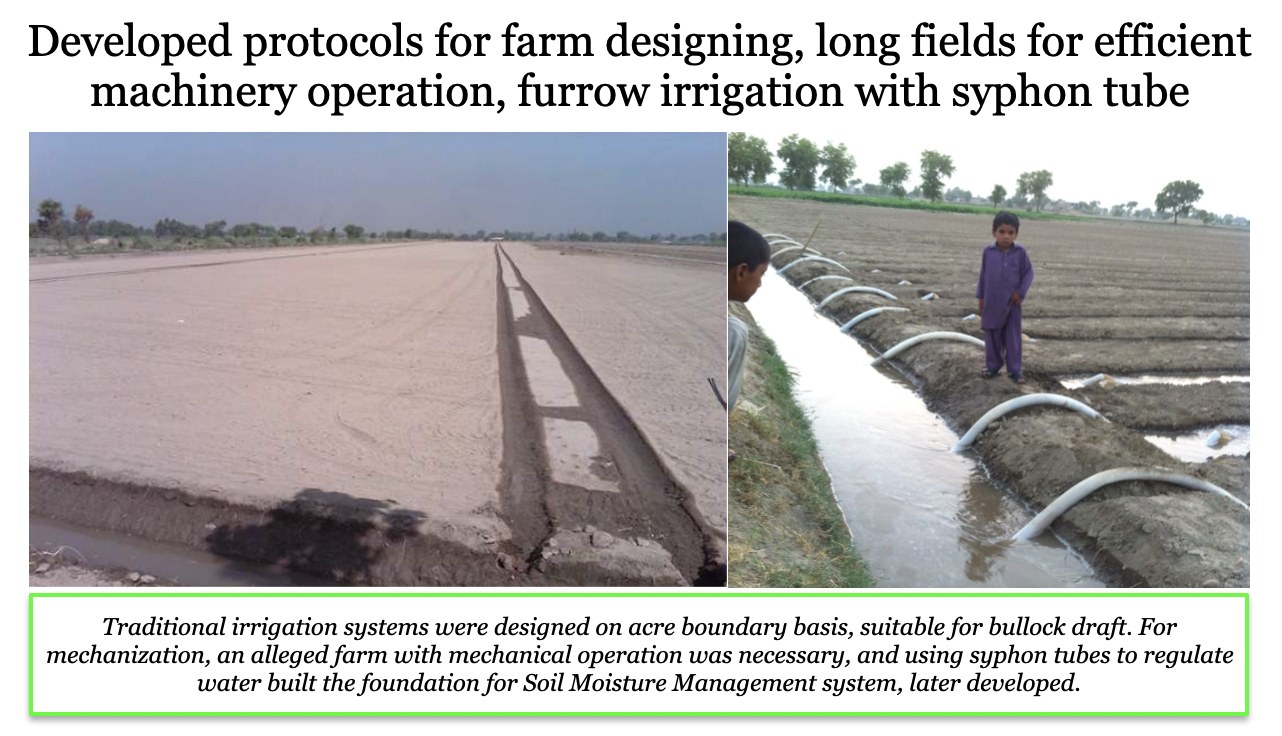
Figure 1. Farm design for machines: long fields, and furrows fed from the watercourse through syphon tubes.
7. Rats in the Furrows, and Checking Soil Moisture
Question: Light rain fell today but the field did not get fully wet. On my one-year-old beds there is dry grass standing, and in the furrows rats have dug out soil in many places. What should I do?
Rats are part of the ecosystem; let them live. The earth is meant to be shared by all species. Give them a space: either leave them as they are, or grow something for them to feed on in the corners of the field or in empty spaces. To make them move away, spray an emulsion of castor oil and soap.
Do not look at the surface and decide that the moisture is too little. Dig a pit 4 to 6 inches (10 to 15 cm) deep in the middle of the bed, to reach the root zone. Take a handful of soil, hold it tight in your hand, and open it. If the soil stays together like a moist ball, there is enough moisture.
Rainwater can only infiltrate, evaporate or run off; there is no other escape.
8. Machine Services: Who Provides Them
Question: I asked for PQNK machine services (subsoiler, mulcher, bed shaper, leveller) for 31 kanal (about 4 acres) at Chak 222 GB Kohala, Tehsil Samundari. Who should I contact? And can I easily get a mulcher, bed shaper and planter in Faisalabad, and from where?
Our task is to research and develop processes that are good for all living beings. We have done that by developing PQNK, pronounced "picnic", which stands for Paedar Qudratti Nizam Kashatqari and means the regenerative and sustainable Pristine Organic Farming System. By adopting it, farmers can grow the highest quality crops without purchased inputs.
We have designed the tools for applying it and shared the drawings with vendors, who independently run their own business of providing these machines to operators. Our job is to make farmers aware and to educate them. Service providers make a business out of machines that smallholders cannot buy, such as tractors, ploughs, haulage trolleys, levelling equipment, laser levellers, subsoilers, bed shapers, mulchers and no-till planters. Look for those who provide these services in your area. With frugal improvisation, these steps can also be carried out without dedicated machines.
Smallholders should develop a side business, as many conventional service providers have done successfully since the mid-1980s. The business is very profitable. For example, a SIPP planter costs around Rs 700,000. A conventional farmer spends over Rs 20,000 per acre on planting, and more on seed. Since Rs 700,000 divided by Rs 20,000 is 35, a SIPP pays for itself after planting just 35 acres.
The vendor of the VIPP planter is named in KP-226, Ask PQNK Field Answers 1.
9. Ch. Ihsan ul Haq
Question: Does Ch. Ihsan ul Haq of the nursery farm have any role in PQNK?
Ch. Ihsan ul Haq is an early adopter of PQNK. He is generous: he helps farmers learn, and shows on his own farm how successful PQNK is.
10. PQNK Farmers in Dera Ghazi Khan
Question: Are there PQNK farmers in Dera Ghazi Khan?
Yes, there are many PQNK farmers in the Dera Ghazi Khan area. If you ask us through direct message, we will contact them and put you in touch. Use the WhatsApp number on pedaver.com/contact.
11. About Ask PQNK Itself
Question: I need its Urdu translation.
Ask Ask PQNK to translate its last answer, and it will give it in Urdu or in any language you ask for.
Question: Do you save memory, so that the answers fit my case?
Ask PQNK remembers what you tell it during a conversation, but it does not keep your details afterwards. It cannot take orders, book machines or call you back. For machines and services, look for service providers in your area (see Question 8).
Question: From Pedaver’s point of view, what time should one wake up in the morning?
Ask PQNK answers questions about PQNK farming from the PQNK library on pedaver.com. For this question there is no PQNK source. Please ask it about your crop, soil, water or farm.
Conclusion
Every question a farmer asks is a gap the library can close. These answers cover plant spacing for moong, soybean and sunflower, strawberry in the heat, climbers on beds, farm design for machines, living with rats, checking soil moisture by hand, and how machine services reach the farmer. The same rule runs through them all: nature has one production system for every plant, and only the space each plant needs changes.
PQNK Principle: One system for every plant. Only the spacing changes.
Related PQNK Sources
1. KP-226: Ask PQNK Field Answers 1. https://pedaver.com/papers/ask-pqnk-field-answers-1/
2. PQNK Book, Chapter 23: The Eight-Step Transition Protocol. https://pedaver.com/books/natural-ecosystem-science/
3. KP-174: Open Field Vertical Farming Under PQNK: Stacking Biology Instead of Expanding Land. https://pedaver.com/papers/open-field-vertical-farming-under-pqnk/
4. SIPP: Slit Insertion Precision Planter. https://pedaver.com/machines/sipp-planter/
5. Ask PQNK: https://pedaver.com/ask, or on WhatsApp at https://wa.me/923437506442
About This Paper
- Crop
- Mung Bean · Soybean · Sunflower · Strawberry
- Problem
- High Input / Production Cost · Suboptimal Planting Density · Machinery / Field-Operation Decision Difficulty · Space / Infrastructure Constraint
- Science
- Production Architecture · Transition · Water · Plants
- Evidence
- Field Observation
- Authority
- Current / Approved PQNK Knowledge
Related PQNK Science
Key Takeaways
- Moong: 4 lines on a 42 inch (107 cm) bed, 8 inches (20 cm) from plant to plant, 52,000 plants per acre.
- Soybean: ideally 100,000 plants per acre, 5 rows on a 42 inch bed at 5 inches (13 cm) from seed to seed.
- Sunflower: 3 rows on a 42 inch bed at 8 inches (20 cm), 40,000 plants per acre; plant in late February or early March, or in July, avoiding rainy periods that crust the soil and restrict germination.
- The conversion is the same for every crop: subsoil the hardpan to 22 inches, water-wash the soil (8 kg of sulphuric acid per acre if pH is above 8), grow Jantar on the beds, then end it with its roots left in the soil and its tops as mulch, and plant the cash crop.
- Strawberry does not withstand excessive heat; under a proper organic mulch the soil stays close to 30 °C when the air is near 50 °C, and in PQNK replanting is not necessary.
- Plants in the centre of the bed show the most vigour; keep plants as far from the water as possible, and design climbing structures for each crop.
- Make the longest fields possible while moving the least soil: a watercourse with syphon tubes on one side, an access road for turning on the other.
- Rats are part of the ecosystem; give them a space, and to make them move away spray an emulsion of castor oil and soap.
- Judge moisture in the root zone, not at the surface: dig 4 to 6 inches deep in the middle of the bed; if a squeezed handful stays together like a moist ball, the moisture is enough.
- Pedaver designs the machines and shares the drawings with vendors; service providers offer subsoiling, bed shaping, mulching and planting, and a SIPP at about Rs 700,000 pays for itself after planting about 35 acres.
Related Knowledge
same problem
Ask PQNK Field Answers 1: What Farmers Asked in November 2026
Answers from Asif Sharif to the questions the Ask PQNK assistant could not yet answer in its first days: cotton cut back and left to regrow, planting old beds by hand without the SIPP or VIPP, turmeric and peas spacing on 42 inch beds, fruit trees on rain-fed heavy clay, worm towers and vertical farming, where to get the VIPP planter, and the cost of converting a field to PQNK (about Rs 21,000 per acre at 2026 prices in Pakistan).
same problem
Chemical Fertiliser Dependency Through the PQNK Lens
An evidence-qualified review of the article “Chemical Fertilizer Industry”. It keeps the article's warning about soil degradation, nutrient pollution and biological decline, disciplines its headline numbers, and argues that fertiliser dependency is a symptom of a damaged production system (tillage, flooding, bare soil and simplified biology) that PQNK removes by restoring aerated, covered, living soil, reaching zero purchased fertiliser and pesticide at maturity.
same problem
Production Architecture: Engineering the Farm So the Living System Never Has to Be Rebuilt
Explains the physical engineering behind the four PQNK principles: permanent raised beds and furrows that separate destructive tractor traffic and irrigation from a protected biological zone, so a field accumulates biological function crop after crop instead of being torn down and rebuilt every season.
same problem
The Chain of Devastation: From the Seed Bag to the Hospital Bed, and Where PQNK Breaks It
A short podcast clip names a trap in eight links: seed that needs NPK and urea, a fertilised plant whose own resistance falls, insects, pesticide, a family that eats the crop and falls ill, then medicines, hospital and insurance, and back to the seed. In ACI agriculture each link is a purchase that makes the next one necessary. PQNK breaks the chain at the soil: a living soil feeds the crop without fertiliser, the plant keeps its resistance, pests stay below 2 percent where every step is followed, nothing is sprayed, and the family eats whole food.