

KP-226 · Workforce & Practice Advisories
Ask PQNK Field Answers 1: What Farmers Asked in November 2026
Answers from Asif Sharif to the questions the Ask PQNK assistant could not yet answer in its first days: cotton cut back and left to regrow, planting old beds by hand without the SIPP or VIPP, turmeric and peas spacing on 42 inch beds, fruit trees on rain-fed heavy clay, worm towers and vertical farming, where to get the VIPP planter, and the cost of converting a field to PQNK (about Rs 21,000 per acre at 2026 prices in Pakistan).
Read or listen to the full paper ↓Abstract
Ask PQNK, the PQNK assistant on WhatsApp and at pedaver.com/ask, was launched on 12 November 2026. In its first three days it received 205 questions and answered 189 of them from the PQNK library. For the rest it did not guess: it said that the answer was not yet on pedaver.com.
Those questions were passed to Asif Sharif, Researcher and Developer of PQNK, and his answers are published in this paper: cotton regrowth, planting by hand, turmeric, peas, rain-fed fruit trees, worm towers and vertical farming, the VIPP planter, and the cost of conversion.
Ask PQNK reads pedaver.com, so from now on it can answer these questions directly. Further papers in this series will follow as new questions come in.
Full Paper
If you use “Listen”, the text of the page may be sent to your browser or operating system’s speech provider, such as Apple, Google or Microsoft, depending on the voice your device uses. Pedaver does not process, transmit or store any audio.
When the assistant does not know, it says so, and the question comes to the author. His answer is then published here, so the next farmer who asks gets it at once.
About This Paper
Ask PQNK, the PQNK assistant on WhatsApp and at pedaver.com/ask, was launched on 12 November 2026. In its first three days it received 205 questions and answered 189 of them from the PQNK library. For the rest it did not guess: it said that the answer was not yet on pedaver.com. Those questions were passed to Asif Sharif, Researcher and Developer of PQNK, and his answers are published in this paper. Ask PQNK reads pedaver.com, so from now on it can answer these questions directly. Further papers in this series will follow as new questions come in.
1. Cotton: Cutting the Plant Back and Letting It Regrow
Question: If the triple-gene cotton variety FH-1148 is cut back to 6 inches, how much will it yield the next season?
Cotton is genetically a perennial plant. It can produce year after year if the soil system is properly maintained as per the PQNK advisories. The yield of the ratoon crop should be in line with that of a fresh planting, if not higher. The variety of the cotton does not matter.
2. Planting Old Beds Without the SIPP or VIPP
Question: Without the SIPP, how do I replant my old beds?
Without the SIPP or VIPP, seed can be planted by hand with a dibbler. This suits a smallholder well. It must be remembered that many crops, such as rice, maize, cotton and vegetables, are already planted by hand. In rice, 60,000 to 80,000 seedlings per acre are transplanted into standing water in scorching heat and humid conditions. Planting by hand on PQNK beds covered with organic mulch is much more convenient.
3. Turmeric on Mature PQNK Beds
Question: How should turmeric (haldi) be planted on mature PQNK beds, and which is the best season to plant it?
Turmeric is planted in March or April and harvested in October-November. Three to four lines are planted on 42 inch (107 cm) PQNK beds, at 12 inches (30 cm) from plant to plant, giving 26,000 to 35,000 plants per acre (64,000 to 86,000 per hectare). Place the seed about 4 inches (10 cm) deep in moist soil, and cover it with organic mulch 3 inches (7.5 cm) thick.
4. Peas (Matar): Spacing on the Bed
Question: What should the line-to-line distance be for peas (matar)?
There are two distinct kinds of green peas, and they are spaced differently:
The single-flush kind. It ripens all at once and is harvested once. It needs less space, so four lines are planted on a 42 inch (107 cm) bed, with 8 inches (20 cm) from seed to seed in the row: about 52,000 plants per acre.
The vine kind. Its ripe pods are picked every few days over a long season. Three lines are planted on a 42 inch (107 cm) bed, with 8 inches (20 cm) from plant to plant: about 40,000 plants per acre.
5. Worm Towers, and Growing Upward
Question: If I add a worm tower on the bed, what result will I see?
As far as I know, there is no such term as a worm tower in field agriculture. What PQNK does recommend is vertical farming, especially for creepers, climbers and vines of every kind. Growing upward saves space and increases the plant population on the same bed. The open field vertical farming model is explained in KP-174.
A worm tower, as used in home gardens, is a pipe with holes buried in the bed and filled with kitchen waste for earthworms. A PQNK bed does not need one: its continuous organic mulch feeds earthworms and soil life along the whole length of the bed, not at one point.
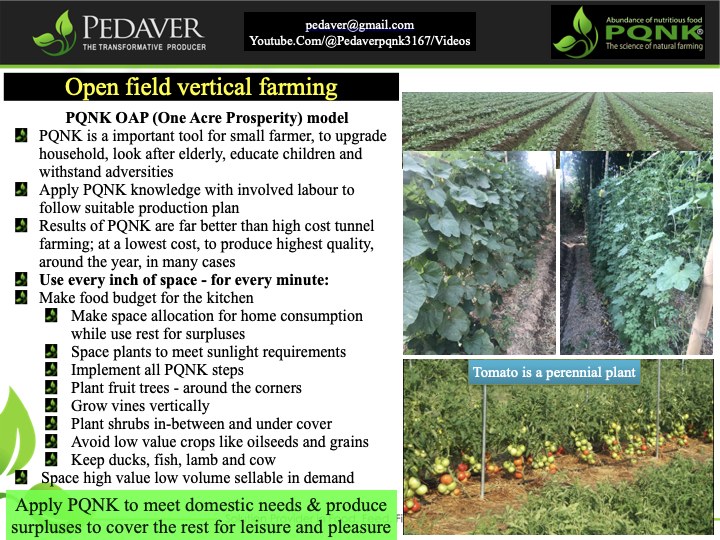
Figure 1. Open field vertical farming: the PQNK One Acre Prosperity model.
6. Fruit Trees on Rain-Fed Heavy Clay
Question: My land is rain-fed heavy clay, and the rain falls mainly in the rainy season. Can I grow banana, apple, pear, pomegranate and papaya?
Where the average rainfall is 16 inches (400 mm) a year or more, every crop and orchard plant can be grown. Every drop of water that falls should be absorbed where it falls. It should not evaporate or run off the field. This is done by following the recommendations in KP-068, Contour Line Farming through the PQNK Lens.
7. The VIPP Planter: Where to Get It and What It Costs
Question: Which vendor has the VIPP machine? What does it look like, and what is its price?
The vendor of the VIPP (Vertical Insertion Precision Planter) is FarmMore Productivity Enhancement (Private) Limited. The contact person is Mr. Naseer Ahmad, +92 301 0046333. For prices, please contact the vendor. Pictures of the VIPP and how it works are on the machines page: pedaver.com/machines/vipp-planter.
8. The Cost of Converting a Field to PQNK
Question: What is the estimated cost of converting two acres to PQNK?
The one-time cost of conversion, at 2026 prices in Pakistan, is about:
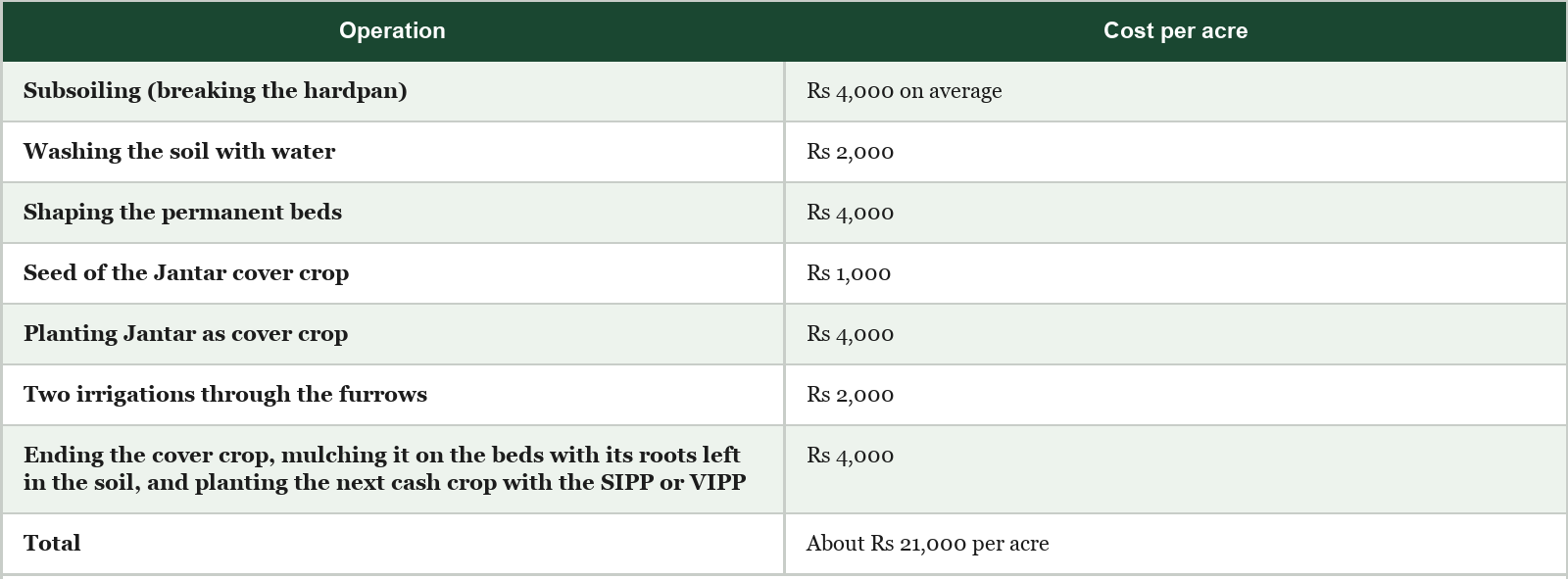
| Operation | Cost per acre |
|---|---|
| Subsoiling (breaking the hardpan) | Rs 4,000 on average |
| Washing the soil with water | Rs 2,000 |
| Shaping the permanent beds | Rs 4,000 |
| Seed of the Jantar cover crop | Rs 1,000 |
| Planting Jantar as cover crop | Rs 4,000 |
| Two irrigations through the furrows | Rs 2,000 |
| Ending the cover crop, mulching it on the beds with its roots left in the soil, and planting the next cash crop with the SIPP or VIPP | Rs 4,000 |
| Total | About Rs 21,000 per acre |
This is on the higher side, because fuel prices are high. For two acres the total is about Rs 42,000. It is paid once: after conversion the beds are never ploughed again, and no fertiliser or spray is bought.
In other countries the cost follows the same operations, priced at local rates. The steps and their order are set out in the PQNK book, Chapter 23, The Eight-Step Transition Protocol.
9. About Ask PQNK Itself
Question: Is this an AI tool? Is the answer coming from a bot?
Yes. Ask PQNK is an AI assistant built by the Pedaver team. It answers only from the PQNK library on pedaver.com, written by Asif Sharif, Researcher and Developer of PQNK.
Question: Can I ask my question by speaking?
Yes. On WhatsApp you can send your question as a voice message, in Urdu or English, and Ask PQNK will answer.
Question: Please reply in English.
Ask PQNK replies in the language you write in. If you ask it to reply in English, Urdu or another language, it will switch.
Conclusion
Every question a farmer asks is a gap the library can close. These answers fill the first gaps that Ask PQNK found in its first days: cotton regrowth, planting by hand, turmeric, peas, rain-fed land, growing upward, the VIPP and the cost of conversion. As more questions come in, more answers will be published, and the assistant will grow with them.
PQNK Principle: No question goes unanswered for long. What the assistant does not know, the field record answers.
Related PQNK Sources
1. PQNK Book, Chapter 23: The Eight-Step Transition Protocol. https://pedaver.com/books/natural-ecosystem-science/
2. KP-174: Open Field Vertical Farming Under PQNK: Stacking Biology Instead of Expanding Land. https://pedaver.com/papers/open-field-vertical-farming-under-pqnk/
3. KP-068: Contour Line Farming through the PQNK Lens. https://pedaver.com/papers/contour-line-farming-through-the-pqnk-lens/
4. VIPP: Vertical Insertion Precision Planter. https://pedaver.com/machines/vipp-planter/
5. Ask PQNK: https://pedaver.com/ask, or on WhatsApp at https://wa.me/923437506442
About This Paper
- Crop
- Cotton · Turmeric · Pea · Banana · Apple · Pomegranate · Papaya · Fruit Trees (crop group)
- Problem
- High Input / Production Cost · Suboptimal Planting Density · Machinery / Field-Operation Decision Difficulty · Space / Infrastructure Constraint · Drought / Water Scarcity · Regional Rainfall / Microclimate Variability
- Science
- Production Architecture · Transition · Water · Plants
- Evidence
- Field Observation
- Authority
- Current / Approved PQNK Knowledge
Related PQNK Science
Key Takeaways
- Cotton is genetically a perennial plant: cut back and left to regrow on a properly maintained PQNK soil, the ratoon crop should yield in line with a fresh planting, if not higher, whatever the variety.
- Without the SIPP or VIPP, seed can be planted by hand with a dibbler; on mulched PQNK beds this is far easier than transplanting rice into standing water.
- Turmeric is planted in March or April and harvested in October or November: three to four lines on 42 inch (107 cm) beds, 12 inches (30 cm) apart, seed 4 inches (10 cm) deep under 3 inches (7.5 cm) of mulch, 26,000 to 35,000 plants per acre.
- Peas: the single-flush kind is planted in four lines on a 42 inch bed at 8 inches (20 cm), about 52,000 plants per acre; the vine kind in three lines at 8 inches, about 40,000 plants per acre.
- A PQNK bed needs no worm tower, because its continuous mulch feeds earthworms along the whole bed; PQNK recommends open field vertical farming for creepers, climbers and vines (KP-174).
- Where the average rainfall is 16 inches (400 mm) a year or more, every crop and orchard plant can be grown, provided every drop is absorbed where it falls (KP-068, contour line farming).
- The VIPP is supplied by FarmMore Productivity Enhancement (Private) Limited, contact Mr. Naseer Ahmad, +92 301 0046333; prices from the vendor.
- Converting a field to PQNK costs about Rs 21,000 per acre once, at 2026 prices in Pakistan: subsoiling, washing, bed shaping, Jantar seed and planting, two furrow irrigations, and ending the cover crop as mulch while planting the cash crop.
Related Crops
Related Knowledge
same problem
Grain First: PQNK and the Coming Food Crisis
A practising PQNK farmer asked whether staple grains will matter more in the years ahead, and whether farmers should favour wheat, maize and rice or vegetables and fruit. Erratic weather, degraded soil and scarce water are squeezing the world’s food supply, and ACI agriculture depends on exactly what is failing. PQNK soil takes in heavy rain, holds moisture through heat and drought and grows without purchased inputs. The strategy for the next ten years: convert the land to PQNK, grow grain first, and keep a reserve of grain in your own store.
same problem
Chemical Fertiliser Dependency Through the PQNK Lens
An evidence-qualified review of the article “Chemical Fertilizer Industry”. It keeps the article's warning about soil degradation, nutrient pollution and biological decline, disciplines its headline numbers, and argues that fertiliser dependency is a symptom of a damaged production system (tillage, flooding, bare soil and simplified biology) that PQNK removes by restoring aerated, covered, living soil, reaching zero purchased fertiliser and pesticide at maturity.
same problem
A Farmer's Guide to Establishing a Prosperous Olive Orchard
A practical planting guide for olive growers in Mediterranean-equivalent climates, laying out two distinct PQNK establishment paths, high-density irrigated beds versus a low-cost curved-furrow-and-borehole system for rain-fed sloping land, plus a year-by-year yield projection showing how consistent soil biology breaks the crop's typical biennial-bearing cycle.
same problem
Production Architecture: Engineering the Farm So the Living System Never Has to Be Rebuilt
Explains the physical engineering behind the four PQNK principles: permanent raised beds and furrows that separate destructive tractor traffic and irrigation from a protected biological zone, so a field accumulates biological function crop after crop instead of being torn down and rebuilt every season.