
KP-222 · Nutrition & Food Quality
Whole Food from a Living Soil: Able Bodies and Clear, Conscious Minds
A farmer from India asked whether the health of a people begins in the soil. This paper answers him, link by link: soil microbes working at full scale help the plant produce whole food, carrying the full spectrum of minerals and protective compounds with no chemical residue; whole food builds an able body and a clear, conscious mind; and such a mind helps build character in a people, from honesty and respect for all to compassion, empathy and cheerfulness. When the life of the soil is broken, every link after it weakens.
Read or listen to the full paper ↓Abstract
A farmer from India who follows PQNK sent Asif Sharif a voice note with a question. He feels, from his time in the field, that where the microbes of a region’s soil are fully alive, its people are strong, clear-minded and of good character, and that when the microbial cycle of nature was broken, the cycle of society broke with it. He asked whether he is right.
This paper answers him. It sets out what whole food is, how the soil’s microbes make it possible, how whole food builds an able body and a clear, conscious mind, and why a farming system that kills the soil’s life also weakens the people who eat from it.
The farmer’s insight stands on the same chain PQNK calls bio-potentiation: soil, plant, food, body and mind are one continuous living system, and it is restored from the soil upward.
Full Paper
If you use “Listen”, the text of the page may be sent to your browser or operating system’s speech provider, such as Apple, Google or Microsoft, depending on the voice your device uses. Pedaver does not process, transmit or store any audio.
Soil microbes, when they function at full scale, help plants produce whole food. Whole food develops able bodies and clear, conscious minds. The health of a people begins in the soil that feeds it.
1. A Farmer’s Question
The voice note came after Asif Sharif had spoken in a PQNK group about the microbes that live on and around plant roots: how many kinds of them work in the soil under every kind of plant and weed, and how they balance the whole system and prepare the plant’s food. The farmer, who farms on the PQNK model himself, listens to nearly all of these talks, and they set him thinking.
Parents everywhere, he said, hope that their children will be honest, healthy, intelligent, hard-working and respectful. They pray for it at their places of worship. He feels that the Creator who is present in every particle of creation is present in the soil itself, in the countless microbes that keep it alive and keep the whole of creation moving forward. Where the soil of a country or a region is healthy, with its many kinds of microbes in full health, the people of that region will be honest, wise, strong and cheerful, with all the good qualities of a whole personality. Where the children of today have lost those qualities, he believes the cause lies in the natural system of microbes that we have damaged. “When we broke the cycle of nature,” he said, “the cycle of our society broke with it. If we keep the cycle of nature whole, the cycle of society will stay whole.”
He asked for confirmation, and for correction if anything in his idea is missing. The sections below give both.
2. What Whole Food Means
Whole food is food that carries everything the plant was designed to put into it. It is not a matter of calories. A grain of wheat, a mango or a leaf of spinach grown in living soil carries the full spectrum of minerals the plant drew from the geological mineral bank, the vitamins and proteins it built from them, and the secondary metabolites (the phytonutrients, flavonoids, carotenoids and phenolic compounds) it makes for its own defence and communication. All of this sits inside the living structure of the plant tissue, the food matrix, which decides how much of it the human body can take up. And it carries no residue of synthetic pesticide, herbicide or fertiliser.
Food grown the ACI (Ancient Conventional Industrial) way is fragmented food. Soluble nitrogen and flooding push the crop to fill with water ahead of its biochemistry, so it grows heavy but thin: more weight, less of what the weight should carry. Chapter Fifty-Nine of the PQNK book describes this as the loss of ecological quality, and Chapter Eleven the decline in the mineral, vitamin and phytonutrient content of staple crops over the years of industrial farming, broadly 20 to 40 percent for many crops and nutrients. The calories are on the plate. The nourishment is not.
3. The Microbes Make Whole Food Possible
A plant cannot make whole food alone. Of its dry weight, more than 95 percent is built from carbon dioxide and water; the remaining few percent, the minerals, decide its quality, and these the plant receives through the life of the soil. The plant pays for that service. It sends 20 to 40 percent of the carbon it fixes below ground, depending on plant type and growth stage, and part of it leaves the roots as sugars and other exudates that feed the microbes around them.
In return, the microbes do what the plant cannot. Mycorrhizal fungi extend their threads far beyond the roots, into the mineral bank, and deliver phosphorus, zinc, iron, copper and the trace elements to the plant. Free-living bacteria take nitrogen from the air. Bacteria, fungi, protozoa, nematodes and earthworms cycle nutrients, build the crumb structure that holds air and water, and protect the roots from disease. Each kind of plant and weed feeds its own community of microbes, so a diverse field above ground keeps a diverse community below it, and a diverse community delivers a fuller spectrum of minerals.
This is what “functional at full scale” means. When the soil is never inverted, never flooded, always covered and never poisoned, the whole community works together, and the plant receives everything its genetic programme needs to produce whole food. When tillage cuts the fungal network, flooding drives out the air, bare soil burns its organic matter in the sun, and soluble fertiliser gives the plant a short cut so that it stops paying its partners, the community shrinks. The plant falls back on the few nutrients in the fertiliser bag, and its food becomes fragmented.
4. From Whole Food to an Able Body
The human gut has its own community of microbes, and it does for the body what the soil food web does for the plant: it decides how much of what is eaten the body can actually use. Whole food, with its fibres and its wide range of phytonutrients, feeds a diverse and working gut community. That community takes up more of the minerals and vitamins in the food and makes compounds the body needs for its own regulation.
A body supplied in this way can do what it was designed to do: keep its immune balance, control its own inflammation, protect its cells with the antioxidant chemistry that minerals such as selenium, zinc and magnesium make possible, and grow and repair itself. This is the able body: strong, energetic and resilient, able to work and to recover. PQNK does not claim that its food cures disease. It claims that food from a living soil gives the body the nourishment in which it can keep itself well, as Chapters Forty-Eight and Forty-Nine of the PQNK book set out. The rise of chronic disease alongside industrial food is the other side of the same chain.
5. From Whole Food to a Clear, Conscious Mind
The brain is the most demanding organ in the body. It depends on a steady supply of iron to carry oxygen, iodine to regulate its development, zinc and magnesium for the hundreds of enzymes that carry its signals, and the phytonutrients that protect its cells from damage. A child short of iron or iodine learns more slowly and tires more quickly; these deficiencies are among the most widespread in the world, and they come from fragmented food.
The mind also depends on the gut. The microbes of the gut and the brain are in constant communication, and a working gut community helps keep mood and attention steady. And a mind free of the low, daily load of chemical residue is a mind that is not quietly disturbed by what it eats. Chapter Forty-Eight names this at the end of the bio-potentiation chain: cognitive clarity and emotional stability.
A clear, conscious mind is one that can attend, learn, judge and choose. It is aware of itself and of others. That is the ground on which the qualities parents pray for, honesty, wisdom, effort and kindness, can grow and hold. Upbringing, faith and example shape character too, but a body that is always short of nourishment and a mind that is never quite clear make every good quality harder to reach. Whole food makes it easier.
Healthy soil microbes therefore reach far beyond the field. Through the wholeness of the food they help the plant produce, they have a positive impact on the development of the brain and on a healthy mind: clear, conscious and in good conscience. Such a mind helps build character in a people: honesty, respect for all, compassion, empathy and cheerfulness.
6. Two Cycles, One System
The farmer’s deepest point is that nature and society share one cycle. PQNK agrees, and the chain can be traced. The soil feeds the microbes; the microbes feed the plant; the plant feeds the person; the person, as farmer, cares for the soil. Break the first link and every link after it weakens. A farming system that kills the life of the soil gives fragmented food to the town, weaker health to its children, and a growing bill for inputs, medicine and debt to the farming household.
The same farming also broke the farmer’s independence, as KP-221 describes: a farmer who must buy every season what a living soil once gave for free is no longer master of their own field. When farmers restore the soil, they restore the first link of both cycles at once: the food becomes whole, the household keeps more of what it produces, and the village has the means and the health to stand on its own.
The name Pedaver means the Producer, a name also used for the Creator, and Pedavaar means the produce. In every faith, farmers have sensed that the living soil is not dead matter but part of a created order, and that working with it is a trust. The farmer from India expressed this in his own words. PQNK expresses it in the language of the field: the soil is alive, by design, and the farmer’s task is to keep it alive.
7. In Practice: Growing Whole Food
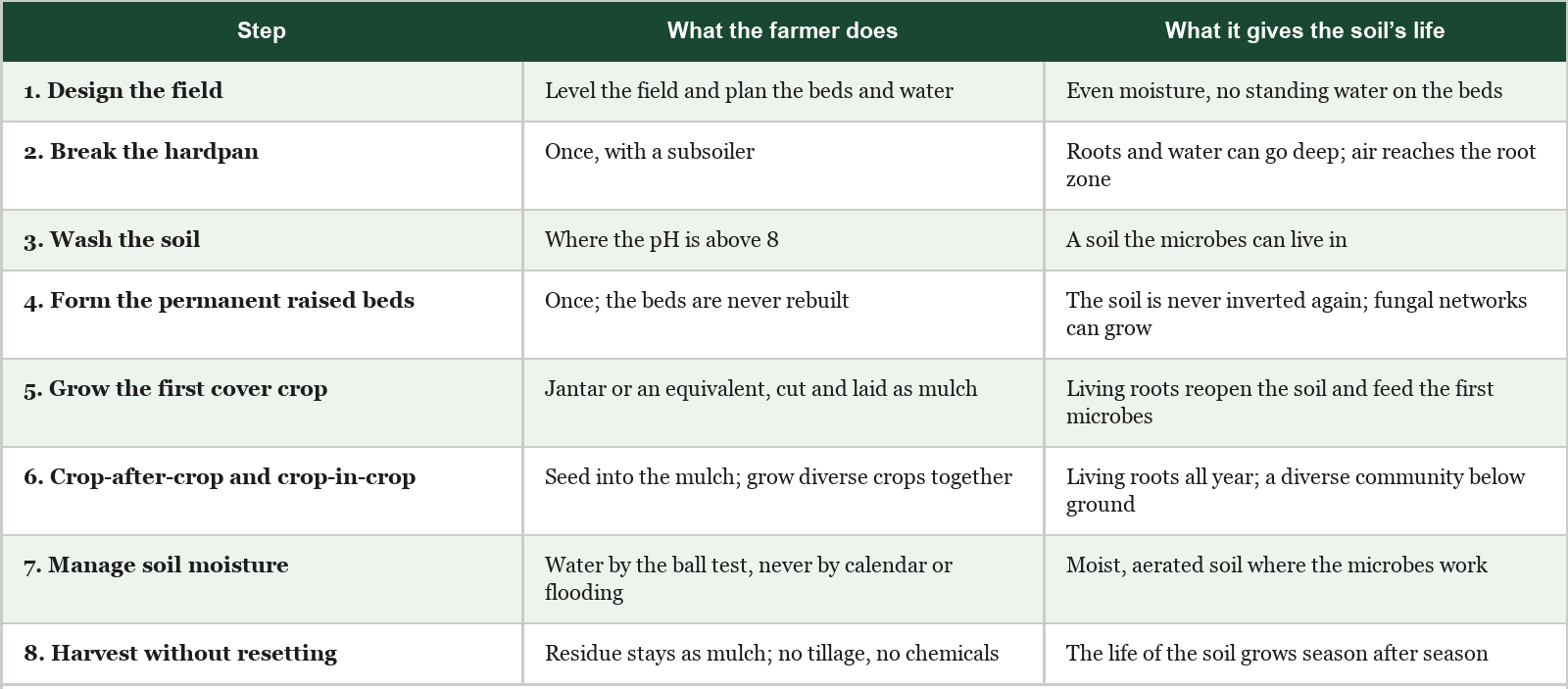
Whole food is not bought in a bag. It is grown by restoring the soil’s life and then leaving it undisturbed. The PQNK conversion follows the eight steps of Chapter Twenty-Three, in order:
| Step | What the farmer does | What it gives the soil’s life |
|---|---|---|
| 1. Design the field | Level the field and plan the beds and water | Even moisture, no standing water on the beds |
| 2. Break the hardpan | Once, with a subsoiler | Roots and water can go deep; air reaches the root zone |
| 3. Wash the soil | Where the pH is above 8 | A soil the microbes can live in |
| 4. Form the permanent raised beds | Once; the beds are never rebuilt | The soil is never inverted again; fungal networks can grow |
| 5. Grow the first cover crop | Jantar or an equivalent, cut and laid as mulch | Living roots reopen the soil and feed the first microbes |
| 6. Crop-after-crop and crop-in-crop | Seed into the mulch; grow diverse crops together | Living roots all year; a diverse community below ground |
| 7. Manage soil moisture | Water by the ball test, never by calendar or flooding | Moist, aerated soil where the microbes work |
| 8. Harvest without resetting | Residue stays as mulch; no tillage, no chemicals | The life of the soil grows season after season |
As the soil matures, the community below ground grows deeper and richer with every undisturbed season, and the food it produces becomes more whole. Kinnow from a PQNK orchard has shown 15 to 20 percent higher Brix than conventional fruit from the same orchard (Chapter Forty), and PQNK growers find their produce denser, more flavourful and longer-keeping.
Conclusion
The farmer from India is right in the heart of his idea. The soil’s microbes, working at full scale, give the plant everything it needs to produce whole food. Whole food builds an able body and a clear, conscious mind, and a people with able bodies and clear minds have the ground on which every good quality can grow. When ACI farming broke the life of the soil, it broke the first link of a chain that runs from the soil to the human mind. PQNK restores that link, and with it, the rest of the chain.
PQNK Principle: Feed the soil’s life, and the soil will feed the plant, the plant the body, and the body the mind. A healthy people begins in a living soil.
Related PQNK Sources
1. PQNK Book, Chapter 48: Bio-potentiation, From Soil to Soul; Chapter 49: PQNK as the Farmacy; Chapter 59: Nutrition-Dense Food; Chapter 23: The Eight-Step Transition Protocol. https://pedaver.com/books/natural-ecosystem-science/
2. KP-178: The PQNK Food Chain: From Soil to Soul, The Principle of Bio-potentiation. https://pedaver.com/papers/the-pqnk-food-chain-bio-potentiation/
3. KP-146: The Rhizospheric Dialogue: How Microbial Biodiversity Mines Geological Abundance and Plant Diversity Unlocks Nutrient-Dense Food. https://pedaver.com/papers/how-microbial-biodiversity-mines-geological-abundance/
4. KP-103: Nutrition-Dense Food and the Recovery of Ecological Quality. https://pedaver.com/papers/nutrition-dense-food-and-ecological-quality/
5. KP-063: The Paradox of Resistance: Why Pests Adapt While Humans Degrade. https://pedaver.com/papers/the-paradox-of-resistance-pests-adapt-humans-degrade/
6. KP-221: PQNK and Agricultural Swaraj: Restoring the Farmer’s Freedom. https://pedaver.com/papers/pqnk-and-agricultural-swaraj/
About This Paper
- Problem
- Declining Nutrient Density in Food · Soil Biology / Microbiome Decline · Diet-Related Health / Food Security Concern · Contamination / Residue / Food Safety Risk · Tillage Damage to Soil Biology / Structure
- Science
- Nutrition · Food Quality · Soil
- Evidence
- Scientific Mechanism
- Authority
- Current / Approved PQNK Knowledge
Related PQNK Science
Key Takeaways
- Soil microbes, when they function at full scale, help plants produce whole food; whole food develops able bodies and clear, conscious minds.
- Whole food carries the full spectrum of minerals, the vitamins and protective compounds built from them, and no chemical residue; ACI food is heavy but fragmented.
- The plant feeds the microbes with 20 to 40 percent of its carbon sent below ground, and the microbes deliver the minerals and nitrogen it cannot reach alone.
- Healthy soil microbes, through the wholeness of food, support brain development and a healthy mind, which helps build honesty, respect for all, compassion, empathy and cheerfulness in a people.
- Whole food is grown, not bought: follow the eight steps of the PQNK conversion in order, then leave the soil’s life undisturbed.
Related Knowledge
same problem
Chemical Fertiliser Dependency Through the PQNK Lens
An evidence-qualified review of the article “Chemical Fertilizer Industry”. It keeps the article's warning about soil degradation, nutrient pollution and biological decline, disciplines its headline numbers, and argues that fertiliser dependency is a symptom of a damaged production system (tillage, flooding, bare soil and simplified biology) that PQNK removes by restoring aerated, covered, living soil, reaching zero purchased fertiliser and pesticide at maturity.
same problem
The Nutritional Roots of Healthcare Expansion and the PQNK Solution
Argues that the healthcare sector's growth has outpaced population growth primarily because industrial agriculture has degraded nutrient density and dietary diversity, fueling preventable chronic disease, and proposes regenerative PQNK agriculture as the upstream intervention that reduces demand on the healthcare system itself.
same problem
The Broken Chain: Restoring the Symbiosis Between Food, Body, and Ecosystem Through PQNK
Argues that widespread food availability coexisting with epidemic chronic disease reflects a twin failure, agriculture severing the link between body, food, and ecosystem, and medicine designed to manage symptoms rather than the root cause, and proposes PQNK as the mechanism for restoring that closed loop.
same problem
Why the World Needs PQNK
A case for large-scale PQNK adoption addressed to five constituencies: farmers, governments, environmentalists, health professionals and poverty-alleviation institutions. Because agriculture sits where soil, water, biodiversity, food, farm economics and human health meet, restoring the farm as a living ecosystem benefits all of them at once.