
KP-192 · PQNK Philosophy, Framework & Economics
The Purchased-Input Treadmill: Why Rising Agricultural Production Does Not Necessarily Create Farmer Prosperity
Rising yield does not automatically mean a farmer keeps more of what the farm produces. This paper names the Purchased-Input Treadmill, the pattern in which functions the farm ecosystem once performed for itself are progressively replaced by recurring purchases of fertilizer, pesticide, seed, fuel and irrigation energy, and argues that PQNK's real economic proposition is not cheaper inputs but the structural return of those functions to the farm itself.
Read or listen to the full paper ↓Abstract
Modern agriculture is judged almost entirely by yield, tonnes per hectare, maunds per acre, but yield alone says nothing about whether the producer is getting economically stronger. The paper opens with a simple thought experiment: two farmers each produce a crop worth Rs. 200,000 per acre; one spends Rs. 140,000 to produce it and keeps Rs. 60,000, the other spends Rs. 60,000 and keeps Rs. 140,000. Measured by output, they are identical. Measured by the economic strength of the producer, they are entirely different production systems. This is the starting point for what the paper calls the Purchased-Input Treadmill: a production architecture in which important functions once performed within the farm ecosystem, nutrient cycling, pest regulation, weed control, soil structure, are progressively replaced by externally purchased products and services that must be bought again every season merely to sustain the same output.
The paper grounds this in real cost data rather than assertion, while explicitly correcting its own accompanying infographic: USDA figures show US farm production expenses remaining historically elevated, with fertilizer alone representing roughly a third to nearly half of operating costs in US corn production during some periods, but it cautions against treating any single percentage as a universal global figure, since input share varies enormously by crop, country, irrigation system and year. The mechanism, not one specific number, is what the paper asks readers to take from the evidence: a technically productive crop can carry a very large externally purchased cost burden, and that burden compounds through what it calls a ratchet effect, once a farming system has been reorganized around external inputs, withdrawing them abruptly does not restore natural production, because the biological capacity that would replace them has not yet been rebuilt. This is offered as the precise reason PQNK requires a staged transition architecture rather than simply instructing farmers to stop buying inputs.
The paper is careful to distinguish PQNK from what it calls cheap-input agriculture, swapping synthetic fertilizer for organic fertilizer, or a commercial pesticide for a botanical one, since that only changes the supplier and leaves the treadmill intact. PQNK's actual objective is stated as a different kind of substitution entirely: externally purchased function replaced by internally regenerated ecosystem function, permanent soil architecture built once instead of repeatedly reconstructed by tillage, moisture managed at the root zone instead of applied on an irrigation calendar, biodiversity restored to regulate pests instead of a chemical program renewed every season. Under this model, farm expenditure increasingly builds productive capacity that remains on the land, root channels, permanent beds, reproducing biological populations, rather than disappearing with the crop cycle the way a purchased input does.
The paper closes on why this is not primarily an environmental argument but a survival one for a country like Pakistan, where roughly 91% of Punjab's farmers operate holdings below 12.5 acres and have little capacity to absorb a sudden rise in the input bill. It proposes judging agricultural progress by a broader accounting than yield alone, net value retained by the producer, recurring input dependency, and the biological and physical condition of the farm left behind for the next crop, arguing that a harvest obtained by depleting the soil's biological capital is not the same achievement as one that leaves the farm more capable of producing the next season without outside help. The treadmill, it concludes, is not broken by a cheaper input or a larger subsidy, but only by changing the production architecture itself until biology resumes the functions farmers had become accustomed to paying outsiders for.
Full Paper
If you use “Listen”, the text of the page may be sent to your browser or operating system’s speech provider, such as Apple, Google or Microsoft, depending on the voice your device uses. Pedaver does not process, transmit or store any audio.
1. The Question Agriculture Rarely Asks
A farmer harvests a record crop.
Agricultural statistics record an increase in production. Extension departments may describe the season as successful. Seed, fertilizer and pesticide suppliers point to the yield as evidence that the technology worked.
But one question remains:
After everybody has been paid, how much of the value created by the farm remains with the farmer?
That question changes the meaning of agricultural productivity.
Suppose two farmers each produce crop worth Rs. 200,000 per acre.
The first spends Rs. 140,000 producing it and retains Rs. 60,000 before other obligations.
The second spends Rs. 60,000 and retains Rs. 140,000.
Measured by gross output, they are identical.
Measured by the economic strength of the producer, they are entirely different production systems.
This is the starting point for understanding the Purchased-Input Treadmill.
2. What Is the Purchased-Input Treadmill?
A treadmill allows a person to run faster without actually moving forward.
The agricultural equivalent occurs when a producer must continually increase expenditure simply to maintain the productive system on which previous output depended.
The recurring purchases may include seed, fertilizer, pesticides, herbicides, irrigation energy, diesel, machinery operations, crop-protection services, supplemental nutrients and increasingly sophisticated combinations of products.
Not every purchased input is inherently harmful, nor is every input unnecessary under every farming condition. The economic issue is structural dependence.
When production becomes dependent upon an external input, the farmer does not purchase that function once.
He purchases it again next season.
And again the season after that.
If its price rises, his production cost rises.
If credit becomes expensive, his financing cost rises.
If crop price falls, the input bill does not automatically fall with it.
The producer therefore carries a recurring liability before the crop has generated a rupee of income.
That is the treadmill.
3. The Evidence: Costs Matter as Much as Receipts
Formal agricultural economics already recognizes this relationship.
USDA defines net farm income broadly as farm income after production expenses, while net cash farm income subtracts cash expenses from cash income. In other words, the economic performance of farming cannot be understood from receipts alone.
The scale is substantial. U.S. farm-sector production expenses reached an inflation-adjusted $484.7 billion in 2023 and remained historically high thereafter; USDA noted that even after forecast declines, expenses remained above the 2004–23 average.
Individual purchased inputs can represent a major fraction of production costs. In U.S. corn, fertilizer represented about 33–44% of operating costs between 2010 and 2019, and around 16–24% of total costs. Fertilizer prices later surged, with average fertilizer cost per acre increasing sharply in 2022.
The point is not that American corn represents all agriculture.
It demonstrates the mechanism:
A technically productive crop can carry a very large externally purchased cost burden.
The same accounting principle applies whether the farmer is in Iowa, Punjab, Sindh, India, Africa or elsewhere, although the actual percentages differ greatly by crop, country, irrigation system, mechanization, land tenure and year.
4. A Necessary Correction to the Infographic
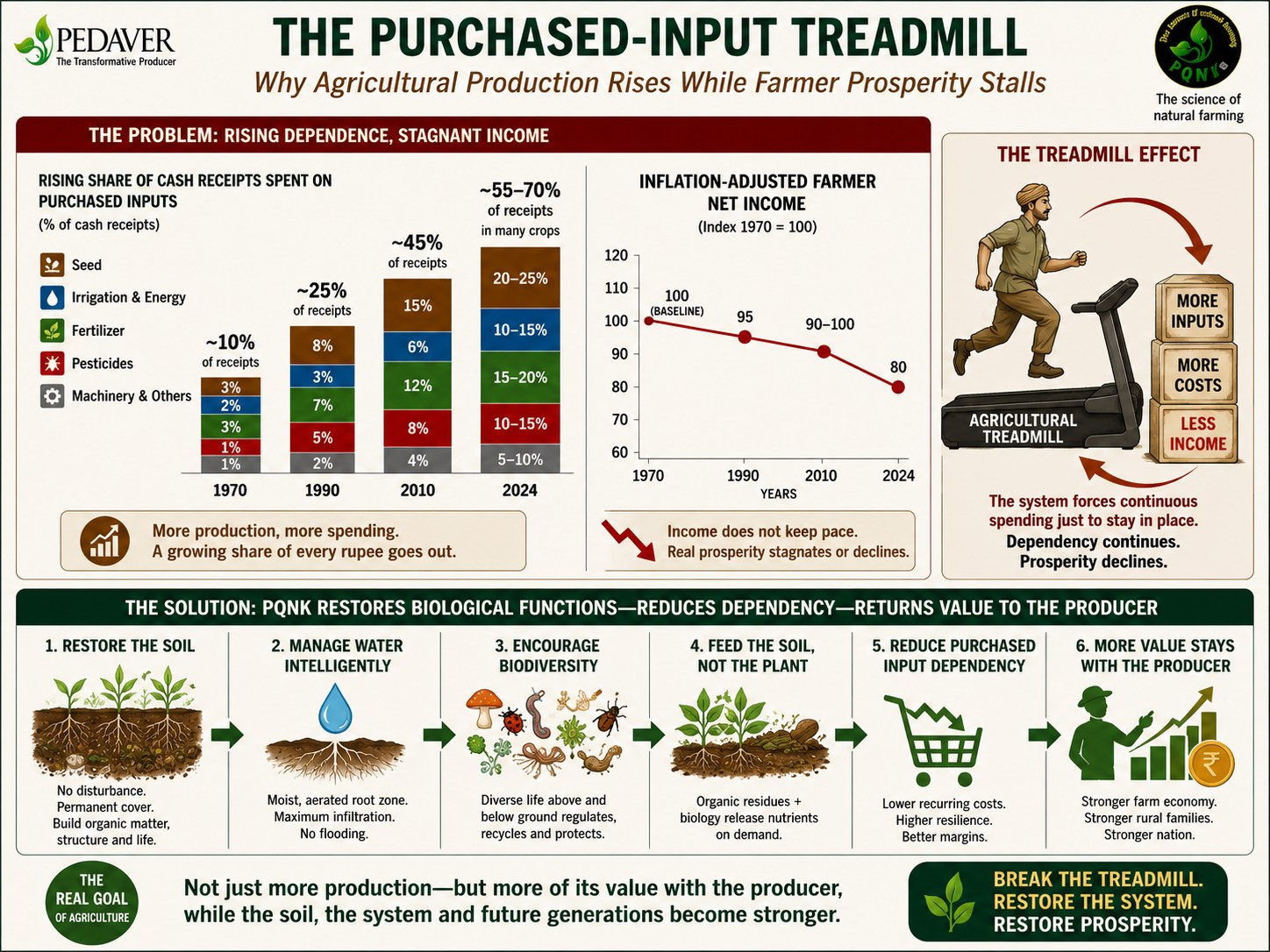
The accompanying infographic illustrates input dependence as rising from roughly 10% of cash receipts in 1970 to 55–70% or more today.
That is a useful conceptual representation, but it should not be mistaken for a single measured global historical series.
Agriculture is too heterogeneous for such a universal numerical progression.
Cotton is not wheat. Potato is not rain-fed millet. Pakistan is not the United States. A highly mechanized irrigated farm has a different cost structure from a smallholder relying mainly on family labour.
Even within one crop, input shares change with fertilizer prices, diesel prices, commodity prices, yield, weather and interest rates.
The scientifically defensible statement is therefore:
Across input-dependent production systems, purchased production costs can absorb a large and sometimes increasing proportion of crop value, and sharp increases in input prices can substantially compress farmer margins.
The treadmill is real.
That correction actually strengthens the argument because PQNK does not need exaggerated numbers to establish its economic case.
5. Industrial Agriculture Changed More Than Inputs
The deeper transformation was not simply that farmers began buying fertilizer and pesticides.
Agriculture progressively transferred functions from the ecosystem to external products.
Natural nutrient cycling became fertilizer procurement.
Biological pest regulation became pesticide programs.
Ecological weed regulation increasingly became herbicide dependence.
Soil architecture became repeated tillage and mechanical reconstruction.
Seed regeneration increasingly became recurring commercial seed purchase in many crops.
Natural soil-moisture buffering was replaced in many systems by increasingly intensive irrigation management.
As more functions moved outside the farm ecosystem, more of the production process became monetized.
The farmer began purchasing not merely products but substitutes for ecological functions.
This distinction is central to the PQNK economic argument.
6. Why High Yield Can Hide Economic Weakness
A crop can yield extremely well and still leave the farmer economically vulnerable.
The reason is simple:
Yield measures biological output. It does not measure retained economic value.
The production manager ultimately needs to know:
Gross value of production − recurring purchased inputs − machinery and energy − finance − labour and other production costs = economic value retained
A technology that raises output by 10% but increases recurring cost by 20% may be agronomically impressive and economically harmful.
Conversely, a system producing the same yield with dramatically lower recurring expenditure creates a major economic gain even though a conventional yield comparison might describe it as “no improvement.”
Therefore agricultural progress needs another metric:
How much net value does the production system retain for the producer per unit of land, water and time?
7. The Ratchet Effect
Purchased-input dependence also contains a ratchet.
Once a farming system has been reorganized around external inputs, abruptly removing them does not necessarily restore natural production.
A biologically impaired soil does not recover merely because fertilizer is stopped.
A compacted field does not become structurally healthy because tillage is abandoned tomorrow.
A simplified biological system does not instantly regenerate pest regulation because spraying stops.
This is why farmers can become trapped.
The existing system requires external support, while withdrawing the support before restoring biological function can reduce production.
The farmer therefore concludes:
“I cannot farm without these inputs.”
Under the existing degraded production architecture, he may temporarily be correct.
But that does not demonstrate that crops biologically require the commercial input system.
It demonstrates that the farm's internal functional capacity has been weakened and has not yet been restored.
This is precisely why PQNK has a transition architecture rather than simply instructing farmers to stop inputs.
8. Subsidizing the Treadmill Does Not Remove It
Governments frequently respond to rising production costs by subsidizing fertilizer, seed, electricity, credit or machinery.
Such measures can provide genuine short-term relief to farmers.
But economically there is an important distinction between:
making an input cheaper
and
making the production system less dependent upon that input.
The first changes who pays part of the bill.
The second changes why the bill exists.
Punjab itself has used input-subsidy programs to reduce farmers' costs and encourage changes in seed, fertilizer use and crop choice. Such programs can improve farm economics in particular circumstances, but they remain interventions within an input-purchasing architecture.
PQNK asks the more fundamental question:
Can the productive function itself be returned to the farm ecosystem?
9. PQNK Is Not Cheap-Input Agriculture
This point requires emphasis.
PQNK should not be understood as:
chemical fertilizer → cheaper organic fertilizer pesticide → botanical pesticide commercial stimulant → microbial bottle expensive input → cheaper input.
That would leave the treadmill intact.
Only the supplier would change.
PQNK's larger objective is:
externally purchased function → internally regenerated ecosystem function
The difference is profound.
Instead of continually purchasing fertility, restore nutrient cycling and biological access to the geological mineral reserve.
Instead of continually purchasing soil reconstruction through tillage, establish permanent soil architecture.
Instead of repeatedly destroying and recreating beds, create them once and protect them.
Instead of inundating soil according to an irrigation calendar, manage the moisture condition of the root zone.
Instead of treating insects as an isolated chemical-control problem, restore biodiversity and biological regulation.
The economics emerge from the biology.
10. The Farm Becomes Productive Capital
Under a purchased-input system, much expenditure disappears with the crop cycle.
The fertilizer was used.
The pesticide was sprayed.
The diesel was burned.
The tillage operation is finished.
Next season much of it must be purchased again.
Under a biologically rebuilding system, management expenditure should increasingly create productive capacity that remains.
Better aggregation remains.
Root channels remain.
Permanent beds remain.
Biological populations reproduce.
Residues become future food for the soil system.
Organic matter contributes to continuing water and nutrient regulation.
Mycorrhizal networks recolonize.
The productive asset is therefore increasingly the functioning farm ecosystem itself.
This is a fundamentally different economic model.
11. The Transition Is an Investment, Not Instant Zero Cost
PQNK should not promise that all costs disappear on the first day.
Transition itself has costs.
Farm layout may need correction.
Hardpan may require one-time breaking.
Permanent raised beds must be established.
Machinery may need adaptation.
Residues and mulch must be managed.
Biology needs time to recover.
There may even be carefully limited nutritional or crop-protection interventions while the biological system is recovering.
But these expenses should be judged differently from a permanently recurring input program.
A useful economic distinction is:
Restorative investment builds future farm capacity.
Dependency expenditure must recur merely to keep the current system operating.
The direction of PQNK should therefore be:
high initial restoration where necessary → declining recurring dependency → increasing internal biological function.
12. Pakistan and the Purchased-Input Problem
The issue is particularly relevant to Pakistan because farm economics is exposed simultaneously to fertilizer prices, diesel and electricity costs, irrigation constraints, machinery costs, credit, seed prices and volatile crop markets.
Pakistan's agriculture also consists overwhelmingly of relatively small farms; the World Bank has noted that approximately 91% of Punjab farmers operate holdings below 12.5 acres.
A small farmer has little capacity to absorb repeated shocks.
If the input bill rises by Rs. 20,000 per acre, a large enterprise may have financing options.
For a smallholder, the same increase can consume household savings, force borrowing or determine whether the next crop is planted at all.
Therefore reducing structural production dependency is not merely an environmental issue.
It is a farmer-survival issue.
13. The Correct Measure of Agricultural Progress
The Green Revolution taught agriculture to celebrate:
yield per acre.
PQNK requires a broader accounting system.
A production system should be judged by at least:
yield and quality, cost of production, net producer income, water consumed, energy consumed, recurring purchased-input dependency, soil biological capacity, soil physical condition, nutritional value of produce, and the productive condition of the farm left for the next crop.
The last measure is especially important.
If a farmer harvested 60 maunds but left the soil poorer, more compacted, more chemically dependent and more expensive to farm next year, part of that apparent income was obtained by liquidating biological capital.
If another production system harvests competitively while leaving the soil more functional and the next crop less dependent on external purchase, it has created capital.
Agricultural economics rarely puts those two farms on the same balance sheet.
It should.
14. From Gross Production to Farmer Prosperity
This leads us to perhaps the most important economic distinction in PQNK:
Food production and farmer prosperity are not the same measurement.
A country can report record wheat production while wheat farmers lose money.
It can produce more cotton while growers leave cotton cultivation.
It can achieve impressive yields while requiring subsidies merely to keep the production system economically tolerable.
That is why national agricultural success should not be measured only by tonnes produced.
We must also ask:
Who captured the value created by those tonnes?
Seed company?
Fertilizer manufacturer?
Chemical supplier?
Fuel supplier?
Machinery owner?
Bank?
Trader?
Or producer?
A functioning food economy requires all legitimate participants to receive value.
But the biological producer cannot remain the residual claimant who accepts whatever value remains after everybody else has been paid.
15. The PQNK Economic Proposition
PQNK therefore makes an economic proposition alongside its biological one:
Restore internally generated productive functions so that a progressively larger share of agricultural value remains with the producer rather than being continuously exported from the farm through avoidable recurring dependency.
This is not opposition to commerce.
Farmers will always purchase machinery, services, knowledge, equipment and materials where these create genuine economic value.
The distinction is between productive exchange and structural dependency.
The test is simple:
Does this expenditure make the farm more capable of functioning independently next season, or does it guarantee that the farmer must purchase essentially the same function again?
That question should be asked of every agricultural input.
16. Breaking the Treadmill
The Purchased-Input Treadmill cannot finally be broken by cheaper fertilizer, a new pesticide molecule or another subsidy.
Those may change the speed of the treadmill.
They do not necessarily remove it.
The treadmill begins to disappear when the production architecture changes.
When soil remains undisturbed.
When it remains covered.
When water and air are managed together rather than repeatedly flooding and drying the root zone.
When biodiversity returns.
When living roots maintain relationships with soil biology.
When residues remain resources rather than waste.
When permanent production architecture replaces seasonal reconstruction.
When biology progressively resumes functions for which farmers had become accustomed to paying outsiders.
That is where ecology becomes economics.
Conclusion: The Farmer Must Keep More of the Value He Creates
The agricultural challenge is often framed as:
How do we produce more?
That question is incomplete.
The more important question is:
How do we produce abundantly while allowing the producer, the soil and the production system itself to become stronger rather than more dependent after every crop?
Purchased inputs are not automatically wrong.
Nor does eliminating an input automatically make a production system correct.
The real issue is the architecture of dependency.
A system requiring increasingly costly external intervention to sustain itself places the farmer on a treadmill.
A system that progressively restores internal biological function creates productive independence.
PQNK therefore changes the economic objective from:
maximum production through purchased inputs
to:
maximum biological performance with minimum recurring external dependency, while retaining greater value with the producer.
That is the economic meaning of moving from industrial agriculture to a natural ecosystem production system.
And that is ultimately how the treadmill is broken:
Restore the soil. Restore the system. Restore the farmer.
Evidence note for the accompanying infographic
I recommend we revise one part of the infographic before attaching it to this paper. The 10%, 25%, 45%, 55–70%historical bars and the accompanying farmer-income index should be labelled “illustrative pattern” unless we can trace each number to a defined dataset. They should not say “measured, quantified” as presently written.
The evidence behind the general argument is strong. USDA directly defines farm profitability through receipts minus production expenses, documents historically elevated recent production expenses, and provides crop-specific evidence of major purchased-input cost shares.
I would rather publish a slightly more conservative infographic attached to a scientifically unassailable paper than preserve impressive numbers that an economist could legitimately challenge.
——————————
Applying PQNK without understanding nature’s operating system will not deliver abundance, stability, or nutrient density.
PQNK (pronounced “picnic”)—the regenerative & sustainable Pristine Organic Farming System—is grounded in Natural Ecosystem Science. This science employs perennial biodiversity, protects soil with organic mulch, and avoids practices such as water inundation, tillage disturbance, and leaving soil bare.
It is the process that matters most. PQNK is a pristine production system designed not merely for yield, but for optimal, balanced output—where quality, sustainability, and ecological harmony emerge from a self‑regulated, zero‑external‑input methodology.
Connect & Resources
Pedaver.Com Facebook: www.Facebook.Com/Pedaver YouTube (PQNK): https://www.youtube.com/@pedaverpqnk3167/videos YouTube: http://www.youtube.com/@aasifsharif PDF Knowledge Papers: https://drive.google.com/drive/folders/1iadwV6mdUPyrUIpB3oRfNv6DLiackaUL?usp=sharing Email: [email protected] WhatsApp: +92 320 677 6666
About This Paper
- Problem
- High Input / Production Cost · External Input Dependency · Farmer Income Instability / Debt
- Science
- Economics · Production Architecture · Transition
- Evidence
- Economic Model/Projection
- Authority
- Current / Approved PQNK Knowledge
Related PQNK Science
Key Takeaways
- The Purchased-Input Treadmill: a production architecture where functions the farm ecosystem once performed for itself, nutrient cycling, pest control, soil structure, are replaced by purchased inputs that must be bought again every season just to sustain the same output.
- Yield measures biological output, not retained economic value — two farms producing identical yield can leave their farmers in entirely different financial positions depending on what it cost to get there.
- The ratchet effect explains why farmers can't simply stop buying inputs: a biologically impaired soil doesn't recover the moment fertilizer stops, which is exactly why PQNK uses a staged transition rather than an instant switch-off.
- PQNK is not cheap-input agriculture — swapping a chemical fertilizer for an organic one, or a synthetic pesticide for a botanical one, only changes the supplier and leaves the treadmill intact. The real shift is externally purchased function replaced by internally regenerated ecosystem function.
- Subsidizing an input changes who pays for it, not why the farm still needs it — the paper distinguishes making an input cheaper from making the production system less dependent on it.
- With roughly 91% of Punjab's farmers on holdings under 12.5 acres, reducing recurring input dependency isn't an environmental preference — for a smallholder with little capacity to absorb a cost shock, it can determine whether the next crop gets planted at all.
Related Crops
Related Knowledge
same problem
The Farmers' Crisis Will Not Be Solved by Another Support Price: Why Pakistan's Farmers Must Reduce Cost, Improve Quality and Build Independence Through PQNK
A nationwide farmers' association's press conference voiced real distress over diesel, fertiliser, wheat and sugarcane policy, and the danger that one failed crop leaves a farmer unable to finance the next. This paper argues that distress is real but the standard remedy, another support price or subsidy, cannot be the permanent foundation of farm viability, because it exchanges biological dependence for political dependence. PQNK reframes the question: since a farmer cannot control the market price, government policy, rainfall or the exchange rate, his strongest and most durable defence is progressively lowering his own cost of production by restoring the soil's biological functions, while building resilience to climate shocks and competing through demonstrable produce quality.
same problem
Knowledge Paper: Liberating Pakistan's Economy — The Unforgivable Neglect of the PQNK Revolution
An economic manifesto arguing that four decades of IMF- and World Bank-prescribed austerity have failed Pakistan because they address fiscal symptoms while ignoring the one lever that actually creates new value: farm productivity. It positions PQNK as the productivity shock capable of turning Pakistan's underused agricultural workforce into its greatest economic asset.
same problem
Chemical Fertiliser Dependency Through the PQNK Lens
An evidence-qualified review of the article “Chemical Fertilizer Industry”. It keeps the article's warning about soil degradation, nutrient pollution and biological decline, disciplines its headline numbers, and argues that fertiliser dependency is a symptom of a damaged production system (tillage, flooding, bare soil and simplified biology) that PQNK removes by restoring aerated, covered, living soil, reaching zero purchased fertiliser and pesticide at maturity.
same problem
Transforming Pakistan's Sugar Industry Through the PQNK (Pristine Organic Farming) System
Pakistan's sugar sector runs on a decades-old cycle of farmer exploitation, long-haul cane transport, and volatile supply. This paper proposes concentrating high-yield PQNK sugarcane cultivation within a 10-15 km radius of each mill, and models the profit, sugar-recovery, and crushing-season gains that follow.