
KP-205 · PQNK Philosophy, Framework & Economics
Beyond the Traditional Cooperative
Argues that smallholders need a third structure between the traditional cooperative and the corporation: individual land ownership and accountability combined with professional production management, machinery services, risk protection, processing and collective market power. Draws on cooperative, machinery-service, land-reform and price-reform experience in Yugoslavia, Pakistan, India and Scandinavia to propose the farmer-owned Crop Production Management Company (CPMC) as the institutional vehicle for PQNK.
Read or listen to the full paper ↓Abstract
Agricultural development is often framed as a choice between the cooperative and the corporation. This paper argues that smallholders need a third structure: one that keeps individual land ownership and accountability while supplying professional production management, machinery services, risk protection, processing and collective market power. PQNK provides the production system; the proposed Crop Production Management Company (CPMC) provides the institutional structure through which smallholders can implement it.
The central weakness of collective ownership is accountability. Cooperative systems observed in Yugoslavia, and those promoted in Pakistan during the 1970s, struggled because common machinery was used by everyone but maintained and replaced by no one, and because larger farmers often gained control of societies meant to serve smallholders. A better machinery model kept ownership, operation and replacement responsibility together in one accountable entrepreneur who serves other farmers, the pattern now visible in private laser-levelling, tractor, thresher and combine-harvester services. Under PQNK this matters even more, because permanent raised beds, controlled traffic and precision seed placement depend on properly designed machinery and skilled operators.
Land reform and price reform add two further lessons. Indian land ceilings pushed owners into hands-on farming, while concentrated holdings in Pakistan often separated ownership from production, leaving decisions to untrained supervisors; yet India's subsidised inputs also show that engagement without an understanding of the living production system can damage soil and groundwater. When Pakistan linked agricultural prices more closely to international markets in the mid-1990s, proposed Farmers' Facilitation Centres and a Commodity Exchange, built around the principle of "sell before you produce", were meant to supply the knowledge, machinery and market access that price reform alone could not; they never materialised.
Successful cooperatives such as Swedish farmer cooperatives and India's Amul leave production with the individual and create scale after harvest through aggregation, processing and marketing. The CPMC applies this to PQNK crop production, which also requires field conversion, precision machinery and whole-cycle management: farmers retain their land, accountable entrepreneurs supply machinery, trained Production Managers supervise implementation, and the farmer-owned company manages risk, aggregates produce, adds value and develops markets. Proposed during farmer training in May 2026 and paused for lack of sufficient farmer commitment, it remains, in the author's view, the most practical institutional route to smallholder prosperity.
Full Paper
If you use “Listen”, the text of the page may be sent to your browser or operating system’s speech provider, such as Apple, Google or Microsoft, depending on the voice your device uses. Pedaver does not process, transmit or store any audio.
Agricultural development is often presented as a choice between the cooperative and the corporation. Smallholders need a third structure: one that preserves individual ownership and accountability while providing professional production management, machinery services, risk protection, processing and collective market power.
1. The Central Problem of Collective Ownership
In 1980, I visited Yugoslavia specifically to study its cooperative system while Marshal Tito was still leading the country. Despite strong state support, I found that the system was not functioning particularly well.
The fundamental weakness was accountability. People generally care for an asset they personally own more diligently than one owned collectively. Common machinery may be used by everyone, but responsibility for maintaining, repairing and eventually replacing it is often accepted by no one.
Pakistan encountered a similar problem when agricultural cooperatives were promoted during the 1970s. In addition to weak responsibility for common assets, larger farmers frequently gained control of cooperative societies. Smallholders, for whose benefit these organisations were supposedly established, received little benefit, if any.
The failure was not caused by cooperation itself. It resulted from an unsuitable division of ownership, responsibility and power.
2. A Better Machinery Service Model
A different arrangement was subsequently tested. Members of a farming society pooled funds to purchase a tractor, planter or harvester, but one member assumed ownership and full responsibility for the machine.
The owner operated, maintained and eventually replaced the equipment while providing services to the other members. Rental payments recovered the value of the asset, while the owner retained the operating cost and a reasonable return. This arrangement performed better because ownership, operational responsibility and accountability for replacement remained together.
Later, with the assistance of the Agricultural Development Bank of Pakistan, now ZTBL, agro-machinery rental services were expanded by financing combine harvesters for individuals and companies. The service model fulfilled its agricultural purpose, although the bank experienced difficulty recovering some loans.
The lesson is clear. Pakistan should train competent rural entrepreneurs and finance them to own, maintain and operate agricultural machinery as a service. Expensive machinery should not be placed under loosely defined collective ownership.
This model has already demonstrated its practicality. Laser land levellers, initially introduced through organised programmes, are now widely available through private service providers. Similar arrangements operate for tractors, threshers, rotavators, combine harvesters, haulage trolleys and other farm machinery.
A smallholder does not need to own every machine. The smallholder needs timely and affordable access to the correct machine, maintained properly and operated by a trained person.
Under PQNK, this requirement becomes even more important. Permanent raised beds, controlled traffic, precision seed placement and protection of the soil architecture require properly designed machinery and skilled operators. The Production Manager must understand the system, while the machinery entrepreneur must deliver the required operation without damaging the field.
3. Land Reform, Ownership and Farmer Engagement
The different agricultural histories of India and Pakistan offer another important lesson.
Land reforms introduced in India from the early 1950s attempted to weaken feudal control and imposed ceilings on agricultural holdings. These limits varied by state and according to land quality. In some categories of irrigated land, the permissible family holding was approximately 12.5 acres.
Smaller holdings compelled owners and their families to become directly involved in farming because the land had to support the household. This engagement encouraged closer supervision, greater familiarity with crops and more careful management of available resources. A significant part of India’s agricultural development was driven by owner-operators who remained physically and intellectually connected with their farms.
Pakistan did not experience land reform with the same reach or effectiveness. Agricultural land remained concentrated in many areas and continued to pass through inheritance. Owners frequently depended upon farm workers supervised by a munshi, who was normally an untrained farm manager.
This created a serious separation between ownership and production. Pakistan has many agricultural landowners, but comparatively fewer people who are personally engaged as knowledgeable, hands-on farmers. Decisions affecting the soil, water, crop and machinery are often delegated to workers without adequate scientific or technical training.
India’s experience also demonstrates that personal engagement alone is insufficient. Subsidised agrochemicals, electricity and irrigation water eventually encouraged excessive fertiliser, pesticide and water use in many intensively cultivated regions. In several areas, this dependency has damaged soil structure, biological activity, groundwater and long-term productivity, sometimes more visibly than in comparable parts of Pakistan.
The lesson is not simply that farms should be small. The owner must be engaged, and that engagement must be guided by an understanding of the living production system. PQNK requires the landowner or responsible operator to become a trained Production Manager, not merely an investor, absentee owner or purchaser of inputs.
4. Price Reform and the Missing Farmer Institutions
A major opportunity emerged in Pakistan during 1994–95, when the Agricultural Prices Commission was abolished and agricultural prices were linked more closely with international markets.
Produce prices increased substantially. Production costs remained largely local, while market prices reflected international values. This created the potential for agriculture to become an engine of rural prosperity.
Price reform alone was insufficient. Farmers also required knowledge, machinery, production planning and organised access to markets. We therefore proposed Farmers’ Facilitation Centres to:
• educate and train farmers;
• provide technical and production guidance;
• arrange machinery on rent;
• connect farmers with specialised services;
• develop marketing channels; and
• improve access to market information.
This was also when the principle of “sell before you produce” came under consideration. Farmers normally produce first and search for a buyer after harvest, when the crop may be perishable, debts are due and bargaining power is weakest. The proposed alternative was to identify demand, buyer, quality, quantity and indicative price before committing land and resources to production.
A Commodity Exchange was therefore planned as a mechanism through which farmers could understand demand, secure buyers and manage price risk before planting. A change of government prevented both the Farmers’ Facilitation Centres and the Commodity Exchange initiative from materialising. The institutional gap they were intended to fill remains largely unresolved.
5. What Successful Cooperatives Actually Do
The most mature farmer cooperatives are not necessarily those that place all productive assets under common ownership.
During visits to Scandinavia, I observed that successful Swedish farmer cooperatives generally concentrated on collecting produce, processing it, adding value and marketing it. Individual farmers retained responsibility for their land and production, while the cooperative created scale after harvest.
Amul in India represents a comparable producer-owned model. Milk producers retain their animals and production responsibility. Their organisation aggregates the milk, maintains quality systems, processes it into higher-value products and markets those products through a powerful common brand.
Production requires personal responsibility. Processing and marketing benefit from collective scale.
The principle can be applied to food crops, but it must be adapted to the realities of crop production. Unlike daily milk collection, PQNK crop production requires field conversion, technical knowledge, precision machinery, biological understanding and management over an entire production cycle. The first challenge is therefore not selling the produce. It is producing it correctly and consistently.
6. The Unmanaged Risk of the Smallholder
Smallholders have very limited capacity to absorb failure. One unsuccessful crop, machinery breakdown, extreme weather event, pest outbreak or marketing disruption can destroy years of savings and force the farmer into debt.
Any programme asking a smallholder to adopt a new production system must therefore address risk directly. Training alone is insufficient. Machinery alone is insufficient. Credit alone may increase vulnerability if the production and marketing systems remain weak.
The farmer needs an integrated structure providing correct field planning, trained Production Managers, precision machinery services, implementation supervision, transitional finance, crop-risk protection, production records, pre-production market planning and assured channels for aggregation, processing and sale.
7. The Crop Production Management Company
During farmer training in May 2026, I proposed the incorporation of a Crop Production Management Company, or CPMC, owned entirely by participating farmers.
The CPMC was not conceived as a traditional cooperative holding machinery that everyone uses but no one adequately maintains. Nor was it designed as an outside corporation taking control of farmers’ land. It was conceived as a professionally managed, farmer-owned production institution.
Each farmer would retain ownership and control of the land. Machinery would be supplied through accountable service entrepreneurs or specialised operating divisions. Professional Production Managers would organise and supervise implementation. The company would aggregate produce, manage quality, develop processing and marketing channels, and negotiate from a position of scale.
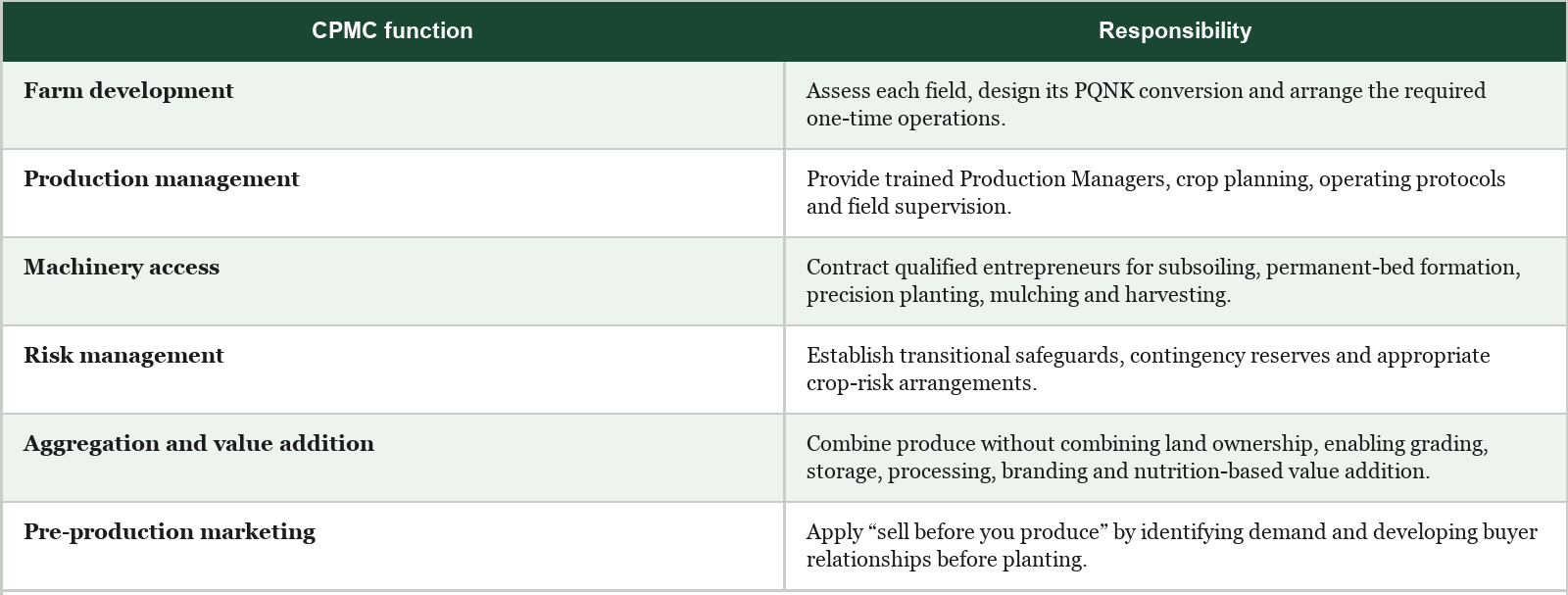
| CPMC function | Responsibility |
|---|---|
| Farm development | Assess each field, design its PQNK conversion and arrange the required one-time operations. |
| Production management | Provide trained Production Managers, crop planning, operating protocols and field supervision. |
| Machinery access | Contract qualified entrepreneurs for subsoiling, permanent-bed formation, precision planting, mulching and harvesting. |
| Risk management | Establish transitional safeguards, contingency reserves and appropriate crop-risk arrangements. |
| Aggregation and value addition | Combine produce without combining land ownership, enabling grading, storage, processing, branding and nutrition-based value addition. |
| Pre-production marketing | Apply “sell before you produce” by identifying demand and developing buyer relationships before planting. |
The proposal was pursued, but the initiative was paused because sufficient farmer interest and commitment did not develop at that stage. Nevertheless, the underlying need has not disappeared. In my considered opinion, the CPMC remains the most practical institutional solution for economically liberating smallholders.
8. The PQNK Institutional Model
The appropriate structure is neither complete individual isolation nor uncontrolled collective ownership. It combines responsibility at the level where responsibility works best.
The structure should combine secure individual land ownership, direct involvement of the owner or accountable Production Manager, professional PQNK training, individually owned machinery-service enterprises, trained operators, affordable implementation finance, transitional production-risk protection, transparent production records, pre-production marketing, farmer-owned value addition and collective bargaining without surrendering individual land.
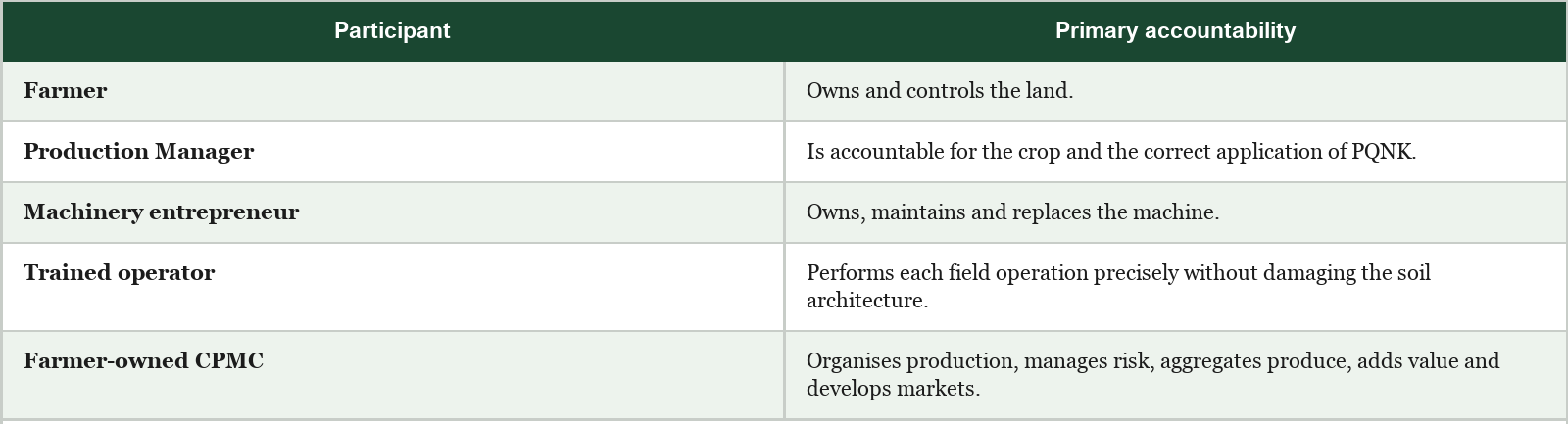
| Participant | Primary accountability |
|---|---|
| Farmer | Owns and controls the land. |
| Production Manager | Is accountable for the crop and the correct application of PQNK. |
| Machinery entrepreneur | Owns, maintains and replaces the machine. |
| Trained operator | Performs each field operation precisely without damaging the soil architecture. |
| Farmer-owned CPMC | Organises production, manages risk, aggregates produce, adds value and develops markets. |
9. Conclusion
Smallholders will not be protected merely by opposing corporate farming, nor will they prosper by repeating traditional cooperative structures that have already failed them. They require a system that joins ownership with responsibility and cooperation with professional management.
PQNK restores the natural production system. Machinery-service entrepreneurs make precision implementation accessible. The CPMC provides the management, risk protection, aggregation, processing and market power that individual smallholders cannot create alone.
Individual ownership and accountability should drive land management, production and machinery services. Farmer-owned collective strength should provide professional management, risk protection, processing, value addition and market power.
This preserves the farmer’s land and independence while providing the knowledge, machinery, protection and commercial strength required for genuine prosperity. It is not a cooperative in the conventional sense, and it is not corporate farming imposed from outside. It is a professionally managed production and market system owned by the farmers themselves.
Sources and Evidence Basis
Author’s first-hand observations: cooperative systems in Yugoslavia (1980) and Scandinavia; agricultural cooperatives, machinery-service and price-reform experience in Pakistan; PQNK farmer training (May 2026).
Zarai Taraqiati Bank Limited (ZTBL), formerly the Agricultural Development Bank of Pakistan: agro-machinery finance.
Gujarat Cooperative Milk Marketing Federation (Amul): producer-owned dairy aggregation, processing and marketing model.
PQNK field framework and governing principles: Pedaver / PQNK knowledge system.
About This Paper
- Problem
- Farmer Income Instability / Debt · Price Volatility / Market Glut · Untrained Labor / Management · Machinery / Field-Operation Decision Difficulty · External Input Dependency · Macro / Policy-Level Externalities
- Science
- Production Architecture · Economics · Transition
- Evidence
- Philosophical/Framework Argument
- Authority
- Current / Approved PQNK Knowledge
Related PQNK Science
Key Takeaways
- Smallholders need neither isolation nor loosely held collective ownership, but a structure that joins individual ownership and accountability with professional management and collective market power.
- Collective ownership of machinery fails mainly on accountability; ownership, operation and replacement responsibility should stay together in one accountable service entrepreneur.
- PQNK's permanent beds, controlled traffic and precision planting make trained operators and properly maintained machinery essential, not optional.
- Owner engagement matters, but it must be guided by an understanding of the living production system, as India's experience with subsidised inputs shows.
- Successful cooperatives such as Amul keep production individual and create scale after harvest through aggregation, processing and marketing.
- "Sell before you produce" means identifying demand, buyer, quality, quantity and indicative price before committing land and resources.
- The farmer-owned Crop Production Management Company (CPMC) is proposed as the institutional vehicle that lets smallholders implement PQNK with management, risk protection and market power they cannot build alone.
Related Knowledge
same problem
The Farmers' Crisis Will Not Be Solved by Another Support Price: Why Pakistan's Farmers Must Reduce Cost, Improve Quality and Build Independence Through PQNK
A nationwide farmers' association's press conference voiced real distress over diesel, fertiliser, wheat and sugarcane policy, and the danger that one failed crop leaves a farmer unable to finance the next. This paper argues that distress is real but the standard remedy, another support price or subsidy, cannot be the permanent foundation of farm viability, because it exchanges biological dependence for political dependence. PQNK reframes the question: since a farmer cannot control the market price, government policy, rainfall or the exchange rate, his strongest and most durable defence is progressively lowering his own cost of production by restoring the soil's biological functions, while building resilience to climate shocks and competing through demonstrable produce quality.
same problem
Chemical Fertiliser Dependency Through the PQNK Lens
An evidence-qualified review of the article “Chemical Fertilizer Industry”. It keeps the article's warning about soil degradation, nutrient pollution and biological decline, disciplines its headline numbers, and argues that fertiliser dependency is a symptom of a damaged production system (tillage, flooding, bare soil and simplified biology) that PQNK removes by restoring aerated, covered, living soil, reaching zero purchased fertiliser and pesticide at maturity.
same problem
Knowledge Paper: The PQNK Imperative — Re-Mothering Our Agriculture through the Pristine Organic System
This paper reframes a century of input-intensive farming as a severed relationship between plant and soil, using the metaphor of 'Soil as Mother' to argue that the Green Revolution orphaned crops by feeding them directly rather than nurturing the system that was designed to feed them. It closes with a policy agenda for 're-mothering' agriculture through machinery subsidies, farmer training, and GMO safeguards.
same problem
Addressing the Critical Gap of Untrained Farm Workforce for Sustainable Agricultural Advancement in Pakistan
This policy note argues Pakistani agriculture is bottlenecked not by strategy but by execution, citing 10-20% grain losses from untrained combine harvester operators and a complete absence of formal training for two critical roles, Farm Production Managers and Machinery Operators, and calls for their formal certification within national agricultural policy.