

Industrial Devastation To Natural Abundance
Extended Knowledge · Chapter 61
When Mulch Becomes a Barrier
Why Mulch Must Breathe
Release 1.0 · 2026-10-27
If you use “Listen”, the text of the page may be sent to your browser or operating system’s speech provider, such as Apple, Google or Microsoft, depending on the voice your device uses. Pedaver does not process, transmit or store any audio.
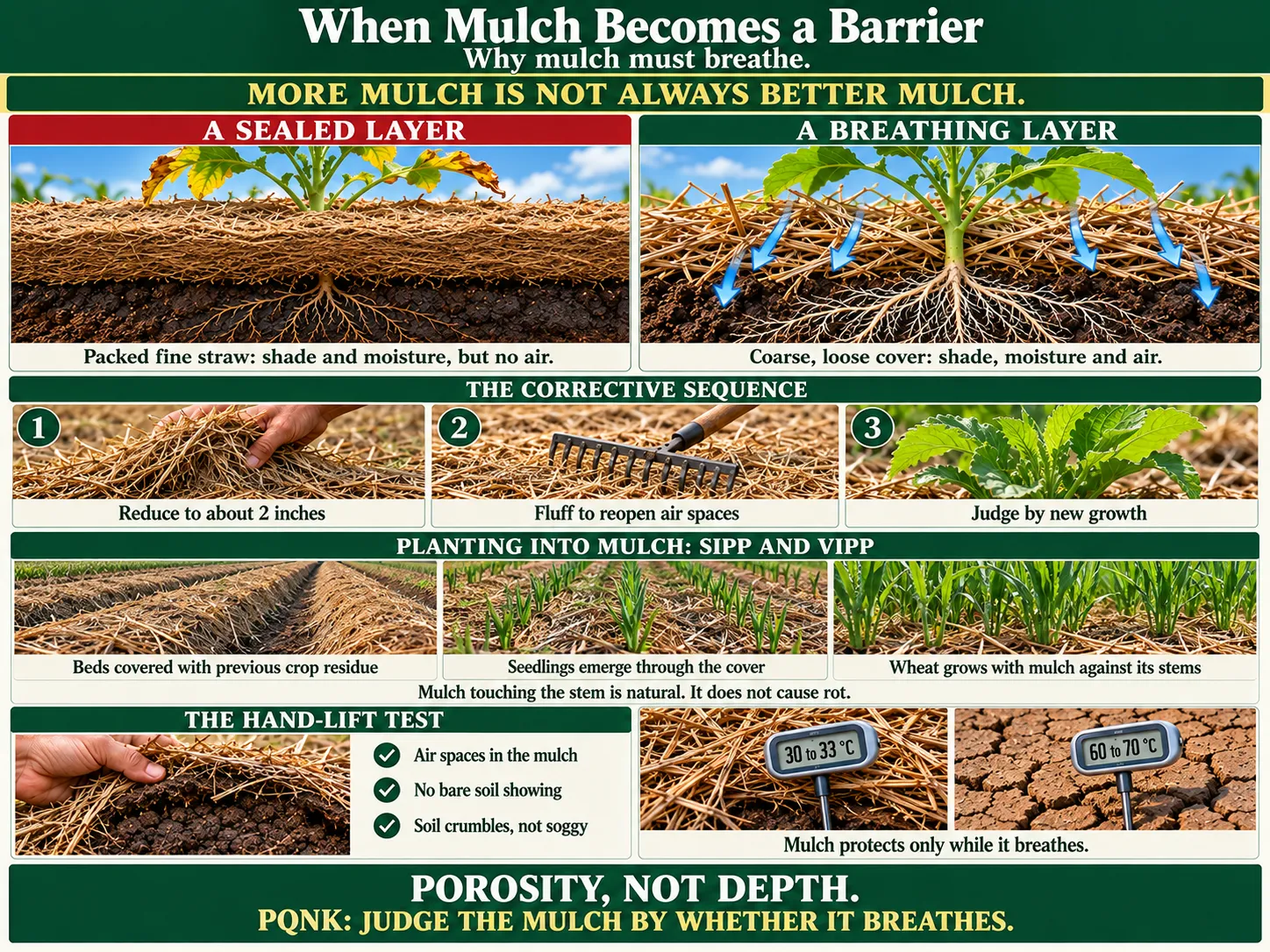
When Mulch Becomes a Barrier: judge the mulch by whether it breathes, not by its depth.
“More mulch is not always better mulch. A layer thick enough to seal the soil against the atmosphere protects nothing. It suffocates exactly what it was applied to keep alive.”
Asif Sharif, Lahore, 2026
A FARMER'S REPORT: DAMAGE UNDER DEEP MULCH
A farmer transitioning to PQNK reported leaf discoloration and apparent burning on a crop growing beneath eight to nine inches of finely chopped wheat straw, an unusually thick application, applied in good faith on the correct assumption that PQNK favours heavy organic cover. The soil beneath remained shaded and, by every check he performed, moist. The symptoms nonetheless matched the visible signature of stress rather than health, and the farmer, reasonably, concluded that something about the mulch itself was the cause.
The diagnosis traced the problem not to the depth of the layer but to what finely chopped straw does at that depth: it packs. Coarse, loosely arranged residue holds interconnected air spaces the way a haystack does, gaps large enough for gas exchange to continue between the soil and the atmosphere above it. Finely chopped material, particularly under its own weight at eight or nine inches, settles and compresses into something closer to a felted mat than a breathable blanket. The visible shading and the measured surface moisture were both present and both correct. Neither one measures whether the root zone beneath is still exchanging oxygen with the air above it, and in this field, it had stopped.
TWO THINGS A PLANT NEEDS, AND WHY LEAF SYMPTOMS ALONE CANNOT TELL THEM APART
This case illustrates a diagnostic trap that recurs throughout PQNK practice: a root requires both water and oxygen, and a plant showing visible stress can be missing either one, or both, while presenting symptoms that look identical from above ground. Leaf discoloration, wilting, and apparent burning are the plant's generic distress signal, not a specific report of which requirement has failed. A farmer who sees these symptoms and checks only soil moisture, finds it adequate, and concludes the mulch cannot be responsible has checked one of two variables and stopped. The oxygen question requires a different kind of check, one this chapter provides directly.
FUNCTIONAL POROSITY: THE VARIABLE THAT ACTUALLY MATTERS
PQNK defines mulch not simply as material covering soil, but as a porous biological cover: a layer that blocks solar radiation and buffers temperature while still permitting continuous gaseous exchange between the soil and the atmosphere. Depth is a poor proxy for this definition. A loosely arranged four-inch layer of coarse residue can be more functionally porous, and therefore more protective of root-zone oxygen, than a tightly packed eight-inch layer of finely chopped material. The determining variable is not how much material sits on the surface. It is whether that material has retained the interconnected air spaces that let gas move through it.
This has an immediate practical consequence for material selection and preparation. Chopping straw finely makes it easier to spread evenly and faster to decompose, both genuine advantages, but finely chopped material is also the material most prone to packing into a sealed layer under its own weight or under irrigation. Coarser, less processed residue resists packing precisely because its irregular geometry keeps particles from nesting tightly against one another. Neither material is wrong in every circumstance. What matters is monitoring the layer's actual porosity, not assuming that a given chopping method or application depth has automatically preserved it.
THE CORRECTIVE SEQUENCE
Where a mulch layer is suspected of having sealed rather than protected the root zone, PQNK specifies a direct corrective sequence rather than a wholesale removal of the cover the farmer has already invested in applying. Reduce the layer to approximately two inches, removing the excess material that was contributing to compaction rather than protection. Fluff the remaining layer by hand or with a light rake to physically reopen visible air spaces, restoring the loose architecture that a packed layer has lost. There is no need to pull the mulch back from the stems. Mulch resting against the stem and root collar does not cause rot; in natural vegetation, fallen litter lies against every stem. When the next crop is planted into the previous crop's residue with SIPP, the seedlings come up through the cover, and VIPP opens a space in the layer for each sprout to emerge. Judge recovery from new growth, not from the leaves that were already damaged before the correction was made; existing damaged tissue will not reverse, but new growth emerging after the correction is the honest indicator of whether the root zone has recovered its oxygen supply.
A FIELD TEST THE FARMER CAN PERFORM WITHOUT EQUIPMENT
PQNK reduces this entire diagnosis to a simple hand-lift test any farmer can perform in the field, in under a minute, on any bed. Lift a section of the mulch layer by hand. Visible air spaces throughout the material, rather than a dense, felted mass, indicate functional porosity. No exposed bare soil beneath, and no exposed bare soil visible from directly above the bed before lifting, confirms adequate coverage. The soil beneath should read as aerated, crumbling slightly under light pressure, rather than saturated or compacted. A layer that passes all three checks is functioning as designed, regardless of its exact depth. A layer that fails any of them is a candidate for the corrective sequence above, regardless of how recently or generously it was applied.
WHAT THIS CHAPTER HAS ESTABLISHED
Organic mulch is thermal and hydraulic infrastructure, and this book documents it holding the soil at 30 to 33 degrees Celsius in extreme heat, when bare, exposed soil passes 60 to 70 degrees (Chapter Thirty-Eight). That protective power depends entirely on the layer remaining porous. A farmer who reads "more mulch" as an unqualified instruction, without reading the layer's actual porosity, can convert PQNK's most protective practice into a cause of the same root-zone oxygen failure the practice exists to prevent. The corrective principle is simple enough to apply on every field, every season: judge the mulch by whether it breathes, not by how many inches of it are on the ground.
Chapter Sixty-Two: Why Only Four Kilograms of NP During Transition