
Industrial Devastation To Natural Abundance
Extended Knowledge · Chapter 60
The Farmer as the Ultimate Instrument
The Trained Senses as the Field’s Primary Laboratory
Release 1.0 · 2026-10-27
If you use “Listen”, the text of the page may be sent to your browser or operating system’s speech provider, such as Apple, Google or Microsoft, depending on the voice your device uses. Pedaver does not process, transmit or store any audio.
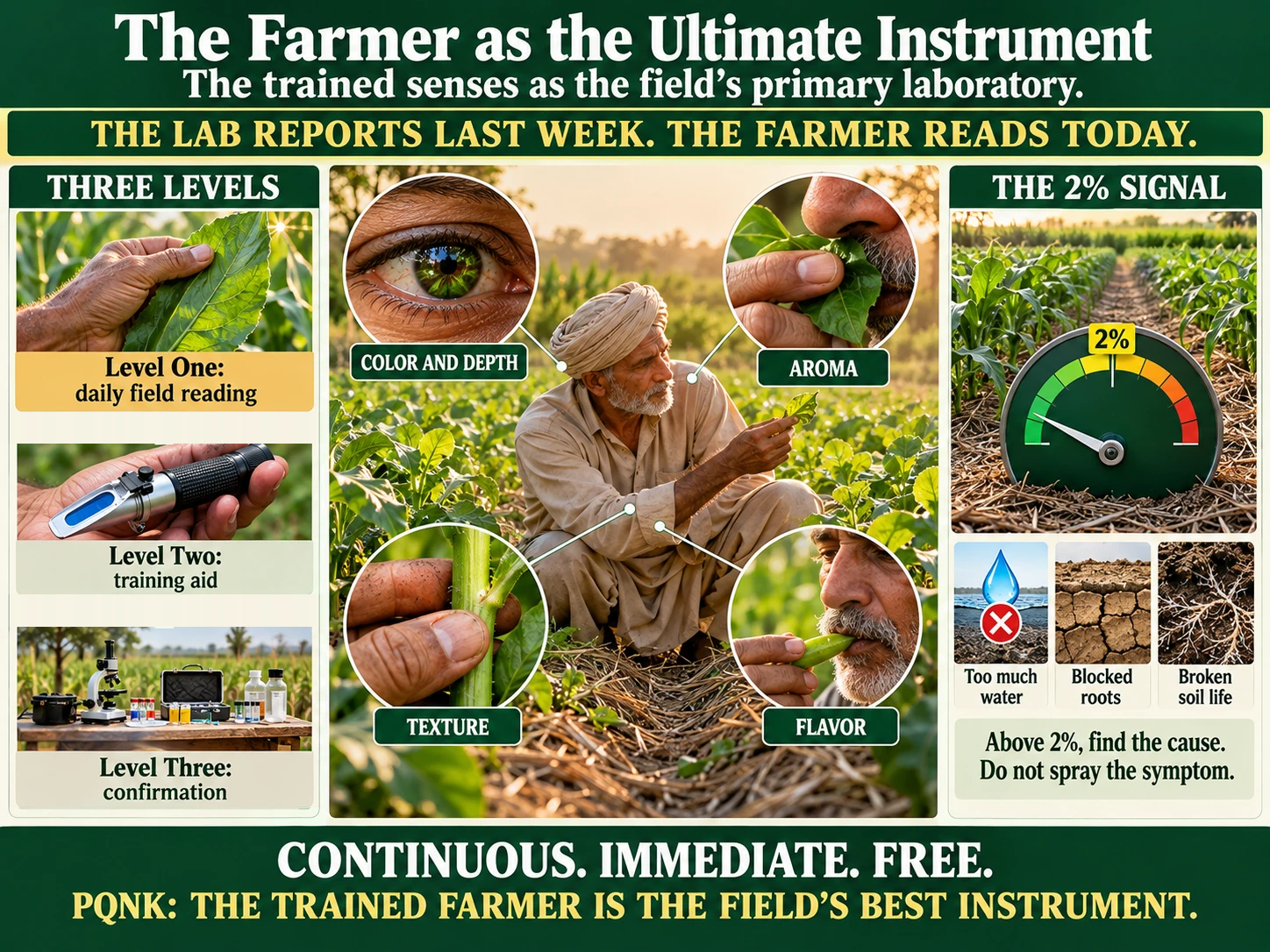
The Farmer as the Ultimate Instrument: the trained senses read the field in real time.
“A laboratory can tell you what a leaf contained last week. A trained farmer can tell you what his field is doing right now, and what it will do tomorrow. Only one of those readings arrives in time to act on.”
Asif Sharif, Lahore, 2026
BEYOND THE LABORATORY: WHY ASSESSMENT HAD TO CHANGE
Conventional agronomy assesses a field the way an accountant audits a company that has already closed for the year: a soil sample is drawn, sent away, and returned weeks later as a table of NPK values and a handful of micronutrients. A sap test does the same at a shorter interval, days rather than weeks, but it still describes a single, narrow window of chemistry extracted from a living, continuously changing system and interpreted after the moment it described has passed. Both instruments are useful. Neither was designed to manage a system whose most important failures, oxygen collapse in a waterlogged root zone, a hardpan blocking a mineral reserve the plant can no longer reach, a microbial bridge disrupted by a recent chemical application, develop and resolve on a timescale of days, not weeks.
PQNK does not reject laboratory analysis. It relocates it. In a mature PQNK system, the laboratory becomes a confirmatory instrument, used occasionally, at the community level, to confirm what the farmer's own senses have already told him. The primary instrument, the one that operates continuously, at zero cost, and with zero delay between observation and action, is the farmer himself: his trained eye, his trained nose, his trained hand, his trained palate. This chapter formalizes what that instrument measures, how it is trained, and why, once trained, it outperforms the tools that were supposed to replace it.
THE FARMER'S PRIMARY LAB: FOUR SENSORY PARAMETERS
PQNK identifies four sensory parameters as the farmer's primary diagnostic instrument, each one a direct, physical expression of an underlying biochemical condition in the plant.
Colour and luminous depth. A leaf's colour is not a single value but a depth: the difference between a flat, uniform green produced by rapid nitrogen-driven cell expansion and the layered, luminous green of a leaf whose chlorophyll development has kept pace with its structural growth. A farmer who has trained his eye on his own crop, season after season, reads this depth the way an experienced physician reads a complexion: not as decoration, but as a direct report on internal biochemical completeness.
Aroma and volatile signature. Every healthy plant releases a volatile signature, the same compounds that a gas chromatograph would separate and name, but delivered instantly and without equipment to anyone who has learned to notice them. A crushed leaf, a disturbed root zone, a ripening fruit, each carries an aroma that shifts measurably between a plant developing under balanced biological nutrition and one under nitrogen or moisture stress. The farmer's nose is a chromatograph that requires no calibration beyond experience.
Texture and structural density. Firmness, turgidity, and the resistance a stem or fruit offers to gentle pressure are direct expressions of cell wall development and water balance. A plant that has expanded faster than its structural biochemistry can support feels different in the hand than one whose growth has been paced by biological nutrient delivery, softer, less resilient, quicker to wilt under identical field conditions.
Flavour. Taste is the most integrated of the four parameters, the sensory synthesis of sugars, acids, mineral-dependent enzymatic products, and the aromatic compounds produced only in the final stages of complete physiological maturation. A flat, watery flavour and a full, complex one are not matters of variety or preference alone. They are, as Chapter Fifty-Nine established, a direct record of how completely the plant's biochemistry matured before harvest.
Each of these four parameters is tied to a specific, identifiable biochemical marker. None of them requires equipment. All of them require training, which is the subject of the next section.
A THREE-LEVEL HIERARCHY OF ASSESSMENT
PQNK organizes farmer assessment into three levels, calibrated to experience and to the stakes of the decision being made.
Level One: Daily sensory and ecosystem literacy. This is the baseline, and for a farmer with several seasons of PQNK experience, it is sufficient for the overwhelming majority of field decisions. It requires nothing beyond the trained eye, nose, hand, and palate described above, applied continuously, in the course of ordinary field walking, to every crop the farmer manages.
Level Two: Temporary instrumental aids. A farmer new to PQNK, or transitioning from a conventional system in which he has learned to distrust his own senses in favour of a printed number, benefits from instruments such as a refractometer, a simple, inexpensive tool that measures the sugar content of plant sap as a Brix reading. These instruments are not rejected by PQNK. They are treated as training aids: a bridge that lets a farmer correlate what a number says with what his own senses are simultaneously reporting, until the correlation is internalized and the instrument is no longer required for routine decisions.
Level Three: Community-level confirmatory analysis. At intervals, and always at the community rather than the individual field level, formal tissue analysis and laboratory testing confirm that the sensory system as a whole remains accurate, and provide the documented quality profile that buyers and markets ask for (Chapter Fifty-Nine). This level exists for market quality profiles, for audit, and for the rare diagnostic puzzle that genuinely requires it. It is not the level at which day-to-day farm management occurs.
The direction of travel across the three levels is deliberate. A farmer begins, if necessary, leaning on Level Two. He does not remain there. The objective of PQNK training is to graduate every farmer to Level One, because Level One is the only level that operates in real time, at zero cost, on every acre, every day.
THE 2% THRESHOLD: A FORMAL FEEDBACK MECHANISM, NOT A TOLERANCE FOR PESTS
Nowhere is the farmer's instrument more consequential than in pest management, and nowhere has PQNK been more precise about what constitutes a genuine problem. PQNK formalizes a two percent pest-pressure threshold: infestation affecting less than two percent of a crop stand is treated as normal background ecological activity, the ordinary presence of insects in any functioning ecosystem, not a condition requiring intervention. Infestation exceeding two percent is treated as a signal, not of a pest problem to be sprayed away, but of a systemic failure somewhere upstream that has made the crop abnormally vulnerable. In a field converted from ACI (Ancient Conventional Industrial) management through every PQNK step, pest pressure very rarely crosses this line, and the rare outbreak that does is brought under control within a few days.
This threshold rests on a single governing insight developed throughout this book: in a biologically intact system, pest pressure is self-limiting, regulated by predator populations, plant defensive chemistry, and the general resilience of a plant growing in balanced biological nutrition. Above-threshold infestation is therefore evidence that one of these regulating mechanisms has failed, and PQNK attributes that failure to three specific, identifiable mechanisms.
Hydraulic dysfunction. Over-irrigation dilutes plant sap, reducing the concentration of the defensive secondary metabolites that make a healthy plant unattractive to pests. A diluted plant is not merely wetter. It is chemically undefended.
Compromised soil architecture. A hardpan layer that blocks root access to the soil's mineral reserve produces a plant that is nutritionally incomplete even in soil that, at depth, holds abundant minerals. Nutritional incompleteness expresses itself as reduced defensive chemistry, exactly as it does in the hydraulic case.
A disrupted microbial bridge. When tillage, inundation, or chemical inputs have damaged the biological community that converts and delivers minerals to the root, the plant is forced toward simple, sugar-heavy exudate production rather than the complex compound profile a fully functioning microbial partnership supports, a profile that pests are measurably less attracted to.
In each case, the correct response to above-threshold pest pressure is not a stronger insecticide. It is a diagnostic walk through these three mechanisms, using the sensory instrument this chapter has described, to find which one has failed.
THE BLIND SPOT IN CONVENTIONAL TESTING
Conventional NPK-focused soil and sap testing was designed to answer a narrow question: is there enough of a small number of soluble nutrients present to support expected yield? It was never designed to describe the much larger reservoir of soil minerals that a living food web can make available without any purchased input, and it has no vocabulary for reporting the biological capacity that determines whether that reservoir is actually being accessed. A farmer who manages exclusively by NPK report is managing to a blind spot: he can see the small, purchased fraction of his soil's fertility and remains structurally unable to see the far larger fraction his own soil biology could deliver for free, if that biology were functioning.
This is the deepest reason PQNK elevates the farmer's trained senses above the laboratory report for routine management. The senses are reading the whole system, colour, aroma, texture, flavour, all four responding to the complete biological condition of the plant, not merely to the fraction of that condition a soluble-nutrient panel was built to measure.
WHAT THIS CHAPTER HAS ESTABLISHED
In a mature PQNK system, the farmer's trained senses become the most sophisticated instrument available for assessing nutritional density and ecosystem health, not as a folk substitute for real measurement, but as a genuinely more complete one: continuous where the laboratory is periodic, whole-system where the laboratory is narrow, and immediate where the laboratory arrives after the moment it describes has already passed. The two percent pest threshold formalizes this instrument's most consequential application, converting an emotional reaction to visible pests into a precise, mechanistic diagnostic sequence. The three-level hierarchy ensures no farmer is asked to trust an untrained instrument: he is trained toward it, deliberately, using the same tools conventional agriculture relies on, until those tools are no longer required.
Chapter Sixty-One: When Mulch Becomes a Barrier