

Industrial Devastation To Natural Abundance
Extended Knowledge · Chapter 62
Why Only Four Kilograms of NP During Transition
A Bridge, Not a Program
Release 1.0 · 2026-10-27
If you use “Listen”, the text of the page may be sent to your browser or operating system’s speech provider, such as Apple, Google or Microsoft, depending on the voice your device uses. Pedaver does not process, transmit or store any audio.
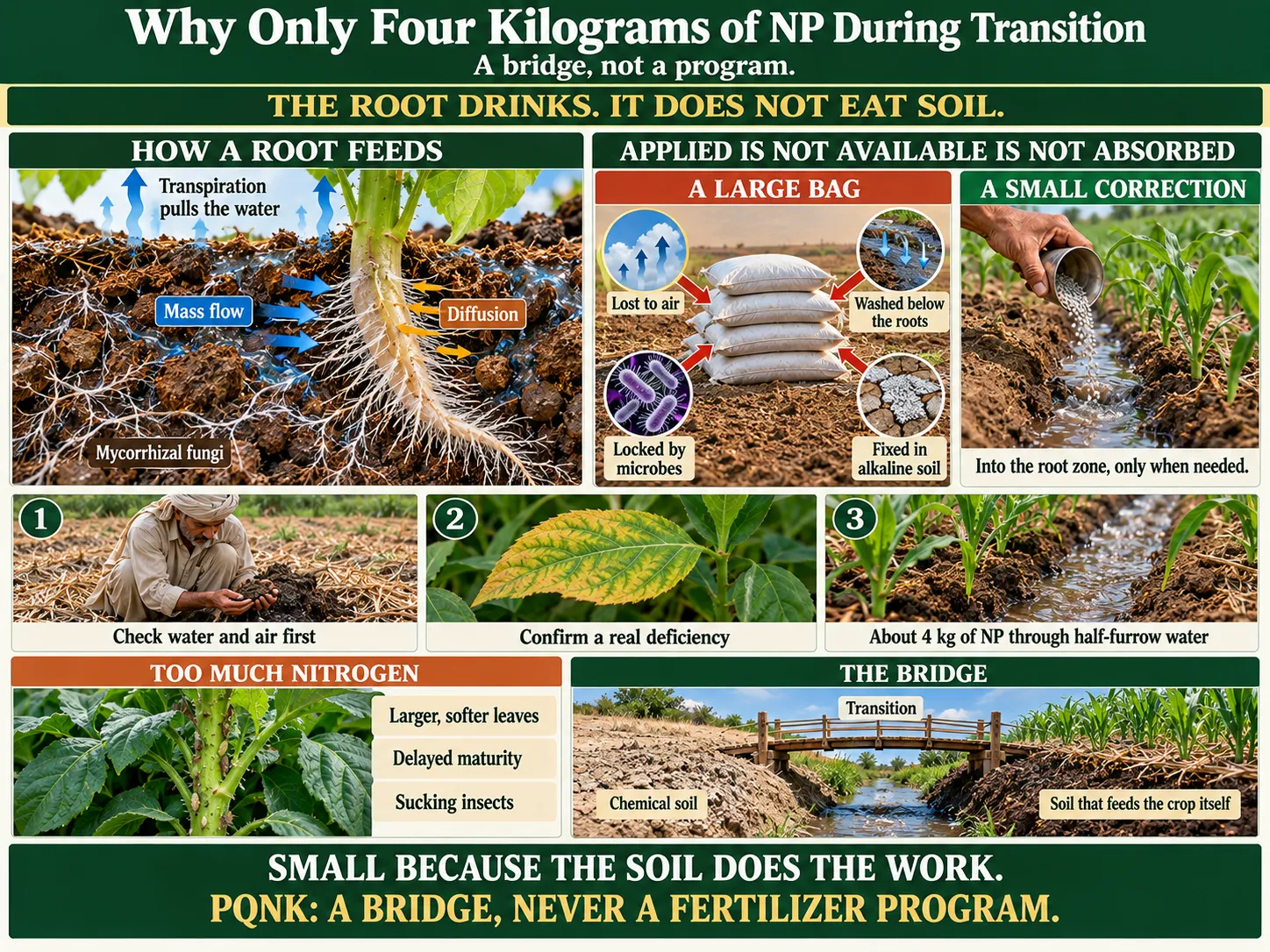
Why Only Four Kilograms of NP: a small correction, delivered to the root zone when the plant needs it, is a bridge to a soil that feeds the crop itself.
“A farmer accustomed to bags of fertilizer per acre hears that PQNK's transitional correction is roughly four kilograms of NP, and asks the only reasonable question available to him: how can that possibly be enough? The answer is not a smaller bag. It is a different understanding of how a root actually feeds.”
Asif Sharif, Lahore, 2026
A TRANSITIONING FARMER'S QUESTION
A farmer moving from conventional to PQNK management, having absorbed the book's account of the 0.083 percent paradox (Chapter Three) and the vast geological mineral reserve every soil holds, nonetheless asked a pointed follow-up question. If PQNK recommends a small transitional correction of roughly four kilograms of NP per acre when a genuine deficiency appears, and conventional practice recommends bags, what justifies a number that small? The honest answer requires tracing the actual physical journey a nutrient takes from the soil to the inside of a root, a journey this book has described qualitatively in earlier chapters and now traces with the precision the question deserves.
THE SOIL SOLUTION: WHERE ABSORPTION ACTUALLY HAPPENS
A root does not absorb soil. It absorbs ions dissolved in the thin film of water, the soil solution, that surrounds every particle of a functioning, aerated soil. Two mechanisms deliver the overwhelming majority of those ions to the root surface. Mass flow carries dissolved nutrients along with soil water as it moves toward the root, driven by the water potential gradient that transpiration creates: as a leaf loses water vapor to the atmosphere, it pulls a continuous column of water, and everything dissolved in it, upward from the root. Diffusion moves nutrients along a concentration gradient created as the root removes what is immediately adjacent to it, drawing replacement ions inward from the slightly less depleted solution beyond. For phosphorus and other relatively immobile nutrients, mycorrhizal fungi extend this acquisition network far beyond what root hairs alone could reach, exploring soil volume the root itself cannot.
This is the sense in which a healthy biological soil functions as an on-demand nutrient-conversion and acquisition system, continuously coupling the plant's actual physiological demand, expressed through transpiration and root exudation, to the ongoing biological and physical process that keeps the soil solution replenished. A fertilizer bag operates on an entirely different logic: it introduces a large nutrient quantity from outside the system, all at once, independent of what the plant can currently use.
APPLIED IS NOT AVAILABLE IS NOT ABSORBED
The four-kilogram figure only makes sense once a second distinction is drawn precisely: fertilizer applied, fertilizer available, and nutrient absorbed are three different quantities, and a large gap can separate the first from the third. Nitrogen applied to soil can volatilize into the atmosphere, leach downward past the root zone with irrigation or rainfall, or become temporarily immobilized within microbial biomass before a root ever encounters it. Phosphorus applied in soluble form can fix rapidly into forms far less available than the fertilizer bag's label implied, particularly in the alkaline soils common across the world's dry farming regions, Pakistan among them. A large conventional application is, in significant part, a wager against these losses: apply enough that whatever survives volatilization, leaching, immobilization, and fixation still exceeds the plant's requirement. A small, precisely timed correction, delivered directly into the root zone through furrow water at the moment a genuine deficiency has been confirmed, does not need to wager against these losses at the same scale, because it is not attempting to survive weeks of exposure to them before the plant can use it.
NITROGEN'S SPECIAL CASE: LUXURY CONSUMPTION AND A SIGNALING MOLECULE
Nitrogen deserves separate treatment because it behaves differently from most other nutrients in ways directly relevant to why an oversized correction actively harms the crop rather than merely wasting money. Plants can absorb nitrogen beyond their immediate physiological need, a pattern plant physiology calls luxury consumption, storing the surplus rather than regulating uptake to match demand as tightly as they do for several other nutrients. Compounding this, nitrate itself functions as a signaling molecule inside the plant, independent of its role as a nutrient, influencing root architecture and leaf development directly. The consequence is that excess soluble nitrogen does not simply produce a larger plant. It produces a specific developmental pattern: larger leaves, denser canopies, delayed maturity, and, according to PQNK field observation, measurably greater susceptibility to sucking insects, a pattern consistent with the diluted-sap mechanism described in Chapter Fifty-Eight. Root uptake remains physiologically regulated throughout this process. The problem is not that the plant has lost control of its own biology. It is that what the plant does with abundant nitrogen, once absorbed, is not what a farmer chasing yield actually wants.
OVER-IRRIGATION IS NOT WATERLOGGING
Because the four-kilogram correction is delivered through furrow water, the distinction between over-irrigation and waterlogging becomes directly relevant to how and when it should be applied, and the two conditions are not the same. Over-irrigation is a passing excess: the root zone cycles through a period of excess moisture and returns to a favorable moisture window without sustained oxygen restriction. It is still unwanted under PQNK, because the soft, lush growth it encourages invites sucking insects (Chapter Fifty-Eight). Persistent waterlogging is different in kind, not merely in degree: oxygen diffusion into the root zone is restricted long enough that root respiration is impaired, and growth is eventually suppressed rather than merely delayed. A transitional correction applied through furrow water should observe the same half-furrow-depth discipline this book establishes as an absolute requirement of Soil Moisture Management, precisely because the correction's purpose is to support the root system's recovery, not to recreate the flooding conditions PQNK's four prohibitions exist to eliminate.
NPK IS NOT COMPLETE NUTRITION
A final distinction closes the argument. Correcting a macronutrient shortfall with a small, targeted NP application is not the same claim as providing complete plant nutrition. NPK correction addresses a specific, diagnosed deficiency in three elements. It says nothing about the dozens of other minerals, and the full complexity of biologically mediated nutrient forms, that a functioning soil food web delivers continuously and that no fertilizer bag, of any size, replicates. A large, green crop grown on a heavy NPK program is not automatically a nutritionally complete one, a point this book develops at length in its treatment of nutrition-dense food (Chapter Fifty-Nine).
THE DESTINATION IS SOIL MOISTURE MANAGEMENT, NOT A SMALLER FERTILIZER PROGRAM
The four-kilogram figure is explicitly a bridge, never a program. It is applied only when a genuine plant deficiency appears after water, aeration, and root-zone conditions have already been examined and found adequate, and it is never delivered on a calendar. Its purpose is not to develop a permanent fertility regime built around smaller quantities. Its purpose is to support the crop through the specific window in which the biological nutrient-conversion system described throughout this chapter is still reactivating after years of chemical suppression, until that system is functioning well enough that routine fertilizer intervention of any size becomes unnecessary. A farmer who replaces a large chemical prescription with a smaller chemical prescription, repeated every season, has not completed a transition from chemistry to biology. He has only reduced the dose while leaving the underlying system exactly where it was.
WHAT THIS CHAPTER HAS ESTABLISHED
The roughly four-kilogram NP transitional dose is not an arbitrarily small number offered as reassurance to a nervous transitioning farmer. It is the correct size for a specific, narrow function: a furrow-delivered corrective bridge, applied only against a confirmed deficiency, sized to what a functioning soil-water-root system can actually deliver to a plant once mass flow, diffusion, and biological cycling are restored, rather than sized to a wager against losses that a healthy biological system no longer needs to make. The number is small because the destination it is bridging toward, a soil whose own biology handles nutrient conversion and delivery without further intervention, makes a large number unnecessary.
Chapter Sixty-Three: The PQNK™ Validation System