

Industrial Devastation To Natural Abundance
The Evidence · Chapter 34
Wheat, One-Tenth the Seed at Half the Cost
Pakistan’s Food Security Crop Transformed
Release 1.0 · 2026-09-29
If you use “Listen”, the text of the page may be sent to your browser or operating system’s speech provider, such as Apple, Google or Microsoft, depending on the voice your device uses. Pedaver does not process, transmit or store any audio.
“The NARC researcher looked at 86 tillers from a single seed and said, ‘This is impossible.’ I asked, ‘Impossible by what standard?’ He replied, ‘By every standard we have.’ I said, ‘Then those standards were developed in damaged soil.’ He looked at the plant again. He did not argue.”
Asif Sharif, Islamabad, 2022
Wheat is Pakistan’s principal food-security crop. It is the staple around which procurement, pricing, input support and national food policy repeatedly turn. It is also the subject of an important institutional comparison of PQNK and conventional management: a trial at Pakistan’s National Agricultural Research Centre (NARC), Islamabad, in which the treatments were grown side by side under the same season, location and wheat variety and assessed by the same research team.
The NARC comparison is important because the measurements were made within Pakistan’s national agricultural research system rather than by Pedaver alone. Its value lies in the treatment contrast: when crop establishment, soil cover, water management and purchased inputs were changed as a system, the wheat plant expressed a markedly different architecture and cost structure. The results should be read as evidence from this specific trial and as a basis for independent replication across soils, varieties and seasons.
WHEAT: THE GLOBAL PRODUCTION CONTEXT
Wheat is grown across more land globally than any other food crop and supplies a major share of human food energy and protein. Across South Asia, the Middle East, Central Asia and parts of Africa, wheat production is constrained by declining soil organic matter, compaction, inefficient irrigation and rising dependence on purchased inputs. Pakistan provides one of the most developed bodies of practical PQNK experience and therefore serves here as a case study for a wider wheat-growing challenge.
Pakistan normally grows wheat on roughly nine million hectares, principally during the rabi (winter) season. The crop is deeply embedded in the country’s procurement, subsidy, extension and seed systems. Most of that infrastructure still assumes a tilled, densely seeded and repeatedly irrigated crop, even where those practices increase costs without repairing the soil functions on which reliable production depends.
Average national wheat yields remain below the potential demonstrated by well-managed fields. From the PQNK perspective, the gap is not corrected by adding seed, fertiliser and irrigation independently. It is addressed by restoring the production system: an aerated root zone, continuous soil cover, living biological associations, precise plant placement and water supplied only when the crop and soil indicate a need.
THE NARC TRIAL: DESIGN AND CONDITIONS
The trial was conducted on-station at NARC, Islamabad, by NARC in collaboration with the Pro Nature Alliance Research & Development (PNARD), in the 2021–22 season, the second year of their wheat trials. Three treatments were sown on 6 December 2021 with the wheat variety Borlaug-2016, each on three plots of three acres, in fields previously cropped with oats under fertiliser and chemicals. Treatment One (T1) applied the PQNK package: the hardpan broken once, no tillage, 42-inch raised beds with 18-inch furrows, precision sowing with a locally manufactured pneumatic precision planter, rice-straw mulch, and no fertiliser, pesticide or weedicide. Treatment Two (T2) was farmer practice with a seed drill at 40 kg of seed per acre, and Treatment Three (T3) farmer practice with broadcast seed at 50 kg per acre, both on tilled flat land with equal quantities of fertiliser, pesticide and weedicide. All three treatments received the same water: one irrigation and two rainfall events.
The same wheat variety was grown at the same research station in the same season. Management was therefore the principal treatment difference. The NARC and PNARD team recorded the observations under the trial protocol. These are measured results from one directly comparable experiment; they are not a substitute for multi-location, multi-season replication, but they provide a strong testable result.
THE NARC TRIAL RESULTS
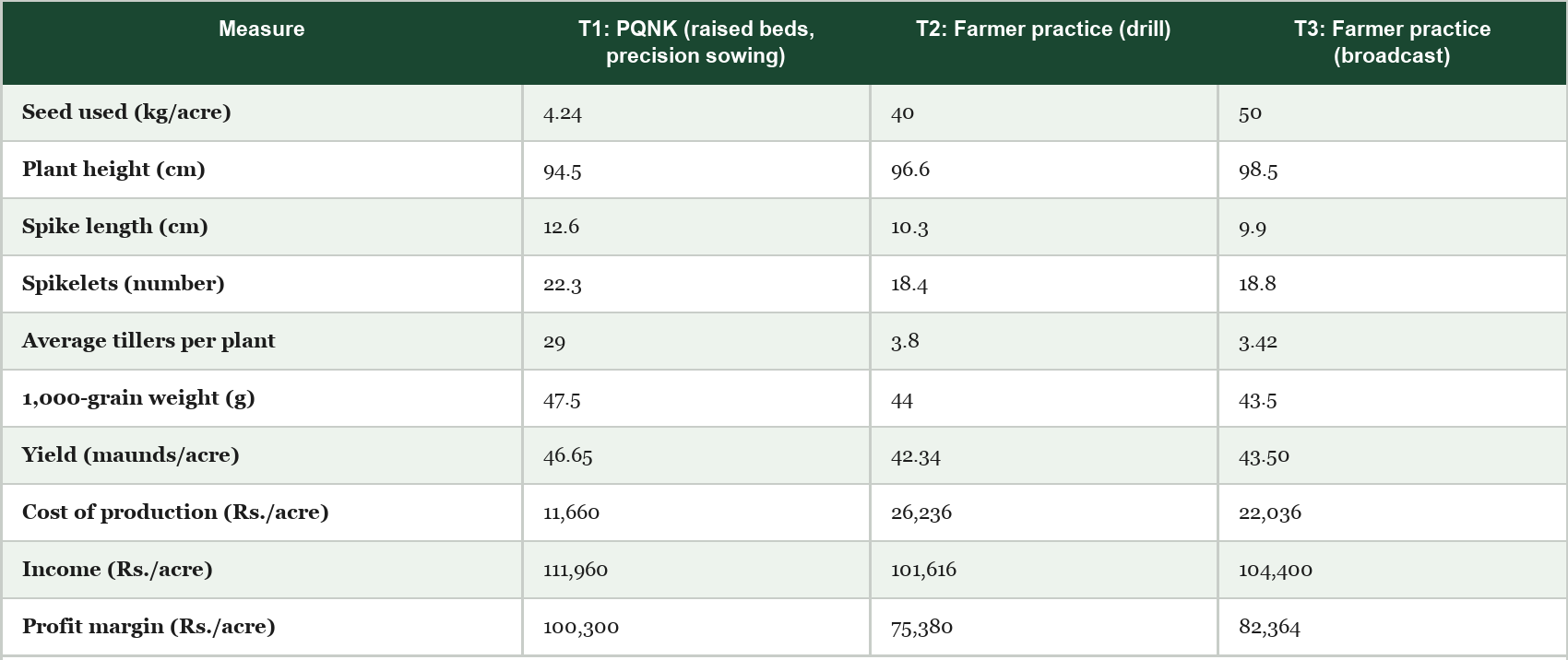
• Seed: 4.24 kg per acre in T1, against 40 kg (drill) and 50 kg (broadcast), about 90 percent less seed.
• Tillers: an average of 29 per plant in T1, with a maximum of 86 from a single seed, against 3.8 and 3.42.
• Yield: 46.65 maunds per acre in T1, against 42.34 and 43.50, about 7 to 10 percent more.
• Cost of production: Rs. 11,660 per acre in T1, against Rs. 26,236 and Rs. 22,036, roughly half.
• Profit margin: Rs. 100,300 per acre in T1, against Rs. 75,380 and Rs. 82,364.
• Inputs: no purchased fertiliser, pesticide or weedicide in T1, with the same water as the conventional treatments.
The following table presents the complete NARC trial comparison.
| Measure | T1: PQNK (raised beds, precision sowing) | T2: Farmer practice (drill) | T3: Farmer practice (broadcast) |
|---|---|---|---|
| Seed used (kg/acre) | 4.24 | 40 | 50 |
| Plant height (cm) | 94.5 | 96.6 | 98.5 |
| Spike length (cm) | 12.6 | 10.3 | 9.9 |
| Spikelets (number) | 22.3 | 18.4 | 18.8 |
| Average tillers per plant | 29 | 3.8 | 3.42 |
| 1,000-grain weight (g) | 47.5 | 44 | 43.5 |
| Yield (maunds/acre) | 46.65 | 42.34 | 43.50 |
| Cost of production (Rs./acre) | 11,660 | 26,236 | 22,036 |
| Income (Rs./acre) | 111,960 | 101,616 | 104,400 |
| Profit margin (Rs./acre) | 100,300 | 75,380 | 82,364 |
Source: NARC/PNARD wheat trial report, 2021–22 (Knowledge Paper KP-161), Tables 1 and 2. Rupee values at trial-period prices; 1 maund = 40 kg. Seed is the quantity the planter actually consumed.
THE TILLER COUNT: WHAT IT MEANS
The most striking observation was the tiller count. The PQNK plants averaged 29 tillers each, against 3.8 and 3.42 in the two conventional treatments, and one PQNK seed produced 86. A plant with that architecture resembles a small bush rather than the sparse plant commonly accepted as normal in a densely seeded field. The number matters not as a spectacle but as evidence that conventional plant form is not necessarily the crop’s biological limit.
A tiller contributes to yield only when it survives and produces a filled spike. Under PQNK, precise spacing gives each plant access to light and root volume, while an aerated, biologically active and covered soil supports nutrient and water exchange throughout the crop cycle. The result is not simply more tillers, but the possibility of more productive stems from far fewer seeds. Final evaluation must therefore record productive tillers, grain-filled spikes and harvested yield, not tiller count alone. In the NARC comparison, the higher tiller count came with longer spikes (12.6 cm against 10.3 and 9.9), more spikelets (22.3 against 18.4 and 18.8), heavier grain (47.5 g per 1,000 grains against 44 and 43.5) and a higher yield.
The biological interpretation is consistent with the wider PQNK evidence: when roots can explore an aerated profile and interact with a functioning soil food web, the plant can express more of its genetic potential. Dense sowing can conceal weak individual plants by increasing plant population; precision sowing takes the opposite route, creating the conditions in which each selected seed can become a high-performing plant.
This changes the unit of management. The conventional system asks how many plants can be crowded into an acre. PQNK asks how completely each plant can use its allotted address. Seed rate, spacing, productive tillers, spike weight and harvested grain must be considered together. In the NARC comparison, the radically lower seed rate did not reduce the crop to a thinner version of the conventional stand; it produced a different plant architecture.
THE ECONOMICS: FROM RS. 26,236 TO RS. 11,660
At the prices recorded for the trial, T1 cost Rs. 11,660 per acre, against Rs. 26,236 for the drill treatment and Rs. 22,036 for the broadcast treatment: roughly half. Against the drill treatment the saving was Rs. 14,576 per acre, about 56 percent. Because rupee values change with time, these figures should not be treated as current budgets. Their enduring significance is structural: PQNK removed recurring expenditure on high seed rates, fertiliser, pesticide and weedicide rather than trying to purchase the same functions more cheaply.
The trial also recorded income and profit. T1 earned Rs. 111,960 per acre and a profit margin of Rs. 100,300, against Rs. 75,380 for the drill treatment and Rs. 82,364 for the broadcast treatment. Most of the difference came from the lower cost of production, supported by the higher yield. These are trial-period values, not a budget: market price, realised yield, labour, machinery charges and local risk must be entered for each farm and season. The relevant PQNK lesson is that profitability begins by eliminating avoidable dependence before the crop reaches the market.
The trial’s planter worked at about 80 percent precision: 5 kg of seed was loaded, 4.24 kg was consumed, and germination was also about 80 percent. Precision is not merely a seed-rate percentage; it describes how consistently the planter creates the intended depth, spacing, soil contact and mulch passage. Missed or poorly placed seeds weaken the geometry on which the system depends. The trial report projected still higher yield and profit at 90 percent precision; future trials should define and measure planting precision explicitly.
PQNK WHEAT IN THE RABI SEASON: THE FULL PROTOCOL
The PQNK wheat protocol for Pakistan’s rabi season follows the eight-step sequence described in Chapter Twenty-Three, with wheat-specific parameters for each step.
Timing: Select the sowing window from local temperature, soil moisture, variety duration and the preceding crop, not from the calendar alone. In much of irrigated Punjab, this commonly falls from late October through the first half of November. Earlier or later planting should be justified by field conditions and the crop sequence.
Seed rate and spacing: Sow 5 rows on the 42-inch bed at 8-inch seed-to-seed spacing, about 62,000 hills per acre with 2 seeds per hill, through a correctly calibrated precision planter. Use 8 kg of selected seed per acre for the first crop, then reduce season by season toward the calculated rate of under 5 kg per acre once planter performance, bed maturity and establishment have been verified. The NARC treatment consumed 4.24 kg per acre. Seed size varies from about 10,000 seeds per kg in long, cool grain-filling regions to about 28,000 in Punjab, so always calibrate with the actual seed lot; the purpose is to give every seed a precise address, not to reach a target rate by irregular placement.
Mulch: Retain the preceding crop’s residue, such as cotton stalk material, maize stover or rice straw, as surface cover. Where residue is insufficient, add suitable clean biomass without importing a weed-seed or contamination problem. The planter must open only the narrow seed path required for placement and leave the surrounding cover and soil structure undisturbed.
Water: Treat irrigation as supplementary. In the NARC comparison, all three treatments received the same water, one irrigation and two rainfall events, so the PQNK results did not depend on extra water. Actual demand varies with rainfall, soil recovery, rooting depth, mulch and crop stage. Apply water slowly through the furrow, with no more than a 4-inch head, only when field observation and the soil-ball test show that nature has not maintained sufficient moisture; do not irrigate by a fixed calendar or saturate the bed.
Companion plants: Where bed geometry, light and harvest operations permit, a compatible legume such as lentil or chickpea can add living-root diversity and strengthen biological nutrient cycling. Species, timing and density must be selected so that the companion supports the wheat system without obstructing precision management or harvest.
Tiller pruning: Pruning the leader tiller improves tillering. While the leading shoot grows unchecked, it holds back the buds at the base of the plant; pruning it releases those buds, and the plant answers with additional tillers from the crown. Prune during early tillering, before the stem begins to elongate, so that the developing ear is not removed. On a PQNK bed each plant has the aerated root zone, the moisture and the space to carry the new tillers through to filled spikes, which is why pruning is part of bringing the seed rate down season by season.
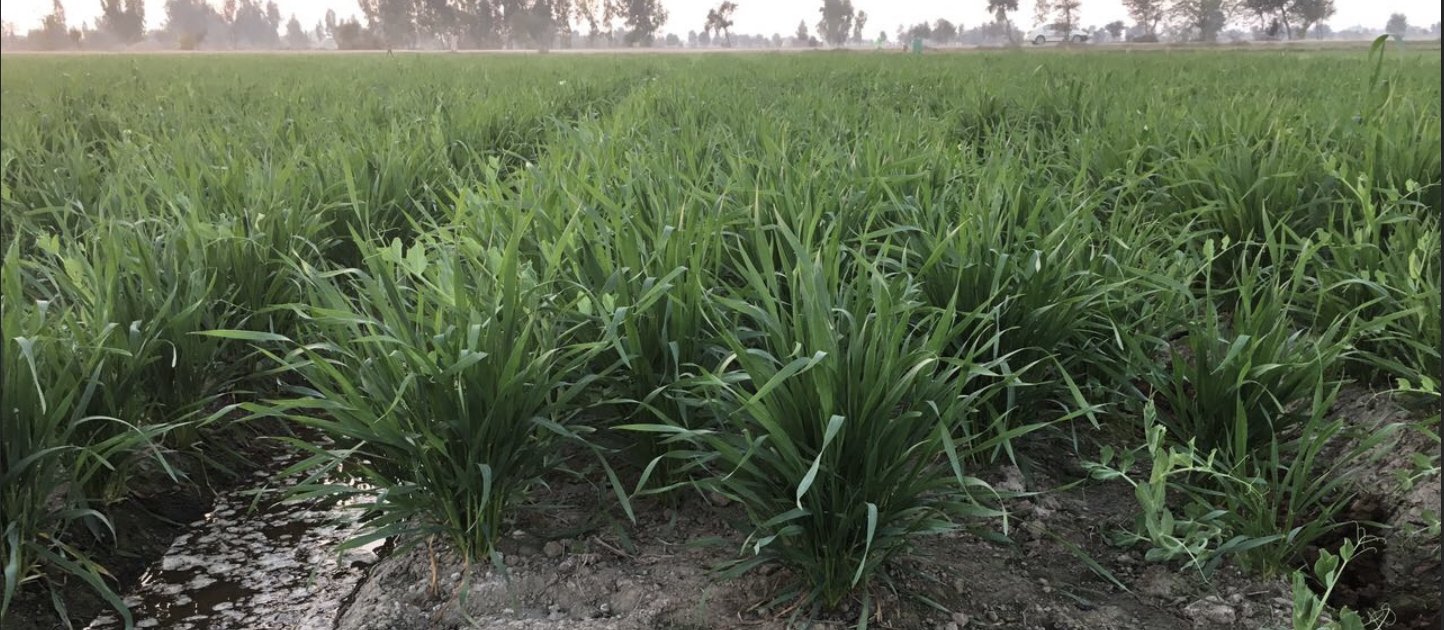
Pruning the leader tiller releases the buds at the crown. On a PQNK bed, the plant answers with more tillers, each with the root zone and space to fill a spike.
WHEAT BEYOND PUNJAB: POTHOHAR AND RAIN-FED CONTEXTS
Irrigated Punjab is Pakistan’s dominant wheat-production region, but substantial wheat areas are rain-fed, particularly across the Pothohar plateau and adjoining districts. In these landscapes, the value of PQNK lies in making each rainfall event more effective through infiltration, soil cover, deeper rooting and reduced evaporative loss.
Under disturbed and compacted management, intense rain can run off while later dry periods leave the crop without accessible moisture. Fracturing the restrictive layer where present, maintaining residue cover and preserving continuous pores allow more rainfall to enter and remain within the root zone. PQNK cannot create rainfall, but it can reduce the proportion that is lost before the crop can use it.
On rolling land, beds and furrows must follow a surveyed contour or other site-specific water-control layout. The objective is to slow runoff, spread it safely and encourage infiltration without concentrating flow and causing erosion. These adaptations require local design, careful outlet protection and field verification; a level-field layout should never be copied blindly onto a slope.
The rain-fed farmer cannot control when rain arrives. The production system can, however, determine how much of that rain enters the soil, how long it remains available and how deeply roots can follow it. That is the practical PQNK response to rainfall uncertainty.
THE POLICY IMPLICATIONS: NATIONAL WHEAT SECURITY
Wheat shortfalls expose Pakistan to volatile international markets and foreign-exchange pressure. National food security therefore depends not only on the quantity harvested in a favourable year, but on lowering the cost, water demand and production risk of every acre.
In the NARC comparison, PQNK yielded 7 to 10 percent more than the conventional treatments while costing roughly half as much. National projections must be made cautiously: each additional 10 percent of yield on roughly nine million hectares, at a three-tonne baseline, would add about 2.7 million tonnes; this is a scenario, not a forecast. Before such figures guide policy, the protocol should be replicated across representative soils, climates, varieties and production managers, with harvested yield, grain quality, water applied and full costs independently recorded.
The immediate policy priority is therefore enabling infrastructure: locally available precision planters and residue-management equipment, trained Production Managers who understand both the machinery and the soil system, service entrepreneurs responsible for maintenance, and transitional risk protection for smallholders. Public support should purchase measurable capability and verified field performance, not create a new input dependency.
WHAT THIS CHAPTER HAS ESTABLISHED
Wheat is central to Pakistan’s food security, and the NARC comparison provides an important institutional test of the PQNK proposition. With the same water as the conventional treatments, PQNK used 4.24 kg of seed per acre, produced an average of 29 tillers per plant, yielded 7 to 10 percent more, used no purchased fertiliser, pesticide or weedicide, and cost roughly half as much to grow. These results should neither be dismissed nor inflated: they should be replicated, measured and evaluated as a complete production system. The protocol is defined, the machinery requirement is known, and the next task is disciplined implementation at field scale.
The next chapter turns to cotton and asks how pest pressure changes when the soil–plant ecosystem, rather than a spray programme, becomes the production system.
Chapter Thirty-Five: Cotton, From BT to PQNK; the Fourth Turning Point