

Industrial Devastation To Natural Abundance
The Evidence · Chapter 33
Rice as Proof of Concept
2008 to Present, Peer-Reviewed Foundation, Field Replication, and Scale
Release 1.1 · 2026-09-29
If you use “Listen”, the text of the page may be sent to your browser or operating system’s speech provider, such as Apple, Google or Microsoft, depending on the voice your device uses. Pedaver does not process, transmit or store any audio.
“Rice is one of agriculture’s most water-intensive staple crops. The 2009 raised-bed trial produced 12.84 tonnes per hectare, compared with a regional average of about 4 tonnes. Later mature PQNK field records used about 8 percent of the water of the flooded-rice reference. The two results are separate, but together they make rice the system’s most demanding proof of concept.”
Asif Sharif, Lahore, 2026
Part Five tests the science and protocol developed in Parts One through Four against crop-specific evidence. Each chapter separates peer-reviewed findings from later PQNK field records and compares results only where the season, soil, climate, and baseline permit a valid comparison. The purpose is to show what PQNK changes in the root zone, crop, water use, yield, and farm accounts, while stating where independent measurement is still required.
Rice begins Part Five because rice was PQNK’s first deliberately designed experiment, its most challenging test, its first peer-reviewed publication, and its most globally significant result. No crop makes the case for PQNK more completely than rice, because no crop violates all four of PQNK’s governing rules as thoroughly as conventional paddy does, and no result demonstrates more clearly what biological restoration produces when those violations are removed.
THE GLOBAL CONTEXT: RICE, WATER, AND THE COMING CRISIS
Rice feeds more than half of humanity and is a primary staple across Asia, sub-Saharan Africa, and parts of Latin America. It occupies roughly 160 million hectares worldwide. Its water demand is especially important in Asia: IRRI research estimates that irrigated rice receives 34 to 43 percent of the world’s irrigation water, or about 24 to 30 percent of its developed freshwater resources and occupies a much larger share of irrigated land in several Asian regions.
Population growth, declining aquifers, and greater climate variability make flooded paddy one of agriculture’s most consequential production challenges. Rice does not biologically require continuous flooding, yet much of the crop is managed in saturated or flooded soil. That practice consumes large volumes of water, produces methane, suppresses aerobic soil functions, and confines roots to a shallow working zone. The problem lies in the production environment, not in the rice plant.
The PQNK rice system addresses these linked constraints. The founding raised-bed trial, published in a peer-reviewed journal in 2011, produced more than three times the regional yield while using about 70 percent less irrigation water. Later mature PQNK field records used about 8 percent of the water of a flooded-rice reference. Because PQNK fields are not flooded, they remove the persistent anaerobic conditions responsible for most paddy methane. This chapter presents the 2009 experiment first, the mature system second, and the subsequent field experience separately.
THE CORE DATA: THE FOUNDING TRIAL AND THE MATURE SYSTEM
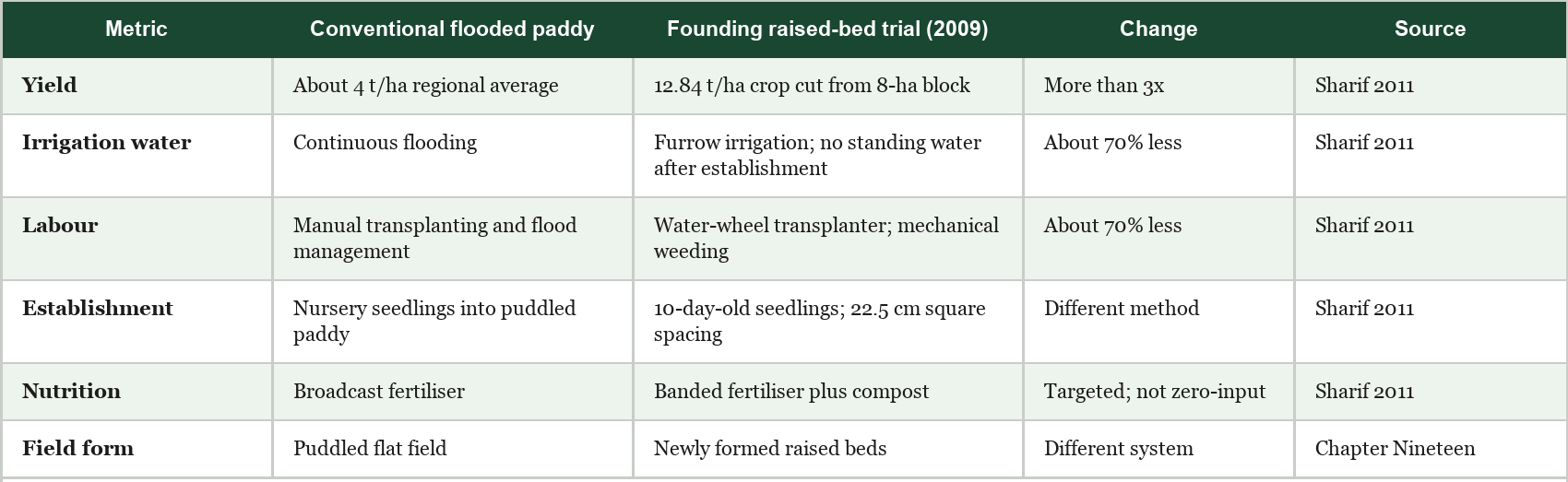
The founding experiment was conducted in 2009 on newly formed raised beds in Punjab and is described in Chapter Nineteen. Its results were published in 2011. The mature PQNK rice system developed later: rice was direct-seeded into permanent mulched beds and managed without flooding. These evidence records must remain separate. The founding trial used transplanted seedlings, fertiliser, and compost; it was neither a zero-input trial nor the source of the 92 percent water-saving figure.
The founding trial, as published:
| Metric | Conventional flooded paddy | Founding raised-bed trial (2009) | Change | Source |
|---|---|---|---|---|
| Yield | About 4 t/ha regional average | 12.84 t/ha crop cut from 8-ha block | More than 3x | Sharif 2011 |
| Irrigation water | Continuous flooding | Furrow irrigation; no standing water after establishment | About 70% less | Sharif 2011 |
| Labour | Manual transplanting and flood management | Water-wheel transplanter; mechanical weeding | About 70% less | Sharif 2011 |
| Establishment | Nursery seedlings into puddled paddy | 10-day-old seedlings; 22.5 cm square spacing | Different method | Sharif 2011 |
| Nutrition | Broadcast fertiliser | Banded fertiliser plus compost | Targeted; not zero-input | Sharif 2011 |
| Field form | Puddled flat field | Newly formed raised beds | Different system | Chapter Nineteen |
Peer-reviewed source: Sharif, A. (2011). Technical adaptations for mechanized SRI production to achieve water saving and increased profitability in Punjab, Pakistan. Paddy and Water Environment, 9(1), 111–119. https://doi.org/10.1007/s10333-010-0223-5
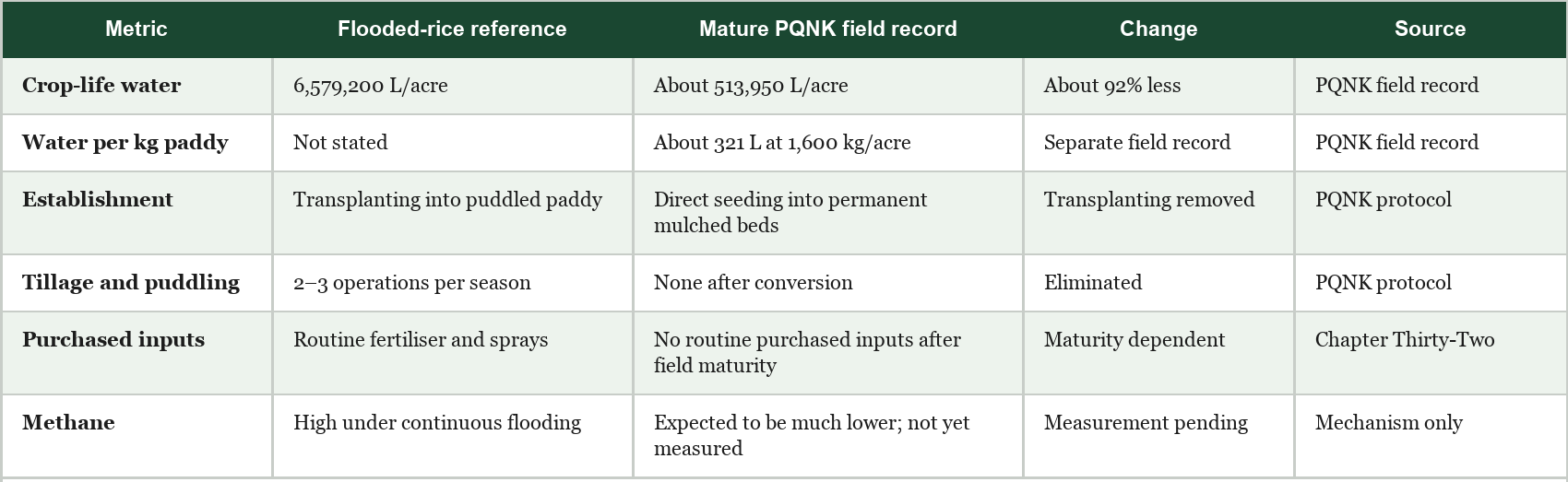
The mature PQNK rice system, from later field records:
| Metric | Flooded-rice reference | Mature PQNK field record | Change | Source |
|---|---|---|---|---|
| Crop-life water | 6,579,200 L/acre | About 513,950 L/acre | About 92% less | PQNK field record |
| Water per kg paddy | Not stated | About 321 L at 1,600 kg/acre | Separate field record | PQNK field record |
| Establishment | Transplanting into puddled paddy | Direct seeding into permanent mulched beds | Transplanting removed | PQNK protocol |
| Tillage and puddling | 2–3 operations per season | None after conversion | Eliminated | PQNK protocol |
| Purchased inputs | Routine fertiliser and sprays | No routine purchased inputs after field maturity | Maturity dependent | Chapter Thirty-Two |
| Methane | High under continuous flooding | Expected to be much lower; not yet measured | Measurement pending | Mechanism only |
The mature-system water record was obtained at 1,600 kg of paddy per acre, approximately the regional average yield used for that comparison. The 12.84 t/ha founding yield and the 92 percent water saving come from different records and must never be presented as one combined result.
THE BIOLOGICAL EXPLANATION: WHY PQNK RICE OUTPERFORMS
The 12.84 t/ha yield is consistent with the production conditions created by the raised-bed system, but a single trial does not establish a universal yield outcome. Its value lies in showing what became possible when root-zone aeration, plant spacing, water management, and timely field operations were changed together.
Aerobic root-zone conditions support deeper rooting. In flooded paddy, oxygen shortage and the compacted puddled layer restrict root development. In the founding trial, rice roots in aerated soil above a fractured hardpan were observed at depths of 24 inches or more. That larger rooting volume improved access to water and mineral nutrients and helped support grain filling.
Precision spacing supports tiller development. At 22.5-centimetre, or about 9-inch, square spacing, each plant had sufficient root-zone volume and light for primary, secondary, and tertiary tillers to develop. The response came from the interaction of spacing with aerated soil, controlled moisture, and reduced competition; spacing alone cannot reproduce the result.
Aerated soil strengthens biological nutrient delivery. Flooding does not eliminate arbuscular mycorrhizal fungi, but research shows that it generally depresses root colonisation and alters the benefit of the symbiosis. In PQNK, moist, aerated soil permits mycorrhizal fungi and the wider microbial community to remain active around living roots. This should improve access to phosphorus and micronutrients. Whether PQNK grain contains more iron, zinc, or other nutrients than grain of the same variety under conventional management must be established by direct comparative analysis.
Biological regulation can remove the routine need for pesticide. Flooding, excessive soluble nitrogen, and a simplified habitat can favour soft vegetative growth while weakening the predator network. In the PQNK field record described here, balanced plant growth and the restored field food web kept pests below the intervention threshold, so no pesticide was applied. This is a field result, not a claim that pest monitoring is unnecessary during transition.
FIELD ADOPTION AND REPLICATION STATUS
The 2011 publication attracted interest from researchers and farmers outside Pakistan. Pedaver records subsequent demonstrations or farmer applications in Pakistan, South Korea, Israel, China, Thailand, India, and Nigeria. These records show geographic transfer, but they do not all have the same evidentiary status. The founding Punjab trial is peer-reviewed; later results are field records unless an independent trial or publication is specifically cited.
South Korea. Pedaver records describe raised-bed rice work adapted to Korean climate and Japonica varieties, with competitive yields and substantially reduced water use. The case supports practical transfer of the method, while the underlying trial data and protocol should be published before it is treated as independent scientific replication.
Israel. Pedaver field records describe direct-seeded rice on raised beds without continuous flooding under water-scarce conditions. The demonstration is important because it shows that rice can be considered where conventional paddy would be impractical. Its yield and water data should be reported with the site, season, variety, measurement method, and comparison baseline.
Pakistan. Farmer-led adoption has extended PQNK direct-seeded rice beyond the original Punjab trial. Pedaver records include fields in Punjab and Sindh, supported by photographs, videos, and farmer accounts. These records are valuable implementation evidence, but future reporting should identify the farm, season, area, variety, yield method, crop-life water, and comparison field so that aggregated claims can be audited.
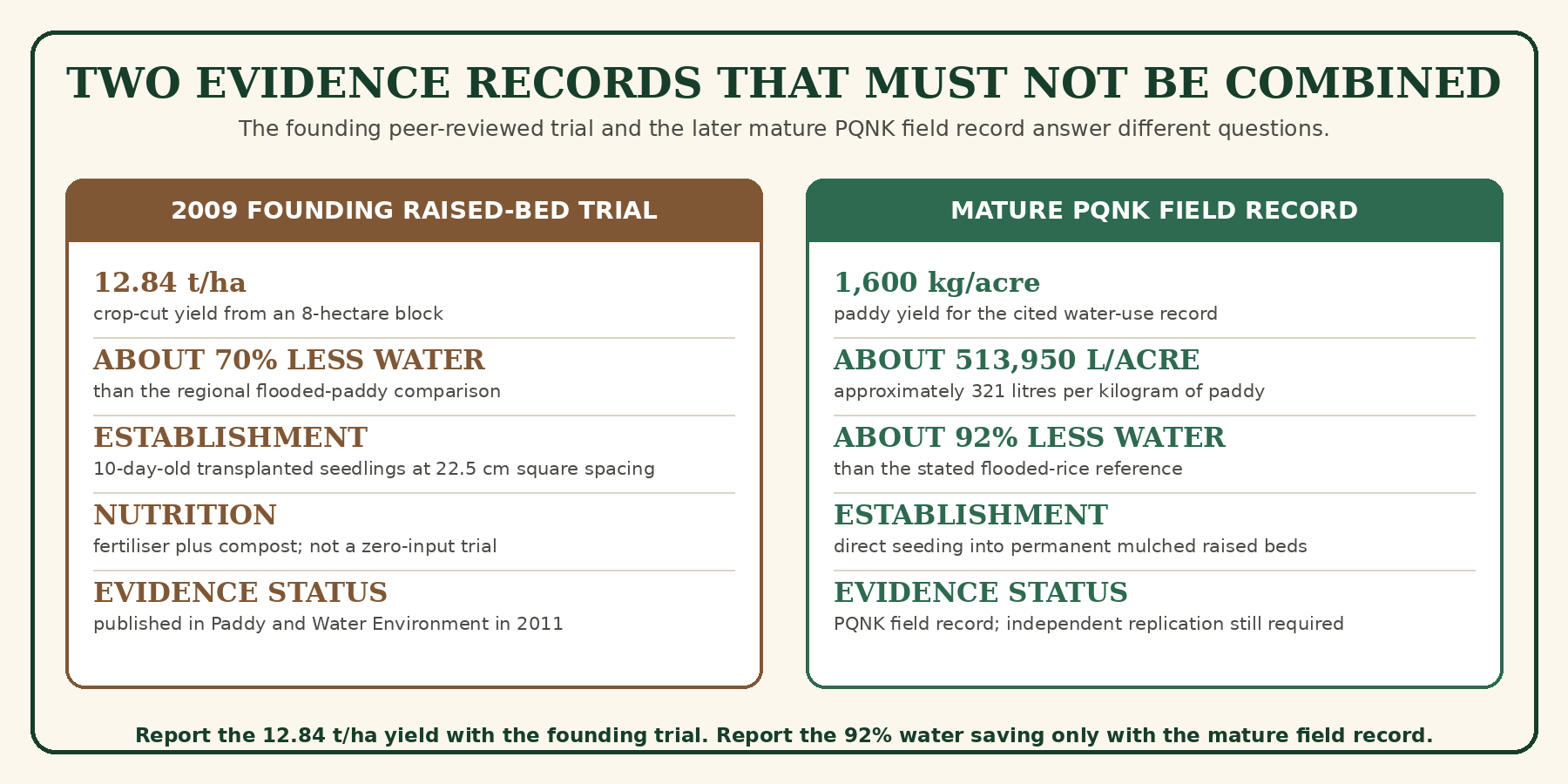
The founding peer-reviewed trial and the later mature PQNK field record are distinct evidence sets and must be reported separately.
THE METHANE DIMENSION: PQNK RICE AND CLIMATE
Flooded rice is a major agricultural source of methane. Prolonged saturation creates anaerobic conditions in which methanogenic microorganisms decompose organic material, and much of the methane reaches the atmosphere through the rice plant. Global methane assessments attribute roughly 8 percent of human-caused methane emissions to flooded rice.
PQNK rice should produce substantially less methane than continuously flooded paddy because its raised beds remain moist and aerated rather than submerged. Evidence from other rice systems shows that drainage and aerobic periods can sharply reduce methane, although effects on nitrous oxide and total greenhouse warming potential must also be measured. PQNK fields have not yet undergone direct seasonal greenhouse-gas measurement; methane and nitrous oxide monitoring is therefore a priority.
If PQNK greenhouse-gas measurements confirm the expected reduction, conversion from continuously flooded paddy could make a significant contribution to agricultural methane mitigation. The scale of that contribution cannot be calculated credibly from mechanism alone. It requires replicated seasonal measurements across soil types, climates, varieties, and water regimes.
PQNK rice addresses yield, water, methane, and soil condition through one root-zone design. The founding trial more than tripled the regional yield while using about 70 percent less water. The later mature field record used about 8 percent of the water of its flooded-rice reference. Aerated beds remove the persistent conditions that generate most paddy methane, while permanent roots and mulch rebuild soil structure. The published and field evidence are promising; the next requirement is independent, protocol-faithful replication.
PQNK RICE IN PRACTICE: WHAT FARMERS REPORT
The peer-reviewed trial provides measured evidence; the Pedaver archive shows how later PQNK rice fields were implemented. It contains photographs, videos, and farmer accounts covering land preparation, establishment, water management, crop development, and harvest. These records are useful for practice and hypothesis formation, but they should not be described as equivalent to independently measured trials.
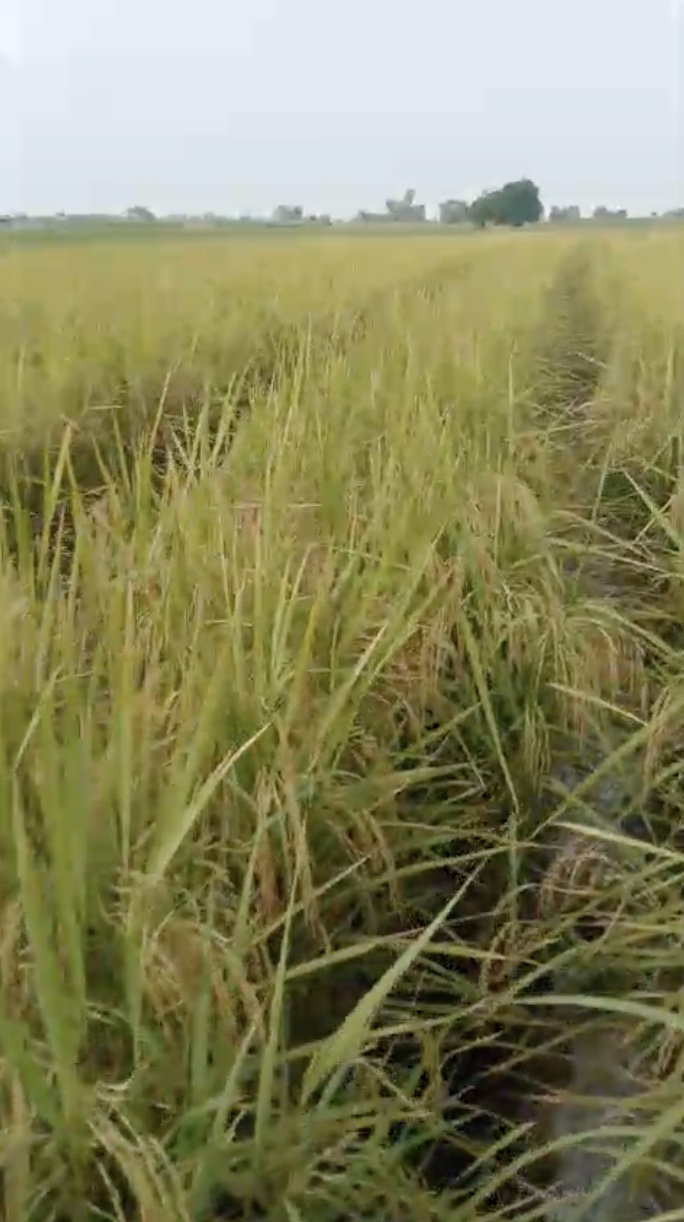
PQNK rice field, 2026 harvest. Video: youtu.be/WFErthS3rT4
Farmers commonly report lower irrigation labour because the field is not kept flooded. Precision establishment can also produce a more uniform stand and maturity pattern, provided that the planter is correctly calibrated and operated. Farmers frequently describe larger, better-filled panicles, but yield comparisons should rely on crop-cut or whole-field measurements rather than visual impressions alone.
After harvest, PQNK fields retain roots and surface residue rather than being puddled for the next crop. Farmers report darker soil, more visible earthworms, and improved aggregation as the system matures. These observations are consistent with recovery of soil structure, but long-term comparisons should also measure bulk density, infiltration, soil organic carbon, and biological activity.
THE INSTITUTIONAL RESPONSE: WHY PQNK RICE HAS NOT SCALED FASTER
The important question is why a published result with large implications for yield and water has not yet received broad, independent replication. Chapter Twelve considered the wider institutional problem. Rice adds a practical constraint: research programmes, machinery, irrigation layouts, and performance standards have largely been designed around puddled and flooded production.
A non-flooded raised-bed system requires institutions to test a different production environment, not merely a different input within the existing paddy system. Credible replication must therefore evaluate the complete protocol: root-zone preparation, bed geometry, establishment machinery, moisture management, mulch, yield, economics, and multi-season soil change. Partial adoption can test a different system and produce a misleading result.
Farmer-to-farmer communication and the Pedaver knowledge network have carried most of the adoption recorded so far. That pathway demonstrates practical interest, but national scaling needs more than testimony. It requires trained Production Managers, precision machinery, auditable field records, transitional risk protection, and independent trials that follow the full PQNK protocol.
WHAT THIS CHAPTER HAS ESTABLISHED
Rice provides PQNK’s strongest proof of concept because conventional paddy conflicts with all four governing rules. The founding raised-bed trial more than tripled the regional yield while using about 70 percent less water and was published in a peer-reviewed journal in 2011. Later mature PQNK field records document direct seeding into permanent mulched beds, no puddling or standing water, and crop-life water use of about 8 percent of the flooded-rice reference. These findings are complementary, but they are not one combined trial.
The founding evidence is published; the mature system now requires independent, protocol-faithful replication and greenhouse-gas measurement. Farmer adoption continues to generate field evidence. The next chapter turns to wheat, Pakistan’s most important food-security crop, and the NARC trial that recorded an average of 29 tillers per plant, a seed rate of 4.24 kg per acre, and production costs of Rs 11,660 per acre compared with Rs 26,236 for the comparison system.
Chapter Thirty-Four: Wheat, One-Tenth the Seed at Half the Cost