
Industrial Devastation To Natural Abundance
The Evidence · Chapter 35
Cotton, From BT to PQNK
The Fourth Turning Point, 200 Bolls Per Plant, Zero Sprays
Release 1.0 · 2026-09-30
If you use “Listen”, the text of the page may be sent to your browser or operating system’s speech provider, such as Apple, Google or Microsoft, depending on the voice your device uses. Pedaver does not process, transmit or store any audio.
“The conventional cotton farmer may apply pesticide twelve times in a season and harvest sixty to one hundred bolls per plant. In the mature PQNK field shown to farmers, no pesticide was applied and the crop carried about two hundred bolls per plant. Farmers asked, ‘Why are we spraying?’ I replied, ‘That is the right question. Now ask it about the fertiliser.’”
Asif Sharif, Lahore, 2019
Cotton helped build Pakistan’s agricultural and textile economy, yet it also exposes the weaknesses of input-dependent production more clearly than almost any other crop. It stands at the centre of four turning points in Asif Sharif’s agricultural journey: the bollworm crisis of the 1970s, the whitefly and cotton leaf curl crisis of the 1980s, the promise and limitations of BT cotton in the 1990s, and the PQNK field observations culminating in cotton plants carrying up to 200 bolls without routine pesticide spraying. Cotton makes the central PQNK argument visible: pest pressure cannot be separated from plant nutrition, soil aeration, moisture management, biodiversity and the production system that connects them.
This chapter examines the cotton evidence as a system: the chronology of pest substitution, the role of BT, the recovery of biological regulation, the reported yield and input results, the cotton-specific PQNK protocol, and the safeguards required during transition. Field observations are presented as field observations; wider causal and national claims are stated only to the extent that the evidence supports them.
COTTON: THE GLOBAL CRISIS THAT CREATED THE QUESTION
Cotton is cultivated across tropical and subtropical regions and supports millions of farming and textile livelihoods. Across those regions, input-dependent cotton often follows a familiar pattern: a technology suppresses one pest category, secondary pests or resistant populations become more important, pesticide programmes expand, and production costs rise while soil function declines. Pakistan provides a detailed case through which to examine this global production-system problem.
Pakistan’s cotton and textile value chain has long been central to rural employment, industrial activity and export earnings. Production across Punjab and Sindh supports farmers, pickers, ginners, spinners, weavers and manufacturers. This makes cotton more than a field crop: failure in the field passes directly into employment, industrial capacity, imports and foreign exchange.
The sector has also experienced severe volatility and decline from its historical peaks. Official records show sharp year-to-year changes in area and production, including a substantial fall in 2024–25. The causes are multiple and interacting: seed quality, weather, water management, pest resistance, cotton leaf curl disease, input cost, weak crop establishment and degraded soil. BT traits act against susceptible caterpillars; they do not control whitefly, jassid, thrips, mites or viral disease, and they do not repair soil structure or biological function. Pakistan’s cotton problem therefore cannot be reduced to a single seed, pest, market or season. It requires a production-system response.
THE FOUR TURNING POINTS REVISITED: WHY BT COULD NOT REPAIR THE SYSTEM
Chapter Seventeen introduced the four cotton turning points that shaped PQNK’s development. Revisited from the field, they show why each single-target intervention provided temporary relief while leaving the wider production system unresolved.
Turning Point One (1970s): The bollworm crisis exposed the vulnerability of cotton grown under heavy nitrogen and repeated pesticide use. In PQNK interpretation, nitrogen-driven soft vegetative growth can increase attraction and feeding opportunity for some pests. Broad-spectrum spraying also removes predators and parasitoids, often faster than pest populations recover, weakening biological regulation over successive seasons.
Turning Point Two (late 1980s and early 1990s): Whitefly and cotton leaf curl disease became dominant threats within the disturbed pest complex. Cotton leaf curl viruses are transmitted by Bemisia tabaci. Repeated insecticide use can disrupt beneficial insects while selecting resistant whitefly populations, making control progressively more difficult. The important point is pest substitution: suppressing one target without restoring ecological regulation can create space for another.
Turning Point Three (1990s): BT cotton reduced damage from susceptible caterpillars, but it did not control sucking pests or correct the soil and water conditions affecting plant health. Sharif’s personal chronology begins in 1995, when he brought approximately two kilograms of experimental BT cotton seed from a United States research farm to Pakpattan and evaluated it under field conditions. That early field experience must be distinguished from Pakistan’s later formal biosafety approvals, variety testing and commercial adoption. BT was an important genetic tool, but it addressed a defined insect group rather than the complete cotton production system; resistance, secondary pests and renewed spraying consequently remained possible.
Turning Point Four (PQNK): Field observations of cotton plants carrying up to 200 bolls under mature PQNK management, without routine pesticide application, shifted the question from killing pests to rebuilding regulation. These fields do not prove that pests disappear or that intervention can never be required. They demonstrate that plant condition, habitat, predators, parasitoids, microbial processes and disciplined observation can keep pest pressure below damaging levels when the production system is functioning.
THE CORE FIELD RESULTS: UP TO 200 BOLLS PER PLANT
• Bolls per plant: up to 200 in the mature PQNK cases, against 60–100 in the cited conventional comparison.
• Pesticide applications: none in the mature PQNK cases, against 5–12 in comparable conventional programmes.
• Water: none needed on mature beds where annual rainfall is 400 mm or more; during transition, 2–3 furrow waterings against 7–9 irrigations in conventional cotton.
• Seed: about 1–1.5 kg per acre through precision placement, against 8–10 kg per acre conventionally.
• Purchased fertiliser: none in the documented mature fields; maturity is judged from field evidence, not a fixed number of crops, and transition safeguards remain available.
• Cotton leaf curl disease: low to absent in the cited PQNK observations, which is not a claim of genetic resistance.
• Lint and picking quality: a higher Grade A share reported in the documented cases; independent measurement is required before it is generalised.
The following table summarises the field comparison and keeps measured observations separate from interpretation.
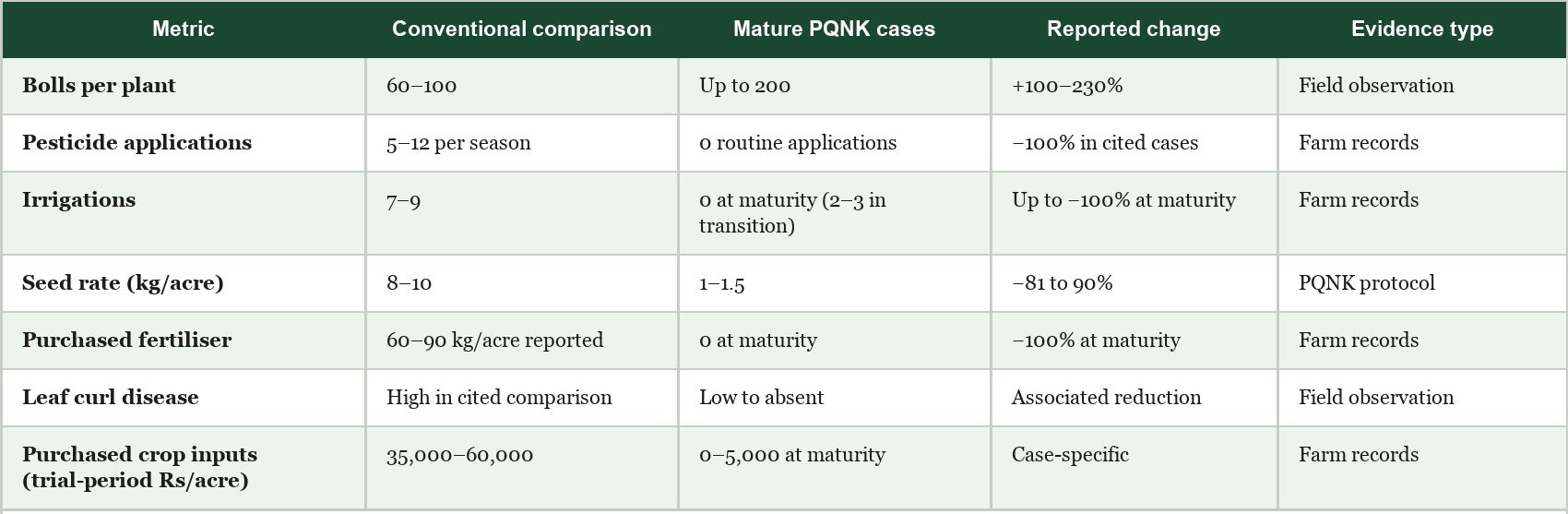
| Metric | Conventional comparison | Mature PQNK cases | Reported change | Evidence type |
|---|---|---|---|---|
| Bolls per plant | 60–100 | Up to 200 | +100–230% | Field observation |
| Pesticide applications | 5–12 per season | 0 routine applications | −100% in cited cases | Farm records |
| Irrigations | 7–9 | 0 at maturity (2–3 in transition) | Up to −100% at maturity | Farm records |
| Seed rate (kg/acre) | 8–10 | 1–1.5 | −81 to 90% | PQNK protocol |
| Purchased fertiliser | 60–90 kg/acre reported | 0 at maturity | −100% at maturity | Farm records |
| Leaf curl disease | High in cited comparison | Low to absent | Associated reduction | Field observation |
| Purchased crop inputs (trial-period Rs/acre) | 35,000–60,000 | 0–5,000 at maturity | Case-specific | Farm records |
THE BIOLOGY BEHIND THE HIGH-BOLL PLANT
A cotton plant carrying up to 200 bolls is not evidence of a special PQNK variety. It is evidence that plant architecture and reproductive duration can change when limiting conditions are removed. The relevant measures are not boll count alone but retained bolls, boll weight, lint yield, ginning outturn and fibre quality. Those measures should accompany future replications so that the visible plant result is connected to harvested performance.
Root depth and mineral access. Conventional traffic and tillage can create a hardpan that restricts cotton rooting. Flooding temporarily reduces soil aeration and confines active roots to a smaller volume. In PQNK fields, the hardpan is fractured once, traffic remains in the furrows, the bed stays covered, and irrigation is supplementary. Field excavation has shown roots extending well below the formerly compacted layer, increasing access to moisture and a wider mineral profile. Because potassium is important for boll and fibre development, deeper and longer-lived roots can materially affect reproductive performance.
Plant condition and food-web regulation. Excess readily available nitrogen can favour vegetative growth over balanced reproduction and may increase susceptibility to sucking pests. A plant supplied through an aerated, biologically active root zone develops under a different nutrient and moisture regime. Cell-wall development and secondary metabolism can contribute to plant defence, while predators, parasitoids, pathogens and competitors regulate insect populations. PQNK pest control is therefore multi-layered; no single organism, compound or predator carries the whole burden.
Cotton leaf curl disease through vector regulation. Cotton leaf curl viruses are transmitted by whitefly, so disease pressure depends partly on vector abundance and movement. In the cited PQNK fields, whitefly and disease incidence were low to absent while neighbouring fields experienced greater pressure. The defensible conclusion is that improved plant condition, habitat diversity and biological regulation were associated with lower vector pressure. This is ecosystem-mediated risk reduction, not genetic immunity, and it requires continued field observation.
Extended reproductive period. Stable soil moisture, moderated soil temperature, deeper roots and balanced growth can allow cotton to continue flowering and retaining bolls after stressed conventional plants have slowed or shed fruiting forms. This longer effective reproductive period is a plausible contributor to the reported boll counts. Plant population, variety duration, sowing date and picking period must be recorded whenever the result is replicated.
The cited farm records compare conventional programmes costing Rs. 35,000–60,000 per acre in purchased crop inputs with mature PQNK cases reporting Rs. 0–5,000. These are trial-period, case-specific values, not current universal budgets, and they exclude land, machinery ownership, labour and picking unless explicitly recorded. Their lasting importance is structural: seed, fertiliser, pesticide and irrigation costs can fall together when biological functions recover.
THE PQNK COTTON PROTOCOL
The PQNK cotton protocol follows the established transition sequence, with cotton-specific calibration and continuous field observation.
Sowing: Select the sowing window from soil temperature and moisture, local weather, variety duration and the preceding crop. In much of Punjab this commonly falls from late March through the first half of May. Use selected seed (above 80% germination rate) and calibrate the SIPP planter to seed size, germination and the intended plant population. On the 42-inch bed, sow 2 rows at 16-inch seed-to-seed spacing, about 13,000 hills per acre with one seed per hill; at about 9,000 seeds per kg this is roughly 1.45 kg of seed per acre (Chapter Twenty-Nine). Every viable seed must receive a precise address through the retained wheat residue; a fixed seed rate must never be achieved by irregular or crowded placement.
Intercropping: Where bed geometry, light and picking permit, sow summer vine crops such as bitter gourd, bottle gourd, ridge gourd, sponge gourd, pumpkin, cucumber and melons between the cotton plants. Their vines cover the bed surface, keep the soil shaded and moist, add living-root diversity and habitat, and produce an additional harvest. The light shade and the moderated microclimate created by the cotton canopy protect them from the full summer heat, so they keep producing longer than they would in open ground. Keep the vines on the bed and out of the furrows, so that water flow and traffic are not obstructed, and manage them so that they do not climb into or smother the cotton. A legume such as mung bean may be included for diversity, but PQNK does not sow legumes for nitrogen: the free-living nitrogen-fixing bacteria of a living, covered soil are sufficient to meet the crop's needs.
Water: On mature PQNK beds, irrigation is not required at all, particularly where annual rainfall is 400 mm or more. Rain, dew and the moisture held by the covered, living soil carry the crop. During transition, two or three flows of water through the furrows may be necessary, but only when the ball test of soil taken from the root zone fails. Run the water slowly, with no more than a 4-inch head, and never flood the bed. A crop that demands water is giving a signal, not following a schedule: it most likely means the soil is still recovering, or the bed is not yet well covered with organic mulch. Water demand is a measure of the soil's immaturity.
Pest observation and threshold management: Inspect the crop at least weekly and record bollworm eggs and larvae, whitefly nymphs, jassids, thrips, mites, damaged fruiting bodies and beneficial organisms. The objective is to determine whether the food web is regulating the population, not to assume that it is. During transition, if pest damage approaches the established 10% threshold, a targeted intervention remains available to protect the crop. Any intervention must be recorded and reassessed; the mature PQNK standard is zero pesticide, not denial of a developing outbreak. Commercial microbial BT formulations, where lawful and appropriate, must not be confused with a claim that naturally occurring soil BT is equivalent to a transgenic BT trait.
Harvest and residue: Pick the cotton as it matures. After the final picking, nothing more is needed than managing the crop residue: leave the roots in the soil, where they decay into channels and food for soil life, and chop the standing stalks with a mulcher so that the chopped material covers the beds as mulch. There is no tillage, burning or removal of residue. The next crop is planted directly through this cover, with the permanent beds and furrows left intact.
THE ECONOMIC RECOVERY: FROM INPUT DEPENDENCY TO PRODUCTION INDEPENDENCE
Cotton’s economic recovery can be substantial because conventional production combines expenditure on seed, fertiliser, repeated irrigation and several pesticide applications. Historical case records cited in this chapter report pesticide programmes ranging from five to twelve applications, with costs varying by season, product, labour and pest pressure. These figures must be updated for each location and year rather than presented as a permanent national price.
In the documented PQNK transition, pesticide expenditure fell as the biological network recovered, purchased fertiliser reached zero once field evidence showed the soil could carry the crop, seed requirement fell sharply through precision placement, and irrigation fell from 7–9 conventional waterings to 2–3 furrow flows during transition, and to none on mature beds where annual rainfall is 400 mm or more. The timing is not automatic: soil condition, residue, machinery precision, weather and Production Manager competence determine the transition. At maturity, remaining crop costs include machinery operation, maintenance, observation, harvest and picking. Profitability comes from eliminating avoidable purchased inputs while protecting harvested lint yield and quality, not from describing production as cost-free.
A further benefit is reduced dependence on seasonal input credit. Where dealers finance pesticide or fertiliser against the expected harvest, the farmer can become locked into purchases regardless of their performance. As the PQNK field matures and recurring chemical purchases decline, that obligation contracts. The gain is economic, but it also restores decision-making to the farmer and Production Manager.
COTTON AND THE EXPORT FUTURE
Pakistan’s cotton sector faces a structural challenge that repeated increases in seed, pesticide and fertiliser use have not resolved. Production volatility has increased reliance on imported lint for a textile industry that requires consistent volume and quality. Rebuilding domestic production therefore requires lower risk and cost per acre, not another cycle of dependency on a single trait or input.
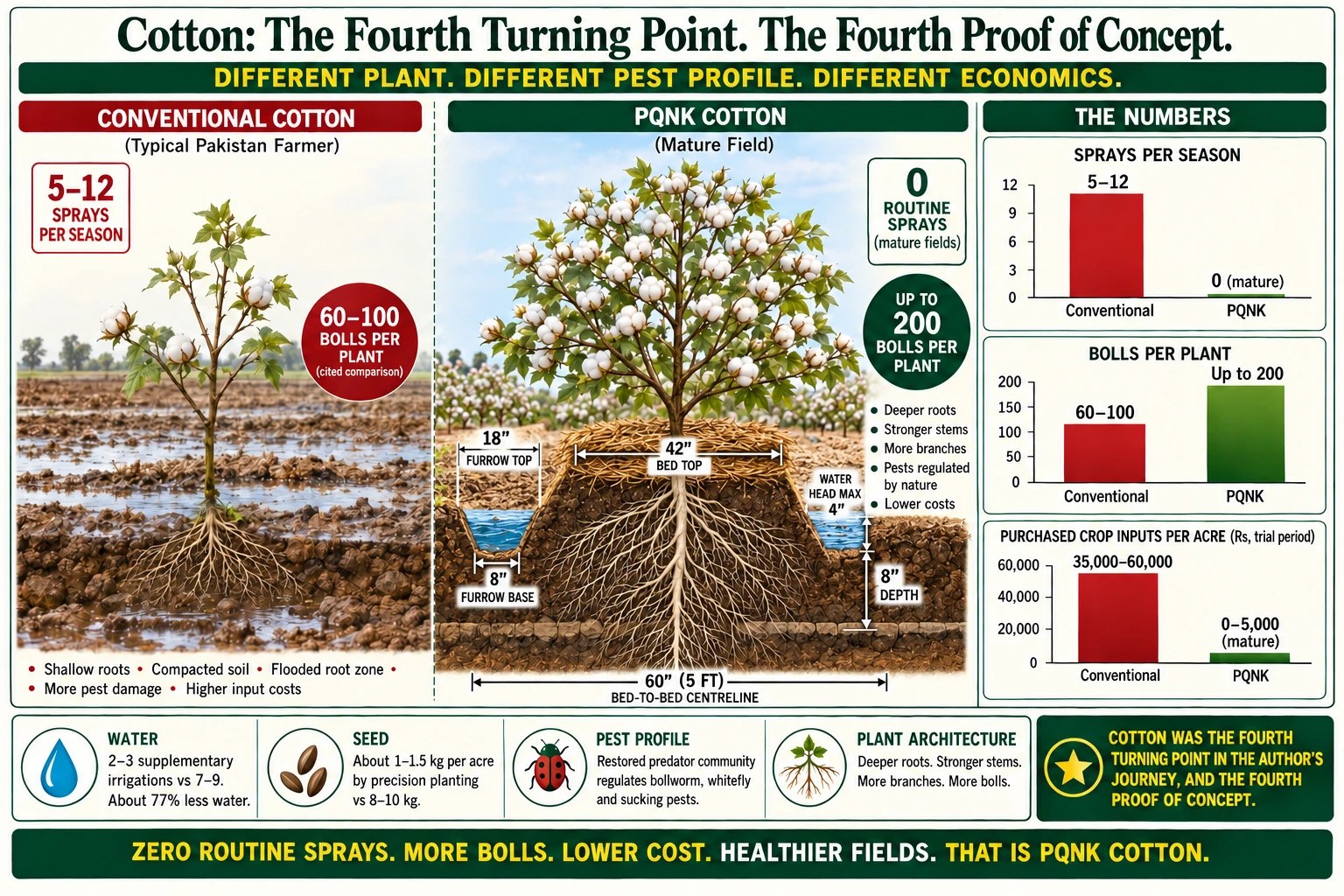
Cotton: The Fourth Turning Point, Zero Routine Sprays, Up to 200 Bolls per Plant
PQNK offers a testable pathway: restore the root zone, reduce irrigation demand, place selected seed precisely, rebuild biological regulation and measure the harvested result. It should not be presented as the only conceivable national response or as a guarantee of self-sufficiency within a fixed number of crop cycles. It should be evaluated through transparent, multi-location comparisons that record plant population, pest pressure, interventions, water applied, retained bolls, seed-cotton yield, lint percentage, fibre quality, full cost and net return. If the reported field results are replicated at scale, the implications for farmer income, pesticide exposure, imports and textile competitiveness would be substantial.
WHAT THIS CHAPTER HAS ESTABLISHED
Cotton makes the PQNK production-system argument unusually visible. The four turning points show the progression from pest crisis, through pest substitution and a single-target genetic response, to the rebuilding of plant and ecological regulation. In the documented field cases, mature PQNK cotton combined zero routine pesticide applications, no irrigation on mature beds where annual rainfall is 400 mm or more, sharply reduced seed use, zero purchased fertiliser at maturity and plants carrying up to 200 bolls. These results are significant, but they must be measured through harvested yield and quality and replicated across varieties, soils, seasons and Production Managers.
The next chapter turns to maize, where PQNK’s contribution is expressed not only through crop performance but through the possibility of fitting more productive crop cycles into the year while reducing the cost and disturbance associated with each cycle.
Chapter Thirty-Six: Maize, Up to Four Crops a Year