

Industrial Devastation To Natural Abundance
The Original System · Chapter 7
Weeds as Soil Physicians
The Paradigm Inversion, Reading the Field’s Own Diagnosis
Release 1.2 · 2026-10-11
If you use “Listen”, the text of the page may be sent to your browser or operating system’s speech provider, such as Apple, Google or Microsoft, depending on the voice your device uses. Pedaver does not process, transmit or store any audio.
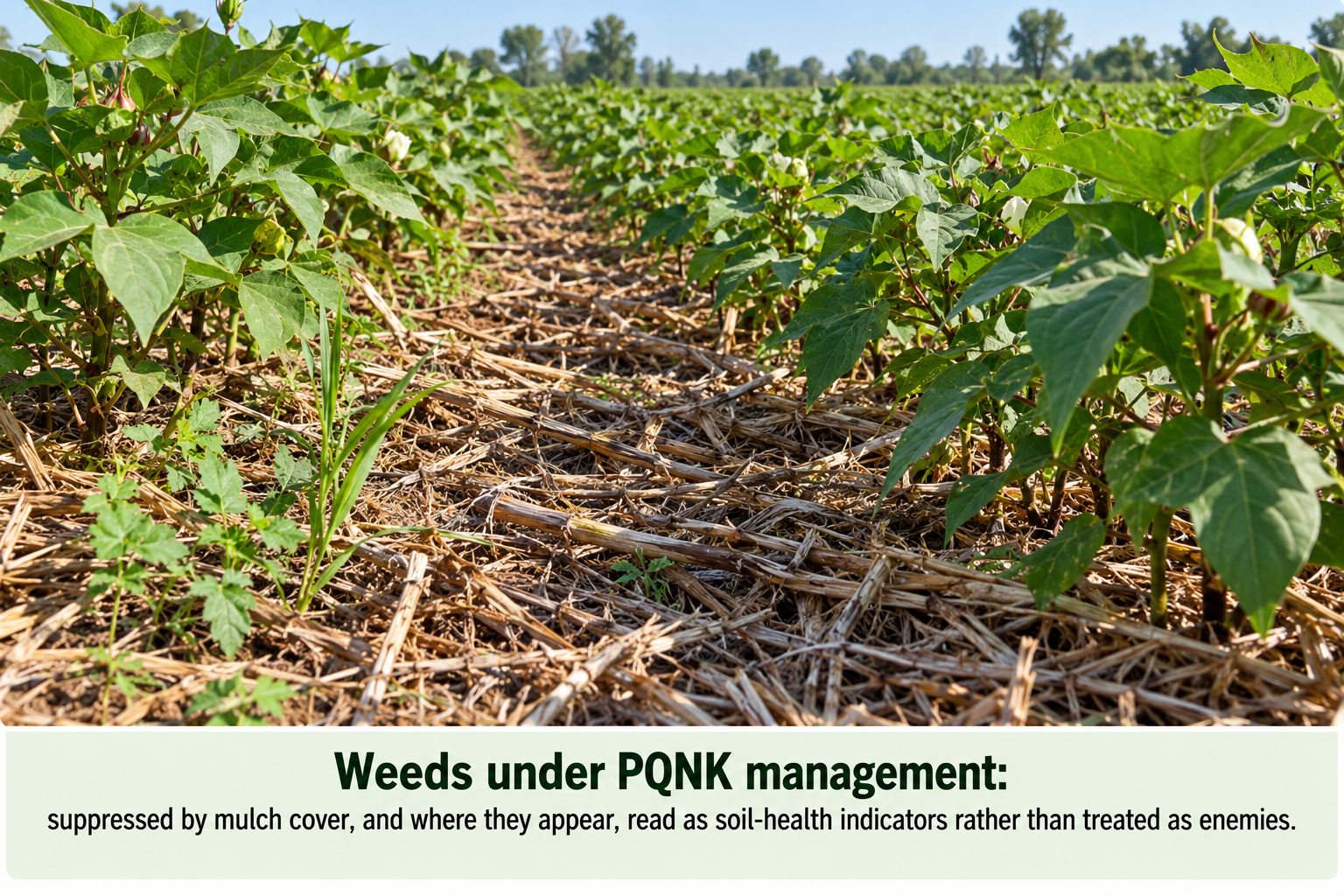
“The weed is not the farmer’s enemy. It is his most honest advisor, the one that tells him, without flattery and without charge, exactly what is wrong with his soil and exactly what must be done to fix it. The herbicide is the farmer’s way of silencing that advisor so he does not have to hear what it is saying.”
Asif Sharif, Lahore, 2026
No aspect of conventional farming thinking is more deeply ingrained, or more completely wrong, than the attitude toward weeds. In the conventional paradigm, weeds are enemies: competitors for water, light, and nutrients, threats to yield, and problems to be solved with chemical herbicides, mechanical cultivation, or both. The global herbicide market, the portion of the pesticide industry devoted to weed control, exceeds forty billion US dollars annually. Farmers spend a significant portion of their already-strained input budgets on weedicides, applied at intervals throughout the growing season to fields that, without continued intervention, immediately produce another flush of growth.
This intervention never ends. The weeds always return. No matter how thoroughly a field is sprayed or cultivated, the same species reappear within weeks. The conventional farmer interprets this as evidence that weeds are persistent and difficult to manage. The PQNK farmer interprets it as evidence that the soil condition that called the weeds is persistent and has not been addressed. The difference between these two interpretations is the difference between a paradigm of warfare and a paradigm of diagnosis. And the difference in outcome, for the farmer’s pocket, for the soil’s health, and for the long-term productivity of the land, is enormous.
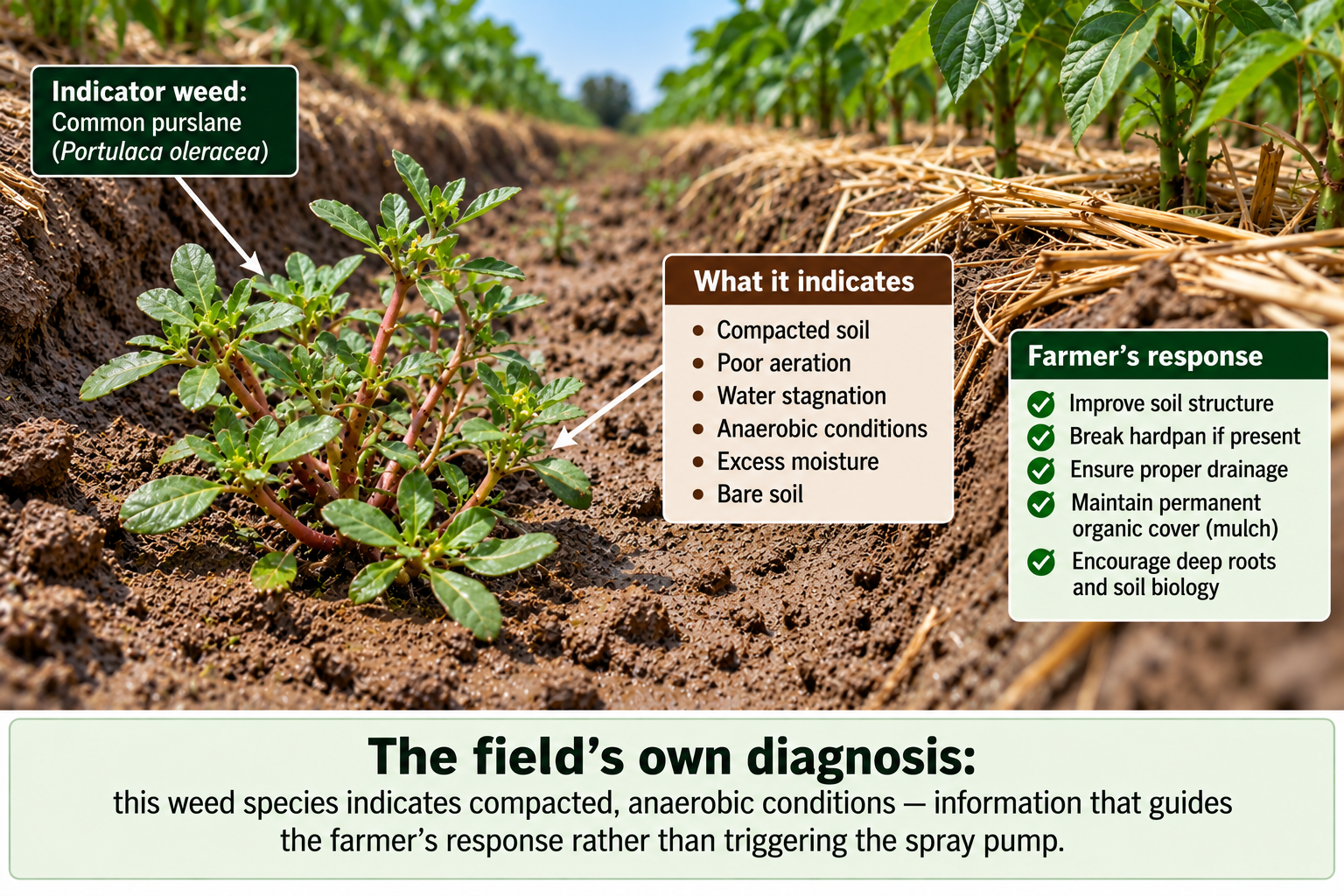
This chapter proposes, with the full weight of ecological science and five decades of field observation behind it, a complete inversion of the conventional understanding of weeds. Weeds are not the problem. They are the solution to the problem. Many of them are pioneer plants, adapted to colonise degraded and disturbed conditions and, in doing so, to begin the process of ecological recovery. They emerge in a field not because the farmer failed to spray them, but because the soil is sending a distress signal and the ecosystem is responding to it with the only tools available. The weed is the soil’s own physician, arriving with a diagnosis and a prescription already in hand. The herbicide is how the farmer shoots the messenger.
WHAT WEEDS ACTUALLY ARE: PIONEER PLANTS IN ECOLOGICAL SUCCESSION
To understand why weeds behave as they do, it is necessary to understand the concept of ecological succession, the process by which a disturbed or bare landscape progresses, through a series of biological stages, toward a stable, diverse, and self-sustaining ecosystem. Succession is not random. It follows a predictable sequence in which each stage creates the conditions required by the next, in a biological relay that runs from bare rock or devastated soil all the way to mature forest or grassland.
Many agricultural weeds are pioneer, or ruderal, species: the first stage of this relay. They carry traits that let them colonise disturbed, depleted, and exposed conditions that most crop plants tolerate poorly. Their seeds are long-lived in the soil, waiting for the right conditions to germinate. Their germination is triggered by the precise conditions that indicate soil disturbance: bare soil surface, exposure to light, disruption of the soil food web. They are not invading the field. They are responding to it. The same seed bank that produces a flush of weeds after tillage has been in the soil for years, dormant, waiting for the signal that it is needed.
The function of pioneer plants is to begin the process of ecological recovery. Their roots break compaction, opening pores and restoring aeration. Their canopy shields bare soil from direct solar radiation, preventing the biological death of the surface layer that occurs when soil is exposed to full sun in Punjab’s summer. Their organic matter contribution, in roots, in leaf litter, in root exudates, begins the slow process of rebuilding the soil carbon that ACI management has destroyed. Their presence often reflects the soil ecosystem responding to disturbance with the biological resources it has available.
Weeds do take up water and mineral nutrients, and an established weed stand can compete with a crop when those resources are limiting. What PQNK challenges is the assumption that this competition must be managed by killing the weed. In a biologically functioning soil, with abundant mineral reserves, active nutrient cycling, sound moisture management and a permanent mulch, nutrient and water competition matter far less than they do in a degraded conventional field. The competition that does the most immediate damage is usually above ground, where weeds intercept light and reshape the crop canopy. PQNK prevents most of it at the source. A weed seed germinates on its own genetic cue, and that cue is triggered by the signals of a disturbed, opened-up soil: a bare surface, collapsed pore structure, sharp swings in temperature and moisture, and, for many species, light. A permanent mulch over undisturbed, well-structured soil sends none of these signals, so most of the seed bank stays dormant and the plants that would compete never establish. The mulch, not the herbicide, is the weed-control system.
THE DIAGNOSTIC LANGUAGE OF WEEDS
Every weed species that appears in a field is communicating something specific about the soil conditions that produced it. The appearance of a particular weed is not random; it is the outcome of a selection process in which only the species best adapted to the prevailing soil conditions will germinate, survive, and thrive. Learning to read this language, to identify which weeds are present and what each one indicates, is one of the most practical and immediately applicable skills the PQNK farmer can develop. It costs nothing, requires no laboratory, and delivers information about the soil that even the most expensive soil testing cannot easily provide.
The key to reading weed communities correctly is to understand that each weed species is adapted to a specific range of soil conditions: compaction depth, moisture level, nutrient status, pH, organic matter content, and disturbance history. When a particular species dominates a field, it is because those conditions dominate the soil. When multiple species appear together, each tells part of the story, and their combination provides a more complete diagnosis than any single species could offer alone.
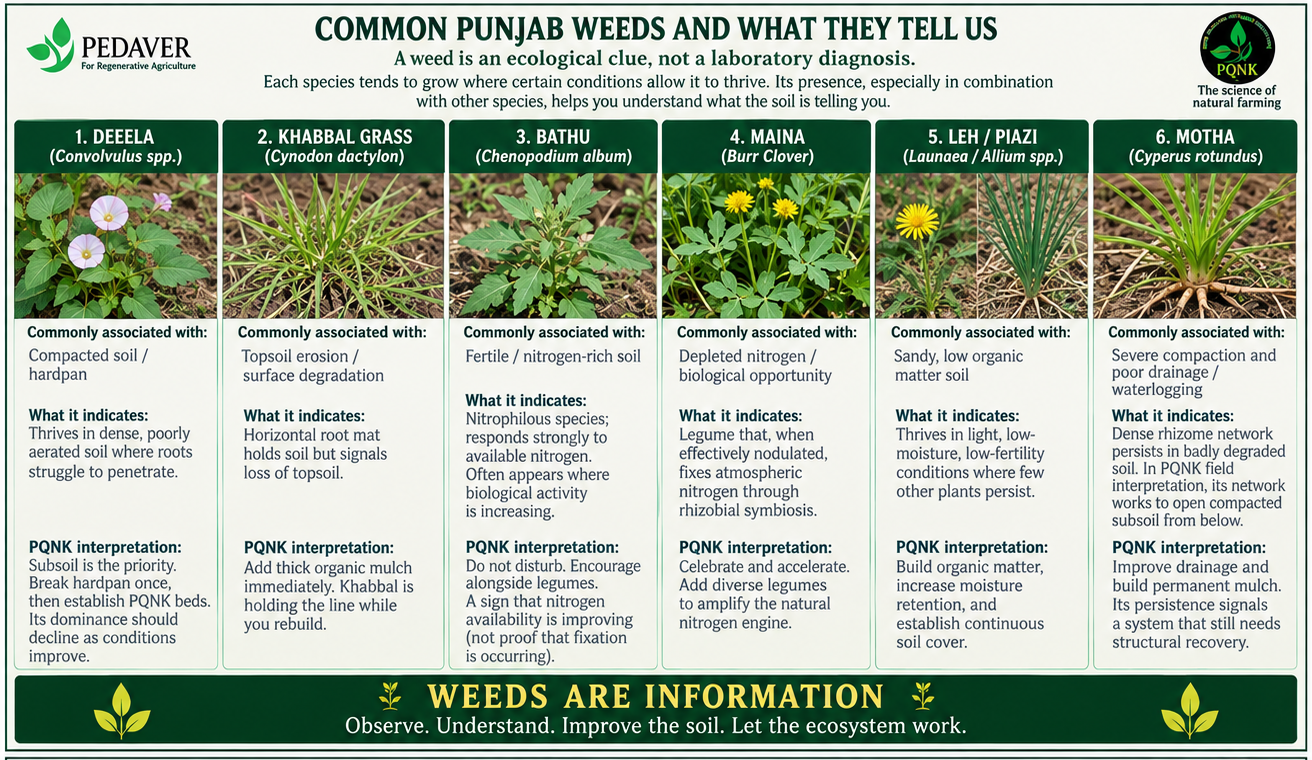
The following guide covers the most common weed species encountered in Punjab’s agricultural fields, translated from the conventional view of weed into the PQNK view of diagnostic indicator. For each species, three questions are answered: what soil condition does its presence indicate, what is it actively doing to help the soil recover, and what is the PQNK prescription that addresses the root cause of its appearance. A weed should be read as an ecological clue, not a laboratory diagnosis. Its strongest meaning comes from repeated field association, its abundance, the accompanying weed community, crop condition, soil structure, and management history.
Read together, the entries show a pattern. Many of these weeds perform ecological functions that can contribute to soil protection and succession, and their presence also points to the conditions favouring them. Deeela is associated with hardpan, and its taproot works into compacted layers; Khabbal holds eroding topsoil; Bathu points to a nitrogen-rich zone; Maina marks a soil whose biology is recovering; Motha is associated with severe compaction and waterlogging. The herbicide that kills them does not change the condition that called them. It silences the diagnosis without treating the cause.
WEED COMMUNITIES: READING MULTIPLE SPECIES TOGETHER
A single weed species tells one part of the story. But in most degraded fields, multiple weed species appear simultaneously, each reflecting a different dimension of the soil’s condition. Reading them together provides a full-field diagnosis that is more informative than any individual indicator.
The ‘Multi-Layer Compaction’ Field. When Deeela and Khabbal grass appear together, the field is experiencing compaction at two distinct depths. Deeela’s deep taproot is targeting the hardpan layer, while Khabbal’s horizontal mat is addressing the erosion and structural collapse of the topsoil above it. This combination is the weed community’s response to a soil that has been simultaneously compacted at depth and degraded at the surface, the most common condition in Punjab’s long-cultivated fields. The PQNK prescription: subsoil immediately to address the hardpan, and apply deep mulch to address the surface. Both weed physicians are right about both problems.
The ‘Barren and Hungry’ Field. When Leh and Piazi appear together, the soil is simultaneously physically impoverished (sandy or light-textured, poor water retention) and nutritionally depleted. The combination indicates a field that has lost most of its biological structure and organic matter, a field that is, in practical terms, closer to dirt than soil. The prescription starts with drought-tolerant cover crops, such as Bajra, that can establish in the difficult conditions, combined with the most generous possible application of organic mulch material. This field needs both physical structure and biological carbon before it can recover.
The ‘Nitrogen-Building Pioneer’ Field. When Bathu and Maina appear together, the reading is encouraging: the field looks less like one that is only degrading and more like one that is starting to recover. Bathu points to a nitrogen-rich zone. Maina appears as the soil’s biology recovers. Together they are an early sign that nitrogen availability is improving: in a living, covered soil, the free-living nitrogen-fixing bacteria supply what the crop needs. The PQNK prescription is to support the process: keep the surface mulched, and apply no tillage or chemicals that would reset the recovery.
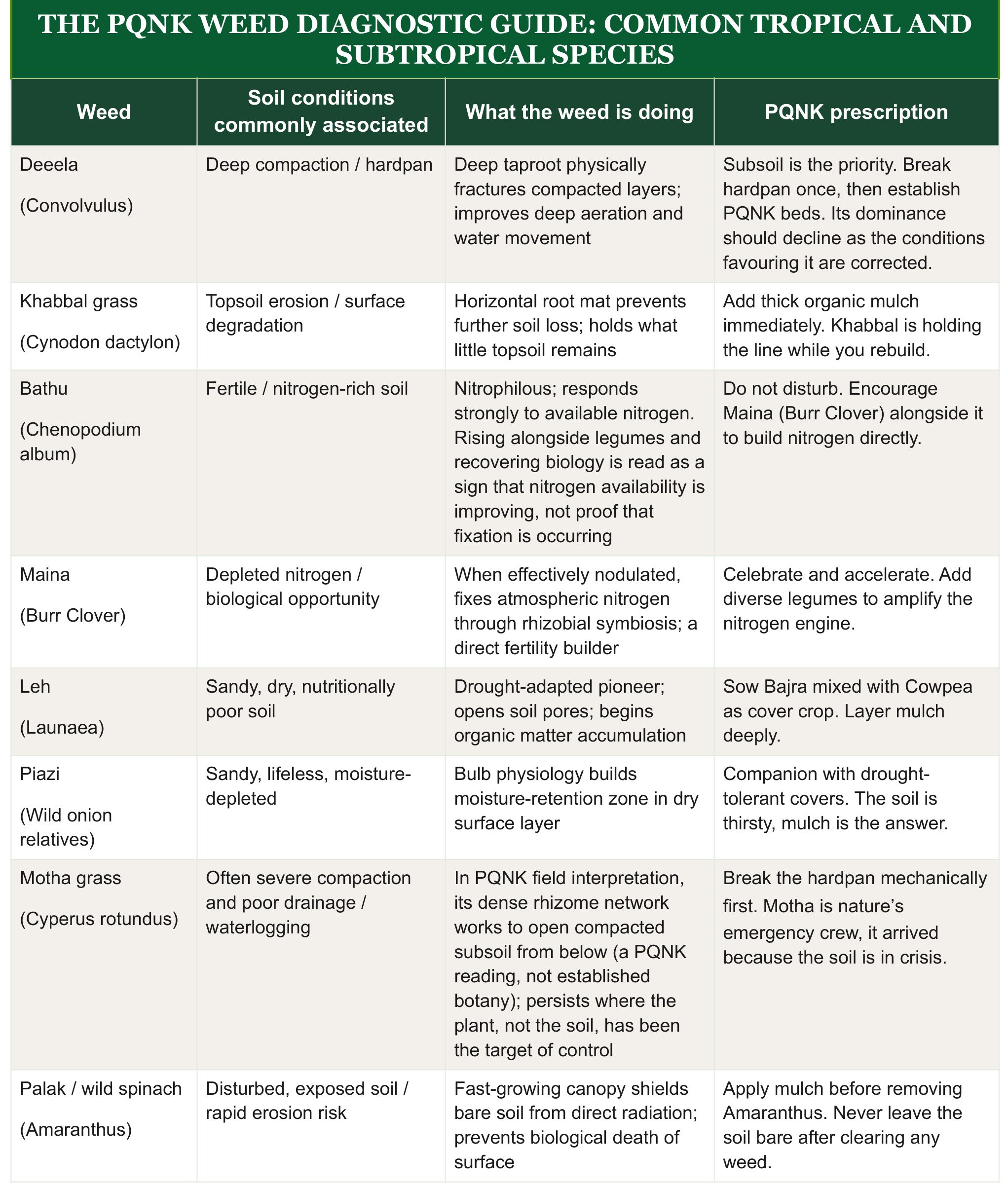
| Weed | Soil conditions commonly associated | What the weed is doing | PQNK prescription |
|---|---|---|---|
| Deeela (Convolvulus) | Deep compaction / hardpan | Deep taproot physically fractures compacted layers; improves deep aeration and water movement | Subsoil is the priority. Break hardpan once, then establish PQNK beds. Its dominance should decline as the conditions favouring it are corrected. |
| Khabbal grass (Cynodon dactylon) | Topsoil erosion / surface degradation | Horizontal root mat prevents further soil loss; holds what little topsoil remains | Add thick organic mulch immediately. Khabbal is holding the line while you rebuild. |
| Bathu (Chenopodium album) | Fertile / nitrogen-rich soil | Nitrophilous; responds strongly to available nitrogen. Rising alongside recovering biology, it is read as a sign that nitrogen availability is improving | Do not disturb. Keep the surface mulched: the living soil’s free-living nitrogen fixers supply the crop. |
| Maina (Burr Clover) | Depleted nitrogen / biological opportunity | Pioneer of a recovering soil; covers the ground and feeds the soil’s biology | Celebrate it: the biology is returning. Keep the surface mulched and do not disturb. |
| Leh (Launaea) | Sandy, dry, nutritionally poor soil | Drought-adapted pioneer; opens soil pores; begins organic matter accumulation | Sow Bajra as a cover crop. Layer mulch deeply. |
| Piazi (Wild onion relatives) | Sandy, lifeless, moisture-depleted | Bulb physiology builds moisture-retention zone in dry surface layer | Companion with drought-tolerant covers. The soil is thirsty, mulch is the answer. |
| Motha grass (Cyperus rotundus) | Often severe compaction and waterlogging | In PQNK field interpretation, its dense rhizome network works to open compacted subsoil from below (a PQNK reading, not established botany); persists where the plant, not the soil, has been the target of control | Break the hardpan mechanically first. Motha is nature’s emergency crew, it arrived because the soil is in crisis. |
| Palak / wild spinach (Amaranthus) | Disturbed, exposed soil / rapid erosion risk | Fast-growing canopy shields bare soil from direct radiation; prevents biological death of surface | Apply mulch before removing Amaranthus. Never leave the soil bare after clearing any weed. |
The ‘Emergency Crisis’ Field. When Motha grass dominates a field, it usually points to a badly degraded soil: severe, persistent compaction, often with waterlogging. Motha (Cyperus rotundus) is one of the world’s most herbicide-resistant weeds, not because it is particularly aggressive in ecological terms, but because the condition it is adapted to is so severe that no intervention aimed at the plant rather than the soil can produce lasting results. Farmers who have sprayed Motha for years know this: it returns every season with equal vigour, because the compaction and waterlogging that called it have not changed. The PQNK prescription is to break the hardpan first, mechanically, so that water soaks in, before expecting any biological recovery. Once the physical constraints are relieved, Motha’s dominance should decline as the conditions favouring it are corrected, giving way to a more diverse weed community that signals improving soil.
WEED COMPETITION: WHAT PQNK ACTUALLY CHANGES
The usual case for herbicides rests on competition: weeds are said to take nutrients, water and light that the crop would otherwise use, so removing them raises yield. Weeds do compete, and a heavy weed stand in a degraded field can cost yield. What is questionable is the assumption that the answer is always to kill the weed rather than to change the conditions that let it dominate. Nutrient competition, in particular, looks very different in a biologically functioning soil than in a depleted one, and that difference is the primary justification the herbicide industry’s existence.
As Chapter Three set out, the mineral reserves of most agricultural soils are very large relative to what a crop removes in a season: soil phosphorus reserves run at roughly one hundred and eighty-two times annual crop withdrawal, and potassium reserves at over a thousand times. Where that reserve is being actively cycled into plant-available form by a living soil, the extra draw from a weed stand is a small share of a large pool, and its effect on the crop is correspondingly small. In a degraded soil, where cycling has stalled and the plant-available fraction is thin, the same weed competition bites much harder. This is why PQNK treats the state of the soil, not the mere presence of the weed, as the thing to manage.
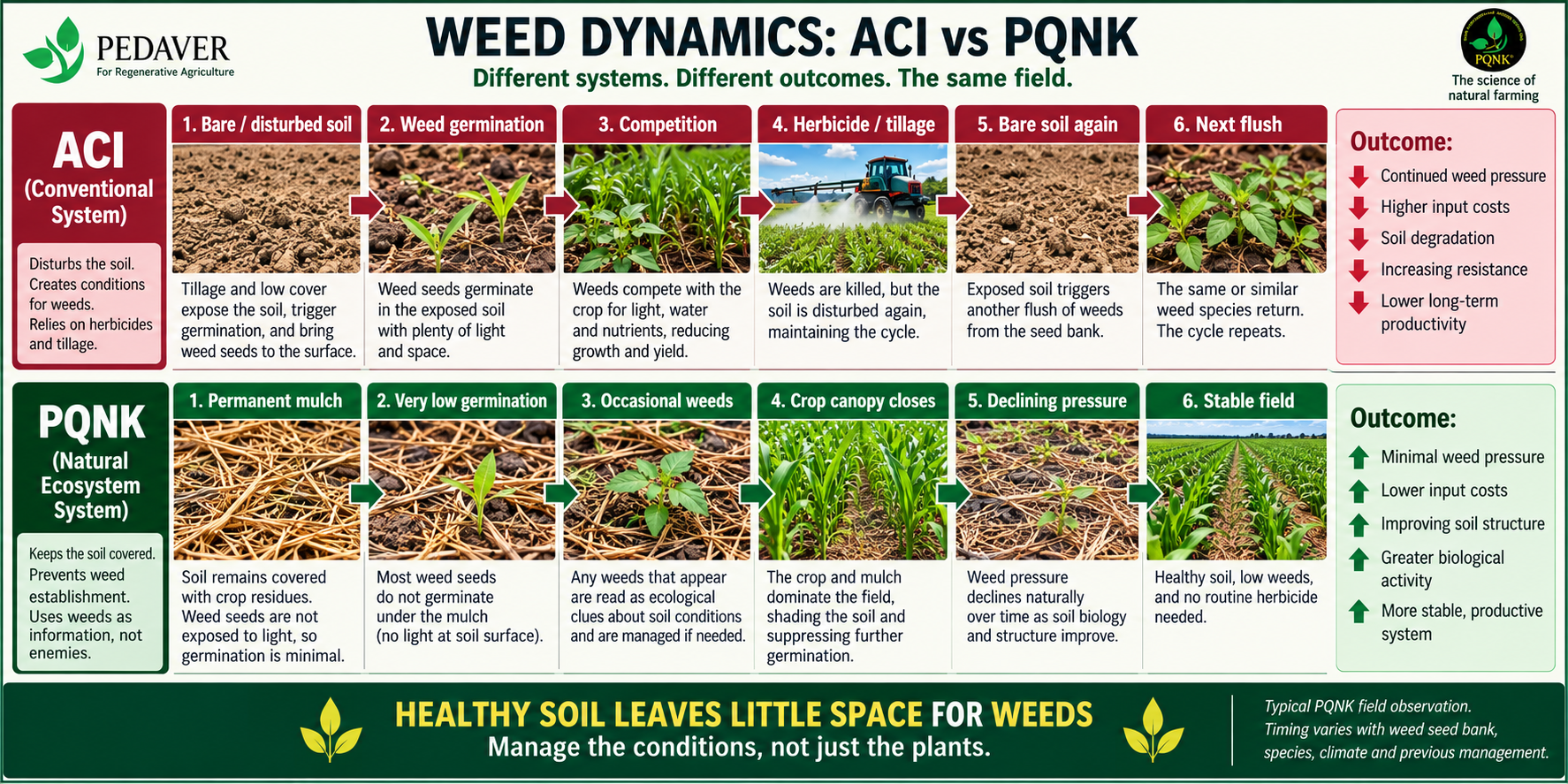
Above ground, the competition is more immediate. A tall weed shading a crop plant reduces the light reaching the crop’s leaves and lowers its productivity, and this is often the most immediately damaging form of weed competition. It is also the form the PQNK mulch system heads off before it can begin: a permanent organic mulch keeps the soil covered and undisturbed, so the signals that call the weed seed bank up, bare soil, collapsed pore structure, wide temperature and moisture swings, light, are largely absent and most of the seed bank stays dormant. The seeds that do not germinate raise no plants to compete. The result is reached without herbicide, without cultivation, and without any step beyond maintaining the mulch layer the PQNK system requires in any case.
In the first season of PQNK establishment, before the mulch layer is fully continuous and deep, some weed germination will occur at gaps and edges. These early weeds should be managed not by herbicide but by cutting them and dropping them as mulch, by thickening the mulch, or, where the weed species is a known soil physician, by deliberate tolerance, allowing it to perform its diagnostic and remedial function for a season before the establishing PQNK system makes its presence unnecessary. By the second and third seasons, in a correctly managed field with a well-maintained mulch layer, weed pressure is typically a small fraction of what it was under conventional management, achieved without a single drop of herbicide. Shading of this kind matters mainly for low-growing field crops in their early stages; in orchards and other tall crops the crop canopy stands well above any weeds, so weed shading is not a concern.
WHAT HERBICIDES DO: THE FULL COST
Herbicides are the largest segment of the global pesticide market, exceeding forty billion dollars annually. Their use in Pakistan has expanded dramatically over the last three decades, driven partly by the labour shortage created as rural communities migrate to cities, and partly by the aggressive marketing of agrochemical companies that have successfully positioned herbicide use as a marker of modern, progressive farming. The full cost of this expansion, in soil biology, in water contamination, in herbicide-resistant weed populations, and in the farmer’s own health, is rarely accounted for.
Herbicides can disrupt the root exudate signalling system. Many herbicides, including the world’s most widely used glyphosate-based formulations, disrupt the root exudate chemistry through which plants communicate with and recruit their soil microbial partners. When a plant’s exudate chemistry is disrupted, its ability to recruit mycorrhizal fungi and other root-zone partners, the BT bacterial community among them, can be impaired, and the biological nutrient-delivery system it depends on is weakened. The herbicide meant to kill the weed can, in the same action, work against the biology that sustains the crop.
Herbicides can alter non-target soil biology. Effects on soil life vary with the active ingredient, the formulation, the rate, the soil, the organism, and how long the exposure lasts. Glyphosate, for example, binds metal ions, and studies have reported reduced populations of some beneficial bacteria and fungi, including mycorrhizal species, effects on earthworm activity, and disruption of nitrogen-fixing bacteria; other studies find limited or transient effects at recommended field rates. What is consistent is that repeated chemical disturbance works against the biology PQNK is trying to rebuild, at the same time as it kills the weed.
Herbicides create resistance. The evolutionary dynamics of herbicide resistance mirror those of pesticide resistance precisely. Any weed population contains individuals with slightly greater tolerance to a herbicide; these survive, reproduce, and pass their tolerance to subsequent generations. Glyphosate-resistant weeds, "superweeds" in the popular press, are now reported across many of the world’s major cropping regions, and reduced sensitivity to commonly used herbicides has been reported in several weed species, driving higher doses, more frequent applications, and a switch to alternative chemicals that set up the next round of resistance. This is the herbicide treadmill: the same structural dynamic as the pesticide treadmill, driven by the same industrial logic.
Herbicides contaminate food and water. Herbicide residues persist in soil and water systems and appear in measurable concentrations in food produced on treated land. Glyphosate and its metabolites have been detected in wheat flour, in oilseeds, in groundwater, and in the blood and urine of agricultural workers. The health implications of chronic low-level exposure to multiple herbicide residues simultaneously remain incompletely understood and actively disputed, a dispute in which the companies that profit from herbicide sales have, historically, funded a substantial portion of the research.
The herbicide kills the weed and damages the soil in the same action. It silences the soil’s diagnostic message while doing nothing about the condition that generated it, so the same species germinates again from the seed bank the following season, carrying the same message that was never heard. And where the same herbicide mode of action is relied on year after year, it progressively selects the resistant individuals in the population, so control becomes harder over time, not easier.
WHEN WEEDS DISAPPEAR: THE SIGN OF A HEALTHY SYSTEM
One of the most satisfying and most instructive observations available to the PQNK farmer is the progressive disappearance of weed pressure without any herbicide application as the PQNK system establishes. This disappearance is not random, and it does not happen all at once. It follows a predictable pattern that reflects the stages of biological soil recovery, and it is one of the most reliable confirmations that the system is working. The pattern described below is drawn from PQNK field observation rather than a fixed ecological timetable; its pace varies with the weed seed bank, the species present, the climate, and how the field was managed before.
In the first season of PQNK establishment, weed pressure is typically still significant, particularly at the edges of beds and in any gaps in the mulch layer. The soil conditions that called the weeds, compaction, biological impoverishment, low organic matter, have not yet been fully addressed. The mulch layer is not yet thick enough to prevent all germination. Some manual management may be needed to prevent shading of the crop.
In the second season, weed pressure is measurably lower. The mulch layer, now thicker and more continuous, prevents most germination. The soil biological community, beginning to recover, has shifted the underground conditions in ways that make the most stress-adapted pioneer species, the weeds that indicate the worst degradation, progressively less appropriate for the improving soil. The species composition of any weed that does appear changes: the most extreme stress indicators decline, replaced by species that indicate milder conditions.
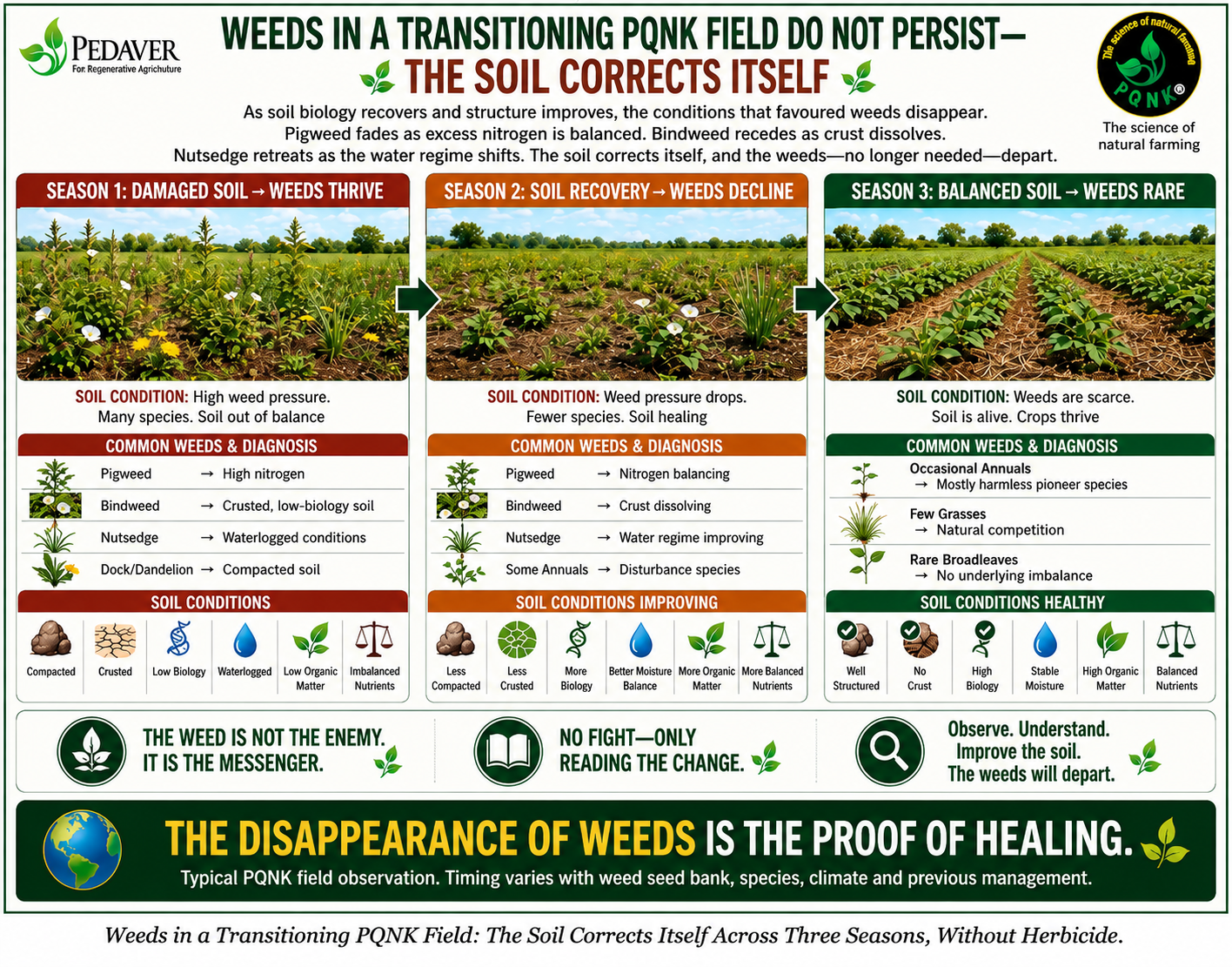
Weeds in a Transitioning PQNK Field: The Soil Corrects Itself Across Three Seasons, Without Herbicide.
By the third season and beyond, in a correctly managed PQNK field, weed pressure is typically minimal without any intervention. The mulch layer is continuous and deep enough to prevent germination of all but the most persistent species. The soil conditions that triggered pioneer plant succession have been substantially corrected: hardpan is fractured, organic matter is rebuilding, biological activity is active. The weeds that were indicators of crisis are no longer needed and no longer appear. The ecological succession that they were initiating has been accelerated and completed by the PQNK protocol. The physicians have discharged themselves, their work done.
The farmer who witnesses this transition, who watches weed pressure declining season after season without spraying a drop of herbicide, while simultaneously watching crop yields and quality improve, has understood something fundamental about the relationship between soil health and agricultural success. The weeds were never the problem. The problem was the soil condition. Fix the soil, and the weeds fix themselves.
THE WEED AS A TEACHER: WHAT EVERY FARMER CAN LEARN
The shift from the conventional view of weeds to the PQNK view is, at its heart, a shift in the farmer’s relationship to knowledge. The conventional farmer is told by the agrochemical industry what his soil needs and what he must buy to provide it. The PQNK farmer is taught to read his own land, to understand the language that his soil is already speaking and to respond to what it says. In this sense, the weed is not merely a diagnostic tool. It is the entry point to a different kind of agricultural education: one that increases the farmer’s knowledge, autonomy, and independence rather than deepening his dependency on purchased products.
The PQNK approach to weed management requires no expense and no purchased inputs. It requires observation, patience, and the willingness to see the field differently, to understand that the weed is not the problem but the response to the problem, and that the correct response to the weed is not to spray it but to listen to it. For the farmer who makes this shift, every weed becomes a data point, every field a conversation, every season a clearer reading of what the soil requires and what it is capable of.
The skills developed in reading weed communities, observation, pattern recognition, biological inference, are the same skills that make an excellent PQNK farmer in every other aspect of the system. The farmer who can read Deeela and understand that the hardpan needs breaking is the same farmer who can read crop root architecture and understand that the biological nutrient delivery system is recovering. The farmer who understands that Motha grass means waterlogging is the same farmer who understands that the furrow irrigation must never exceed half-depth. These are not separate skills. They are expressions of a single capability: the ability to read the ecosystem.
The PQNK farmer does not have to wait for an agronomist to tell him what his soil needs. A laboratory analysis gives a chemical snapshot; the weed community gives a living, integrated record of the conditions the field has actually been growing plants under. The skilled PQNK farmer learns to read both, the species present and the field conditions that produced them, and the reading costs nothing and is available to everyone.
PART ONE: WHAT HAS BEEN ESTABLISHED
Seven chapters have now established, with biological precision and documented field evidence, the complete picture of what the natural ecosystem is, what it does, and what ACI agriculture has done to it. Before turning to Part Two, the full account of how ACI agriculture came to dominate global food production and at what cost, it is worth pausing to consolidate what has been learned.
The Earth’s original design was a self-sustaining biological production system that operated for four hundred million years without depletion, without external input, and without waste. It ran on four integrated systems: a geological mineral bank accessed by a microbial assembly line; a carbon cycle that built and sustained soil structure, water retention, and biological activity simultaneously; a natural water system that captured every drop of rain, dew, and humidity and stored it in the soil profile for continuous root-zone delivery; and a biological pest and weed management system that prevented any single species from achieving the densities required for ecological damage.
ACI agriculture dismantled all four systems through three primary mechanisms: tillage (which destroyed soil structure, severed mycorrhizal networks, and oxidised carbon); soil inundation (which drowned aerobic biology, compacted structure, and drove salinity buildup); and bare soil exposure (which burned organic matter, evaporated water, and eliminated the surface biological community). The chemicals applied to compensate for each failure deepened the failure they were compensating for, in a cycle of manufactured dependency that the industry that profits from the cycle has every incentive to maintain indefinitely.
PQNK restores all four systems through a precise, sequential, eight-step protocol that initiates measurable biological recovery within the first growing season and works toward full system self-sufficiency, the closed loop of zero purchased inputs, maximum biological productivity, and continuously improving soil health, which a correctly managed field often approaches around the third crop cycle; maturity is confirmed by field evidence, not by the calendar. Documented PQNK field applications, together with wider use of elements of this biological approach, have been recorded across a range of crops, soils and climates in Pakistan and other countries, from heavy Punjab clay to light Balochistan sand, from the semi-arid to the sub-tropical.
Part Two now asks the question that Part One’s evidence makes unavoidable: if nature’s design was this complete, this productive, and this freely available, how did agriculture come to work against it for so long? Not for sixty years, but across the whole history of cultivation: from the first seed pushed into a dug hole, through more than ten thousand years of the plough opening the soil horizontally, to the machinery that now inverts it outright and the agrochemicals layered on top. That escalating sequence is what the name Ancient Conventional Industrial records. The answer is not comfortable. But it is necessary.
Chapter Eight: The First Error, When Humans Buried Seeds in Fear, Not Understanding