

Industrial Devastation To Natural Abundance
The Destruction · Chapter 8
The First Error
When Humans Buried Seeds in Fear, Not Understanding
Release 1.0 · 2026-09-09
If you use “Listen”, the text of the page may be sent to your browser or operating system’s speech provider, such as Apple, Google or Microsoft, depending on the voice your device uses. Pedaver does not process, transmit or store any audio.
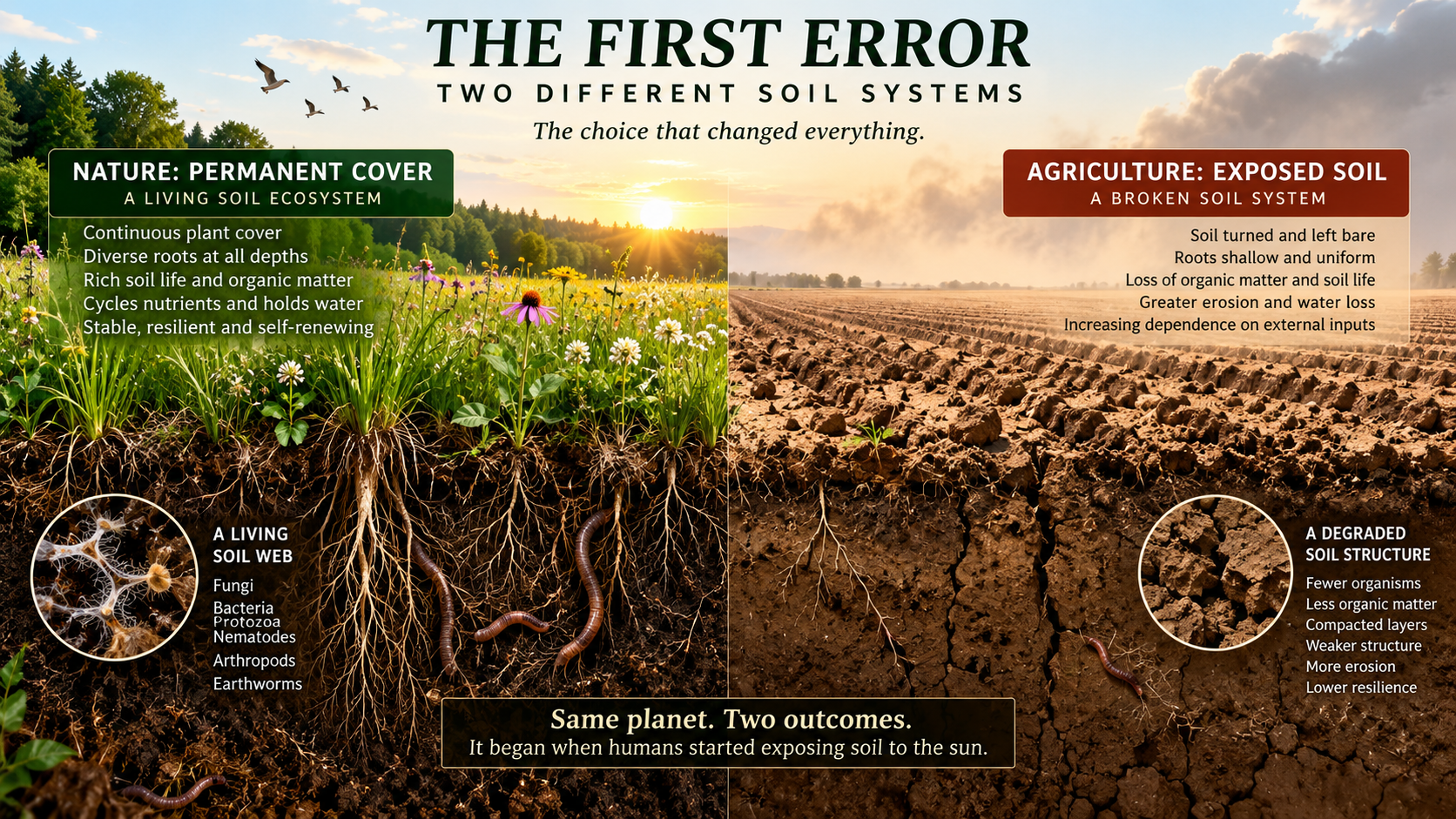
“The first farmer did not destroy the earth intentionally. He destroyed it innocently. He was afraid, and he wanted control. Both are very human. Both are understandable. Neither excuses ten thousand years of not asking what he had actually done.”
Asif Sharif, Lahore, 2023
Part One established what the natural ecosystem is. It is a system of extraordinary precision, depth, and productivity. For hundreds of millions of years it has sustained an evolving diversity of life, species emerging, adapting, diversifying, and disappearing, while the underlying biological processes of photosynthesis, decomposition, nutrient cycling, soil formation, and ecological succession continued without a break. More than a million species have already been scientifically described, and estimates of total living diversity run into many millions. The system carried all of this without depletion, without external input, and without human assistance. Part Two asks how humanity managed to dismantle it. Not over four hundred million years, but in the blink of geological time: ten thousand years for the foundation of damage, and sixty-eight years for the catastrophic acceleration.
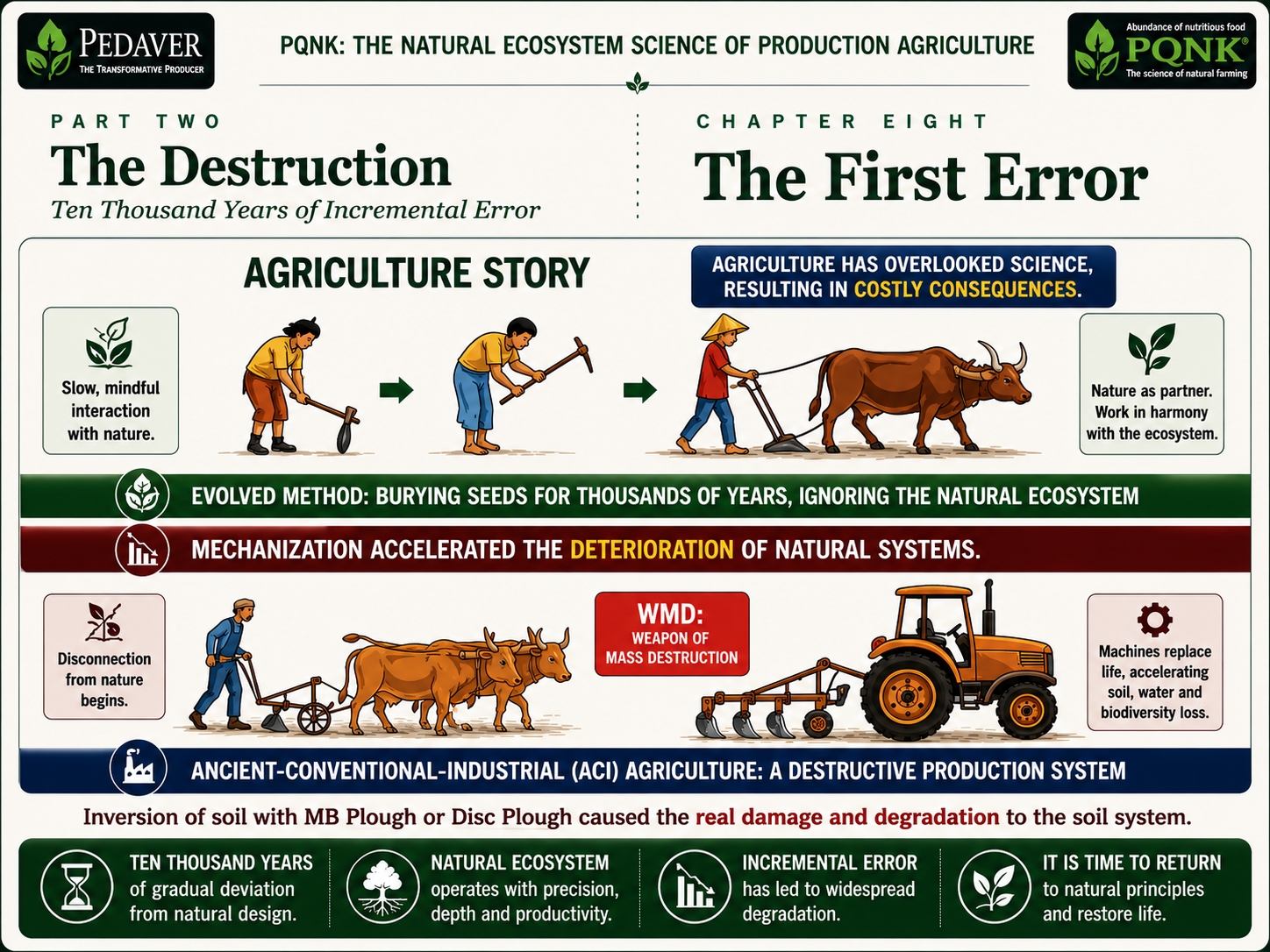
Agriculture Story: the progression from hand cultivation to mechanised ACI agriculture.
The story of agriculture’s long war against the natural ecosystem does not begin with malice. It begins with something more recognisable and, in many ways, more troubling: fear, convenience, and the very human tendency to solve an immediate problem without asking what the solution will cost in the long run. The first farmer was not a villain. He was a frightened person doing something practical. The tragedy is that what he did, out of entirely comprehensible motivations, set in motion a chain of consequences that ten thousand years of accumulated human intelligence has still not fully reckoned with.
This chapter traces that chain from its beginning: the single act that started the ten-thousand-year error, the logic that sustained it through millennia, and the point at which incremental damage became something qualitatively different, the moment when the ancient error was industrialised, weaponised, and deployed at a scale that nature had never encountered and cannot absorb.
BEFORE THE PLOW: WHAT THE WORLD LOOKED LIKE
To understand what was lost, it is necessary to understand what existed before it was disturbed. Before the first seed was buried, before the first soil was turned, before the first forest was cleared for cultivation, the land surface of Earth was a continuous, interconnected biological system of astonishing productivity. The grasslands of Central Asia, the forests of the Fertile Crescent, the savannahs of Africa, the floodplains of the Indus and the Nile, every one of these landscapes was, in the ecological sense, a biological production system of the first rank. It was not necessarily yielding more harvestable grain or edible human food per acre than a modern farm. It was doing something biologically more impressive: fixing large quantities of carbon into total biomass above and below ground, supporting diverse food webs, recycling its own nutrients, protecting its soil, and managing its own water, and sustaining that output without a single purchased input.
They produced this food without plowing, without irrigation, without fertiliser, without pesticide, and without any human management. They did so because the soil food web, the mycorrhizal networks, the carbon cycle, the water management system, and the biological pest regulation mechanism described in Part One were fully intact and operating at peak biological efficiency. Gross and net primary productivity, the standard scientific measures of how much carbon an ecosystem fixes and how much it retains, bear this out. A recent global comparison put mean potential gross primary productivity at roughly two kilograms of carbon per square metre per year for forests, about 1.8 for croplands, and about 1.5 for grasslands, and found forests to be the most productive land cover across roughly two-thirds of the land climatically suited to all three; converting natural ecosystems to farmland was estimated to have lowered global gross primary productivity overall. The photosynthetic output of an undisturbed grassland is at least comparable to that of cultivated cropland on a per-acre basis, and in forests it commonly exceeds it. The edible fraction, the biomass available to humans and animals as food, was spread across thousands of species rather than concentrated in a handful of cultivated varieties. The system was diverse, resilient, and permanent.
Early Homo sapiens lived within this system as participants, not managers. They were highly skilled foragers and hunters who understood the seasonal patterns of food availability, the locations of reliable food sources, and the behaviours of the animal populations they hunted. The evidence from archaeobotany and skeletal remains is heterogeneous, but across a large share of the populations that have been studied it points the same way: the shift to a grain-centred diet is associated with more dental disease, more markers of nutritional stress, reduced stature, and, in many settings, a heavier physical workload than the foraging life it replaced. The picture varies from region to region and is still debated, but for most of the populations examined the direction is not favourable to early farming. Where the forager diet has been reconstructed, it was typically more varied and less dominated by a single starch staple than the grain-centred diet agriculture produced.
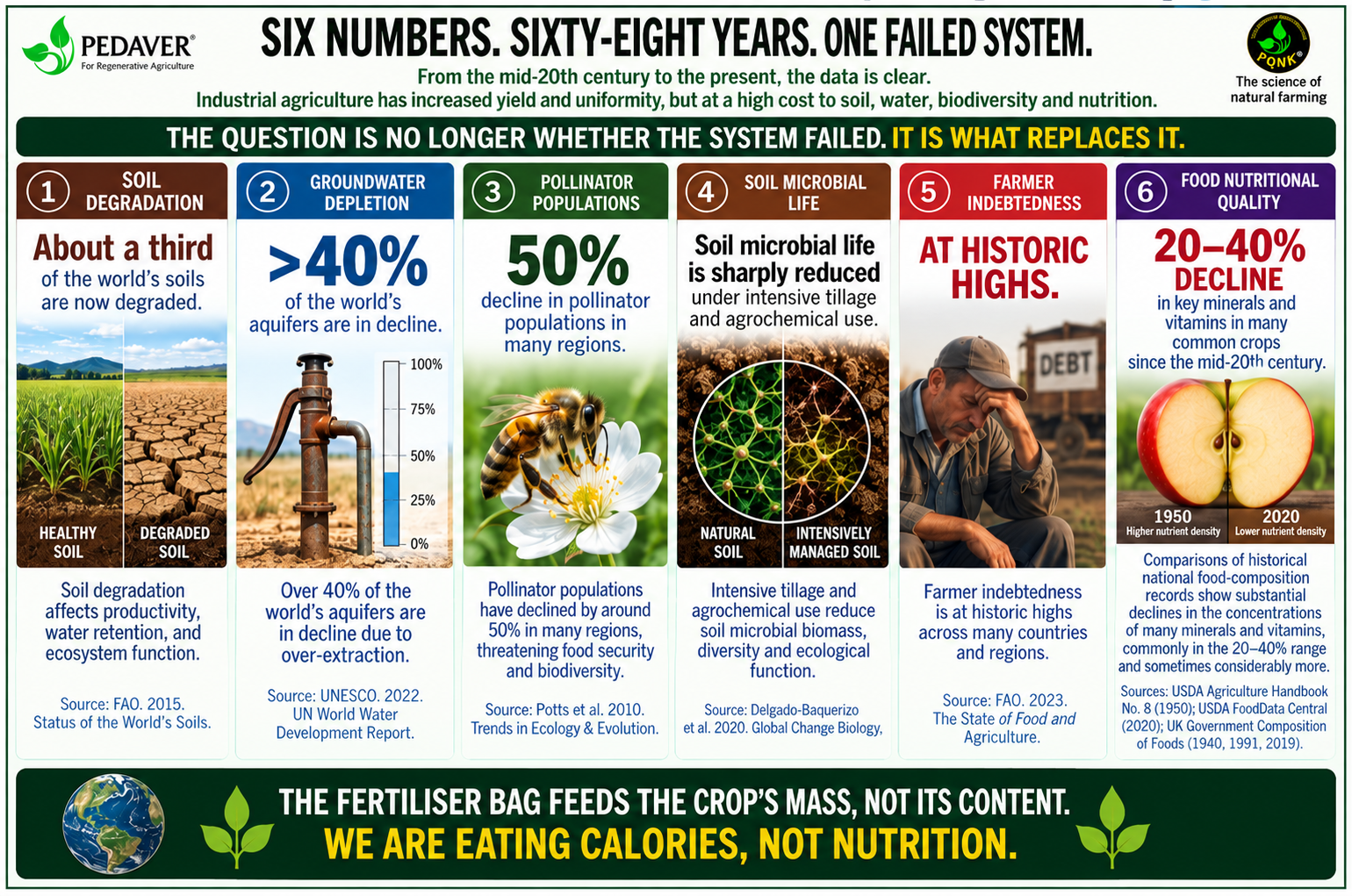
Six Numbers, One Failed System: soils degraded, groundwater depleted, pollinators halved, and food nutrition thinned since the mid-twentieth century.
THE MOMENT OF TRANSITION: FEAR, NOT NECESSITY
The standard narrative of agriculture’s origins presents the transition from foraging to farming as a response to necessity: a growing population, declining wild food availability, or climate change that forced early humans to find more reliable ways of producing food. This narrative is compelling and widely taught, but the evidence for it is weaker than its popularity suggests, and archaeologists continue to debate why agriculture began. The archaeological evidence for the origins of agriculture in the Fertile Crescent, the region that includes modern-day Iraq, Syria, and the Levant, tells a different story.
The earliest evidence of systematic seed planting, dating to approximately 10,000 BCE in the Fertile Crescent, does not coincide with evidence of food stress or population pressure. The wild food resources of the region were abundant. Wild wheat and barley grew in quantities sufficient to support dense human populations without cultivation. Wild game populations were healthy. The climate was favourable. There is little evidence that the people who first planted seed systematically were doing so to escape starvation, and several of the best-documented early farming regions show no sign of the population pressure or resource collapse that the necessity account requires.
Humans did not first discover seed. Nature had been planting seed for hundreds of millions of years: wind carried it, birds transported it, animals buried it, fruit fell and decomposed around it, and water moved it across landscapes. Humans became another dispersal agent. They collected edible plants from the surrounding ecosystem and carried them back to camp, and seeds and other propagules were dropped, discarded, or lost around these settlements, where some germinated. Archaeologists have discussed this pathway for more than a century as the dump-heap hypothesis, and more recent work treats humans as an additional seed-dispersing organism whose movements reshaped where useful plants grew. The connection would have been difficult to miss: the food gathered from distant places could reproduce close to home.
This offered something of immense value. Hunting and gathering required repeated movement through an uncontrolled landscape, exposing people to injury, predators, conflict, weather, and the uncertainty inherent in locating dispersed resources. A food-bearing plant growing beside the settlement reduced that exposure, along with the labour and distance needed to obtain the same resource. PQNK therefore proposes that security and convenience, rather than simple food scarcity, were among the powerful forces behind the earliest deliberate cultivation.
The first error was not the discovery that seed could be planted. It was the method chosen to make planting reliable: opening the soil, placing the seed beneath the surface, and covering it again. The method worked. Germination needs adequate water, a suitable temperature, and oxygen, in proportions that vary by species, and shallow burial improves seed-to-soil contact, steadies the moisture around the seed, and hides it from birds, rodents, and ants; only excessive burial prevents emergence. It was not intended as an assault on the soil biology; the concept of soil biology did not exist. But in opening the soil to place the seed, the first cultivator severed mycorrhizal threads, disrupted bacterial communities, exposed organic matter to oxidation, and broke aggregate structure that those organisms had spent years building. Because the technique succeeded, it was repeated. The ecological damage was, at first, tiny and invisible. It was local. It was recoverable. But the direction was set.
The first farmer did not hate the soil. He simply did not know what he was destroying when he buried his seeds. The tragedy is not the ignorance of ten thousand years ago. The tragedy is the ignorance of the present, maintained deliberately, against all evidence, by an industry that profits from it.
THE SURPLUS THAT MADE POWER POSSIBLE
Escaping the danger of the forest solved the immediate problem, but it produced a second, unanticipated consequence: the harvest, grown and stored in one place, sometimes yielded more than the group needed to survive the season. Foraged abundance belongs to no one. It is distributed across an entire landscape, available to whoever reaches it, and cannot be hoarded, counted, or withheld. A harvest gathered into a granary is different in kind, not only in scale. It can be counted, guarded, rationed, and denied. That difference, the controllability of stored surplus, and not surplus itself, is what made organised power possible for the first time in human history. The first rulers did not need to plant a seed. They needed only to control the granary. The civilisations, and later the empires, that followed were, at their foundation, systems for controlling stored food, and, through it, the people who depended on it. The captured science and purchased-input dependency that a later chapter of this book documents is the same mechanism, refined and made less visible over ten thousand years, but built on the same principle: whoever controls the food supply controls the people who eat from it.
WHY THE ERROR WAS SELF-REINFORCING
The ten-thousand-year persistence of tillage agriculture is not a mystery. It persisted because it appeared to work, at least in the short term, and because the consequences of its failure were slow enough to develop that any individual farmer could not observe them clearly within a single lifetime. The mechanism by which the error was self-reinforcing is worth understanding in detail, because it is the same mechanism that sustains Ancient Conventional Industrial (ACI) agriculture today.
Tillage produced an initial yield benefit. The first time a patch of ground is tilled, the destruction of soil aggregates releases a burst of previously protected organic matter into plant-available form. The oxidation of this organic matter by the microbial community, which, in an undisturbed soil, would proceed slowly over years, is massively accelerated by the exposure to oxygen that tillage creates. This released fertility typically produces vigorous growth in the first season or two, though how large the boost is and how long it lasts depend on the soil, the climate, and how much organic matter the natural system had accumulated. The farmer sees a good crop and attributes the success to his technique. He is right, in the narrowest sense: his technique did produce the crop. What he cannot see is that the technique consumed, in one or two seasons, organic matter that the natural system had accumulated over decades.
The decline was gradual and misattributed. After the initial burst of released fertility, tilled soils produced progressively lower yields as organic matter declined and soil structure degraded. But this decline was slow enough that individual farmers rarely connected it directly to the tillage practice. Instead, they attributed declining yields to the land itself, the field was ‘tired,’ ‘exhausted,’ ‘worn out.’ The solution proposed, and adopted across the ancient world, was to move on: clear new land, till it, take the initial fertility burst, and repeat the cycle. This is the pattern of slash-and-burn agriculture that has been practiced on every inhabited continent. It is the original cover-up technology: when the fix stops working, apply the same fix to a new piece of ground.
Agriculture became culturally embedded before its costs were understood. By the time the full ecological consequences of tillage agriculture began to be visible, in the deforestation of the Fertile Crescent, the erosion of the hillsides of ancient Greece, the soil exhaustion documented in Roman agricultural writing, farming was not merely a practice. It was a civilisational identity. Cities, trade networks, legal systems, and religious structures had all been built on the agricultural surplus that tillage farming made possible. To question tillage was, implicitly, to question everything that had been built on top of it. This is one of the most powerful forces maintaining any failing system: the infrastructure built on it has more invested in its continuation than any individual critic has in pointing out the failure.
THE ANCIENT WORLD NOTICED: WHAT EARLY OBSERVERS RECORDED
The consequences of tillage-based agriculture were not invisible to the people experiencing them. Ancient agricultural writers, from Hesiod in eighth-century Greece to the Roman agronomists Columella and Varro in the first century CE, documented soil exhaustion, declining yields, and the progressive abandonment of once-productive land. They proposed solutions: crop rotation, manuring, fallowing, legume cultivation. These solutions had genuine merit. They slowed the rate of degradation and in some cases partially restored fertility. But they did not address the fundamental problem because they did not understand it. Without a concept of soil biology, without any understanding of what tillage was destroying beneath the surface, ancient agronomists could only work with what they could see, the symptoms rather than the cause.
In the Indian subcontinent, agricultural traditions going back thousands of years preserved practices that came closer to the natural ecosystem model than most Western farming traditions: minimum soil disturbance, extensive use of organic matter, polyculture systems that maintained biological diversity, and irrigation practices that respected the soil’s absorption capacity. These traditions were not based on a theoretical understanding of soil biology. They were the accumulated practical wisdom of generations of farmers who had observed, over centuries, what practices sustained productivity and what practices destroyed it. This empirical wisdom was largely swept aside in the twentieth century by the Green Revolution’s confident prescription of synthetic inputs, high-yield monocultures, and intensive irrigation, a prescription backed by the authority of modern science and the financial resources of international institutions. The accumulated wisdom of ten thousand years of observation was discarded in a generation.
THE INDUSTRIAL AMPLIFICATION: FROM ERROR TO CATASTROPHE
For the first nine thousand nine hundred years of agriculture, the error was self-limiting in a grim but functional sense: the damage that tillage could do in any given area was constrained by the power of the tools available. A farmer with an ox-drawn wooden plow could till a few acres. A community of such farmers could till a few thousand acres. The degradation was real, and its consequences for ancient civilisations were genuine, the deforestation of the Fertile Crescent contributed to the decline of the civilisations that depended on it, but it was local, and the natural ecosystem could partially recover in the abandoned areas while the damage continued elsewhere.
The Industrial Revolution changed this entirely. The steam engine, and later the internal combustion engine, put power into the plow that was orders of magnitude greater than any ox could provide. A single tractor pulling a multi-furrow plow could till in a day what would have taken a traditional farmer a season. The scale of potential damage expanded from thousands to millions of acres. And in the twentieth century, particularly after the Second World War, this mechanical amplification was combined with a chemical one: the synthesis and mass production of compounds that could suppress target organisms in the soil, the crop, or the field margins at a scale and speed never before possible, and that, depending on the chemistry, the dose, and the exposure, also affected non-target organisms and the ecological relationships between them.
The result was not merely faster degradation of the kind that ancient agriculture had produced. It was degradation of a qualitatively different kind: the elimination of biological communities that had evolved over millions of years, in timescales so short that evolutionary adaptation was impossible. A mycorrhizal network that had taken decades to establish could be severed in a single tillage pass. A BT bacterial community that had coexisted with plant roots for thousands of years could be disrupted, and in places sharply reduced, by repeated chemical applications. The natural ecosystem, which had survived ice ages, volcanic winters, and meteor impacts, was confronting something it had never encountered: a force capable of destroying it faster than it could rebuild.
For nine thousand nine hundred years, agriculture damaged the soil slowly enough that the damage appeared manageable. Then, in less than one human lifetime, the industrial revolution gave agriculture the power to do what it had always been doing at a speed that made recovery impossible. The error did not change. The power behind it did.
THE BIRTH OF THE CHEMICAL FERTILISER INDUSTRY: 1842
The industrial amplification of tillage's damage is only one part of the historical account. The second and in many ways more decisive rupture came not from the plow but from the laboratory, and it predated the post-war chemical capture by more than a century.
In 1840, the German chemist Justus von Liebig published his treatise on the mineral nutrition of plants, establishing the theoretical foundation for the argument that crops require specific chemical elements, nitrogen, phosphorus, potassium, and that these elements could be supplied from external manufactured sources. Liebig's chemistry was not wrong in its narrow terms. Plants do require these elements. What his framework systematically excluded was the biological system through which those elements are naturally delivered, mobilised, and regulated, the mycorrhizal networks, the microbial assembly lines, the root exudate communication system. Working with extraction chemistry and controlled pot experiments, Liebig had no means of observing that system. He saw the mineral. He did not see the biology that moved it. The failing that matters is not Liebig’s; nineteenth-century science had no way to observe soil microbiology. It is that agricultural science went on organising itself around mineral replacement for more than a century after that biology became observable.
Two years later, in 1842, the English entrepreneur John Bennet Lawes patented the process of treating phosphate rock with sulfuric acid to produce soluble superphosphate, the world's first manufactured chemical fertiliser, and opened the first commercial fertiliser factory in Deptford, London. The chemical era in agriculture had formally begun. The following year, in 1843, Lawes and the chemist Joseph Henry Gilbert began the long-term field experiments at Lawes’s Rothamsted estate that have now run for more than 180 years, producing the largest continuous agronomic dataset in history, a dataset whose own results would, over those decades, document with precision both the initial yield benefits and the long-term biological costs of the approach it was designed to validate.
For over a hundred years before the post-war corporations arrived with their surplus nitrogen from munitions manufacturing, the intellectual framework of mineral replacement without biology had been embedding itself in agricultural science, its commercial products accumulating the appearance of validity, and the biological understanding of why those products were simultaneously degrading the living system beneath the crop had been systematically excluded from the account.
THE POST-WAR CHEMICAL CAPTURE: WHEN BUSINESS TOOK THE WHEEL
The period between 1945 and 1960 is the inflection point in the history of agricultural degradation. Before 1945, the damage done by tillage agriculture was substantial but constrained. After 1960, it became exponential. The reason is not primarily mechanical; tractors and machinery had been available for decades. The reason is chemical and commercial: the entry into agriculture, with overwhelming financial resources and institutional backing, of corporations whose business model required a broken system and who had both the means and the motivation to ensure that the breaking continued.
The corporations that entered agriculture on a large scale after the Second World War were, in many cases, the same firms that had supplied the war effort with explosives, propellants, and chemical agents. The connections are real, though the chronology is often compressed in the retelling. Ammonia synthesis by the Haber-Bosch process, first industrialised before the First World War, had always served both fertiliser and explosives; the post-war years brought a large expansion of nitrogen-fixing capacity, much of it directed toward agriculture. Organophosphorus chemistry, explored in the 1930s for insecticides and, on a separate track, for nerve agents, produced a family of agricultural insecticides that were commercialised widely after 1945. The factories, the chemical expertise, and the supply chains were in place. What was needed was a market, and agriculture, with its billions of farmers and its vast land surface, was the largest available.
The strategy that these corporations adopted, whether by conscious design or structural logic, was identical in structure to what would later be called a subscription business model: create a product that is consumed continuously and must be repurchased every season; ensure that the conditions requiring the product cannot be eliminated without also eliminating the product; and control the research that might otherwise demonstrate that the product is unnecessary. The difference between this model and a conventional subscription is the scale of the harm it caused and the invisibility of its mechanism to the people paying for it.
The farmer who began using synthetic nitrogen fertiliser in the 1950s or 1960s saw an initial yield improvement and attributed it to the fertiliser. He did not see, could not see, because the timeline was too long and the mechanism too complex, that the fertiliser was suppressing his soil’s biological nutrient-cycling capacity, making him progressively more dependent on the product that was progressively destroying his ability to function without it. He did not see that the pesticide he was adding to manage the pest pressure that nitrogen-forced plants attracted was simultaneously killing the biological pest management system that would otherwise have made the pesticide unnecessary. Each product created the condition that made the next product necessary. The farmer walked willingly into a dependency whose architecture he could not see, reinforced by a commercial system that profited from recurring purchased inputs.
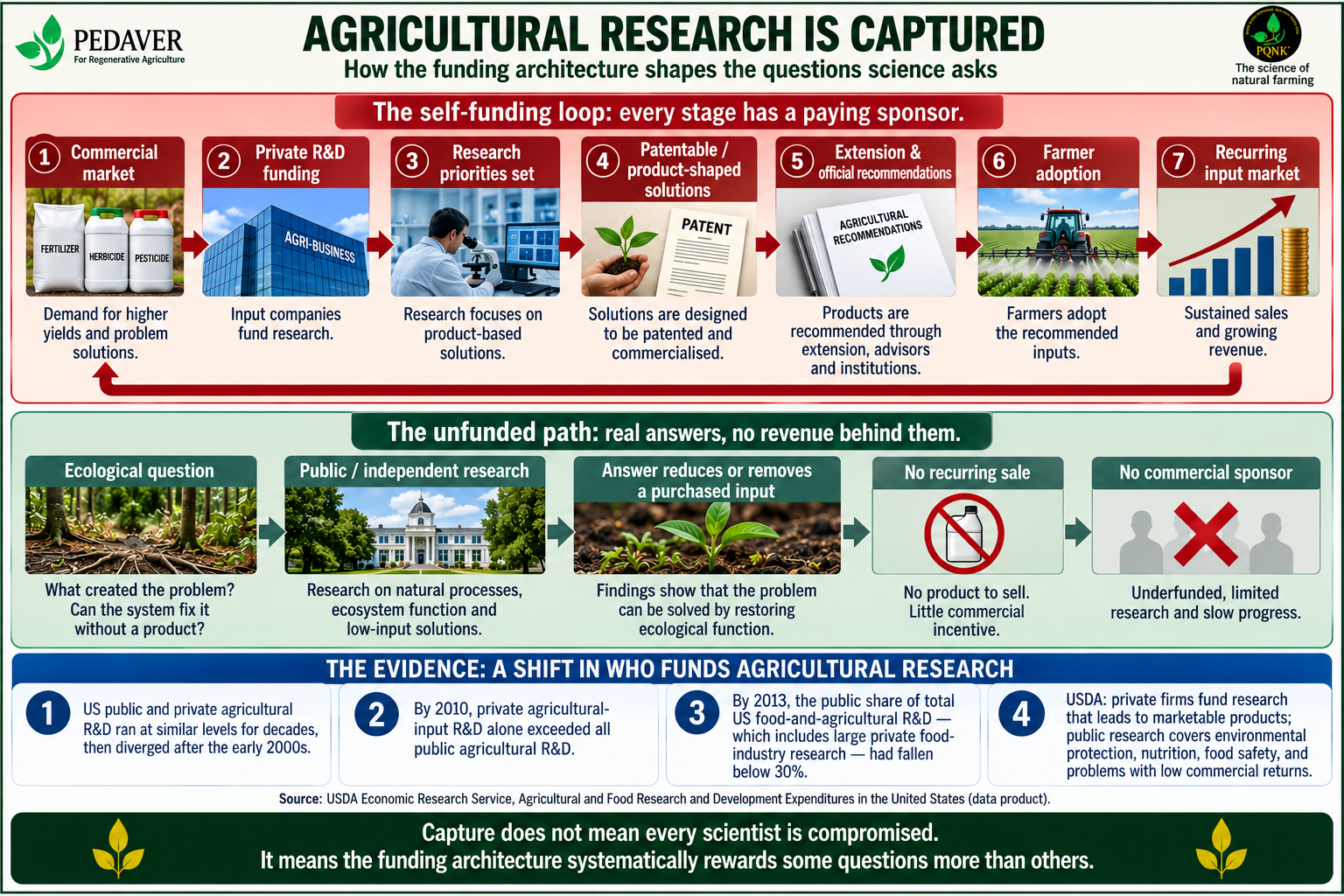
Agricultural Research Is Captured: capture does not mean every scientist is compromised; it means the funding architecture systematically rewards the questions that lead to a saleable product over the questions that would make products unnecessary.
The pattern of ACI degradation described in this chapter is not a Pakistani phenomenon, or a South Asian one, or a developing-world one. It is a universal template. The Fertile Crescent, the cradle of the agricultural civilisation that produced the first error, is today a landscape of salinity and soil collapse. The American Midwest, the most productive agricultural region in human history, has lost substantial topsoil to erosion and oxidation under intensive cultivation, with major losses documented across parts of the Corn Belt. The Punjab of India and Pakistan, the river-fed plains that fed empires for millennia, are showing measurable groundwater depletion and widespread soil-organic-matter decline across most of their cropped area. Central Asia, the great steppe that produced some of the most naturally fertile soils on Earth, has had its biological capital consumed in a few decades of Soviet and post-Soviet industrial agriculture. The template is the same everywhere. Only the timeline differs.
PAKISTAN’S AGRICULTURAL TRAGEDY: A COMPRESSED VERSION OF THE GLOBAL STORY
Pakistan’s agricultural history compresses the global story of ACI degradation into an especially short and especially instructive timeline. In 1947, at independence, Pakistan’s agricultural soils were, by any measure, among the most potentially productive in the world. The Indus basin, one of the great alluvial plains of human history, nourished by the snowmelt of the Himalayas, had deep, organically rich soils that had been managed for millennia under low-intensity farming systems that, while not ecologically perfect, preserved the fundamental biological infrastructure of the soil.
The Green Revolution of the 1960s arrived in Pakistan with the full institutional backing of the Pakistani government, international development organisations, and the United States, which saw modernisation of Pakistani agriculture as both an economic and a strategic objective. High-yield wheat and rice varieties, developed at international research centres funded partly by the Rockefeller and Ford Foundations, were introduced alongside package deals that included the synthetic fertilisers, pesticides, and irrigation infrastructure that the new varieties required. The yields, initially, were spectacular. Pakistan moved from food deficit to food surplus. The Green Revolution was declared a triumph.
What the headline yield statistics did not capture was what was happening below the surface. Soil organic matter in much of the Punjab has fallen below one percent, and below half a percent in many districts, well under the level needed for stable structure and active biology. It was materially higher before intensive input-based cultivation, though the arid alluvial soils of the Indus plain were never as carbon-rich as a temperate grassland soil. The water table, once within easy reach of shallow wells, now lies tens of metres down across much of the canal-irrigated Punjab and is still falling by one to three metres a year in the worst-affected districts. Pesticide resistance emerged and was managed by escalating chemical applications. Salinity spread across irrigated fields where high water tables, inadequate drainage, evaporation, irrigation-water quality, and insufficient salt removal combined to concentrate salts in the root zone. After the initial Green Revolution gains, yield growth in several major crops slowed while purchased-input costs increased and evidence of soil and water degradation accumulated.
Pakistan today faces an agricultural system in which the great majority of farmers use conventional, input-dependent methods that are demonstrably unsustainable, on soils showing widespread degradation, with groundwater declining rapidly in heavily pumped districts, in a climate that is becoming more extreme partly as a consequence of the agricultural practices that are themselves being threatened by the change. The first error, the burial of seeds in fear ten thousand years ago, has arrived, in Pakistan, at its logical contemporary expression.
What happened between 1960 and today to agriculture in Pakistan happened, at different speeds and under different political labels, to agriculture in virtually every country where the ACI system was adopted. India's Punjab and Haryana mirror Pakistan's trajectory almost exactly. Bangladesh's rice paddies show the same waterlogging and salinity accumulation. Egypt's Nile Delta, once the most productive agricultural land in the ancient world, is saltier and biologically poorer with every decade of flood-irrigation cotton. The American Corn Belt has lost topsoil at rates that soil scientists have described as geologically unprecedented. The names of the chemicals differ. The institutions carrying the message differ. The crops and the climate differ. Yet recurring patterns of soil degradation, water stress, input dependency, and ecological simplification appear across many ACI systems.
THE ERROR THAT WAS ALWAYS VISIBLE: WHAT THE EVIDENCE SAID
It would be charitable to the agrochemical industry to suggest that the consequences of ACI agriculture were not visible until recently. They were not. The evidence that tillage destroys soil structure has been in the scientific literature since at least the 1930s, when American soil scientists documenting the Dust Bowl identified the loss of soil organic matter through tillage as the primary driver of the catastrophe. The evidence that synthetic nitrogen suppresses mycorrhizal associations has been documented since the 1960s. The evidence that pesticides kill beneficial soil organisms has been available since the 1970s. The evidence that flood irrigation builds salinity has been documented in every major irrigated agricultural system since the ancient Mesopotamians. None of this evidence was hidden. It was simply not convenient.
The agricultural research system that should have acted on this evidence was, by the 1960s and 1970s, substantially funded by the same industry whose products the evidence implicated. The institutional mechanisms for translating inconvenient evidence into policy change had been progressively captured by the interests that would be damaged by that change. This is the subject of a later chapter, Captured Science, which addresses how agricultural research came to be shaped by the industries whose products the evidence implicated. But it is worth noting here, in the chapter about the first error, that the continuation of the error long past the point at which it was understood was not innocent. The first farmer buried his seeds in ignorance. By the twentieth century, however, industrial agriculture continued despite accumulating evidence of soil degradation and ecological damage, while commercial incentives increasingly rewarded the products used to manage the resulting symptoms.
What the word capture means here is specific. It does not require corrupt scientists or a secret conspiracy. A research system becomes commercially captured when the questions most likely to attract funding, institutional support, patent protection, and commercial development are increasingly the questions whose answers can be sold. United States Department of Agriculture figures record the shift plainly: public and private agricultural research spending ran roughly level for decades, then diverged sharply after the early 2000s. By 2010, private spending on agricultural-input research alone exceeded all public agricultural research spending; by 2013, the public share of total United States food-and-agricultural R&D, including large private food-industry research, had fallen below thirty percent. The 1980 Bayh-Dole Act had already set the direction, encouraging land-grant universities to license their work to industry partners and giving administrators and researchers a direct financial interest in findings that stayed useful to those partners; faculty at land-grant institutions have since reported direct pressure to shape their research toward the agribusiness funders paying for it, a pattern documented in the research-integrity literature rather than merely alleged from outside it. The USDA itself notes the difference in purpose: private firms concentrate on research that leads to marketable products, while public research is more likely to address environmental protection, nutrition, food safety, and problems with large social benefit but weak commercial return.
The consequence is not, for the most part, false science. It is incomplete science. The question “which product solves this problem?” attracts sustained investment. The question “what created the problem, and can the ecosystem resolve it without a product?” attracts very little, because no recurring sale depends on the answer. A farming system whose aim is to make fertiliser, pesticide, and other repeat purchases unnecessary is, by construction, a weak commercial research proposition for the industries whose revenue depends on selling them. Over decades, that asymmetry shapes what is studied, what is taught, what is passed on through extension services, and what comes to be regarded as normal agriculture.
The full balance sheet, soil, water, climate, production cost, yield, food quality, and smallholder viability, compiled dimension by dimension with sourced data, is developed in the companion PQNK Knowledge Paper, What Science Delivered: The Documented Balance Sheet of a Century of Input-Funded Agricultural Research.
The first farmer buried seeds in ignorance. That was forgivable. For ten thousand years, the error was sustained in partial ignorance. That was tragic but understandable. The twenty-first century continuation of industrial agriculture, maintained against all evidence by institutions whose funding depends on its continuation, is neither ignorant nor forgivable. It is a choice.
WHAT THIS CHAPTER HAS ESTABLISHED
The first error was simple: a frightened human buried a seed in soil to protect it, and in doing so disturbed the biological community that made the soil productive. The error was understandable, even admirable in its intention. What was not understandable, and what this part of the book will examine in detail, is the systematic amplification, institutionalisation, and commercial exploitation of that error over ten thousand years, and most aggressively over the last sixty-eight.
The self-reinforcing mechanism of the error is now clear: tillage produced an initial yield benefit by consuming accumulated biological capital; the subsequent decline was attributed to everything except tillage; the solution proposed was always more of the same intervention applied to new land or with greater chemical force. This pattern, initial benefit, gradual decline, denial of cause, escalation of intervention, is the template for ACI agriculture in every era and every geography.
Pakistan’s agricultural crisis is the contemporary expression of this template, concentrated in one country by the compressed timeline of the Green Revolution. What happened to Pakistani agriculture between 1960 and today is what happens to every agricultural system that adopts the ACI package, the fertiliser, the pesticide, the flood irrigation, the tillage, the monoculture, at the intensity and scale that the post-war chemical industry made possible.
The next chapter traces the precise mechanism by which the first error became a chain: the cover-up technology sequence in which each ACI intervention creates the problem that requires the next intervention, and in which the farmer is simultaneously the victim of the chain and the source of revenue that keeps it running.
Chapter Nine: Ancient Conventional Industrial, The Cover-Up Technology Chain