
Industrial Devastation To Natural Abundance
The Evidence · Chapter 41
Tropical Crops, Banana and Papaya
Banana Restored in Sindh; Papaya in Punjab Without Inputs
Release 1.0 · 2026-10-14
If you use “Listen”, the text of the page may be sent to your browser or operating system’s speech provider, such as Apple, Google or Microsoft, depending on the voice your device uses. Pedaver does not process, transmit or store any audio.
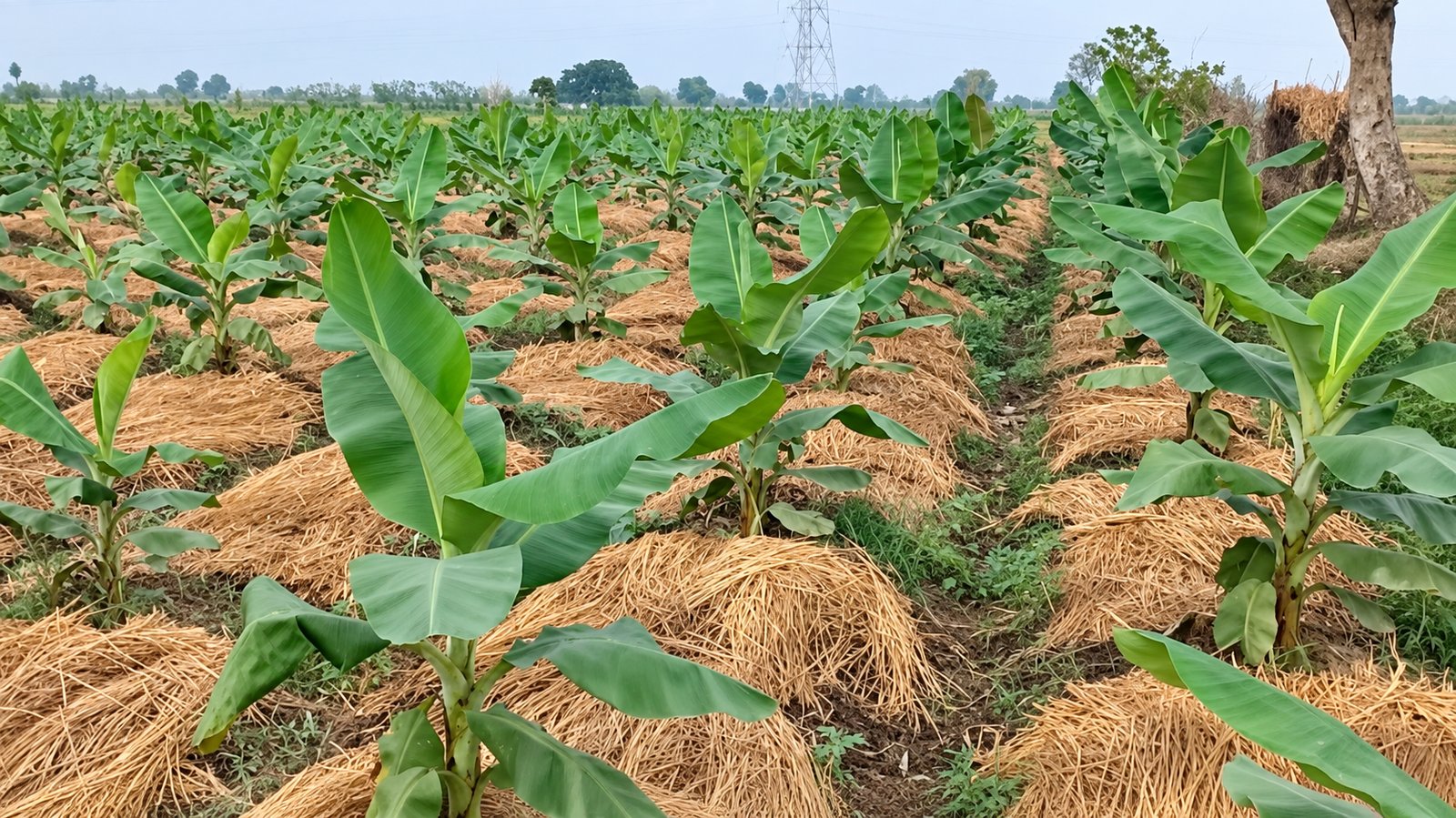
Banana rows under thick straw mulch
“Banana did not fail in Sindh because of its climate. It failed because of what we did to its soil. The biological system does not read textbooks. It reads soil.”
Asif Sharif, Lahore, 2021
The previous chapters in Part Five have addressed field crops, vegetables and orchards. This chapter turns to two tropical fruit crops. Banana has its traditional home in Sindh, where Ancient Conventional Industrial (ACI) management has driven its cost of production up and its quality down. Papaya, a crop of warm, humid tropical climates, has been taken up by farmers in Punjab, where conventionally it needs heavy inputs and pesticides to survive. In both, PQNK produces a good crop without purchased inputs, and both reveal how far the conventional framework has underestimated what living soil can do within a given climate.
BANANA: RESTORING A TRADITIONAL CROP
Banana (Musa spp.) is a tropical crop, and in Pakistan it is grown mainly in Sindh, its traditional home. There, under ACI management, the crop has been in decline: the cost of production has risen steeply with every season’s fertiliser, pesticide and fungicide, the quality of the fruit has deteriorated, and plants are lost to disease. The problem is not the climate, which has always suited banana in Sindh. It is what ACI practices have done to the soil.
Under PQNK, Sindh’s banana growers are turning this around. Many farmers have moved their fields to PQNK, and their reports are consistent: production has improved, the cost of production has come down, the quality of the fruit has risen, the crop needs far less water and fertiliser, and the plants are free of disease.
The explanation is biological, not climatic. ACI management degrades the soil that banana depends on: tillage and flooding compact it into a hardpan, bare soil heats and dries, and the soil biology that makes minerals available and protects the roots is lost. The plant is then propped up with fertiliser and defended with pesticides and fungicides, at a rising cost. PQNK restores the soil instead. The mulch layer keeps the root zone cool through the summer heat and at about 10 to 20°C through the winter, as described in Chapter Thirty-Eight. Live grass and the banana’s own older leaves, laid down as mulch as they age, protect and feed the soil biology. Soil moisture management (SMM) keeps the root zone moist without the flooding that an aerobic root zone cannot tolerate. A plant growing in living soil defends itself, and the diseases that ACI banana suffers fall away without sprays.
Water requirement: 77–92% less than flood irrigation (SMM vs flood irrigation)
Cost of production: Lower (far less fertiliser and water; no pesticide or fungicide once converted)
Fruit quality and health: Higher, disease-free (vs deteriorating and diseased under ACI)
Sucker production: Self-perpetuating (no replanting cost after initial establishment)
The PQNK banana protocol: The field is first converted in the four PQNK steps: the hardpan is broken once, one deep water wash cleans the soil, permanent raised beds are formed, and roots are retained and mulch maintained with no tillage. Banana is then established from suckers (vegetative offshoots of the mother plant) on the permanent beds, with a thick mulch layer applied immediately around each planting position. Spacing is 8 to 10 feet between plants, to allow the lateral root system to develop without competition and to permit tractor access in the furrows for all management operations. Irrigation follows the SMM protocol: water is given in the furrow only when the soil-ball test shows a need, never above a 4-inch head, and the mulch layer keeps the root zone moist between applications. Mature beds where annual rainfall is 400 mm or more need no irrigation. No fertiliser, pesticide or fungicide is used once the soil is converted. Older leaves are removed only as they age naturally and are laid on the bed as mulch; green leaves are not stripped. The sucker management system, retaining one first-generation sucker and one second-generation sucker per plant at any given time, maintains continuous production without replanting.
The economic advantage: PQNK banana answers the pressure Sindh’s growers feel most, the cost of production. With no fertiliser, pesticide or fungicide once the soil is converted, far less water, and no replanting, because the suckers carry the plantation forward from one cycle to the next, the cost of every harvest comes down while the quality of the fruit goes up.
A farmer’s report from the foothills of Nainital, India, shows the same principle at the edge of banana’s range. In a region of frost-risk winters, hot summers and heavy monsoon rain, a banana plantation on PQNK has stayed healthy and productive without chemical inputs, protected by live grass and mulch cover (Knowledge Paper KP-026).
Banana did not decline in Sindh because of its climate. It declined because of what was done to its soil. In living soil under a mulch blanket, the crop recovers its health, its quality and its economics. The limit was never the climate. It was the soil.
PAPAYA: A TROPICAL CROP IN PUNJAB, WITHOUT INPUTS
Papaya (Carica papaya) is native to the warm, humid tropics of Central America and Mexico, where it grows best at 21 to 32°C and 60 to 80 percent humidity. Farmers in Punjab took it up as a high-value crop, but in Punjab’s hotter, drier summers and cooler winters the plant is under stress, and conventionally it has needed heavy inputs: purchased hybrid seed, heavy nitrogen fertilisation, repeated pesticide and fungicide sprays to prevent pests and diseases such as Phytophthora root rot and powdery mildew, and flood irrigation across the 8 to 10 month production period.
Under PQNK, papaya growers in Punjab grow good crops without chemical fertilisers or pesticides. They keep their own seed, taken from the healthiest, most vigorous and most productive plants in their own fields, so each generation is selected under the farm’s own conditions.
In living PQNK soil, papaya roots work with the soil biology, including mycorrhizal fungi, which deliver minerals and water to the plant. With water, air and nutrition all in balance, the plant expresses its full productive potential, and that same balance carries through into healthy fruit and well-formed seed.
Seed from such a plant carries its parents’ genetics and starts life well nourished. Selecting the best plants season after season builds a seed stock adapted to local conditions, at no cost to the farmer.
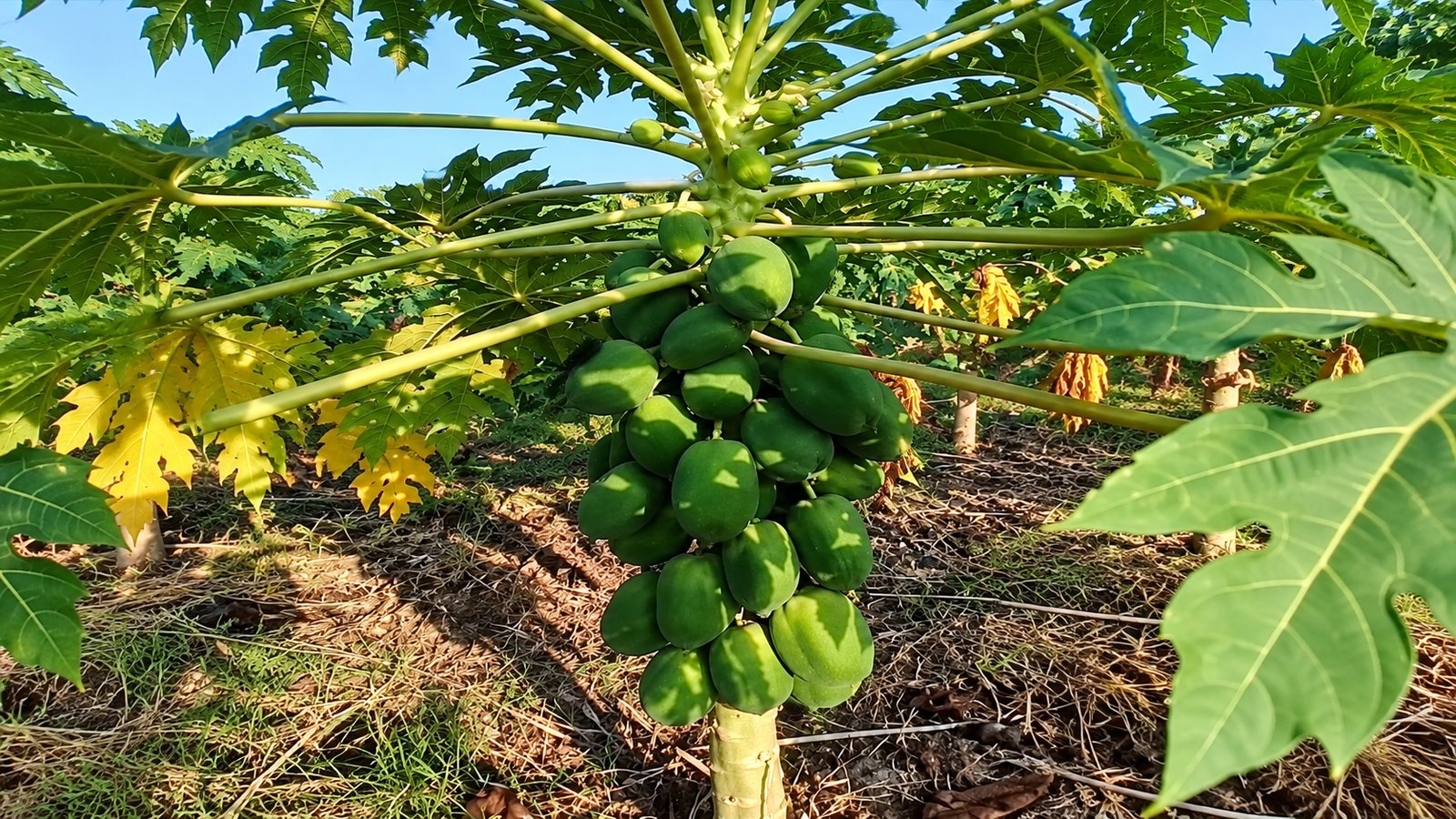
Papaya heavy with fruit
Seed cost: Zero (farmer-saved) (vs purchased hybrid seed conventional)
Fertiliser: None once converted (vs heavy NPK conventional)
Phytophthora incidence: Very low (vs high, fungicide-dependent conventional)
Fruit weight: 0.5–1.5 kg per fruit (about 50 fruits per plant)
The papaya protocol: PQNK papaya is established from farmer-saved seed germinated in nursery trays and transplanted to permanent raised beds at 8 to 10 feet spacing with thick mulch applied around each transplant position. Irrigation follows the SMM half-depth protocol. No fertiliser is applied from the second production season. Phytophthora root rot, the primary disease constraint in conventional papaya, is managed biologically by the Trichoderma and Bacillus community that the PQNK soil biology maintains in the root zone, and by the aerobic root zone conditions that prevent the anaerobic microenvironment in which Phytophthora thrives. In established PQNK papaya fields, Phytophthora incidence is very low to absent without any fungicide application.
The most striking difference between PQNK and conventional papaya is fruit load and quality. A PQNK papaya plant in biologically active soil with full mycorrhizal mineral delivery carries about 50 fruits, each weighing 0.5 to 1.5 kilograms, sweeter than fruit forced with nitrogen. The fruit load reflects the plant’s full expression of its genetic potential, unrestrained by nutritional imbalance. The sweetness reflects the sugar accumulation capacity of a plant with adequate potassium rather than an excess of nitrogen, the same mechanism documented in PQNK sugarcane’s sucrose advantage.
PRESERVING SUPERIOR PAPAYA PLANTS THROUGH CLONAL PROPAGATION
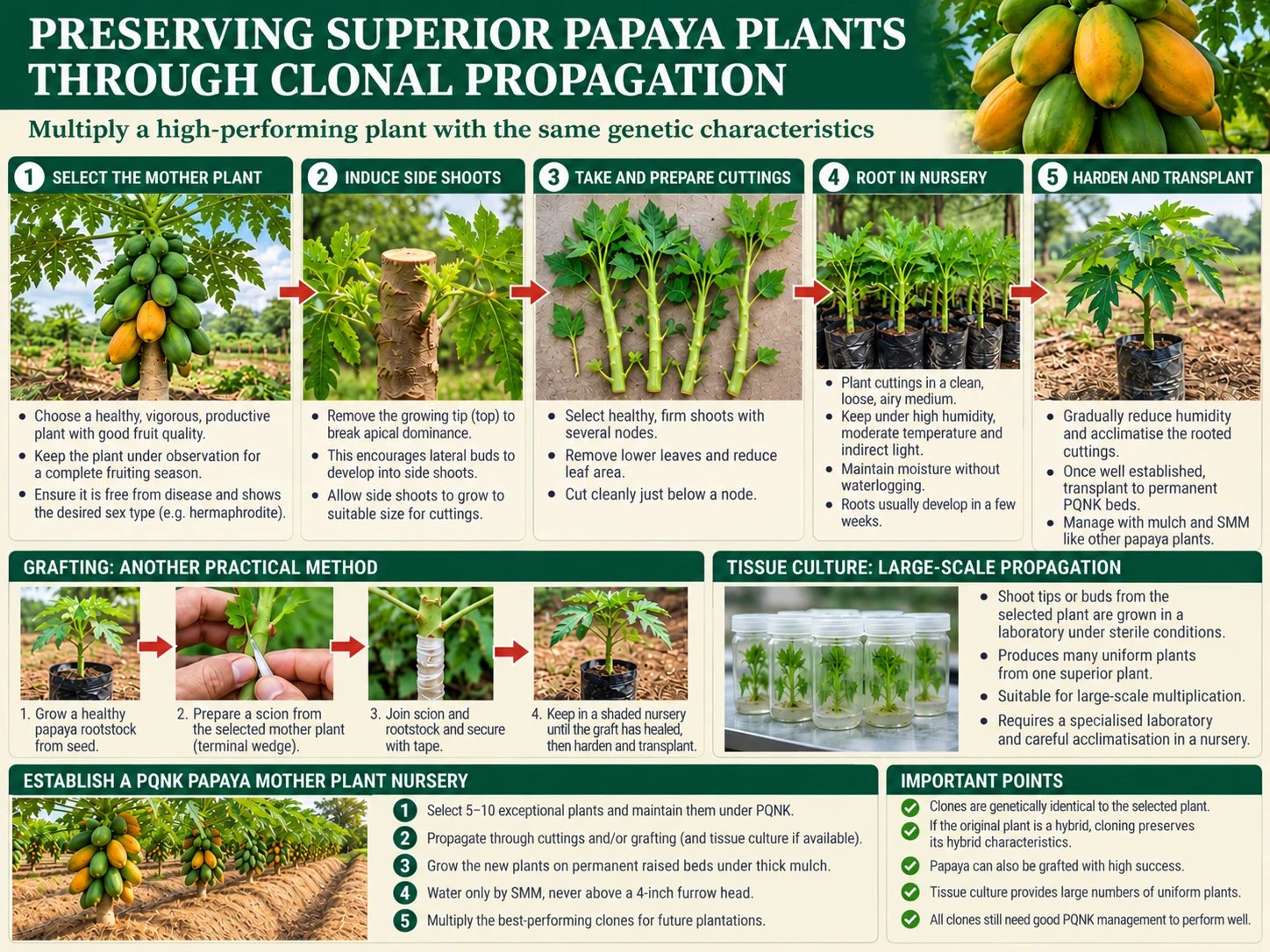
Preserving a superior papaya plant: cuttings, grafting and tissue culture
Seed does not always reproduce its parent. Papaya cross-pollinates, and seed from a hybrid plant splits into different types in the next generation. When a PQNK grower has an outstanding plant, healthy, heavy-bearing and with the fruit the grower wants, vegetative propagation keeps that exact plant: every new plant made from it carries the same genetics.
There are two nursery methods. In the first, the selected mother plant is kept for propagation and its growing tip is removed so that it puts out side shoots. Firm side shoots are cut with clean tools, rooted in a clean, loose, airy medium under shade and high humidity, and hardened gradually before they are transplanted to the permanent beds. In the second, a shoot from the mother plant is grafted onto a healthy seedling rootstock; the grafted shoot carries the mother plant’s genetics.
For large-scale multiplication, a tissue-culture laboratory can produce many identical plants from shoot tips of the selected plant, which are then hardened in a clean nursery. Whichever method is used, the new plants go onto PQNK beds and are managed with mulch and SMM like any other papaya, and it is the living soil that lets them express the mother plant’s performance.
The economics are kept deliberately on the low side. At 600 plants per acre, about 50 fruits per plant and an average fruit weight of 0.62 kilograms, an acre produces about 18,600 kilograms of fruit. At Rs. 50 per kilogram, well below the wholesale price of over Rs. 100, the gross income is about Rs. 930,000 per acre, close to Rs. 1,000,000, with no purchased inputs. Conventional papaya costs more than Rs. 200,000 per acre per year to produce.
AIR LAYERING: PRODUCING NEW PAPAYA PLANTS DIRECTLY ON THE MOTHER PLANT
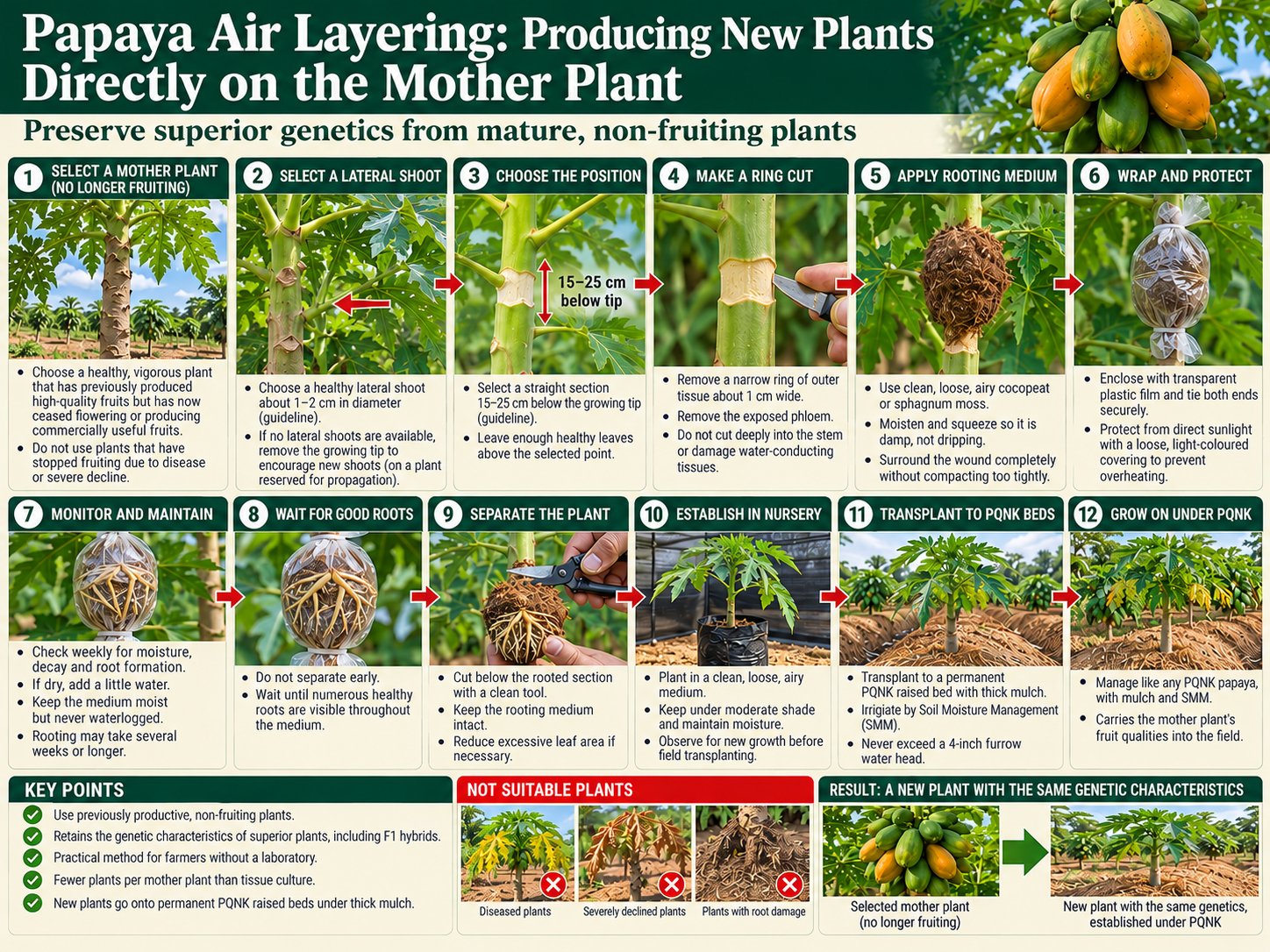
Papaya air layering: producing new plants directly on the mother plant
Selecting the mother plant
A papaya plant that has given superior fruit, in quality, yield, vigour and adaptation to the farm, in time stops flowering or producing marketable fruit. Under PQNK such a plant is not removed at once. If it is healthy, it is kept as a mother plant for clonal propagation, so the farm keeps the genetics of its best plants, including selected first-generation (F1) hybrids, without giving up any of its younger, fruiting plants.
Air layering uses a healthy lateral shoot while it is still attached to the mother plant. Where the plant has no lateral shoots, its growing tip is removed to wake its dormant buds, and the new shoots are allowed to grow to a good size first. Only healthy plants are kept: a plant that stopped fruiting because of disease, severe decline or root damage is not used.
How air layering works
In air layering, a shoot grows its own roots while it is still on the mother plant. Unlike a cutting, it goes on receiving water and minerals from the parent the whole time. A narrow ring of bark is removed from the shoot; this stops sugars and the plant’s natural growth substances from moving down through the phloem, so they gather above the ring, and new roots form there.
Once the roots are well formed, the shoot is cut free and grows on as a plant in its own right. No seed is involved, so the new plant carries exactly the genetics of the mother plant. This is what makes air layering so valuable for a superior F1 hybrid papaya, whose seed does not reproduce the same plant.
The method, step by step
Step 1: Select the mother plant. Choose a healthy, mature papaya plant that has given high-quality fruit, good in size, sweetness, appearance and yield, and that has finished its productive fruiting period but still has a sound stem, healthy leaves and the vigour to put out new shoots.
Step 2: Select or develop a lateral shoot. Choose a healthy, well-developed lateral shoot of firm, actively growing tissue, about 1 to 2 cm across. If the plant has no lateral shoots, remove its growing tip with a clean, sharp tool so that dormant buds break, and let the new shoots mature before layering. Top only plants kept for propagation, because topping ends their fruiting.
Step 3: Choose the rooting position. Select a straight, easily reached section of the shoot about 15 to 25 cm below its growing tip, with enough healthy leaves above it. Avoid soft, damaged or diseased tissue.
Step 4: Make the ring cut. With a clean, sharp knife, remove a ring of outer tissue about 1 cm wide around the shoot, taking away the phloem inside the ring so that it cannot rejoin. Do not cut deep into the stem: the water-conducting tissue beneath must stay intact. Papaya stems are soft and succulent, so the cut is made with a light hand.
Step 5: Apply the rooting medium. Moisten clean cocopeat or sphagnum moss evenly, then squeeze it until it is damp but not dripping. Pack a generous handful around the ring so that the whole wound is covered, keeping it loose and airy rather than pressed tight against the stem.
Step 6: Wrap and protect. Wrap the medium in clear plastic film and tie both ends firmly, without squeezing the shoot. Shade the wrap from the midday sun with a loose, light-coloured outer cover that can be opened for checking, so the rooting zone stays moist without overheating.
Step 7: Check every week. Look at the layer about once a week for moisture, decay and new roots. If the medium has dried, open the wrap, add a little clean water and close it again. The medium is kept moist but never waterlogged. Roots take several weeks to form; a shoot that shows decay is removed.
Step 8: Wait for good roots. Do not separate the shoot when the first roots appear. Wait until healthy roots fill the medium, enough to carry the shoot on its own.
Step 9: Separate the new plant. Cut the shoot with a clean, sharp tool just below the rooted section. Handle it gently and keep the rooting medium intact around the roots; do not pull, shake or wash the root ball. If the shoot carries a lot of foliage, remove some leaves to limit water loss, keeping enough for photosynthesis.
Step 10: Establish it in the nursery. Plant it in a container of clean, loose, airy growing medium, under moderate shade and sheltered from strong wind and heat. Keep the medium moist but not saturated. When the plant has rooted into the container and is growing again, harden it gradually to field conditions.
Step 11: Transplant to the PQNK bed. Plant it on a permanent raised bed with its root ball intact. Mulch the surrounding soil thickly, keeping the mulch just clear of the stem base. Irrigate through the furrows by Soil Moisture Management (SMM): water only when the soil-ball test shows a need, never above a 4-inch head, so the soil stays moist and aerated.
Step 12: Grow it on. From here the new plant is managed like any other PQNK papaya, with mulch and SMM, and carries the mother plant’s fruit qualities into the field.
Why air layering matters under PQNK
Air layering extends the value of a superior papaya plant beyond its own fruiting life. A plant that no longer bears marketable fruit still has healthy tissue that can give new plants, so the farmer keeps the best genetics on the farm instead of buying hybrid seed every season or relying on saved seed that does not breed true.
The new plant carries the mother plant’s genetics; its yield comes from the soil it grows in. On permanent raised beds under mulch, with living soil biology and SMM, it has every condition it needs to express the full performance of the plant it came from.
The aim is not simply another papaya plant. It is to keep the identity of a proven plant and carry it into its next generation in PQNK soil.
From the Field: Papaya on PQNK, the Profitable Tropical Plant
A papaya grower shows his orchard, fully on PQNK: no fertiliser and no spray. Last year the beds were mulched with paddy straw. Over the year the mulch blew away in places and broke down, so after the water channel was cleaned the beds were mulched again. The trees are fruiting heavily, the fruit is going to market, and his crop is better than that of the growers around him.
Before PQNK, he says, there was endless labour: spraying day and night at high cost, and still the diseases were not controlled. Since the beds were mulched the family has been free of that worry. They only check the plants and give water.
Watch the video: https://youtu.be/G-dP-x8U0j8
WHY TROPICAL CROPS FLOURISH IN PQNK SOIL
The banana and papaya results illustrate a principle that runs through every chapter of Part Five: the limits of what a crop can produce in a given climate are determined more by soil biology than by temperature or rainfall. This is the insight that the conventional framework misses because it treats climate as the primary constraint and soil as the medium through which inputs are delivered. PQNK treats soil as the primary system and climate as the context within which that system operates.
A living soil with a thick mulch layer creates its own microclimate at the surface and root zone level that can differ substantially from the ambient air temperature and humidity. The mulch moderates temperature extremes: cooler in summer, warmer in winter, more humid in dry periods, quicker to take in rain in wet ones. The biological activity of the soil community generates heat as a metabolic by-product. The deep root access enabled by hardpan fracturing gives the plant access to the more stable temperature environment of the subsoil throughout the year. Together, these biological modifications of the immediate plant environment extend the practical climate envelope of many crops beyond what meteorological data alone would suggest possible.
This principle has implications that extend well beyond banana in Sindh and papaya in Punjab. Chapter Forty-Two documents the crops that PQNK has made possible in what were previously considered unsuitable conditions: strawberry in Sindh, olive in Punjab, saffron in Pakistan’s dryland zones, watermelon in peri-urban smallholder systems. The boundary of agricultural possibility is not fixed by geography. It is set by soil biology and moves when the biology is restored.
TROPICAL CROPS AND THE PQNK DIVERSIFICATION STRATEGY
From a farm planning perspective, tropical crops in the PQNK system serve a specific strategic function beyond their direct income contribution: they extend the biological diversity of the farm and the income diversification of the farming household in directions that the conventional system cannot reach.
A farmer growing banana and papaya alongside their PQNK wheat, cotton, vegetables, and citrus has income streams that are not correlated: when wheat prices are low, banana prices may be high; when cotton encounters a difficult season, papaya production continues uninterrupted. The diversification that the PQNK biological system makes possible, because its living soil carries tropical crops through conditions where conventional soil fails them, is not only agricultural diversity. It is economic resilience. The PQNK farmer who grows six crops is not six times as vulnerable to market volatility as the conventional farmer who grows one. They are substantially less vulnerable.
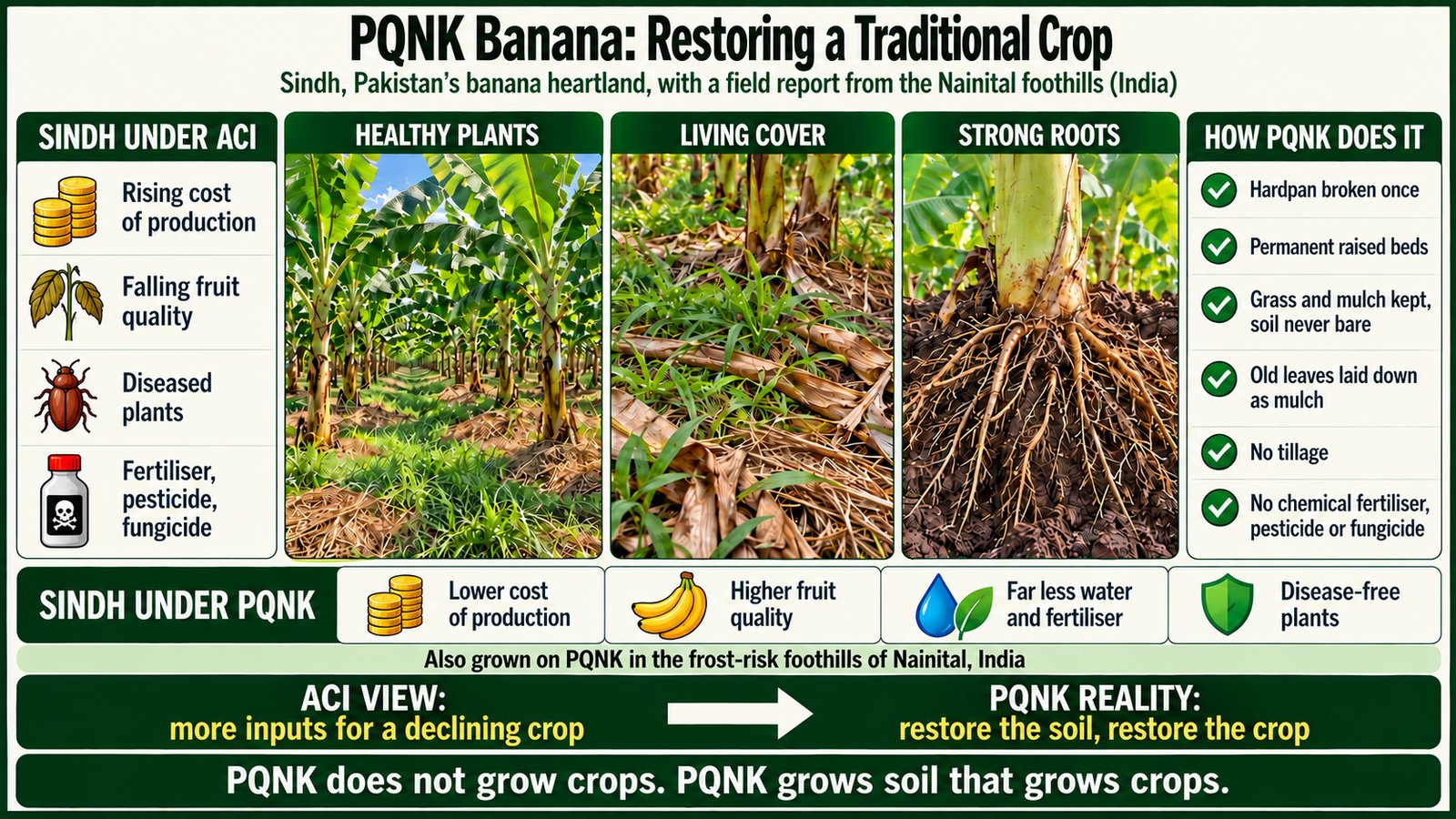
PQNK banana in Sindh: under ACI, rising costs, falling fruit quality and diseased plants; under PQNK, a lower cost of production, higher fruit quality, far less water and fertiliser, and disease-free plants. Also grown on PQNK in the frost-risk foothills of Nainital, India
The combination of banana, papaya, and citrus on the tree component of the One Acre Prosperity model creates a year-round fresh fruit supply that can supply regular market or direct consumer delivery. Banana and papaya produce fruit throughout the year rather than in a single seasonal harvest. Citrus has its own seasonal window. The three together produce fresh fruit income in every month of the year from the permanent tree component of the farm.
WHAT THIS CHAPTER HAS ESTABLISHED
Tropical crops in PQNK systems demonstrate that what a crop can produce is set by soil biology, not by climate data alone. Banana recovering its health, quality and economics in Sindh, where ACI practices had raised its cost and spread disease, and papaya carrying about 50 fruits per plant without purchased inputs in Punjab, far from its humid tropical home, are consequences of the same biological restoration that produces an average of 29 wheat tillers per plant, 200 cotton bolls per plant and 12.84 tonnes of rice per hectare. The mechanism is always the same. The crop changes. The biology does not.
The next chapter documents the frontier crops, strawberry, olive, bamboo, watermelon, saffron, where PQNK’s biological expansion of agricultural possibility is at its most surprising and where the commercial implications for Pakistan’s premium crop sector are most significant.
Chapter Forty-Two: New Frontiers, Strawberry, Olive, Bamboo, Watermelon, and Saffron