
Industrial Devastation To Natural Abundance
The Evidence · Chapter 40
Orchards, Citrus, Mango, and Dying Trees
The Toba Tek Singh Data, and How PQNK Revives What Conventional Management Is Killing
Release 1.0 · 2026-10-11
If you use “Listen”, the text of the page may be sent to your browser or operating system’s speech provider, such as Apple, Google or Microsoft, depending on the voice your device uses. Pedaver does not process, transmit or store any audio.
Kinnow citrus in fruit
“A declining tree may be suffering from a failing root-zone environment. Give it back its living soil and it will tell you it was never really dying. It was just waiting.”
Asif Sharif, Lahore, 2020
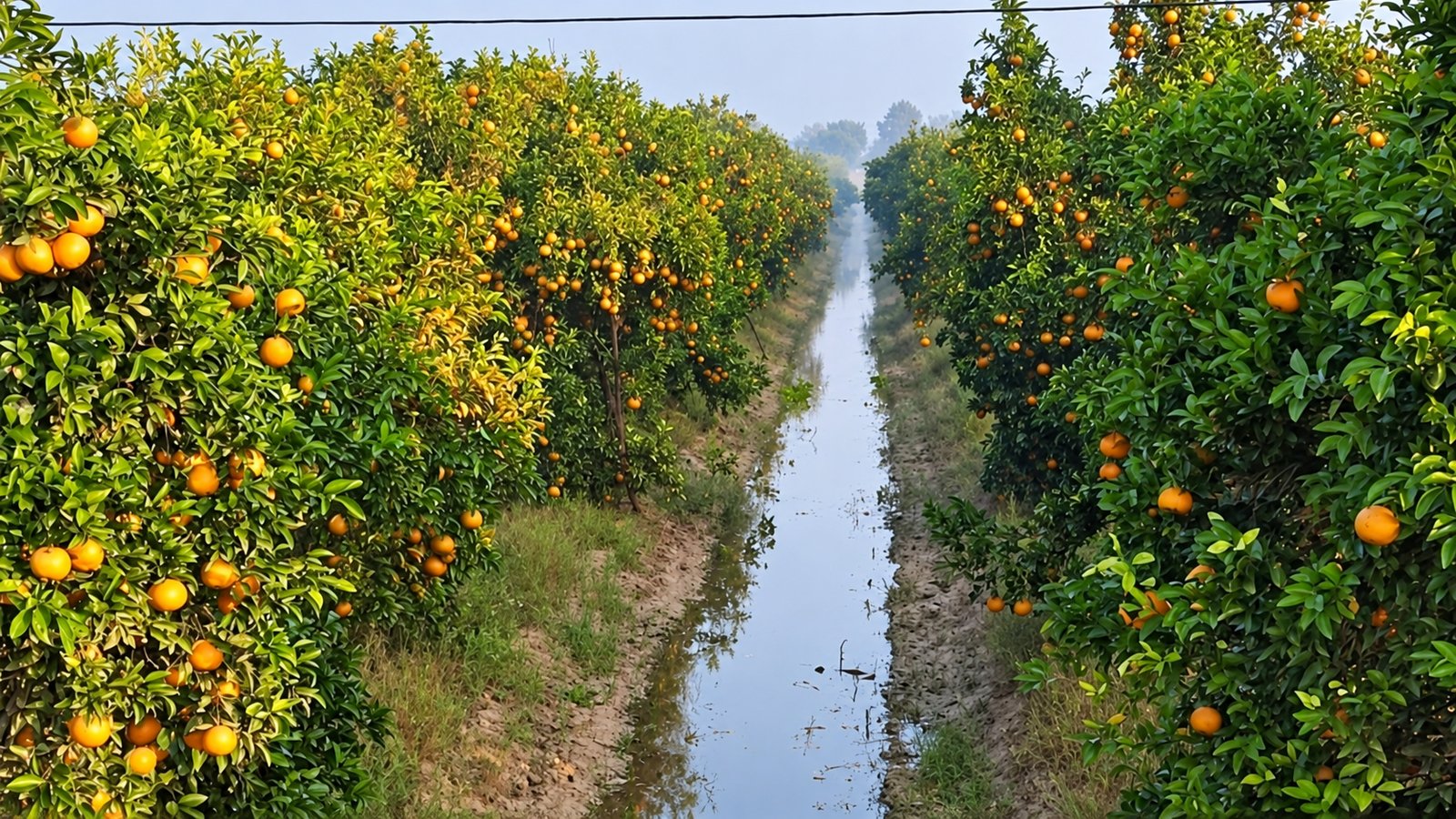
Pakistan's citrus orchards are in structural decline. The Kinnow mandarin, the centrepiece of Punjab's horticultural economy, is producing fruit of steadily declining quality. Fruit size, colour, shelf life and flavour have all deteriorated, and so has taste, because fruit from degraded soil carries lower nutrient density and a narrower diversity of minerals and compounds than the tree is capable of producing. Export competitiveness has fallen. Yields are declining as well: the soil that feeds the trees is degrading year after year, and even ever-increasing chemical inputs can no longer hold the tonnage per acre. The farmer pays more each season for a smaller harvest of poorer fruit, the clearest sign that the problem is not a shortage of inputs but a collapse of the biological system beneath the trees.
Orchards are the long game of PQNK agriculture. Where annual crops show their biological transformation within a single 90 to 150-day season, perennial fruit trees show theirs over years and decades: the slowly improving A-grade proportion as the root system deepens into recovering soil, the progressively sweeter fruit as the mycorrhizal mineral delivery matures season by season, and the most remarkable outcome of all: the revival of trees that conventional management had classified as dying and scheduled for removal.
The Toba Tek Singh citrus data is the most precisely documented individual farm comparison in the PQNK evidence base for orchards: the same trees, the same variety, the same district, before and after PQNK management, with the results measured at the packing shed in the most commercially relevant terms: A-grade fruit proportion and net return per acre.
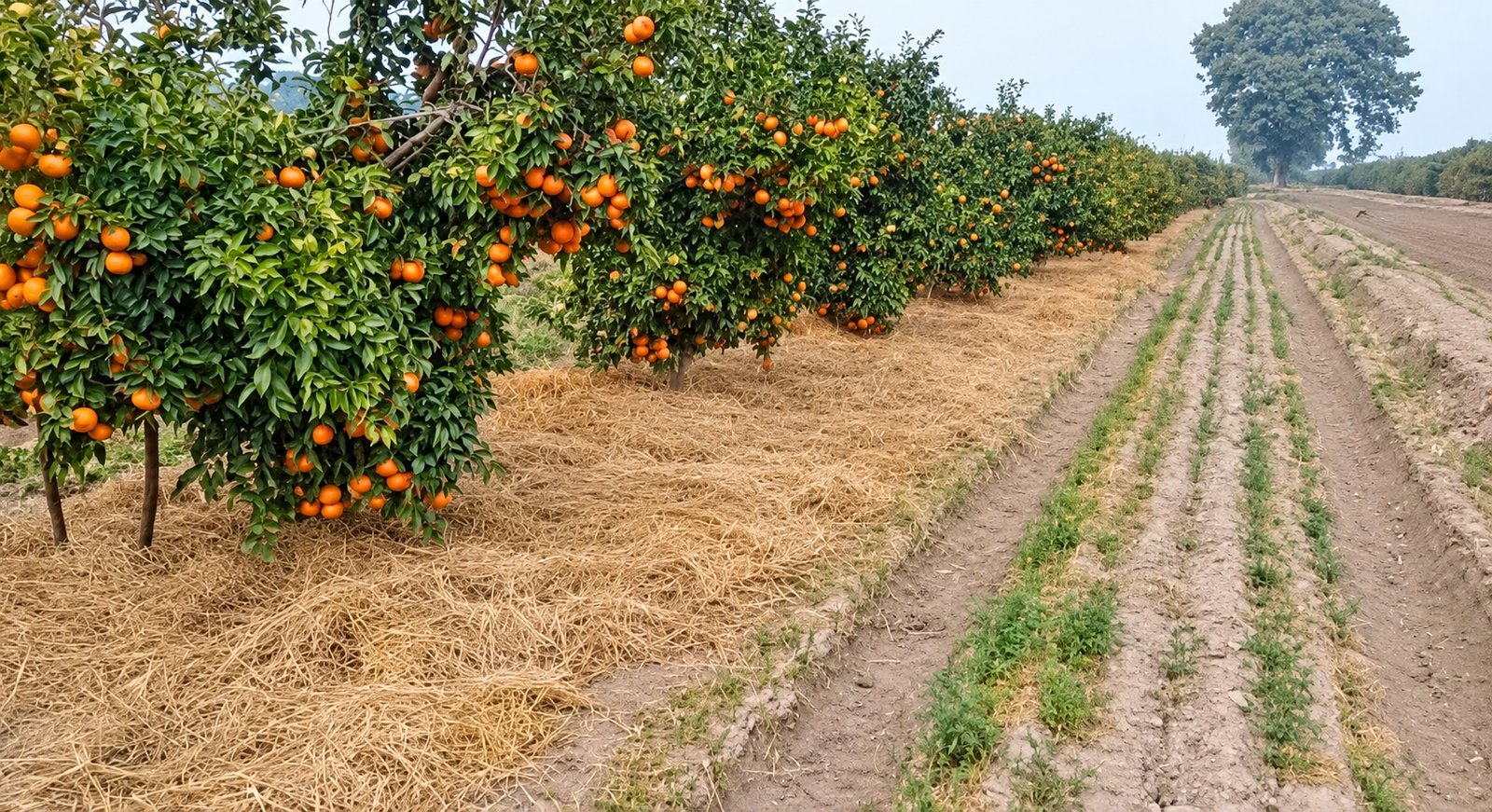
Citrus rows on permanent beds, with straw mulch on the beds and the furrow between the rows
ORCHARDS AND ACI MANAGEMENT: THE PROGRESSIVE DECLINE
The orchard sector is in a documented decline that mirrors the decline of annual crop sectors but is more slowly visible because the decline of a 20-year-old citrus tree unfolds over seasons rather than weeks. The decline manifests in three measurable dimensions: declining A-grade proportion over years as fruit size and colour grade deteriorate; increasing susceptibility to gummosis, Phytophthora, and other soil-borne diseases as root system health declines; and the appearance of the dying tree syndrome (slow yellowing, reduced fruiting, progressive branch dieback) in trees that are not old enough to die naturally.
Declining trees can have several causes, including disease, rootstock problems, age and restricted root-zone conditions. PQNK first examines whether management has impaired soil structure, aeration and biological function. Twenty years of flood irrigation have created the hardpan (a compacted, impermeable structural failure, not a textural problem) that prevents the tree’s roots from accessing the subsoil mineral reserve. Repeated input-dependent management has impaired the mycorrhizal associations that delivered those minerals when the soil was biologically active. Repeated broad-spectrum chemical applications have reduced the biological community in the root zone that protected the roots from soil-borne disease. The tree has no diagnosis. It has a biography of what was done to its soil.
THE TOBA TEK SINGH CITRUS DATA
Toba Tek Singh district in central Punjab is an important citrus-producing district, with Kinnow mandarin the dominant variety and the primary citrus export commodity. The comparison between PQNK and conventional citrus management was documented over three to four seasons across orchards established under conventional management and transitioned to PQNK following the protocol described in this chapter. The values below are the PQNK field records from those orchards.
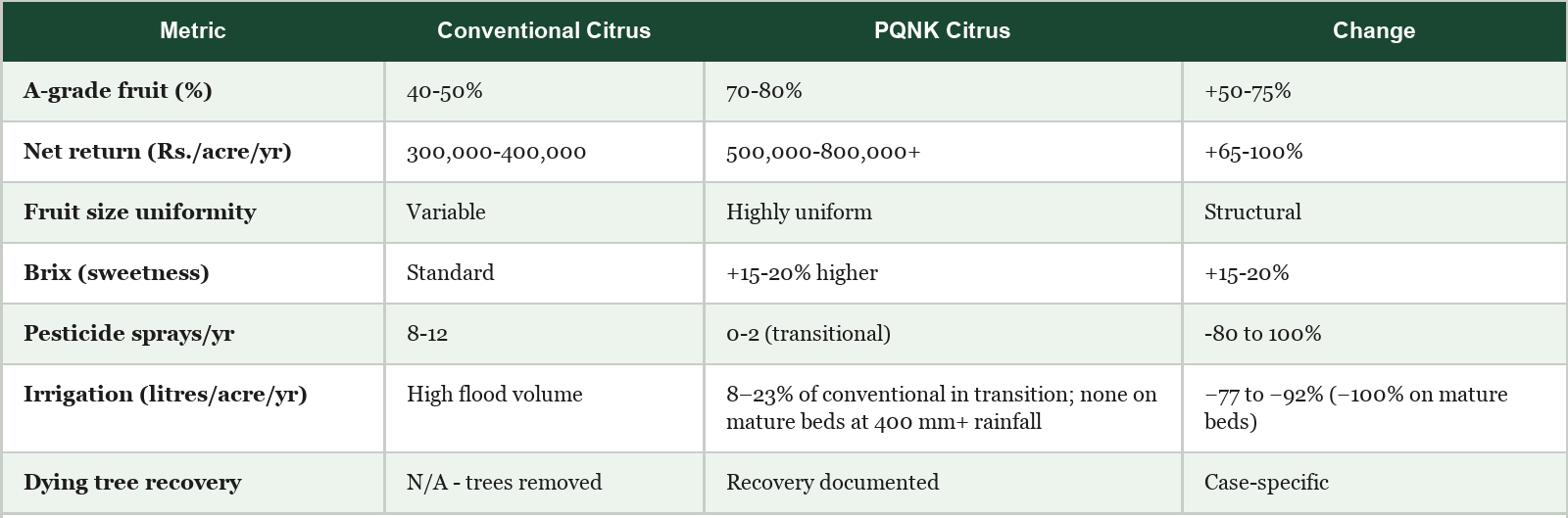
A-grade fruit under PQNK: 70 to 80 percent, against 40 to 50 percent conventional in the same district. Net return per acre: Rs. 500,000 to 800,000 plus (approximately US$ 1,800 to 2,900), against Rs. 300,000 to 400,000 (approximately US$ 1,080 to US$ 1,440) conventional. Income improvement: 65 to 100 percent on the same trees, same variety. Pesticide reduction: 80 to 100 percent by the second PQNK season in established orchards. Brix improvement: 15 to 20 percent above conventional Kinnow from the same orchard. Irrigation reduction: 77 to 92 percent below flood irrigation through the PQNK soil moisture management protocol on fractured hardpan; on mature PQNK beds where annual rainfall is 400 mm or more, rain, dew, humidity and capillary rise carry the trees without irrigation.
The 70 to 80 percent A-grade proportion against the conventional 40 to 50 percent is the most commercially significant number in the table. Citrus packing houses price A-grade fruit at 30 to 50 percent premium over mixed grade. A shift from 45 percent A-grade to 75 percent on the same volume of fruit represents a revenue increase of 30 to 40 percent from the grade premium alone, before any improvement in total fruit volume or reduction in input cost is counted. Combined with the input cost elimination that PQNK achieves by the second or third season, the total income transformation from Rs. 300,000 to Rs. 800,000 per acre (approximately US$ 1,080 to US$ 2,900) is the documented outcome.
The Sujjahabad restoration case documents the progression in detail. An orchard under severe decline (visibly yellowing canopy, undersized fruit, high pest pressure) was converted to PQNK management. Within the first season following conversion, canopy colour began to recover. By the second season, fruit size and quality had measurably improved. By the third season, the orchard was producing export-grade fruit without a single pesticide or fertiliser application. The mechanism was the same as in every PQNK result: the soil biology was restored. The restored biology provided the complete mineral nutrition, micronutrients included, that Kinnow requires for colour development, sugar synthesis, and disease resistance. No input had provided this nutrition previously because the biology that makes micronutrients plant-available had been destroyed by years of conventional management.
WHY PQNK CITRUS PRODUCES MORE A-GRADE FRUIT
Citrus fruit grade is determined by size, colour, skin texture, and the absence of blemish. All four are primarily functions of the tree’s nutritional status and the consistency of its water supply. A tree that receives a complete mineral spectrum from a functioning mycorrhizal network produces fruit that develops to full genetic size, with the bright orange-yellow colour that the carotenoid pigment profile of a nutritionally complete tree provides, smooth skin from adequate calcium nutrition in cell wall development, and minimal blemish from the biological pest management network that PQNK’s canopy diversity maintains.
The conventional citrus tree receives NPK fertiliser rather than the full mineral spectrum. Nitrogen drives vegetative growth rather than fruit development. The calcium deficiency that NPK fertilisation often produces (because calcium uptake competes with potassium and magnesium in high-NPK conditions) results in the thin-skinned, easily blemished fruit that grades as B or C. The conventional tree’s pest pressure, managed by sprays that damage the skin and leave residue marks, further reduces the grade proportion. The PQNK tree’s complete mineral nutrition and intact biological pest management produce the A-grade consistency that the Toba Tek Singh data documents.
THE ORCHARD PQNK PROTOCOL
Hardpan fracturing
The hardpan found in most conventionally managed orchards is not a textural problem: it is a structural failure. Soil texture, the inherited proportion of sand, silt, and clay particles, is permanent and geological, essentially unchangeable on a human timescale. Soil structure, the living arrangement of those particles into aggregates built and maintained by biological processes, is what ACI management destroys. The hardpan is a compacted, impermeable structural layer created by the mechanical pressure of decades of heavy equipment, which collapses soil aggregates and seals the pore spaces that root penetration and water movement depend on. It must be broken once, as the foundational step before any other PQNK practice can function fully.
On flat irrigated orchard land, the subsoiler is deployed between the tree rows, never directly under the canopy where root density is highest and root damage risk is greatest. The fracturing between rows opens the subsoil to capillary water movement and biological colonisation from the sides of the root zone. On sloping terrain, subsoiling follows the contour line. Contour furrows are cut along the slope and left open: they trap water along the line of equal elevation, prevent runoff, and substantially increase the depth and duration of rainfall infiltration into the root zone. The full benefit of natural precipitation is captured rather than lost to runoff. This single action (hardpan fracture) is the key that unlocks the land’s potential and allows everything that follows to function correctly.
Mulch under the tree canopy
A thick layer of organic mulch (straw, dried leaves, or pruning material from the orchard itself) is applied across the full area under each tree’s canopy. This mulch layer reduces direct evaporation from the root-zone surface, keeps the root zone far cooler than bare soil (in hot summer, bare soil passes 70 °C while the soil under mulch stays at 30 to 33 °C), feeds the decomposer community recovering in the previously chemical-managed soil, and begins the biological carbon accumulation that will progressively improve the soil structure under the canopy.
Furrow irrigation at half-depth
Irrigation furrows run between tree rows and deliver water at half-depth, never above a 4-inch head, distributing through capillary action into the root zone laterally. The soil moisture management protocol for orchards extends irrigation intervals far beyond the conventional calendar: water is given only when the soil-ball test shows a need, and a PQNK citrus orchard in transition typically uses 77 to 92 percent less water than the conventional baseline for the same orchard. On mature beds where annual rainfall is 400 mm or more, no irrigation is needed.
Under-canopy diversity
The space under the tree canopy and between tree rows is managed for biological diversity rather than left bare. A combination of ground covers, flowering herbs, and short-season vegetables maintains continuous soil cover, sustains the predator insect community, and contributes organic matter to the tree root zone. This under-canopy diversity is one of the primary drivers of the pest management improvement in PQNK orchards: the parasitoid wasps and predator beetles that manage scale insects, thrips, and psyllids need year-round habitat and food sources, which the under-canopy diversity provides.
The special challenge of sandy soils
A significant proportion of citrus cultivation occurs on yellow sandy soils: loose, low in fertility, and quick to lose water. The conventional view treats this as a textural limitation: sandy soil holds neither water nor nutrients, so intensive irrigation and heavy fertilisation are the only options. PQNK’s answer begins with a different understanding entirely. Soil texture (the inherited proportion of sand, silt, and clay particles) is permanent and geological; it cannot be changed. Soil structure (the living arrangement of those particles into aggregates, built and maintained by biological processes) is entirely within the farmer’s management. The PQNK strategy does not attempt to change the texture. It builds structure within the texture through biological action.
Before or immediately after establishing citrus trees, a specific cover crop combination is grown across the entire orchard floor. Crowfoot grass (Dactyloctenium aegyptium) provides fibrous surface roots that bind sandy soil, reduce erosion, and maintain surface structure. Sunhemp (Crotalaria juncea) provides a deep taproot that creates bio-pores for air and water movement, activates microbial life, and provides abundant mulch material when crimped. Jantar (Sesbania bispinosa) is selected for its deeply penetrating taproot and its abundant above-ground foliage, which delivers a large volume of green organic matter to the soil surface when crimped. The combination of fibrous and deep taproot systems simultaneously binds the surface, activates the mid-profile, and reaches into the lower four feet.
As biology takes hold in the sandy profile, the transformation is structural. Mycorrhizal fungal hyphae thread through sand particles like steel rebar, stitching them together into stable clusters. Bacterial and fungal secretions (polysaccharides and glomalin) coat and bind those particles into water-stable aggregates. Earthworm casts add perfectly structured, nutrient-rich aggregate throughout the profile. Microbial activity follows root exudate wherever roots grow. The result: sandy soil that retains moisture, holds nutrients, and supports the full aerobic biological community that makes those nutrients plant-available. Its texture remains sandy; its function begins to resemble that of a productive loam.
After the cover crops are crimped, the organic matter is left in place as mulch. Grazing the cover crop is not recommended: the above-ground foliage is the primary source of organic material for the soil surface, and removing it through grazing reduces the volume available. In many cases the cover crop foliage is barely sufficient for full surface coverage; grazing compromises this. Sandy soils lose moisture rapidly; the mulch layer extends the time the surface biology remains active between rainfall or irrigation events. Irrigation on levelled sandy orchard land follows the standard PQNK furrow system. Drip irrigation applies only where the plantation is established on sand dunes and furrow delivery is not physically possible. Where drip is necessary, the drip line must be placed at least four feet from the trunk of each tree and kept well covered with thick organic mulch; irrigation applied close to the trunk encourages shallow root development near the surface rather than driving roots deep into the biological profile that is developing below. In orchards being converted from conventional management, compost tea or vermiwash applied every 15 to 20 days during the establishment phase introduces the functional organisms that begin the nutrient cycling the orchard system will eventually sustain independently.
The non-intervention principle
Citrus management in conventional orchards is high-intervention: multiple fertiliser splits, preventive fungicide sprays, irrigation on a fixed schedule, annual soil cultivation under the tree canopy. Each of these interventions, in a functioning PQNK system, is unnecessary and counterproductive.
The PQNK citrus orchard is managed by watching, not by doing. The farmer’s primary tool is observation: canopy colour as a proxy for mineral status, fruit set and retention as indicators of root zone function, earthworm presence as evidence of biological activity, mulch decomposition rate as a measure of microbial vitality. When these indicators are positive, the correct response is to do nothing. The system is functioning. Intervention in a functioning system is damage.
When indicators are negative (chlorotic foliage, poor set, surface hardness, declining earthworm count) the response is to diagnose the cause rather than apply a remedy. Is the mulch too thin? Has the soil surface been disturbed? Has flood irrigation been applied? The diagnosis drives the management response. The default response is never apply a nutrient. The default response is restore the condition that makes nutrients available.
Q Farmer Ikram has moved his citrus orchard onto PQNK permanent beds, and the trees are healthy and active. Soil and weeds were collecting in the furrows between the rows, and he asked whether to remove the soil from the centre so the water could flow.
A Do not remove the soil; the problem is excess water, not soil. Before watering, check the soil 2 feet from the trunk and 4 inches deep; if it forms a ball, do not water. With good mulch and correct water management the orchard hardly needs irrigation. Never disturb the beds, and give water only in the furrow, and only when it is needed. Weeds in the furrow do no harm, as the water runs slowly. Running the tractor two or three times along the furrow makes its bottom firm, like a footpath, so the water moves into the beds. Do not leave the centre bed empty: mulch the tree beds and the centre bed with paddy straw, then sow wheat or vegetables. About 8 feet between trees is best; where trees stand farther apart, plant a peach between them, for a peach harvest in summer and citrus in winter: two harvests a year and less risk. Watch the full Q&A: https://youtu.be/wpNUKbCNXAA
THE DYING TREE REVIVAL: WHAT HAPPENS WHEN YOU RESTORE THE SOIL
The most compelling individual evidence from PQNK orchard management is not from the Toba Tek Singh comparison data but from the dying tree revival cases documented across orchard districts by farmers who applied PQNK to trees that conventional management had declared beyond recovery.
The pattern is consistent across cases. A citrus or mango tree showing the classic declining syndrome (thinning foliage, reduced fruiting, yellowing leaves, branch dieback) is treated with the PQNK orchard protocol: subsoiling between the rows, mulch applied under the canopy, irrigation converted to half-depth furrow, under-canopy diversity established. In the first post-treatment season, the tree typically shows modest improvement in foliage density and colour. By the second season, the fruit set improves measurably: more fruit, better size, better colour. By the third and fourth seasons, the tree is indistinguishable from a healthy tree of the same variety, and its A-grade proportion has exceeded the conventional healthy standard.
The biological explanation is the same as for every other PQNK result. The tree’s root system was constrained by the hardpan that prevented access to the subsoil mineral bank. Mycorrhizal function and biological nutrient cycling had been impaired by years of conventional management, and broad-spectrum pest management had reduced the beneficial organisms that regulate pests. Remove the constraints and the tree recovers. The biological system that the tree needs is rebuilding in the soil around it even as it appears to be dying. It just needs the conditions that allow the recovery to happen.
There is also a more specific root-level mechanism behind the subsoiling step itself. Years of flood irrigation suffocate a tree’s fine hairline roots in the saturated, oxygen-starved soil beneath the canopy, and those roots decay in place. The subsoiling pass, run just outside the canopy line rather than under it, severs this already-dead tissue rather than living roots, and clears the way for new roots to grow into the freshly aerated soil the subsoiler opens up, a root system that, for the first time, stays aerated instead of periodically drowned. This is why the technique belongs to the orchard’s transition phase specifically, and not to any ongoing intervention on established beds; the fuller mechanism is developed in the companion PQNK Knowledge Paper, The Underground Air.
The conventional advisor told the farmer to remove the dying trees and replant. The observed recoveries show why root-zone conditions deserve careful assessment before a declining tree is removed. The trees were dying because the soil was dead. Replanting without addressing a restrictive soil environment can repeat the original problem. The PQNK answer was to restore the soil and watch the trees restore themselves.
MANGO: A PREMIUM TROPICAL EXPORT CROP
Pakistan’s mango sector is the country’s largest fresh fruit export and the crop most directly linked to its reputation in premium international fruit markets. Sindhri, Anwar Ratol, Langra, and Chaunsa are internationally recognised as among the finest varieties in the world when grown in optimal conditions. The challenge is that optimal conditions in the conventional mango belt have been progressively degraded by the same ACI management practices that have degraded the citrus sector: flood irrigation-induced hardpan, mycorrhizal network destruction through fertiliser dependency, and biological pest management elimination through insecticide programmes.
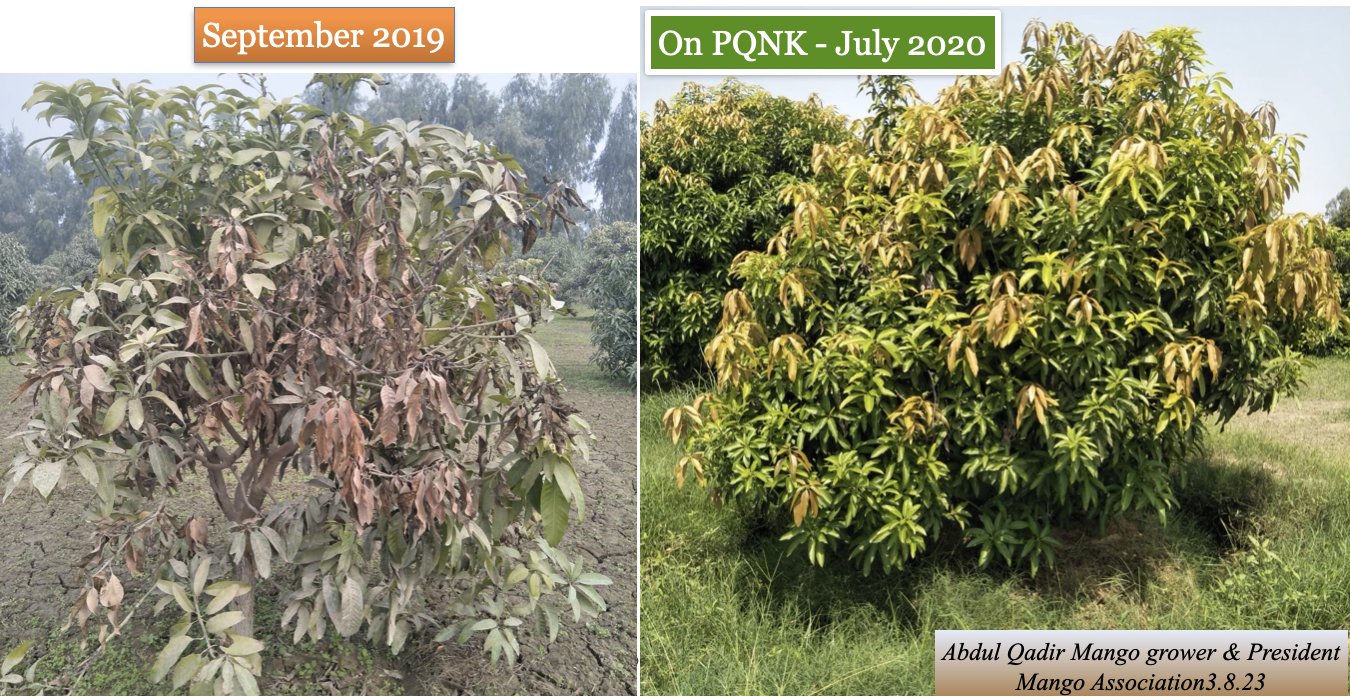
The same mango orchard in September 2019, before PQNK (left), and in July 2020, on PQNK (right). Abdul Qadir, mango grower and President, Mango Association
PQNK mango shows the same trajectory as PQNK citrus: improved fruit size and uniformity, higher sweetness and aroma intensity, improved grade proportion, and progressive elimination of the pest pressure that is the primary limiting factor in Pakistan’s mango export quality.
The first defence against mango fruit fly (Bactrocera dorsalis and related species) in a PQNK orchard is not a trap or a spray. It is the plant’s own biology. A biologically complete plant, growing in living soil with full mineral nutrition, produces a suite of aromatic and chemical compounds within its own tissues as part of its natural immune and signalling system. This is the first layer of the PQNK pest management architecture: operating not through introduced substances but through the plant’s own restored biology. Where the first layer is imperfect, the next layers operate: the parasitoid wasps, predator beetles and other natural enemies that establish in a biologically diverse PQNK orchard, as described in the pest ecology chapter of this book. One condition undermines all of these layers simultaneously: excessive irrigation. When the soil is over-irrigated (whether because the hardpan has not been fractured and water infiltration is poor, or because irrigation is applied beyond the soil moisture management protocol) the concentration of protective compounds in the plant sap is diluted. The plant, in an over-irrigated condition, also diverts energy toward excessive vegetative growth, expanding leaf surface area to drive evapotranspiration upward and increase soil solution uptake. Sucking insects find the weakened sap hospitable rather than hostile. Sucking insects in this context also serve a biological signalling function: their feeding triggers the plant’s defence responses. Under correctly managed PQNK soil moisture, with fractured hardpan enabling deep and even water distribution, the plant keeps its protective compounds at full strength and its defences intact.
Mango flowers on branches that are about nine months old. Pruning should therefore not be done after the harvest, but during the dormant period, from the end of December to early January.
One additional consideration in mango is the reluctance of mature trees to flower after years of excessive nitrogen-driven vegetative growth. The PQNK response is bruising: a controlled wound-response protocol that activates the hormonal cascade favouring floral differentiation over vegetative growth. Bruising is done with care, to wound the bark without damaging the tree. In mature orchards transitioning from conventional management, it is often the intervention that unlocks flowering in trees that have not set fruit for years.
POMEGRANATE: HIGH-DENSITY ORCHARD PRODUCTION
The citrus restoration principles apply to all orchard fruit species. Pomegranate under PQNK is established at high density: 1,089 trees per acre on a 2 metre by 2 metre spacing, oriented north to south for maximum light interception. The four-step protocol is identical: hardpan fracture, pH correction, permanent beds, root retention.
The dominant problem in conventional pomegranate management (fruit cracking and pest attack) is largely a water problem. Pomegranate is highly sensitive to irregular or excessive irrigation. Over-irrigation drives water pressure inside the developing fruit beyond what the skin can contain, causing splitting. It also creates the soil moisture conditions that favour soil-borne disease organisms attacking the root zone and the pest community that exploits stressed trees. Less water, applied correctly, produces healthier fruit. Under PQNK management, the soil moisture management protocol delivers water infrequently and deeply through the fractured hardpan profile, maintaining the even, moderate moisture level that pomegranate requires without the peaks that cause cracking. The soil biology restoration that produces grade improvement in citrus and mango produces the same result in pomegranate: deeper colour, higher juice percentage, and fruit that retains its quality through the supply chain.
ALTERNATE BEARING: THE ENERGY MATHEMATICS OF STRESSED TREES
The phenomenon of alternate bearing (in which a fruit tree produces a heavy crop one year and little or no crop the next) is widely accepted within conventional horticulture as a fixed characteristic of certain species. Apples, pears, peaches, citrus, and mangoes all exhibit it in managed orchards. It is treated as a natural limitation of high-energy fruiting, to be managed through fruit thinning, chemical growth regulators, and careful pruning. PQNK field experience shows that alternate bearing is largely a symptom of a stressed tree: an incomplete mineral supply and a restricted root zone.
The conventional explanation is energetic: a tree that produces a heavy crop depletes its stored carbohydrate reserves, and the following year lacks the resources to initiate both vegetative growth and fruit set simultaneously. The solution offered by industrial horticulture is to reduce crop load in the heavy year, forcing the tree to hold energy in reserve. The limitation of this approach is that it treats the symptom (energy depletion) without asking why a tree managed with synthetic fertilisers and pesticides should be energy-depleted in the first place.
The answer is mineral incompleteness. Plants require a defined range of essential mineral nutrients and many biologically produced compounds participate in metabolism. Conventional NPK fertilisation supplies three macronutrients in chemical form. The tree receiving only nitrogen, phosphorus, and potassium (without the full spectrum of trace minerals, biological cofactors, and microbially-mediated nutrient forms) is perpetually operating at metabolic deficit. In a high-production year, that deficit becomes acute. The tree cannot sustain its biological processes and its reproductive output simultaneously, and it shuts down one to preserve the other.
In forest ecosystems where no synthetic input has ever been applied, fruit trees produce crops of consistent quality and quantity year after year. Their fruits are denser, more aromatic, and more nutritionally complete than their cultivated counterparts: not despite the absence of synthetic fertiliser, but in part because of it. The soil biological community (microbes, fungi, nematodes, and the full rhizospheric web) assembles and delivers exactly the mineral composition each species requires, in the bioavailable forms the plant is designed to receive.
Under PQNK management, the soil biological community is progressively restored. As the rhizosphere reactivates and the full mineral spectrum becomes biologically available, the tree’s metabolic deficit is resolved at its source. The result, documented across PQNK citrus and mango orchards, is a marked reduction in alternate bearing. Trees that had been alternating for years under conventional management produce consistent annual crops from their second or third PQNK season onwards. The yield in what would have been the off year meets or exceeds the weight of the previous on-year crop, while nutritional density (measured by Brix, aroma, and skin texture) is uniformly higher across both seasons.
The practical implication is significant. An orchard with more consistent annual cropping delivers a more dependable multi-year yield than one with pronounced on-year and off-year fluctuations, without any increase in area, water, or management cost. For the farmer operating within the One Acre Prosperity model, where the orchard generates the primary income stream, the elimination of alternate bearing doubles the reliability of the most economically consequential component of the farm.
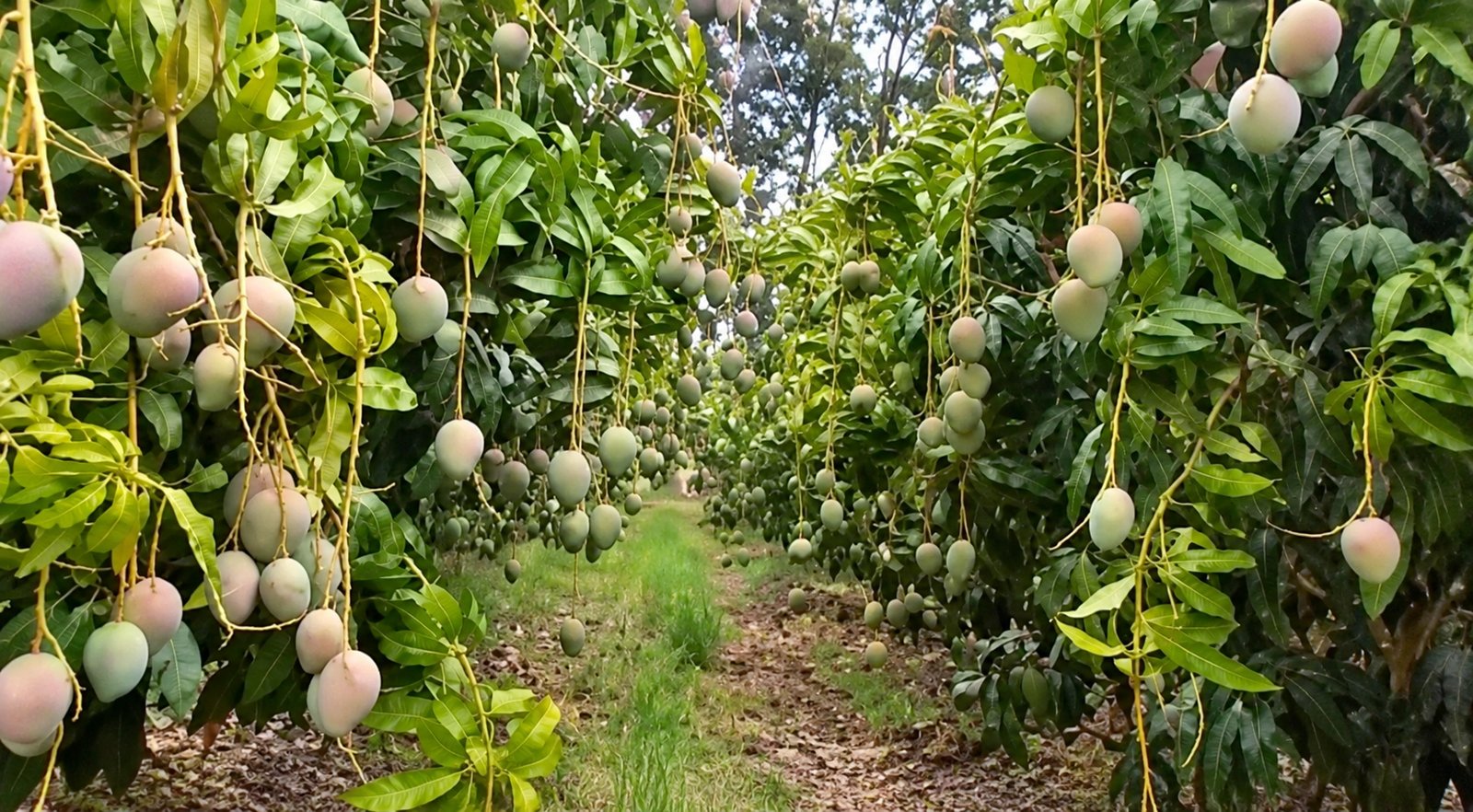
Mango trees laden with fruit
ORCHARDS AS THE ECONOMIC CENTREPIECE OF THE ONE ACRE FARM
In the One Acre Prosperity model, fruit trees occupy 40 percent of the acre and generate the primary long-term income of the farm. The choice of species depends primarily on market access and farmer preference. Under PQNK management, the conventional constraints of climate and soil type are substantially reduced: in mature PQNK beds, soil temperature, water, and air are regulated year-round through the permanent mulch layer, biological activity, and the soil moisture management system, allowing many species to establish and produce in conditions where conventional management would classify them as unsuitable. Where frost or extreme heat is a concern, PQNK manages the canopy microclimate and soil moisture, and a 2% solution of food-grade ethanol may be sprayed once every 4 to 5 days, as in potato (Chapter Thirty-Eight). The principle holds across species: orchards become the farm’s major long-term income source.
The first 3 to 4 years of orchard establishment are financed by the income from vegetable and annual crops grown between the young trees under the designed diversity system. By year 2 to 4 (depending on the species and the quality of grafting material used) the trees are in production and the annual crops progressively move to the margins as the canopy closes. By year 10, a mature PQNK citrus orchard at Toba Tek Singh productivity levels generates Rs. 600,000 to 900,000 per acre (approximately US$ 2,100 to 3,200) from the fruit alone, with near-zero purchased inputs, with the quality improving with every season as the root system deepens into increasingly biologically rich soil.
WHAT THIS CHAPTER HAS ESTABLISHED
Orchards demonstrate PQNK’s most patient and most compounding benefit: the progressive deepening of root systems into biologically recovering soil over years and decades produces fruit quality and income that exceed the conventional baseline, and revives trees that conventional management had classified as beyond recovery. The Toba Tek Singh citrus data: 70 to 80 percent A-grade, Rs. 500,000 to 800,000 per acre net: is the most commercially precise individual farm comparison in the PQNK evidence base.
The next chapter turns to tropical crops, banana and papaya, where PQNK has enabled production in regions where these crops were previously considered climatically impossible, and where the zero-cost production model transforms them from luxury crops into smallholder income engines.
Chapter Forty-One: Tropical Crops, Banana Where It Shouldn’t Grow; Papaya at Zero Cost