

Industrial Devastation To Natural Abundance
The Discovery · Chapter 17
The Turning Points
Four Cotton Turning Points and the Questions They Forced
Release 1.0 · 2026-09-14
If you use “Listen”, the text of the page may be sent to your browser or operating system’s speech provider, such as Apple, Google or Microsoft, depending on the voice your device uses. Pedaver does not process, transmit or store any audio.
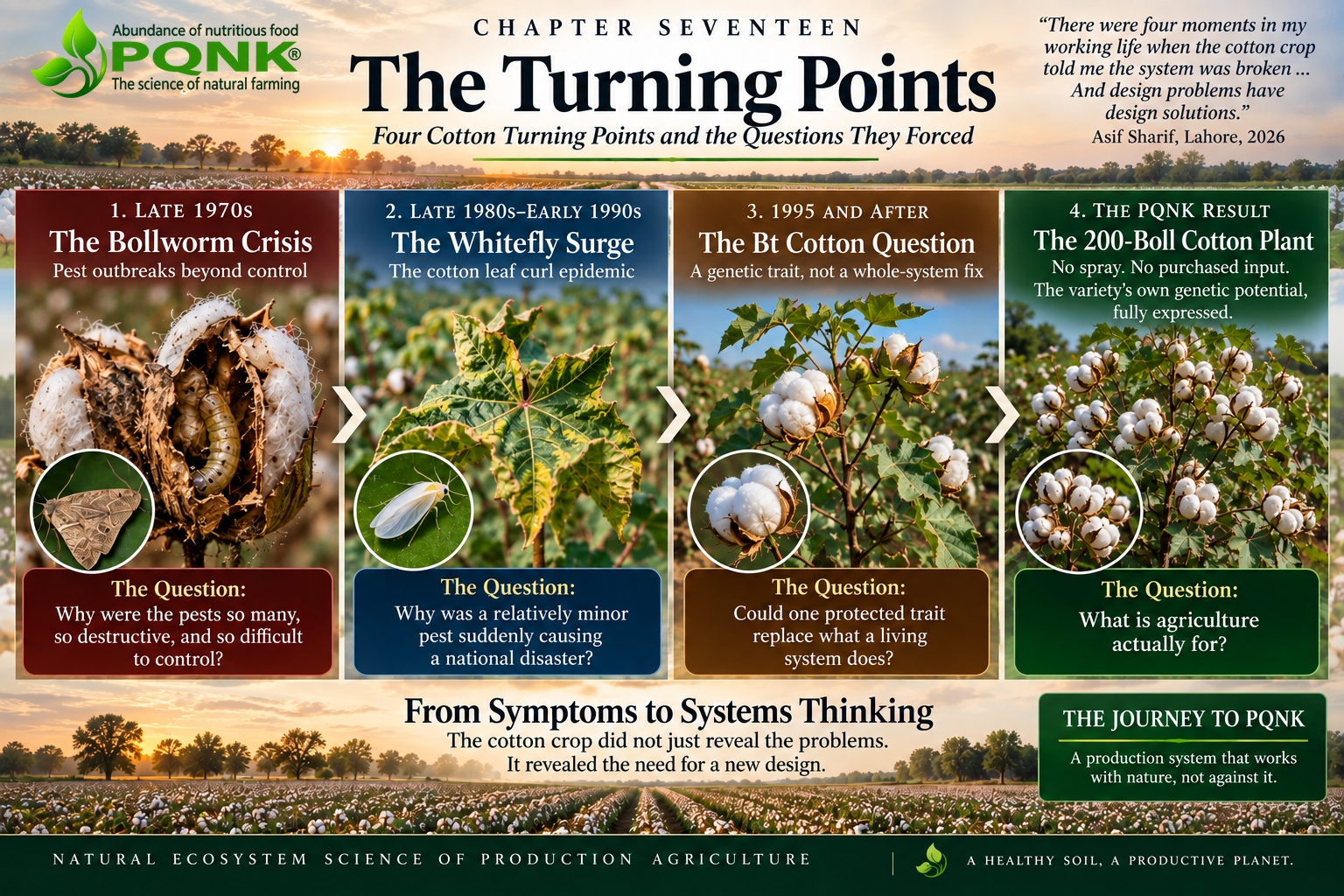
“There were four moments in my working life when the cotton crop told me the system was broken. The first time I thought: this is a pest problem. The second time I thought: this is a resistance problem. The third time I thought: this is a soil problem. The fourth time I knew: this is a design problem. And design problems have design solutions.”
Asif Sharif, Lahore, 2026
Pakistan’s cotton sector has been, across the arc of Asif Sharif’s working life, both the country’s most important agricultural industry and its most instructive case study in agricultural failure. No crop has been more central to Pakistan’s economy. No crop has more thoroughly demonstrated the consequences of the Ancient Conventional Industrial (ACI) management paradigm. And no crop has been more directly implicated in the four turning-point observations that, across thirty years of accumulation, produced the intellectual framework of PQNK.
There were four distinct turning points in Sharif’s cotton experience. Each one asked a question. Each question deepened the next. Together, they form the diagnostic sequence that moved him from master of the industrial system toward architect of its replacement. This chapter traces that sequence.
TURNING POINT ONE: THE BOLLWORM CRISIS OF THE LATE 1970S
By the late 1970s, cotton pest pressure was becoming an increasingly important warning within the production system Sharif was helping to modernise. American bollworm, Helicoverpa armigera, and pink bollworm, Pectinophora gossypiella, were among the major caterpillar pests confronting cotton growers. Over the years that followed, pesticide use intensified as farmers tried to protect increasingly valuable crops. What Sharif saw in this period was the beginning of a pattern that would become unmistakable later: each chemical intervention could suppress a target pest for a time, yet repeated intervention also altered the wider biological community on which natural regulation depended.
The conventional explanation increasingly centred on resistance, and resistance was real. But Sharif’s later interpretation went deeper. Broad-spectrum insecticides do not act only on the target pest; they can also reduce parasitoids, predators and other non-target organisms that contribute to pest regulation. Once that biological regulation is weakened, pest resurgence and secondary-pest outbreaks become more likely. The lesson was not that resistance did not matter, but that chemistry alone could not explain the behaviour of the whole field ecosystem.
A second question developed alongside it: what role was crop nutrition playing in pest pressure? Sharif repeatedly observed that heavily nitrogen-fed crops often produced lush, soft vegetative growth and were especially vulnerable to sucking insects and other pests. Established plant-insect research supports the broader principle that nitrogen status can alter plant chemistry, growth and herbivore performance, although the response varies by crop, pest and environment. In PQNK, this became an important distinction: the objective is not to force growth with a nutrient pulse, but to maintain a biologically regulated root environment in which nutrient acquisition follows plant demand as closely as the field system allows.
TURNING POINT TWO: THE WHITEFLY SURGE OF THE LATE 1980S
The second turning point emerged from the whitefly and cotton leaf curl disease crisis that intensified around Multan in the late 1980s and became devastating across Punjab in the early 1990s. Bemisia tabaci, the cotton whitefly, was not merely a feeding pest; it was the vector of the begomovirus complex responsible for cotton leaf curl disease. A problem that had existed locally for years expanded into an epidemic and became one of the most damaging episodes in Pakistan’s cotton history.
The whitefly itself was not new. What changed was the epidemiological system around it: susceptible cotton varieties, abundant vector populations, continuous host availability and a production environment under heavy insecticide pressure. Sharif’s field interpretation focused particularly on the biological vacuum created by repeated broad-spectrum spraying. Modern entomology supports the underlying mechanism that insecticides can disrupt natural enemies and contribute to secondary-pest resurgence, but cotton leaf curl disease cannot be reduced to pesticide use alone. It was a virus-vector-host epidemic whose severity reflected several interacting biological and management factors.
The cotton leaf curl epidemic caused enormous economic damage. Published research estimates losses to Pakistan at about US$5 billion between 1992 and 1997. The response included resistant varieties, vector management and new insecticide programmes aimed at sucking pests. For Sharif, however, the episode reinforced a wider systems question: why had cotton production become so dependent on repeated intervention while the field’s own regulatory biology was receiving so little attention?
What this crisis forced was a recognition that pest management could not be understood only as a resistance problem or a chemistry problem. It was also a biological-system problem. Natural enemies, crop genetics, plant nutrition, virus epidemiology, vector ecology and field management interacted. Repeated pesticide use could be part of the disruption rather than a neutral background to it. The important change in Sharif’s thinking was therefore from asking which chemical would control the next pest to asking what had happened to the field system that once helped regulate pest populations.
By the early 1990s, I understood that Pakistan’s cotton crisis could not be explained as a pest problem alone. It was a biological-system problem. We were repeatedly treating the visible organism while paying too little attention to the system in which the outbreak was occurring.
TURNING POINT THREE: THE BT COTTON QUESTION, 1995 AND AFTER
Sharif’s first encounter with Bt cotton in 1995 was the third turning point in the cotton story. This was before Bt cotton became widely established in Pakistan. The technology was compelling because it placed an insecticidal trait derived from Bacillus thuringiensis within the plant itself, giving targeted protection against susceptible caterpillar pests. Where the trait was effective, bollworm damage and the need for caterpillar-directed sprays could fall substantially. To Sharif, the result initially appeared to offer a powerful technological answer to the cotton pest crisis.
But the experience also sharpened a distinction that later became central to PQNK. A genetic trait can protect the plant against particular susceptible insects; it does not rebuild the wider field ecosystem. Sucking pests such as whitefly, thrips, aphids and mealybugs remain outside the direct target spectrum of Bt cotton, and their importance can change as pesticide programmes, crop ecology and pest communities change. The lesson was not that Bt technology had no value. It was that solving one biological interaction could not substitute for restoring the production system as a whole.
Pakistan’s later Bt-cotton experience reinforced that distinction. Control of bollworms did not remove the need to manage other pests, nor did it by itself repair soil structure, restore natural-enemy networks, improve water management or rebuild biological nutrient cycling. The pesticide treadmill could be reduced for one target and still persist elsewhere in the crop-management programme.
The deeper lesson Sharif drew from Bt cotton was therefore a systems lesson. Bacillus thuringiensis is itself a naturally occurring soil bacterium, and its insecticidal proteins became the basis of Bt crop technology. Genetic engineering placed a specific protective trait inside the crop; PQNK later approached pest resilience from the opposite direction, by restoring the living soil, biodiversity, plant nutrition and field conditions that support multiple biological regulatory processes at once. These are not identical mechanisms, and soil Bt bacteria should not be described as naturally performing the same whole-plant function as a Bt transgene. The comparison is instead between a targeted genetic intervention and restoration of a wider biological production environment.
TURNING POINT FOUR: THE 200-BOLL COTTON PLANT
The fourth turning point was not another pest crisis but a field result that demanded a different framework. It came from PQNK-managed cotton where the developing restoration principles had been applied: permanent raised beds, no repeated tillage, organic soil cover, careful moisture management and no routine agrochemical programme.
In Sharif’s field record, individual PQNK cotton plants of a variety with the genetic potential for high boll counts reached about two hundred bolls under favourable conditions without pesticide spraying. That starting genetic potential matters: PQNK restores the conditions under which a plant can express what it is genetically capable of, but it does not create boll-bearing capacity a variety does not already carry. The importance of the observation was therefore not a claim that every cotton plant, field or season, on any variety, will produce two hundred bolls. It was evidence of how much of a variety’s own potential could be expressed when root development, soil structure, moisture and biological function were no longer being managed through the conventional input sequence. The plants showed vigorous canopy development and deep rooting, while the soil displayed visible aggregation and biological activity. This field observation became a critical piece of the developing PQNK argument and a result to be measured systematically in future comparative work.
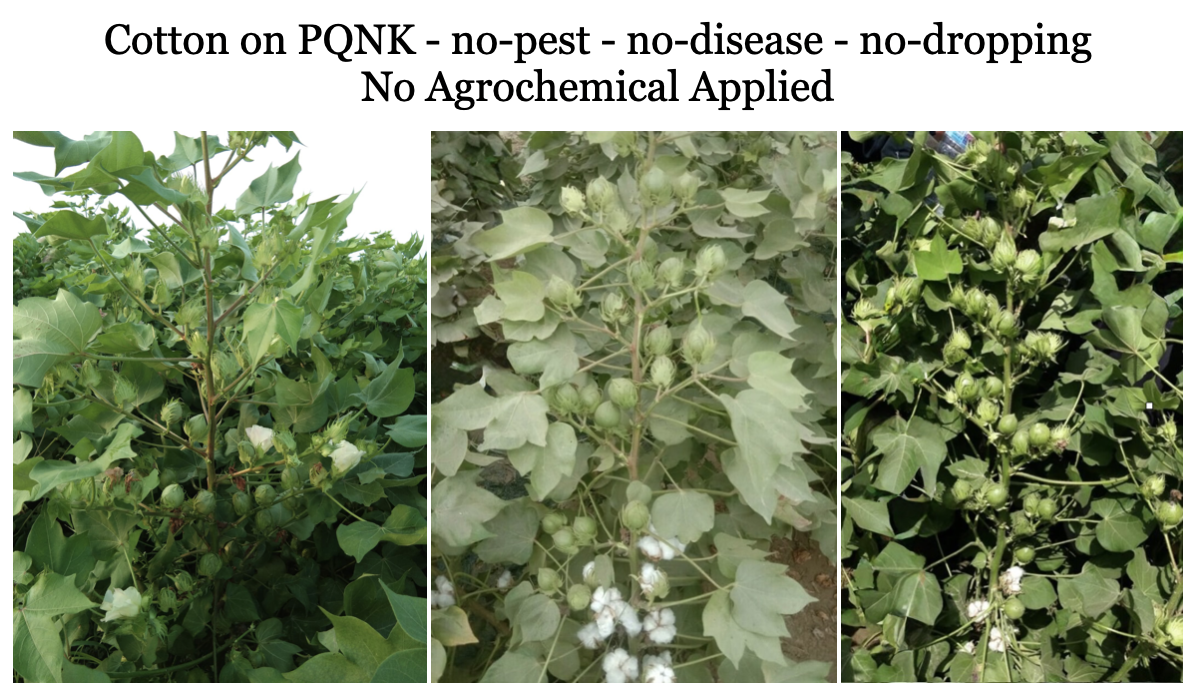
Cotton on PQNK — no pest, no disease, no dropping, no agrochemical applied.
The four-turning-point sequence was now conceptually complete. The bollworm experience had asked why pest control was becoming progressively more difficult. The whitefly and leaf curl crisis showed that the field problem involved an interacting biological system, not a single target organism. Bt cotton then demonstrated the power, and the limits, of solving a specific pest interaction through genetics. The PQNK cotton result pointed toward a different question: what happens when the production environment itself is restored? The answer Sharif pursued was not to engineer every missing service separately, but to rebuild the soil, moisture, cover and biodiversity conditions through which natural regulation can operate.
Two hundred bolls per plant without a spray. When I saw that result, the question changed for me. Instead of asking what more we could add to the crop, I began asking what the natural production system could do when we stopped disrupting it and restored the conditions it required.
THE MOMENT OF REALISATION: FROM OBSERVATION TO FRAMEWORK
The four cotton turning points did not produce PQNK directly. They produced the question that produced PQNK: if the natural system can deliver superior results without any purchased input, what exactly must be restored for it to do so? The answer required going deeper than the cotton crop and deeper than Pakistan’s agricultural context, it required understanding the principles that govern biological productivity in any ecosystem, which is what led to the Amazon.
But before the Amazon, there was a period of synthesis in which observations accumulated across cotton, irrigation, machinery, soil and crop management and began to cohere into a framework. It was not yet named PQNK and it was not yet codified into the transition protocol used today. Its central insight, however, was becoming clear: agricultural productivity could not be separated from soil structure, aeration, moisture and biological function. The field had to be treated as a living production system rather than as an inert medium receiving inputs.
This was not a single moment of discovery but a convergence of observations. Pest outbreaks were connected to disrupted biological regulation. Water problems were connected to infiltration, hardpan, evaporation and soil structure. Nutrient performance was connected to roots, microorganisms and mineral cycling. Farmer economics were connected to the growing number of functions being purchased from outside the farm. PQNK would later bring these relationships together under one restoration framework: repair the production environment first, then measure how many external interventions become unnecessary.
THE MILK AND YOGURT PARADIGM: HOW FAST CAN A SYSTEM CHANGE?

One of the practical questions the developing framework had to answer was time. If soil structure and biological function had been degraded, how quickly could useful recovery begin? Farmers could not wait a decade for the first agronomic benefit. The transition had to produce visible improvement early enough to remain economically workable.
PQNK field experience showed Sharif that meaningful change could begin within the first growing season when the transition protocol was correctly applied. That does not mean every soil reaches a fully mature biological state in one season, or that every field follows an identical timetable. Soil history, climate, residue supply, compaction, salinity, crop sequence and management all affect the rate of recovery. The milk-to-yogurt metaphor became a way of explaining the principle: biological transformation depends not only on ingredients, but on creating the conditions in which the living community can function.
A degraded ACI soil is like the milk in the metaphor: much of the mineral material is already present, but its organisation, pore structure, carbon supply and biological networks may be badly impaired. PQNK does not literally add a microbial ‘starter culture’ in the way yogurt is inoculated. Instead, it creates the physical and biological conditions that allow existing and incoming soil organisms, roots and mycorrhizal networks to rebuild function. One-time hardpan breaking where required opens the profile; permanent beds prevent repeated recompaction; mulch supplies carbon and protects the surface; living roots feed the rhizosphere; no repeated tillage protects developing networks; and Soil Moisture Management maintains the air-water balance. Field recovery can begin quickly, while biological maturation continues crop after crop.
People ask me: how long does the PQNK transition take? I tell them that the change can begin in the first season if we create the right conditions. The milk-and-yogurt example is not a literal soil recipe. It is a reminder that biology responds when its operating conditions are restored. One season can show the direction. Crop after crop strengthens the living system.
THE ADVERSITY THAT DEEPENED THE SEARCH
The intellectual journey from the cotton turning points to the codified PQNK system was not smooth. Between the 1990s, when the framework was developing, and 2008, when the Amazon encounter gave Sharif a powerful natural-ecosystem reference point, years of adversity tested the direction and deepened the questions the emerging system had to answer.
For a period during these years, Sharif’s business activities were substantially interrupted by circumstances outside his control, a period he regards, in his own words, as a significant personal sacrifice rather than a setback. Commercial commitments receded, and more attention could be directed toward the field observations and biological questions that would later be brought together as PQNK.
During this period, work continued at farm level through observation, experimentation and documentation. Fields managed with progressively more biological practices were providing practical signals: lower pest pressure in some unsprayed crops, improving soil structure where repeated tillage stopped, and better moisture behaviour where soil cover and controlled irrigation were used. These observations were not yet a complete theory. They were the empirical trail that the later PQNK framework would organise.
WHAT THE TURNING POINTS ESTABLISHED
The four cotton turning points, the milk-to-yogurt insight, and the years of field observation that connected them established three propositions that the Amazon encounter would help Sharif place within a larger natural-ecosystem framework.
First: many problems treated separately in conventional agriculture are connected through the production environment. Pest pressure, water behaviour, nutrient cycling and farm economics can all be altered by the way soil structure, biology, moisture and crop management are organised. The important discovery was therefore not a claim that every agricultural problem has one exclusive cause, but that restoring the underlying biological system can address several constraints simultaneously.
Second: PQNK field observations showed that restoring soil cover, aeration, root continuity, moisture balance and biological activity could reduce the need for interventions that had previously been treated as unavoidable. The 200-boll cotton observation became one striking example of that possibility. Its significance lies in what it asks agriculture to measure: not only yield, but the yield achieved per unit of water, energy, purchased input and ecological disturbance.
Third: useful transition can begin rapidly when the correct physical conditions are created, but restoration should be understood as a biological process rather than a fixed countdown. PQNK expects measurable change from the first season and progressive strengthening crop after crop. The practical obstacle is therefore not that farmers must wait decades before seeing benefit; it is knowing how to establish the field correctly, manage moisture, retain cover and roots, and protect the recovering biological system.
The next chapter brings Part Three to its central ecological encounter: the Amazon. In 2008, Sharif saw at landscape scale the same governing principles that his agricultural observations had been pointing toward: continuous biological cover, undisturbed soil organisation, biodiversity, recycling and production driven by solar energy and water rather than recurring purchased inputs. The encounter did not ‘validate nature’. Nature was already the operating precedent. What it gave Sharif was the reference system through which the scattered field observations could finally be organised.
Chapter Eighteen: The Amazon Revelation, 2008: Seeing Nature’s Production Principles Working Together