
Industrial Devastation To Natural Abundance
The Discovery · Chapter 18
The Amazon Revelation
2008: Seeing Nature’s Production Principles Working Together
Release 1.0 · 2026-09-16
If you use “Listen”, the text of the page may be sent to your browser or operating system’s speech provider, such as Apple, Google or Microsoft, depending on the voice your device uses. Pedaver does not process, transmit or store any audio.
“The Amazon did not give me a farming recipe. It allowed me to see, in one living landscape, the relationships that decades of farming had taught me to look for.”
Asif Sharif, Lahore, 2008
BEFORE THE AMAZON
The journey to the Amazon did not begin the search that later became PQNK. By 2008, I had already spent more than three decades inside production agriculture. I had mechanised farms, changed irrigation methods, tested crops and varieties, worked with tractors, combines, planters, seed, fertiliser and crop protection, and participated in agricultural policy and commercial agriculture. I had seen what modern agricultural technology could achieve, but I had also seen the weaknesses that appeared when the production environment itself was damaged.
The earlier chapters have traced that journey. What matters here is that I did not go to Brazil looking for a philosophy to adopt. I went with questions that had accumulated through years of field work. Why did cultivated soil repeatedly lose structure? Why did irrigation so easily move from necessity to excess? Why could increasing purchased inputs produce more vegetative growth without necessarily producing a healthier crop? Why did pest pressure become so difficult to control in simplified agricultural environments? Why did machinery, which could make farming faster and more precise, so often disturb the soil on which production ultimately depended?
By then, I had begun to see that these were not separate problems. Soil, water, roots, microorganisms, plants, insects, residues and machinery were interacting parts of one production environment. I needed to understand that environment as a system.
BRAZIL, 2008
I spent three weeks in Brazil in 2008. One week was spent in the Amazon rainforest. During the other two weeks I visited farms and agriculture-related government offices. Those visits were important because I was not interested only in seeing a forest. I wanted to substantiate what decades of agricultural work had taught me and to compare managed agriculture with a natural ecosystem functioning without the recurring production operations familiar to a farmer.
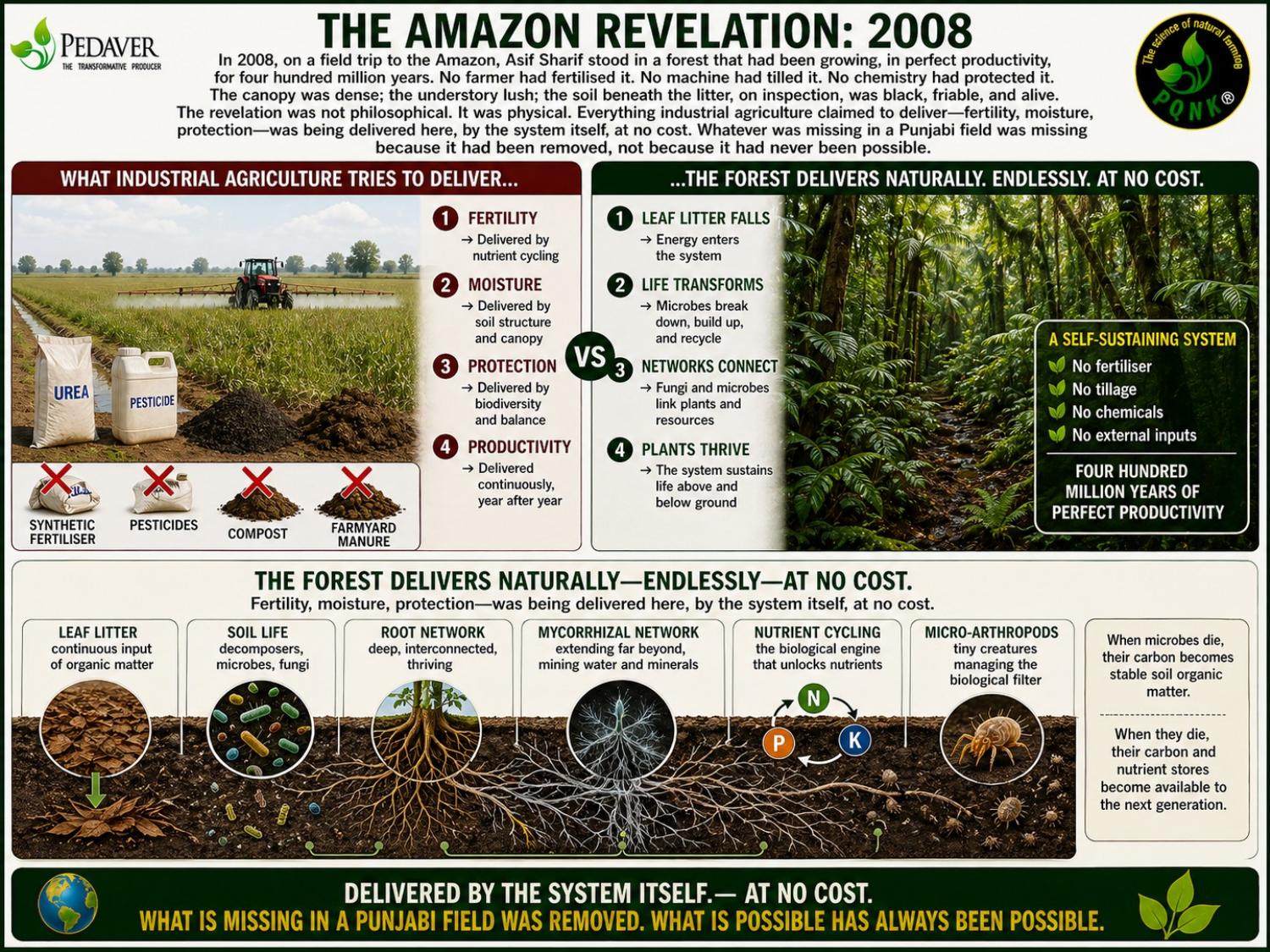
The week in the Amazon was different from the farm visits. I was looking at a terrestrial ecosystem rather than a production field. There were no crop rows, no prescribed planting geometry, no irrigation schedule and no harvest objective. Yet the forest was producing enormous quantities of living material while maintaining soil cover, cycling organic matter, moving water through vegetation and atmosphere, supporting extraordinary biological diversity and continuously rebuilding itself.
That contrast was important. The Amazon did not tell me how wide an agricultural bed should be, how deep a furrow should be, when a farmer should irrigate, or how seed should be placed through residue. Those questions still had to be solved in agricultural fields. What the Amazon showed me was the operating environment within which biological production had evolved.
THE REVELATION WAS THE SYSTEM
The significance of the Amazon was not its age as an unchanged forest. The present Amazon rainforest has not stood unchanged for hundreds of millions of years. Landscapes, rivers, climate, species and human occupation have all changed through time. The much longer history belongs to terrestrial plant life and the evolution of complex land ecosystems.
For hundreds of millions of years, plants, roots, fungi, microorganisms and animals have interacted with soil, water and atmosphere. The Amazon is one of today’s great expressions of that evolutionary history. Standing inside it, I could see many functions that agriculture normally studies separately operating together.
The soil surface was protected. Roots occupied the ground continuously. Organic material returned to the surface and decomposed. Water moved through vegetation, soil and atmosphere. Many organisms occupied different ecological niches. Herbivores existed alongside predators, parasites, pathogens and competitors. Fertility was not being delivered according to a fertiliser schedule; nutrients were continually being taken up, incorporated into living material, returned and recycled.
The important realisation was that none of these functions stood alone. Cover affected temperature and moisture. Moisture affected roots and microorganisms. Roots affected soil structure and water movement. Organic residues fed decomposers. Diversity created many biological relationships. The system worked through interaction.
This became one of the central foundations of PQNK: agriculture should not begin by asking which purchased input can replace a missing function. It should first ask why that function has been lost and whether the production environment can be managed so that the biological system performs more of the work itself.
THE FIRST OBSERVATION: PROTECT THE SOIL SURFACE
One of the clearest contrasts with cultivated land was the condition of the soil surface. In intact rainforest, the ground is commonly protected by vegetation, fallen leaves, decomposing organic material and living roots. The surface is not routinely exposed to direct sun and raindrop impact, then cultivated again before the next biological cycle.
Natural disturbance can expose soil. Trees fall, rivers move, animals disturb the ground, and climatic events can create openings. But exposed space is normally recolonised. Biological cover is the prevailing direction of the system.
For agriculture, this was a practical lesson. A protected surface moderates soil temperature, reduces direct evaporation, cushions rainfall impact and provides food and habitat for organisms living at and below the surface. Later, permanent organic mulch became the agricultural means by which PQNK protects that surface. The purpose is not to make a field look like a forest. The purpose is to preserve the function of cover while still producing a crop.
THE SECOND OBSERVATION: DIVERSITY PERFORMS WORK
The Amazon’s diversity was not important merely because many species were present. Different plants occupied different heights and rooting depths. Fungi and bacteria decomposed and transformed organic material. Insects, birds, mammals and other organisms participated in pollination, herbivory, predation, seed movement, decomposition and countless other relationships.
These relationships include cooperation and competition, growth and mortality, predation and defence, disease and recovery. A natural ecosystem is not a place where nothing is attacked or nothing dies. Its strength lies in the number and diversity of relationships through which biological functions are performed.
This distinction matters greatly for PQNK. Biodiversity in a production field does not mean abandoning the crop that the farmer intends to harvest. It means avoiding unnecessary biological simplification around that crop. Crop-after-crop, crop-in-crop where practical, retained roots and residues, companion vegetation where useful, and habitat for beneficial organisms can increase the number of biological functions operating within the production system.
The objective is not a static idea of perfect balance. It is a more resilient production environment in which decomposition, nutrient cycling, pollination and biological regulation are not reduced to a single fragile pathway.
THE THIRD OBSERVATION: WATER MOVES THROUGH A LIVING SYSTEM
The Amazon also changed the scale at which I thought about water. Agriculture normally sees water from the point at which it enters a field: rainfall, canal water, a tube-well or another irrigation source. A forest makes the larger cycle visible.
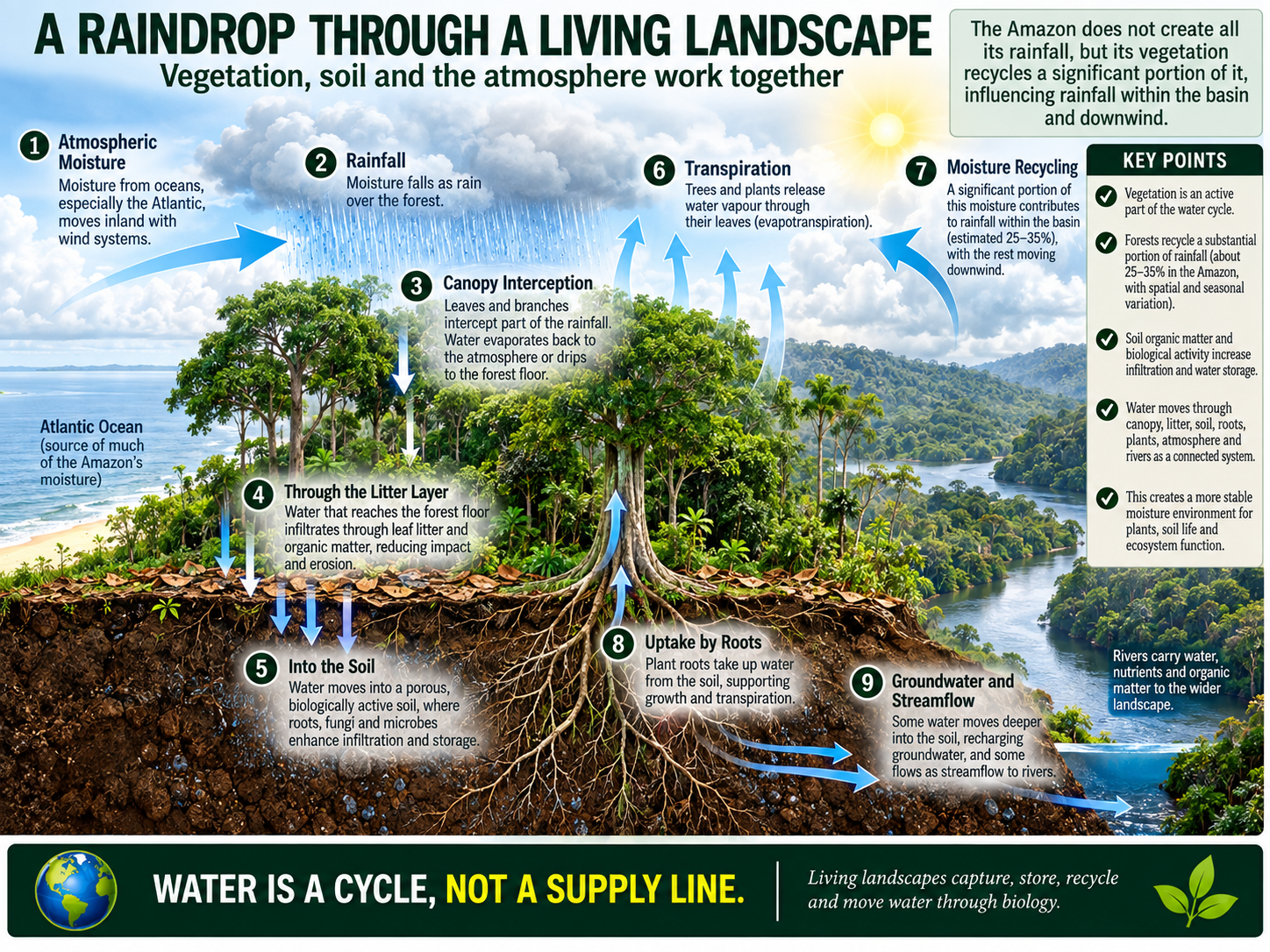
Rain falls onto vegetation and soil. Some is intercepted by the canopy. Some evaporates. Some reaches the ground and infiltrates. Some becomes runoff or drainage. Roots take up water and plants return large quantities to the atmosphere through transpiration. That atmospheric moisture participates again in weather and rainfall processes. The vegetation is therefore not simply using water; it is an active part of the hydrological cycle.
The Amazon receives major atmospheric moisture from the Atlantic Ocean, while the forest itself recycles a substantial share of water through evapotranspiration. The proportion varies across the basin and through the seasons. The scientifically important point is not that the forest creates all of its own rainfall. It is that vegetation, soil and atmosphere are connected parts of one water system.
For production agriculture, this reinforced a principle that later became Soil Moisture Management. Roots require water, but they also require oxygen. The objective is therefore not maximum water in the soil. It is sufficient moisture within an aerated root environment. PQNK would later translate that principle into practical irrigation management on permanent raised beds.
THE FOURTH OBSERVATION: FERTILITY IS CONTINUOUSLY RECYCLED
The apparent fertility of a tropical forest presents an important question. Large areas of the Amazon occur on old, highly weathered and acidic soils. In many locations, phosphorus and other nutrients can limit biological production. Yet these landscapes can support enormous standing biomass.
The explanation is not that plants have escaped the need for minerals. Every plant still requires mineral nutrients. The important feature is the efficiency with which nutrients already present in the living system are retained, transformed and reused. Leaves and other organic materials fall. Roots die and regrow. Fungi, bacteria and soil animals decompose organic matter. Plants recover nutrients from ageing tissues. Roots and mycorrhizal fungi explore the soil. Nutrients move repeatedly between living biomass, organic residues and soil.
This cycle is not perfectly closed. Natural ecosystems receive nutrients through processes such as weathering, atmospheric deposition and biological nitrogen fixation, and they lose nutrients through leaching, erosion, gases, fire and movement of material. Agriculture also removes nutrients in harvested produce. What matters is the principle of biological cycling: fertility is a continuing process, not simply an event that occurs when a bag is opened.
This observation later became central to PQNK. The aim is to rebuild the soil environment in which roots, microorganisms, organic residues, mineral particles, moisture and air can interact continuously. Purchased fertiliser may be used during transition when a crop shows genuine deficiency, but it is not intended to remain the permanent engine of the system.
THE FIFTH OBSERVATION: BIOLOGICAL REGULATION
During my week in the Amazon, I did not see the kind of crop-wide pest outbreak that had become so familiar to me in agricultural monocultures. Yet insects were everywhere. Leaves were eaten. Organisms competed. Plants became diseased and died. The forest was not pest-free. It was biologically occupied.
That difference was important. In a diverse ecosystem, a herbivore exists inside a much larger network that may include predators, parasitoids, pathogens, competing herbivores, alternative hosts and changing food resources. Plant populations are also distributed among many species rather than presented as one vast, genetically similar food source.
Biological regulation does not guarantee that no population will ever increase or that no natural disturbance will become severe. It means that pest and disease organisms operate within a much richer network of biological relationships than exists in a simplified field from which many organisms have been repeatedly removed.
The PQNK implication was therefore not ‘nature has no pests.’ It was that crop protection should begin by protecting the biological regulatory system. During transition, a pesticide may still be used when pest pressure crosses the defined economic threshold. The long-term objective, however, is to make routine chemical protection increasingly unnecessary by restoring the ecological conditions in which regulation can function.
PRODUCTIVITY: THE RIGHT COMPARISON
The Amazon’s productivity was visually overwhelming, but it must be interpreted correctly. Forest productivity and agricultural grain yield are not the same measurement. A rainforest produces leaves, wood, roots, fruit, reproductive structures and other biomass across many species and layers. A wheat or rice yield normally refers to one harvested component of one crop. Comparing tonnes of forest biomass directly with tonnes of grain therefore creates a false equivalence.
The useful comparison is not a contest over which system produces the larger number of tonnes per hectare. The useful question is how a natural ecosystem maintains large quantities of living biomass and continuing biological production without the recurring industrial production architecture used in conventional farming.
Its energy comes primarily from sunlight. Much of its carbon comes from atmospheric carbon dioxide. Water circulates through the soil-plant-atmosphere system. Nutrients are repeatedly cycled through living and dead organic material. Biological communities perform decomposition, nutrient transformation and regulation. The system invests continuously in the infrastructure that allows future production.
PQNK does not propose converting agricultural land into rainforest. It asks whether cultivated land can recover more of these functions while continuing to produce food, fibre and other crops. That is a much more demanding engineering question, and it cannot be answered by analogy alone.
WHAT THE AMAZON COULD NOT PROVIDE
The Amazon supplied no agricultural dimensions. It did not tell us that a bed should be 42 inches wide, that tractor tyres should remain in permanent furrows, that a compacted hardpan should be broken to 22 inches during conversion, or that irrigation should be judged by the physical condition of the soil. It did not design a planter capable of placing seed through residue. It did not determine how a farmer should manage the vulnerable transition from degraded soil to a more biologically active production environment.
These were problems that had to be solved through agricultural experience and engineering. A forest does not carry a tractor or combine. It does not need a uniform harvest at a particular date. It does not remove tonnes of grain, fibre, tubers or cane for sale. It does not begin each season with the economic obligations of a farmer.
This is why PQNK should be understood neither as forest imitation nor as a collection of natural-farming slogans. Nature provides the operating principles. Production agriculture requires those principles to be translated into geometry, machinery, water management, planting, harvesting and transition procedures that work on real farms.
FROM ECOLOGICAL UNDERSTANDING TO ENGINEERING
When I returned from Brazil, I did not return with a completed PQNK manual. I returned with a clearer framework for interpreting what I had already learned and for deciding what the next field experiments should test.
The years that followed were therefore years of translation. Some ideas had already emerged from earlier field work. Others were progressively refined through later crops, machinery development and farmer experience. Permanent beds, controlled traffic, hardpan correction, Soil Moisture Management, retained roots and residues, crop-after-crop and crop-in-crop, and specialised planting machinery belong to that continuing development. They should not be projected backward as though the entire mature system appeared during one week in the Amazon.
The importance of 2008 is more fundamental. The unit of thought had changed. Instead of treating soil, water, fertility, crop protection and machinery as separate departments of agriculture, they could be examined as interacting parts of one living production system.
That shift also changed the role of engineering. Machinery was no longer valuable simply because it could cultivate more hectares, move more soil or complete an operation faster. Its value had to be judged by whether it helped production while protecting the biological and physical infrastructure of the field.
THE FIRST AGRICULTURAL TRANSLATION
Rice soon became one of the most important crops through which this developing direction could be tested. Conventional rice production appeared to depend on practices that raised the central questions most sharply: puddling, prolonged standing water, repeated soil disturbance and high labour demand.
Beginning in 2009, the mechanised raised-bed rice work in Punjab tested a different production environment. It was not yet mature PQNK. Young seedlings were transplanted onto newly formed raised beds. Fertiliser and compost were banded. Mechanical weed control and soil aeration were used. The first irrigation briefly overtopped the beds to settle the seedlings, after which water was applied through the furrows rather than maintaining continuous flooding.
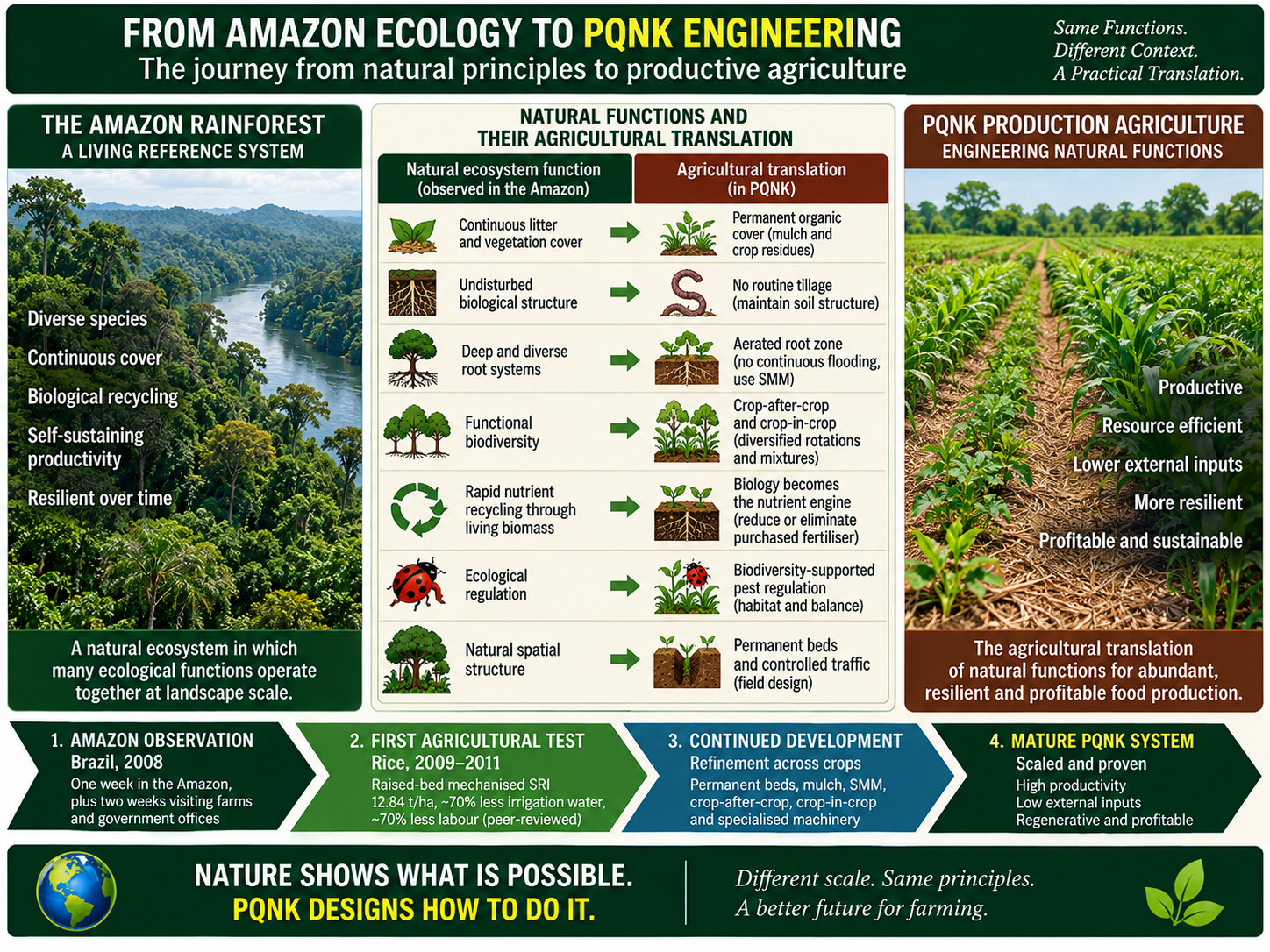
That distinction is historically important. The rice work was an early bridge between ecological understanding and agricultural engineering. Later PQNK rice moved further: direct seeding, mature permanent beds, retained cover, no inundation and a production system increasingly organised around Soil Moisture Management and biological function.
The 2009-2011 rice work therefore belongs exactly where it appears in this book. It was not the moment at which nature was ‘proved.’ Nature did not require that validation. It was the moment when an emerging agricultural translation began to produce field measurements strong enough to challenge one of agriculture’s most persistent assumptions: that high-yield rice required continuous flooding.
WHAT CHANGED IN 2008
Looking back, the Amazon Revelation was not the discovery of a single new mechanism. It was the recognition that the mechanisms belonged together.
Soil should be protected rather than repeatedly exposed. Water should support a moist, aerated biological root environment rather than displace its air. Organic material should remain part of the production cycle. Roots should be allowed to build and occupy soil. Biodiversity should be encouraged because biological functions are performed through relationships. Machinery should serve the living system rather than repeatedly reconstruct it.
These ideas would take years to convert into the mature PQNK system described in this book. But after Brazil, the direction was clear enough to guide that work.
Nature is the production system. PQNK is the agricultural translation: not an attempt to reproduce a rainforest, but an attempt to produce crops while respecting the operating principles through which terrestrial ecosystems sustain biological production.
FROM THE AMAZON TO THE RICE FIELD
The next chapter moves from ecological observation to measured agricultural work. Rice placed water, soil aeration, root development, labour and machinery into the same experiment. The question was no longer what the Amazon looked like. The question was what agriculture could learn from the way a living system functions.
The answer began to emerge on raised beds in Punjab. It would not yet be the final PQNK system, but it would become one of the decisive steps toward it.
The Amazon helped me see the system. The rice field forced me to engineer it.
Chapter Nineteen: The First Experiment, Rice on Moist Soil Raised Beds, Paradoxical Agriculture Becomes Proof