
Industrial Devastation To Natural Abundance
Extended Knowledge · Chapter 52
The Sugar Industry
The PQNK Transformation for Every Cane-Growing Nation
Release 1.0 · 2026-10-25
If you use “Listen”, the text of the page may be sent to your browser or operating system’s speech provider, such as Apple, Google or Microsoft, depending on the voice your device uses. Pedaver does not process, transmit or store any audio.
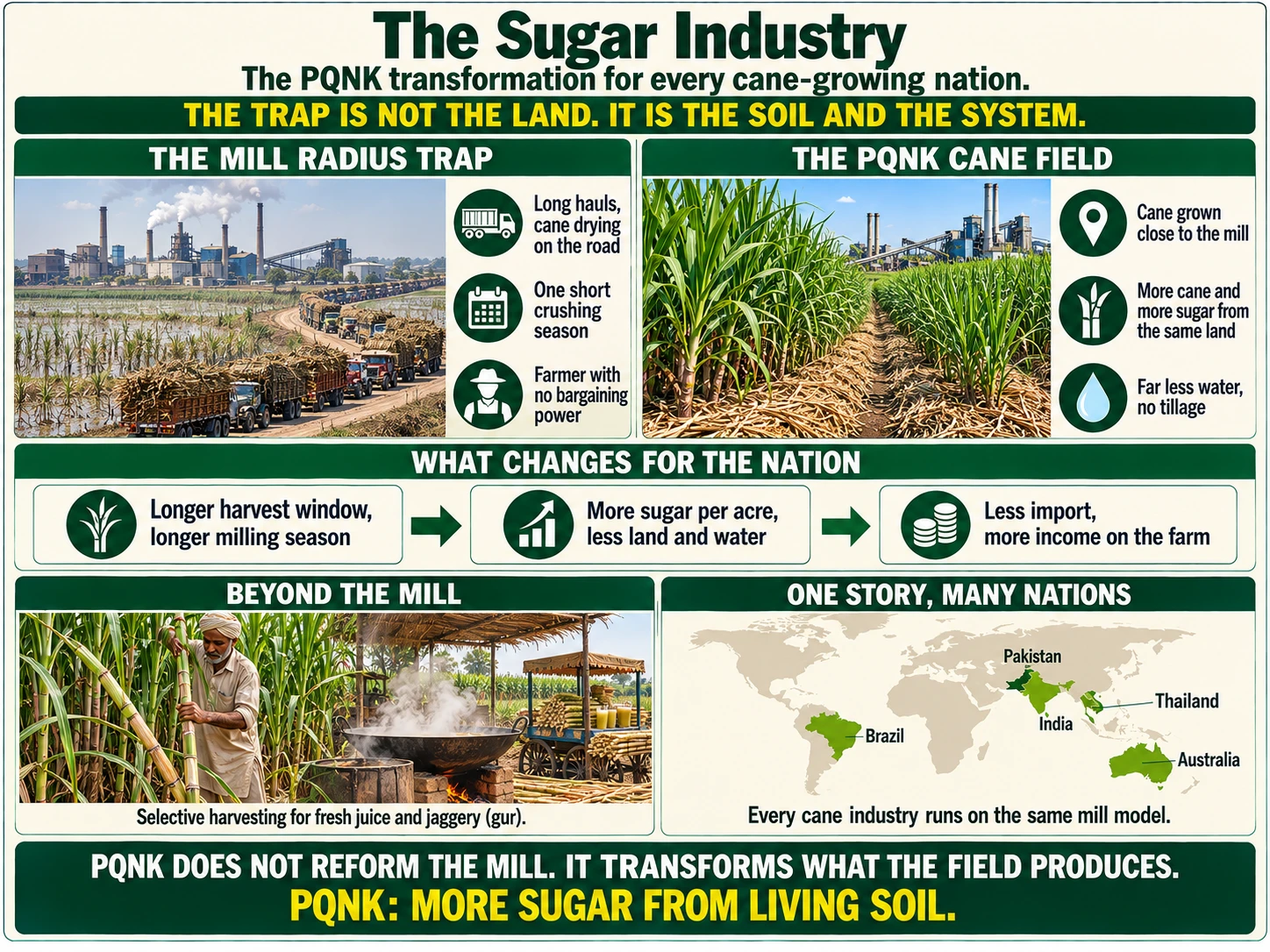
The Sugar Industry: more sugar from living soil, for every cane-growing nation.
The cane sugar industry, in Pakistan as in most cane-growing countries, is caught in a structural trap: a tug of war between mills and farmers that swings from one side to the other in cycles. Pakistan’s mills once drew cane from a fixed zone of contracted farmers. That system is gone. Mills are now free to buy cane wherever they can find it, and they set up purchase centres with weighing scales across hundreds of miles.
When sugarcane is over-planted, the cycle favours the mills. They drop prices and impose quality cuts, and farmers line up for days with their cane in trolleys, waiting for their turn while it dries and loses weight. Discouraged, farmers stop planting, and the next cycle begins: cane runs short, prices rise, and the mills collect cane from hundreds of miles away at a huge cost in transport. Neither side wins for long. The farmer has no security, and the mill has no steady supply of fresh, quality cane.
PQNK breaks this trap, not by reforming the mill structure, but by transforming what the farm produces and when it produces it. The transformation is both quantitative and qualitative, and it has implications at the national level that extend well beyond the farm gate.
The same model runs the cane industries of Brazil, India, Thailand and Australia: a mill, a crushing season, farms that clear their fields once a year, and supply that swings between glut and shortage. Where the model is most intensive, its costs reach beyond the farm; in Australia, fertiliser and sediment running off the Queensland cane belt are among the main pressures on the water quality of the Great Barrier Reef. The trap is not Pakistani. Pakistan, one of the world’s five largest sugarcane producers, is the case this book has documented.
THE MILL RADIUS MODEL
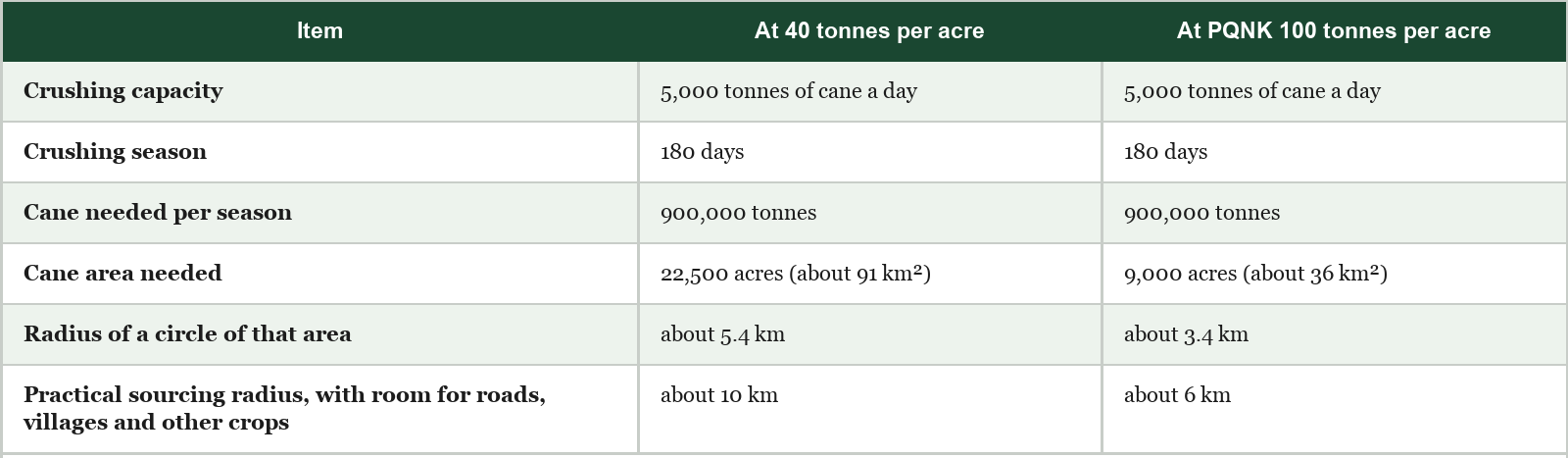
The way out is for the mill to grow its cane close to home, and we have long proposed to the mills that they source from the smallest possible radius. The arithmetic shows how small that radius can be. A mill with a crushing capacity of 5,000 tonnes of cane a day, running for 180 days, needs 900,000 tonnes of cane a season. At an average of 40 tonnes per acre, that is 22,500 acres, a circle with a radius of about 5.4 km. Leaving room for roads, villages and other crops, a radius of about 10 km is enough.
HOW MUCH LAND DOES A SUGAR MILL NEED?
| Item | At 40 tonnes per acre | At PQNK 100 tonnes per acre |
|---|---|---|
| Crushing capacity | 5,000 tonnes of cane a day | 5,000 tonnes of cane a day |
| Crushing season | 180 days | 180 days |
| Cane needed per season | 900,000 tonnes | 900,000 tonnes |
| Cane area needed | 22,500 acres (about 91 km²) | 9,000 acres (about 36 km²) |
| Radius of a circle of that area | about 5.4 km | about 3.4 km |
| Practical sourcing radius, with room for roads, villages and other crops | about 10 km | about 6 km |
1 acre = 0.405 hectare; 1 km² = 247 acres. At a 10 km radius, cane takes under a third of the land around the mill. The PQNK column is at the 2,500 maunds (100 tonnes) per acre of the published PQNK model, with cane on the same share of the land.
Mills are willing to spend huge sums on transport, yet they rarely spend it on incentives for the farmers in the close area, which would buy them a regular supply of fresh, quality cane: no queues, no long hauls, no cane losing weight on the road. At PQNK yields the radius shrinks further, and the close-area farmer becomes the mill’s most valuable partner (KP-005).
More significantly, PQNK widens the harvesting window. The published PQNK sugar-industry model extends harvesting from five months (November to March) to eight (October to May), letting a mill run eight to ten months instead of six (KP-005). That improves capital utilisation and softens the seasonal labour shocks that create social disruption in mill towns. Year-round selective harvesting, cutting only mature canes from a permanent stand as from an orchard, belongs to the fresh-juice and gur markets described below; cane for the mill follows the mill’s maturity, cutting and delivery requirements (Chapter Thirty-Seven).
SUGARCANE AND COTTON: WHY ZONING DOES NOT APPLY UNDER PQNK
Conventional planning keeps sugarcane and cotton apart. In Pakistan the debate never ends: why were sugar mills installed in cotton-growing areas, and has the spread of cane cut cotton production? The argument rests on one belief, that sugarcane is a water-guzzling crop that fills the air with humidity, and that cotton suffers in the humid air around it.
Under PQNK the zoning question is irrelevant, because the belief does not hold. Sugarcane is a narrow-leaved C4 grass, and for the mass it produces it needs less water than any other major field crop. The humidity of a conventional cane belt comes from flooding: 64 inches of water a year spread over the open soil, much of it evaporating straight into the air. On PQNK beds the soil is covered with mulch, and the water stays in the soil, where the roots use it.
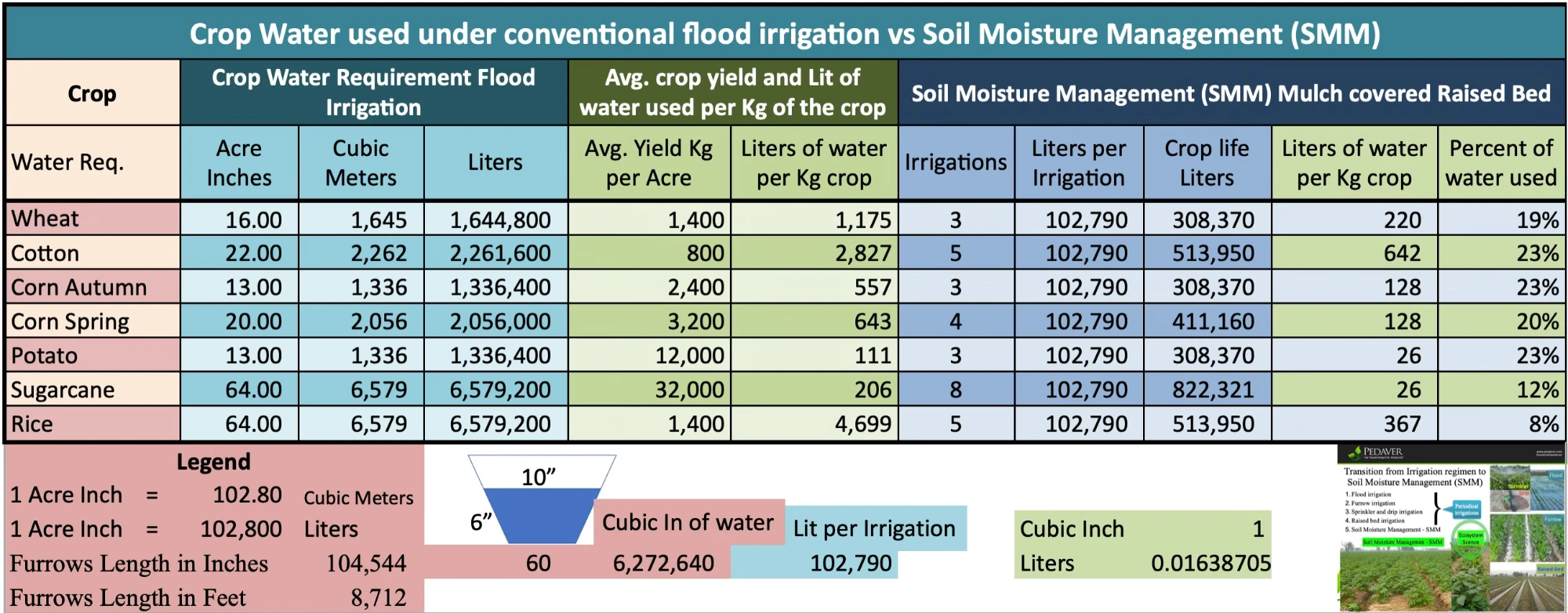
The comparison below shows it crop by crop. Under flood irrigation, a kilogram of sugarcane takes about 206 litres of water, against 1,175 for wheat, 2,827 for cotton and 4,699 for rice. Under Soil Moisture Management (SMM) on mulch-covered raised beds, sugarcane needs about 26 litres per kilogram, the lowest of all the crops, level with potato, and 12 percent of the water flood irrigation uses.
| Crop | Flood: acre inches | Flood: cubic metres | Flood: litres | Avg. yield kg per acre | Flood: litres of water per kg crop | SMM: irrigations | SMM: litres per irrigation | SMM: crop life litres | SMM: litres of water per kg crop | SMM: percent of water used |
|---|---|---|---|---|---|---|---|---|---|---|
| Wheat | 16.00 | 1,645 | 1,644,800 | 1,400 | 1,175 | 3 | 102,790 | 308,370 | 220 | 19% |
| Cotton | 22.00 | 2,262 | 2,261,600 | 800 | 2,827 | 5 | 102,790 | 513,950 | 642 | 23% |
| Corn Autumn | 13.00 | 1,336 | 1,336,400 | 2,400 | 557 | 3 | 102,790 | 308,370 | 128 | 23% |
| Corn Spring | 20.00 | 2,056 | 2,056,000 | 3,200 | 643 | 4 | 102,790 | 411,160 | 128 | 20% |
| Potato | 13.00 | 1,336 | 1,336,400 | 12,000 | 111 | 3 | 102,790 | 308,370 | 26 | 23% |
| Sugarcane | 64.00 | 6,579 | 6,579,200 | 32,000 | 206 | 8 | 102,790 | 822,321 | 26 | 12% |
| Rice | 64.00 | 6,579 | 6,579,200 | 1,400 | 4,699 | 5 | 102,790 | 513,950 | 367 | 8% |
| Legend | 1 acre inch = 102.80 cubic metres = 102,800 litres | Furrow length 8,712 feet (104,544 inches) per acre | 60 square inches of water in the furrow section | 6,272,640 cubic inches | 102,790 litres per irrigation | 1 cubic inch = 0.01638705 litres |
Crop water under conventional flood irrigation and under Soil Moisture Management (SMM) on mulch-covered raised beds. One SMM irrigation is one acre-inch, about 102,790 litres, run down the furrows.
These SMM figures are for the transition years, when the beds still take a few furrow flows. They come to 8 to 23 percent of the flood-irrigation water, a saving of 77 to 92 percent. On mature beds, at 400 mm of rain or more, even these flows are no longer needed.
Rain carries most of the load. Against an annual rainfall of about 630 mm, 2,543,452 litres per acre, the whole crop-life water of an SMM sugarcane crop is about a third of the rain that falls on the field; for wheat, corn and potato it is about an eighth.
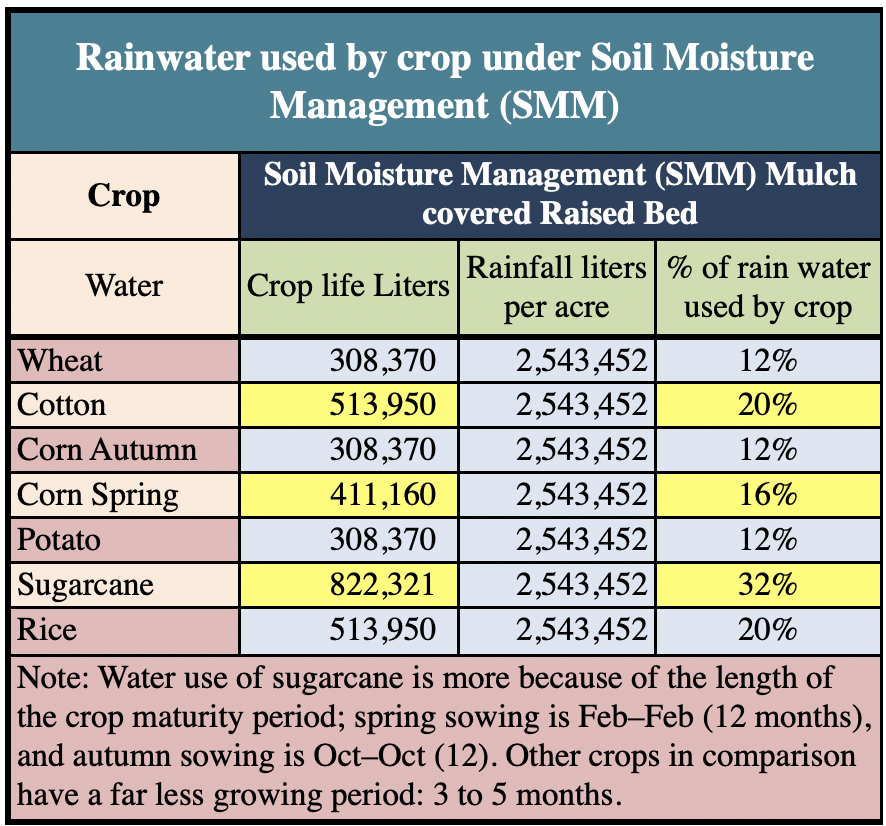
| Crop | Crop life litres | Rainfall litres per acre | % of rain water used by crop |
|---|---|---|---|
| Wheat | 308,370 | 2,543,452 | 12% |
| Cotton | 513,950 | 2,543,452 | 20% |
| Corn Autumn | 308,370 | 2,543,452 | 12% |
| Corn Spring | 411,160 | 2,543,452 | 16% |
| Potato | 308,370 | 2,543,452 | 12% |
| Sugarcane | 822,321 | 2,543,452 | 32% |
| Rice | 513,950 | 2,543,452 | 20% |
| Note | Water use of sugarcane is more because of the length of the crop maturity period; spring sowing is Feb–Feb (12 months), and autumn sowing is Oct–Oct (12). Other crops in comparison have a far less growing period: 3 to 5 months. |
Rainwater used by crop under Soil Moisture Management (SMM).
A cane field managed this way does not fill the air with moisture, and a cotton field beside it does not suffer from it. Under PQNK, cane and cotton can grow side by side, and a mill can stand in a cotton district without taking anything from the cotton farmer.
THE YIELD AND SUCROSE ARITHMETIC
The financial case for PQNK sugarcane at the national scale is compelling. Documented PQNK fields have reached 2,800 maunds (about 112 tonnes) per acre (KE-027), and recorded cases report over 2,000 maunds (80 tonnes), against 600 to 1,000 maunds (about 24 to 40 tonnes) for conventional cane (Chapters Five and Thirty-Seven). At the 2,500 maunds (100 tonnes) of the published PQNK model, the same land produces about three times as much cane as conventional management at 800 maunds (32 tonnes).
The sucrose advantage compounds this. PQNK field records have reported sucrose of 10 to 14 percent where comparable conventional cane was reported at 8 to 10 percent, and the 2,800-maund field was reported with 44 percent higher sugar recovery. Combined with the threefold yield, the sucrose carried per acre under PQNK is about four times that of conventional management, from the same land, with lower input costs.
National sugar production arithmetic:
Conventional: 32 tonnes/acre × 9% sucrose = 2.9 tonnes sucrose/acre
PQNK: 100 tonnes/acre × 12% sucrose = 12 tonnes sucrose/acre
PQNK carries about four times more sucrose from the same land area.
If one third of a country’s sugarcane area converts to PQNK, national production roughly doubles.
THE IMPORT SUBSTITUTION ARGUMENT
Pakistan imports sugar in years of domestic shortfall, spending foreign exchange on a commodity that could be produced domestically at about four times current volumes per acre from existing land. Many sugar-importing nations face the same choice. The import cost is not a market efficiency; it is the financial consequence of soil degradation. Every tonne of sugar imported is a tonne that degraded soil could not produce.
PQNK sugarcane is, in this frame, an import substitution strategy that requires no new land, no new irrigation infrastructure, and no new varieties. It requires only that the existing land be managed in a way that allows the soil to function as biology intended.
JAGGERY (GUR) AND DIRECT MARKET OPPORTUNITIES
The mill-dependency model is not the only commercial path for PQNK sugarcane farmers. The year-round selective harvesting system, and the consistently high sucrose content of PQNK cane, makes on-farm jaggery (gur) and fresh juice production highly viable. These markets command premium prices, especially for residue-free cane grown without synthetic fertiliser or pesticide, and allow the farmer to capture value that is currently extracted by the mill and the trader.
PQNK produce is Organic Plus. It comes from a closed-loop system, it carries no chemical residues, and it is nutrient-dense and diverse. That can be built into a brand, PQNK Organic Plus, and sold at a premium price.
Fresh juice vendors can source daily from PQNK farms, receiving the freshest possible product without the juice quality degradation that occurs when cane sits after field harvest. The combination of superior sweetness, higher juice percentage, and chemical-free production creates a product that the market is already prepared to pay a premium for.
THE PATH TO ADOPTION
Sugarcane farmers are, in general, risk-averse, and rationally so. Their capital investment per acre is high, their debt exposure is significant, and their cash flow depends on the mill price. Asking them to abandon conventional practice in favour of an unfamiliar system requires either strong social proof or policy support.
The PQNK adoption path for sugarcane therefore begins small: one or two acres of conversion on a farm with ten to fifteen acres of conventional cane. The visual comparison between the PQNK demonstration area and the conventional field, which becomes visible within twelve to eighteen months, is typically sufficient to drive broader adoption without external persuasion. Farmers adopt what they can see working in their own field, under their own conditions, with their own hands.
Chapter Fifty-Three: The Four-Step PQNK Transition Protocol, Reopening the Living Earth