

Industrial Devastation To Natural Abundance
Extended Knowledge · Chapter 51
Okra Under PQNK
Fruiting Management and the Non-Intervention Principle
Release 1.0 · 2026-10-25
If you use “Listen”, the text of the page may be sent to your browser or operating system’s speech provider, such as Apple, Google or Microsoft, depending on the voice your device uses. Pedaver does not process, transmit or store any audio.
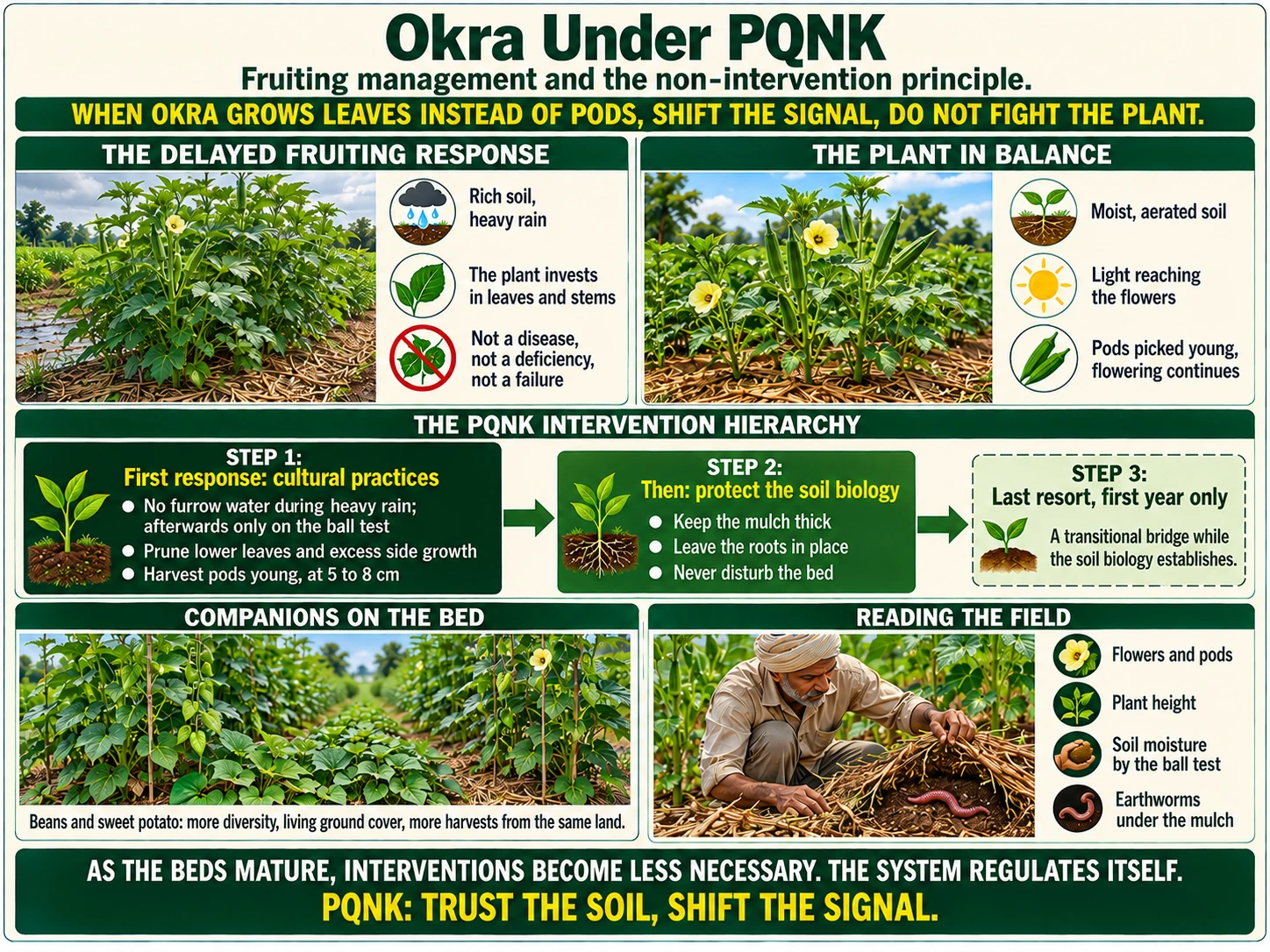
Okra Under PQNK: trust the soil, shift the signal.
Okra is one of the first crops many farmers trial under PQNK. It establishes quickly, produces visual results within weeks, and responds dramatically to improved soil conditions. But it also presents a specific management challenge that surprises farmers transitioning from conventional practice: in a functioning PQNK system, okra can produce extraordinary vegetative growth while delaying fruiting. The farmer, trained by conventional practice to intervene at the first sign of suboptimal performance, must learn a different response.
UNDERSTANDING THE DELAYED FRUITING RESPONSE
Okra begins flowering 50 to 65 days after planting under optimal conditions. In first-year PQNK fields, particularly during periods of above-average rainfall, the crop may push vigorous vegetative growth while delaying this transition. This is not a disease, a deficiency, or a PQNK failure. It is a physiological response to conditions that are optimal for vegetative growth.
The relevant mechanism is nitrogen-to-reproduction balance. When soil nitrogen availability is high relative to the plant's reproductive triggers, the plant continues allocating resources to vegetative growth, taller stems, larger leaves, more branching, rather than initiating flowers. This is the plant behaving rationally: in nutrient-rich conditions, vegetative investment maximises future reproductive capacity. The farmer's job is to shift the signal.
Excessive rainfall compounds this dynamic by diluting soil nutrient concentrations and saturating the root zone for a time, temporarily suppressing the microbial activity that converts organic nitrogen to ammonium and nitrate. The plant experiences conditions that mimic nitrogen stress, prompting further vegetative growth to access more nutrients, even as the soil is biologically rich.
THE INTERVENTION HIERARCHY
PQNK's approach to okra fruiting problems follows a strict intervention hierarchy. The hierarchy matters because each level of intervention carries different implications for the soil system, and because the most ecologically aligned interventions are almost always sufficient when applied correctly.
Level One: Cultural Practices (First Response)
• Give no furrow water during periods of heavy or continuous rainfall, and afterwards only when the ball test shows a need. Let the soil return to a moist, aerated state without saturation. This concentrates soil mineral ratios and triggers the plant's reproductive transition.
• Strategic pruning of lower leaves and excessive lateral growth improves light penetration to the reproductive structures and redirects plant energy upward.
• Harvest pods promptly at 5 to 8 cm length. Okra left to over-mature signals the plant to redirect resources toward seed development, suppressing new flower formation. In high-performing PQNK fields, this harvesting discipline alone determines whether the crop continues to fruit prolifically.
Level Two: Biological Support (If Level One Is Insufficient)
• Keep the mulch thick and the beds undisturbed, and leave the roots of earlier crops and of the ground cover in place. The fungal network and the soil life they feed are what deliver zinc and boron to the okra root; PQNK adds no compost and no purchased microbial culture, it protects the biology that is already rebuilding.
Level Three: Targeted Micronutrient Application (Last Resort Only)
Boron and zinc do play important roles in okra reproduction. Boron is essential for pollen tube elongation and cell wall integrity in reproductive structures. Zinc activates enzymes for protein synthesis in reproductive tissue and participates in the synthesis of the auxin precursor tryptophan, which influences flower initiation.
In a properly functioning PQNK soil system, these micronutrients are supplied by the soil biology in appropriate proportions without external input. In a transitioning or first-year system, temporary deficiencies may occur as the biology establishes. If Level One and Level Two have been applied for 7 to 14 days without improvement, a single foliar application of boron (800 mg/L) and zinc (400 mg/L) can provide a temporary bridge while the soil biology establishes.
This is not a PQNK recommendation in the conventional sense. It is a transitional measure for first-year systems that should become unnecessary once the soil biology is fully established. If boron-zinc applications are required in years two and three, the diagnosis is incomplete, something is preventing the soil system from functioning, and that underlying cause must be identified.
COMPANION PLANTING FOR OKRA
PQNK okra benefits from strategic companion planting. Climbing beans and sweet potatoes are documented beneficial companions: the beans diversify the root exudate profile in the soil, supporting a broader microbial community, while the sweet potato provides dense ground cover that maintains soil moisture and suppresses weeds between okra rows. The combination improves overall system resilience and creates multiple saleable products from the same land.
READING THE FIELD
PQNK okra management relies on the farmer’s trained eye rather than on records or soil chemical tests (Chapter Sixty). Flowering, fruit set, plant height against flowering stage, soil moisture at root depth by the ball test, and earthworms under the mulch tell the farmer whether the system is working, and whether any intervention is warranted.
As the beds mature, the interventions become less frequent, less intense and less necessary, and the system regulates itself.
Chapter Fifty-Two: Pakistan's Sugar Industry, The PQNK Transformation