

Industrial Devastation To Natural Abundance
Extended Knowledge · Chapter 57
The PQNK Weed-Indicator System
Reading the Field Through Vegetation
Release 1.0 · 2026-10-27
If you use “Listen”, the text of the page may be sent to your browser or operating system’s speech provider, such as Apple, Google or Microsoft, depending on the voice your device uses. Pedaver does not process, transmit or store any audio.
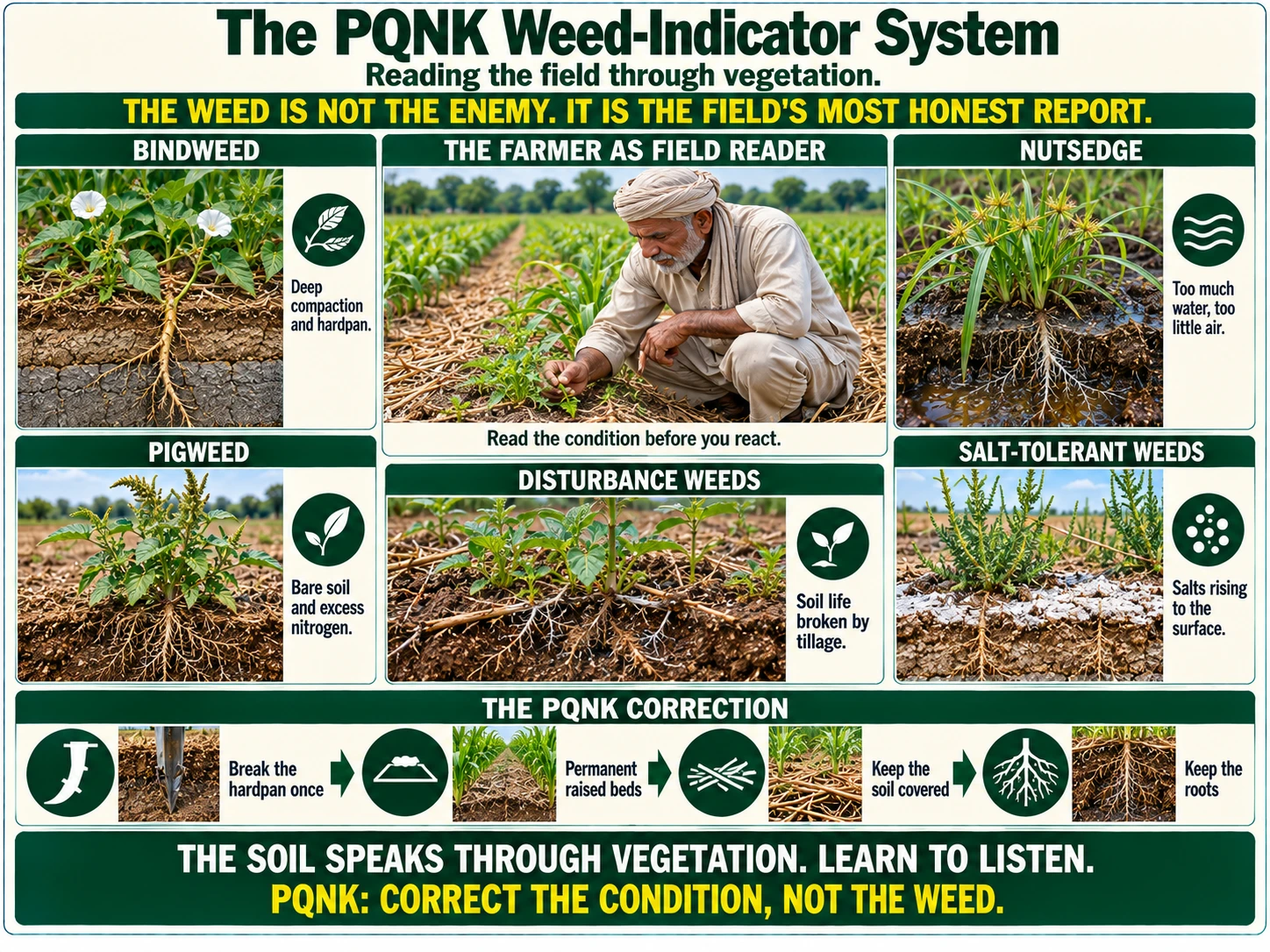
The PQNK Weed-Indicator System: correct the condition, not the weed.
“The field does not hide its condition. It announces it through every plant that volunteers to grow. The question is whether the farmer has learned to read the announcement or only to silence it.”
Asif Sharif, Lahore, 2026
THE WEED-INDICATOR SYSTEM AS A FORMAL DIAGNOSTIC INSTRUMENT
Chapter Seven established the foundational inversion that defines PQNK's relationship with weeds: the weed is not the farmer's enemy but his most honest diagnostician. What that chapter introduced as a philosophical principle, this chapter develops as a practical system. The PQNK Weed-Indicator System is a formal, named diagnostic instrument, a structured framework through which specific weed species and weed community patterns are interpreted as biological readings of specific underground ecological conditions.
This distinction, between a philosophical stance toward weeds and a formal diagnostic system, is important. A philosophy changes how the farmer feels about weeds. A diagnostic system changes what the farmer does when he sees them. The Weed-Indicator System is operational. It assigns ecological meaning to specific plants, connects that meaning to identifiable soil conditions, and directs the farmer toward the specific corrections those conditions require. It transforms the weed population from a frustration to be managed into an instrument to be read.
The diagnostic logic of the system rests on a principle that the ecosystem continuously attempts self-correction. When soil structure collapses, oxygen declines, salts accumulate, biology weakens, or nutrient balance becomes distorted, certain plant species naturally colonize the environment most suited to those conditions. The weed is responding to the condition, not causing it. This distinction changes the management response at its root. Suppressing the weed without correcting the condition it signals produces only temporary reduction. The ecological invitation remains, and the same weed or an equivalent successor returns. Permanent weed reduction in a PQNK system is achieved not through suppression alone but through the systematic correction of the underground conditions the weeds are reporting.
WHY MULCH SUPPRESSES WEEDS BUT NEVER TOUCHES THE CROP
Before reading individual weed species as diagnostic signals, one mechanical question deserves a direct answer, because farmers new to PQNK ask it consistently: how does the mulch layer know to suppress a weed seed while allowing the deliberately planted crop seed beneath it to emerge? The honest answer is that it does not know anything, and it does not need to. Mulch does not distinguish one seed from another. Every seed, crop or weed, carries its own biological germination triggers, responding independently to moisture, temperature, oxygen, and light. The crop seed germinates because it has been placed at the correct depth, in contact with soil moisture, and released from its own dormancy requirements by the planting operation itself. A weed seed sitting in the same field responds to the same set of environmental cues, not to the mulch's opinion of which plant belongs there.
What mulch actually does is change the conditions that determine which of the weed seeds already present, and they are almost always present, find those conditions met. This reframes the diagnostic logic that the rest of this chapter develops in detail: heavy weed emergence is not a random event. It is driven overwhelmingly by two conditions in particular, poor soil porosity and bare, exposed soil. Aggressive-rooted species colonize compacted ground because it offers little competition from anything else. Vegetation claims exposed soil because no productive ecosystem leaves ground permanently bare. Correct the porosity, and maintain the cover, and the field's total weed pressure falls, not because the mulch is selectively poisoning weed seeds, but because fewer of the conditions those seeds require are being offered.
This mechanism also resolves the nutrient-competition fear that drives most herbicide-dependent weed management. A farmer trained to think of soil fertility as a fixed quantity of applied fertilizer reasonably worries that any second plant is stealing nutrition intended for the crop. The soil's living conversion system, developed at length in Chapter Three, applies directly here: once that system is functioning, nutrient delivery is not a bag divided between competitors but a continuous biological process responsive to demand. The presence of a low-growing plant that merely covers otherwise bare soil, without shading the crop, does not automatically mean it is stealing anything. The competition that actually matters under PQNK management is overwhelmingly above ground, for sunlight, not below ground, for a fixed nutrient pool that no longer exists in a functioning system.
None of this licenses indifference to mulch management itself. A mulch layer that packs so densely it restricts root-zone aeration has stopped protecting the living soil and started suffocating it, a failure this book addresses directly in the chapters on organic mulch. The objective of mulch is never to kill anything. It is to change which conditions are on offer, so that the field's vegetation, crop and volunteer alike, responds to a soil that is porous, covered, and alive.
BINDWEED: THE SIGNAL OF DEEP STRUCTURAL COLLAPSE
Among the weeds that carry the most diagnostic weight within the PQNK Weed-Indicator System, bindweed (Deeela, Convolvulus) occupies a prominent position, not because it is the most damaging in competition terms, but because it is one of the most reliable indicators of a specific and serious underground condition: deep structural collapse. Fields where bindweed dominates are fields where the soil profile has deteriorated across its full depth, not merely at the surface, but through the layer structure that governs root penetration, water movement, and atmospheric exchange below the tillage zone.
Bindweed thrives specifically because it possesses an aggressive rooting system capable of penetrating hardened and poorly aerated layers that exclude most crop root systems. In a structurally healthy soil, bindweed has no particular competitive advantage. It is simply one of many species competing for space. But in a compacted, hydraulically restricted, biologically weakened soil, bindweed gains an overwhelming edge because normal crop roots cannot reach the moisture and aeration pockets that its penetrating taproot can locate. The plant is not attacking a healthy field. It is colonizing an ecological vacancy created by underground structural failure.
The PQNK reading of heavy bindweed dominance therefore triggers a structural diagnostic sequence, not a herbicide application. The farmer asks: where has underground continuity collapsed? Is there a hardpan layer resisting deep infiltration? Has the biological pore architecture been destroyed by repeated tillage and flood irrigation? Is the subsoil aerated or are lower layers oxygen-depleted and structurally sealed? These are the questions the bindweed is raising, and they are the questions that must be answered before any durable correction is possible. The correction protocol targets hardpan fracture, permanent bed formation, biological root penetration through retained root succession, and mulch continuity. As these interventions restore underground structural integrity, the ecological vacancy that bindweed was exploiting closes, and its dominance declines without requiring its direct destruction.
NUTSEDGE: THE SIGNAL OF HYDRAULIC AND ATMOSPHERIC IMBALANCE
Nutsedge (Motha grass, Cyperus rotundus) is the PQNK Weed-Indicator System's primary diagnostic species for disturbed water-air balance within the upper soil profile. Its ecological reading connects directly to one of the three architectural destructors that PQNK defines as disqualifying for natural ecosystem production agriculture: the inundation of soil with water. Fields subjected to repeated flood irrigation, or fields where a hardpan stops infiltration and pore spaces remain chronically saturated, create precisely the oxygen-deficient conditions in which nutsedge gains its competitive advantage over crop plants.
The mechanism is specific. A healthy soil profile maintains a dynamic balance between water and air across its pore network. Water infiltrates downward rapidly through continuous pore channels, emptying the larger pores of the upper profile and allowing atmospheric oxygen to re-enter behind the receding water front. In a compacted, structurally degraded soil, this balance fails. Pore channels are blocked, water movement is slow, and the upper profile remains saturated for extended periods after irrigation or rainfall. Under these conditions, oxygen is depleted, anaerobic microbial processes dominate, and the root environment becomes hostile to most crop species. Nutsedge is adapted precisely to this hostile environment. It tolerates the oxygen deficiency and the waterlogging that suppress crop root function.
The PQNK response to nutsedge dominance is therefore directed at restoring the water-air balance of the soil profile: reopening hardpan layers to restore rapid downward infiltration, establishing permanent raised beds that lift the root zone above the furrow water and let it soak in sideways, rebuilding aggregate structure to restore pore network integrity, and establishing mulch continuity that moderates surface moisture and prevents the surface sealing that slows infiltration. Blind suppression of nutsedge without these corrections leaves the saturated, oxygen-deficient profile conditions intact, and the plant returns as reliably as the next irrigation event reproduces the conditions it requires.
PIGWEED: THE SIGNAL OF NITROGEN EXCESS AND BIOLOGICAL DEREGULATION
Pigweed (Amaranthus, the wild spinach or palak of Chapter Seven) carries a different diagnostic message from the structural and hydraulic indicators. Where bindweed signals collapse of underground architecture and nutsedge signals failure of water-air balance, pigweed signals a third category of soil disorder: the disruption of ecological nutrient regulation. It appears aggressively where soluble nitrogen is excessive relative to the soil's biological capacity to moderate and integrate that fertility, a condition characteristic of systems dominated by synthetic fertilizer application combined with weak biological cycling.
Chapter Seven reads Amaranthus first as a fast cover that shields disturbed, exposed soil, and that reading still holds: wherever soil is left bare, it arrives to cover it. Its nitrogen signal is a second reading, and it applies where Amaranthus surges in a heavily fertilised field. It is not the same signal as Bathu (Chenopodium album), whose rise alongside recovering biology Chapter Seven reads as a welcome sign that the soil’s own nitrogen supply is returning.
In an ecologically balanced soil, nitrogen moves through the system gradually, processed through microbial decomposition, root interaction, and biological cycling in ways that moderate its availability and prevent the surge concentrations that fuel uncontrolled vegetative growth. In a biologically degraded soil, this moderating capacity is absent. Applied soluble nitrogen remains in the soil solution at high concentration, available to any plant aggressive enough to exploit it before it leaches or volatilizes. Pigweed is precisely such a plant, fast-growing, nitrogen-hungry, capable of converting soluble fertility into explosive vegetative expansion before the crop plant can access the same resource through its more measured biological processes.
The PQNK interpretation of pigweed dominance directs the farmer not toward a stronger herbicide but toward a fertility management diagnosis: Is nitrogen being applied in excess of the soil's biological capacity to process it? Is the carbon balance of the soil system adequate to regulate nitrogen cycling? Is biological decomposition active enough to stabilize nutrient movement? The correction protocol strengthens biological nutrient cycling through mulch continuity, increased carbon inputs, improved root-zone microbial density, and reduced dependence on soluble synthetic fertility. As ecological regulation of the nitrogen cycle is restored, the excessive vegetative stimulation that pigweed exploits diminishes, and its dominance declines without any herbicide application.
SALT-INDICATOR WEEDS: THE BIOLOGICAL WARNING OF MINERAL ACCUMULATION
Salt-affected soils often announce their deteriorating condition through vegetation long before the severity of salinity becomes visible through crop failure. In the agricultural plains of Pakistan and across much of the irrigated world, the combination of flood irrigation, restricted infiltration above a hardpan, shallow water tables, surface evaporation, and interrupted infiltration creates conditions that concentrate dissolved minerals in the upper soil profile through capillary rise. The salt does not arrive suddenly. It accumulates progressively, season by season, invisibly displacing crop productivity below the threshold of obvious damage until the system passes a tipping point beyond which correction becomes costly and slow.
Within the PQNK Weed-Indicator System, the early warning of salt accumulation is visible in the vegetation succession before it becomes visible in the crop. Salt-tolerant opportunistic species that normally occupy marginal or disturbed ground begin extending into productive field areas, dominating where evaporation consistently exceeds infiltration and where the capillary fringe concentrates dissolved salts near the surface. These plants are not salt lovers in any ecological sense. They are survivors, species whose tolerance thresholds for mineral stress are simply higher than those of the crops they are displacing. Their presence signals that the surface soil has crossed the tolerance boundary of normal crop ecology.
The PQNK correction for salt-indicator weed dominance is directed at restoring the hydraulic conditions that move dissolved minerals downward through the profile rather than upward. This requires hardpan fracture to restore deep infiltration, transition-phase water-washing of the upper profile to dilute and leach accumulated salts, permanent bed formation to separate the active root zone from the saturated lower profile, mulch cover to suppress surface evaporation and eliminate the capillary-rise concentration mechanism, and biological deep rooting to restore the hydraulic channels through which salts are carried permanently downward. As these corrections restore downward hydraulic movement, the surface salt concentrations that invited salt-tolerant vegetation decline, and the weed community gradually returns to the species composition of a balanced field.
FUNGAL-COLLAPSE WEEDS: INDICATORS OF UNDERGROUND BIOLOGICAL SIMPLIFICATION
A fifth category of weed diagnostic within the PQNK Weed-Indicator System connects weed succession patterns to the condition of the soil's fungal ecology. This connection is less intuitive than the structural and hydraulic indicators but equally important. In an ecologically mature soil, fungal networks perform functions that no other biological system can replicate, connecting organic matter decomposition to root nutrition, stabilizing aggregates through hyphal binding and glomalin production, moderating moisture distribution through hyphal water transport, and maintaining the biological coordination that integrates the decomposition, carbon, and nutrient cycles into a unified ecological process. When these fungal systems are disrupted, the soil loses its biological integration and reverts to a simpler, less stable ecological state.
Repeated tillage is the primary mechanism of fungal network destruction. Each tillage pass severs the hyphal networks that fungi have constructed through the soil matrix, and the energy cost of rebuilding them from scattered fragments is sufficient to prevent full recovery before the next tillage event. The result, in chronically tilled soils, is a fungal community that is perpetually in early-recovery mode, shallow, fragmented, and structurally ineffective. The biological integration functions that mature fungal networks provide are absent. The soil ecology simplifies toward bacterial dominance, aggregate instability, and fragmented decomposition processes.
Within the PQNK Weed-Indicator System, fields where disturbance-adapted opportunistic weeds repeatedly dominate despite management, where no single structural, hydraulic, or fertility explanation fully accounts for the persistence of aggressive weed pressure, often reflect this underlying condition of fungal biological simplification. The field favors rapid colonizers because the underground ecological organization that would support stable, complex plant communities has not recovered. The PQNK response focuses on rebuilding fungal continuity: root retention to provide the hyphal colonization pathways that fungal networks require; permanent no-till to prevent the hyphal severance that resets the recovery process every season; mulch continuity to provide the surface organic matter that sustains fungal decomposition networks; and biological decomposition stability to give the fungal community the time and conditions required to mature toward ecological integration. As fungal recovery progresses, the biological organization of the soil strengthens, and the weed succession gradually shifts away from disturbance-dominated colonizers toward the more balanced ecological community of a stabilizing permanent bed.
THE WEED COMMUNITY AS A LIVING SOIL REPORT
Individual weed species carry specific diagnostic signals within the PQNK Weed-Indicator System, but the most sophisticated reading of the field comes not from individual plants but from the weed community as a whole, the collective vegetation pattern that describes the current ecological state of the field across all its conditions simultaneously. This is the distinction between reading a single word and reading a sentence. A single weed species tells the farmer one thing. The composition, distribution, and relative dominance of the entire weed population tells the farmer the current condition of the underground ecosystem with far greater precision.
Different combinations of ecological stress produce different community compositions. A field where bindweed dominates in low-lying areas while nutsedge appears near irrigation inlets and pigweed concentrates along fertilizer application zones is communicating three simultaneous and spatially specific conditions: structural collapse in the lower topography, chronic waterlogging near the water entry points, and nitrogen excess at the fertility application sites. No laboratory test would resolve these three simultaneous and spatially differentiated problems as quickly or as economically as the field's own vegetation pattern. The weed community has already run the diagnostic. The farmer's task is to read it.
Reading the weed community as a living soil report requires tracking change over time as well as observing composition at any single moment. A transition from waterlogging-indicator dominance toward deeper-rooted succession species suggests improving infiltration and aeration. Declining salt-tolerant weeds indicate recovering hydraulic continuity and reduced surface evaporation. Reduced pressure from aggressive disturbance weeds signals increasing mulch stability and recovering biological succession. The direction of change in the weed community reveals the direction of ecological movement in the soil, whether the field is improving, deteriorating, or holding stable under the current management regime. This is information that no periodic soil test delivers, because the weed community is updated continuously by the plants themselves, season by season, and even within the season as conditions shift.
TRANSITION-STAGE WEEDS: READING THE REGENERATIVE YEARS CORRECTLY
One of the most practically important applications of the PQNK Weed-Indicator System occurs during the regenerative transition phase, the years during which a field is converting from ACI (Ancient Conventional Industrial) management to PQNK permanent bed ecology. This period is ecologically turbulent, and the weed population reflects that turbulence in ways that can easily be misinterpreted as system failure if the farmer has not been prepared to read them correctly. Some farmers abandon the PQNK transition prematurely because the weed population during the early regenerative years is more complex and at times more aggressive than it was under the suppressive regime of herbicide-dependent management. This misreading can end a transition sooner than any technical error in bed formation or irrigation management.
The reason for this transitional complexity is straightforward. During the early regenerative years, multiple ecological imbalances are simultaneously in the process of correction. Compacted layers may still be partially intact, restricting infiltration in some zones while biopores are forming in others. Salts may still be redistributing through the profile as downward hydraulic continuity is gradually restored. Fungal continuity may still be in early recovery. Biological density may still be building. The field is not yet in a stable ecological state, it is moving through a succession of ecological states, each one more advanced than the last, and each one characterized by a different weed community.
Within the PQNK Weed-Indicator System, transition-stage weed behavior is therefore interpreted as ecological evidence of progress, not failure. The appearance of new weed species during the transition years does not mean the system is not working. It means the system is changing the ecological conditions of the field, and the vegetation is reporting those changes. The farmer's task is to track the succession, to observe which species are increasing, which are declining, what the distribution patterns are shifting toward, and what underground condition the vegetation may be signaling in each zone. The field is communicating continuously. The farmer who has learned to read it receives a detailed ecological progress report without the cost of a single laboratory analysis.
WEEDS AS TEMPORARY ECOLOGICAL WORKERS: THE ECOSYSTEM'S SELF-REPAIR MECHANISM
A further dimension of the PQNK Weed-Indicator System extends beyond diagnosis into ecological function. Many weeds do not merely signal the condition of a disturbed soil, they actively participate in the ecosystem's attempt to correct it. This is one of the deeper ecological insights within the system, and it changes the farmer's relationship with transitional vegetation from hostility to cautious recognition. The ecosystem recruits the species capable of surviving under its current damaged conditions and deploys them in roles that begin the slow process of ecological repair.
A weed with an aggressive deep taproot penetrating a compacted layer is not simply exploiting a niche. It is physically fracturing the compaction, depositing organic carbon at depth through root decomposition, and creating the initial biological pore channels that future crop roots will use when the layer softens. A weed that rapidly covers bare soil between crop cycles is not simply a competitor for the next crop's resources. It is protecting the surface from the raindrop impact and temperature extremes that would otherwise destroy the aggregate structure the permanent bed is building. A weed that tolerates waterlogged conditions and survives in periodically saturated soil is not simply occupying space. It is maintaining biological occupation of a zone that would otherwise be ecologically vacant, keeping the soil biology from collapsing into complete anaerobic stasis while the hydraulic corrections are being implemented.
This does not mean that all weeds should be permitted unlimited dominance in a production field. Crop competition is real, and management remains necessary during the production season. But the PQNK Weed-Indicator System asks the farmer to understand the ecological role the weed may be performing before reacting to it. A field that is aggressively colonized by succession weeds during the transitional off-season is a field the ecosystem is trying to protect and repair. Destroying that cover without replacing it with managed mulch or cover crop removes the ecosystem's self-repair mechanism and sets the regenerative timeline back. The weed that appears to be the farmer's problem may, in the correct ecological reading, be the field's own solution to a problem the farmer has not yet diagnosed.
THE PERMANENT FAILURE OF SUPPRESSION WITHOUT ECOLOGICAL CORRECTION
The PQNK Weed-Indicator System closes with a conclusion that has both economic and ecological implications for every farmer still operating under a suppression-based weed management model. The fundamental failure of herbicide-dependent weed management is not technological. Herbicides work in the narrow technical sense of killing plants. The failure is ecological: suppression without correction leaves the soil condition that produced the weed intact, and that condition reproduces the same weed or an equivalent successor as reliably as the next growing season. The farmer pays for suppression indefinitely because he has not addressed what the suppression was obscuring.
A compacted field repeatedly produces structural-indicator weeds because the compaction that invited them has not been corrected. A waterlogged field produces moisture-stress species because the blocked infiltration that created the anaerobic conditions has not been corrected. A biologically collapsed field favors disturbance succession because the tillage and chemical management that destroyed the biological organization have not been replaced by the retention and continuity practices that would restore it. A salt-affected field produces salt-tolerant opportunists because the hydraulic conditions that are concentrating salts at the surface have not been corrected. A nitrogen-overstimulated field favors aggressive vegetative weeds because the biological regulation of the nitrogen cycle has not been rebuilt. In every case, the weed is returning the bill for an ecological debt that suppression has been deferring but never paying.
Within mature PQNK systems, fields where permanent beds have been established, root retention is practiced consistently, mulch continuity is unbroken, fungal systems have recovered, biological density has increased, and infiltration and aeration have been restored, the ecological conditions that the indicator weeds were reporting have been systematically corrected. The structural-collapse conditions that invited bindweed have been replaced by a biologically active, well-aerated, deeply porous profile. The waterlogging conditions that invited nutsedge have been replaced by a permanent bed system that keeps the root zone aerated. The nitrogen excess that invited pigweed has been replaced by a biologically regulated fertility cycle. The ecosystem has corrected what the weeds were reporting, and the report has changed accordingly. The field stops signaling distress not because the distress was suppressed but because the distress was healed.
THE RETURN OF ECOLOGICAL OBSERVATION: THE FARMER AS FIELD READER
Industrial agriculture progressively replaced direct ecological observation with external prescription. The laboratory test replaced the observation of vegetation succession. The fertilizer recommendation replaced the reading of crop color and root architecture. The herbicide schedule replaced the interpretation of weed community composition. The agrochemical representative replaced the farmer's own accumulated ecological knowledge of his specific field. The result was a generation of farmers who were technically literate in the language of input management and ecologically illiterate in the language of the living system they were managing. The land stopped being observed as a living organism communicating its condition continuously through biological signals.
The PQNK Weed-Indicator System is one of the instruments through which that ecological literacy is restored. The farmer who learns to read weed succession is no longer dependent on periodic laboratory reports for an understanding of his soil's current condition. He reads the condition continuously, in every visit to the field, through the living report that the vegetation is providing. He sees where infiltration is failing before a yield decline confirms it. He sees where salts are beginning to concentrate before crop performance degrades. He sees where fungal recovery is progressing and where compaction still restricts biological activity. The field becomes diagnostically transparent to the observer who has learned its ecological language.
This restoration of ecological observation is not a rejection of soil science or agronomic measurement. It is the reintegration of direct biological reading alongside laboratory and analytical tools, a return to the complete observational practice that predated the reduction of farming to input chemistry. Natural ecosystems have communicated their conditions through vegetation succession for as long as plants have grown on disturbed soils. The PQNK Weed-Indicator System does not invent this language. It formalizes it, organizing the ecological signals that observant farmers have always noticed into a systematic diagnostic framework that can be taught, applied consistently, and refined through the accumulated field experience of successive seasons. The soil speaks through vegetation. The PQNK Weed-Indicator System teaches the farmer to listen again.
Chapter Fifty-Eight: Pest Ecology, The Collapse of Biological Balance