

Industrial Devastation To Natural Abundance
Extended Knowledge · Chapter 58
Pest Ecology
The Collapse of Biological Balance
Release 1.0 · 2026-10-27
If you use “Listen”, the text of the page may be sent to your browser or operating system’s speech provider, such as Apple, Google or Microsoft, depending on the voice your device uses. Pedaver does not process, transmit or store any audio.
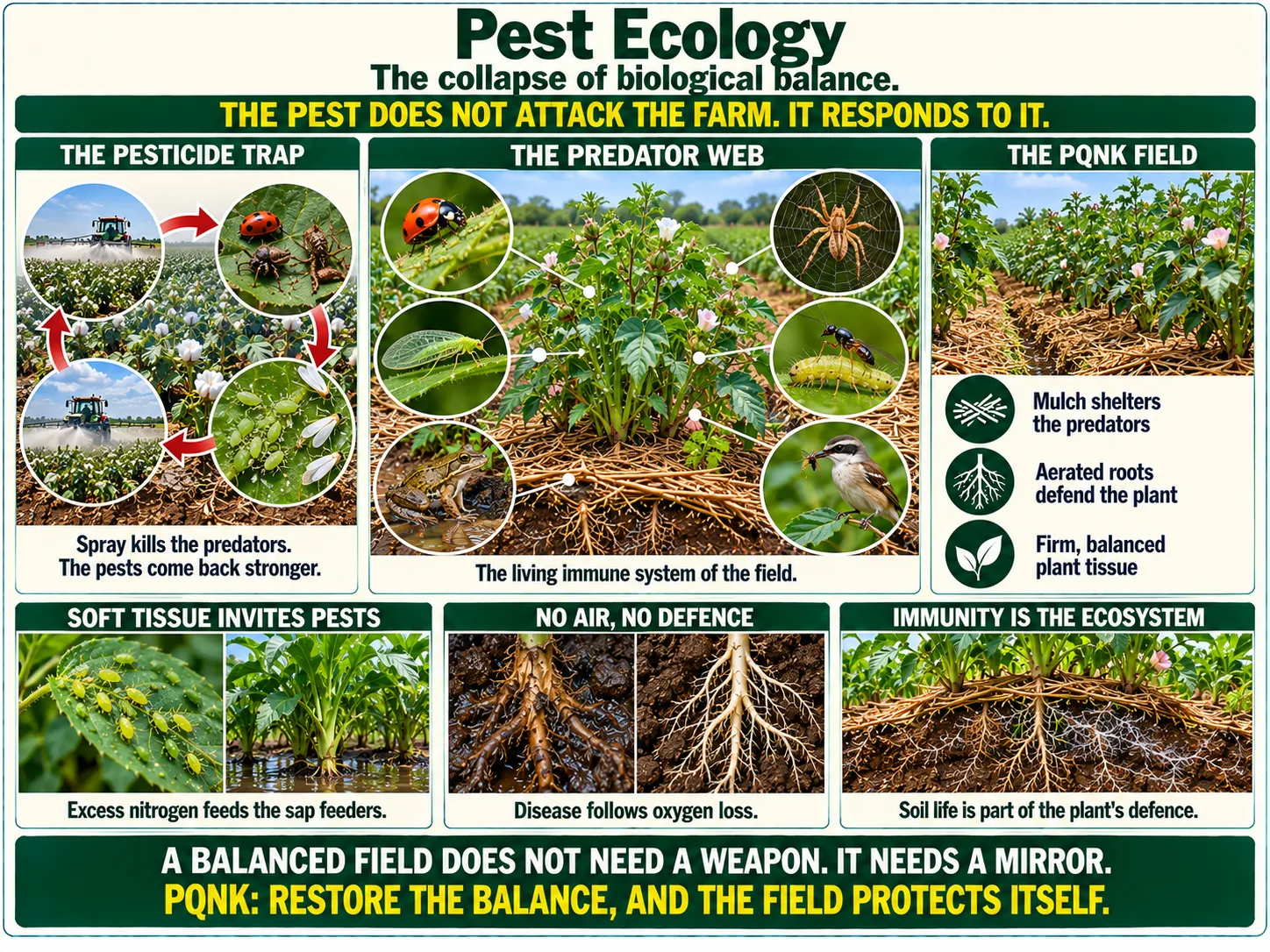
Pest Ecology: restore the balance, and the field protects itself.
“The pest does not attack the farm. It responds to the farm. The distinction matters enormously, because one problem requires a weapon, and the other requires a mirror.”
Asif Sharif, Lahore, 2026
PEST ECOLOGY AS ECOSYSTEM SCIENCE
Chapter Six established that Bacillus thuringiensis belongs to a natural pest protection system that the pesticide industry was built to replace, and that pest pressure falls sharply when the field is managed under PQNK ecological continuity. That chapter addressed the instrument of control. This chapter addresses the deeper question: why do pest outbreaks occur in the first place, and what does their occurrence reveal about the condition of the agricultural ecosystem? These are different questions, and their answers lead to a different level of understanding, one that governs not just how pest pressure is managed but how it is interpreted as a diagnostic signal of ecological collapse.
Within PQNK, pest ecology is treated as a branch of ecosystem science rather than as a subset of insect toxicology. The fundamental principle is that a pest outbreak is not an isolated biological event, an external organism arriving to attack an otherwise healthy crop. It is, in most cases, an ecological event that reflects disturbance within the biological balance of the field itself. The appearance of excessive insect pressure signals that something has changed in the structural, physiological, or biological organization of the ecosystem, that a regulatory relationship has weakened, a habitat has been destroyed, a nutrient balance has been distorted, or a soil condition has been created that produces physiologically vulnerable plant tissue. The insect is responding to a condition that already exists. It did not create the vulnerability it is exploiting.
This distinction, between the pest as cause and the pest as responder, is not philosophical. It is operational. When a farmer treats pest pressure as an external attack, his entire management logic is directed toward suppression: finding a stronger chemical, applying it more frequently, targeting the insect population with greater precision. The ecological condition that produced the outbreak remains untouched, and the same pest or an equivalent successor returns as reliably as the next growing season reproduces the conditions it requires. When a farmer treats pest pressure as an ecological signal, his management logic is directed toward diagnosis: what condition in the soil, the plant physiology, or the biological community produced this invitation? The suppression may still be needed as a tactical response, but the strategic response is corrective, directed at the field, not at the insect.
THE PREDATOR WEB: THE LIVING IMMUNE SYSTEM OF THE FIELD
In natural ecosystems, no insect population exists without a corresponding system of biological regulators, predators, parasites, pathogens, and competitors that prevent any single species from reaching uncontrolled dominance. Spiders consume vast quantities of small insects at every stage of their life cycle. Predatory beetles patrol the soil surface and the crop canopy with relentless efficiency. Parasitic wasps lay their eggs inside pest larvae, using the pest's own body as the nursery for the predator's next generation. Birds systematically harvest insects from crop surfaces, stems, and soil. Frogs and reptiles regulate ground-level insect populations across the furrow zones. Microbial organisms and entomopathogenic fungi infect and kill susceptible insect populations from within. These relationships are not incidental. They constitute the predator web, the layered, interconnected biological regulation system through which the field governs its own insect populations.
The predator web is the living immune system of the field. Like the immune system of an animal, it does not eliminate every potential threat. It maintains the balance of biological populations within bounds that the ecosystem can absorb without destabilization. A field with an intact predator web is not a field without pests. It is a field in which pest populations are continuously regulated by the biological relationships that contain them, in which a temporary increase in one species triggers a corresponding increase in its predators, which restores the balance. This self-regulating dynamic is the ecological norm. Permanent uncontrolled pest dominance is not.
Industrial agriculture dismantled this web with remarkable thoroughness. Broad-spectrum pesticides killed predators and prey together, but the recovery rates differed critically. Many pest species, aphids, whiteflies, mites, thrips, reproduce in days and can rebuild their populations within a single week. Their predators, spiders, parasitic wasps, predatory beetles, lacewings, reproduce in weeks or months and require stable habitat to sustain their populations between pest events. Every pesticide application therefore killed pests and predators alike in the short term, but within two weeks the pest population had largely recovered while the predator population had not. The next generation of pests encountered a field from which their biological regulators had been erased. The outbreak that followed was larger than the one that prompted the first spray. The response was a second spray. The cycle accelerated. This is not a failure of pesticide technology. It is the predictable outcome of using a broad-spectrum biological disruptor in an ecosystem that depends on biological balance for its stability.
Within PQNK, restoring predator web continuity is understood as a primary objective of long-term pest management, more important than any specific biological control application, because the predator web, once restored, operates continuously and free of charge across the entire field, every hour of every day, for as long as the ecological conditions that sustain it are maintained. Permanent beds create the stable surface habitat that ground-level predators require. Mulch continuity provides the micro-habitat conditions for beneficial insects and spider populations. Reduced disturbance allows predator populations to persist between crops rather than being reset by every tillage event. As these habitat conditions stabilize, the predator web gradually reassembles, and the field begins performing its own pest regulation again.
VEGETATIVE EXCESS AND THE ECOLOGICAL MECHANISM OF SAP-FEEDER OUTBREAKS
Among the most practically important insights within PQNK pest ecology is the understanding of why sap-feeding insect pressure, aphids, whiteflies, jassids, thrips, and related species, is so consistently associated with high-input farming systems. The conventional explanation is that high-yield crops attract more insects because they are more productive. The PQNK explanation is more specific and more actionable: high-input systems create physiologically imbalanced plant tissue that is structurally attractive to sap-feeding organisms in ways that balanced plant tissue is not.
The mechanism is rooted in plant physiology. Under conditions of excessive soluble nitrogen, the primary input in synthetic fertilizer systems, plants maintain prolonged vegetative growth with high concentrations of free amino acids and simple soluble compounds in their sap. The tissue remains soft, watery, and structurally weak: cells with thin walls, high water content, and abundant dissolved nitrogen compounds. For sap-feeding insects, this physiological state is optimal. They feed by piercing plant tissue and extracting the sap directly, and tissue with high dissolved nitrogen, thin cell walls, and elevated water content offers both easy physical access and high nutritional value per unit of feeding effort. The same plant growing under biologically moderated nutrition, where nitrogen cycling is mediated by microbial decomposition and delivered gradually through root-zone ecology rather than applied as a soluble flood, develops denser cell walls, lower free amino acid concentrations, and tissue that is structurally more resistant to sap-feeder penetration.
The oxygen-deficiency of flood-irrigated soils compounds this vulnerability. When soil oxygen is depleted, root respiration weakens and the plant's capacity to regulate its own sap composition declines. Mineral uptake becomes less selective. Carbon-nitrogen ratios shift toward nitrogen excess. Structural compounds, lignin, cellulose, plant defense chemistry, are produced in lower quantities relative to the simple soluble compounds that sap feeders exploit. The plant is physiologically undefended not because it lacks genetic capacity for defense but because the soil conditions created by ACI (Ancient Conventional Industrial) management have denied it the aerobic root environment it requires to activate that defense. The insect that arrives to feed on this tissue is not an aggressor creating vulnerability. It is an opportunist exploiting a vulnerability that the farming system created before the insect arrived.
FLOWERING TRANSITION AND THE NATURAL DECLINE OF SAP PRESSURE
One of the most instructive observations in PQNK field ecology is the pattern of sucking insect pressure across the growth cycle of the crop. In many crops managed under ACI conditions, sap-feeder pressure peaks during the extended vegetative phase, the period when nitrogen stimulation is high, growth is rapid, and the plant is producing maximum quantities of the soft, nitrogen-rich tissue that these insects prefer. Then, as the crop transitions into flowering and reproductive development, sap pressure frequently declines without any additional chemical intervention.
This decline is not accidental. It reflects a genuine change in the internal physiology of the plant. The transition from vegetative to reproductive growth is governed by a fundamental shift in how the plant allocates carbon and nitrogen. During flowering transition, the plant redirects resources toward reproductive structures, flowers, seeds, fruit, and reduces the vegetative expansion that characterized the earlier phase. Free amino acid concentrations in sap decline as nitrogen is incorporated into structural proteins. Tissues that were soft and accessible during the vegetative phase become more structured and resistant. Sap composition changes in ways that reduce its nutritional value to the insects that were exploiting it. The ecological invitation that excessive vegetative growth was broadcasting weakens, and sap feeder populations decline in response.
Within PQNK, this natural moderation of sap pressure during flowering transition is more pronounced and more reliable than in ACI systems because PQNK plant physiology is more balanced from the beginning. In a field where nitrogen delivery is biologically moderated, the vegetative phase does not produce the extreme tissue softness and amino acid excess that drives the most severe sap-feeder outbreaks. The crop develops with greater structural integrity throughout its growth cycle. The transition from vegetative to reproductive growth is cleaner and more complete. The natural moderation that flowering transition brings is amplified rather than masked by the continued nitrogen excess that characterizes ACI management even in the reproductive phase. PQNK does not create crops without insect pressure. It creates crops whose physiology does not maximize the ecological invitation that sap feeders are responding to.
THE PESTICIDE-INDUCED IMBALANCE CYCLE: HOW CHEMICAL CONTROL CREATES DEPENDENCE
The escalating pesticide dependence of modern agriculture is not a mysterious phenomenon. It is the predictable output of a self-reinforcing biological cycle that begins the moment the first broad-spectrum pesticide is applied to a field with an intact predator web. Understanding this cycle with precision is important because it explains why farms that spray heavily experience more severe pest pressure over time, not less, and why the only exit from the cycle is ecological restoration rather than chemical escalation.
The cycle operates as follows. An initial pest outbreak triggers a pesticide application. The pesticide kills a significant proportion of the pest population and of the predator population alike, including the predators that would have controlled the pest outbreak naturally if the spray had not been applied. Within one to two weeks, the pest population recovers because its reproduction rate is faster than the predator's. The predator population, slower to recover and dependent on stable habitat that the spray has disrupted, lags behind the pest recovery by weeks or months. The second pest generation encounters a field with fewer predators than the first generation did. The outbreak is larger. A second spray is applied. The cycle repeats, each iteration leaving the predator web slightly more depleted and the pest population slightly more resistant than the last. After several seasons of this cycle, the field has no functional predator web, the pest populations have developed partial resistance to the chemicals being used, and the farmer is applying more pesticide at higher cost for diminishing returns.
This is not a description of exceptional mismanagement. It is a description of the standard operating procedure of ACI agriculture repeated across hundreds of millions of hectares worldwide for more than sixty years. The pesticide industry did not create this cycle through malice. It created it through the logical consequence of selling a product that destroys the biological system that makes the product unnecessary. Each application that kills the predator web creates the conditions for the next sale. The cycle is commercially self-sustaining and ecologically catastrophic.
Within PQNK, breaking this cycle requires not a better pesticide but an exit from pesticide dependency itself, a transition in which the field is managed for ecological stabilization rather than for chemical suppression, and in which the predator web is actively rebuilt through the habitat conditions that PQNK permanent bed management creates. When the conversion from ACI to PQNK follows every step, pest populations very rarely rise above a 2 percent threshold, and the rare outbreak that does cross it is brought under control within a few days. A field long managed under heavy pesticide use does begin with a depleted predator community, and the balancing relationships take some seasons to reassemble fully. The direction of the trajectory is clear: each season of reduced disturbance, maintained mulch cover, and retained root architecture brings the predator web closer to functional density. The field's own immune system is recovering. The recovery is not instant. It is reliable.
DISEASE ECOLOGY AND THE COLLAPSE OF AEROBIC SOIL CONDITIONS
The same ecological framework that governs pest outbreaks applies with equal force to plant disease. Within PQNK, plant disease outbreaks are not interpreted primarily as the consequence of pathogen arrival, as external biological threats invading otherwise healthy crops. They are interpreted as the consequence of ecological conditions within the soil-plant system that have shifted toward states that are favorable to disease development. The pathogen exists in most field environments permanently. What determines whether it becomes a disease is the physiological condition of the plant it encounters and the ecological condition of the soil environment in which the interaction occurs.
The most important soil variable in PQNK disease ecology is oxygen. Root health depends on continuous aerobic respiration. Roots consume oxygen and release carbon dioxide continuously, and the efficiency of this process governs the root's capacity for nutrient uptake, water regulation, biological interaction, and the production of systemic defense compounds that protect the plant against opportunistic pathogens. When soil oxygen is depleted, as it consistently is under flood irrigation, in compacted soils, and in waterlogged beds, root respiration weakens. The root's biological activity declines. Its capacity to regulate its own chemistry and physiology is impaired. And its capacity to produce and maintain the defense systems that resist pathogen colonization is compromised.
Under oxygen-depleted conditions, the soil microbial community itself shifts toward anaerobic dominance, toward the bacterial and fungal populations that thrive in the absence of oxygen. Many of these anaerobic organisms are opportunistic pathogens or produce metabolic byproducts, organic acids, ethylene, hydrogen sulfide, reduced manganese and iron compounds, that are toxic to root tissue. The stressed, oxygen-deprived root encounters both a weakened internal defense system and an external chemical environment that is actively injurious. The disease that follows is not a random biological accident. It is the predictable consequence of a water management system, flood irrigation, that reliably creates the anaerobic soil conditions under which disease vulnerability is maximized.
PQNK disease ecology therefore begins its correction not with fungicide application but with soil aeration. The permanent raised bed, by elevating the root zone above the furrow water level, so that water soaks in sideways and air returns to the root zone between irrigation events, restores the aerobic conditions that healthy root respiration requires. The biological pore network, built through root retention and mulch-supported decomposition, maintains atmospheric continuity to the root zone even during the period immediately following irrigation. And the replacement of flood irrigation by furrow water under Soil Moisture Management prevents the periodic saturation that drives the oxygen-depletion cycle. These structural corrections address the ecological condition that determines disease vulnerability. The fungicide addresses the symptom after the vulnerability has been exploited. PQNK addresses the condition before the vulnerability develops.
PLANT IMMUNITY AS AN ECOSYSTEM PROPERTY, NOT A GENETIC FEATURE
One of the most significant conceptual contributions of PQNK pest and disease ecology is its reframing of plant immunity. In conventional agricultural science and in the seed industry, plant immunity is treated primarily as a genetic attribute, a characteristic of the variety, encoded in the plant's DNA, that can be bred into or out of crop lines. Plant breeders spend decades developing varieties with resistance to specific pathogens, and the protection those varieties provide is understood as residing in the genetic architecture of the plant itself. Within PQNK, this understanding is not wrong, genetic disease resistance is real and valuable, but it is radically incomplete.
The expression of a plant's genetic resistance potential depends entirely on the physiological condition of the plant at the time it is challenged by a pathogen or pest. A plant growing in oxygen-depleted soil, fed through excessive soluble nitrogen, with a shallow root system that cannot access the mineral reserves that support stress-response chemistry, is physiologically compromised regardless of the resistance genes it carries. Its biological defense systems require aerobic root conditions to function, adequate magnesium and calcium and silicon for structural tissue integrity, and the fungal associations that transfer plant-protective secondary metabolites through the root system. When the soil ecology that supports these functions has been destroyed by tillage, flooding, and chemical management, the plant's genetic resistance potential is present in theory and absent in practice.
Within PQNK, plant immunity therefore emerges as a property of the entire ecological system, not of the plant in isolation. The living soil biology that surrounds the root zone is part of the plant's immune system. The mycorrhizal network that connects the root to the broader soil biological community is part of the plant's immune system. The aerobic pore structure that delivers oxygen to root respiration is part of the plant's immune system. The mulch layer that moderates surface temperature extremes and maintains the stable moisture conditions under which root function is optimal is part of the plant's immune system. When these ecological components are present and functioning, the plant's genetic defense capacity is expressed fully. When they are absent, as they are in virtually every ACI-managed field, the genetic capacity exists but the ecological conditions required for its expression do not.
This understanding has practical consequences for how farmers invest in crop protection. Breeding for disease resistance while continuing to manage under ACI conditions is a strategy of diminishing returns, because the ecological support system for the resistance traits being bred is systematically destroyed by the farming system itself. Restoring that ecological support system through PQNK permanent bed management, root retention, mulch continuity, and aerobic soil conditions allows the plant's existing genetic capacity to express itself fully, without the cost of new varieties, chemical fungicides, or any intervention beyond the ecological management the system already provides.
BIOLOGICAL STABILIZATION: THE RETURN OF ECOLOGICAL SELF-REGULATION
The endpoint of PQNK pest and disease ecology is not a field without biological challenge. Natural ecosystems are never without insects, fungi, bacteria, or competition among species. The endpoint is a field in which biological populations exist within the balanced relationships of a functioning ecosystem, in which no single species achieves uncontrolled dominance because the regulatory systems that contain it are intact, active, and self-sustaining. This state is called biological stabilization, and it is the practical expression of ecological self-regulation in the permanent PQNK field.
Biological stabilization develops progressively. During the early years of the regenerative transition, any instability that appears is small and short-lived, because the predator web is still rebuilding, the soil ecology is still reorganizing, and the plant physiology is still improving as the aerobic and biological soil conditions that support it are restored. Where it appears, farmers should interpret it correctly, not as evidence that the PQNK system is failing, but as evidence that the field is passing through the ecological succession that leads from industrial disturbance toward regenerative stability. Each season of retained root architecture, maintained mulch cover, and reduced chemical disturbance brings the field one stage further along this succession.
Within a mature PQNK system, one in which permanent beds have been established and managed without tillage for multiple seasons, in which root retention has deepened the biological pore architecture, in which mulch continuity has stabilized the surface ecology, and in which the predator web has had time to rebuild its functional density, the pattern of pest and disease pressure changes qualitatively. Outbreaks still occur, but they do not escalate to the uncontrolled dominance patterns that characterize ACI systems. The ecosystem responds. The predator web activates. The balanced plant physiology of the PQNK crop resists. The disease pressure that depressed yields in the ACI field does not find the same aerobic-deficit conditions that made its expression inevitable there. The field is not sterile. It is balanced. And a balanced ecosystem, unlike a chemically suppressed one, does not require external intervention to maintain that balance. It maintains itself, through the ecological relationships that the PQNK system was designed to restore and protect.
Chapter Fifty-Nine: Nutrition-Dense Food, The Recovery of Ecological Quality