

Industrial Devastation To Natural Abundance
Extended Knowledge · Chapter 56
Root Retention Science
The Underground Architecture of the Permanent Bed
Release 1.0 · 2026-10-26
If you use “Listen”, the text of the page may be sent to your browser or operating system’s speech provider, such as Apple, Google or Microsoft, depending on the voice your device uses. Pedaver does not process, transmit or store any audio.
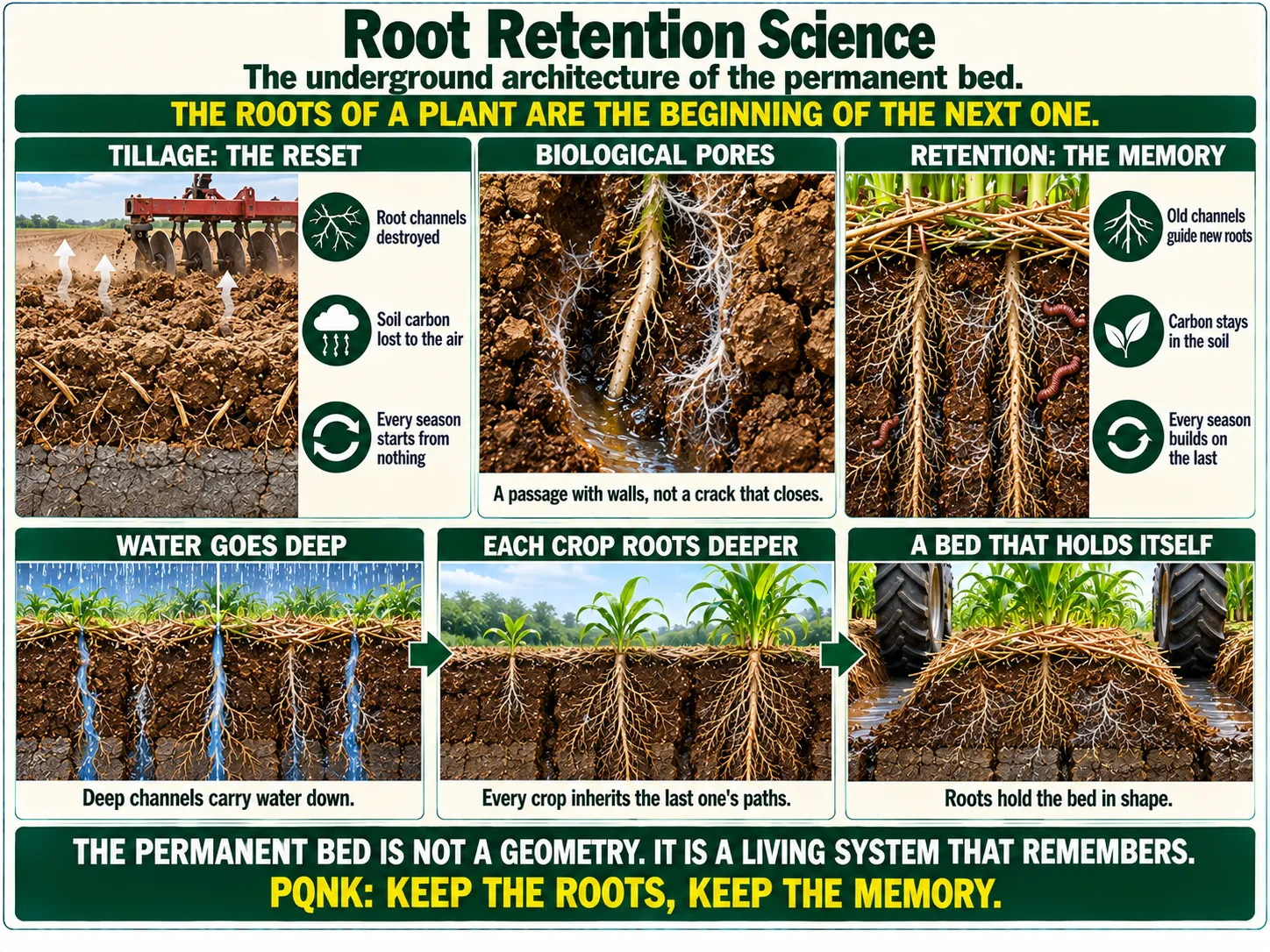
Root Retention Science: keep the roots, keep the memory.
“The roots of a plant are not the end of a plant. They are the beginning of the next one. When those roots are destroyed, the beginning is cancelled, and agriculture starts again from nothing, every season, forever.”
Asif Sharif, Lahore, 2026
ROOT RETENTION SCIENCE: A FORMAL DISCIPLINE WITHIN PQNK
PQNK does not treat root retention as an incidental benefit of no-till farming. Within the PQNK system, Root Retention Science is a named and formally defined discipline, a body of knowledge that governs how plant root structures are managed, preserved, and integrated into the long-term architecture of the permanent bed. This distinction is not semantic. It reflects a foundational recognition that what happens below the soil surface after harvest is not a passive aftermath but an active ecological event with consequences that extend across multiple growing seasons and accumulate across years.
Conventional agriculture has no science of root retention because it has no reason for one. In a system that re-tills the soil before every crop, roots are regarded as residue, biological material that must be fragmented, mixed, and decomposed as rapidly as possible to clear the seedbed for the next cycle. The economic logic is immediate, and the ecological cost is invisible because it accrues beneath the surface where no measurement is routinely taken. PQNK reverses this logic entirely.
In Root Retention Science, retained roots are classified as ecological infrastructure. They are not temporary feeding organs that expire with the plant and become waste. They are structural elements that, once embedded in the soil, serve functions that no mechanical operation can replicate. The science of retaining them is, therefore, as important as the science of growing them. PQNK insists that a farming system which devotes full agronomic attention to what happens above the soil and abandons all governance of what happens below the soil is an incomplete system, one that repeatedly destroys half of what it builds.
BIOLOGICAL POROSITY VERSUS MECHANICAL POROSITY: THE FUNDAMENTAL DISTINCTION
The distinction between biological porosity and mechanical porosity is one of the defining conceptual boundaries of Root Retention Science. Mechanical porosity refers to the temporary void structure created by tillage, the loosened, fragmented, aerated condition of tilled soil immediately after cultivation. Biological porosity refers to the continuous, structured, wall-lined pore network created by living and decomposing root systems that have been retained in undisturbed soil over successive seasons.
These two forms of porosity differ in almost every structural property that matters to a growing plant. Mechanical porosity collapses. The loosened tilth created by a disc, chisel, or rotavator settles under rainfall, irrigation, and the weight of field traffic within weeks. The initial aeration that greets the seed is gone by the time the root system reaches depth. What the plant encounters at the sub-surface is the same compacted layer that the tillage was meant to address, often made worse by the weight of the implement that was used to break it.
Biological porosity does not collapse. The channels created by decomposing roots are lined with microbially-stabilized organic matter that resists compaction. The walls of these channels are coated with fungal hyphae, microbial biofilms, and humic compounds that bind soil aggregates and maintain pore integrity under physical pressure. A root channel that has been held open for three or four seasons by successive generations of root decomposition is more structurally durable than any void created by mechanical intervention. It is not a loosened space in a compacted matrix. It is a constructed passage with walls.
This distinction has immediate agronomic consequences. A plant whose root system encounters existing biological pore channels at depth does not need to generate the physical force to penetrate compacted soil layers. It follows established pathways and expends its energy on extension rather than penetration. The speed of deep root colonization, the uniformity of root distribution, and the plant's access to subsoil water and mineral reserves are all governed by whether biological porosity is present or absent. Tillage, by destroying the biological pore network, guarantees that every new crop begins root development in a structurally impoverished environment regardless of how productive the season before it was.
ROOT RETENTION AND THE CONTINUITY OF SOIL BIOLOGY
When a root system is left intact in the soil after harvest, it does not simply sit in passive decomposition. It becomes a transition medium, a biological corridor through which the living community associated with one crop generation passes its ecological relationships to the next. The rhizosphere that formed around active roots does not expire when the plant dies. It persists in the soil as a zone of elevated microbial density, altered pH, and concentrated exudate chemistry. This zone becomes the preferred site of colonization for the roots of the following crop because the microbial infrastructure that supports root function is already assembled there.
In conventional tillage systems, this transition never occurs. The rhizosphere is physically disrupted and mixed into the bulk soil mass. The microbial community that took an entire growing season to assemble around the root architecture of the previous crop is dispersed, and the ecological relationships it represented are severed. The incoming crop must recruit and assemble its own rhizosphere community from the disturbed soil matrix, a process that takes time, consumes plant energy, and delivers reduced early-season nutrient access at precisely the moment when seedling establishment is most vulnerable.
Root Retention Science defines this continuity not as a bonus but as a prerequisite of productive soil ecology. The permanent bed is not merely a physical structure. It is a biological continuity system. Each season of undisturbed root retention adds a layer of ecological complexity that did not exist before. The soil does not reset between crops. It advances. The microbial associations become richer, the fungal networks become denser, and the pore architecture becomes more refined. Over multiple seasons, the permanent bed develops a biological character specific to its location, its crop history, and its management, a character that is the product of accumulation, not repetition.
ROOT RETENTION AND THE PRESERVATION OF SOIL CARBON
Soil carbon is among the most consequential variables in agricultural soil function, yet conventional tillage systems systematically destroy it through a mechanism that is rarely described with precision. Tillage does not merely bury or mix organic carbon, it oxidizes it. When the soil is inverted or fragmented by tillage implements, protected organic matter that was stabilized in soil aggregates is exposed to atmospheric oxygen. The microbial communities that decompose organic matter under aerobic conditions accelerate dramatically. Carbon that would have remained in the soil for years or decades under undisturbed conditions is converted to carbon dioxide and released within weeks of tillage.
Root carbon is especially vulnerable to this mechanism. Living roots allocate a substantial portion of the carbon fixed by photosynthesis to below-ground structures, root tissue itself, root exudates, mucilage, and the compounds that feed mycorrhizal and microbial partners. This below-ground carbon allocation represents a significant investment by the plant in soil building. In a retention system, this investment is preserved. The carbon deposited in root tissue and in root-associated organic matter remains in the soil, protected within aggregates and pore linings, contributing to the long-term organic matter content of the bed.
In a tillage system, this investment is cancelled at the end of every season. The carbon that the plant deposited below ground is oxidized and returned to the atmosphere. The soil receives no accumulation. Year after year, the organic matter content of tilled soils either holds at a low equilibrium driven by annual residue inputs or declines as tillage intensity increases. The soil does not build. It cycles, processing the same carbon through the same oxidation pathway, season after season, without net gain.
Root Retention Science establishes that the path from low-organic to high-organic soil is not achieved by adding external organic matter alone. It is achieved by stopping the destruction of the organic matter that plants are already producing. Retaining roots, retaining the carbon deposited by roots, and retaining the aggregate structure in which that carbon is protected, these three acts of retention together constitute the soil carbon economy of the permanent bed. Over successive seasons, the organic matter content of the retained bed rises, and with it the water-holding capacity, the cation exchange capacity, the aggregate stability, and the biological activity of the soil.
ROOT RETENTION AND HYDRAULIC CONTINUITY
Water moves through soil most efficiently along continuous, structured pathways. In undisturbed soils, the primary pathways for rapid water movement are the channels left by previous root generations, vertical and lateral passages that extend from the surface through the root zone and, in mature beds, into the subsoil below. These channels serve as preferential flow paths that allow water to reach depth quickly, recharging the subsoil moisture reserve and supporting deep root access to water between irrigation or rainfall events.
The concept of hydraulic depth captures a quality of soil that is invisible in standard infiltration measurements but critical to plant resilience under water stress. A soil with high hydraulic depth has root channels that extend to two, three, or four feet below the surface, channels that connect the surface to the subsoil water zone and allow deep roots to access moisture long after the surface layer has dried. This hydraulic depth is built exclusively by successive generations of deep-rooted crops whose root channels have been retained after harvest. It cannot be created by mechanical operation. No implement reaches the full depth of a mature root system, and no implement leaves a lined, stable passage when it is withdrawn.
Tillage severs hydraulic continuity at every pass. The vertical root channels of the previous crop are fragmented. The connections between the surface and subsoil are interrupted. Whatever hydraulic depth the previous crop had developed is lost, and the next crop begins with a shallow, surface-dependent root system that is fully exposed to drought stress the moment the surface layer dries. In regions where rainfall is irregular or irrigation is restricted, this is not an academic limitation, it is the primary mechanism of crop failure. Root Retention Science addresses this failure not through water management alone but through the preservation of the underground infrastructure through which water is managed.
CUMULATIVE ROOT INTELLIGENCE: FUTURE ROOT SYSTEMS DEEPENED BY THE PAST
One of the most significant properties of the permanent bed, and one of the clearest expressions of Root Retention Science, is the phenomenon that can be described as cumulative root intelligence. This term describes the measurable deepening and refinement of successive root systems as they follow, extend, and elaborate the pathways established by their predecessors. It is not metaphorical. It is a structural consequence of biological pore inheritance.
A seedling whose roots encounter existing biological pore channels at depth colonizes those channels preferentially because the conditions within them, moisture, microbial activity, available carbon, and existing chemical signals, are more favorable than the surrounding bulk soil. Once inside the channel, the root extends with lower mechanical resistance, reaching greater depth with less energy expenditure. Where the previous root channel ended, the current root extends further, depositing new exudates, recruiting new microbial partners, and deepening the pore network for the generation that follows. Each successive crop generation thus inherits a deeper, more refined root architecture than the one that preceded it.
This cumulative deepening has compounding consequences for yield. Deep root access means access to subsoil mineral reserves that are unavailable to shallow-rooted crops. It means access to subsoil moisture that remains available through dry periods when surface soil is depleted. It means the physical stability of a plant anchored at depth rather than held by a shallow mat of roots vulnerable to wind throw and drought stress. And it means the progressive transfer of organic carbon to greater depths, building the soil's carbon profile downward year after year.
In a tillage system, this cumulative process never begins. Every season's root architecture is destroyed before it can be inherited. The next crop begins from zero, no channels, no pore inheritance, no deepened access. The root system of the tenth year in a tilled field is no deeper and no more capable than the root system of the first year. In a permanent retained bed, the root system of the tenth year is substantially more capable than the first. The field has learned something about water, mineral access, and biological connectivity that a tilled field can never accumulate. This learning is Root Retention Science.
ROOT RETENTION AND THE STABILIZATION OF THE PERMANENT BED
The physical geometry of the permanent bed, its raised profile, its defined shoulders, its consistent crown, is maintained not only by the absence of tillage and the confinement of traffic to permanent furrows. It is maintained from within by the structural reinforcement of retained root systems. Living roots and the residual structures of decomposing roots perform a continuous engineering function inside the bed that has no mechanical equivalent.
Living roots bind soil aggregates through direct physical contact and through the exudation of polysaccharides and mucilage that act as biological cements. A bed with an active root system is structurally more resistant to surface erosion, internal slumping, and raindrop impact than a bare or recently tilled bed. This binding effect persists through the decomposition phase. As roots die and begin to decompose, the fungal and microbial communities that carry out decomposition continue to produce glomalin, a highly stable glycoprotein that is one of the primary structural agents of water-stable soil aggregates. The aggregate stability of the bed increases not despite the death of roots but through it, as decomposition produces the biological cements that hold the bed architecture in place between crops.
The consequence of this internal reinforcement is that a mature permanent bed becomes increasingly self-stabilizing over successive seasons. Its shoulders resist the lateral spread that would flatten it. Its crown holds its elevation under rainfall. Its internal structure resists the compaction that would close its pore network. This progressive stabilization means that the infrastructure cost of maintaining the bed geometry decreases over time, less bed renovation is needed, less energy is consumed in bed repair, and the consistency of crop establishment across the bed surface improves season after season. The bed becomes more reliable as it matures, not less.
ROOT RETENTION AND THE ELIMINATION OF ECOLOGICAL RESET
Every tillage event in conventional agriculture is an ecological reset. It is not merely a physical operation performed on soil. It is the cancellation of everything that the previous season built below the surface. The microbial community assembled around the root architecture of the previous crop is dispersed. The pore network constructed by root extension is fragmented. The carbon deposited by roots and their microbial associates is exposed to oxidation. The hydraulic pathways built by deep root channels are severed. The aggregate structure stabilized by root exudates and fungal activity is shattered. And the accumulated biological complexity of the rhizosphere is mixed into the bulk soil and reduced to undifferentiated material.
This reset has a cost that is compounded by its invisibility. Because the destruction occurs underground, farmers cannot observe it directly, and the instruments of conventional agronomy are not routinely deployed to measure it. The yield reduction caused by ecological reset is absorbed as a baseline, the normal level of production in a tillage system, against which no undisturbed comparison is held. Farmers who have never operated a permanent bed system have no reference for what accumulation produces. They manage for the ceiling of what reset permits, not for the ceiling of what continuity makes possible.
Root Retention Science defines the elimination of ecological reset as a primary engineering objective of the permanent bed, not a consequence of no-till adoption but a deliberate design goal. The bed is designed to eliminate reset because reset is not a neutral operation. It is a subtraction. Every tillage pass removes biological capital that took an entire season to build. A farming system that subtracts this capital every season is a system with a permanent ceiling on soil biological development. That ceiling can only be raised by stopping the subtraction, by committing to retention as the governing principle of below-ground management.
ROOT SUCCESSION: A MULTI-GENERATIONAL ECOLOGICAL PROCESS
The concept of ecological succession, the directional development of an ecosystem toward greater complexity and stability over time, is well established in natural ecology. In forest ecosystems, grasslands, and wetlands, succession describes the progressive replacement of pioneer species by more complex communities as the physical and biological environment is modified by each successive stage. In PQNK agriculture, Root Retention Science recognizes that an analogous process of root succession occurs in the permanent bed when roots are retained across seasons and the soil is not reset by tillage.
In the first seasons of a permanent bed, the root architecture is dominated by the structure of the crops being grown. The pore network is relatively shallow, the biological community associated with the root zone is still assembling, and the inherited infrastructure available to incoming root systems is limited. Over successive seasons, the depth and complexity of the pore network increases. The biological community associated with the root zone becomes denser and more diverse. The aggregate structure becomes more stable. The bed develops what can be understood as a biological successional stage, an underground ecosystem state that is more complex, more stable, and more productive than the state that preceded it.
This root succession follows a directional trajectory that cannot be reversed without tillage and cannot be accelerated without retention. Its rate is determined by the number of seasons of uninterrupted root retention, by the biological activity of the crops grown, and by the root architectures they contribute. In PQNK, crop after crop and crop-in-crop bring deep-taprooted and fibrous-rooted crops onto the same bed, and each deposits channels of a different geometry, depth and chemical character, so the succession is richer for the variety of roots that build it. Yet a mature PQNK bed does not depend on that variety: retained roots and living soil let it carry the same crop season after season without decline.
ROOT RETENTION AND THE TRANSITION FROM DEAD SOIL TO LIVING SOIL
The phrase 'living soil' is widely used in regenerative and organic agriculture, but it is rarely defined with biological precision. In Root Retention Science, the transition from dead soil to living soil is defined in specific functional terms: a soil is functionally dead when it has lost the biological pore architecture, the microbial community continuity, and the organic carbon accumulation that support autonomous plant root function. A soil is functionally living when these three properties are present and self-sustaining.
Tillage-degraded soils typically exhibit the characteristics of functional deadness regardless of their chemical fertility. They may contain adequate levels of nitrogen, phosphorus, and potassium, supplied through fertilizer, yet fail to support deep, autonomous root function because the biological infrastructure of the soil has been destroyed. The plant feeds from the surface. It cannot access the subsoil. It is dependent on every input that is applied because the soil cannot mobilize its own reserves through biological activity. This dependency is not inherent to the plant. It is a consequence of the destruction of the underground infrastructure that makes autonomy possible.
Root retention initiates the transition from dead to living soil by reintroducing the biological infrastructure that tillage removes. Each season of retained roots adds depth to the pore network, continuity to the microbial community, and carbon to the soil organic matter. These three additions are not independent, they reinforce each other. Deeper pore networks support more diverse microbial communities. More diverse microbial communities stabilize more carbon. More stable carbon supports more complex aggregate architecture. More complex aggregate architecture supports deeper pore networks. The transition from dead to living soil is not a single event. It is a trajectory, a multi-season biological development process that Root Retention Science governs and accelerates through the design decisions embedded in the permanent bed system.
The transition threshold, the point at which a bed has developed sufficient biological infrastructure to support autonomous plant function without full dependence on external inputs, is not reached in a single season or through any single management action. It is the product of seasons of patient retention, each one building on the last. This is why Root Retention Science is not a technique applied to individual crops but a governing principle applied to the bed as a long-term biological investment. The investment compounds. The bed that was dead becomes capable, and the bed that is capable becomes self-sustaining, but only because retention was chosen from the beginning and maintained without interruption.
UNDERGROUND CONTINUITY: WHAT MAKES PERMANENCE GENUINELY PERMANENT
The permanence of the permanent bed in PQNK is not guaranteed by the absence of tillage alone. It is guaranteed by the accumulation of underground biological infrastructure across successive seasons of uninterrupted root retention. A bed can be physically maintained as a raised profile without tillage yet remain biologically impermanent if the root retention principle is not honored, if crops are harvested and the root systems removed, burned, or chemically terminated in ways that interrupt biological continuity between seasons.
Underground continuity is the property that distinguishes a permanent bed from a raised bed. Any elevated planting surface can be described as a raised bed. Only a surface that has accumulated seasons of retained root architecture, continuous microbial community development, progressive carbon accumulation, and inherited pore infrastructure constitutes a permanent bed in the PQNK sense. The permanence is in the soil, not in the geometry. The geometry is the container. The underground biological accumulation is the content.
This understanding has design implications for how the PQNK system is managed over time. Decisions that affect the continuity of the root retention regime, choices about crop selection, harvest methods, residue management, and between-season treatment of the bed, must be evaluated not only for their immediate agronomic effects but for their consequences on the underground continuity that the bed is building. An action that is agronomically acceptable in a single-season analysis may be ecologically damaging when evaluated against the multi-season accumulation that root retention science requires. The permanent bed is managed as a long-term biological system, not as a sequence of independent crop cycles.
ROOT RETENTION AS THE BIOLOGICAL MEMORY OF THE FIELD
A field managed under permanent root retention develops, over successive seasons, a biological memory that is specific to its history, its crops, its soil type, and its management. This memory is not metaphorical. It is encoded in the physical architecture of the pore network, in the composition and density of the microbial community, in the distribution of organic carbon at different depths, and in the chemical signals preserved in the root channels of previous crops that orient the root systems of future ones.
A field with ten seasons of uninterrupted root retention carries a biological record of every crop that was grown in it, every deep root that penetrated to a new horizon, every microbial community that assembled around a rhizosphere, and every gram of carbon that was deposited and preserved. This record is not static, it is an active infrastructure that shapes the behavior of each new root system that enters the soil. The field remembers where water moved efficiently, where microbial communities were most productive, and where roots found the conditions for deep extension. Each new crop follows that memory and extends it.
This biological memory is the most profound expression of what Root Retention Science contributes to PQNK agriculture. It is the accumulated intelligence of a field that has been managed with continuity rather than reset. It is what separates a PQNK permanent bed from any other planting configuration, the depth of its biological history, the richness of its underground ecology, and the accumulated infrastructure of root generations that have each contributed something that did not exist before them. To till this field is not merely to loosen its soil. It is to destroy its memory, to erase the record of everything that was built below the surface and to return the field to the biological equivalent of the first day, where nothing has been accumulated and everything must begin again.
Root Retention Science exists to prevent that erasure. It governs the decisions that protect the underground architecture of the permanent bed, not because roots are valuable in themselves, but because they are the medium through which a field acquires biological depth, hydraulic resilience, carbon wealth, and the capacity for self-sustaining productivity that defines the PQNK vision of agriculture. The permanent bed is not a geometry. It is a living organism that grows more capable with every season it is allowed to remember.
Chapter Fifty-Seven: The PQNK Weed-Indicator System, Reading the Field Through Vegetation