

Industrial Devastation To Natural Abundance
Extended Knowledge · Chapter 54
The PQNK Bed System
Engineering the Physical Architecture of Living Agriculture
Release 1.0 · 2026-10-26
If you use “Listen”, the text of the page may be sent to your browser or operating system’s speech provider, such as Apple, Google or Microsoft, depending on the voice your device uses. Pedaver does not process, transmit or store any audio.
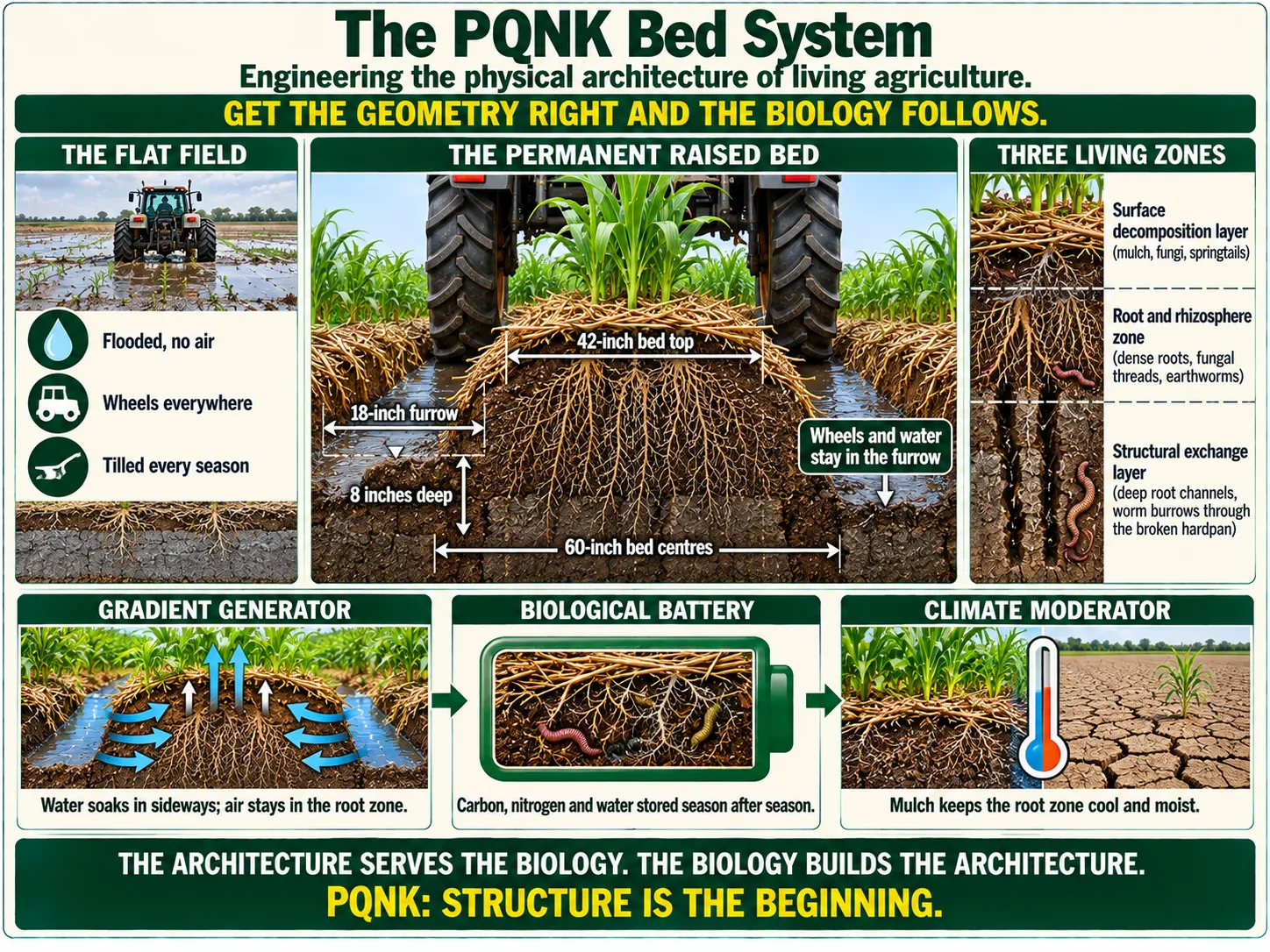
The PQNK Bed System: the architecture serves the biology, and the biology builds the architecture.
“Every building is designed for those who live in it. The flat field was designed for the tractor. The permanent bed is designed for the life in the soil. Get the geometry right, keep the wheels in the furrow, and the biology follows.”
Asif Sharif, Lahore, 2026
The bed is not a production convenience. It is the foundational architectural decision upon which all ecological function either builds or collapses. Get the geometry right and the biology follows. Abandon the geometry and no amount of organic input will restore what has been broken.
I. THE ARCHITECTURE OF COLLAPSE: WHY FLAT FIELDS DESTROYED SOIL CONTINUITY
Modern conventional agriculture inherited a field design that was engineered not for biology but for mechanical uniformity. The flat, open field, irrigated by flood or furrow inundation across its entire surface, became the dominant template of industrial crop production. This template was never ecologically evaluated. It was adopted because it was simple to machine, simple to flood, and simple to harvest. What it was not, and what it could never be, was biologically sound.
The flat field operates on a logic of inundation. Water is applied across the entire surface and allowed to spread, pool, or sheet across the field. The soil beneath has no raised root zone. No architectural relief. No zone of protected oxygen exchange. When water enters in volume, it fills every pore space in the upper soil profile simultaneously. Oxygen is displaced. The aerobic microbial community, the living engine of decomposition, nutrient cycling, and root support, collapses within hours.
This is not a temporary setback. Each inundation event leaves a biological scar. The aerobic community recovers partially between irrigations, but never fully. Each subsequent flood arrives before restoration is complete. Over seasons and years, the average biological activity of the soil declines. Organic matter that enters the soil from surface decomposition is consumed faster than it is stabilized. The carbon fraction falls. The fungal network, which requires both aerobic conditions and undisturbed soil continuity, retreats and fragments. The soil becomes progressively less alive.
Simultaneously, the flat field enables and even encourages tillage. Because the surface is uniformly accessible, every season brings a full mechanical inversion. The plow or disc enters the soil to break the crust formed by the previous inundation cycle, to incorporate surface residues, and to prepare a seedbed. This tillage operation destroys every biological structure that the previous growing season built. The fungal threads, some extending meters through the soil, are severed. The aggregate architecture, built over weeks by microbial exudates and root action, is shattered. The earthworm channels, constructed over months and used by roots as highways of exploration, are collapsed. The soil begins each season not from where the previous season ended, but from below zero.
The result is what PQNK science identifies as the ACI (Ancient Conventional Industrial) condition: the state in which flooding, tillage and industrial inputs together create a soil system incapable of sustaining itself. Flat-field inundation and flat-field tillage are not separate problems requiring separate solutions. They are a unified architectural failure that cannot be corrected by any amendment, biological or chemical, applied to a geometry that continues to destroy.
The compounding effect is mechanical hardpan formation. Repeated tillage to the same depth, combined with the compressive force of tractor wheels on saturated soil, creates a dense, impermeable layer at the tillage depth. This hardpan prevents downward water movement, concentrates root exploration in the shallow zone above it, cuts off communication with the deeper soil atmosphere, and traps water at the rooting zone in a permanent cycle of shallow-rooting and oxygen stress. The flat field does not merely fail to support biology. It actively produces conditions in which biology cannot survive.
II. THE PERMANENT RAISED BED: RESTORING ECOLOGICAL FIELD ARCHITECTURE
The PQNK Bed System is the architectural response to the flat-field collapse mechanism. It does not attempt to correct the flat field by adding amendments. It does not attempt to repair tillage damage by introducing biological inoculants to a soil that will be tilled again next season. It replaces the flat field entirely with a different physical architecture, one designed not for mechanical convenience but for the perpetual functioning of living systems.
The permanent raised bed is precisely what its name states: a raised, permanent structural element within the field. It is raised above the furrow grade to keep air in the root zone, to separate the rooting zone from surface water accumulation, and to establish a zone of controlled and protected biological activity. It is permanent in that it is constructed once and maintained indefinitely, never tilled, never inverted, never reconstructed from season to season. Its permanence is not a convenience feature. It is the ecological requirement.
In natural ecosystems, soil biological complexity accumulates over time. A soil that has been undisturbed for decades carries biological structures, chemical gradients, fungal networks, root channel archives, and aggregate architectures that took those decades to build. Conventional tillage destroys this accumulated capital every year, forcing the system to begin reconstruction annually, a reconstruction that never reaches completion before the next destruction arrives. Permanent bed architecture ends this cycle. The soil is allowed to accumulate, compound, and deepen its biological complexity without interruption across seasons, years, and decades.
The permanent bed does not merely protect existing biology. It creates the physical preconditions for new biological organization that flat-field systems are architecturally incapable of supporting. The raised profile keeps the water in the furrows, from where it soaks sideways into the bed, rather than pooling at the rooting zone. The undisturbed soil structure allows fungal networks to establish and extend continuously. The protected zone beneath the permanent mulch cover maintains moisture and temperature stability that encourages colonization by organisms that require stable conditions, organisms absent from conventionally managed soils. The bed becomes, over time, a distinct ecological entity with its own biological identity.
III. THE ENGINEERING OF THE GEOMETRY: WHY EVERY DIMENSION HAS ECOLOGICAL MEANING
The PQNK Bed System is not a general concept of raised beds. It is a precisely specified physical geometry, and the precision is not arbitrary. Every dimension, the width of the bed top, the width of the furrow, the vertical height differential between the two, is determined by the intersection of biological requirements and engineering constraints. Understanding why the dimensions are what they are is inseparable from understanding what the system is designed to accomplish.
The bed top in the PQNK system is engineered to approximately forty-two inches in width, and the reason is the machinery, not the human hand. Beds and furrows are made to create a permanent path for machinery: every tyre of every tractor and implement passes only through the furrows, so the bed is never compacted from either side. The size of the bed and furrow is therefore designed around the wheel track of the machinery that will work the field, while taking the soil and the topography into account. The regional PQNK standard is built around the 45 to 65 horsepower tractors commonly used in the region, whose rear tyres sit about 58 to 60 inches apart, centre to centre. A sixty-inch bed-to-bed centreline places each rear tyre in a furrow, and dividing that sixty inches into a forty-two-inch bed top and an eighteen-inch furrow gives the tyre room to run without touching the bed. The forty-two-inch figure is not a round number or a traditional measurement. It is the widest bed that this wheel track can straddle while every wheel stays in the furrow.
The furrow top is engineered to approximately eighteen inches in width. This dimension is determined by the tire width and stance requirements of the tractors that will work the field. In the PQNK system, all mechanized field operations, including bed preparation, transplanting, harvesting, and mulch application, are conducted with tractors whose wheels track within the furrow. The tractor never drives on the bed. The furrow is the permanent traffic lane. Eighteen inches accommodates the tire contact patch of a standard agricultural tractor while leaving the bed surface undisturbed. This is the principle of controlled traffic: compaction is concentrated in designated, sacrificed zones so that the production surface is never subjected to compressive mechanical force.
The vertical height differential between the bed top and the furrow base is engineered to approximately eight inches, with the furrow about eight inches wide at its base. This height keeps the rooting zone above the water in the furrow, so that irrigation and rainfall soak sideways and upward into the bed by capillary action instead of saturating it, while the bed holds the moisture its biology needs between irrigation or rainfall events. Eight inches is not the maximum possible height: taller beds hold the root zone further from the water but are more difficult to manage and more vulnerable to drying at the edges. Eight inches is the calibrated balance between air in the root zone and moisture retention for the range of field conditions the PQNK system is designed to serve.
Together, these three dimensions, forty-two inch bed top, eighteen inch furrow, eight inch height, define a field geometry in which the production surface is protected from both compaction and inundation, the traffic zone absorbs all mechanical impact, and the raised root zone stays aerated while the bed preserves its biological moisture reserves. The geometry is not decorative. It is functional engineering in service of biological continuity.
Two kinds of tractor work on a farm, and they need different tyres. The first kind does the heavy work: land development, shifting and levelling soil, deep ploughing and subsoiling, carriage, and any heavy load that needs more power and traction, and so it runs on wide tyres. The second kind is the row-crop tractor, used for planting and for operations between and within the crop rows, and its tyres are normally kept 9 to 13 inches wide. Once the beds have been made by following the PQNK steps, the farm needs only the narrow-wheeled tractor, with tyres no wider than 13 inches and ideally 9 to 11 inches. After the permanent bed is formed, only a few passes are needed from crop establishment to harvest: planting, pruning and harvesting, and, once every few years, bed renovation, because rain, the passing of tractors and machines, animal grazing and weeds in the furrows slowly put the beds out of shape. Narrow tyres matter because a wide tyre presses against the sides of the furrow, and compacted furrow sides let less water seep into the bed and less air reach the roots.
One clarification is essential before any of these numbers are treated as fixed. The forty-two inch bed, eighteen inch furrow, and eight inch height are the correct geometry for the tractor specification described in Section IV, a two-wheel-drive tractor in the forty-five to sixty-five horsepower range with rear wheel-centre spacing of roughly fifty-eight to sixty inches and thirteen-inch tires. They are an engineering solution to that specific machine, not a universal PQNK prescription. A farmer working with a different tractor, a different track width, a different tire size, must recalculate the furrow width and bed width from the actual dimensions of the equipment that will travel the field, using the same governing principle: the furrow must accommodate the tractor's tire contact patch without the wheels ever touching the bed surface. The geometry is engineered around the tools available to the farmer executing it, not imposed as an abstract standard onto whatever machinery he happens to own.
The same discipline applies to hardpan-breaking depth. This book, and PQNK practice generally, references a subsoiling depth of about 22 inches (Chapter Fifty-Three), but that figure describes a common outcome, not a fixed target to be applied uniformly. The correct hardpan depth for a given field is found empirically: by digging a soil pit and locating, by direct observation, the restrictive compacted layer that is actually present. Hardpan depth varies with soil type, tillage history, and years under conventional management, and a subsoiler set to a standard depth on a field whose hardpan sits shallower, or deeper, than that standard will either fracture nothing or waste energy passing through soil that was never the problem. The tine must shatter completely through whatever layer the soil pit reveals. The number that matters is the one the farmer's own field produces, not the one printed in a book.
IV. CONTROLLED TRAFFIC: THE ECOLOGICAL DISCIPLINE OF MOVEMENT
Controlled traffic is one of the most consequential and least understood principles in PQNK field design. Conventional agriculture moves field machinery across the entire field surface without restriction. Tractors, planters, harvesters, and spray rigs traverse the full field width in patterns that ensure every square meter of the production surface is traversed multiple times each season. The compaction produced by this traffic is then addressed by additional tillage, a cycle in which compaction creates the need for tillage and tillage creates the conditions for the next compaction event.
Controlled traffic breaks this cycle by confining all mechanized movement to permanent, designated lanes from which the machinery does not deviate. In the PQNK Bed System, the furrows are those permanent lanes. The furrow does not produce crops. It is engineered specifically to absorb the mechanical impact of tractor movement without compromising the ecological integrity of the adjacent bed. Compaction in the furrow is not a problem to be solved, it is a managed consequence of a deliberate architectural decision to sacrifice one zone in order to protect another.
The tractors specified for the PQNK system are selected to match the furrow geometry. Tractors in the forty-five to sixty-five horsepower range, configured as two-wheel drive with rear wheel-centre spacing of approximately fifty-eight to sixty inches, are matched to the bed-and-furrow geometry so that both rear wheels track within furrows on either side of a single bed. The tire width of approximately thirteen inches fits within the eighteen-inch furrow without overlapping onto the bed surface. The tractor straddles the bed, its body passing over the bed top, its wheels confined to the furrows, executing any field operation without mechanical contact with the production surface.
This matching of machine geometry to field geometry is not a minor operational detail. It is the physical mechanism by which the ecological protection offered by the permanent bed architecture is actually enforced in the field. A bed geometry that is not matched to available machinery is a bed geometry that will eventually be compromised, because field operations require tractors, tractors require access, and without pre-designed traffic lanes, the path of least resistance leads across the production surface. The PQNK system pre-designs the traffic solution so that protecting the bed is the path of least resistance.
Beyond the immediate cycle of compaction avoidance, controlled traffic enables the permanent bed to accumulate biological complexity over time. Soil that is not compacted retains its pore architecture. Pores allow air and water movement, provide habitat for microbial colonies, and create the physical space through which roots and fungal threads navigate. Once pore architecture is established through biological activity, once earthworms have built channels, roots have created passageways, and fungi have threaded the aggregate matrix, the pore system becomes self-reinforcing. New roots follow old root channels. Fungal extensions colonize the architecture laid down by prior-season networks. Earthworms inherit and expand the channels created by their predecessors. The biological legacy compounds. Controlled traffic is the physical guarantee that this compounding is never interrupted by mechanical reset.
V. PERMANENT STRUCTURE AND THE FORMATION OF ECOLOGICAL MEMORY
The concept of ecological memory is central to understanding why the PQNK Bed System produces fundamentally different results from any management system that retains seasonal soil disturbance. Ecological memory is the accumulated biological infrastructure that a living soil builds over time, and which a disturbed soil loses, forcing perpetual reconstruction from the beginning.
In undisturbed soil, each growing season adds to what the previous season built. Root channels from the current season become pathways for next season's roots. Fungal networks established this year provide the scaffold on which next year's network will extend. Organic matter stabilized into humic compounds this season remains in the soil for decades, building the water-holding and nutrient-exchange capacity that all future crops will draw upon. The soil does not restart each year. It continues. Each year begins from a position of greater biological richness than the year before, not despite the previous season's biological activity, but because of it.
This is the condition that PQNK science describes as ecological permanence. The permanent bed does not merely avoid the damage of tillage and inundation. It creates the physical precondition for the accumulation of biological capital that no annual system can achieve. A field under permanent bed management for three years is biologically richer than the same field was in year one. A field in year seven is richer than year three. A field in year twenty carries biological architecture of a depth and complexity that no annual reconstruction system can approximate, because the annual system never builds past year one.
The organic mulch layer that permanently covers the bed surface is the surface expression of this ecological memory. Mulch is not applied merely to suppress weeds or retain moisture, though it accomplishes both. It is applied because it maintains the stable temperature and humidity conditions at the soil surface that allow the biological communities at the soil-atmosphere interface to remain continuously active. The decomposition community that processes mulch into organic matter works year-round in a mulched bed, rather than only during the growing season in a bare-soil system. The organic matter it produces accumulates continuously. The soil beneath the mulch layer steadily deepens in biological richness and physical structure.
Ecological memory also operates at the chemical level. As the biological community of the permanent bed matures, it produces and stabilizes increasingly complex arrays of chemical signals, root exudates, fungal metabolites, microbial byproducts, that create chemical gradients within the soil profile. These gradients guide root navigation, attract specific microbial communities to the rhizosphere, and regulate nutrient availability through biochemical pathways that have no equivalent in annually tilled systems. The soil chemistry of a mature permanent bed is not simply more fertile than a tilled soil. It is qualitatively different, a self-regulating chemical environment that no external input program can replicate.
VI. BIOLOGICAL ZONATION: THE PERMANENT BED AS LIVING STRATIFIED ECOSYSTEM
One of the most distinctive and ecologically significant features of the mature PQNK permanent bed is the formation of biological zonation, distinct ecological layers within the soil profile, each with its own community composition, biological function, and relationship to the layers above and below. This stratification does not exist in tilled soils, which are mixed and homogenized by mechanical inversion. It is a product of ecological permanence and is one of the most reliable indicators that a permanent bed system is functioning as designed.
The uppermost zone of the permanent bed is the surface decomposition layer, which corresponds roughly to the mulch and the uppermost inch or two of soil directly beneath it. This zone is dominated by decomposer organisms, fungi, bacteria, actinomycetes, nematodes, mites, springtails, millipedes, and other detritivores, that process raw organic material into the simpler compounds that can enter the soil biological cycle. The temperature and moisture conditions in this zone are the most variable in the profile, fluctuating with surface conditions, but the permanent mulch cover moderates these fluctuations to a range within which biological activity continues year-round. The surface decomposition layer is the point of entry for all organic inputs and the gateway through which atmospheric carbon enters the soil system.
Below the surface decomposition layer lies the rhizosphere and feeder root zone, the most biologically active layer in the profile and the zone where the greatest density of microbial life, fungal activity, and root-microbe interaction is concentrated. This zone extends from just below the soil surface to a depth that varies with crop type and bed maturity but typically ranges from four to fourteen inches in a well-established permanent bed. The biological diversity of this zone in a mature permanent bed is among the richest of any habitat on land. It is here that nutrient cycling, nitrogen fixation, mycorrhizal mineral exchange, root signal transmission, and the vast majority of soil-mediated plant support processes occur.
The deepest functional zone of the permanent bed is the structural and atmospheric exchange layer, the region below the active rhizosphere that connects the soil biology to the deep mineral subsoil and to the atmospheric gases that diffuse downward through the macropore architecture above. This zone is not where the majority of biological activity occurs. It is where the physical architecture of the bed is anchored: where large root channels descend to break hardpan, where earthworm burrows reach the subsoil layers, and where the gas exchange that maintains oxygen availability in the upper zones is regulated. In flat-field systems, this zone is typically the hardpan, impermeable, biologically dead, and structurally isolating. In the permanent bed, it is a functioning layer of the living soil system.
These three zones do not develop in a newly constructed bed. They form gradually over seasons as the biological community matures, differentiates, and begins to organize spatially. The surface decomposition community establishes first, within the first season of permanent mulch application. The rhizosphere community deepens and diversifies over the second and third seasons as root channels and fungal networks extend and the soil aggregate structure develops. The deep structural zone becomes functionally distinct in the third through fifth years as earthworm populations reach densities sufficient to maintain deep burrowing activity and as the root channels of prior-season perennials and deep-rooted annuals leave a permanent archive of macropore architecture. The three-zone stratification is both a product of and a prerequisite for full ecological function in the permanent bed system.
VII. THE TRANSITION FROM FLAT FLOOD FIELD TO PERMANENT ECOLOGICAL ARCHITECTURE
The transition from a conventional flat-field system to the PQNK Bed System is an engineering event, not merely a management change. It requires physical reshaping of the field surface, reconfiguration of irrigation delivery, recalibration of all mechanized operations, and a transitional period during which the new architecture establishes biological function. Understanding the transition protocol is essential for practitioners who are converting existing fields rather than building a new production system from bare land.
The first physical step in the transition is survey and design. The field must be surveyed for slope, the way water moves across it, and any existing infrastructure, irrigation channels, water courses and road access points, that will need to be integrated with or modified for the new bed layout. In irrigated land the field is zero-levelled, and it is laid out as the longest field that can be made with the least movement of soil. This is a compromise made once, during the development phase: long fields lose less land to water courses and to the ends of the field where machinery turns. In a zero-levelled field, water moves along the furrows at a head of about four inches, so the gravity flow is slow and constant, and the water has time to soak sideways into the beds. Pooling furrows create the inundation conditions the system is designed to eliminate. The design phase is not optional and cannot be replaced by ad hoc field judgment. A poorly designed bed grid will fail hydraulically regardless of how well the beds themselves are managed biologically.
Once the design is complete, the bed formation itself is executed with a bed-forming implement, a purpose-designed tool that moves soil from the designated furrow positions to the designated bed positions, creating the height differential in a single pass. In most field conditions, a single bed-forming pass is sufficient to establish the basic geometry. The first crop on the newly formed beds is a deep-rooted cover crop such as Jantar: its roots open pores in the soil for water infiltration and aeration, and feed the soil microbes. Once the cover crop is terminated, cash crops follow crop after crop, and better still crop-in-crop. The residue of each crop adds to the thick cover the cover crop has already built, so no mulch needs to be brought in from outside the field. Where the mulch is thin, weeds grow and add to the cover of the soil.
The irrigation system must be reconfigured to deliver water into the furrows rather than across the field surface. In the PQNK Bed System, water is introduced at the furrow head and moves by gravity along the furrow channel. It does not flood the bed surface. It infiltrates laterally and upward into the bed structure by capillary action from the furrow. This furrow-based delivery ensures that the bed surface remains aerated while the lower levels of the bed maintain the moisture levels that biological activity requires. The transition from surface flood irrigation to furrow irrigation is often the most significant infrastructure change in a conventional field conversion.
In the first season following conversion, the biological system of the new beds is effectively at zero, a construction site, not yet a living ecosystem. The surface decomposition community will begin to establish within weeks of mulch application, but the deeper rhizosphere community will require a full growing season to begin developing. Biological function, and with it crop support, increases with each successive season of undisturbed ecological accumulation.
By the second season, the bed surface will have begun developing visible indicators of biological activation: accelerated decomposition of mulch material, increased earthworm activity, improved soil friability in the surface layer, and, in most environments, visibly better crop root development compared to the first season. By the third season, all three biological zones described above should be visible, and irrigation needs visibly lower than in the first season as the soil’s water-holding capacity, built by organic matter accumulation and improved aggregate structure, takes over; mature beds at 400 mm of rain or more need no irrigation at all.
VIII. FIELD GEOMETRY AS ECOLOGICAL GOVERNANCE
The concept of field geometry as ecological governance is one of the most profound intellectual contributions of the PQNK system to the science of production agriculture. It reframes the physical design of the field, a topic traditionally treated as a question of engineering convenience, as a fundamental ecological decision with consequences for every biological process that the field will support or suppress.
Governance, in the ecological sense, means the establishment of conditions that determine what is possible and what is not. The geometry of the field is the most foundational form of ecological governance because it determines the physical context within which all subsequent biological decisions occur. A field designed for inundation governs toward a biology of anaerobic tolerance and shallow rooting. A field designed for tillage governs toward an annual biology of fast-establishing organisms that can complete their life cycles before the next mechanical reset. A field designed for permanent, raised, aerated, undisturbed beds governs toward a biology of depth, complexity, continuity, and increasing self-regulation over time.
This means that no management decision made after the field geometry is established can fully overcome the ecological governance imposed by the geometry itself. A farmer who applies the most sophisticated biological inputs to a flat, flood-irrigated field is governing against the biology they are attempting to cultivate. The inputs may produce marginal improvements, but the geometry will continually pull the system back toward the biological conditions it was designed to support: shallow roots, anaerobic tolerance, annual restart, and external input dependence. The geometry is upstream of all other management decisions. It governs the field more completely than any input, inoculant, or management protocol applied within it.
The inverse is also true. A farmer who establishes the correct geometry and then allows the biological community to develop within it does not need to govern the field through continuous intervention. The geometry itself does the governing, creating the aerated root zone that prevents oxygen collapse, creating the protection conditions that allow biological continuity, and creating the traffic management conditions that prevent compaction without requiring the farmer to police machinery movement. Good field geometry reduces the management burden because the geometry manages the field conditions automatically, continuously, and without external input.
This is why PQNK science insists that geometry must come first. Before the choice of crop variety, before the choice of biological amendment, before the question of irrigation frequency, the field geometry must be designed and established. Everything else follows from the geometry, and everything else is limited by the geometry if the geometry is wrong.
IX. THE PERMANENT BED AS A BIOLOGICAL CIVILIZATION
There is a dimension of the PQNK permanent bed that cannot be fully captured in the language of soil science or agronomy. It requires a different conceptual framework, one that acknowledges the degree to which the biological community of a mature permanent bed has developed the characteristics of a self-governing, self-maintaining, self-repairing society of organisms with shared infrastructure, division of labor, communication systems, and collective memory.
The word civilization, applied to soil biology, is not metaphor. It is precision. A civilization is a community that has built durable infrastructure, developed specialized roles for its members, established communication and coordination systems, and accumulated a shared knowledge base that persists across generations of individual members. The biological community of a mature permanent bed exhibits all of these characteristics.
The durable infrastructure of the biological civilization within the bed is the physical architecture of the soil itself: the network of macropores, root channels, fungal threads, aggregate structures, and chemical gradients that the community has constructed over seasons. This infrastructure persists beyond the life of any individual organism. The earthworm that built a particular channel is long gone, but the channel remains, used by its successors, by plant roots, and by water moving through the profile. The fungal network that colonized a particular aggregate cluster died back at the end of last season, but the chemical signals it left in the organic matter of that cluster will guide this season's fungal growth back to the same location. The infrastructure outlasts the builders and serves the inheritors.
The division of labor within the biological civilization is highly organized and deeply specialized. Decomposer organisms process raw organic inputs. Nitrogen-fixing bacteria concentrate at root surfaces and atmospheric exchange zones. Mycorrhizal fungi distribute mineral resources across the network from zones of surplus to zones of need. Predatory nematodes regulate the populations of bacterial feeders, preventing any single microbial group from dominating the community to the detriment of others. Earthworms process organic matter into stable humic compounds while simultaneously maintaining the infiltration and aeration infrastructure. Each group performs specific functions that support the whole, and the whole functions at a level no individual group could achieve.
The communication systems of the biological civilization operate through chemical signaling, the exchange of molecular messages between organisms that coordinates activity, signals resource availability, triggers defensive responses, and guides the spatial organization of the community. Root exudates invite specific microbial communities into the rhizosphere. Fungal signals alert connected plants to water stress. Microbial metabolites modulate the pH of the immediate soil environment to optimize conditions for their own activity and that of their mutualists. This chemical conversation is continuous, multi-directional, and of a complexity that science is only beginning to characterize. It is the communication infrastructure of the biological civilization, and it develops its full sophistication only in conditions of biological continuity that the permanent bed provides.
The collective memory of the biological civilization is encoded in the physical and chemical architecture it has built. The soil remembers. The memory is not stored in neurons, it is stored in pore structure, chemical gradient, organic matter composition, and the spatial distribution of organisms that have organized themselves around the cues left by their predecessors. Disrupting the physical architecture, through tillage, inundation, or compaction, destroys this memory. The civilization must begin again from the beginning. The permanent bed protects this memory as its most precious ecological resource.
X. ECOLOGICAL PERMANENCE AND THE END OF SEASONAL RECONSTRUCTION
Every conventional agricultural system is, at its core, a system of annual reconstruction. Each season, the soil is mechanically reset to a condition of minimum biological complexity, tilled, bare, compacted by traffic, and inundated by irrigation or rainfall, from which the biological community must reconstruct itself before it can support the crop. This reconstruction is energetically expensive, time-consuming, and never complete. The crop growing in conventionally managed soil is always growing in a soil that is in a state of recovery from the previous season's destruction, never in a soil that has reached its full biological potential.
The permanent bed system ends seasonal reconstruction. There is no destruction event at the end of each season from which the soil must recover. The bed is not tilled after harvest. The mulch is not removed. The soil is not flooded for field preparation. The biological community that supported the current season's crop is left intact to continue its work through the inter-season period and to begin the next growing season from a position of greater complexity than the one it ended this season.
This shift from annual reconstruction to continuous accumulation is not merely an improvement in efficiency. It is a categorical change in the nature of the agricultural system. Annual reconstruction systems are, by definition, extractive: they consume biological capital each season and replace it imperfectly through inputs. Continuous accumulation systems are, by definition, generative: they build biological capital each season, and the crops grown within them are drawing on a resource base that is increasing rather than decreasing over time.
The practical consequences of this shift show clearly in fields kept under permanent beds for several years. External input requirements, fertilizers, amendments, irrigation volume, decline season by season as the soil's own biological systems take over functions previously dependent on external supply. Crop resilience to weather stress, drought, flooding, temperature extremes, increases progressively as the soil's water-holding capacity, infiltration, and temperature buffering capacity improve with accumulating biological structure. Yield variability between years decreases as the self-regulating biological community moderates the environmental perturbations that cause yield crashes in biologically impoverished soils.
The end of seasonal reconstruction is not merely the end of a labor-intensive and ecologically destructive annual practice. It is the beginning of a fundamentally different relationship between the farmer and the land. The farmer who has built a permanent bed system over five or more years is no longer managing against the field, fighting compaction, fighting oxygen deficit, fighting weed pressure, fighting nutrient depletion. The farmer is managing with the field, supporting and directing a living system that is increasingly capable of supporting itself, increasingly resilient to perturbation, and increasingly generous in its productive output.
XI. THE BED AS A GRADIENT GENERATOR: HOW ARCHITECTURE CREATES BIOLOGICAL FUNCTION
The productivity of a natural ecosystem does not arise from uniformity. A forest is not productive because water, air, minerals, temperature, and biological activity are distributed equally throughout the landscape. On the contrary, nature functions through differences. Water moves because one location contains more moisture than another. Air moves because pressure and temperature vary. Roots proliferate where conditions are more favourable than elsewhere. Biological activity concentrates where food, oxygen, moisture, and habitat intersect simultaneously. Life depends upon gradients. Without gradients there is no movement. Without movement there is no exchange. Without exchange there is no biological function.
The PQNK Bed System is designed around this reality. Its purpose is not simply to provide a place where crops can be planted. Its deeper function is to create and maintain the gradients through which ecological processes operate, continuously, across every season, without reconstruction.
The raised geometry of the bed creates a moisture gradient between the furrow base and the bed top that does not exist in a flat field. At the furrow base, moisture accumulates during irrigation or rainfall events. At the bed top, moisture is lower, particularly in the upper centimetres of the profile. This gradient drives lateral water movement from the furrow into the bed through capillary action: the invisible, energy-free, biologically powered distribution system that saturated flooding replaces with brute force and oxygen deprivation. The gradient also drives the biological community. Organisms that require higher moisture concentrate near the furrow edges of the bed. Those that require better aeration concentrate toward the centre and surface. The biological community stratifies spatially in response to the physical gradient, increasing the diversity of niches available within a single bed cross-section and therefore the diversity of functions performed by the organisms occupying them.
The bed also creates a temperature gradient across its surface profile. The mulched bed centre maintains a more stable temperature than the exposed furrow margins. The soil beneath the mulch is insulated from the extremes of surface heating and cooling that bare soil experiences. These differences create habitat diversity within a small physical space, diversity that supports a greater range of biological organisms than a thermally uniform surface could sustain. The bed is not a uniform production platform. It is a generator of the biological diversity that makes the living soil possible.
XII. THE BED AS A BIOLOGICAL BATTERY: STORAGE, RELEASE, AND THE ACCUMULATION OF ECOLOGICAL CAPITAL
Most discussions of agricultural productivity focus on what enters the field: irrigation water, fertilizers, machinery, seed, fuel, and labour. The field is viewed as a place where resources are converted into harvestable products, with efficiency measured by the ratio of output to input. This perspective overlooks an equally important question: what does the field retain?
The long-term behaviour of an agricultural system depends not only upon the resources it receives but upon its ability to store, organise, and reuse those resources over time. A system that consumes everything it receives remains permanently dependent upon continuous external supply. A system that retains part of what it receives gradually becomes more capable, more resilient, and more productive with each passing season.
The mature PQNK permanent bed is a biological battery in this precise sense. It stores carbon within the soil organic matter matrix, available for release through microbial decomposition at rates determined by the biological community rather than by the farmer’s application schedule. It stores nitrogen within the root biomass, the fungal network, and the microbial community, cycling continuously through the root-microbe partnership and becoming available to the next crop without any fertilizer application. It stores water within the aggregate structure of the biologically active soil, held against evaporative loss by the combination of organic matter water-binding capacity and the permanent mulch surface layer.
Each season, the biological battery charges further. The crop root biomass that remains in the soil after harvest adds to the organic matter pool. The mulch layer from chopped residues adds to the decomposable carbon. The fungal network, which was not destroyed by tillage, extends further. The earthworm population increases. The aggregate structure strengthens. The water-holding capacity deepens. By the third season of permanent bed management, the biological battery is holding substantially more ecological capital than it did at the beginning of the first season. By the tenth season, the permanent bed is operating on a reserve of biological capital that is qualitatively different from anything achievable in an annual-tillage system, because annual tillage does not allow capital to accumulate. It resets the battery to zero at the beginning of every season.
The conventional field is a flow-through system: resources enter, resources are harvested, the remainder is discarded. The permanent PQNK bed is an accumulation system: resources enter, some are harvested, and the remainder compounds. The difference in long-term productivity between these two systems is the difference between spending every income and investing part of it.
XIII. THE BED AS A CLIMATE MODERATOR: CREATING A PROTECTED MICROCLIMATE
Climate is often discussed as though it exists only at regional or global scales. Rainfall patterns, seasonal temperatures, humidity, and weather events are treated as forces beyond the farmer’s control. While this is largely true at the landscape level, every field possesses its own microclimate, and the microclimate experienced by the plant is determined not by the regional weather station but by the immediate physical environment of the root zone, the soil surface, and the crop canopy.
In conventional agriculture, the microclimate of the crop is highly unstable. Bare soil is exposed to direct solar radiation. Surface temperatures rise rapidly during the day and fall rapidly at night. Wind moves freely across the exposed surface. Water evaporates directly from bare soil between irrigation events. Moisture conditions fluctuate sharply, creating biological stress cycles that consume the plant’s physiological reserves and reduce the energy available for productive growth.
The PQNK Bed System creates a fundamentally different microclimate through its physical architecture alone. The three-inch organic mulch layer on the bed surface insulates the soil from direct solar radiation during the day, keeping the soil beneath it at about 30 to 33 °C in hot summer when bare soil passes 60 to 70 °C, roughly 30 to 40 degrees cooler. At night, the same mulch layer retains heat that bare soil would radiate immediately, reducing the amplitude of temperature oscillation across the diurnal cycle. The root zone below the mulch experiences a thermal environment that is cooler in summer and warmer at night: precisely the combination of conditions that maximises the activity range of the soil biological community.
The mulch layer also suppresses direct evaporative water loss from the soil surface. Evaporation from bare soil between irrigation events can take a large share of the water applied in hot, dry conditions. A permanently mulched bed loses a fraction of this to direct evaporation. The moisture retained within the bed between irrigation or rainfall events is correspondingly higher, and the interval at which the crop experiences moisture stress correspondingly longer.
In the increasingly variable climate conditions that agricultural regions across Asia, Africa, and the Americas are experiencing, the buffering capacity of a thermally and hydrologically stable bed system is the difference between a crop that survives a heat event or drought interval and a crop that does not. The architecture of the field is a form of climate adaptation that requires no ongoing input, no technology beyond the initial bed formation, and no external management once established.
XIV. THE INTEGRATION OF ALL FORCES: ARCHITECTURE AS THE FOUNDATION OF REGENERATIVE FIELD CIVILIZATION
The preceding sections of this chapter have examined different dimensions of a single integrated system. The flat-field collapse analysis, the permanent bed specifications, the engineering dimensions, the controlled traffic principle, the formation of ecological memory, the biological zonation model, the transition protocol, the governance concept, the biological civilization, the end of seasonal reconstruction, and the bed as gradient generator, biological battery and climate moderator are not separate topics. They are perspectives on the same physical reality: the PQNK Bed System as the architectural foundation of regenerative agriculture.
Architecture is the word that unifies these perspectives. Architecture is the discipline of designing physical structures to serve the functions that inhabit them. In conventional engineering, architecture serves human functions, shelter, circulation, communication, production. In the PQNK system, architecture serves biological functions, infiltration, aeration, root navigation, microbial habitat, water movement, gas exchange. The permanent raised bed is architecture in the deepest sense: a designed physical structure that creates the conditions for the flourishing of the living systems it contains.
The PQNK Bed System differs from all prior attempts at raised bed or conservation agriculture in its insistence on the integration of all dimensions simultaneously. It is not enough to raise the bed if the bed is not permanently maintained. It is not enough to maintain the bed permanently if tractor traffic destroys the surface biology. It is not enough to control traffic if the irrigation system continues to inundate the bed. It is not enough to convert the irrigation if the bed geometry does not match the water requirements of the local soil and climate. Every element of the system supports and depends upon every other element. The architecture is an integrated whole, and partial implementation produces partial, and often unpredictable, results.
This integration requirement is one of the most challenging aspects of PQNK implementation for practitioners who have been trained in reductive agricultural science, the science that evaluates individual inputs and individual practices in isolation. The PQNK Bed System is irreducibly systemic. Its effects emerge from the interaction of its components, not from the individual performance of any single component. A field that implements the correct bed dimensions but retains conventional flood irrigation has not implemented the PQNK Bed System. A field that eliminates tillage but continues with flat-field architecture has not implemented the PQNK Bed System. A field that installs the correct geometry but drives tractors across the bed surface has not implemented the PQNK Bed System. The system is the architecture in its entirety, functioning as a unified ecological design.
When the full architecture is in place and functioning, when the permanent raised beds are correctly dimensioned, permanently mulched, irrigated through the furrows, and protected from mechanical intrusion by a controlled traffic system matched to the field geometry, the field begins the process of becoming what PQNK science envisions as a regenerative field civilization: a productive agricultural system that increases in biological richness, ecological resilience, and productive generosity with each passing season, without external reconstruction, without cyclical biological destruction, and without increasing input dependence.
CONCLUSION: STRUCTURE IS THE BEGINNING
Every biological improvement that any agricultural system can achieve depends on the physical conditions in which biology operates. Biology does not override physics. Life does not thrive in architectures designed for its suppression. The first question of sustainable agriculture, prior to the question of what to plant, what to add, how to irrigate, or how to manage pests, is the question of physical structure.
The PQNK Bed System answers that question with a geometry designed from first ecological principles. It raises the production surface to protect the rooting zone from inundation. It establishes permanence to allow biological capital to accumulate without seasonal interruption. It defines and enforces traffic lanes to prevent compaction of the production surface. It covers the surface permanently to maintain the conditions for year-round biological activity. It matches every dimension to both biological requirements and engineering constraints. It creates a field architecture in which the dominant ecological dynamic is accumulation rather than extraction, complexity rather than simplification, and self-regulation rather than external management.
Structure is the beginning. Not the end, but the non-negotiable beginning without which no biological practice, no organic amendment, no careful irrigation management, and no careful crop planning can achieve its potential. The field that begins with wrong architecture will always be fighting against itself. The field that begins with right architecture will, over time, need less and less fighting, because the architecture itself is doing the work.
In the permanent raised bed field of the PQNK system, the architecture and the biology are not in tension. The architecture serves the biology. The biology builds the architecture. Each reinforces the other across seasons and years, in a compounding cycle of ecological enrichment that has no ceiling and no end. This is what it means to engineer the physical architecture of living agriculture.
WHAT THIS CHAPTER HAS ESTABLISHED
This chapter has presented the PQNK Bed System in its full ecological depth: as an architectural response to the flat-field collapse mechanism; as a precisely specified geometry in which every dimension serves a biological function; as a controlled traffic system that eliminates compaction from the production surface permanently; as a structure within which ecological memory accumulates over seasons and years; as a stratified living ecosystem with distinct biological zones; as a gradient generator that creates the physical differences within which ecological processes operate; as a biological battery that stores and compounds ecological capital across seasons; and as a climate moderator that creates the stable thermal and hydrological conditions within which the biological community thrives.
The bed is the foundational decision of the PQNK system. It is the decision that precedes and enables every other decision. Get the geometry right, establish permanence, protect the surface, and the biology follows. The chapters that follow describe what the biology does with the architecture the bed provides.
Chapter Fifty-Five: Jantar, The Biological Architecture of Living Soil: From Mechanical Restoration to Self-Organizing Regeneration