

Industrial Devastation To Natural Abundance
Extended Knowledge · Chapter 55
Jantar
The Biological Architecture of Living Soil: From Mechanical Restoration to Self-Organizing Regeneration
Release 1.0 · 2026-10-26
If you use “Listen”, the text of the page may be sent to your browser or operating system’s speech provider, such as Apple, Google or Microsoft, depending on the voice your device uses. Pedaver does not process, transmit or store any audio.
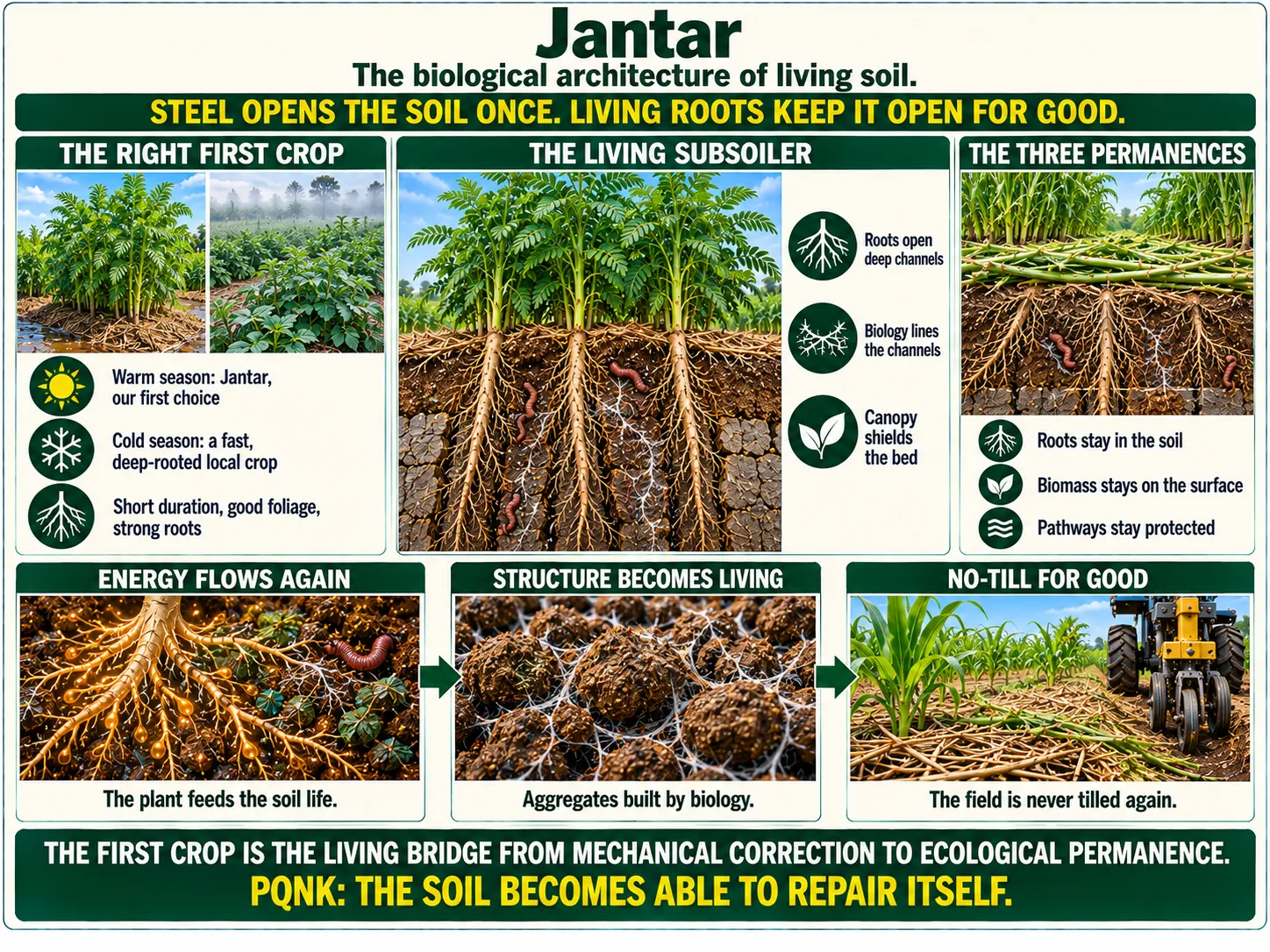
Jantar: steel opens the soil once; living roots keep it open for good.
“The permanent bed is built in a day. The living soil inside it takes seasons to become itself. Jantar is the organism that begins that becoming, not by adding to the soil from outside, but by reorganizing it from within.”
Asif Sharif, Lahore, 2026
I. THE GAP BETWEEN STRUCTURE AND LIFE
The PQNK transition protocol creates physical architecture. Hardpan is fractured. Beds are formed. Furrows are defined. The geometry of the field is reorganized from the flat, flood-inundated surface of industrial convention into the raised, aerated, permanent structure that ecological agriculture requires. This work is real, necessary, and foundational. Without it, the biological system that PQNK is designed to restore has no physical environment in which to establish itself.
But architecture is not life. A bed that has been formed, a profile that has been fractured, a field that has been reshaped, these are structures awaiting biological occupation. The pores exist, but nothing yet lives in them. The channels are open, but no roots yet move through them. The surface is raised above the furrow, but no organic cover yet protects it. The field has been corrected mechanically. It has not yet begun to recover biologically.
This gap, between mechanical correction and biological recovery, is the most critical interval in the PQNK regenerative transition. During this interval, the newly formed structure is structurally fragile. Aggregates are not yet biologically stabilized. Surface pores are not yet protected by organic cover. The underground profile, though fractured, is not yet inhabited by the living communities required to hold those fractures open and convert them from temporary mechanical openings into permanent biological corridors. If this interval is not shortened, the corrected field can begin regressing toward the conditions that preceded it.
Jantar enters the system at precisely this point. Its role is not to add inputs to the soil. Its role is to close the gap between the architecture that has been engineered and the biology that must now inhabit and stabilize that architecture. It is the living bridge between the two.
Jantar is PQNK’s first choice for this role, but it is not the only one, and it is not universal. What the newly formed bed needs is a fast-growing, deep-rooted crop that opens the soil pores for aeration and infiltration, covers the surface with good foliage, and becomes food for the soil microbes. Which crop does that best depends on the climate, and on the season in which the transition begins. Jantar is a warm-season crop and cannot grow in cold conditions, so a transition started as winter sets in, or in a cold climate, needs a different first crop: a short-duration crop with good foliage and a strong root system that grows well in that season and place. In the cold season, fast-growing crops such as radish, with its deep taproot, mustard, oats and barley do this work well. Alfalfa also roots deeply, but it builds less foliage and takes longer before it can be terminated for the next crop, so it suits a longer transition rather than a quick start. The principle is fixed; the crop is chosen for local conditions. Throughout this chapter, Jantar stands for that first crop, because wherever it can grow, it is the best choice.
II. THE LIVING SUBSOILER: BIOLOGICAL VERSUS MECHANICAL PENETRATION
The conventional understanding of soil loosening begins and ends with steel. A subsoiler fractures compacted layers through mechanical force applied from outside the soil. The fracture is immediate and visible. The soil opens. But the opening is temporary. Without biological continuity inhabiting the fractured zone, the mechanical opening gradually closes again as soil particles re-compact under their own weight, under rainfall, under the movement of water through the profile.
This is why Chapter Twenty-Five established that hardpan breaking within PQNK is engineering rather than agriculture, it is a one-time physical intervention designed to restore the first conditions for biological function, not a permanent solution to the structural problems of industrial soil. Steel does the initial work. But steel cannot do the permanent work. For that, biology must enter.
Jantar's root system does something categorically different from what a subsoiler does. As its roots descend through the fractured profile of the permanent bed, they do not merely occupy existing pores. They create biological continuity around themselves as they grow. Root exudates, the continuous chemical secretions of the living root, stimulate microbial populations in the immediately surrounding soil. These microbial communities begin producing the biological glues that bind mineral particles into stable aggregates around the root channel. Fungal threads extend from the root surface into adjacent zones, threading through soil particles and physically binding the pore walls. The root channel becomes a biologically lined corridor rather than a mechanically cracked fissure.
This distinction is the difference between temporary correction and permanent restructuring. A mechanical fracture is passive, it creates space but cannot maintain it. A biological root channel is active, it continuously regenerates the conditions that keep it open, stimulates the communities that stabilize its walls, and leaves behind a biologically organized structure that persists long after the root itself has decomposed. The decomposed root channel becomes a biopore: a macropore of biological origin whose walls are stabilized by humic compounds, microbial exudates, and fungal threads that resist collapse under normal field conditions.
In this sense, Jantar functions as a living subsoiler. But where the mechanical subsoiler cuts through soil from outside and moves on, the living subsoiler reorganizes the soil from within and leaves its work permanently embedded in the structure of the field. The plant becomes part of the reconstruction machinery of the ecosystem itself.
III. THE FIRST BIOLOGICAL OCCUPANT OF THE REGENERATING BED
After bed formation, the permanent bed is physically present but biologically empty in any meaningful ecological sense. The upper soil layers, disturbed during the establishment process, lack the organized biological communities that characterize mature living soil. The deeper layers, recently fractured from decades of hardpan, are biologically inactive. The surface is exposed to solar radiation, wind, and rainfall impact without the organic protective cover that natural ecosystems maintain continuously.
The field requires a first occupant, an organism capable of rapidly colonizing this vulnerable newly constructed environment and beginning the process of biological stabilization before the corrected architecture can begin deteriorating again. In PQNK, that organism is Jantar, or, where Jantar cannot grow, the fast-growing, deep-rooted crop that does its work best in the local climate and season.
The importance of Jantar as a first occupant goes beyond the specific ecological functions it performs, valuable as those are. It is important because of what it prevents. An unoccupied bed surface, exposed to direct sunlight and rainfall impact, begins forming a surface crust as fine particles are dislodged and redistributed by rain, then sealed by solar drying. This crust reduces infiltration, increases runoff, and creates conditions hostile to the germination of subsequent crops. An unoccupied bed profile, lacking active roots and their associated biological activity, loses the biological continuity that keeps newly fractured pores open. The mechanical openings begin closing. The hardpan reasserts itself gradually beneath the biological vacuum.
Jantar interrupts both of these regression pathways simultaneously. Its rapid canopy development covers the surface within weeks of planting, eliminating direct solar impact and softening rainfall contact before crust formation can establish itself. Its root system simultaneously occupies the underground space of the permanent bed, filling the newly fractured profile with living biological activity before the mechanical openings can close for lack of biological support. The bed begins functioning biologically, as an actively inhabited ecosystem, rather than merely existing structurally as corrected industrial soil.
This is the principle of first biological occupation: the ecological truth that newly created structure is only as stable as the biological community that inhabits and maintains it. PQNK engineers the structure and immediately follows with the organism designed to inhabit and stabilize it. Jantar, PQNK's first choice, is that organism.
IV. BIOMASS CONTINUITY: THE THREE PERMANENCES
One of the defining features of industrial agriculture was its systematic interruption of biomass continuity. Crop residues were removed for fodder, burned for field clearance, or buried by tillage. In each case, the organic material produced by the growing season left the surface ecology of the field and entered either an off-site system or a rapid oxidation cycle underground. The field began each new season from a surface that was organically impoverished and biologically depleted compared to what it had been at the end of the previous growing season.
This is the opposite of how natural ecosystems function. In a forest, a grassland, or any undisturbed biological community, organic material produced by one season accumulates into the soil and surface layer of the next. The leaf litter of this autumn becomes the organic layer of next spring. The roots of this season's grasses become the biopores and organic matter of next season's soil. The ecosystem does not interrupt its own accumulation. It builds continuously on what preceded it.
Within PQNK, Jantar embodies this principle through what may be called the three permanences: the roots remain inside the soil, the biomass remains on the surface, and the biological pathways remain protected. When the Jantar crop is terminated, chopped and laid across the bed surface, none of the organic material it has produced is removed from the system. The aerial biomass, now the first major mulch layer of the permanent bed, begins decomposing slowly under conditions protected from direct solar oxidation by its own mass and by the moisture it traps beneath it. The root system, left in place within the soil, begins the slow biological decomposition that converts living root channels into permanent biopores lined with humic compounds and microbial communities. The pathways opened by the living root remain open after the root has gone, because the biology the root supported during its life continues maintaining the channel architecture after the root itself has departed.
These three permanences together represent the moment when the PQNK field transitions from a system that removes its biological capital each season to a system that accumulates it. The first Jantar cycle does not produce a mature living soil. But it lays the foundation, the first organic layer, the first biopore network, the first surface protection, upon which every subsequent season will build. The soil begins accumulating instead of being reset.
V. THE BIOLOGICAL REPLACEMENT OF TILLAGE
Industrial agriculture entered a structural dependency on tillage that progressively deepened over decades. Tillage was applied to correct compaction, but tillage itself caused compaction. It was applied to incorporate residues, but incorporating residues buried the organic material that should have remained at the surface. It was applied to create seedbed looseness, but the looseness it created was structurally unstable, dependent upon continued mechanical input rather than upon biological organization.
The self-reinforcing nature of tillage dependency is one of the deepest architectural problems of industrial agriculture. Each tillage event destroys the biological aggregation that was developing since the previous event. The soil must rebuild its aggregate architecture from zero each season. But the season is too short and the disturbance cycle is too frequent for true biological stabilization to occur before the next tillage event arrives. The soil remains permanently in the early stage of biological recovery, the stage that precedes stable structure, because stable structure is never allowed to mature before it is mechanically destroyed again.
PQNK interrupts this cycle by replacing the annual tillage event with the annual biological event. The PQNK transition protocol needs only two one-time soil-working passes at establishment: the subsoiler that breaks the hardpan and the bed-former that shapes the permanent beds, ready for Jantar. After that, only the planter enters the soil, and the field is never tilled again (Chapter Fifty). The subsequent opening of the soil surface is accomplished not by steel but by roots, by the roots of Jantar in the first season, and by the roots of successive crops and permanent plantings in every season thereafter.
This is not merely a reduction in tillage. It is a fundamental change in the mechanism of soil loosening. Mechanical tillage fractures soil from outside, creates temporary looseness, and moves on. Biological root penetration reorganizes soil from within, creates permanent biopores, stimulates the microbial aggregation that stabilizes those pores, and leaves behind a biological architecture that future roots will use and extend. Each season's root system inherits the biopore network left by the previous season's roots and extends it further into the profile. The soil becomes progressively more open, more biologically active, and more structurally stable, not despite the absence of tillage, but because of it.
Jantar initiates this transfer from steel to biology. By aggressively occupying the full depth of the newly formed permanent bed in the first season, it establishes the foundational biopore network upon which the no-till permanence of the PQNK system depends. It demonstrates to the field, in the most direct biological terms, that the work of soil opening no longer belongs to a machine. It belongs to life itself.
VI. BIOLOGICAL SOIL STRUCTURE: A LIVING ACHIEVEMENT
Soil structure is commonly understood as a physical property, the arrangement of particles, the distribution of pore sizes, the bulk density of the profile. This understanding is accurate as far as it goes, but it misses the most important fact about soil structure in a functioning biological system: stable structure is not a physical condition. It is a biological achievement. It is produced and maintained by living organisms, and it weakens and collapses when those organisms are absent or when their activity is interrupted.
The aggregate, the fundamental structural unit of fertile soil, is not simply a cluster of mineral particles held together by particle-to-particle physical attraction. It is a biological composite. Mineral particles are bound together by microbial exudates, particularly the glomalin proteins produced by arbuscular mycorrhizal fungi, which form sticky organo-mineral bridges between adjacent particles. The aggregate is further stabilized by fine root hairs and fungal hyphae that thread through and around it, providing physical reinforcement analogous to the steel rods in reinforced concrete. The interior of a mature aggregate contains a diverse microbial community maintained in an aerobic environment by the pore continuity around it.
This biological composite is stable in a way that mechanically pulverized soil is not. A tillage-created soil crumb is a collection of mineral particles broken apart from a larger mass by mechanical force. It has no biological stabilization. In contact with rainfall, its surface particles are dislodged and redistributed, blocking surface pores and initiating the crust formation that reduces infiltration and increases runoff. In contact with root pressure, it compresses rather than deforming elastically around the root. It is mechanically loose but biologically unstable.
Jantar contributes to biological soil structure through every dimension of its activity in the permanent bed. Root exudates feed the microbial communities that produce aggregate-stabilizing compounds. Root hairs and associated fungal networks physically reinforce developing aggregates. The continuous biological activity around the active root system creates zones of high microbial density where aggregate formation is rapid and stable. After the root dies and decomposes, the organic compounds it leaves behind continue serving as aggregate-stabilizing agents within the soil for months and years.
The result is the beginning of a transformation in the structural character of the soil, from the mechanically fragmented, biologically unstable material produced by decades of industrial management toward the biologically organized, aggregate-rich, pore-continuous medium that characterizes living soil. Jantar does not complete this transformation. It initiates it. The transformation deepens with each successive season of biological activity, each crop cycle whose roots extend the aggregate network further through the profile, each mulch layer whose decomposition adds humic compounds to the aggregate matrix. The structure becomes regenerative rather than temporary, building itself each season rather than being rebuilt by machines.
VII. RESTORING BIOLOGICAL ENERGY FLOW
Living soil is not merely a physical medium inhabited by biology. It is an energetically active system driven by the continuous transfer of photosynthetically captured carbon from the above-ground plant world into the underground biological world. This energy transfer is the engine that powers the decomposition, aggregation, nutrient cycling, and biological organization that make soil fertile and structurally stable.
The transfer occurs through roots. As a plant grows, it channels a substantial portion of the carbohydrates produced through photosynthesis into its root system and releases them into the surrounding soil as exudates, a continuous stream of sugars, amino acids, organic acids, and other carbon-rich compounds that feed the microbial communities inhabiting the rhizosphere. This exudation is not incidental. It is a deliberate biological investment by the plant in its soil ecosystem. The plant feeds the microbes; the microbes process organic matter and mineral resources into forms the plant can absorb; the plant feeds the microbes more. The energy cycle is continuous, mutually reinforcing, and the foundation of everything that makes natural soil capable of supporting plant life without external input.
Industrial agriculture interrupted this energy flow at multiple points simultaneously. Bare fallowing eliminated root activity entirely during inter-crop periods. Tillage periodically eliminated the above-ground plant community entirely, cutting off exudate supply for weeks or months at a time. Residue removal and burning prevented the organic matter of one season from becoming the energy source of the next. The underground ecosystem, starved of its primary energy input, progressively weakened, and with it the biological processes that the energy supported: aggregation, decomposition, nutrient cycling, and structural stabilization.
Within PQNK, Jantar restores this energy flow during the critical first season of the regenerative transition. Its rapid establishment places an active, vigorously growing root system throughout the permanent bed profile within weeks of planting. Large quantities of photosynthetically captured carbon begin flowing through the root system into the soil as exudates. The microbial communities of the newly fractured profile, still sparse and weak from years of industrial energy starvation, respond to this influx of biological energy by beginning to expand and organize themselves around the zones of active exudation.
The underground ecosystem becomes energetically active again. And once this energy cycle is re-established, it begins to sustain itself. The microbes fed by Jantar exudates process organic matter and minerals, supporting the plant's continued growth, which produces more exudates, which feeds more microbes. After termination, the retained biomass extends this energy supply beyond the growing season. Decomposer communities beneath the mulch layer continue processing the organic material of the Jantar biomass as an energy source through the inter-season period, maintaining biological activity at the soil surface even when no living roots are present above ground.
This continuous biological energy flow is one of the foundations of long-term soil fertility within PQNK. It is the mechanism by which the field eventually achieves the self-sustaining nutrient cycling that eliminates the need for external fertility inputs. Jantar initiates it during the first transition season, and the crops and permanent plantings that follow build upon it continuously.
VIII. THE TRANSITION TOWARD SELF-SUSTAINING FERTILITY
Industrial agriculture separated fertility from biology so completely that the relationship became invisible. Fertility meant the presence of nitrogen, phosphorus, and potassium in plant-available form in the soil profile. These nutrients were delivered from outside through synthetic fertilizers, mined, manufactured, transported, and applied at rates calculated to compensate for what the biological system could no longer provide for itself. The biological dimension of fertility, the living processes through which soil ecosystems mobilize, cycle, and regulate nutrient availability, was not merely undervalued. It was functionally replaced.
The soil of a heavily fertilized industrial field often contains large quantities of minerals in physically present but biologically inaccessible forms. The minerals are there, but the biological machinery required to make them available to plant roots is absent or severely degraded. Microbial populations that solubilize phosphorus, fix atmospheric nitrogen, and cycle organic nitrogen into plant-available ammonium are sparse. Mycorrhizal fungi that extend the effective root area by orders of magnitude and access minerals in soil pores too small for roots to enter are absent or non-functional. The deep mineral reserves of the subsoil, vast in most agricultural soils, are biologically disconnected from the active root zone.
Within PQNK, the restoration of fertility does not begin with nutrient supply. It begins with the restoration of biological continuity through which the soil's own mineral reserves become biologically accessible. Jantar contributes to this restoration through the same root, rhizosphere, and biomass processes described in preceding sections, but the fertility implication of these processes deserves explicit treatment.
PQNK grows Jantar for its deep root system and its biomass, not for its nodules. The nitrogen of a PQNK field comes from free-living nitrogen-fixing bacteria in a living, covered soil (KP-047).
As Jantar roots descend through the permanent bed profile, they carry biological activity into soil layers that have been biologically inactive for years or decades. Microbial communities that could not establish themselves in the biologically empty hardpan zone now colonize the rhizosphere of the descending Jantar roots. These communities include phosphorus-solubilizing bacteria, nitrogen-transforming organisms, and the diverse decomposer networks that process organic matter into plant-available mineral forms. The soil's mineral reserves, previously locked in the inaccessible chemistry of biologically dead subsoil, begin entering biological circulation.
The large biomass that Jantar produces and retains within the bed further accelerates this recovery. As the biomass decomposes under the protection of the mulch layer, the nutrients it contains are not leached away or volatilized as they would be in a bare, exposed residue. They are integrated gradually into the surface biological layer, processed by the organisms that inhabit the mulch-soil interface, and made available to the roots of subsequent crops through the biological pathways that Jantar's own roots helped establish. The fertility cycle begins closing internally. Nutrients no longer flow only from external application to export in the harvested crop. They begin circulating within the permanent bed ecosystem, becoming available each season through biological processing rather than through external supply.
IX. ECOLOGICAL SELF-ORGANIZATION: WHEN THE FIELD BEGINS GOVERNING ITSELF
There is a threshold in the regenerative trajectory of a PQNK field at which something qualitatively changes. Before this threshold, the field is being managed toward recovery, each improvement is produced by deliberate intervention, and the field would regress without continued management attention. After this threshold, the field begins participating in its own stabilization. The ecological processes governing structure, moisture, fertility, and biological density begin reinforcing one another through internal feedback rather than depending upon external correction at each step.
This is what PQNK science means by ecological self-organization: the emergence of a field system that increasingly governs its own biological and physical conditions through the interaction of its own living components. It is not the same as a field that requires no management, the PQNK farmer remains actively engaged, observing the system, supporting its development, and making the judgments that no ecological process can make for itself. But it is a fundamentally different quality of engagement. The farmer is working with a system that is increasingly capable of supporting itself, rather than perpetually maintaining a system that would collapse without continuous intervention.
Jantar helps initiate this threshold during the regenerative transition. Its role is not to produce self-organization directly, that is a property of the mature system, not of any single organism within it. Its role is to connect the individual regenerative processes, root penetration, microbial activation, aggregate formation, surface protection, moisture moderation, energy flow, into a functioning whole. Each of these processes, operating in isolation, produces only partial recovery. A loosened soil without biological continuity remains unstable. Biomass without root penetration provides surface cover but not underground structure. Biological density without atmospheric continuity produces anaerobic rather than aerobic ecology.
What Jantar provides is simultaneity: all of the foundational regenerative processes begin operating at the same time, across the same field volume, as a consequence of the single act of planting and managing one crop. Root penetration, microbial stimulation, surface protection, moisture buffering, aggregate nucleation, and energy flow do not arrive sequentially, each waiting for the previous to complete. They arrive together, and their concurrent operation creates the conditions for the biological integration that self-organization requires.
As this integration strengthens over successive crop cycles, the field begins exhibiting the characteristic behaviour of a self-organizing ecological system: moisture regulation improving without irrigation scheduling, biological density increasing without inoculant application, structural stability deepening without mechanical loosening, nutrient availability expanding without fertilizer input. The ecosystem is doing the work that was previously done by management. This is not the completion of the PQNK process. It is the beginning of its mature phase.
X. BIOLOGICAL MOMENTUM AND THE COMPOUNDING OF RECOVERY
Ecological recovery in degraded soil does not proceed at a constant rate. In the early stages of transition, when biological populations are sparse and the energy supply to the underground ecosystem is limited, recovery is slow. Each improvement depends upon the prior establishment of conditions that did not previously exist: microbial diversity cannot expand without the pore continuity that makes aerobic habitat available; aggregate formation cannot accelerate without the microbial communities that produce aggregate-stabilizing compounds; root penetration cannot deepen without the biopore network that guides and facilitates it. When none of these preconditions are present, recovery is necessarily slow and may be easily reversed by adverse conditions.
This is why the gap between mechanical correction and biological occupation is dangerous. In that interval, none of the self-reinforcing processes of biological recovery have yet engaged. The field is physically open but biologically inert. Any significant rainfall event, any period of drying, any temperature extreme can damage the newly formed structure before it has been stabilized by biology. The field is vulnerable precisely because the biological processes that would make it resilient have not yet begun.
Jantar generates the initial biological momentum that begins the self-reinforcing cycle of recovery. Once its roots are active in the profile, the conditions for the next stage of recovery improve rapidly. Microbial populations expand around the rhizosphere, creating the conditions for aggregate formation. Aggregate formation improves the pore continuity that supports further microbial diversity. Improved pore continuity deepens atmospheric exchange, supporting aerobic biology at greater depths. Deeper aerobic biology expands the root zone ecology that subsequent crops can occupy. Each improvement creates the precondition for the next.
This compounding dynamic is what PQNK means by biological momentum: the property of a recovering ecosystem in which each stage of recovery makes the subsequent stage more rapid, more stable, and less dependent upon external support. A field with strong biological momentum becomes progressively more resilient, more productive, and more self-sufficient over time, not because it is receiving increasing external input, but because its internal biological systems are strengthening through continuity and interaction.
Jantar does not create this momentum by itself. It initiates the conditions from which momentum can develop. The crops that follow, crop after crop and crop-in-crop, the accumulating organic cover, the deepening biopore network, and the maturing biological communities of the permanent bed each contribute to the momentum that Jantar starts. But every PQNK field that has achieved biological stability carries within its ecology the trace of the first Jantar cycle, or of the first crop that stood in its place, that began the compounding process. That first cycle is where the momentum of the entire subsequent regeneration was born.
XI. JANTAR AND THE THRESHOLD OF NO-TILL PERMANENCE
Permanent no-till agriculture, the condition in which tillage is not only absent from the current season but has been absent for years and will remain absent permanently, is a biological condition before it is an agronomic one. It is not achievable by simply deciding not to till. It requires that the soil possess enough living continuity, enough biopore depth, enough aggregate stability, enough biological density, to maintain its own structural openness without periodic mechanical intervention. A biologically impoverished soil that is not tilled will compact. Its surface will crust. Its pore network will collapse under rainfall and the weight of equipment. No-till permanence requires a soil that is biologically capable of maintaining its own structure through living ecological activity.
This is the condition that Jantar begins preparing during the PQNK regenerative transition. Its deep biopore network provides the initial macropore infrastructure that allows water to infiltrate without surface ponding, oxygen to reach the depths of the profile without mechanical assistance, and future roots to descend without encountering the impenetrable compaction that characterized the pre-transition field. Its aggregate-nucleating rhizosphere activity begins the process of biological structural stabilization that must eventually become strong enough to maintain the field's porosity independently. Its surface mulch layer provides the first permanent organic cover that protects against the surface crusting and aggregate breakdown that would otherwise make no-till impractical.
The maturation of these conditions, the deepening of the biopore network, the strengthening of aggregate stability, the expansion of biological density, is the work of successive seasons, not of a single Jantar cycle. But the direction and the foundation are established by Jantar. Each subsequent season of permanent bed management builds upon the structural and biological capital that Jantar deposited in the first transition year. By the third or fourth year of permanent bed management under PQNK, the soil has typically accumulated sufficient biological organization to maintain its own structure reliably without mechanical assistance. No-till permanence has become a biological reality rather than a management aspiration.
This is the deeper agricultural significance of Jantar within PQNK. It is not merely a cover crop or a green manure in the conventional agricultural sense of those terms. It is the organism that prepares the soil for the permanent biological self-management that no-till requires. Without Jantar, or a first crop that does its work, establishing the initial biopore network, the aggregate nucleation sites, the surface mulch foundation, and the biological energy cycle, the transition to permanent no-till would be slower, more fragile, and more dependent upon external management support at each stage. With Jantar establishing these foundations in the first season, the field crosses the threshold into biological self-maintenance more rapidly and with greater ecological stability.
CONCLUSION: THE LIVING BRIDGE
The role of Jantar in the PQNK system is comprehensible only when it is understood within the full ecological context of what the PQNK transition is attempting to accomplish. The transition is not merely a change in agronomic practice. It is a biological restoration, the reconstruction of a living soil ecosystem that industrial agriculture progressively destroyed over decades of inundation, tillage, bare exposure, and chemical dependency. The physical architecture of that restoration, the raised beds, the furrows that carry water and wheels, the controlled traffic lanes, creates the conditions in which biological recovery is possible. But the architecture itself is not the recovery. Biology is the recovery.
Jantar, or the first crop that takes its place where Jantar cannot grow, is the organism that begins the biological recovery. It closes the gap between the mechanical architecture and the living soil. It occupies the newly formed bed as its first biological inhabitant, preventing the regression that an unoccupied corrected field will undergo. It opens the deep profile through living root penetration, converting temporary mechanical fractures into permanent biological corridors. It initiates aggregate formation and biological structural stability through its rhizosphere activity. It restores the biological energy flow that powers the entire underground ecosystem. It retains its biomass within the system rather than removing it, beginning the cycle of organic accumulation that will deepen across successive seasons into the mature, self-sustaining fertility of the permanent PQNK bed. It prepares the field for the no-till permanence that is the long-term goal of the entire system.
None of these contributions depend upon Jantar being a permanent fixture of the field. It is explicitly a transitional species, important during the regenerative transition precisely because it is vigorous, rapid, and ecologically aggressive in ways that the slower-growing permanent plants of the mature system are not. Its role is to do quickly what the mature system will eventually do continuously: occupy, stabilize, energize, and organize the biological architecture of the living soil. Once the mature system has developed the biological density and continuity to take over these functions, Jantar recedes from necessity, though it may be sown again as a biological refresher when specific zones of the bed require renewed deep penetration or surface organic addition.
The living bridge that Jantar provides is the bridge from mechanical correction to ecological permanence. It is crossed once, at the foundation of the PQNK field's biological life, and what lies on the other side is a soil system that no longer needs to be repaired, because it has become capable of repairing itself.
Chapter Fifty-Six: Root Retention Science, The Underground Architecture of the Permanent Bed