

Industrial Devastation To Natural Abundance
The Original System · Chapter 5
The Natural Water System
Rain, Dew, Humidity, and Soil Moisture Management
Release 1.1 · 2026-10-02
If you use “Listen”, the text of the page may be sent to your browser or operating system’s speech provider, such as Apple, Google or Microsoft, depending on the voice your device uses. Pedaver does not process, transmit or store any audio.
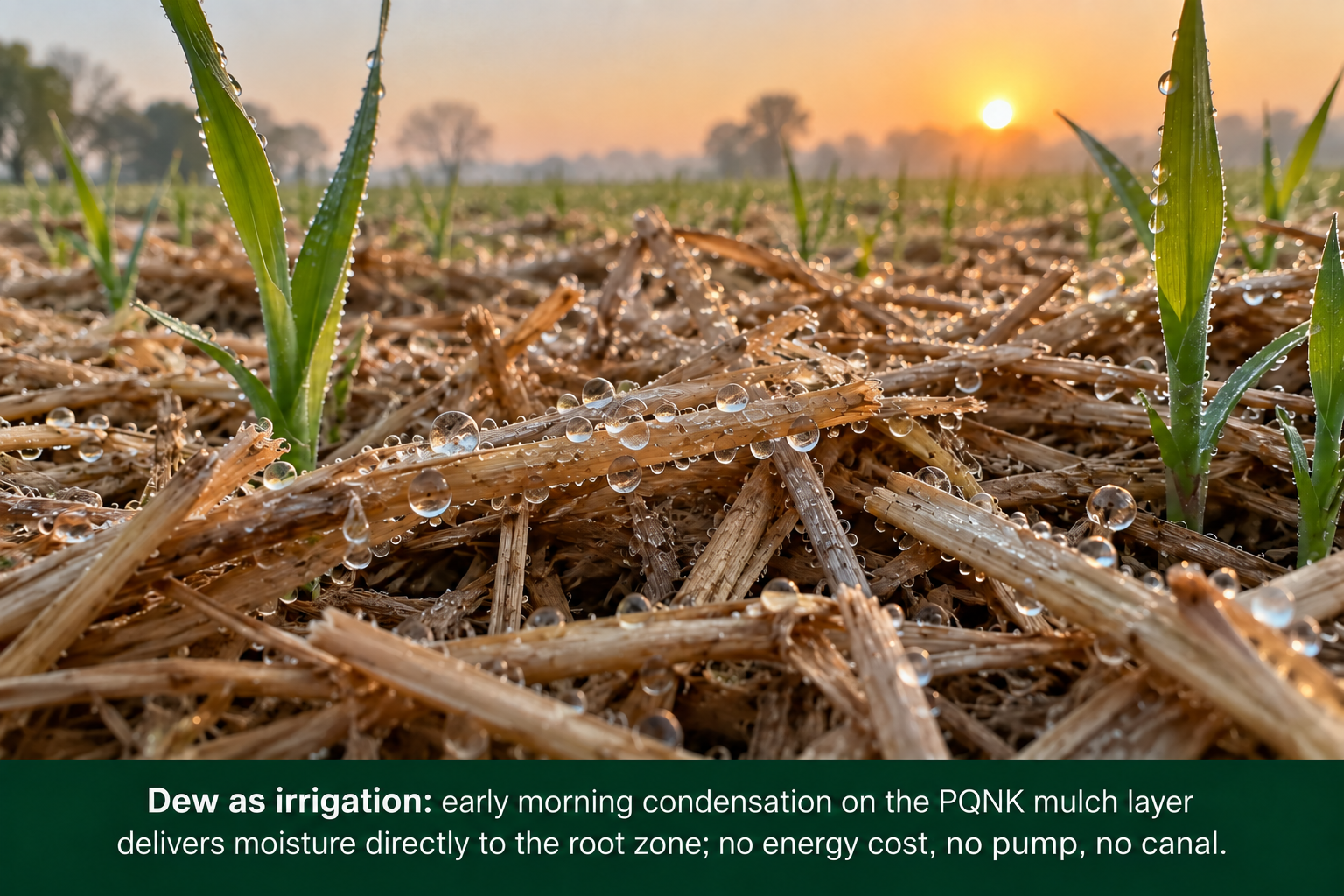
“The farmer who irrigates a PQNK field is not adding water. He is topping up a system that is already working. The farmer who irrigates a conventional field is not farming. He is keeping a patient alive on a drip.”
Asif Sharif, Lahore, 2026
More than half of the world's population lives in water-stressed regions. Rivers are depleting. Aquifers, the underground reservoirs that took millennia to fill, are being drawn down at rates that alarm hydrologists across every continent. In Pakistan's Punjab, as in Egypt's Nile Delta, India's Indo-Gangetic Plain, and Mexico's Central Plateau, the water table has dropped from a few feet below the surface to, in many areas, two hundred feet or more, within the span of a single farming generation. The conventional response to this crisis is engineering: more canals, deeper tube wells, drip irrigation systems, precision sprinklers, satellite-guided water management. Billions are spent. The water table continues to fall.
The engineering response fails because it addresses the symptom while deepening the cause. The cause of this water crisis is not insufficient rainfall. Pakistan receives, on average, between 250 and 1,200 millimetres of rainfall per year depending on region, enough, in a biologically functioning soil, to grow virtually any crop without irrigation. The cause is that the soil can no longer hold the water it receives. The hardpan prevents infiltration. The absence of organic matter reduces water-holding capacity. The bare soil evaporates everything that does enter. And the broken capillary system cannot distribute what little remains to the root zone.
PQNK addresses the water crisis at its actual source: the soil. By restoring the biological architecture that enables the soil to receive, store, and distribute water, and by adding the organic mulch layer that eliminates evaporative loss, PQNK converts a water-stressed farm into one that is, in many conditions, water-sufficient from rainfall alone. This is not a theoretical proposition. It has been demonstrated on farms across Pakistan’s driest regions, in Balochistan, in Cholistan, and across the rain-fed Pothohar plateau, where PQNK wheat has been grown to commercial yield with no irrigation at all.
THE FOUR SOURCES OF WATER IN A PQNK SYSTEM
Conventional farming recognises one primary source of crop water: irrigation. Rain is a bonus; everything else is negligible. PQNK recognises four distinct water sources, each of which is captured, retained, and utilised by the system in ways that conventional farming, with its bare soil and broken hardpan, cannot access. Together, these four sources can meet the complete water requirement of most crops in most climates without supplemental irrigation, or substantially reduce irrigation requirements where some supplementation is still needed.
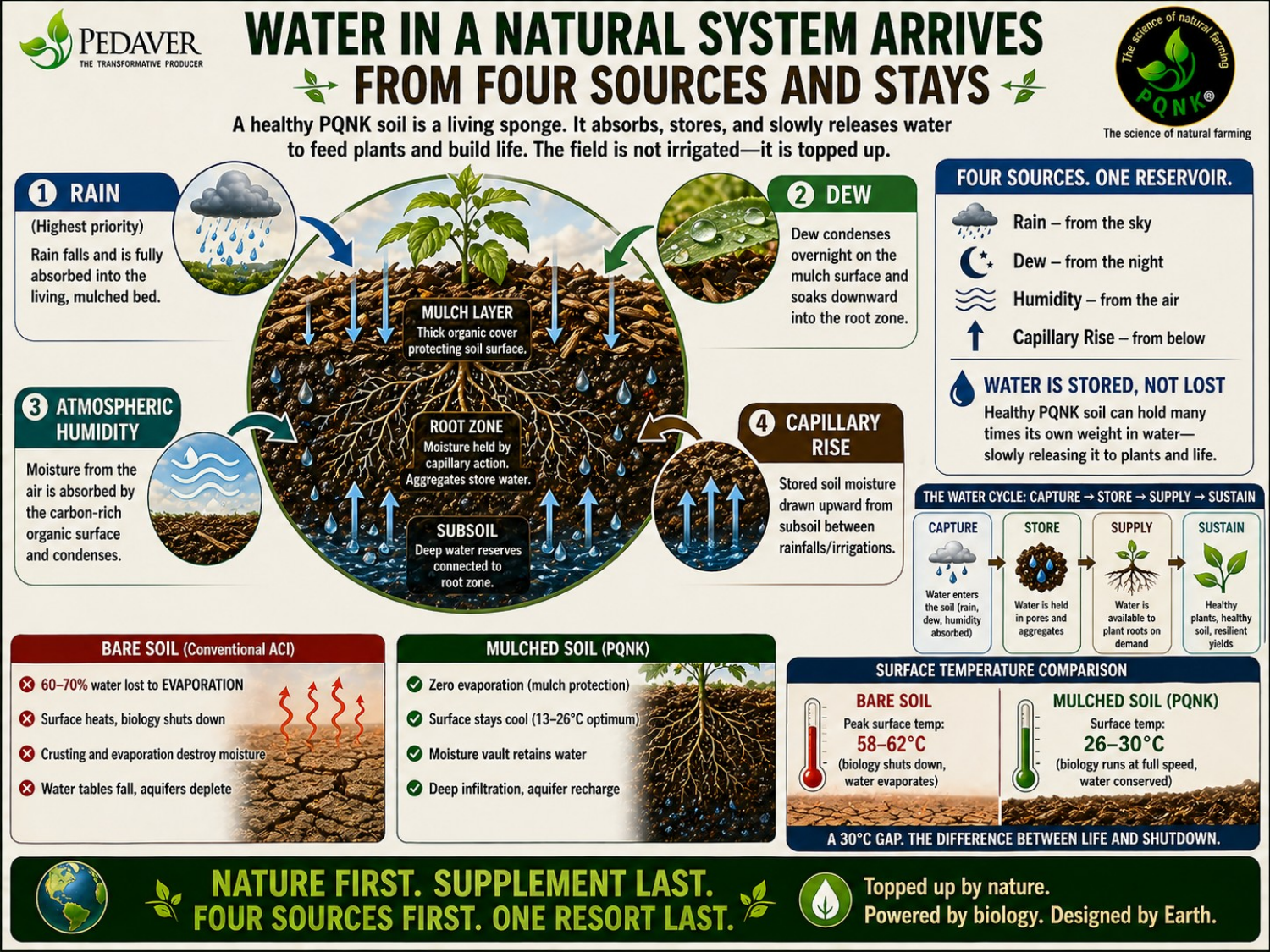
Water in a Natural System: Rain, Dew, Atmospheric Humidity, Capillary Rise, Four Sources Before One Drop of Irrigation
Source One: Rainfall. In a PQNK field with fractured hardpan and restored soil structure, rainfall infiltrates rapidly and completely into the soil profile. The mulch layer intercepts the kinetic energy of falling raindrops, preventing the surface sealing, called crusting, that causes runoff in bare soils. The living root channels and earthworm burrows distribute water rapidly through the profile. The high organic matter content holds the water in place, releasing it slowly to roots over days and weeks. In a PQNK field, a heavy rainfall event that would cause flooding and erosion in an adjacent conventional field disappears into the soil within hours. The water that was running off and destroying topsoil is now charging the subsoil reservoir that will feed the crop through the next dry period.
Source Two: Dew. Dew is one of the most underestimated water sources in agriculture, primarily because it is invisible on bare soil, it evaporates within an hour of sunrise. On a mulch-covered PQNK bed, it does not evaporate. It is intercepted by the rough, fibrous surface of the mulch, which provides vastly more surface area for condensation than bare soil. The condensed water is then drawn by capillary action downward through the mulch and into the soil below, where it contributes to the root zone moisture that sustains the crop. In regions with significant diurnal temperature variation, warm days and cool nights, dew events can deliver the equivalent of several millimetres of rainfall per week. A PQNK farmer collects every one of them. A conventional farmer collects none.
Source Three: Atmospheric humidity. Even when there is no dew event, the air contains water vapour that the mulch layer continuously absorbs. This absorption is not dramatic, it does not deliver the quantities that rainfall or even dew can provide, but it is continuous, twenty-four hours a day, throughout the growing season. In regions with moderate to high atmospheric humidity, this source alone can maintain a measurable film of moisture at the mulch-soil interface that keeps the surface biology active and the capillary system charged even in extended dry periods. It is the difference between a soil that is dormant and one that is merely resting.
Source Four: Capillary movement within the soil. The capillary system is the soil’s internal water distribution network. In a soil with intact aggregate structure and an unbroken pore network, water moves upward from the subsoil moisture reservoir toward the drier root zone above, driven by the same capillary forces that make a paper towel absorb a spill against gravity. This upward movement is continuous as long as the soil surface remains drier than the subsoil, which the mulch layer ensures by preventing surface evaporation. The capillary system means that water stored deep in the profile, from a rainstorm weeks earlier, continues to supply the root zone long after the rain has been forgotten. This is the mechanism by which PQNK crops remain vigorous through dry spells that would devastate a conventional crop with no subsoil reserve.
A PQNK farm harvests water from four sources simultaneously: rain, dew, humidity, and the subsoil reservoir drawn up by capillary action. A conventional farm harvests one: irrigation. The difference in water efficiency is not a matter of technology. It is a matter of whether the soil is alive or dead.
HOW CONVENTIONAL FARMING BREAKS THE WATER CYCLE
To understand why PQNK water management is so dramatically more effective than conventional approaches, it is necessary to trace precisely what ACI practices do to each stage of the natural water cycle. The damage is not random; it is systematic, and it operates through three specific mechanisms that reinforce one another until the farm becomes entirely dependent on external water supply.
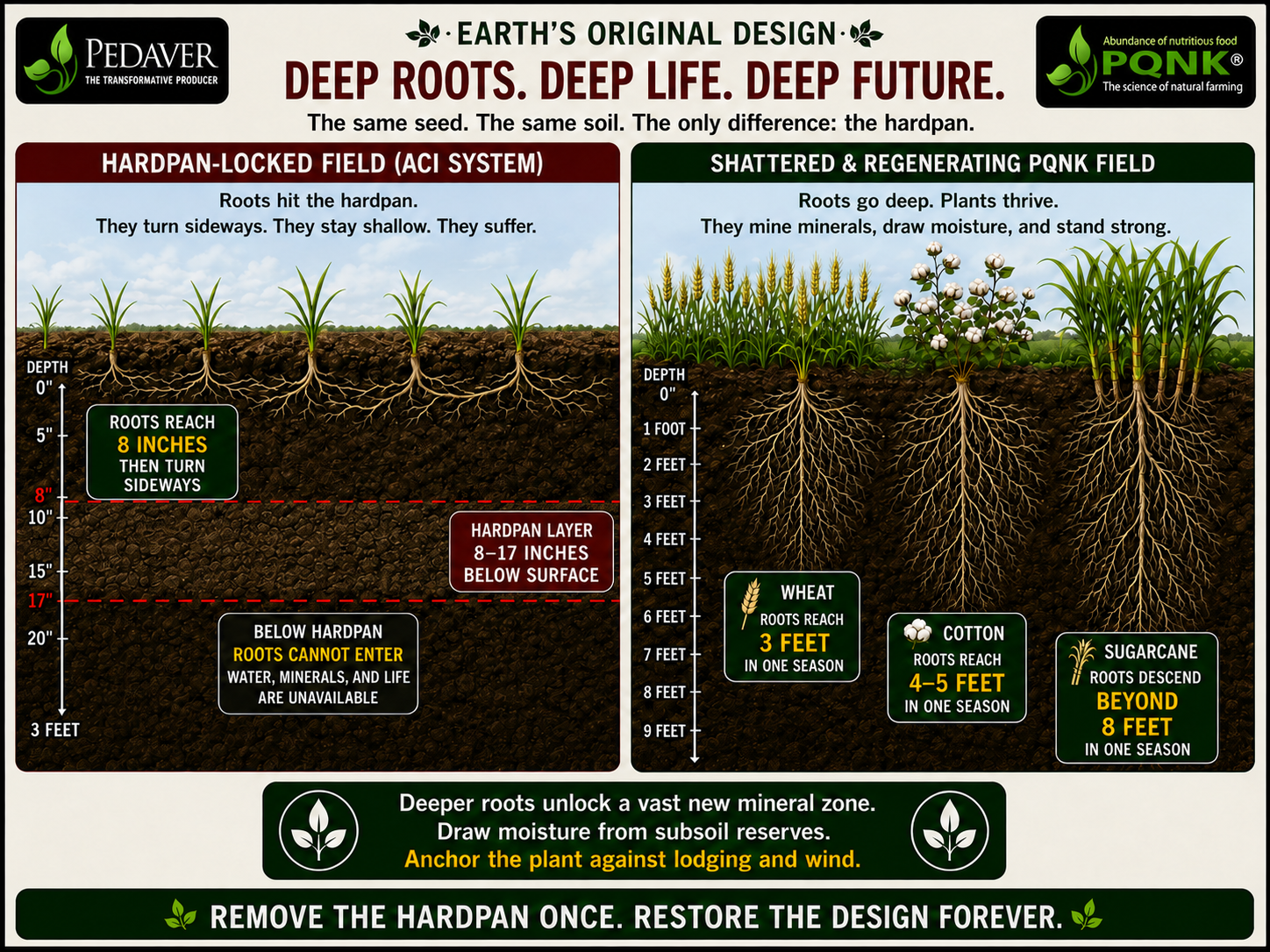
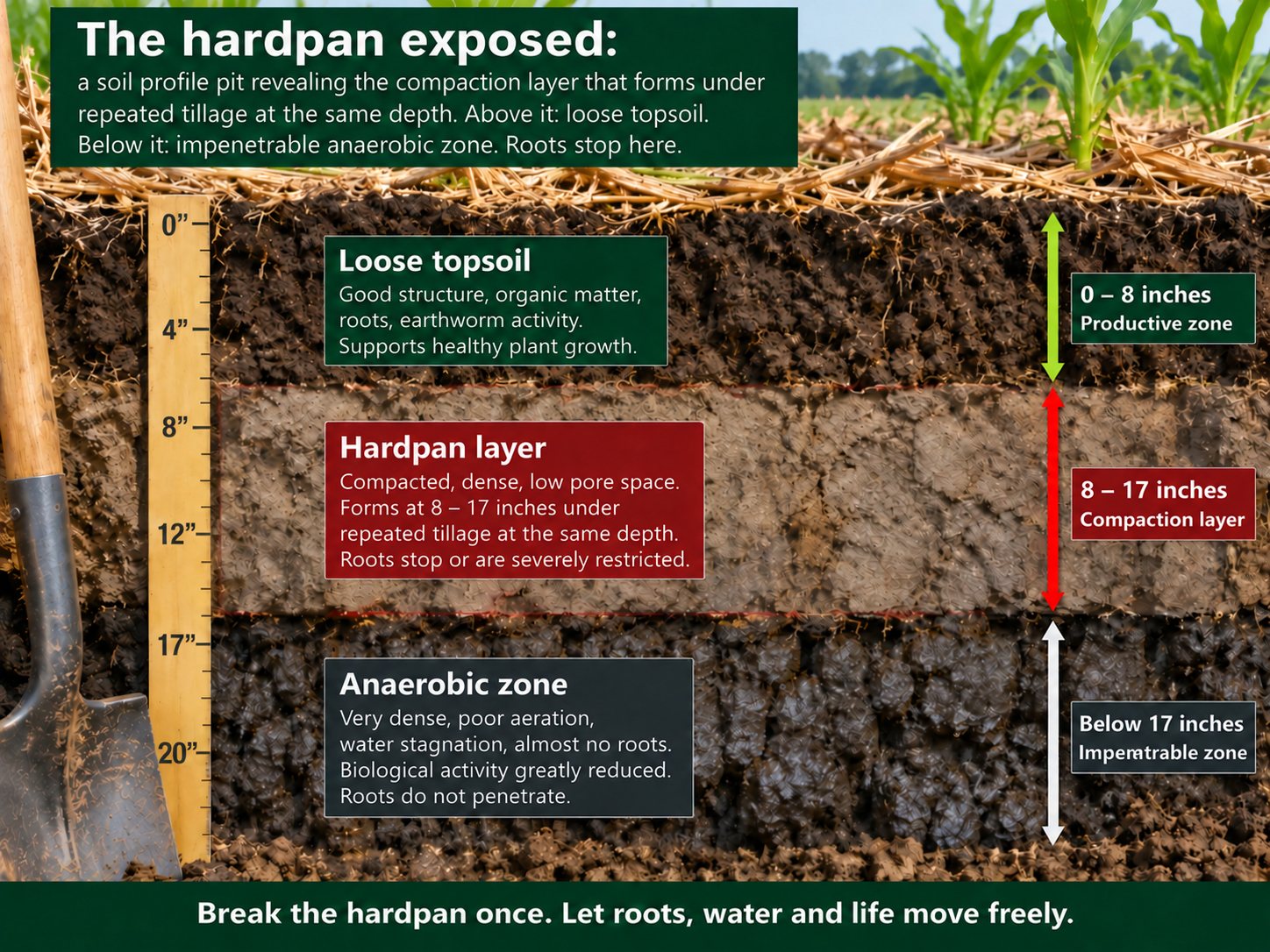
The hardpan blocks infiltration. As established in earlier chapters, the hardpan created by decades of tillage and machinery compaction forms an impermeable barrier beneath the topsoil. When rain falls on a field with hardpan, it infiltrates the loose topsoil quickly enough but then hits the hardpan and can go no further. The topsoil becomes saturated. The excess water ponds on the surface and evaporates or runs off. The subsoil below the hardpan remains dry. The roots, confined to the saturated topsoil, are simultaneously waterlogged and unable to access the deeper moisture reserve. When the topsoil dries between events, the crop is already stressed because there is nothing below the hardpan to draw on. This is why conventional crops need frequent irrigation: not because there is insufficient water in the region, but because the storage system has been destroyed.
Bare soil maximises evaporative loss. A bare soil surface under full solar radiation in a hot, dry summer, of the kind common across the world’s irrigated drylands, can evaporate several millimetres of water per day directly from the surface layer. This evaporation comes almost entirely from the top few centimetres, precisely the zone where the fine roots responsible for most water and nutrient absorption are concentrated. The result is that water applied through irrigation, even if it infiltrates adequately, evaporates rapidly from the surface before roots can use it. The farmer irrigates more frequently to compensate for evaporative loss, which wets the surface again, which evaporates again. A large proportion of irrigation water in conventional systems never reaches a crop root. It goes directly back to the atmosphere.
Flood irrigation destroys soil structure and salinity builds. Flood irrigation, still the dominant method across Pakistan and much of the irrigated world, applies water in quantities that overwhelm the soil’s absorption capacity, regardless of whether the hardpan is present. The hydraulic force of water flooding across a field disperses soil aggregates, sealing the surface with a fine silt layer that dramatically reduces infiltration for subsequent events. Simultaneously, flood irrigation carries dissolved salts from deeper in the profile upward to the root zone and eventually to the surface, where evaporation concentrates them. Over years and decades, salinity builds to levels that progressively restrict root function, reduce water uptake efficiency, and eventually render the soil unproductive. This is not an unusual outcome. It is the normal trajectory of every conventionally managed field wherever flood irrigation has been practised.
SOIL MOISTURE MANAGEMENT: THE PQNK WATER PROTOCOL
Soil Moisture Management, SMM, is the PQNK framework for understanding and managing water at the farm level. It is not a technology; it is a way of thinking about water that recognises the soil as the primary water management infrastructure, and the farmer’s job as maintaining that infrastructure rather than substituting for it with engineering. The goal of SMM is to maintain the soil profile in a state of continuous optimal moisture, not too wet, not too dry, using the four natural sources as the primary supply and irrigation as a supplement only when all four sources are insufficient.
The optimal moisture state for a PQNK soil is sometimes described as ‘near-wilting’, a term that requires careful explanation because it sounds alarming to a farmer accustomed to the convention that adequate water means abundantly wet. In a PQNK context, near-wilting does not mean a stressed crop. It means a crop that is drawing water from a concentrated mineral solution in the soil pore water, where the ratio of dissolved minerals to water is higher than in a well-watered conventional soil. This concentration effect means the plant is absorbing more minerals per unit of water taken up, producing more nutritionally dense tissue, and investing less energy in moving large quantities of dilute water through its vascular system. The crop looks slightly different from a heavily irrigated conventional crop. The leaves may be a little smaller, the growth a little slower, but the grain or fruit it produces is greater in quantity and measurably richer in minerals, vitamins, and secondary metabolites.
Keeping a PQNK crop near the wilting point is not stress. It is concentration. The plant is drinking a rich solution rather than a dilute one. The food it produces reflects the difference in every mouthful.
WHEN AND HOW TO IRRIGATE IN A PQNK SYSTEM
The decision to irrigate in a PQNK system is made by observing the crop and the soil, not by following a calendar or a predetermined schedule. In a conventional system, irrigation intervals are fixed because the farmer knows the soil cannot hold adequate moisture between events. In a PQNK system, the interval between irrigations extends progressively as the soil biological structure rebuilds, because each improvement in organic matter and aggregate structure increases water-holding capacity. The farmer learns to read what the soil and crop are telling him, rather than looking at the calendar.
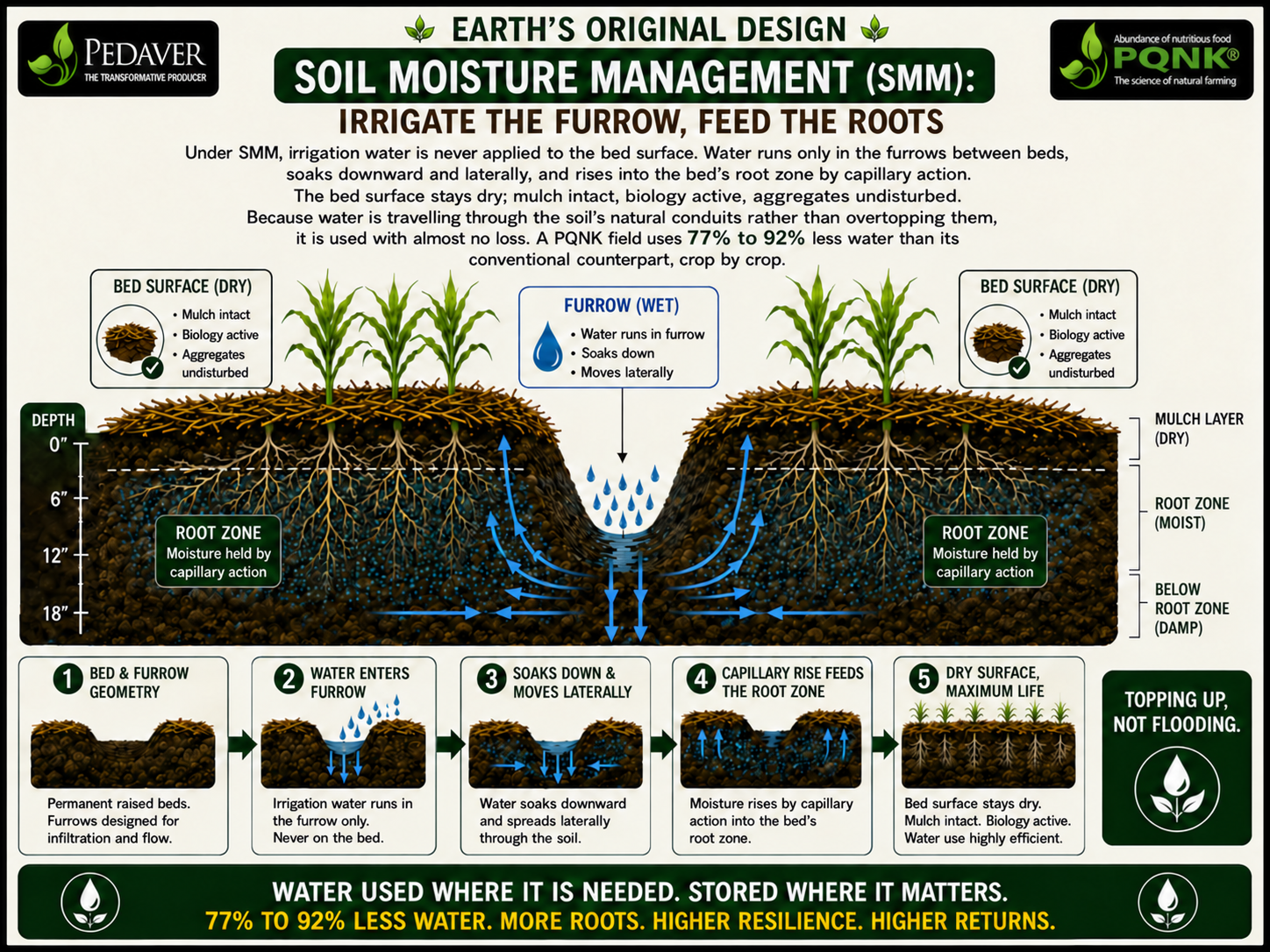
SMM, Irrigate the Furrow, Feed the Roots: Water Applied Once, Delivered Everywhere by Capillary Action
Indicators that irrigation is needed: The crop shows slight afternoon wilting that does not fully recover by the following morning, this is genuine moisture stress, not the temporary midday wilt that even well-watered crops show under intense sun. The soil at four to six inches depth feels dry when a handful is compressed. The mulch layer, even when moist on its surface from dew, shows dry conditions immediately beneath it.
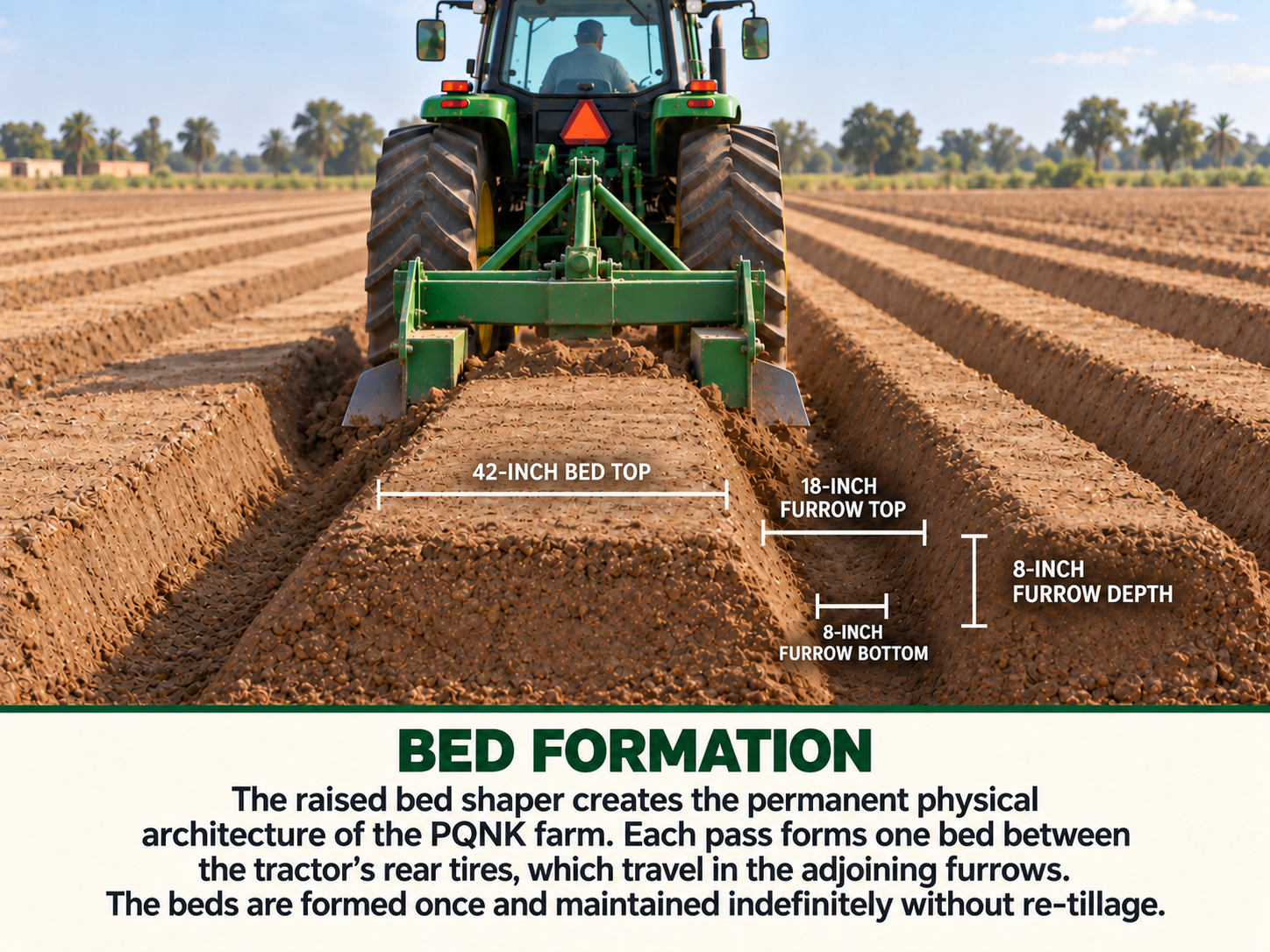
How irrigation is applied in PQNK: Water is delivered through the furrows only, never over the bed surface. The furrow carries water along the length of the field; from there, capillary action and the fractured soil profile distribute it laterally and upward through the bed. The critical rule is that the water level in the furrow must never exceed half the furrow depth. This is the threshold below which water does not flood the bed surface and above which it would inundate the root zone, drowning the aerobic soil biology that the entire PQNK system depends upon. A farmer who keeps the water at half-furrow depth is irrigating correctly. One who fills the furrow to the brim is reverting to flood irrigation and will see the consequences in deteriorating soil structure within a season.
THE NUTRIENT-HARVESTING EFFECT WITHIN THE RAISED BED
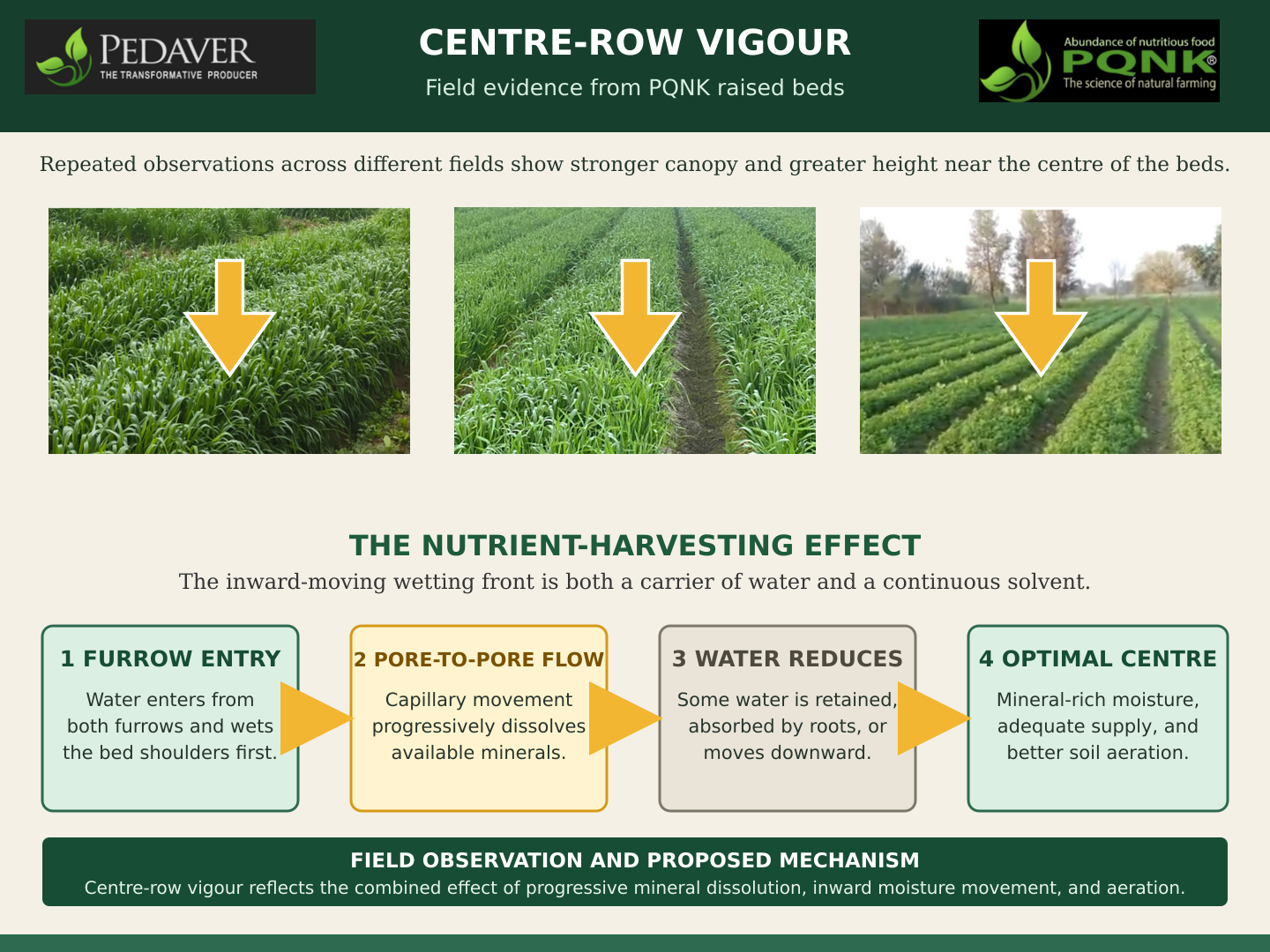
Water does not cross the raised bed as a chemically unchanged liquid. Water entering from each furrow first wets the bed shoulder and then advances laterally towards the drier centre through capillary forces. As this wetting front moves from pore to pore, it remains in continuous contact with mineral surfaces, organic matter, microbial products, and nutrient ions already released into the soil solution. Where these materials are soluble, the moving water progressively dissolves and mobilises additional minerals along its flow path.
The inward flow therefore becomes a nutrient-harvesting process. Some of the water is retained in smaller pores, absorbed by roots along the pathway, or drawn downward by gravity, while the remaining flow continues carrying the accumulated dissolved-mineral load. As wetting fronts advance from both furrows towards the middle of the bed, the central root zone can receive a comparatively nutrient-dense solution while remaining less saturated and better aerated than the soil immediately beside the furrows. The resulting combination of concentrated nutrition, sufficient moisture, and oxygen explains the repeatedly observed greater vigour and height of plants in the centre rows of PQNK raised beds.
Duration and frequency: Irrigation in a PQNK system runs until the subsoil moisture at the depth of the deepest roots is adequately charged, typically a shorter duration than conventional irrigation because the fractured profile distributes water more efficiently. Frequency decreases substantially as the system matures: a first-season PQNK field may still require irrigation at intervals not dramatically different from the conventional baseline, because the soil biological structure is still rebuilding. By the second or third season, the interval typically extends to two or three times the conventional frequency. In mature PQNK systems on adequately-rainfall regions, many farmers report eliminating irrigation entirely.
THE WATER SAVINGS: WHAT THE NUMBERS SHOW
The water savings achieved by PQNK Soil Moisture Management are not marginal improvements. They are structural reductions that arise from eliminating evaporative loss and storing rainfall in the soil profile. All water savings in a PQNK system come from one source: the elimination of evaporation from the soil surface. The crop itself uses exactly the same amount of water as a conventional crop of the same species, transpiration rates are determined by physiology, not farming system. What changes is how much extra water must be applied to compensate for what is lost before the crop can use it.
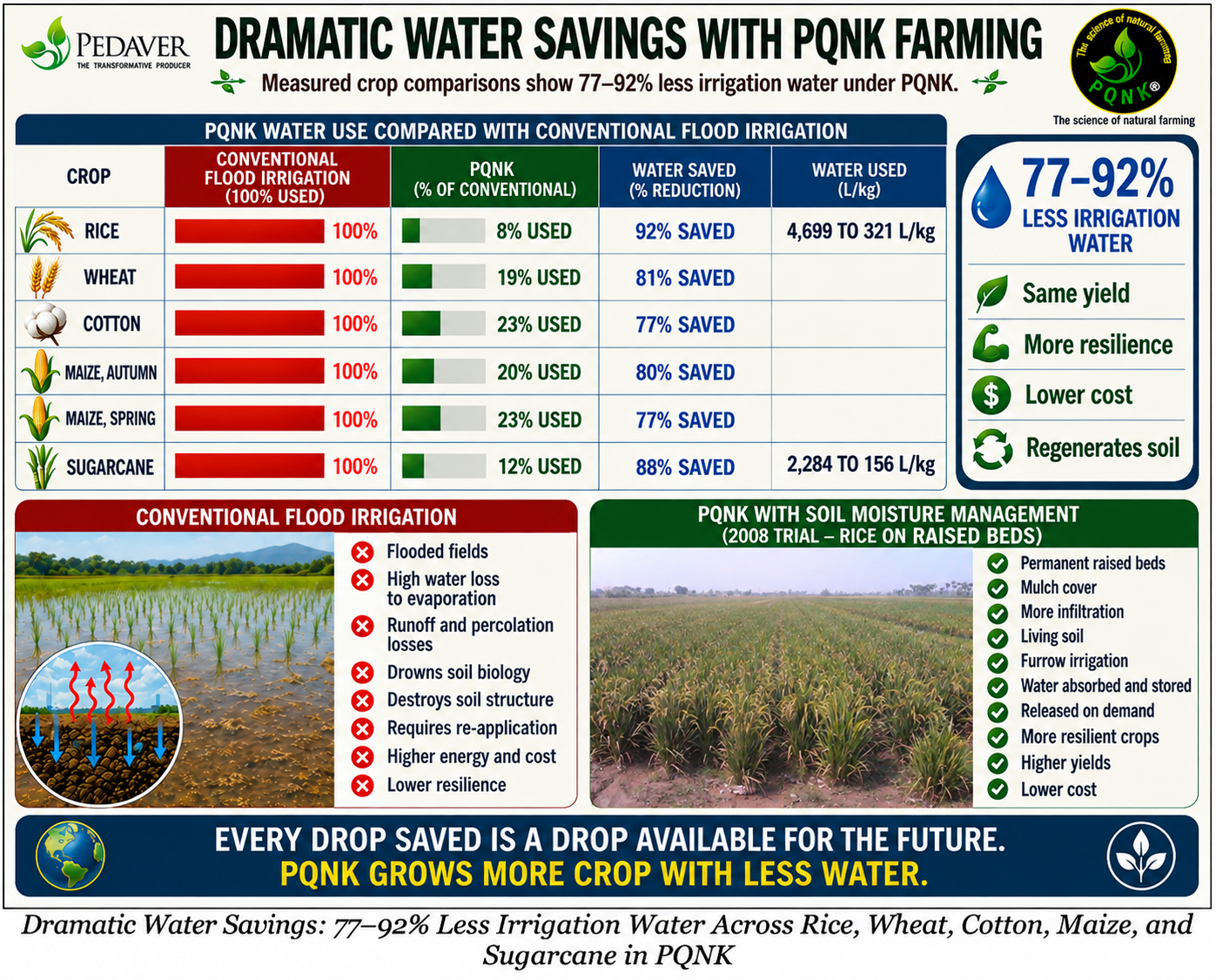
The following figures, derived from field observations across multiple PQNK farms, illustrate the scale of reduction achievable across major crops. These are directional comparisons; actual savings vary by soil type, climate, and stage of PQNK transition. In all cases, savings increase over successive seasons as soil biological structure continues to improve.
The rice figure deserves particular attention. Paddy rice, grown in flooded conditions, is the single most water-intensive crop in conventional agriculture, consuming approximately six and a half million (6,500,000) litres of water per acre per crop. PQNK's founding rice trial, transplanting young seedlings onto newly formed raised beds with furrow irrigation, cut that by seventy percent, a result documented in the peer-reviewed study published in the journal ‘Paddy and Water Environment’ in 2011, which also reported a yield of 12.84 tonnes per hectare, more than triple the regional average. Once the fuller PQNK protocol, hardpan fracture and permanent mulch cover, was added in the seasons that followed, water use fell further, to approximately five hundred thousand (500,000) litres, a ninety-two percent reduction, recorded in PQNK's own subsequent field records. The result has since been replicated across thousands of farms in Pakistan and adopted in Israel, Korea, China, and Thailand.
The sugarcane figure is equally striking. Sugarcane is typically grown with eight or more flood irrigations per crop cycle, each delivering enormous volumes of water across the field, because farmers have been taught that sugarcane is a water-guzzling crop. It is not. Under PQNK management, with permanent raised beds, thick organic mulch and furrow irrigation to half-depth, the documented fields in transition needed about four supplementary furrow irrigations, each delivering a fraction of the conventional volume, and even then many farmers irrigate by the calendar or out of fear rather than by the soil-ball test. The mulch layer’s moisture conservation means that the intervals between irrigations extend substantially. Once the beds mature, where annual rainfall is 400 mm or more, rain, dew, humidity and capillary rise carry the crop, and furrow water is given only when the ball test shows a need. PQNK sugarcane fields that have produced 2,800 maunds (about 112 tonnes) per acre have done so on this reduced water regime.
WATER, FLOODS, AND AQUIFER REPLENISHMENT
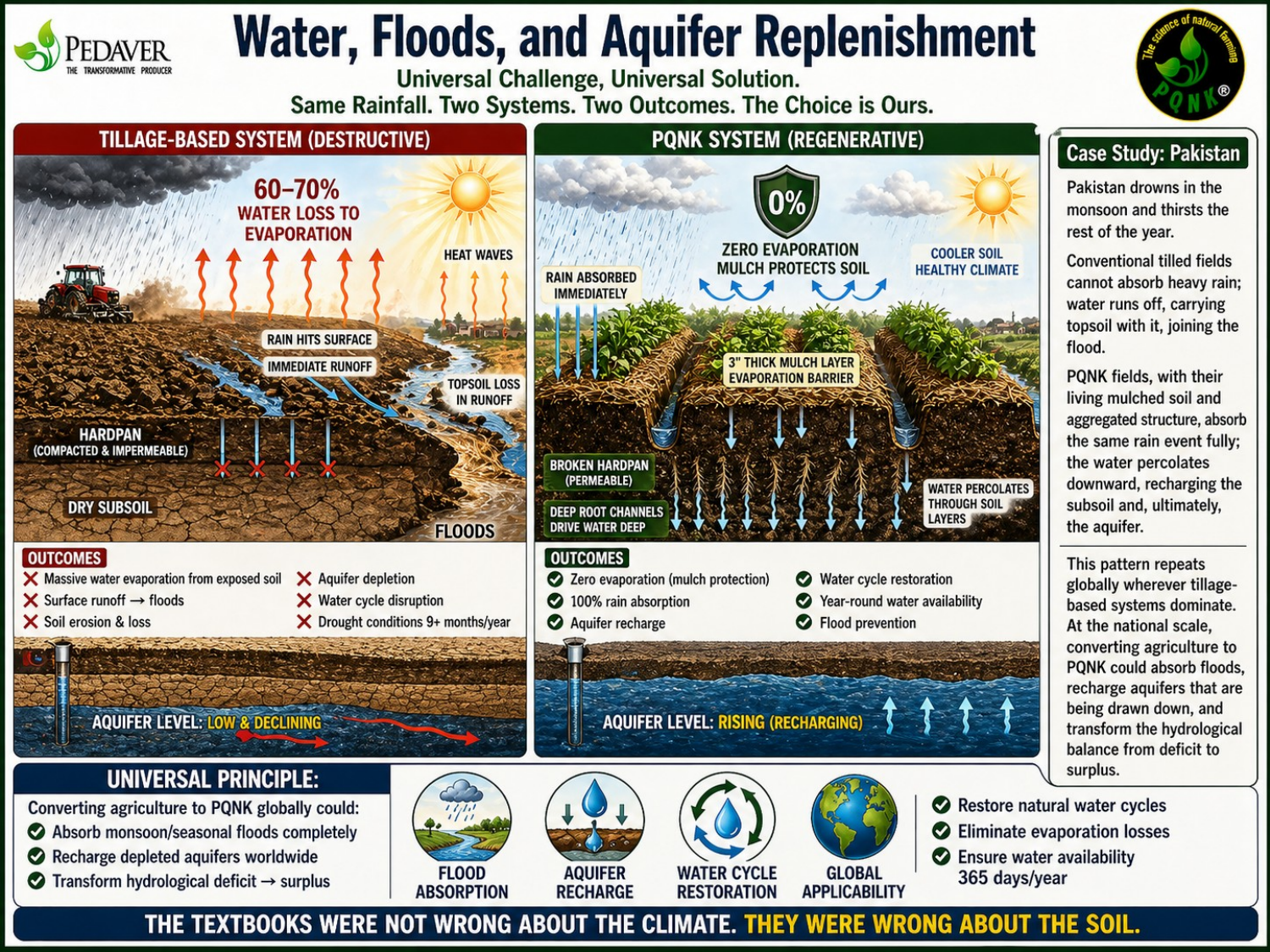
The water crisis is not only about the water that farmers use, in Pakistan or in any country where industrial agriculture has hardened the soil. It is about the water cycle at the landscape level: the interaction between rainfall, surface runoff, infiltration, aquifer recharge, and the atmospheric water cycle. ACI agriculture has disrupted this cycle at every point. PQNK restores it at every point. The consequences of this restoration extend far beyond the individual farm.
Flood mitigation. Pakistan’s recurring floods are not simply a consequence of heavy monsoon rainfall. They are amplified by the impermeability of agricultural soils. When monsoon rains fall on hundreds of thousands of acres of hardpan-sealed conventional fields, the water that cannot infiltrate runs off into drainage channels, combines with river flows, and creates flood volumes that the river system cannot accommodate. If those same acres had functioning PQNK soil, with fractured hardpan, restored aggregate structure, and a mulch layer that absorbs the kinetic energy of rainfall, a substantial proportion of the monsoon precipitation would infiltrate rather than run off. Flood peaks would be lower. The 2020 Sindh floods documented exactly this: PQNK fields absorbed the rainfall while adjacent conventional fields flooded. The difference was not the rainfall. It was the soil.
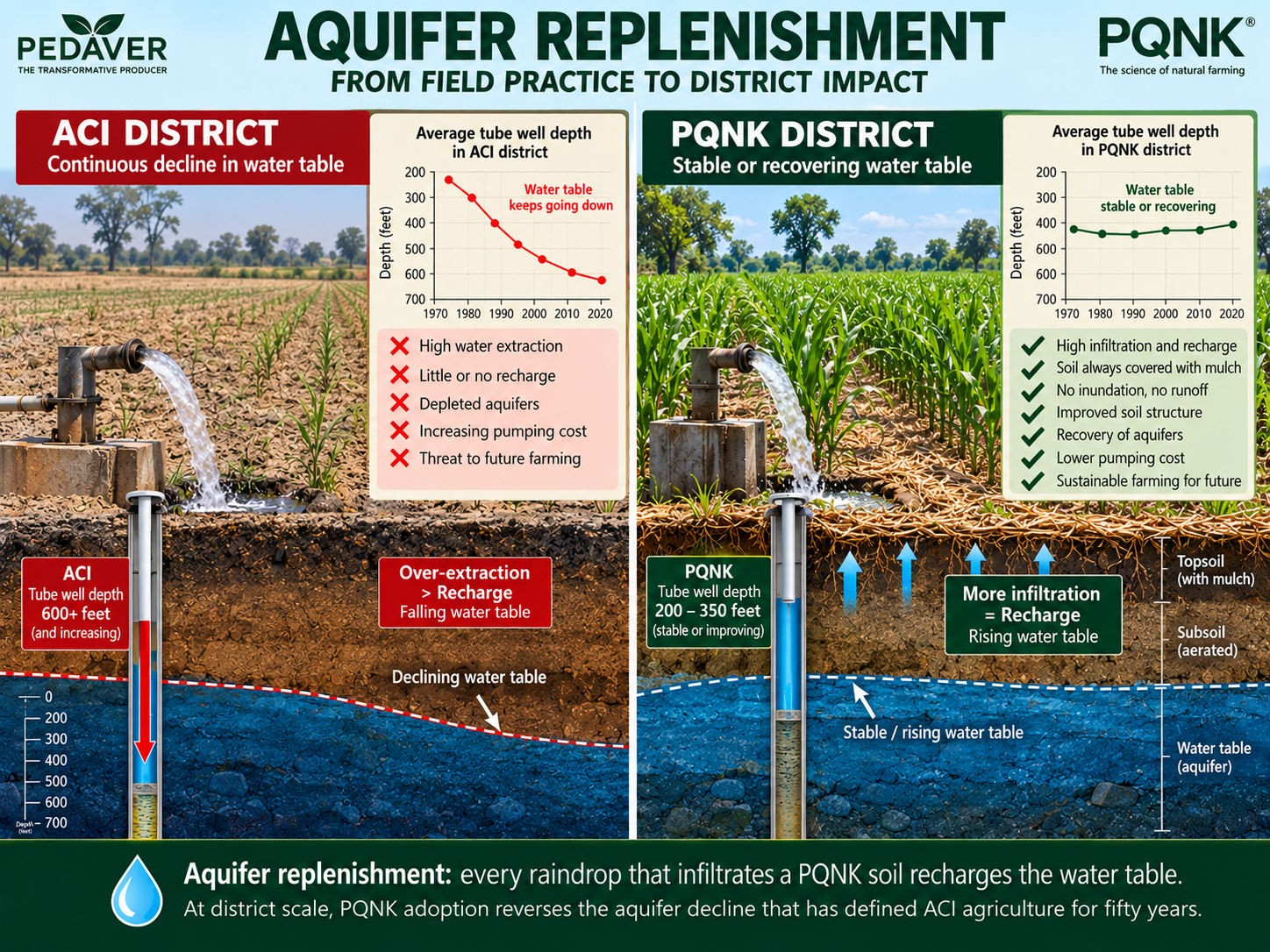
Water, Floods, and Aquifer Replenishment: Two Systems, Two Futures, ACI Depletes, PQNK Restores
Aquifer replenishment. Every litre of rainwater that infiltrates a PQNK field rather than running off is a litre that may eventually reach the groundwater table. The slow percolation of water through a biologically active soil profile, through root channels, earthworm burrows, and the pore network of well-structured aggregates, is the primary mechanism by which aquifers recharge naturally. ACI’s hardpan has effectively turned off this recharge mechanism across millions of acres of Pakistani farmland, while simultaneously increasing groundwater extraction to compensate for the irrigation demand created by the hardpan itself. PQNK reverses this: less water extracted from the aquifer, more water returning to it. In communities where PQNK has been adopted at scale, farmers have reported measurable rises in local water table depth within three to five years of transition.
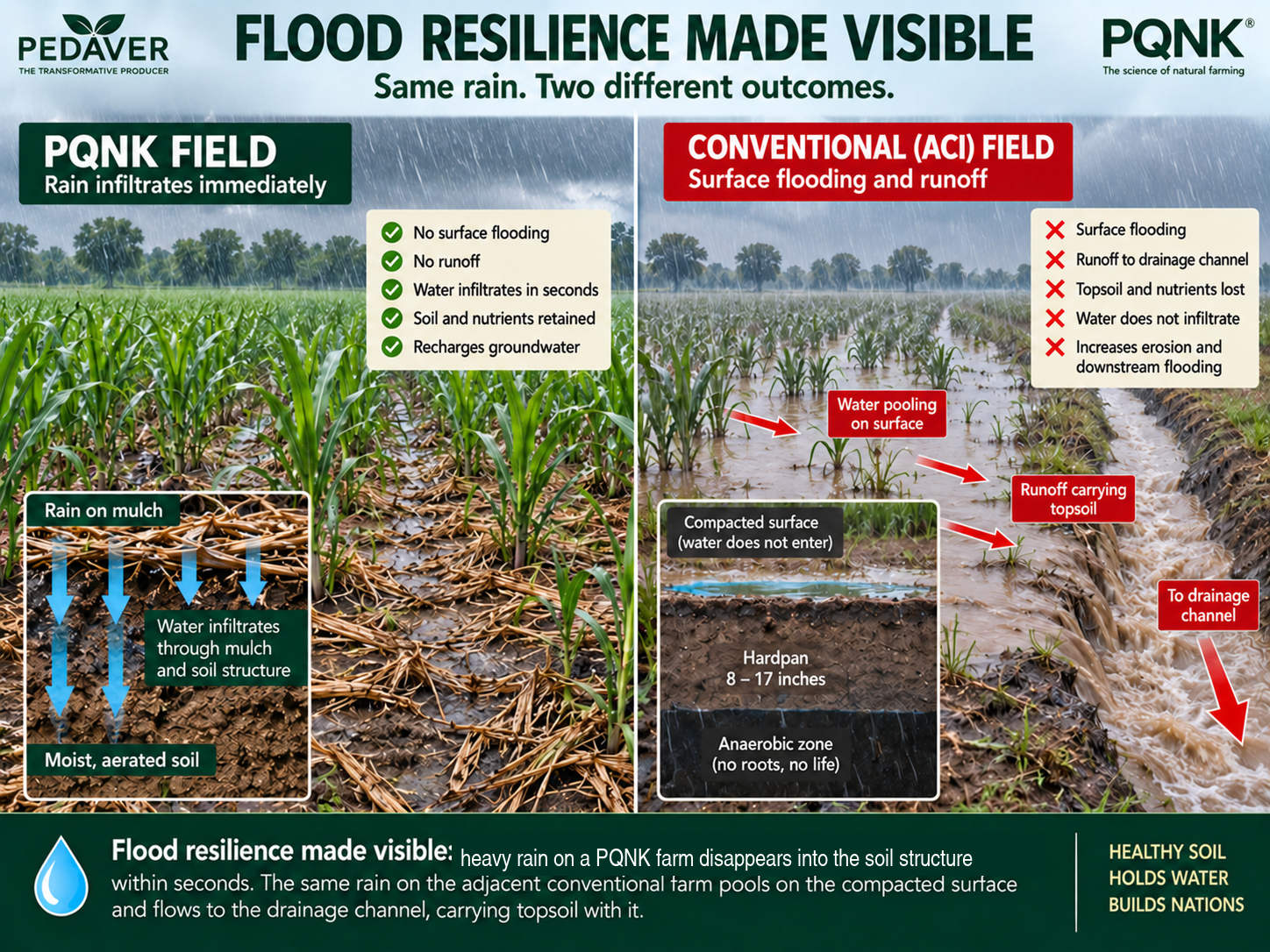
Drought resilience. The same soil structure that enables a PQNK field to absorb a heavy rainstorm also enables it to sustain the crop through a prolonged dry period. The subsoil moisture reservoir charged during the last rainfall event, deeper and more capacious in a PQNK field because the hardpan is absent, continues supplying the root zone via capillary rise for weeks or months after the last rain. The mulch layer prevents the surface from drying out completely, maintaining the capillary gradient that drives upward water movement. PQNK crops in Balochistan and the Pothohar plateau have survived multi-week dry spells that destroyed adjacent conventional crops, not because they received more rainfall, but because they held what they received.
Q How does PQNK use 77–92% less water than conventional irrigation while producing higher yields?
A PQNK uses supplementary furrow irrigation only when four natural sources, rain, dew, atmospheric humidity, and capillary rise, have been exhausted. Water applied to the furrow moves laterally by capillary action through the biologically fractured profile to the root zone. No evaporation. No waterlogging.
Q Why does flood irrigation require more water over time?
A Because flooding compresses the soil surface, destroys aggregate structure, eliminates the biological pore network, and seals the surface against infiltration. Each flood makes the next less efficient. PQNK does the reverse: each season the profile becomes more permeable and water retention higher.
PQNK CONTOUR LINE FARMING: SLOPING AND RAINFED LAND
The PQNK water management system described in this chapter applies in its standard form to irrigated flatland agriculture, the dominant farming context across the canal-irrigated plains of South Asia, Punjab and Sindh among them. But a significant proportion of that farmland, and of agricultural land worldwide, is on rolling or sloping terrain where conventional laser leveling is not appropriate and where rainfall, not irrigation, is the primary or sole water source.
For such land, PQNK has developed the Contour Line Farming approach, a system specifically designed for slopes that captures and infiltrates rainfall without leveling the terrain, prevents erosion, and enables productive farming on land that is currently either unused or highly degraded by conventional practices. The complete protocol for contour farming is documented in the PQNK knowledge paper ‘Contour Line Farming through the PQNK Lens,’ and will be treated in detail in the crop and regional chapters that address rain-fed farming contexts. The principles are the same: restore the soil’s infiltration capacity, eliminate bare soil, and allow the natural water cycle to function. The implementation adapts to the terrain.
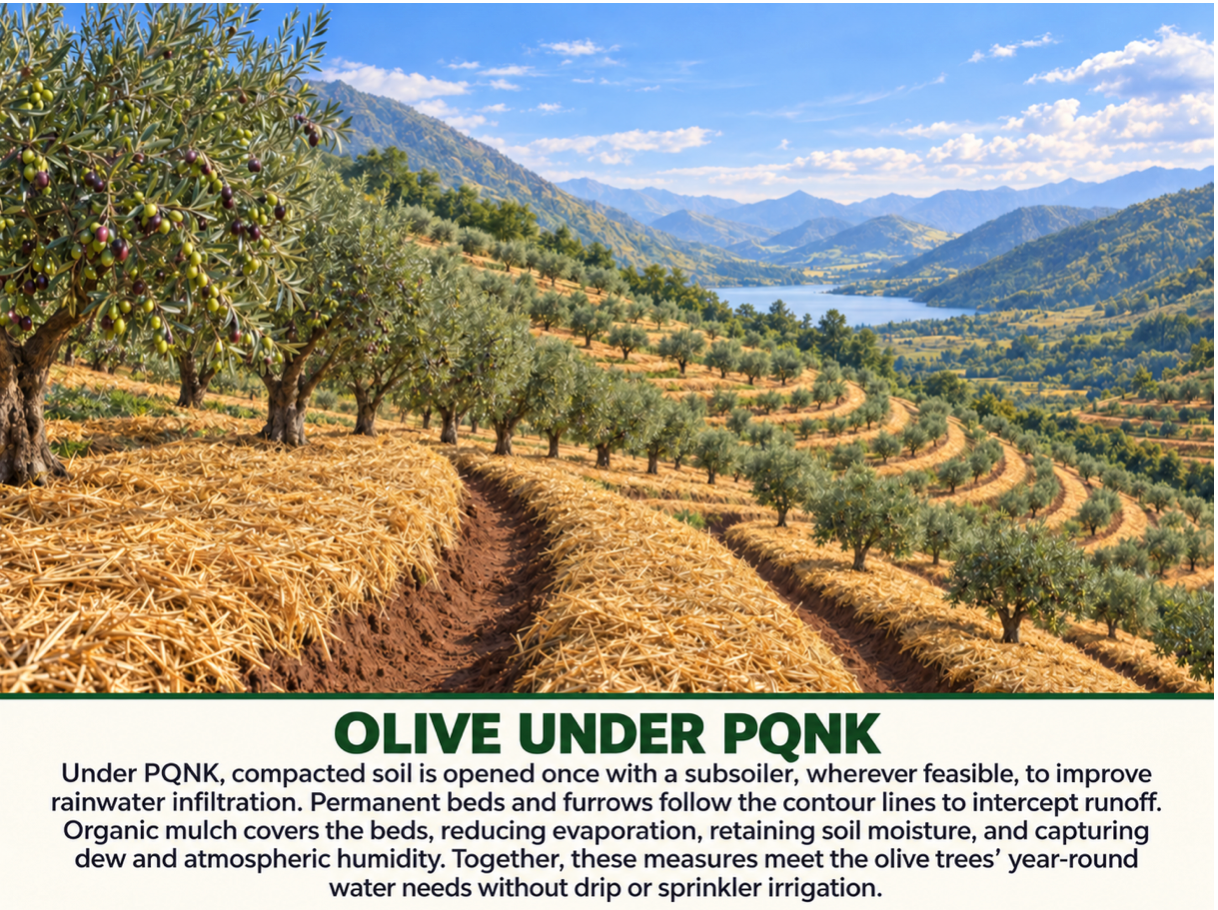
For olive cultivation on sloping rainfed land, PQNK applies the same natural water principles through contour-aligned permanent beds and furrows. Where feasible, compacted soil is opened once with a subsoiler so rainwater can enter the deeper profile. The beds and furrows follow the contour lines rather than the downhill gradient, interrupting runoff and giving rainfall time to infiltrate. Organic mulch covering the beds reduces evaporation, retains soil moisture, and captures dew and atmospheric humidity. Together, these measures meet the olive trees’ year-round water needs without drip or sprinkler irrigation.
THE CLIMATE CONNECTION: WATER VAPOUR AND THE PQNK SOLUTION
The water crisis and the climate crisis are not separate problems. They are expressions of the same root cause: a global agricultural system that has converted hundreds of millions of hectares of biologically functional soil into biologically impoverished hardpan, driving water that should be stored in the soil into the atmosphere instead.
Water vapour is the most abundant and most potent greenhouse gas in the atmosphere, far more significant in its warming effect than carbon dioxide over short time horizons. When vast areas of bare agricultural soil evaporate their moisture under direct solar radiation, they are not merely wasting water. They are loading the atmosphere with water vapour that both warms the climate and intensifies precipitation events, creating the pattern of more extreme floods and more extreme droughts that is now observable across agricultural regions worldwide. The irrigation that conventional farming requires to compensate for this evaporative loss further depletes aquifers, reducing the landscape’s capacity to moderate climate extremes.
PQNK addresses this atmospheric feedback directly. By covering every soil surface with organic mulch, it eliminates the evaporation that loads the atmosphere with unproductive water vapour. By restoring infiltration, it returns water to the geological storage system rather than the atmospheric one. By reducing irrigation water use by seventy-seven to ninety-two percent across the documented crop comparisons, and sometimes eliminating supplemental irrigation in adequately rainfed settings, it reduces the groundwater extraction that was itself a source of eventual evaporation. A landscape of PQNK-managed farms is a landscape that retains its water in the ground and in the crops, not in the air above it. In a world where climate disruption is being driven substantially by the water cycle consequences of agricultural mismanagement, this is not a minor agricultural improvement. It is a systemic correction.
The solution to the water crisis is not more canals, deeper tube wells, or more efficient irrigation hardware. It is three inches of organic mulch on every raised bed, and the restoration of the soil biology that makes the rain that already falls do everything the crop requires.
WHAT THE FARMER OBSERVES: SIGNS OF WATER SYSTEM RECOVERY
As with carbon recovery, the restoration of the soil water system under PQNK management is not invisible. The farmer can observe it directly, without instrumentation, through a series of progressive changes that appear in a reliable sequence as the system matures.
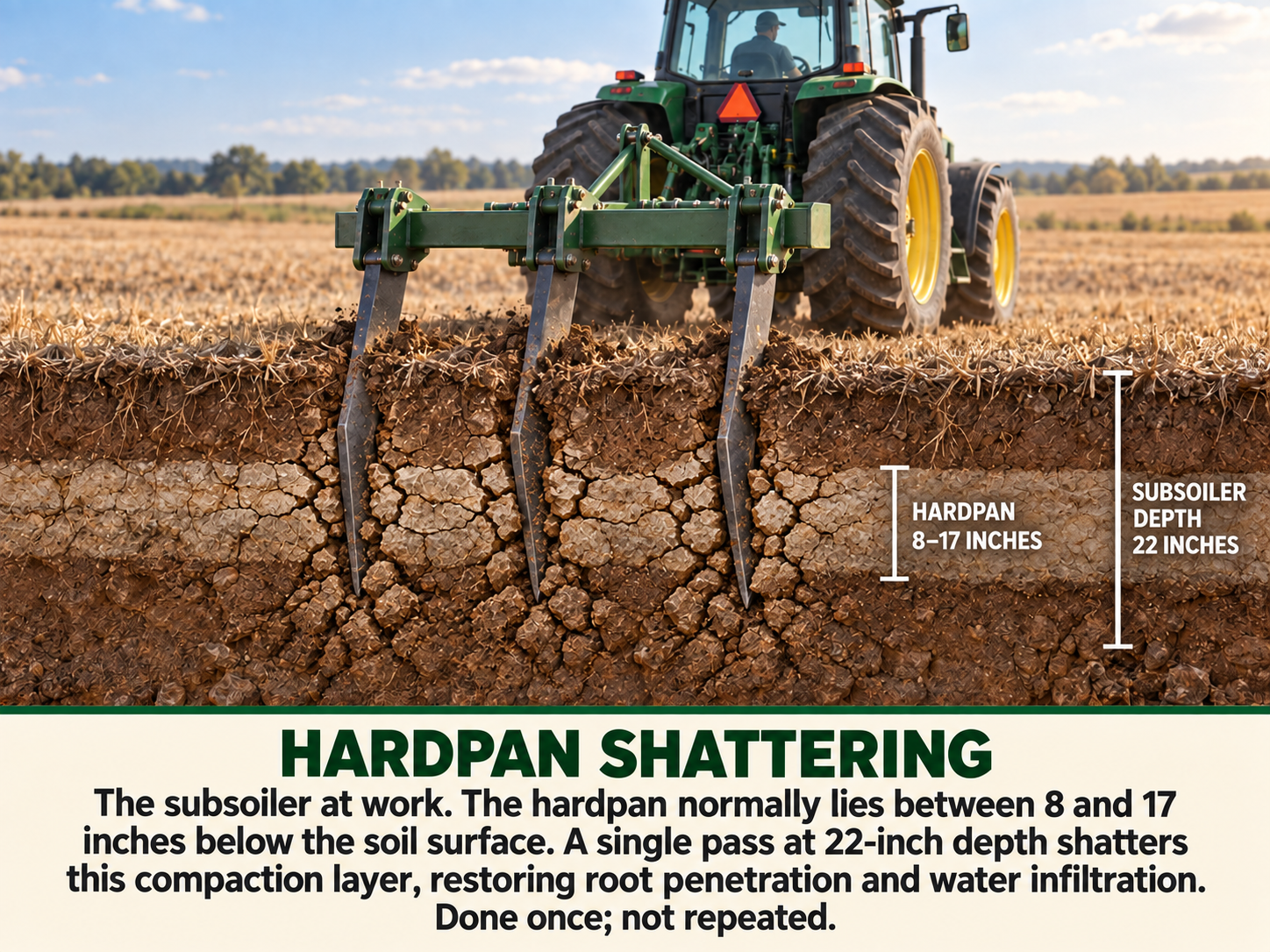
First season: After the initial hardpan shattering and bed formation, the most immediate observable change is in rainfall response. A heavy rain that previously caused ponding and runoff disappears into the soil within hours. The bed surface, covered with mulch, shows no puddling or crusting. The furrows drain cleanly rather than remaining waterlogged. The farmer finds that the first irrigation can be delayed beyond the conventional interval, perhaps by a week initially, without visible crop stress.
Second season: The irrigation interval extends more noticeably. The farmer observes that the soil at depth remains moist for longer after each irrigation or rainfall event. Morning dew is visibly retained on the mulch surface and is gradually absorbed into the soil. The crop shows less afternoon wilt than it did in the first season under equivalent conditions. Water used per irrigation event begins to decline as the distribution efficiency of the restored pore network improves.
Third season and beyond: In regions with adequate rainfall, irrigation may become infrequent or unnecessary. In drier regions, water usage has typically fallen to a fraction of the conventional baseline. The farmer begins to observe that crops recover quickly from dry spells that would previously have required emergency irrigation. Earthworms, visible in the soil when the bed is disturbed, confirm that the biological water management infrastructure is rebuilding. In some fields, a subtle greening of the landscape around PQNK farms, the result of moisture migrating from the charged soil profile into the surrounding environment, becomes visible to neighbouring farmers and has been the single most persuasive demonstration of PQNK’s water management capability.
WHAT THIS CHAPTER HAS ESTABLISHED
Water scarcity across the agricultural world is not a natural condition. It is an agricultural consequence, the result of practices that prevent rainfall from entering the soil, evaporate the water that does enter, and extract groundwater faster than it can recharge. The crisis is real and urgent. But it is not irreversible, and it does not require the engineering solutions that continue to be proposed and funded at enormous cost without addressing the underlying cause.
PQNK restores the soil’s capacity to receive, store, and distribute water through four mechanisms acting simultaneously: hardpan fracturing that enables deep infiltration; organic mulch that eliminates evaporative loss; restored aggregate structure that maximises water-holding capacity; and the capillary system that continuously distributes stored water to the root zone between rainfall or irrigation events. The result is a farm that captures all four natural water sources, rain, dew, humidity, and capillary rise, and uses irrigation only when all four are insufficient.
The water savings documented across PQNK farms range from seventy-seven to ninety-two percent depending on crop, with rice showing the most dramatic reduction. These savings are not efficiency improvements; they are structural changes in the farm’s water relationship. At landscape scale, widespread PQNK adoption would reverse aquifer depletion, reduce flood intensity, improve drought resilience, and reduce the atmospheric water vapour loading that is a significant contributor to climate disruption.
The next chapter turns from water to the biological pest protection system that is the third pillar of PQNK’s no-input production capability: the BT bacteria, the natural predator network, and the plant immune system that makes pesticides not merely unnecessary but counterproductive in a functioning ecosystem.
Chapter Six: Nature’s Pest Protection, BT Bacteria, the Living Immune System