

Industrial Devastation To Natural Abundance
The Original System · Chapter 4
Carbon: The Currency of Life
Release 1.0 · 2026-09-04
If you use “Listen”, the text of the page may be sent to your browser or operating system’s speech provider, such as Apple, Google or Microsoft, depending on the voice your device uses. Pedaver does not process, transmit or store any audio.
“The farmer who burns his crop residue is burning his bank. He is converting years of biological investment into smoke and calling it convenience. The soil beneath that fire will remember what was taken from it long after the farmer has forgotten he took it.”
Asif Sharif, Lahore, 2022
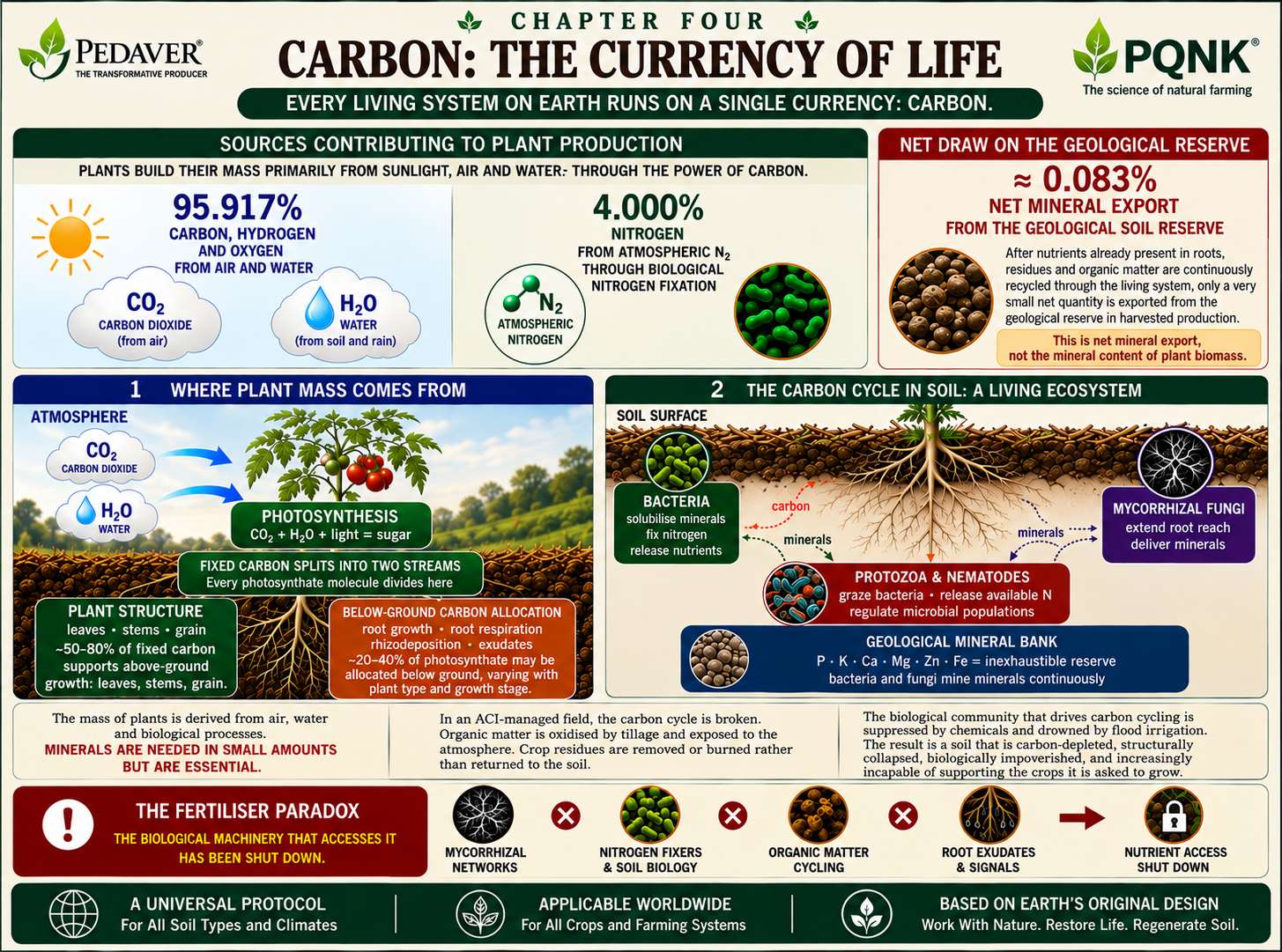
Every living system on Earth runs on a single currency: carbon. Not money, not oil, not water, carbon. The carbon atom, with its four bonding sites and its extraordinary versatility as a structural element, is the backbone of every protein, every sugar, every fat, every hormone, every enzyme, every strand of DNA that has ever existed in any living organism on this planet. Without carbon cycling continuously through the system, from atmosphere to plant to soil to atmosphere again, there is no life. There is no fertility. There is no food.
In an ACI-managed field, the carbon cycle is broken. Organic matter is oxidised by tillage and exposed to the atmosphere. Crop residues are removed or burned rather than returned to the soil. The biological community that drives carbon cycling is suppressed by chemicals and drowned by flood irrigation. The result is a soil that is carbon-depleted, structurally collapsed, biologically impoverished, and increasingly incapable of supporting the crops it is asked to grow. This is not a metaphor. It is chemistry. And its reversal, through the PQNK carbon management system, is the foundation upon which every other aspect of PQNK biological recovery rests.
It is worth being clear at the outset about what a crop actually produces. The grain, fruit or fibre a farmer carries off the field is one destination of the carbon the plant fixed, not the whole of it. The same photosynthesis also built the leaves and stems, fed and maintained the roots, paid for the plant's defensive chemistry, supported the insects, animals and microorganisms that live with it, and passed a large share of its output into the soil. A plant did not evolve to manufacture a harvest for one species. It evolved inside a biological community, and its captured carbon has many destinations. The harvested portion is the one we measure; it is not the one the plant is working hardest to produce.
This chapter explains the carbon cycle in the terms that matter most to the farmer: where carbon comes from, where it goes, what it does when it arrives in the soil, what happens when it is lost, and how PQNK restores and maintains the carbon flows that make everything else, fertility, water retention, pest resistance, structural integrity, possible.
CARBON’S JOURNEY: FROM SKY TO SOIL
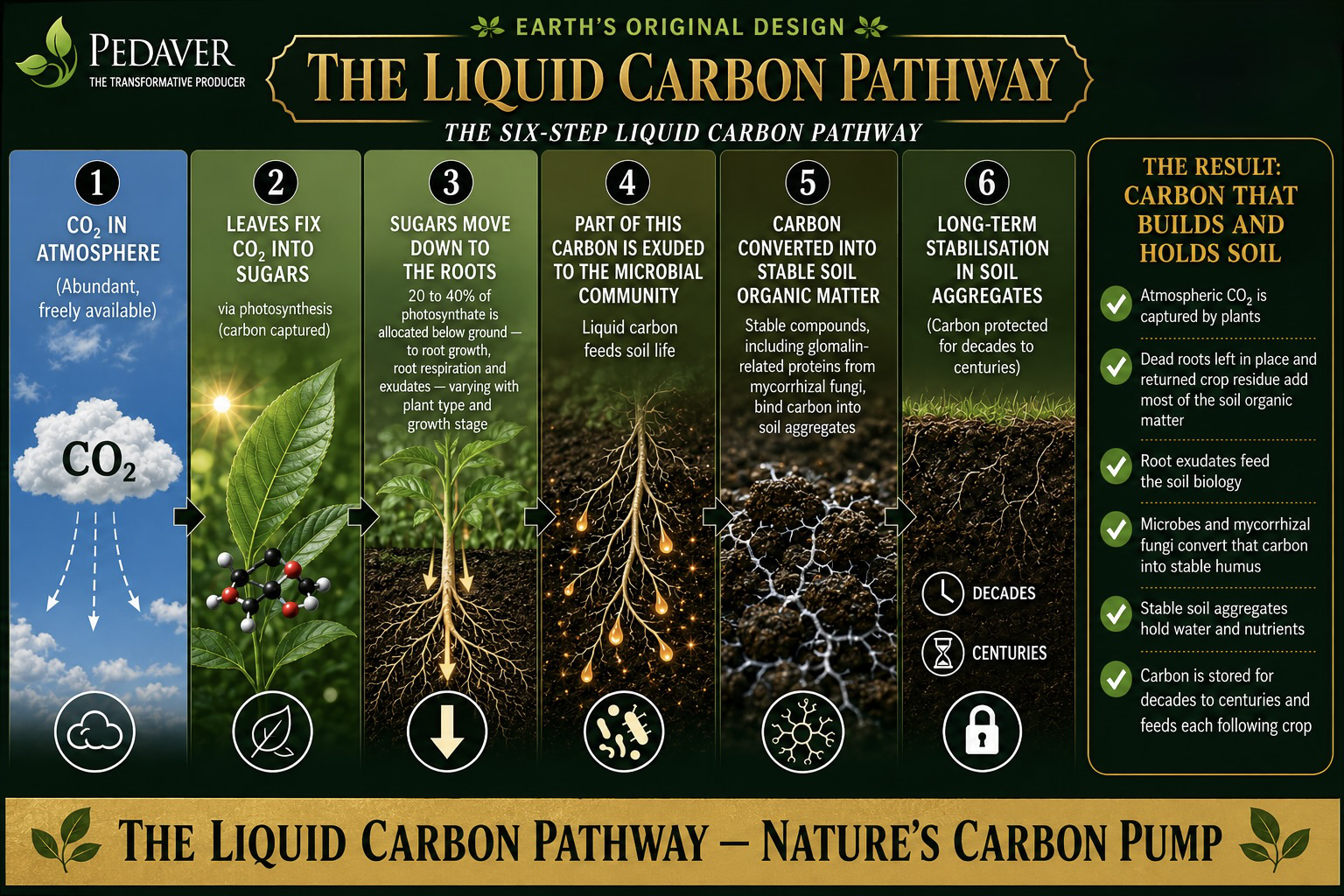
The carbon cycle in a farm ecosystem begins in the atmosphere. Carbon dioxide, CO₂, currently present in the atmosphere at approximately 0.04 percent by volume, is absorbed through the stomata of plant leaves during daylight hours. Inside the leaf, in the chloroplasts of the mesophyll cells, the energy of sunlight drives the fixation of carbon dioxide. The first stable product is a three-carbon acid, 3-phosphoglycerate; it is then reduced, using that captured energy, to glyceraldehyde-3-phosphate, the first three-carbon sugar and the building block from which the plant constructs every other organic molecule it needs. This is photosynthesis: the conversion of atmospheric carbon and solar energy into biological material. It is the foundational productive act of all terrestrial life.
What is less commonly understood, and what is critical to understanding PQNK, is what happens to the carbon after it is fixed. The intuitive assumption is that the plant keeps the carbon it captures and uses it to build itself. In part this is correct: carbon goes into leaves, stems, grains, and roots. But the plant retains only as much as it needs for its own growth and reproduction. The surplus is sent down through the phloem into the root zone, where it pays for root growth and root respiration and passes into the soil as exudates, as sloughed root cells, and as root and residue material that decomposes in place. Estimates of how much of a plant’s total fixed carbon is committed below ground, all of these pathways together and not exudates alone, range from twenty to forty percent. The range is wide because the figure depends on the crop and its growth stage, on soil temperature, on the air and water balance of the soil, and on anything that removes leaf area and resets the plant’s carbon budget, grazing, pruning, and insect feeding among them. What matters for the farmer is the direction of the flow. A leaf takes in carbon dioxide and fixes the carbon into sugar. That carbon is then either used above ground, by the plant and by the animals, insects, and microbes that feed on it, or it moves into the soil. Once in the soil it does not simply stay put. A living soil breathes: carbon is always entering it, circulating through the biology, being transformed, and returning to the air as the soil respires. PQNK does not stop that cycle. It keeps the inputs flowing, through roots, residues, and living cover, while withholding the practices that force the losses wide open, tillage, burning, a bare overheated surface, flooding, and compaction. When the inputs are steady and the avoidable losses are shut off, enough carbon is retained and stabilised for the soil to rebuild. That is the discipline in one line: keep feeding the soil, and stop tearing its withdrawals open.
Carbon fixation and the plant's immediate need for growth are not always in step. When water, nutrients, temperature or the plant's own stage of development limit how fast it can build new tissue, photosynthesis does not stop; the leaf keeps capturing carbon while structural growth waits. In those periods the plant holds more fixed carbon than it can immediately use above ground. That surplus is not wasted. It is stored, put into protective compounds, sent down to the roots, released into the soil, or handed to the microorganisms working around the root. This is why the carbon economy of a healthy plant can be substantially larger than the crop it sets, and why a PQNK field that keeps its plants unstressed and photosynthesising for longer feeds the soil more, not less.
The plant is, in economic terms, a solar-powered factory that captures atmospheric carbon as raw material, processes it into biological products, and then reinvests a major portion of its profit into the infrastructure, the soil biological community, that will determine how productive the factory can be next season. This investment is so fundamental that it has been called the primary driver of soil biological activity: the fuel that powers the entire soil food web. Without the carbon flowing from plant roots into the soil, the microbial community has nothing to eat, nothing to build with, and no energy to drive the nutrient cycling processes that keep the plant alive.
WHAT SOIL CARBON DOES: THE FOUR FUNCTIONS
Carbon in the soil performs four distinct and equally essential functions, each of which is measurably compromised in ACI-managed fields and measurably restored in PQNK fields. Understanding all four is necessary for seeing why carbon is not just one item on a list of soil-health factors. It is the currency the whole living system runs on, at once a driver of biological function and a result of it. It does not act alone: living roots, the microbial community, soil structure, the balance of water and air, biodiversity, and steady temperatures all work with it.
Function One: Feeding the microbial workforce. A large part of the soil food web depends, directly or indirectly, on organic carbon that the plant supplies. Most of these organisms cannot fix carbon from the air for themselves; they run on carbon compounds that reach them from outside. In a productive soil that source is the crop: root exudates during the growing season, and decomposing residues and roots through the rest of the year. Without a continuous supply of organic carbon, the microbial community declines. Bacteria populations crash. Fungal networks contract. Protozoa and nematodes, deprived of their bacterial and fungal prey, disappear. The nutrient cycling machinery, the system that accesses the mineral bank held in the local soil profile, fixes atmospheric nitrogen, suppresses pathogens, and builds soil structure, shuts down proportionally to the carbon available to power it. A soil that runs out of carbon runs out of biology, and a soil that runs out of biology runs out of fertility.
Function Two: Building and stabilising soil structure. Soil carbon is the primary structural material of the soil aggregate, the fundamental unit of soil architecture.
Bacterial polysaccharides and fungal glomalin, both carbon-rich biological compounds, are the glues that bind mineral particles into the stable aggregates that give soil its characteristic crumbly, porous texture. Without these carbon-based biological glues, aggregates break apart. Soil particles disperse when wet, seal the surface, block infiltration, and compact under the weight of rainfall or machinery. The structural collapse of ACI soils, the hardpan, the surface crusting, the waterlogging, is, at its chemical foundation, a carbon deficit problem. The soil has lost the carbon-based biological compounds that held it together.
Function Three: Holding water. Soil organic matter, the complex mixture of living organisms, fresh plant residues, and well-processed carbon that constitutes the carbon fraction of the soil, is extraordinarily effective at absorbing and retaining water. Organic matter changes how a soil handles water out of all proportion to its weight. Because dry organic matter is very light and bulky, even a rise of one or two percent by weight takes up a disproportionate share of the soil’s volume, lowers its bulk density, and binds mineral particles into aggregates that create and hold the medium-sized pores where plant-available water sits. Organic matter also takes up water directly, holding several times its own dry weight, but the greater part of its effect is structural: a soil richer in organic matter absorbs more of each rainfall and irrigation and releases it to roots more slowly. A soil with three percent organic matter holds substantially more plant-available water than the same soil at one percent organic matter, the difference can mean the survival of a crop through a dry spell without irrigation. In the Punjab soils that have been degraded from three to four percent organic matter in the 1950s to below one percent today, this loss of water-holding capacity is a primary driver of irrigation dependency: the soil cannot hold enough rainfall to sustain the crop between events, so the farmer must irrigate at intervals that the original soil would have managed without assistance.
Function Four: Sequestering atmospheric carbon. Soil is the planet’s largest terrestrial carbon reservoir, containing roughly three times more carbon than the atmosphere and several times more than all living vegetation combined. When carbon is added to soil faster than it is respired away, which is what happens in a PQNK system with continuous mulch, intact root systems, and active biology, the soil holds a net gain: it takes in more carbon dioxide than it releases, and part of that gain moves into stabilised forms, protected inside aggregates and bound to mineral surfaces, that can stay put for decades or longer. When carbon leaves the soil faster than it is added, which is what happens with every tillage event, every burning of crop residue, every long spell of bare soil, the soil becomes a net source, releasing carbon dioxide back to the atmosphere and adding to the climate disruption that threatens agriculture globally.
STABLE SOIL CARBON: THE LONG-TERM BANK
Not all soil carbon is equal. The organic matter in soil exists along a spectrum of stability, from fresh plant residues that decompose within weeks, to well-protected carbon that can persist in the soil for decades or longer. Understanding this spectrum is essential for the PQNK farmer, because managing soil carbon means managing not just the quantity of carbon inputs but their quality and their fate.
At the labile end of the spectrum sit the fresh organic materials: recently deposited mulch, living root exudates, freshly dead microbial cells. These are rapidly decomposed by bacteria and fungi, releasing their nutrients back into soil solution and producing energy that drives microbial activity. This labile fraction is the immediate food supply for the soil biological community, the weekly wage, so to speak, that keeps the workforce active.
At the stable end sits what farmers have always called humus: the dark, well-processed carbon that stays in the soil the longest. It lasts not mainly because it is a special chemical that microbes manufacture, but because of where it ends up. Fresh plant material is fed on and reworked by the soil biology into fine particles, and those particles become bound inside aggregates and stuck onto clay and mineral surfaces, out of easy reach of the organisms that would otherwise consume them. Protected that way, different fractions of soil carbon turn over on very different timescales, from a single season to many decades. This long-lasting carbon holds water, helps hold the aggregates together, feeds nutrients back slowly, and adds substantially to the soil’s Cation Exchange Capacity, its ability to keep positively charged minerals in a form roots can take up.
Between the labile and stable ends of the spectrum lies the active fraction of soil organic matter, partially decomposed materials that are still undergoing transformation, that feed the microbial community at a moderate rate, and that gradually contribute to the stable pool. Managing these three fractions, labile, active, and stable, is, in essence, what the organic mulch system of PQNK is designed to do.
The goal of PQNK carbon management is not to maximise any single carbon input, but to maintain a continuous flow of diverse organic materials through all three fractions simultaneously, feeding the immediate biological workforce, building the active transition pool, and accumulating the stable bank that makes every subsequent season more productive than the last.
The rate at which this happens surprises farmers who have been told that building soil takes generations. A large share of everything a crop grows is put below ground, into roots and the carbon they release, and how large that share is varies widely with the species, the growth stage, the soil, and the growing conditions. Under PQNK that entire below-ground portion is left in place. Most of the above-ground growth that is not carried off as harvested grain or fibre goes back onto the same field as mulch. Between the two, most of the plant biomass not removed in the harvest returns to the soil carbon pool, and the roots leave behind a network of pores and channels the next crop grows into. Because the mulch holds soil temperature within the biological range, that returned carbon is not flashed back off to the air by an overheated surface the way it is on bare ground. And because breaking the hardpan lets roots proliferate to many times their former depth and density, the quantity of root carbon delivered rises sharply from the first season. Whole-plant return, protection from oxidation, and a multiplied root system together push soil organic matter upward within the first years of transition, and the gain compounds: each season’s higher organic matter supports more biology, deeper roots, and a larger return the season after.
HOW ACI AGRICULTURE DESTROYS SOIL CARBON
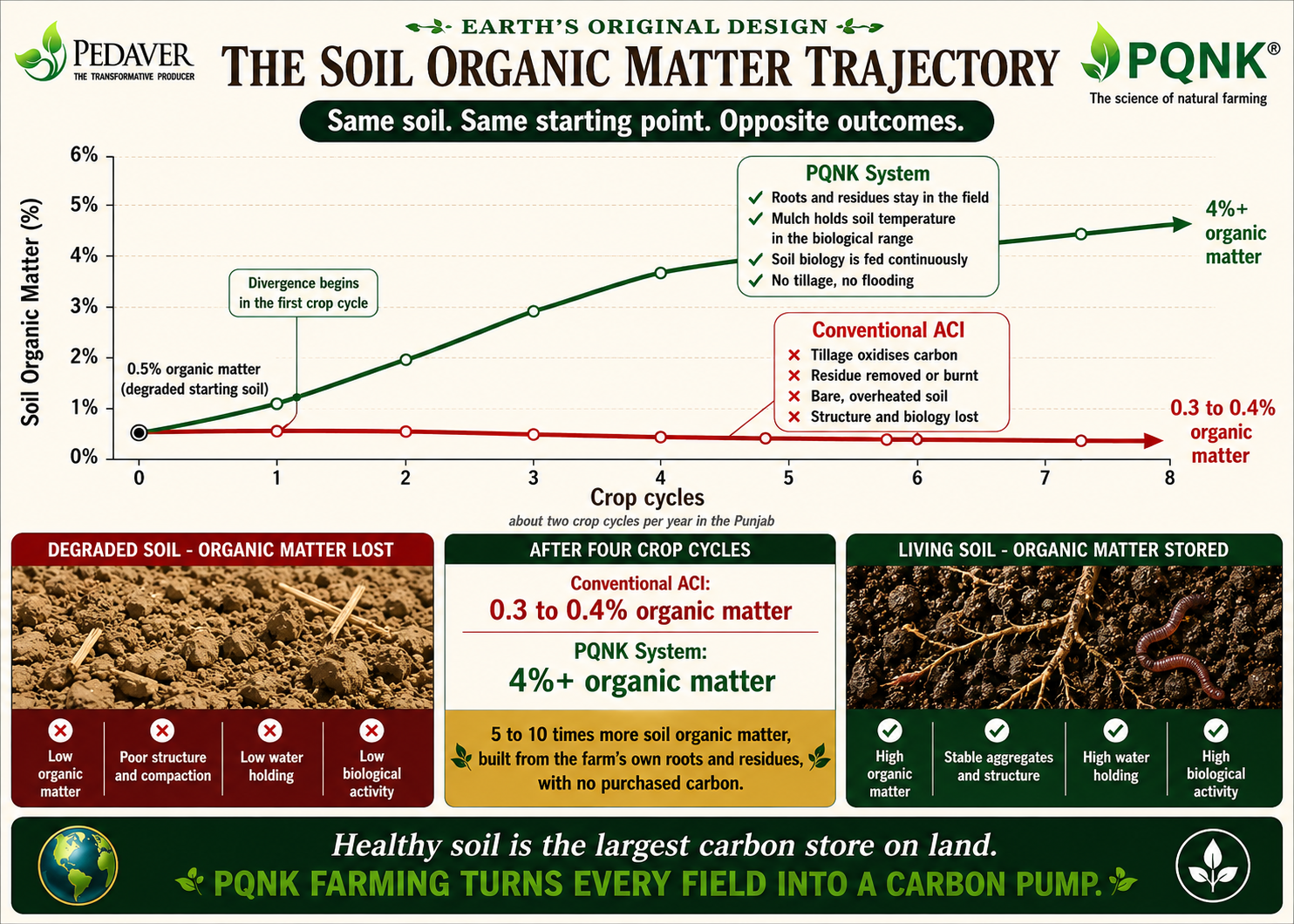
The loss of soil carbon under ACI management is not a slow, natural wearing-down. It is a mechanically driven collapse. Every tillage pass breaks open the aggregates that physically shield organic matter and exposes that carbon to rapid oxidation; every spell of bare fallow leaves the surface unshaded through the hottest months. On a tilled, bare field in the Punjab summer, where PQNK measurements have put the soil surface at sixty-five to seventy-two degrees Celsius, the organic material in the top few centimetres is not lost over seasons but within days to weeks. Repeated year after year, this hollows the soil out. The Punjab soils of Pakistan show the whole trajectory: from roughly three to four percent organic matter in the 1950s to below one percent across large areas today, about three-quarters of the soil’s carbon gone in sixty years of continuous ploughing, residue removal and bare summer fallow. A soil left in that state recovers only over a very long time on its own. Under PQNK, with the tillage stopped, the surface kept covered, and the roots and residues returned, the same rebuild takes only a few crop cycles.
Tillage oxidation. When a plow or rotavator turns the soil, it does three things to carbon simultaneously. It physically breaks apart the soil aggregates that protect organic matter from microbial decomposition, exposing previously protected carbon to immediate biological breakdown. It incorporates oxygen into the soil profile, stimulating the aerobic decomposition of organic matter at a rate far exceeding natural carbon inputs. And it severs the mycorrhizal networks whose glomalin production is one of the primary contributors to stable carbon formation. A single tillage pass can mineralise and release as carbon dioxide organic matter that the soil took years to accumulate. Repeated annually, tillage ensures that the soil can never build a stable carbon reserve.
Crop residue removal and burning. In ACI systems, the harvest removes the grain and often the straw, either mechanically collected or grazed by livestock, and the remaining residue is frequently burned before the next planting. This practice removes the primary source of fresh carbon input to the soil in a system where living roots are already being cut short by tillage. Without residue return, the soil receives little fresh organic matter to replace what tillage oxidises, and the carbon balance runs steadily negative: more is lost through tillage oxidation than is returned by any remaining biological pathway. Burning is the most acute form of this loss: flame temperatures in a crop fire, five hundred to eight hundred degrees Celsius, pass across the soil surface, killing the surface biological community and converting years of biological carbon investment to carbon dioxide in minutes.
Bare soil exposure. Between crops, ACI fields are typically left bare, no cover crop, no mulch layer, no living vegetation. In the Punjab summer, when midday air temperatures run between forty-five and fifty-two degrees Celsius, the surface of that bare soil, under direct solar radiation, reaches sixty-five to seventy-two degrees in the PQNK field measurements. At those temperatures the surface layer of organic material, the most biologically active and most carbon-rich zone of the profile, is effectively cooked between crop cycles: microbial activity accelerates and then collapses, and organic matter is oxidised far faster than any biological input can replace it. In the PQNK field measurements taken on the same days, the soil beneath an adequate mulch layer held below thirty degrees, roughly forty degrees cooler than the bare surface beside it at the peak of the day. That is the difference between a surface where the biology keeps working and one where heat and drying have shut it down. These are PQNK field readings under the conditions described, not fixed values for every soil or season.
THE MULCH LAYER: REPLICATING THE FOREST FLOOR
Walk into any old-growth forest and look at the ground. What you see is the PQNK mulch system in its natural, undirected form: a layer of decomposing leaves, fallen branches, dead insects, animal droppings, and fungal threads, covering the soil surface to a depth of several centimetres, continuously replenished from above and continuously consumed from below by the biological community it feeds. This forest floor is not a covering; it is the interface between the atmosphere and the soil, the zone where the carbon cycle transitions from atmospheric to biological to geological and back.
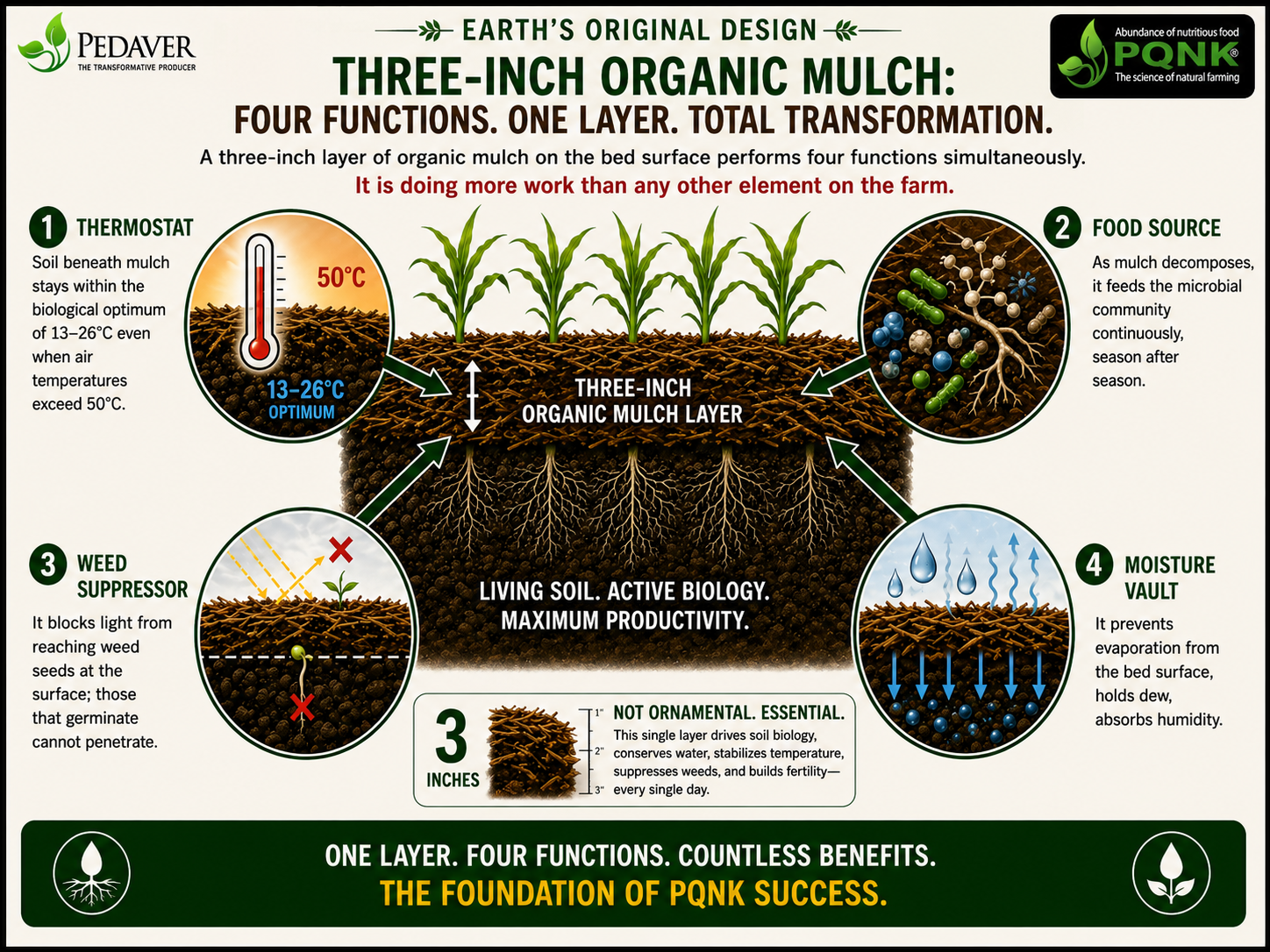
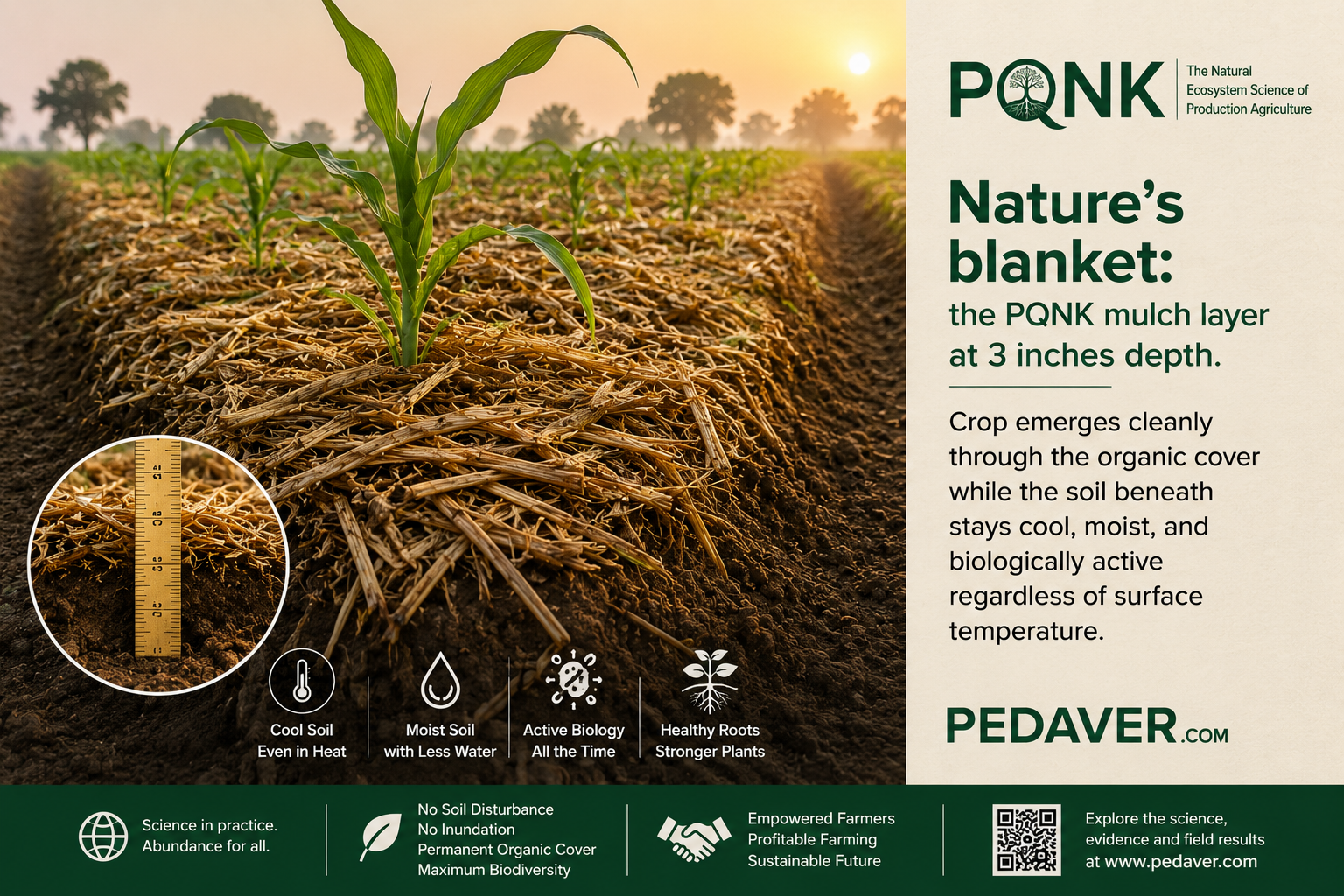
In a PQNK field, organic mulch replicates this forest floor with whatever materials the farm produces: wheat straw chopped and spread after harvest, corn stover laid between beds after the combine passes, cover crop biomass terminated in place by the crimper-mulcher, grass cuttings from field margins, any available plant material. The mulch layer does not need to be any specific material. It needs only to be thick, a minimum of three to five inches depending on the material, continuously maintained, and never removed. It must insulate the soil and keep sunlight off the surface while still letting air move freely into it; a dense, matted layer that seals the soil does as much harm as leaving it bare. What goes on the field stays on the field. This is the simplest and most important rule in PQNK.
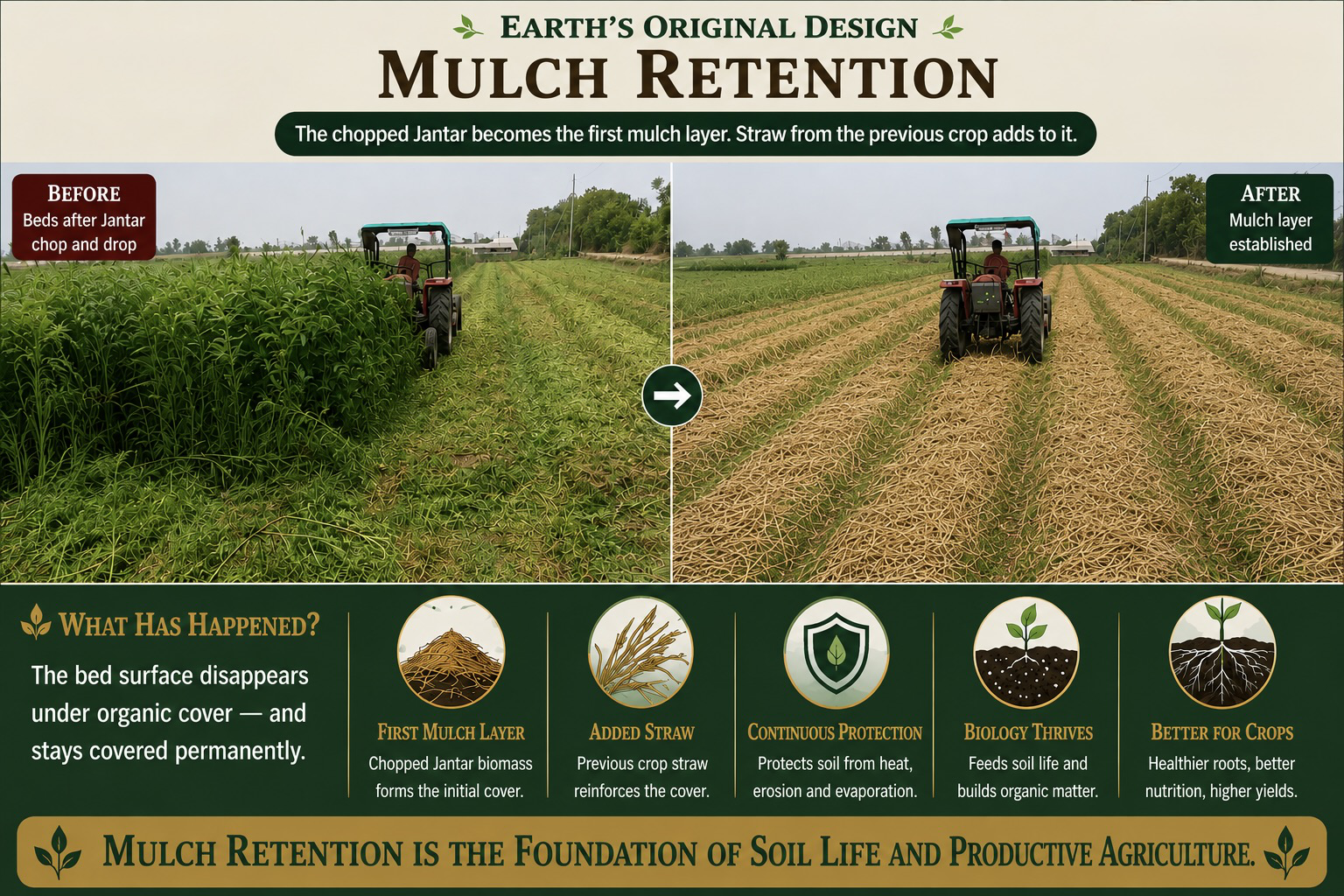
The processes that the mulch layer drives are not sequential but simultaneous, and they reinforce one another in a web of mutual benefit that, once established, becomes progressively more self-sustaining:
Temperature moderation. The mulch layer is an insulation blanket, and how well it works depends on its material and its thickness: the thicker the layer, the more stable the soil beneath it, provided it is never packed so tight that it stops air exchange. An adequate mulch holds the soil within, or in the hottest part of the day only marginally above, the thirteen to twenty-six degree Celsius window in which soil biology and roots work best, keeping it below thirty degrees even when the air above is near fifty and the bare field alongside is above seventy. In winter the same layer holds warmth in, extending the biological season and shielding roots from frost. The soil temperature, which is what actually governs root function and microbial activity, is decoupled from the air temperature by the mulch. A PQNK farmer can therefore grow crops through heat and cold that would shut a bare soil down.
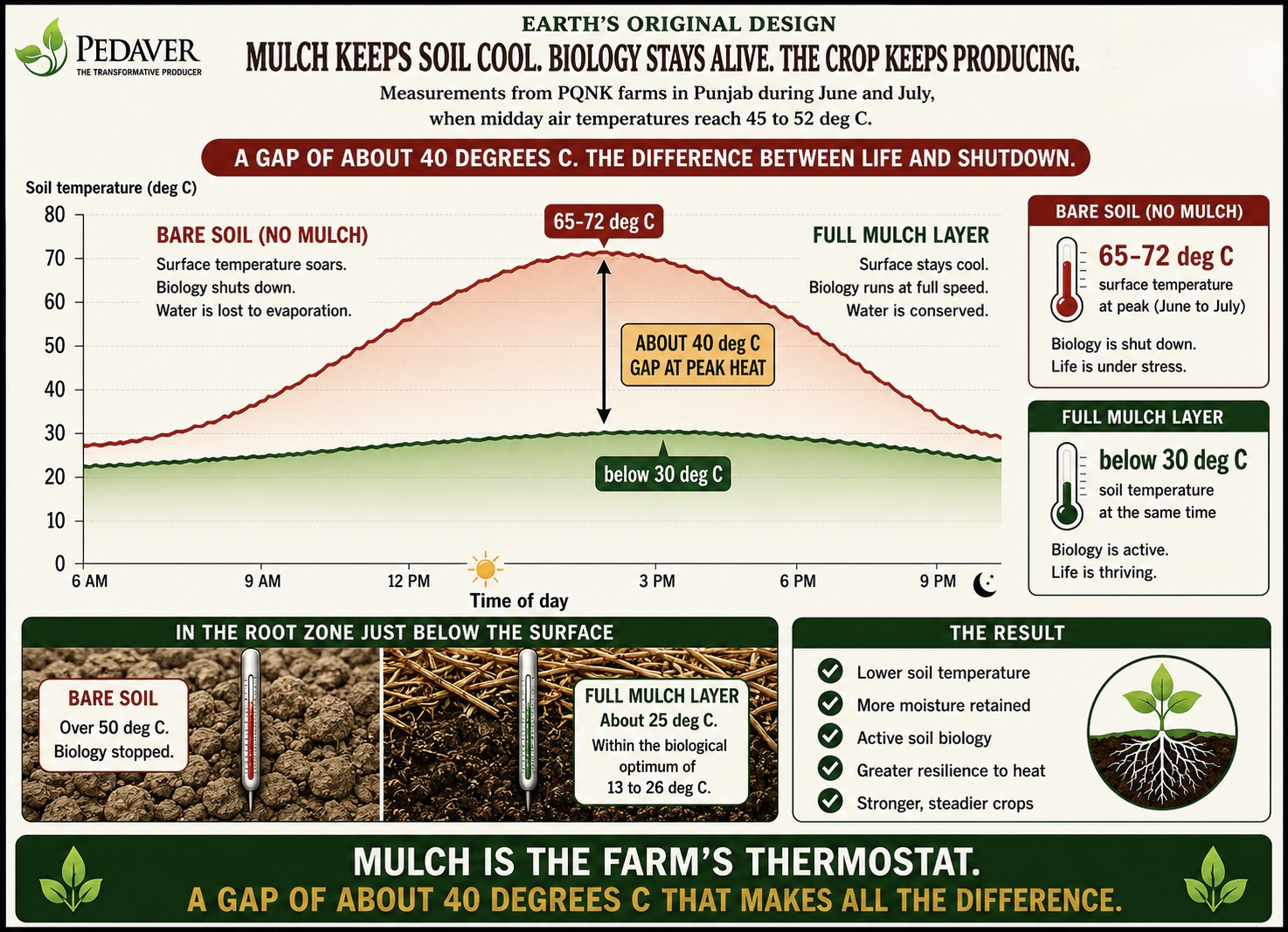
Moisture conservation. The mulch layer substantially reduces evaporative loss from the soil surface, which is the single largest source of water waste in conventional farming. In an unprotected soil, water applied through irrigation or delivered by rainfall begins evaporating immediately as the surface dries. A thick mulch layer shades the surface and breaks the direct path between the moist soil and the open air, so far more of the water that entered the soil stays available to roots instead of returning to the atmosphere. This is the largest single component of PQNK water savings: not reduced crop demand, but sharply reduced evaporative waste. Mulch does this work together with the rest of the soil’s water architecture, the aggregation, the continuous pores, the old root channels, the broken hardpan, the organic matter, and the temperature buffering, which together let water enter, move, and stay within reach of roots without crowding out the air they need.
Continuous carbon feeding. The lower layers of the mulch are continuously decomposed by soil organisms, releasing carbon, nitrogen, and other nutrients into the soil in a slow, steady supply that mirrors the way a forest floor feeds the trees above it. New material added to the top of the mulch replenishes what decomposes below. The system is self-renewing: every crop cycle produces the residue that feeds the next cycle’s biological community. The farm generates its own fertility inputs from within.
ROOTS: THE UNDERGROUND CARBON PUMPS
The mulch layer manages carbon at the soil surface. But the carbon that builds the deepest, longest-lasting soil fertility, the slow-cycling carbon that forms the long-term biological bank of the field, is placed not at the surface but deep in the soil profile, by roots. Every living root is a carbon pump, continuously extracting carbon from the atmosphere through photosynthesis and delivering it, through exudates and eventual decomposition, to the biological community at every depth the roots reach.
The practical implication of this for PQNK management is the rule that no root system is ever removed from the soil. When a crop is harvested, the plant is cut at the base. The root system, which, for a mature wheat plant, may extend one to two metres deep and occupy a root volume of several litres, is left entirely in the soil to decompose in place. As it decomposes, it releases all the carbon it accumulated during the growing season back into the soil biological community. It also leaves behind a network of channels, root pores, that dramatically improve water infiltration and gas exchange at depth, where no mechanical subsoiling can easily reach.
It is tempting to read carbon sent to the roots as carbon that failed to become grain, as though the plant held a fixed budget and every unit spent below ground were taken from the harvest. That is not how the system works. Roots are not only a cost. They open new soil volume, reach deeper water, engage fungi and bacteria, build the channels and structure that later crops grow into, and return organic matter that raises the soil's capacity to hold water and nutrients. A plant that invests well below ground can capture more resources above ground, not fewer. In a restored PQNK soil the two are not competitors: the underground investment is what makes the larger harvest possible, season after season.
In a PQNK system that has been managed for multiple seasons, the cumulative effect of this root decomposition becomes visible. Dig into the soil of a three-year PQNK field and you will find a profile markedly different from the adjacent ACI field: darker at depth, with visible channels and pores left by decomposed root systems, teeming with earthworms at depths where the ACI field has none, with a crumbly, friable structure that extends far below the old tillage depth. This is three years of underground carbon pumping, compounding season after season.
The earthworms found at depth in that profile are doing work no machine can sustain. A true hardpan is too compacted for a worm to break; it has to be fractured once, mechanically, to open the profile. But once that one intervention is made, the worms and the roots move into the fractures and take over. They line the old plough pan with casts and permanent burrows and, over a few seasons, heal it biologically, so it does not re-form. The mechanical break is a single act of surgery. After it, the biology maintains the depth of the living soil on its own.
The pace of this accumulation is not theoretical, and it is far quicker than the conventional literature allows. Three things decide it. First, the roots of each crop are left in the ground instead of being pulled or plowed out, and in a PQNK field, where the hardpan has been broken and the profile is biologically open, those root systems are many times larger and deeper than their ACI equivalents, so the quantity of root carbon delivered is far greater. Second, the crop residue is returned to the same field rather than carried off or burned.
Third, the soil is never inundated and driven anaerobic, so what is deposited is not lost again to rot or to an overheated bare surface. Where all three hold together, documented field measurements on PQNK farms have recorded soil organic matter rising from about half a percent to more than four percent within roughly four crop cycles, with soil structure returning toward its natural, aggregated state over the same period. This is measured PQNK field evidence, not a rate promised for every soil, climate, and farm; but where it has been recorded it is far quicker than the ten or twenty years conventional restoration is assumed to need. In a PQNK field, every crop cycle adds root carbon and returned residue to the soil; in an ACI field, every tillage event oxidises root carbon before it can reach the protected, slow-cycling pool. One system compounds a gain every season; the other compounds a loss.
Every root left in the soil is a deposit in the biological bank. Every root pulled out or plowed up, every fire lit on the stubble, every season the ground is left bare, is a withdrawal. An ACI crop still makes some deposits: its roots, its rhizodeposition, whatever residue is not removed. The problem is the balance. For more than a century and a half, ACI management has been drawing carbon out faster than its crops put it back, so the account falls every year. PQNK is built the other way round: keep the deposits coming with every crop cycle, and close off the avoidable withdrawals, so the balance rises instead of falls.
CARBON AND CLIMATE: THE FARMER’S ROLE IN THE GLOBAL BALANCE
Agriculture’s role in climate change is most often discussed in terms of methane from livestock and nitrous oxide from fertilisers. These are real contributions, but they are secondary to a larger and less-discussed driver: the loss of soil carbon through tillage, burning, and bare soil exposure, which converts a system that was historically a net carbon sink into a net carbon source.
The numbers are striking. Global agricultural soils have lost, since the advent of intensive farming, an estimated fifty to seventy percent of their original organic carbon content. This lost carbon, the accumulated biological work of millennia, now resides in the atmosphere as carbon dioxide, contributing to the warming that threatens the agricultural productivity on which human civilisation depends. ACI agriculture is, in the most direct sense, burning its own future.
Documented field observations show measurable organic-matter increases beginning in the first or second season after transition. Soil carbon is never locked away for good; it is always cycling. What changes under PQNK is the balance: carbon comes in through roots, residues, and cover faster than it leaves, so the soil holds a net gain, and part of that gain moves into the slower, protected fractions that stay for decades. How much stays, and for how long, depends on the biology, the soil’s own mineralogy and depth, the climate, and the management. Even so, applied across a meaningful share of the world’s degraded farmland the accumulated gain would be large. Estimates from several research groups suggest that rebuilding a fraction of the soil carbon agriculture has lost could offset a significant part of annual human carbon dioxide emissions. The farmer who manages carbon is managing his own profitability and a piece of the global balance at once.
PQNK’s carbon management system achieves climate benefits as a direct consequence of its agricultural logic, not as an add-on or a concession to environmental politics. Carbon is kept in the soil because keeping it there makes the soil more productive. Mulch is maintained because maintaining it reduces irrigation costs. Roots are left in the soil because leaving them there builds the biological community. The environmental benefits, carbon sequestration, reduced emissions, improved water cycle regulation, are consequences of a management system that is already the most economically rational approach to farming available. In PQNK, doing right by the farmer and doing right by the atmosphere are the same action.
THE CARBON HIERARCHY: WHAT TO ADD, IN WHAT ORDER
A practical question for the farmer beginning the PQNK transition is: what organic materials should be used as mulch, and in what priority? The answer is simple in principle and flexible in practice: use whatever the farm produces, in the greatest quantity available, as consistently as possible. The specific material matters less than the commitment to continuous surface coverage.
That said, different organic materials contribute differently to the three fractions of soil organic matter, and understanding this allows the farmer to optimise the mulch system for both immediate biological activity and long-term humus accumulation.
Crop residues (wheat and rice straw, corn stover, cotton stalks, sugarcane trash). These are the primary mulch material for most PQNK farms because they are produced on the farm itself and are available in large quantities immediately after harvest. Wheat and rice straw, spread by a straw-chopper attachment on the combine harvester, covers the bed surface at harvest and begins decomposing immediately. Corn stover, similarly spread, provides a coarser, longer-lasting surface cover. Cotton stalks, chopped, contribute both immediate carbon and a structural layer that resists compaction from rainfall. These materials are moderate-to-slow decomposers, contributing to both the active and stable fractions of soil organic matter.
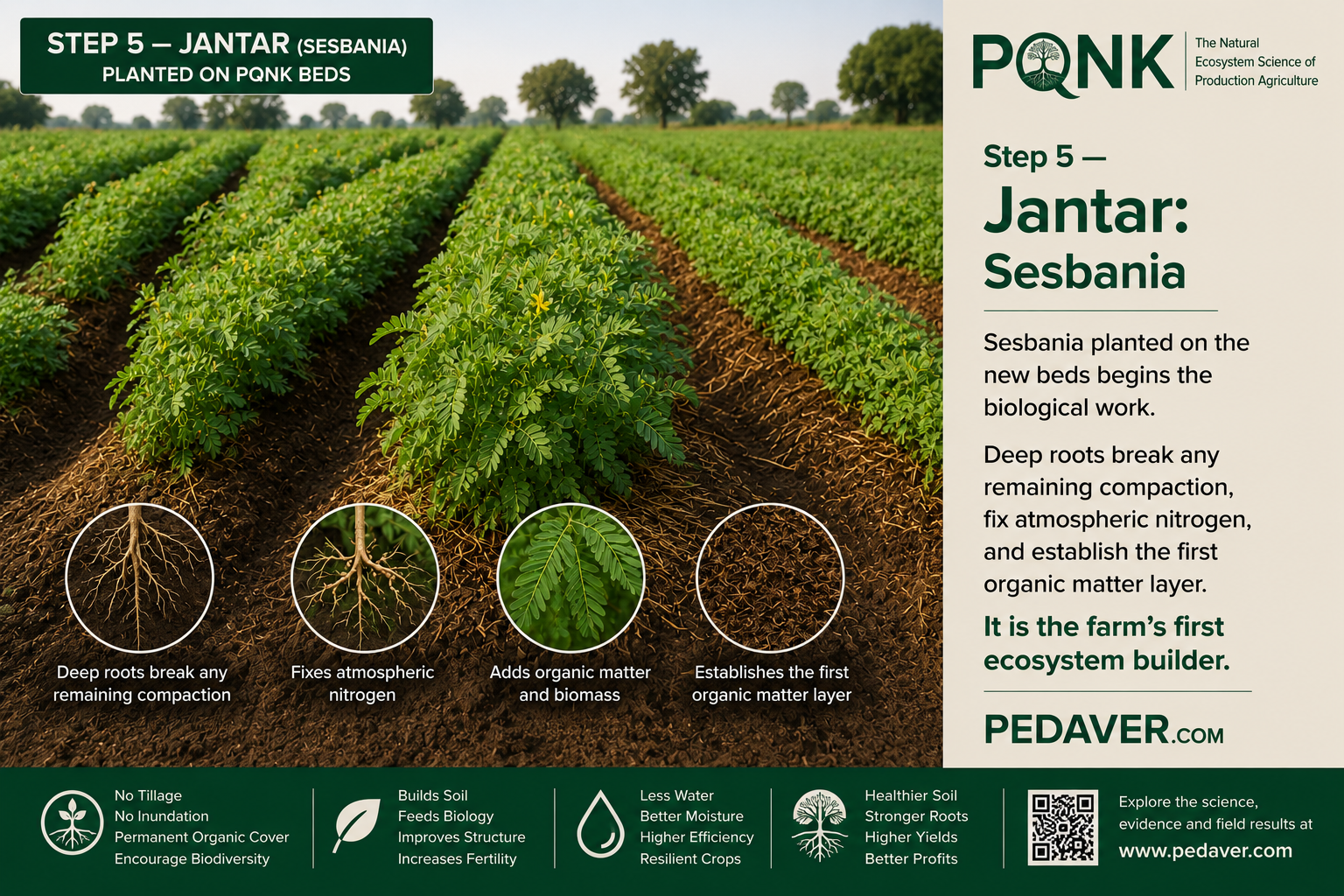
Cover crop biomass, and in the PQNK transition protocol this means primarily Jantar (Sesbania bispinosa), becomes the foundational mulch layer when terminated in place. Jantar is chosen for four specific properties, each of which performs irreplaceable physical or biological work in a field under transition.
First, its root architecture. Jantar's vigorous, deep-penetrating root system physically penetrates compacted soil layers, opens collapsed pores, and creates infiltration channels through hardpan that water and subsequent crop roots can follow. In fields where decades of tillage and flood irrigation have produced near-impenetrable compaction, this root penetration, working alongside the mechanical subsoiling of Step Two, is part of the structural restoration itself.
Second, its speed. Jantar reaches substantial biomass within weeks of planting. The root network begins its structural work almost immediately after establishment, putting the soil's rehabilitation on a rapid timeline.
Third, its feeding of the soil microbial community. Jantar's root exudates and root biomass provide carbon substrates to the reactivating soil biology at precisely the stage when those communities most need them, during the early transition, when the biological community is re-establishing after years of chemical suppression.
Fourth, its foliage. Dense and broad-leafed, Jantar's aerial biomass, when chopped and dropped at termination, creates the thick organic blanket that permanently covers the raised bed surface, regulates soil temperature, suppresses evaporation, and continues feeding the surface biology as it decomposes.
Jantar is a legume. Its root nodules host populations of symbiotic diazotrophic bacteria, Rhizobium and related genera, that fix atmospheric nitrogen, a process conducted by the bacteria themselves within the root structures. This fixed nitrogen is released on decomposition and is a secondary benefit the system receives. It is not the reason PQNK selects Jantar. The reason is root architecture, speed, microbial feeding, and mulch. No other commonly available species does as much physical and biological soil work, as fast, from a standing start on degraded land. Jantar and the one-time hardpan fracture belong to the transition. A mature PQNK field in its sustained state does not depend on planting Jantar again each cycle; by then the crops’ own roots and residues, and the resident soil life, carry the work forward.
Grass cuttings, tree prunings, and farm by-products. Any organic material that can be brought to the field and spread on the bed surface contributes to the system. Grass cuttings from field margins and irrigation channels, leaves and small branches from fruit tree pruning, rice hulls, groundnut shells, sugarcane bagasse, all have a role. The farmer who trains himself to see every organic by-product of the farm as a potential soil input rather than a waste product has understood the closed-loop economics of PQNK at its most fundamental level.
One material that is emphatically not part of the PQNK carbon system is purchased compost. Composting is an ACI-era concept that addresses the symptom of carbon loss rather than its cause. Purchasing compost to apply to a field that is being tilled and left bare between crops is analogous to repairing a leaking bucket by pouring more water into it. PQNK fixes the leak, it eliminates tillage, eliminates bare soil, and eliminates the practices that cause carbon loss, and then builds its own carbon from within. No purchased input, including compost, is part of a mature PQNK system. The farm produces what it needs.
CARBON RECOVERY: WHAT THE FARMER OBSERVES
The restoration of soil carbon under PQNK management is not an invisible laboratory process. It is visible, measurable by simple observation, and accelerating: the improvements in the first season enable greater improvements in the second, and the second enables the third, in a compounding biological progression that runs in the opposite direction to the compounding degradation of ACI management.
The signs of carbon recovery that a farmer will observe, typically beginning within the first season after PQNK establishment, include the following:
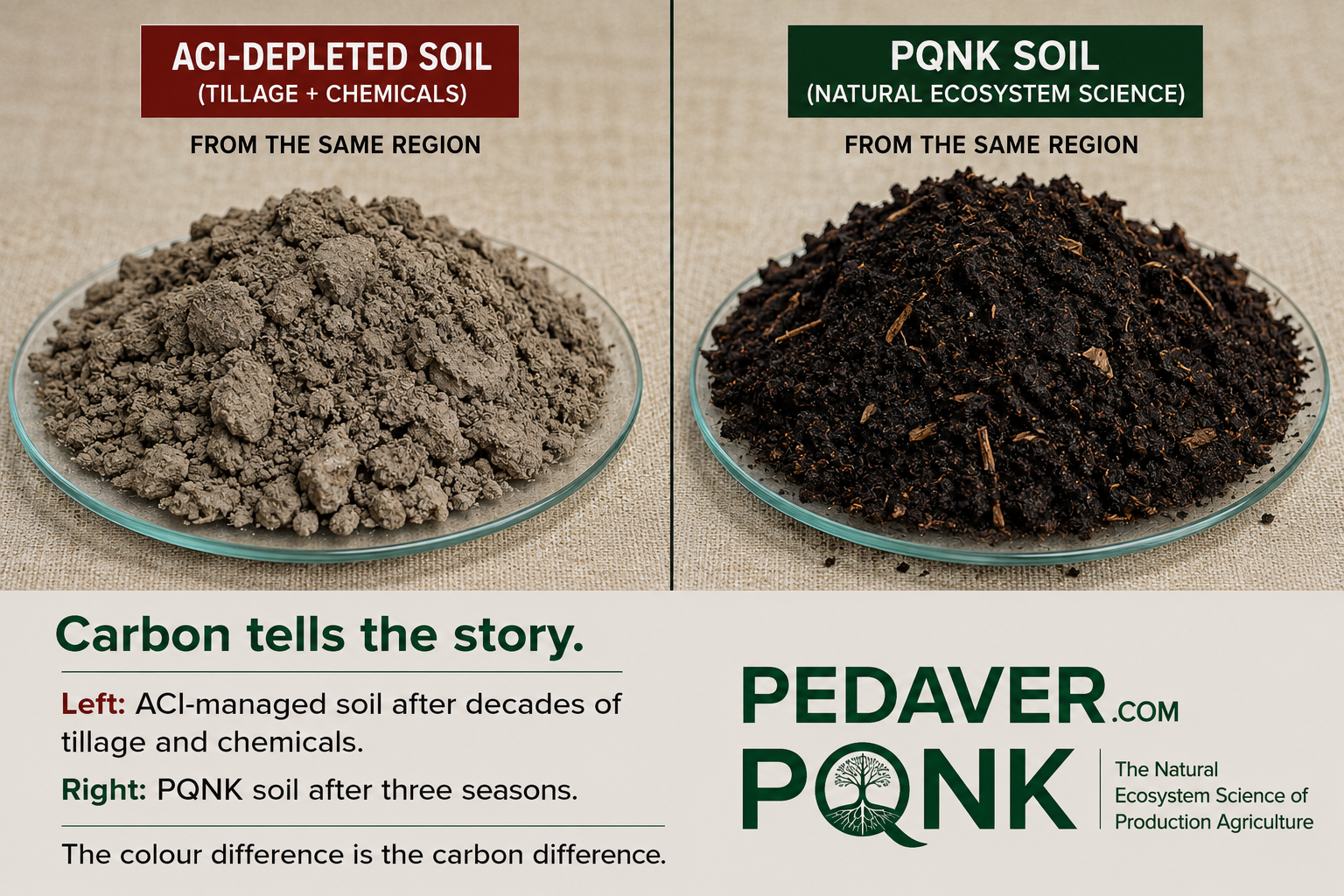
Darkening of the soil. As organic matter accumulates, soil colour deepens from the pale grey or light brown of degraded soil toward the dark brown and eventually near-black of humus-rich soil. This darkening is visible to the eye and is one of the most satisfying indicators of biological recovery. It typically begins in the zone immediately beneath the mulch layer and extends progressively deeper over successive seasons.
Return of earthworms. Earthworms are, among other things, voracious carbon processors. They consume organic matter and mineral particles together, producing castings that are among the most carbon-rich and biologically active materials in the soil. Their appearance in a field that previously had none is a reliable indicator that organic matter has accumulated to the threshold required to support them. Farmers transitioning to PQNK typically observe the first earthworms within one to three seasons, and populations that increase substantially thereafter. Earthworms are more than carbon processors; they are the farm's ecosystem engineers. Their burrows are its biological tillage and its deep-drainage network, carrying air and water down through the profile without a plough. Their casts are packets of readily available nutrients and living microbes deposited directly in the root zone, so a rising worm count is not just a sign that organic matter has accumulated; it is one of the mechanisms by which the carbon system keeps working.
Improved water infiltration. As carbon-based aggregate structure rebuilds, the soil’s capacity to absorb rainfall and irrigation water improves measurably. Irrigation water that previously pooled on the surface and ran off begins disappearing rapidly into the profile. After heavy rainfall, standing water that previously persisted for days drains within hours. The farm’s effective irrigation efficiency improves without any change to irrigation infrastructure, because the soil itself has become a better receiver.
Improved crop performance between irrigations. As the soil’s water-holding capacity increases with rising organic matter, the interval between irrigations at which the crop begins to show stress extends noticeably. A crop that previously wilted within three days of the last irrigation may remain vigorous for weeks as soil organic matter recovery progresses. Supplemental moisture intercepted by mulch from dew and atmospheric condensation adds to the soil-water supply, while the mulch simultaneously reduces evaporative loss. PQNK field observations indicate that this contribution forms part of the system’s overall water economy, although its quantity under different crops and climatic conditions remains to be measured separately. This observable change in crop behaviour is one of the most direct signals available to the farmer that the carbon system is working.
Reduction in weed pressure. As the mulch layer establishes itself and thickens over successive seasons, weed germination under the mulch diminishes. The first season after PQNK establishment typically still sees some weed emergence at the edges of the mulch layer and in any gaps. By the second and third seasons, with a well-maintained and thickening mulch layer, weed pressure is typically a fraction of what it was under ACI management, without any herbicide application.
None of this requires a laboratory. A farmer can read his soil's carbon with his eyes, his nose and his hands. Colour deepens from pale grey toward chocolate brown as organic matter builds. The smell changes from inert or sour to the sweet, earthy scent of an active soil biology. A squeezed handful holds together but breaks apart easily into crumbs, the sign of stable, carbon-bound aggregates. And the surest indicator is life itself: earthworms, beetles and the white threads of fungal hyphae. A laboratory organic-carbon test gives the precise figure and the baseline to track across years; between tests, the senses are enough.
Q Is carbon a fertiliser?
A Carbon is the food of the biological community that performs fertilisation. When carbon is abundant, as root exudates, as mulch, as decaying organic matter, the microbial workforce that unlocks and delivers plant nutrition operates at full capacity. When carbon is depleted, the workforce starves and fertility collapses.
Q Why does burning crop residue destroy future productivity?
A Because residue is the farm's carbon deposit. Burning converts the carbon that should feed next season's biological workforce into CO₂ and ash. It trades a long-term biological investment for a short-term trace mineral return.
Q How does the PQNK closed loop maintain carbon without external input?
A Crop residue retained as mulch continuously feeds the soil biological community. That community converts organic matter into stable soil carbon. The next crop's roots extend deeper through the biologically active profile, capturing more carbon from the atmosphere through photosynthesis. The loop closes itself.
WHAT THIS CHAPTER HAS ESTABLISHED
Carbon is not one factor among many in soil fertility. It is the principal biological currency the living production system runs on, the medium through which biology, structure, water, and the exchange with the atmosphere are all connected. Its build-up is both a cause of restored function and a sign that function has returned. It cannot do this alone, but none of the rest holds together without it being present in adequate amount and kind, and supplied continuously from the farm’s own production cycle.
This also reframes how success is measured. A rising organic-carbon level is not a by-product of a good season; it is the cause of good seasons. Higher yield and lower costs are the visible results; the carbon accumulated in the soil is what produced them. Because it moves slowly, organic carbon is a lagging indicator, but a rising trend across years is the clearest proof that a farm is building biological capital rather than spending it, and in a PQNK field it is a more reliable measure of progress than any single season's harvest.
ACI agriculture depletes soil carbon through three simultaneous pathways: tillage oxidation, residue removal and burning, and bare soil exposure. The consequences of this depletion, biological collapse, structural failure, water loss, and fertiliser dependency, are not separate problems requiring separate solutions. They are expressions of the same root cause: a farm running out of carbon.
PQNK restores and maintains soil carbon through three simultaneous inputs: the organic mulch layer at the surface, the root systems left intact in the soil profile, and the stream of carbon that living plants pass continuously into the soil as exudates and root turnover. The consequences of this carbon restoration, biological recovery, structural rebuilding, water retention, and self-generated fertility, compound over successive seasons until the farm achieves the closed-loop, self-sustaining productivity of the natural ecosystem it is designed to replicate.
The next chapter turns to the natural water system, rain, dew, humidity, and the capillary mechanics of a soil that has been restored to biological function. It will demonstrate, with the same precision applied here to carbon, that the farmer who manages soil moisture correctly has access to a water supply that is more abundant, more reliable, and more cheaply obtained than any irrigation infrastructure yet devised.
Chapter Five: The Natural Water System, Rain, Dew, Humidity, and Soil Moisture Management