

Industrial Devastation To Natural Abundance
The Discovery · Chapter 19
The First Experiment
Rice on Moist Soil Raised Beds, Paradoxical Agriculture Becomes Proof
Release 1.0 · 2026-09-16
If you use “Listen”, the text of the page may be sent to your browser or operating system’s speech provider, such as Apple, Google or Microsoft, depending on the voice your device uses. Pedaver does not process, transmit or store any audio.
“They called it paradoxical agriculture. They were right. It was paradoxical, but only within a framework that assumed the soil was dead. Within the framework that assumes the soil is alive, every result made complete and obvious sense. The paradox was not in the experiment. It was in the assumption that made the results seem impossible.”
Asif Sharif, Lahore, 2012
Rice was an unusually demanding crop with which to test the emerging biological framework. Conventional paddy management in Pakistan commonly combines puddling or tillage, prolonged surface flooding, dense single-crop stands and periods of exposed soil between crops. The 2009 work asked a more precise question: could rice produce a high yield if continuous flooding were removed and the root zone were kept moist and aerated instead?
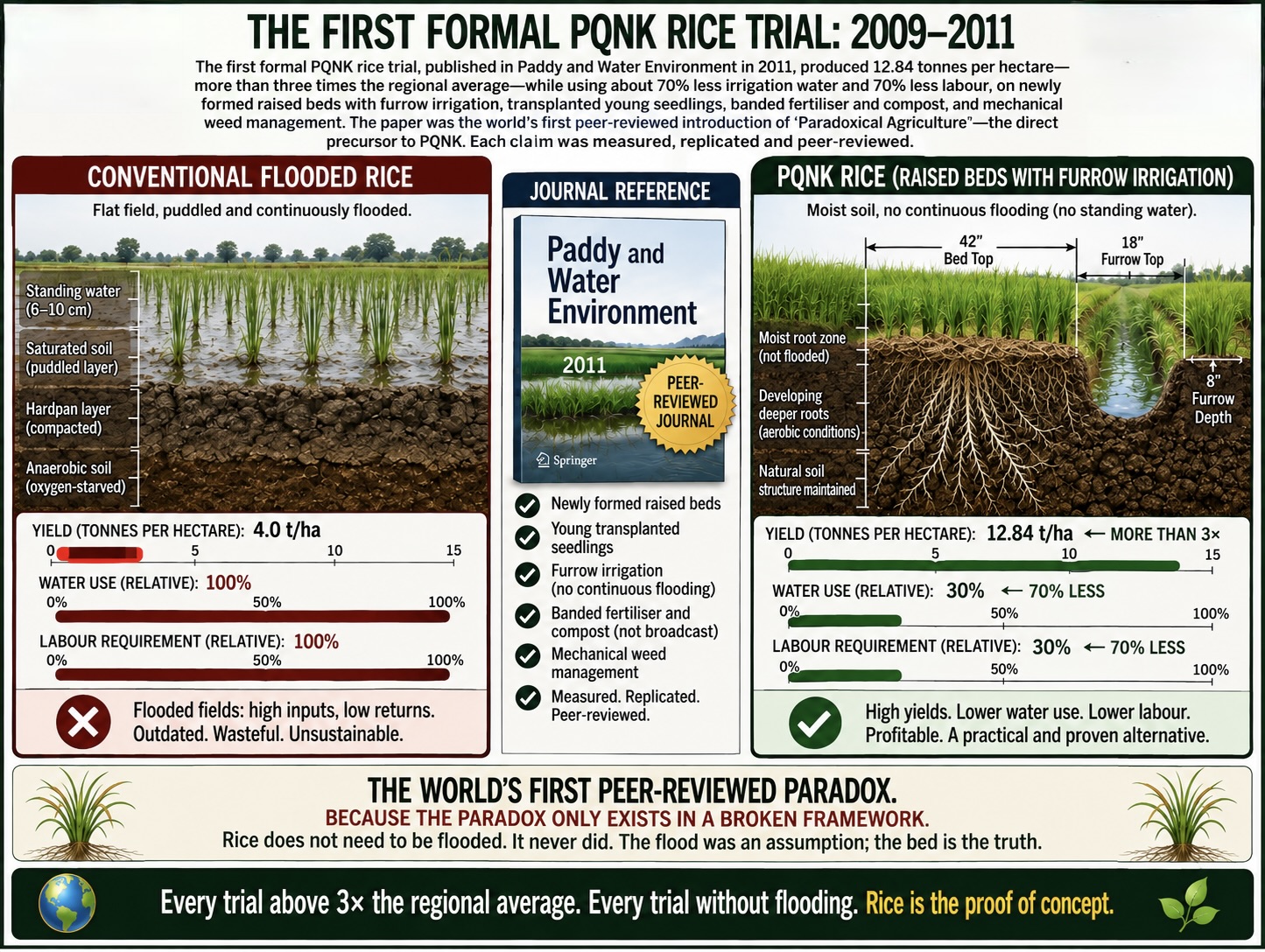
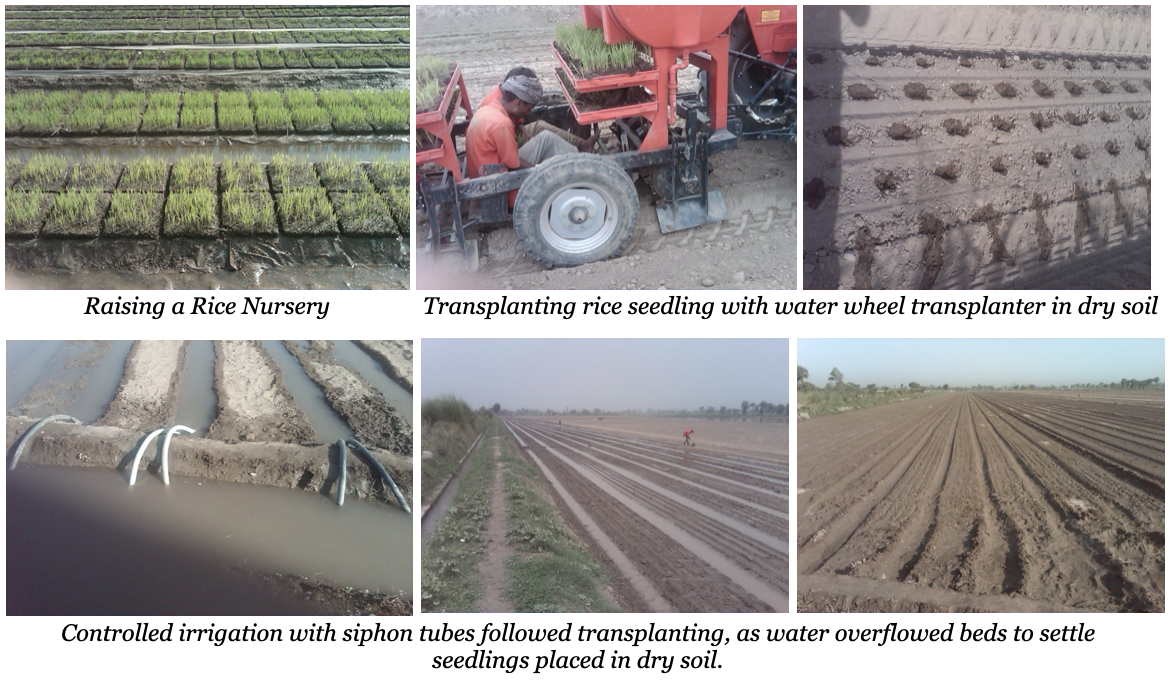
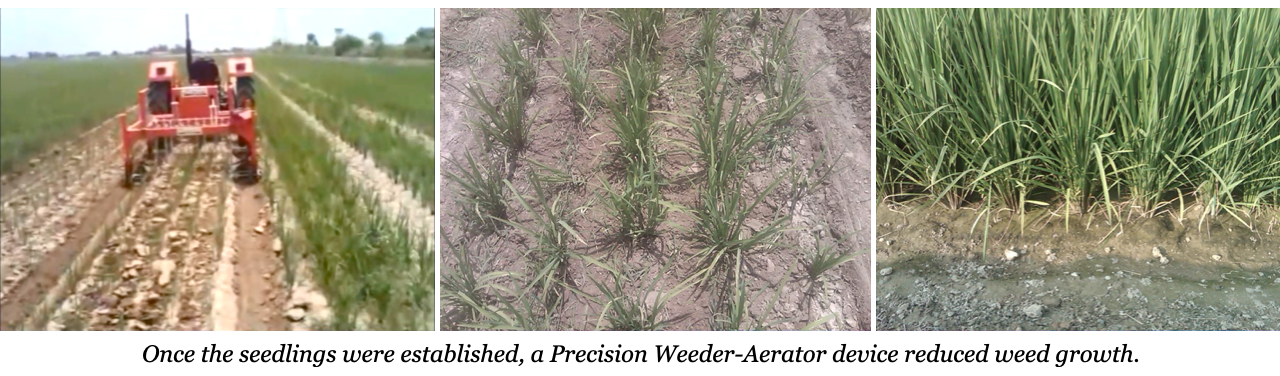
The first experiment was not yet mature PQNK. It was a transitional mechanised SRI system on newly formed raised beds. Ten-day-old seedlings were transplanted at precise spacing; water was supplied through furrows rather than maintained as continuous standing water; fertiliser and compost were banded; and weeds were controlled mechanically with a tractor-mounted weeder-aerator. These distinctions matter because the experiment should be described as it was, not retroactively as the fully developed PQNK system that emerged later.
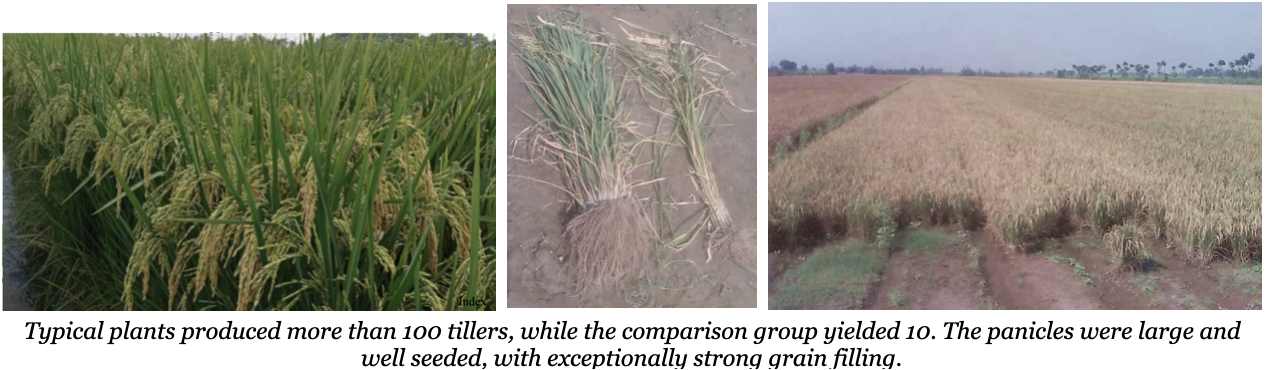
The measured result was nevertheless remarkable. Crop-cut sampling in the monitored 8-hectare block averaged 12.84 tonnes per hectare. Irrigation-water application was about 70 percent lower than the conventional flooded comparison, and labour requirement was reduced by a similar order. The work was subsequently published in the peer-reviewed journal Paddy and Water Environment. What appeared paradoxical was not that rice could survive without continuous flooding. Rice biology had never required permanent inundation. The important finding was how strongly the crop responded when water, spacing, aeration and field operations were reorganised around the plant and root zone.
THE PROBLEM WITH PADDY: WHAT CONTINUOUS FLOODING CHANGES
To understand why the result attracted attention, it is necessary to distinguish the rice plant from the flooded production system in which it is conventionally grown. Rice is adapted to tolerate flooded conditions, but continuous inundation changes soil oxygen status, microbial processes, root behaviour, greenhouse-gas emissions and the amount of water that must be delivered to the field.
Flooding sharply reduces oxygen diffusion into soil and shifts the root-zone microbial community toward organisms and processes adapted to anaerobic conditions. Aerobic organisms do not all disappear, and rice itself develops adaptations such as aerenchyma that transport oxygen internally. But prolonged saturation suppresses many aerobic processes and can reduce the functioning of organisms, including arbuscular mycorrhizal fungi, that depend on an aerated soil environment. The PQNK concern is therefore not that flooded soil becomes literally biologically dead, but that its biological operating environment is fundamentally altered.
Flooded rice soils also create conditions favourable to methanogenesis. Under oxygen-depleted conditions, microorganisms can produce methane while decomposing organic matter. Rice cultivation is consequently an important agricultural methane source. Maintaining a moist but non-inundated root zone changes this process by preserving more aerobic conditions.
The water issue is equally important. A flooded rice field requires water not only for crop transpiration but also to establish and maintain the standing-water regime, with additional losses through evaporation, seepage, percolation and field conveyance. The approximately 6.58 million litres per acre figure used in PQNK comparisons is a documented conventional reference from our field records, not a universal requirement of the rice plant. The central question is how much of that field-applied water is actually necessary when continuous flooding is removed.
THE DESIGN OF THE FIRST EXPERIMENT
The design translated an emerging ecological idea into a practical rice-production experiment. Its importance lies in the sequence of engineering decisions, and also in recognising which elements belonged to this first trial and which were developed later.
No continuous flooding: furrow irrigation and moist-soil management. Water was delivered through the furrows rather than maintained as a standing layer across the field. During establishment, the first irrigation was allowed to overtop the newly formed beds by roughly 2-3 cm to settle the transplanted seedlings. Thereafter, the system operated without continuous paddy flooding. This distinction is important: the experiment reduced inundation radically, but it should not be described as if the bed surface never became temporarily wet.
Q How did the first experiment produce 12.84 tonnes per hectare?
A It combined very young seedlings, precise spacing, newly formed raised beds, furrow irrigation, banded fertiliser and compost, and mechanical weed control/aeration. It was a transitional mechanised SRI experiment, not yet the mature no-input, permanent-mulch PQNK system.
Q Why was the result considered paradoxical?
A Because a very high rice yield was obtained without maintaining the conventional continuously flooded paddy environment. The experiment demonstrated that continuous flooding is not a physiological requirement of the rice plant.
Q What water saving did the peer-reviewed experiment establish?
A The 2009-2011 published work reported about 70 percent lower irrigation-water application than the conventional comparison. The later approximately 92 percent saving belongs to subsequent mature PQNK field records and must not be attributed to the original trial.
Reduced disturbance: newly formed raised beds and precision transplanting. The beds were constructed for the experiment and therefore were not yet the permanent, never-re-formed beds of mature PQNK. Approximately ten-day-old seedlings were transplanted at precise spacing. The purpose-built water-wheel transplanter reduced the labour burden of manual transplanting and placed seedlings consistently. The later PQNK progression would go further by retaining permanent beds and ultimately direct-seeding through residue.
Targeted nutrition rather than a no-input claim. The published experiment used banded fertiliser together with compost. It therefore cannot be presented as a zero-purchased-input trial. Its significance was that inputs, water and field operations were reorganised around the raised-bed root zone rather than broadcast through a puddled, continuously flooded field.
Mechanical weed control and aeration. Weeds were managed with a tractor-mounted precision weeder-aerator. This was another transitional feature. As permanent cover, retained roots and mature biological function developed in later PQNK, the objective shifted toward avoiding repeated soil disturbance. The first experiment should therefore be understood as a bridge between conventional rice engineering and the mature PQNK architecture.
THE RESULTS: WHAT THE NUMBERS SAID
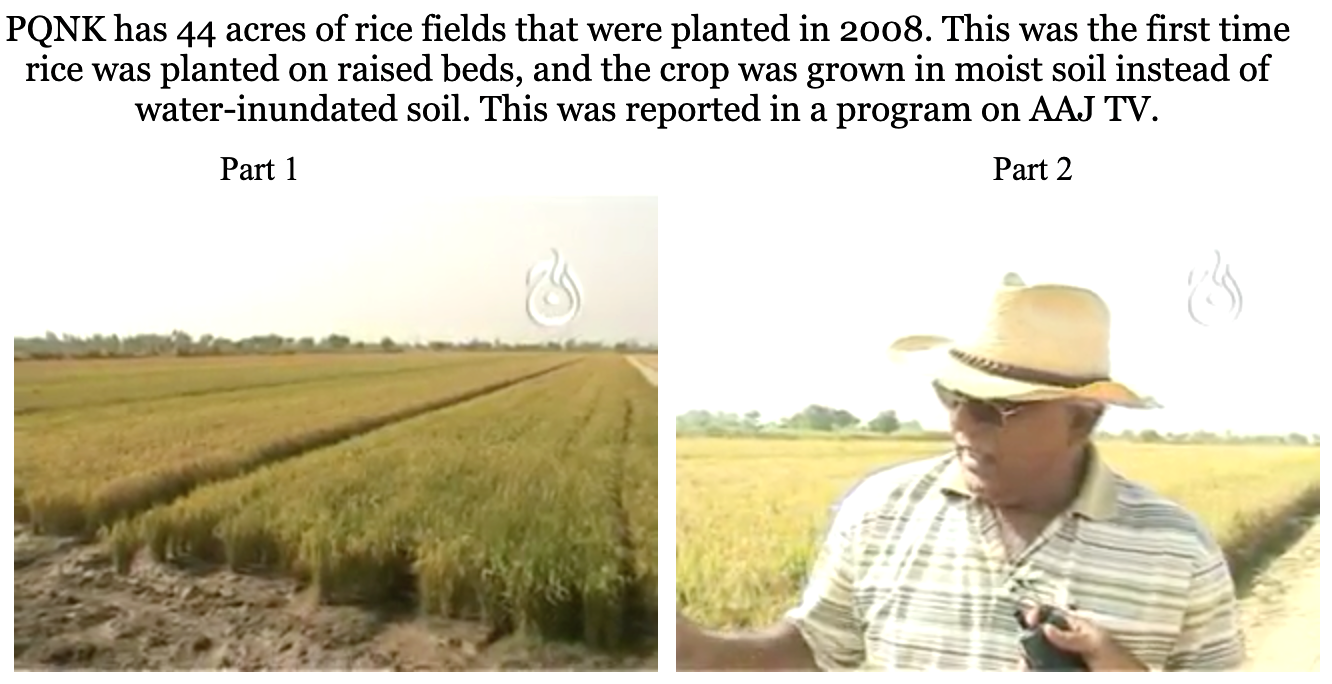
The experiment was conducted on 44 acres (17.8 hectares) of leased land. Of this area, 4 acres (1.6 hectares) were reserved as a control and cultivated under the conventional, continuously flooded rice system, while the remaining 40 acres (16.2 hectares) were shaped into the raised-bed system. Crop-cut sampling from a monitored 8-hectare (20-acre) block within that raised-bed area averaged 12.84 tonnes per hectare (5.20 tonnes per acre), demonstrating that exceptionally high rice productivity could be achieved without maintaining the conventional continuously flooded paddy environment. Keeping that monitored block distinct from the full 40 raised-bed acres avoids turning a sub-block result into a claim about every acre of the farm.
The yield was exceptionally high for the local comparison and demonstrated that removing continuous flooding did not impose a yield penalty. The strongest conclusion is therefore the measured one: rice on the experimental raised-bed system achieved 5.20 tonnes per acre (12.84 tonnes per hectare), while irrigation-water application and labour requirement were each reduced by about 70 percent relative to the conventional reference. Comparisons with theoretical yield ceilings or national systems elsewhere are unnecessary to establish the significance of that result.
The water result must also be kept in chronological order. The founding raised-bed experiment achieved about a 70 percent reduction in irrigation-water application. The later mature PQNK rice system, after development of permanent beds, hardpan correction, retained residues, direct seeding and Soil Moisture Management, produced separate field records of approximately 513,950 litres per acre compared with 6,579,200 litres per acre for the stated flooded-rice reference, equivalent to about 8 percent of that reference. The later 92 percent saving is important evidence, but it is not the water result published from the original 2009-2011 experiment.
The 12.84 tonnes per hectare result changed the direction of the work. It showed that high rice productivity and continuous flooding were not inseparable. The next task was no longer to defend the old paddy architecture more efficiently, but to keep removing the operations that the plant did not require.
WHY THE YIELD WAS HIGH: WHAT THE EXPERIMENT SUPPORTS
The experiment supports several plausible agronomic explanations for the yield response, but it did not independently measure every biological mechanism later incorporated into PQNK. The chapter therefore distinguishes measured outcomes from interpretation.
Root-zone aeration and spacing. Raised-bed furrow irrigation avoided prolonged whole-field saturation, while precise transplanting reduced plant-to-plant competition. Rice is capable of growing in flooded soil, but a more aerated root environment changes nutrient transformations, root activity and microbial conditions. The experiment demonstrated the production outcome; later PQNK work expanded the biological interpretation.
Tiller development. Very young seedlings planted at wider, regular spacing have more room to develop tillers than densely established stands. Productive tillering is one recognised pathway through which SRI-type management can increase yield. In this trial, precise spacing, reduced competition and root-zone conditions acted together rather than as isolated treatments.
Nutrition and soil biology. Banded fertiliser and compost supplied nutrients in the founding experiment, while the moist-soil system avoided the continuously reduced conditions of flooded paddy. Later PQNK practice progressively shifted the emphasis from purchased nutrient supply toward biological cycling in permanent, mulch-covered beds. Claims about superior nutritional density, milling quality or shelf life belong to later field observations and Knowledge Papers unless supported by measurements from this trial.
PUBLICATION AND ITS RECEPTION
The work was published in 2011 in Paddy and Water Environment under the title “Technical adaptations for mechanized SRI production to achieve water saving and increased profitability in Punjab, Pakistan.” The paper reported the 12.84 tonnes per hectare crop-cut yield and approximately 70 percent reductions in irrigation-water application and labour requirement. It described mechanised adaptations of System of Rice Intensification principles, not a mature PQNK protocol. This publication is important because it provides a peer-reviewed historical marker in the development pathway that later led to PQNK.
The result also challenged a deeply established management convention. Rice researchers were accustomed to studying the crop inside flooded-paddy systems. The Punjab work demonstrated that the crop could be managed very differently while maintaining, and in this case greatly increasing, yield. The useful scientific consequence is not to portray institutions as refusing evidence, but to recognise that a single field study, however striking, raises the next questions: replication across soils and climates, mechanism, engineering, economics and long-term soil effects.
The published experiment therefore occupies a precise place in the PQNK evidence chain. It is independent peer-reviewed documentation of an early raised-bed, non-continuously-flooded rice system developed by Sharif. Subsequent farmer photographs, videos, yield records and water records are a different evidence class: large-scale field observations of the continuing adaptation. They are valuable for demonstrating practical reach, while controlled measurement remains useful for quantifying specific outcomes.
The important lesson from the years that followed was that the result had opened a research direction. The field had shown that rice did not have to be defined by standing water. The engineering challenge was now to simplify the system further, protect the soil more completely and make the method repeatable for ordinary farmers.
FROM THE FIRST EXPERIMENT TO THE FULL SYSTEM
Rice was a demanding early test because conventional paddy management is built around inundation. The experiment showed that a different water architecture could support exceptional production. But it did not yet test all four mature PQNK rules simultaneously, and it should not be presented as though it did.
The experiment established three foundations for later development. First, continuous flooding was not necessary for high rice yield. Second, raised-bed water management and precision establishment could sharply reduce irrigation-water application and labour. Third, the system created a practical engineering platform from which later changes could proceed: permanent beds, retained roots, continuous mulch, direct seeding, biodiversity and Soil Moisture Management.
The significance of the rice work was therefore developmental rather than doctrinal. It did not prove every later PQNK proposition in one season. It supplied a measured bridge from the old architecture toward a system increasingly governed by natural ecosystem function. Subsequent work in rice and other crops tested and refined the remaining elements under production conditions.
FROM TRANSPLANTING TO DIRECT SEEDING: THE RICE SYSTEM MATURES
The 2009 experiment still depended on a nursery, transplanting, newly formed beds, purchased nutrient inputs and mechanical weeding. Each of those operations became a question for the next stage of development. If the bed was to become a protected biological production zone, why reform it? If roots and residues were to remain, why repeatedly disturb the surface? If seed could be placed accurately through residue, why maintain the nursery-transplanting step?
The mature PQNK answer was direct seeding into permanent, mulch-covered raised beds using Soil Moisture Management rather than continuous flooding. This later system must be evaluated on its own records. In the PQNK rice comparison now used in the Knowledge Papers, 1,600 kg of paddy per acre was produced with approximately 513,950 litres of crop-life water, or about 321 litres per kilogram, against a stated flooded reference of 6,579,200 litres per acre. This is the source of the later approximately 92 percent saving. It should not be backdated into the 2011 publication.
Later PQNK observations also extend beyond yield and irrigation quantity to grain filling, milling recovery, aroma, taste, nutrition and storage quality. These are important areas for measurement, but they should remain identified as later field observations unless a specific comparison has been analytically documented. The historical claim of this chapter does not depend on them.
The same discipline applies to food-safety claims. A production system that avoids synthetic pesticides removes one obvious route to pesticide-residue violations. Aflatoxin risk, however, depends on fungal ecology, crop stress, harvest moisture, handling and storage, and should not be presented as automatically eliminated by field management alone. The separate Knowledge Paper on rice quality and export performance can examine those mechanisms and evidence in detail.
WHAT THIS CHAPTER HAS ESTABLISHED
The first formal raised-bed rice experiment provided a measured turning point in the development that later became PQNK. It showed that rice could produce 12.84 tonnes per hectare in the monitored trial while irrigation-water application and labour were each reduced by about 70 percent relative to the conventional comparison. Those are the peer-reviewed results and they are strong enough without enlargement.
Just as important is what the experiment did not yet represent. It was not zero-input farming. It was not yet direct seeded. The beds were newly formed rather than permanent. Fertiliser and compost were banded, and weeds were mechanically controlled. Mature PQNK emerged by continuing to remove disturbance, inundation and dependence on recurring external operations while strengthening cover, roots, biodiversity and Soil Moisture Management.
The paradox was therefore productive. It exposed a distinction that would become central to PQNK: the biological requirement of the plant is not the same thing as the conventional practice surrounding the plant. Rice requires an adequately supplied root zone. It can tolerate flooding, but continuous flooding is not its physiological requirement. Once that distinction was visible, the engineering path opened.
Chapter Twenty: The Naming of PQNK, From Paradox to Picnic, the System Codified and Named