

Industrial Devastation To Natural Abundance
Extended Knowledge · Chapter 59
Nutrition-Dense Food
The Recovery of Ecological Quality
Release 1.0 · 2026-10-27
If you use “Listen”, the text of the page may be sent to your browser or operating system’s speech provider, such as Apple, Google or Microsoft, depending on the voice your device uses. Pedaver does not process, transmit or store any audio.
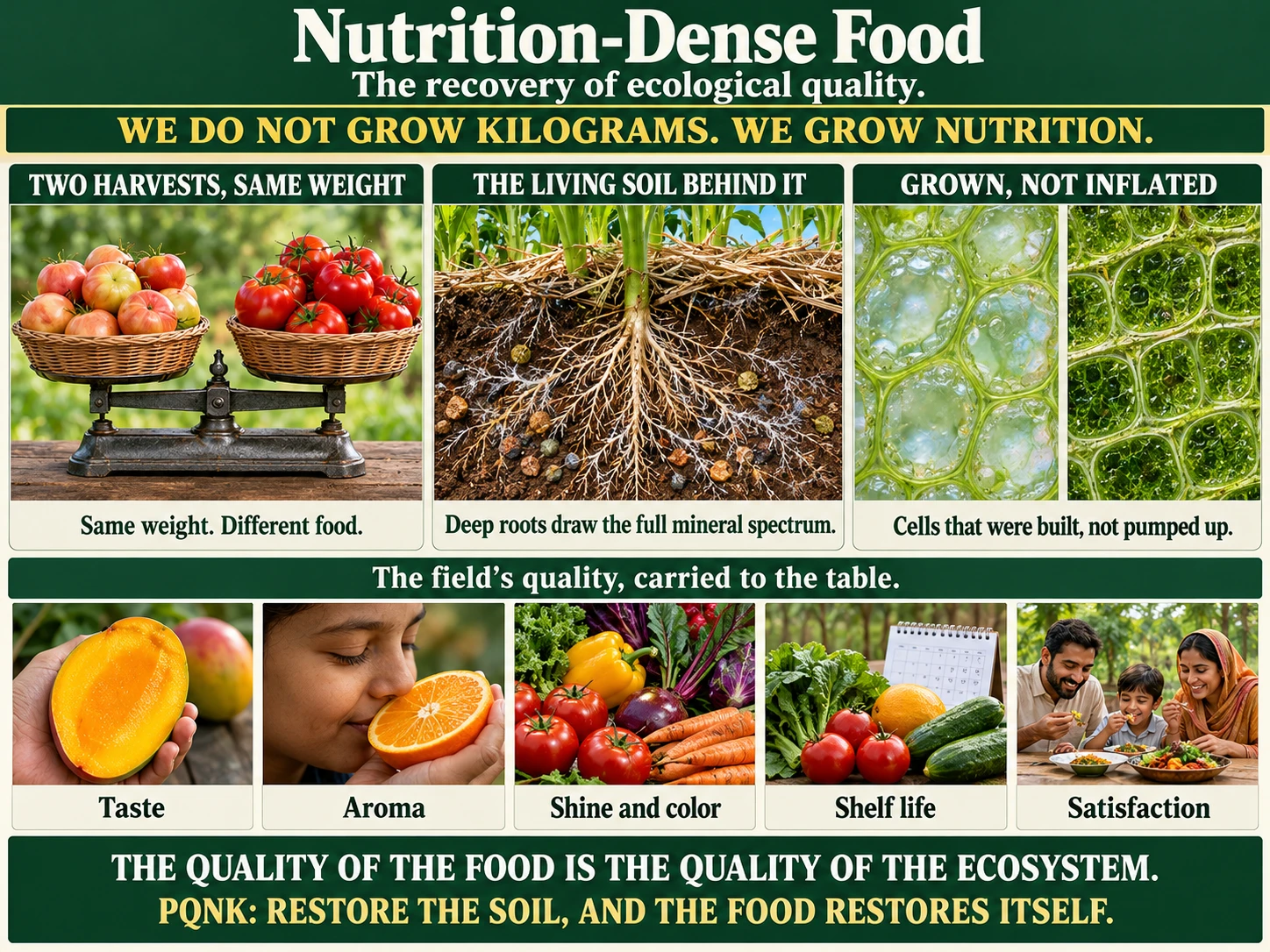
Nutrition-Dense Food: we do not grow kilograms, we grow nutrition.
“Industrial agriculture learned to produce abundant food. What it forgot to produce was complete food. The difference between the two is invisible on a weighing scale and immediately apparent on a dining table, and in the body of the person who ate at it.”
Asif Sharif, Lahore, 2026
NUTRITION-DENSE FOOD AS A DEFINITION OF ECOLOGICAL SUCCESS
The PQNK system has always maintained that the correct measure of agricultural success is not yield alone. Yield is the quantity of food produced. It says nothing about the biological content of that food, about whether the plant that produced it was physiologically complete, whether it drew from the full mineral complexity of a living soil, whether it developed at the pace its biochemistry required, or whether the food that arrives at the table carries the depth of nutritional organization that a human body expects from a complete biological diet. Within PQNK, the concept that integrates all of these dimensions is nutrition-dense food.
Nutrition-dense food is not food containing high concentrations of isolated nutrients as measured by a standard laboratory panel. That definition captures only the measurable fraction of biological food quality. Nutrition-dense food within PQNK is defined as the biological expression of a stable ecological system functioning correctly from soil to plant, a crop that developed under balanced mineral interaction, moderated moisture movement, fungal continuity, deep root access, and the full living complexity of an undisturbed soil ecosystem. The quality of the food, in this definition, is the direct and measurable consequence of the quality of the ecosystem that produced it.
This definition has practical implications that reach beyond nutrition science into agronomy, economics, and public health. It means that improving the nutritional quality of any nation's food supply is not primarily a breeding problem, a fortification problem, or a dietary education problem. It is a soil ecology problem. The nutritional impoverishment that characterizes much of the food produced under ACI (Ancient Conventional Industrial) management, the diluted flavors, the shortened shelf lives, the watery textures, the reduced mineral content, is not an inherent property of the crops being grown. It is the predictable consequence of growing those crops in an ecosystem whose biological complexity has been progressively dismantled by tillage, flood irrigation, and soluble chemical fertility. Restore the ecosystem, and the nutritional quality of the food restores itself.
It is useful to separate three levels at which the output of a field can be described. The first is physical yield: the tonnes, maunds or kilograms harvested, the figure on which farm economics and national statistics are built, and one that must never be dismissed. The second is nutritional yield: the quantity and diversity of useful nutrients contained within that harvested mass, from energy and protein to the minerals, vitamins, fibre and secondary compounds discussed in this chapter. The third is biological food value: how much of that nutrition survives digestion, absorption and metabolism to actually meet a human requirement, since nutrients present in a laboratory assay are not always equally available to the body. Two fields can produce the same physical yield and differ substantially at the second and third levels.
This distinction gives PQNK a more complete measure of agricultural efficiency: nutritional productivity, the quantity and diversity of useful nutrition a field delivers, rather than the mass it ships. Where conventional accounting asks how many tonnes an acre produced, nutritional productivity asks how much usable nourishment that acre produced, and in time it can be expressed per acre (0.405 hectare), per acre-inch of irrigation water (about 103 cubic metres), and per unit of production cost. Measured this way, a smaller quantity of nutritionally dense, diverse food can meet the same human need as a larger quantity of diluted food, while additional tonnes of nutritionally thin grain can raise output statistics without raising what people are actually nourished by.
This is why the PQNK objective cannot be stated simply as maximum harvested mass, or maximum calories, or maximum biomass. It is to produce abundant, nutritionally dense and diverse food that meets the biological needs of consumers, from a production ecosystem that retains the capacity to produce again. Kilograms remain a necessary measurement; they cease to be the final one. In the phrase PQNK uses for it: we do not grow kilograms, we grow nutrition.
TASTE AS AN INDICATOR OF ECOLOGICAL DENSITY
Taste-density, the strength, depth, and satisfaction of the flavor experience, is one of the most accessible and immediately recognizable indicators of nutritional quality in food. Within PQNK, taste is treated as an ecological signal rather than a purely subjective sensory preference. Strong, full, complex natural flavor in a crop is the sensory expression of complete biochemical development in the plant that produced it. Diluted, flat, or watery flavor is the sensory expression of incomplete biochemical development, a plant that grew rapidly on soluble nitrogen stimulation, expanded its water volume ahead of its biochemical complexity, and arrived at harvest with high fresh weight and low biological density.
The biochemical basis of this relationship is specific. Flavor compounds in food are not simply sugars and acids, they are a complex matrix of primary metabolites, mineral-dependent enzymatic products, and the aromatic volatile compounds produced during the final stages of physiological maturation. This entire matrix depends on the rate and completeness of plant development. Under ACI management, excessive soluble nitrogen drives rapid vegetative expansion that outpaces the plant's biochemical development timeline. The cell walls expand faster than the mineral-dependent compounds that characterize ripened tissue can accumulate. The fruit or vegetable achieves its commercial size before its biological complexity has been completed. The result is a product that weighs correctly, ships acceptably, and tastes of very little.
Under PQNK ecological management, plant growth is moderated by the pace of biological nutrient cycling, a pace determined by the living soil system rather than by the rate of soluble input application. Growth is slower in the vegetative phase and more complete in the maturation phase. Mineral interaction with the root zone occurs through the full spectrum of the soil's biological complexity, mycorrhizal transfer, microbial mineralization, the slow release of organically bound reserves, rather than through the narrow channel of soluble NPK. The plant develops at a rate that allows its biochemical maturation to keep pace with its physical expansion. The taste that results is not a marketing claim. It is the sensory record of a complete ecological development process.
SECONDARY METABOLITES AS FOOD QUALITY: FROM DEFENCE CHEMISTRY TO NUTRITIONAL COMPLEXITY
Earlier chapters established that secondary metabolites serve as plant defence compounds and ecological communication signals, the chemistry through which plants interact with their biological environment, recruit beneficial organisms, and resist pest pressure. This dimension of secondary metabolites is well established within the book. What has not yet been addressed is the second dimension of these same compounds: their role as the primary carriers of biological food quality in the crops that humans eat.
The thousands of secondary metabolites produced by plants under stable ecological conditions, flavonoids, terpenes, phenolic acids, glucosinolates, carotenoids, anthocyanins, volatile esters, and hundreds of other compound classes, are simultaneously plant defence chemicals and human nutritional compounds. The antioxidant activity that makes polyphenols effective against oxidative stress in plant tissue is the same activity that makes them protective in human metabolism. The aromatic volatile compounds that signal physiological maturity to pollinators and seed dispersers are the same compounds that constitute the flavor experience in human food. The pigment molecules that communicate health and ripeness signals to frugivorous animals are the same pigments that provide color intensity, antioxidant activity, and visual vibrancy in food. The plant's ecological chemistry and the food's nutritional quality are not separate systems, they are the same biological expression, viewed from different perspectives.
Industrial agriculture systematically suppressed secondary metabolite production through the management conditions it imposed. Excessive soluble nitrogen diverts plant carbon allocation toward rapid vegetative tissue expansion and away from the energy-expensive synthesis of secondary metabolite compounds. Shallow rooting in compacted soils limits access to the trace mineral cofactors, manganese, zinc, copper, boron, molybdenum, that are required as enzymatic catalysts for secondary metabolite biosynthesis. Disrupted fungal networks reduce the transfer of precursor compounds that mycorrhizal associations contribute to plant biochemistry. The result is a crop with the genetic capacity to produce a full secondary metabolite profile and the ecological conditions that prevent that capacity from being expressed. Within PQNK, restoring the ecological conditions, deep roots, fungal continuity, stable mineral cycling, moderated growth, restores the expression of this biochemical potential. The food becomes more nutritionally complex because the plant was allowed to become more biologically complete.
SHINE, GLOW, AND THE VISIBLE EXPRESSION OF BIOLOGICAL BALANCE
Agricultural grading systems have always recognized visible quality as a proxy for food value, but the relationship between appearance and biological quality runs deeper than cosmetic uniformity. Within PQNK, the visible characteristics of a harvested crop are treated as physiological indicators of the ecological condition under which it developed. Natural surface shine, depth of color, tissue firmness, and structural coherence are not merely aesthetic attributes. They are the external expression of the internal biological organization of the crop.
Natural shine in fruit and vegetables is produced by the integrity and composition of the outer cell layers. Crops that developed under balanced ecological conditions, stable moisture movement, complete mineral interaction, uninterrupted mycorrhizal support, produce surface tissues with dense, structurally coherent cells whose natural wax and protein composition produces a reflective quality that requires no artificial enhancement. This shine is the visual signature of healthy cell wall development. It indicates that the outer tissue formed completely under balanced biochemical conditions rather than expanding rapidly under hydraulic pressure. Crops produced under excessive irrigation and soluble nitrogen typically develop surface tissues with higher water content, thinner cell walls, and lower structural protein concentration, cells that were inflated rather than built. These crops often appear dull or require post-harvest wax application to achieve the visual presentation that biologically healthy crops produce naturally.
Depth of color carries parallel meaning. Pigment density in fruits and vegetables reflects the concentration of the biosynthetic compounds, anthocyanins, carotenoids, chlorophylls, whose production depends on the same stable ecological conditions that govern secondary metabolite development broadly. A deep red tomato, a richly colored mango, an intensely green leafy vegetable, these are visual records of complete biochemical maturation under adequate mineral supply, adequate light exposure during a correctly paced developmental timeline, and adequate trace mineral availability for pigment biosynthesis. Pale, washed-out coloration in produce is frequently a visual indicator of the nutritional dilution that excessive irrigation and nitrogen stimulation produce. Within PQNK, the field observation rule is straightforward: crops that look alive usually are alive, in the full biochemical sense, and those that do not have usually been grown in a way that prioritized size over completion.
SHELF LIFE AS A CONTINUATION OF FIELD ECOLOGY
Post-harvest shelf life is universally understood as a logistical property, a characteristic of the storage conditions, the cold chain, the packaging, and the handling systems that govern what happens to food after it leaves the field. Within PQNK, this understanding is correct but incomplete. Shelf life is also, and primarily, a continuation of the biological condition under which the crop developed during growth. The structural integrity, moisture balance, and biochemical stability that determine how long a harvested crop retains its quality are established in the field, not in the cold store. Post-harvest technology can extend what the field created. It cannot create what the field failed to produce.
The mechanism is cellular. A crop that developed under balanced ecological conditions produces cells with dense walls, stable membrane integrity, and low free water content relative to structurally bound water. These cells resist the enzymatic breakdown and microbial colonization that drive post-harvest deterioration because their structural components, lignin, pectin, cellulose, structural proteins, were fully assembled during growth. The membrane systems that regulate cellular metabolism remain intact and functional after harvest, continuing to manage the cellular biochemistry that maintains tissue coherence. A crop that developed under excessive irrigation and soluble nitrogen produces cells with high free water content, thin walls, and incompletely assembled structural polymers. These cells are physiologically immature at harvest regardless of their commercial size. Their membranes are weaker, their structural proteins less cross-linked, their resistance to enzymatic breakdown lower. They begin deteriorating from the moment of harvest because the biological processes that maintain cellular integrity were never completed during growth.
Within PQNK, this understanding transforms shelf life from a logistical problem into an ecological feedback signal. A farm whose produce consistently deteriorates faster than comparable produce from adjacent farms is a farm whose ecological conditions are producing biologically immature crops, crops that achieved commercial size ahead of biological completion. The correct response is not improved refrigeration but improved field ecology: furrow water under Soil Moisture Management in place of flooding, an end to soluble nitrogen beyond the small transitional dose, deeper root access to balanced mineral reserves, and the restoration of the mycorrhizal and microbial networks that support complete physiological maturation. Longer shelf life, in a PQNK field, is not a post-harvest achievement. It is the harvest-time reward of a production season managed for biological completeness rather than for maximum fresh weight.
MINERAL COMPLEXITY AND DEEP NUTRITIONAL BALANCE
The nutritional framework of industrial agriculture reduced mineral management to three primary inputs, nitrogen, phosphorus, and potassium, supplemented occasionally by secondary macronutrients and a narrow range of micronutrients when obvious deficiency symptoms appeared. This reduction was pragmatic and economically rational within its own logic: NPK drives yield, yield drives revenue, and deficiency symptoms that reduce yield are corrected when they appear. What this framework cannot address is the nutritional complexity that emerges not from correcting deficiencies but from restoring the full biological cycling of the complete mineral spectrum that living soils contain.
Living soil in an undisturbed ecosystem contains dozens of mineral elements in forms and concentrations that evolved alongside the plant root systems that access them. Silicon strengthens cell walls and activates defence responses. Selenium is incorporated into protective enzymes. Cobalt supports the soil bacteria that fix nitrogen from the air. Boron governs cell wall formation and membrane integrity. Molybdenum is essential for nitrogen assimilation. Chromium, vanadium, nickel, and other trace elements participate in enzymatic systems whose roles in plant physiology are still incompletely understood but whose contribution to the nutritional completeness of the food they produce is measurable in the human diet. These elements are present in living soils in forms that biological processes, microbial dissolution, organic acid release from roots, fungal hyphal mining, can make available to plants. They are absent or unavailable in the simplified chemistry of soluble NPK-based fertility.
PQNK mineral complexity emerges from the same ecological conditions that drive all other dimensions of biological food quality: deep root access, fungal network connectivity, active microbial mineral cycling, stable soil organic matter that hosts mineral reserves, and the absence of the hydraulic flushing that flood irrigation uses to deliver soluble inputs but simultaneously leaches trace elements from the root zone. When these conditions are present, the crop draws from the mineral intelligence of the living soil, a mineral intelligence accumulated over years of biological activity and retention in a system that has not been repeatedly reset by tillage and flooding. The food that results carries a mineral complexity that is measurable in laboratory analysis and recognizable in the deeper satisfaction that people report when eating food grown this way. The body knows mineral completeness even when nutrition science has not yet fully catalogued what it consists of.
AROMA CHEMISTRY AND THE LIVING SIGNATURE OF FOOD
Aroma is among the most sensitive and reliable indicators of biological food quality available to any observer, from the trained analyst to the casual consumer. The smell of a ripe fruit, a freshly harvested vegetable, or a grain at optimal maturity is the olfactory record of hundreds of volatile organic compounds produced during the final stages of physiological maturation, terpenes, esters, aldehydes, alcohols, and other compound classes whose synthesis requires stable mineral supply, complete enzymatic function, and the time and ecological conditions for biochemical maturation to proceed at its natural pace.
The chemistry of food aroma is inseparable from the ecology of the field that produced the food. The monoterpenes responsible for the characteristic fragrance of citrus fruits are synthesized in gland cells whose development depends on adequate calcium, potassium, and magnesium ratios in the maturing peel. The esters that give tropical fruits their recognizable aromatic identity are assembled through enzymatic pathways that require zinc and iron cofactors sourced from the complete mineral reserves of a biologically active soil. The volatile phenylpropanoids that constitute the herbal aromatics of many vegetables and herbs are produced through secondary metabolite pathways whose expression is suppressed when nitrogen excess drives vegetative growth faster than enzymatic maturation can follow. Every aspect of food aroma chemistry traces back, through the biochemistry of the plant and the ecology of the soil, to the management decisions made in the field.
Within PQNK, the practical consequence of this relationship is that food grown under stable ecological conditions carries a living aromatic signature that ACI-managed food cannot match, not because the variety is different, but because the ecological conditions that allow aromatic chemistry to complete its biosynthetic pathway are present in one system and absent in the other. Consumers recognize this difference instinctively, often before tasting the food. The stronger fragrance of a PQNK mango relative to a conventionally grown mango of the same variety, harvested in the same week from adjacent farms, is not a matter of post-harvest treatment or storage duration. It is the olfactory record of a more complete ecological development process. Within PQNK, aromatic intensity is therefore treated as a practical field-accessible indicator of ecological maturity, one that requires no laboratory equipment and no specialist training to detect.
HUMAN SATIETY AND BIOLOGICAL COMPLETENESS
One of the most consequential and least discussed dimensions of the nutritional dilution produced by ACI agriculture is its effect on human satiety. Industrial food systems succeeded enormously in one narrow dimension of their mandate: they produced sufficient calories. What they increasingly failed to produce was food that satisfies the full range of biological signals that regulate healthy human appetite. The result, observable in every country that underwent rapid agricultural industrialization, was the paradox of populations simultaneously overfed in caloric terms and chronically underfed in biological quality terms: high rates of overweight and obesity coexisting with widespread micronutrient deficiency and the low-grade nutritional inadequacy that manifests as persistent cravings, fatigue, poor physical resilience, and the suite of diet-related non-communicable diseases that now constitute the primary health burden of the modern world.
Within PQNK, satiety is understood as a biological response to nutritional completeness rather than to caloric volume alone. The human appetite system did not evolve to count calories. It evolved to recognize the complete biochemical signatures of nutritionally adequate food, the mineral balance, the secondary metabolite complexity, the amino acid completeness, the aromatic volatile profile, the structural tissue integrity, that characterize food produced within a functioning ecological system. When these signals are present, appetite is satisfied efficiently. When they are absent, as they increasingly are in the flat, diluted, water-expanded produce of industrial agriculture, appetite continues signaling incompleteness despite physical fullness. The body is seeking something that the food does not contain.
The practical field observation within PQNK is consistent: people eating food from mature PQNK farms report earlier satisfaction, reduced portions, longer-lasting fullness, and a qualitative difference in the eating experience that they typically describe as the food being more real, more satisfying, or more filling, without being able to specify precisely what the chemical difference is. These reports are not anecdote. They are the sensory detection of ecological completeness by a human biological system that was designed to recognize it. Within PQNK, this satiety response becomes one of the practical validators of ecological quality, accessible to every farmer through the testimony of every person who eats from their field, and requiring no laboratory to detect. The ecosystem enters the body through food quality. The body responds to what the ecosystem provided or withheld.
NUTRITION-DENSE FOOD AND EXPORT DIFFERENTIATION: THE ECONOMIC ARGUMENT
The agricultural export position of most producing nations, Pakistan among them, has historically been defined almost entirely by volume, the tonnage of rice, cotton, mangoes, citrus, and other commodities moved through international trade channels at commodity prices determined by global supply and demand rather than by the intrinsic biological quality of the product. This positioning places their agriculture in permanent competition with lower-cost producers and systematically undervalues the potential of their agricultural land and knowledge base. The path out of this positioning is not to become an even lower-cost commodity producer. It is to become a producer of biological quality that commodity agriculture cannot replicate.
International food markets are moving, with increasing speed and consistency, toward quality differentiation based on biological attributes that conventional grading systems cannot capture. Premium retail segments in Europe, the Gulf, East Asia, and North America increasingly reward produce that demonstrates superior taste, longer shelf life, stronger aroma, and verified nutritional density, attributes that consumers associate with provenance, production method, and biological integrity rather than with cosmetic appearance alone. The emergence of certified premium markets for regeneratively grown food represents not a niche but a structural shift in food economics: the growing recognition by consumers that biologically complete food is worth more than biologically diluted food of the same variety and appearance.
Within PQNK, nutrition-dense food from ecologically managed permanent bed systems carries the biological attributes that these premium markets are seeking. The same ecological conditions, deep root access, fungal continuity, stable mineral cycling, moderated growth, complete physiological maturation, that produce the flavor, aroma, mineral complexity, and structural stability described throughout this chapter also produce the extended shelf life, transport resilience, and freshness retention that export logistics require. PQNK food is not a premium product that sacrifices commercial practicality for biological quality. It is a product in which biological quality and commercial practicality reinforce each other, because the biological conditions that produce superior taste also produce the tissue integrity that survives long supply chains intact. This is the ground on which PQNK produce stands as Organic Plus: grown in a closed-loop system, free of chemical residues, nutrient-dense and diverse, and able to carry its own brand and a premium price.
QUALITY PROFILES: MAKING ECOLOGICAL QUALITY VISIBLE TO MARKETS
PQNK field results are definitive: the farmer, the cook and the consumer already see, smell and taste the difference. What export markets, regulators and institutional buyers need is that same difference expressed in the language they trade in. This is the function of a PQNK quality profile for ecological food: not a research exercise, but a commercial bridge connecting ecosystem health with market recognition.
A quality profile goes beyond residue testing and yield to describe the full ecological quality of the produce, using tests that buyers and certifiers already use. Mineral analysis shows the breadth of the mineral profile, not merely NPK content but the trace elements that reflect soil biological activity and deep root access. Nutrient analysis records secondary metabolites, antioxidant activity, vitamins and amino acids. Aroma profiling by gas chromatography-mass spectrometry captures the volatile compounds that make up aromatic quality. Taste panels describe flavor complexity, depth and satisfaction. Shelf-life records show how long the produce holds its quality. Visual grading documents color depth, surface vitality and structural coherence.
These measurements, taken together, constitute a biological profile of the food rather than a cosmetic grade. They make visible the ecological quality that was previously invisible to market systems, and in making it visible, they make it tradeable. A documented biological profile demonstrating superior mineral complexity, aroma intensity, shelf stability, and nutritional density transforms PQNK produce from an undifferentiated commodity into a verified ecological product with measurable attributes that justify premium positioning. Within the PQNK vision for agriculture worldwide, this quality profile is not an academic supplement to the production system. It is the commercial bridge between the living soil health that PQNK restores and the market value that soil health deserves to command. The healthier the ecosystem becomes, the stronger the biological evidence carried by the food it produces, and the more transparent that evidence becomes to every market willing to look for it.
Chapter Sixty: The Farmer as the Ultimate Instrument