
Industrial Devastation To Natural Abundance
The PQNK System · Chapter 23
The Eight-Step Transition Protocol
From Conventional Agriculture to PQNK
Release 1.0 · 2026-09-17
If you use “Listen”, the text of the page may be sent to your browser or operating system’s speech provider, such as Apple, Google or Microsoft, depending on the voice your device uses. Pedaver does not process, transmit or store any audio.
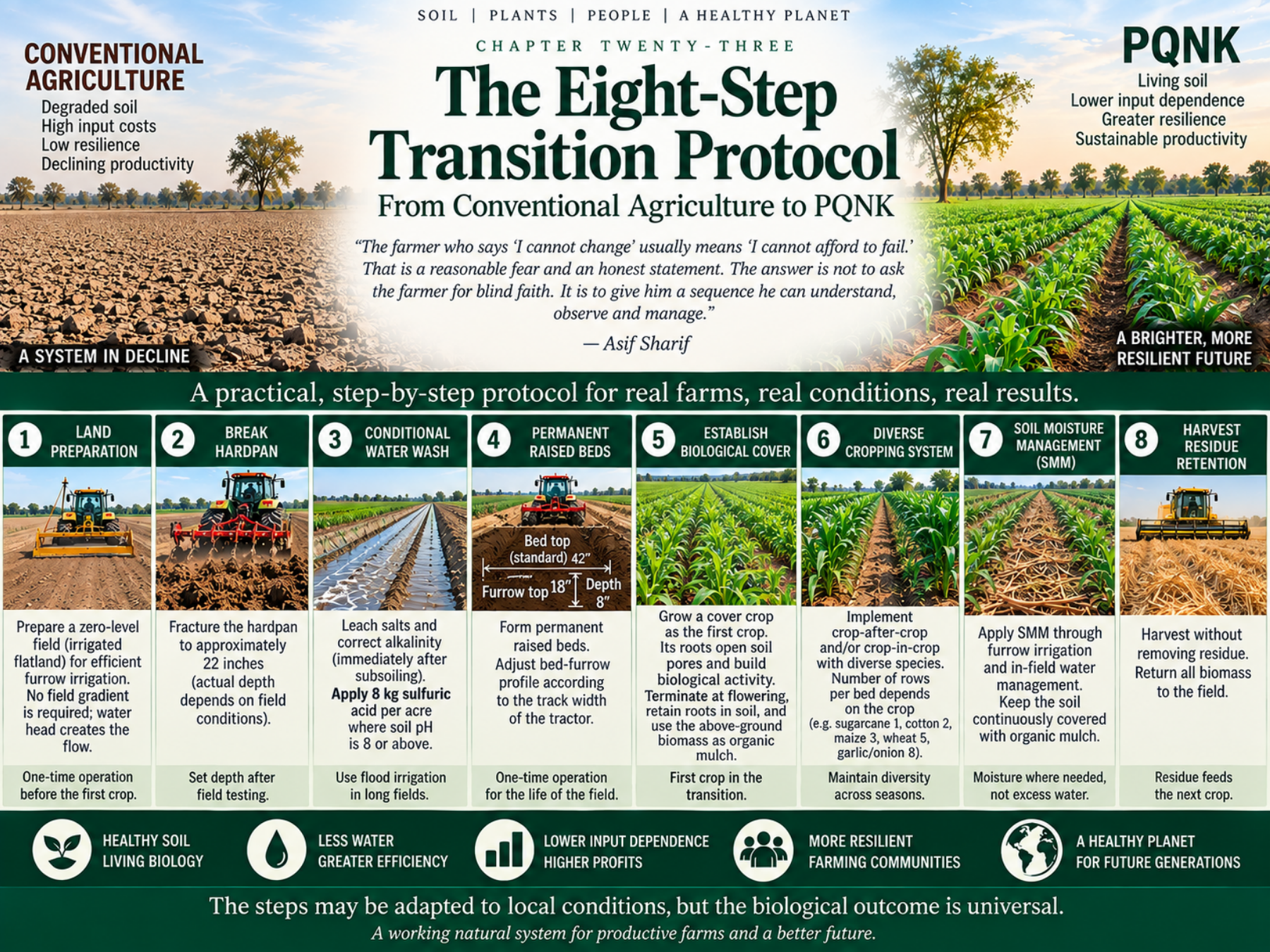
The eight-step transition from conventional agriculture to PQNK, from land preparation and hardpan-breaking through permanent raised beds, biological cover, diverse cropping and Soil Moisture Management, to harvest without resetting the system.
“The farmer who says, ‘I cannot change,’ usually means, ‘I cannot afford to fail.’ That is a reasonable fear and an honest statement. The answer is not to ask the farmer for blind faith. It is to give him a sequence he can understand, observe, and manage.”
Asif Sharif
Chapter Twenty-Two established the four governing rules of PQNK: no inundation, no tillage after conversion, continuous organic mulch cover, and biodiversity. Those rules define the biological operating environment. This chapter translates them into a field conversion protocol.
The protocol has eight steps, but they are not eight permanent operations repeated for every crop. The early steps correct inherited physical constraints and establish permanent field architecture. The later steps shift management from rebuilding the field for each crop to maintaining a living production system crop after crop.
The biological principles are universal. The engineering is adaptive. A farmer on level irrigated land in Punjab, a farmer on sloping land, and a farmer working with a different tractor wheel track will not use identical dimensions or water-delivery arrangements. They should, however, create the same biological conditions.
Correct the field once, establish permanent beds and biological cover, then grow crop after crop without destroying the soil system that has been created.
BEFORE THE FIRST STEP: READ THE FIELD
Before conversion, the farmer should understand the field well enough to make the one-time engineering decisions correctly. Three observations are especially useful: field topography and water movement, the presence and depth of hardpan, and soil conditions, including pH and salinity, that determine whether sulfuric acid should accompany the required conversion water wash.
Field design. On flat flood-irrigated land, identify the longest practical field layout that can distribute water uniformly with minimum soil disturbance. On sloping or rolling land, follow contour and erosion-control logic rather than forcing the field into a flatland geometry.
Hardpan. Probe several locations rather than assuming that one point represents the whole field. In PQNK usage, hardpan and plough pan refer to the same compacted layer created by repeated cultivation and traffic.
Soil reaction and salts. Where soil pH is above 8 or visible salinity and alkalinity indicate a corrective need, the transition may include the one-time water-wash described below. This is a conversion operation, not a recurring PQNK input.
THE EIGHT STEPS
Step One: Design the field
When: Before the first PQNK crop.
What: On flat flood-irrigated land, design the field into the longest practical plots and establish a zero-level field surface. The field itself does not require a longitudinal gradient for irrigation flow; the necessary hydraulic gradient is created by the water head as water enters and moves through the furrows. Laser levelling may be used where required to establish this zero-level condition with minimum soil disturbance. On slopes or rolling land, use contour-based field design appropriate to the topography.
Why: The permanent architecture that follows should not have to be repeatedly destroyed to correct water distribution. Good design allows the furrows to function as hydraulic and traffic corridors while the beds remain protected biological production zones.
What to observe: Water should be capable of moving through the intended furrow network without persistent ponding, severe erosion or large dry sections. The design should also allow machinery to remain in designated traffic paths once the beds are formed.
Step Two: Break the hardpan
When: Once, during conversion.
What: Use a heavy-duty subsoiler in a single deep pass to approximately 22 inches, sufficient to pass through the usual compacted layer. This is a traction-demanding conversion operation. A heavy tractor with normal wide agricultural tyres may be required and is acceptable at this stage because the permanent beds have not yet been formed.
Why: Hardpan restricts deep rooting, drainage, gas exchange and vertical water movement. Fracturing it creates an initial physical route that roots, soil organisms and subsequent wetting and drying can occupy. The objective is not to cultivate the entire soil profile. It is to remove the compacted barrier once.
What to observe: A probe should penetrate more deeply than before conversion, roots should progressively occupy the opened profile, and rainfall or irrigation should infiltrate without the same persistent perched-water behaviour associated with the compacted layer.
Once permanent beds are established, the traffic rule changes. Routine operations should use tyres that remain completely within the furrows. For the regional PQNK bed profile, approximately 9–11 inch tyres are preferred for low-draft planting and maintenance operations because they avoid pressing the bed sidewalls. Sidewall compaction restricts lateral infiltration from the furrow into the bed.
Step Three: Wash the soil
When: Immediately after hardpan fracturing and before permanent raised-bed formation.
What: Give the opened soil profile a deep water wash. This is a standard PQNK conversion operation after hardpan breaking. Where soil pH is 8 or above, approximately 8 kg of sulfuric acid per acre is recommended with the irrigation water, taking into account local soil chemistry, irrigation-water quality and safe handling requirements. The water wash is required; the sulfuric acid is the conditional component.
Why: Hardpan breaking opens the compacted profile. The subsequent deep water wash moves soluble salts and accumulated materials downward through the newly opened profile and prepares the root zone for the permanent biological production system. Where high pH requires correction, sulfuric acid assists this transition process. It is a corrective conversion treatment, not a recurring fertiliser programme.
What to observe: After washing, water should move more freely through the opened profile and the root-zone condition should begin improving. Where high pH, salinity or alkalinity was present, subsequent soil observation and testing can be used to follow the response. The field then proceeds to permanent raised-bed formation; the deep conversion wash is not repeated as a routine crop operation.
Step Four: Form the permanent raised beds
When: After the conversion wash and before establishment of biological cover.
What: Shape permanent raised beds around the tractor wheel track while considering soil characteristics where adjustment is required. The standard PQNK 42–18 profile is designed for the 45–65 HP tractors commonly used in this region, which normally have a rear tyre centre-to-centre spacing of approximately 58–60 inches. The bed top is 42 inches; the furrow is 18 inches wide at the top, approximately 8 inches wide at the bottom, and about 8 inches deep.
In other regions, the bed-furrow profile must be adjusted according to the track of the tractor and, where necessary, the soil characteristics. The dimensions are adaptable, but the engineering principle is fixed: tractor tyres travel in the furrows under controlled traffic and never over the raised beds.
Why: The bed becomes the permanent biological production zone. The furrow becomes the hydraulic and traffic corridor. Keeping machinery off the bed protects pore structure, roots and biological continuity, while the bed elevation allows water to move laterally from the furrow without intentionally inundating the crop root zone.
What to observe: The bed profile should remain intact after irrigation and field operations. Tyres should fit within the furrows without pressing the bed shoulders. Water applied in the furrow should wet the bed laterally while the bed surface remains free of standing irrigation water.
Step Five: Grow the first biological cover crop
When: Immediately after the permanent raised beds have been formed.
What: Grow a vigorous, deep-rooted cover crop, such as Jantar (Sesbania) where agronomically appropriate, as the first crop on the newly established permanent beds. Allow its roots to penetrate and biologically open the soil profile. When the cover crop is terminated, retain the entire root system undisturbed in the soil and use the above-ground plant biomass as the first organic mulch covering the bed surface.
Why: The first cover crop performs two jobs simultaneously. Below ground, its living roots penetrate the newly opened profile, create biological pathways and pore spaces, feed soil organisms and begin rebuilding soil structure. Above ground, its biomass provides the organic material needed to establish continuous mulch cover.
What to observe: The soil surface should become completely protected by organic material while the root system remains undisturbed below it. Root channels, aggregation and biological activity should progressively develop within the bed. Thereafter, it is normally unnecessary to grow a separate crop merely to manufacture mulch for every succeeding crop. Once PQNK crop production begins, properly managed crop residues become the continuing source of surface mulch. Each crop therefore contributes to the biological environment inherited by the crop that follows.
Step Six: Move to crop-after-crop and crop-in-crop
When: From the first production crop onward.
What: Plant the next crop without destroying the permanent beds, removing the retained root system or recreating a tilled seedbed. Crop-after-crop means that one crop enters the living architecture left by the previous crop. Crop-in-crop adds compatible diversity where practical so that the field is not repeatedly reduced to a single biological function.
Planting: Use SIPP, VIPP or another low-disturbance precision method capable of placing seed through residue while leaving the surrounding soil and mulch substantially intact. Seed rate and spacing are crop-specific; precision gives each plant the required space rather than imposing one universal density.
Why: Continuity is the point. Every time the soil is tilled, roots removed and beds rebuilt, the field loses part of the biological structure accumulated by the preceding crop. Crop-after-crop allows that inheritance to compound.
What to observe: The next crop should establish through the existing cover with minimal soil exposure. Old roots remain below ground while new roots occupy the same protected profile. Diversity increases without requiring the field to be reset.
Step Seven: Manage soil moisture, not an irrigation calendar
When: Throughout every crop.
What: Use Soil Moisture Management (SMM). Judge irrigation need from the condition of the soil and crop rather than from a fixed calendar. Use the practical ball test to determine whether adequate moisture remains. Where furrow irrigation is used, apply water slowly and normally only to about half the furrow height, allowing it to move laterally through the bed. Rainfall, stored subsoil moisture, dew and other environmental moisture contributions are part of the field water balance.
Why: The objective is a moist, aerated root zone, not a flooded one. Water carries dissolved nutrients to the plant, but roots and soil organisms also require oxygen. SMM therefore manages the water-air relationship rather than maximising the amount of water applied.
What to observe: The bed should remain moist enough for plant function while retaining aeration. Irrigation water should not stand over the bed surface. As structure and biological function improve, irrigation demand and frequency may decline, but the farmer should respond to field condition rather than assume a fixed reduction for every soil, crop or climate.
Step Eight: Harvest without resetting the system
When: At every harvest.
What: Remove the economic produce while leaving roots in the soil and retaining useful crop residue on the surface. Do not plough, burn or expose the soil in preparation for the next crop. Manage residues so that the next crop can be planted through them with minimum disturbance.
Why: Harvest should remove the product, not dismantle the production system. Retained roots continue to contribute channels and organic substrates below ground. Surface residue becomes mulch and returns part of the crop’s captured carbon and nutrients to the biological cycle.
What to observe: After harvest, the field should still look biologically occupied: permanent beds remain, roots remain below ground, residue protects the surface, and the next crop can be inserted without conventional land preparation.
WHAT IS PERMANENT AND WHAT REPEATS
The eight-step protocol is best understood as a transition from temporary engineering intervention to permanent biological management. Steps One through Four complete the one-time physical conversion and establish the permanent field architecture. Step Five uses the first cover crop to begin biological opening of the soil and to produce the initial organic mulch. Thereafter, Steps Six through Eight form the continuing production cycle: grow crop after crop within the existing architecture, manage soil moisture rather than flooding, and harvest without destroying the system. Properly managed residues from succeeding crops maintain the organic surface cover.
The machines therefore change role after conversion. Heavy power may be necessary for the one-time hardpan-breaking and bed-forming operations. Once the beds exist, routine operations should become lighter and more precise. SIPP and VIPP planting are low-draft operations. Narrow tyres, controlled traffic and minimum disturbance then protect the bed rather than reconstruct it.
THE FIRST CROPS: MANAGING THE TRANSITION
The transition period deserves active observation because the field is changing from an input-managed system to one increasingly regulated by soil structure, roots, residues and biology. PQNK does not require the farmer to sacrifice a crop while waiting for biology to recover.
Where a genuine nutrient deficiency appears during the early transition, approximately 4 kg NP per acre may be applied with furrow water as a temporary support; in difficult cases this may be repeated two or three times according to crop response. Where pest pressure crosses the approximately 10 percent transition threshold, a pesticide may be used to protect the crop. Where heavy summer weeds threaten establishment, herbicide may also be used as a transitional measure. These are safeguards for the conversion period, not components of the mature PQNK production system.
The objective is to reduce and then remove dependence on such interventions as the field develops biological function. The farmer should therefore record what was needed, where it was needed and whether the requirement declines in succeeding crops.
THERE IS NO FIXED THREE-CROP CLOCK
Biological recovery does not proceed according to a universal calendar. A field with severe compaction, salinity, low residue availability or poor water quality may take longer than a field that begins in better condition. Climate, crop sequence, management quality and the success of the initial conversion also affect the speed of transition.
For that reason, PQNK should not promise that every farm will reach zero purchased inputs by a particular crop. The direction is clear: declining disturbance, declining dependence on external inputs, improving soil structure, greater biological regulation and progressively more efficient use of water and energy. The rate must be read from the field.
WHAT THIS CHAPTER HAS ESTABLISHED
The eight-step transition protocol is the engineering bridge between conventional agriculture and PQNK. It begins by correcting inherited physical constraints and ends by changing the farmer’s relationship with the soil: from rebuilding it for every crop to protecting a permanent living production system.
The protocol is universal in principle but adaptive in engineering. Field dimensions, tractor geometry, crop sequence, water delivery and transition speed can change with location. The four governing rules do not: no inundation; no tillage after conversion; continuous organic mulch cover; encourage biodiversity.
Once this distinction is understood, PQNK becomes easier to implement. Conversion is temporary. The permanent bed and the biological process are not. The farmer’s task after conversion is no longer to manufacture a seedbed each season. It is to maintain the conditions in which the natural production system can continue working.
The following chapters examine the major components of this operating system in greater depth.
Chapter Twenty-Four: The Complete PQNK System Timeline