

Industrial Devastation To Natural Abundance
The PQNK System · Chapter 24
The Complete PQNK System Timeline
From the Day of Transition to the Mature Ecosystem
Release 1.0 · 2026-09-18
If you use “Listen”, the text of the page may be sent to your browser or operating system’s speech provider, such as Apple, Google or Microsoft, depending on the voice your device uses. Pedaver does not process, transmit or store any audio.
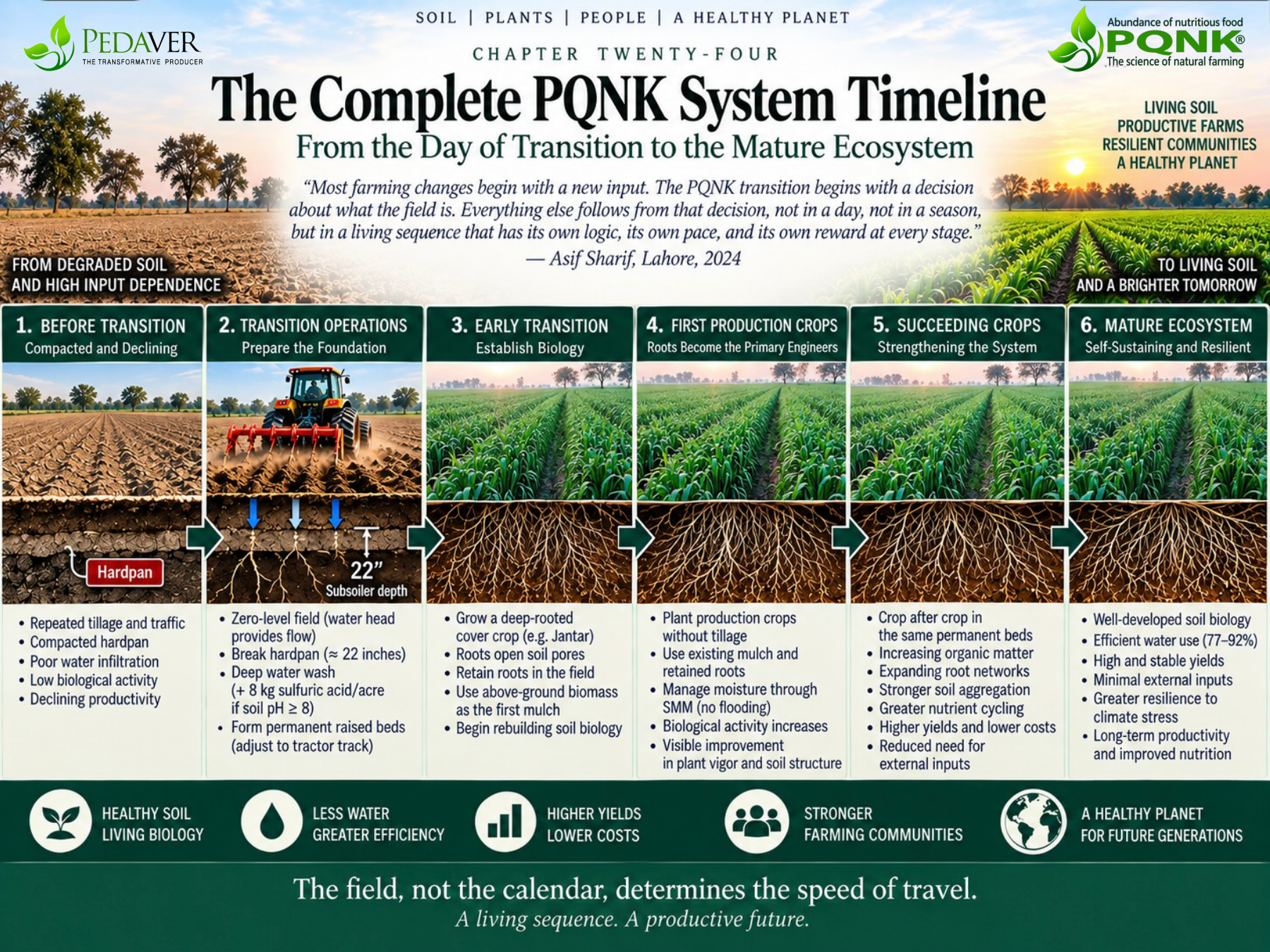
The PQNK progression in six phases, before transition, transition operations, early transition, first production crops, succeeding crops, and the mature ecosystem, each shown against the field's own biological evidence rather than a fixed timetable.
“Most farming changes begin with a new input. The PQNK transition begins with a decision about what the field is. Everything else follows from that decision, not in a day, not in a season, but in a living sequence that has its own logic, its own pace, and its own reward at every stage.”
Asif Sharif, Lahore, 2024
Chapter Twenty-Three presented the Eight-Step Transition Protocol as a structured procedure, a sequence that converts a conventionally managed field into PQNK. This chapter presents something different: the living progression of that conversion as the field responds. The protocol describes what the farmer does. This chapter describes what begins to change underground and above ground as physical constraints are corrected, biological cover is established, roots are retained, soil moisture is managed, and succeeding crops enter the same permanent architecture.
Understanding this progression is useful because biological recovery does not follow a universal calendar. A farmer may see important changes within weeks, while other functions may require several crop cycles to strengthen. Starting soil condition, hardpan severity, salinity, water quality, climate, crop sequence, residue production and management all affect the rate. The purpose of a timeline is therefore not to promise that a particular condition will be reached in the second or third crop. It is to show the direction of change and the evidence the farmer should watch for.
The timeline is a biological map. The field, not the calendar, determines the speed of travel.
THE EARLY TRANSITION: THE FIRST CHANGES BENEATH THE SURFACE
The earliest phase begins with the one-time conversion operations described in Chapter Twenty-Three. On flat flood-irrigated land, the field is designed and levelled to zero grade, with the water head providing the hydraulic gradient for flow. The hardpan is broken to approximately 22 inches. The opened profile is given the required deep water wash; where soil pH is 8 or above, approximately 8 kg of sulfuric acid per acre is recommended with the irrigation water, subject to local soil and water conditions and safe handling. Permanent raised beds are then formed according to tractor track and soil requirements.
Once the permanent beds are formed, the first biological phase begins. A vigorous, deep-rooted cover crop such as Jantar is established where agronomically appropriate. At this stage the field may not yet look dramatically different, because much of the important work is taking place below the surface.
The fractured hardpan provides an initial physical opening through the compacted layer. Water and air can move through pathways that were previously restricted, while the roots of the cover crop begin penetrating the opened profile. Those roots do more than occupy the soil. They create and enlarge biological pathways, feed rhizosphere organisms, leave carbon below ground and begin building the pore architecture that later crops will inherit.
The permanent bed-furrow architecture also begins performing its hydraulic and traffic functions. Water is supplied through the furrows without intentionally inundating the bed. It moves laterally into the raised bed while the root zone remains moist and aerated. Tractor traffic is confined to the furrows so the production bed is protected from renewed compaction.
The first cover crop is also the source of the first mulch. When it is terminated, its roots remain undisturbed in the bed and its above-ground biomass is laid on the surface as organic mulch. From this point onward, the field begins to carry both parts of the PQNK biological architecture: retained roots below and protective organic cover above.
The farmer’s task during this early phase is observation and protection of the new architecture, not unnecessary intervention. At the same time, PQNK does not require the farmer to sacrifice a crop while transition is underway. A genuine nutrient deficiency, economically significant pest pressure or severe weed problem may require the temporary safeguards defined in the transition protocol. The objective is to use only what is necessary while allowing dependence on external intervention to decline as biological function develops.
THE FIRST PRODUCTION CROPS: ROOTS BECOME THE PRIMARY ENGINEERS
After the cover crop has established the first biological inheritance, production crops enter the permanent beds without conventional land preparation. Their roots grow into a profile that has already been physically opened and biologically occupied. The field is no longer reset between crops.
Root development now becomes one of the principal drivers of continuing change. Roots explore existing pores and create new ones, release compounds into the rhizosphere, interact with bacteria and fungi, and leave channels and organic substrates behind when the crop is harvested. Mycorrhizal associations can extend the effective soil volume explored by roots where compatible host plants and conditions are present. Each retained root system therefore contributes to the physical and biological inheritance of the next crop.
This underground continuity is more important than any promise tied to a particular season. The field may begin showing deeper rooting, improved aggregation, better infiltration and longer moisture retention, but the rate will vary. A severely compacted or saline field should not be expected to progress at the same speed as a field that begins in better condition.
Above ground, early PQNK crops may equal, exceed or occasionally fall below a conventional comparison depending on starting condition, crop, weather and quality of management. Yield alone should therefore not be used as the only early transition indicator. Water requirement, root development, soil condition, residue production, pest pressure, input requirement and net production cost should be observed together.
System integrity remains essential. The permanent beds are not tilled, roots are retained, the soil surface remains covered, and irrigation is managed through SMM rather than by routine flooding. If a genuine deficiency appears, approximately 4 kg NP per acre may be applied with furrow water as temporary support and repeated when crop response justifies it. If pest pressure crosses the approximately 10 percent transition threshold, pesticide may be used to protect the crop. Herbicide may also be used where severe summer weeds threaten establishment. These are transition safeguards, not components of the mature PQNK system.
The early production phase is therefore a period of building and observation. The important question is not, “Which crop number is this?” It is, “Is this crop leaving the field biologically stronger for the crop that follows?”
Mulch and roots perform different but complementary work. Mulch protects the surface, moderates soil temperature, reduces direct evaporation and supplies decomposer organisms. Living and retained roots work throughout the soil profile by creating pores, feeding the rhizosphere and maintaining biological continuity. No fixed percentage should be assigned to either contribution; both are necessary parts of the same operating environment.
ESTABLISHMENT ACROSS SUCCEEDING CROPS: WHEN THE SYSTEM BECOMES VISIBLE
As crop follows crop without tillage, the biological effects that were initially difficult to see can become increasingly visible. There is no universal point at which this occurs. On some fields the response may be rapid; on others it may require several crop cycles. What matters is the direction of change.
After the first cover crop has supplied the initial mulch, properly managed residues from succeeding crops become the continuing source of surface cover. The economic produce is removed, roots remain in the soil, and useful above-ground residue is retained or managed as mulch. In this way the field increasingly produces the material needed to protect its own surface rather than depending on imported mulch.
The root zone also accumulates biological continuity. New roots enter pores and channels left by earlier roots. Soil aggregation can improve as roots, fungal hyphae, microbial products and organic matter interact. Mycorrhizal networks can become more extensive where host crops and conditions support them. Nutrient cycling increasingly occurs through the interaction of roots, organisms, residues, water and mineral surfaces rather than through repeated reconstruction of the soil and routine application of soluble fertiliser.
Practical changes may include longer intervals between irrigations, better infiltration, more stable soil moisture, stronger root systems, improved crop uniformity and reduced need for corrective inputs. Pest and weed behaviour may also change as the field environment changes. These responses should be observed and recorded rather than assumed. The farmer is learning to read the system instead of following a fixed input calendar.
CROSSING THE THRESHOLD: THE FIELD DECIDES WHEN
There is no universal “third-season threshold” in PQNK. A field crosses from transition toward sustained PQNK when its biological and physical functions have strengthened enough that the recurring external supports of conventional agriculture are no longer routinely required. That point may arrive earlier in some functions and later in others.
The transition can be judged through evidence rather than crop count. The farmer should ask whether the permanent bed structure remains intact, whether the soil remains continuously covered, whether retained roots and succeeding roots are building a deeper pore network, whether irrigation requirement is declining, whether crop establishment is becoming more reliable, and whether fertiliser, pesticide and other corrective interventions are becoming less necessary.
As biological function strengthens, the root-microbe relationship assumes a larger role in nutrient acquisition. Roots, mycorrhizal fungi where present, bacteria and other organisms interact with mineral surfaces and decomposing residues. Nutrient supply becomes increasingly linked to biological cycling and plant demand. This does not mean that every soil reaches identical fertility or that every crop becomes independent of all external correction on the same timetable.
The water system also changes progressively rather than suddenly. Better structure, deeper rooting, permanent cover and SMM can increase infiltration, reduce direct soil evaporation and extend the period for which useful moisture remains available to the crop. Irrigation may decline substantially, but rainfall, climate, crop demand, soil storage and water quality still determine the local water balance. PQNK manages soil moisture; it does not assume that every mature field becomes irrigation-free.
Biological regulation of pests can also strengthen as habitat, plant condition and biodiversity improve. Predators, competitors and other ecological interactions can reduce the likelihood that a single pest population dominates the field. This is regulation, not the disappearance of pests, and it should be judged by field pressure and economic damage rather than by an assumption that intervention can never again be required.
The professional transition occurs when the farmer stops asking primarily, “What input should I apply?” and begins asking, “What condition is the living system showing me?” That shift can occur only when field observation replaces the calendar as the guide.
THE MATURE PQNK ECOSYSTEM: LIFE IN THE SUSTAINED STATE
A mature PQNK field is not defined by having completed a fixed number of seasons. It is defined by sustained ecological function under the four governing rules: no inundation, no tillage after conversion, continuous organic mulch cover and biodiversity. The system remains dynamic because weather, crops, organisms and water supply continue to change.
In the sustained state, several characteristics should increasingly be present:
The soil functions as a living production system rather than merely as a physical medium. Permanent roots and residues support biological activity; aggregation and pore continuity are maintained by roots, organisms and organic matter; and nutrient cycling increasingly depends on the interaction among plant demand, decomposing residues, microorganisms and the mineral reserves of the soil. The objective is not to claim a perfectly closed nutrient cycle, because harvested produce removes matter from the field, but to minimise unnecessary external dependence by strengthening biological cycling.
The water economy becomes more efficient, not closed. Rainfall, irrigation where required, stored soil moisture and other environmental contributions form the local water balance. Permanent cover reduces direct evaporation, deeper roots enlarge the soil volume available to the crop, and protected structure improves infiltration and storage. The farmer continues to use SMM and supplies irrigation when the field indicates a genuine moisture deficit.
Purchased-input costs can fall sharply as recurring tillage, routine fertiliser and pesticide programmes, and unnecessary irrigation are reduced or eliminated according to field performance. Other costs remain: seed where purchased, planting and harvesting, machinery ownership or hire, labour, maintenance, water delivery where irrigation is required, and any justified transitional or corrective intervention. The economic objective is therefore not an unsupported promise of zero cost. It is a production system in which more of the essential work is performed by the field’s biological processes and less by recurring purchased inputs.
WHAT THIS CHAPTER HAS ESTABLISHED
This chapter has described the biological progression of PQNK from one-time physical conversion, through the first cover crop and succeeding production crops, toward sustained ecosystem function. The progression has a direction, but it does not have a universal crop-count timetable. Some changes can begin within days or weeks; others strengthen across multiple crop cycles. The rate depends on the field.
The chapters that follow examine the physical and operational elements that create these conditions: hardpan correction, permanent bed architecture, the cover-crop and mulch process, root retention, SMM and precision machinery. These are not recurring instructions for rebuilding a production system. They are the engineering and management conditions that allow a living system to continue its work without being reset between crops.
Chapter Twenty-Five: Hardpan