
Industrial Devastation To Natural Abundance
The PQNK System · Chapter 22
The Four Governing Rules
The Litmus Test for PQNK Agriculture
Release 1.0 · 2026-09-17
If you use “Listen”, the text of the page may be sent to your browser or operating system’s speech provider, such as Apple, Google or Microsoft, depending on the voice your device uses. Pedaver does not process, transmit or store any audio.
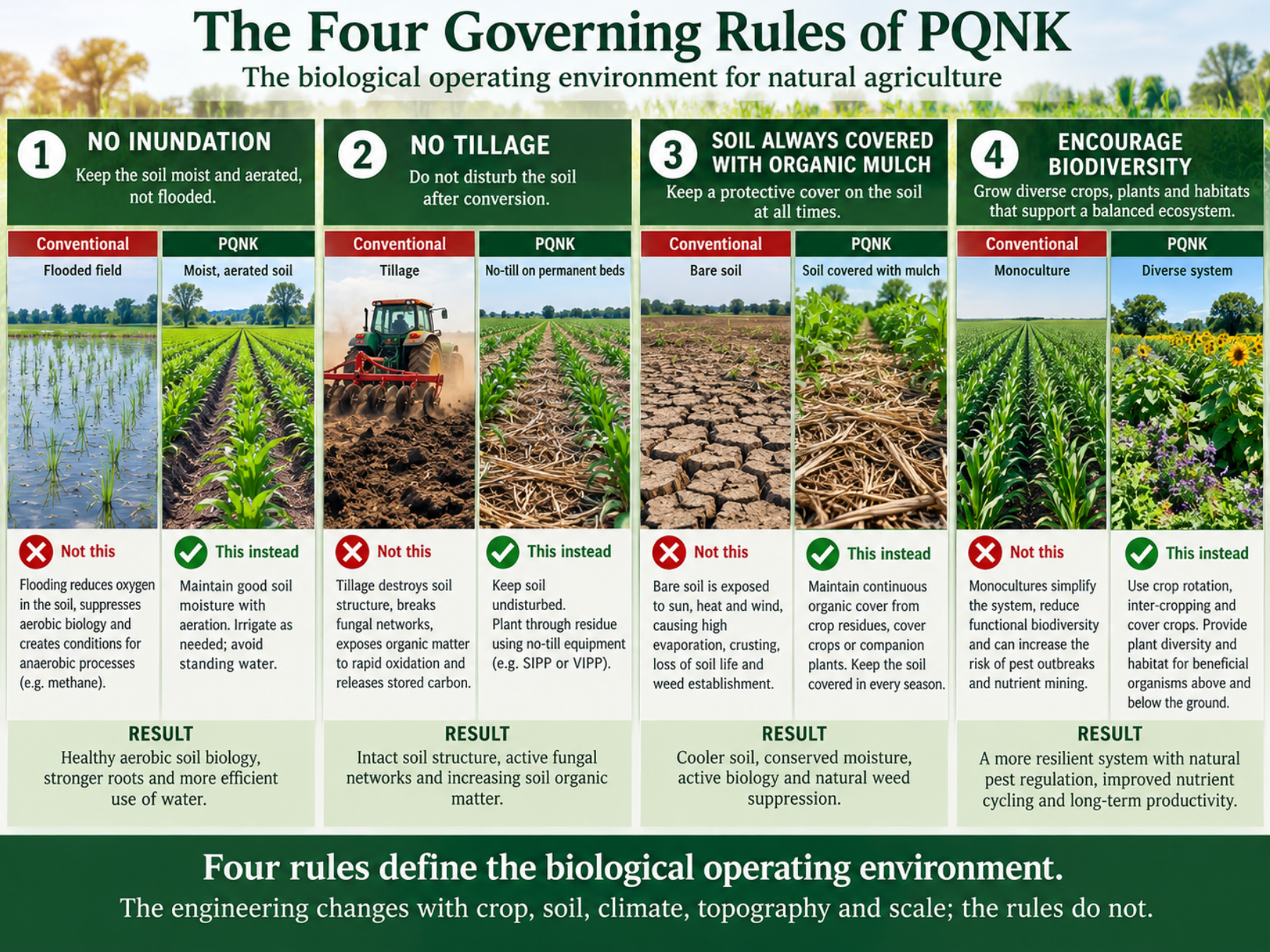
The Four Governing Rules of PQNK, each set against its conventional counterpart and the biological result: no inundation, no tillage after conversion, soil always covered with organic mulch, and encouraged biodiversity.
“You do not need to understand every organism in the soil before you can protect the system that supports them. Ask four questions: Is the soil kept aerated rather than inundated? Is it protected from tillage? Is it continuously covered? Is biodiversity being encouraged? These four decisions establish the conditions within which the living production system can function.”
Asif Sharif, Lahore, 2021
Part Four is the reference section of this book. Parts One through Three established the scientific argument, the historical context and the path through which PQNK was recognised and codified. Part Four now describes the system itself: the governing rules, the transition protocol, the field engineering and the management decisions through which those rules are applied. A farmer reading Part Four should finish it with a clear picture of how to begin the transition on their own land without confusing the permanent biological rules with the temporary operations required during conversion.
This chapter establishes the foundation for everything that follows. PQNK has four governing rules: no inundation, no tillage after conversion, continuous organic soil cover, and encouraged biodiversity. These are the biological boundaries of the system. Permanent raised beds, controlled traffic, SIPP or VIPP planting, Soil Moisture Management, cover crops, crop-after-crop and crop-in-crop are the engineering and management methods used to put those rules into practice. They are essential parts of implementation, but they should not be confused with a second set of principles.
WHY THE FOUR RULES COME FIRST
Most agricultural systems are described by a package of practices or inputs. PQNK begins one level deeper, with the conditions required for a living terrestrial production system to function. Soil organisms need a habitable physical environment, roots need air as well as water, the surface needs protection from heat and evaporation, and the field needs biological diversity rather than repeated simplification. The first task is therefore not to add another product. It is to stop repeatedly creating the conditions that weaken the biological system and to maintain the conditions that allow it to recover and regulate itself.
The four rules are governing boundaries, but they must be interpreted biologically rather than mechanically. A temporary rain event is not the same as deliberately maintaining a field under inundation. One-time hardpan fracturing and bed formation during conversion are not the same as recurring tillage. A transition crop may require limited protective intervention while the biological system is rebuilding. The objective is consistency after conversion: preserve aeration, stop recurring soil disturbance, maintain organic cover and build functional biodiversity crop after crop.
THE FOUR GOVERNING RULES
These four rules apply across PQNK crops and environments. Their field expression may differ with soil, climate, topography, water source, tractor geometry and farm scale, but the biological purpose remains the same.
One. No inundation
PQNK keeps the root zone moist and aerated rather than deliberately saturated for prolonged periods. When pore space remains filled with water, oxygen diffusion falls sharply and soil processes shift toward anaerobic conditions. Root respiration, many aerobic organisms and mycorrhizal function can be impaired, while strongly reduced conditions can favour processes such as methanogenesis. This is why PQNK does not use standing-water paddy culture or routine flood irrigation as a production method. A temporary heavy-rain event is an environmental occurrence, not a management failure; the engineering objective is drainage and recovery of aeration. Furrow irrigation is applied slowly and conservatively so water enters the bed laterally without inundating the bed surface.
Two. No tillage after conversion
Recurring tillage disrupts soil aggregates, fungal networks, pore continuity and biological habitat, and it accelerates exposure of protected organic matter to decomposition. PQNK therefore separates conversion from permanent management. Where a hardpan exists, it is fractured once, normally to about 22 inches, and the permanent raised beds are formed. These are corrective engineering operations. After the field architecture is established, the beds are not ploughed, cultivated, inverted or rebuilt between crops. Traffic remains in the furrows and the biological production zone remains undisturbed.
Three. Keep the soil continuously covered with organic mulch
Bare agricultural soil is exposed directly to solar heating, evaporation, raindrop impact and rapid moisture fluctuation. PQNK therefore keeps the bed surface protected with organic material. Retained crop residues, cover-crop biomass and other suitable plant material form a surface blanket that moderates temperature, reduces direct evaporation, cushions rainfall impact, suppresses many weeds and supplies carbon to decomposer organisms as it breaks down. The mulch remains on the surface rather than being incorporated by tillage. The practical test is simple: the production bed should not be deliberately left bare between crops.
Four. Encourage biodiversity
Natural terrestrial ecosystems are biologically diverse above and below ground. PQNK therefore avoids designing the field around biological uniformity as a permanent condition. Diversity is encouraged through crop-after-crop sequencing, crop-in-crop where practical, cover crops, companion species, retained roots and residues, and habitat for beneficial organisms. Different root architectures, residues, exudates and flowering periods support a wider biological network and reduce dependence on a single crop-pest-nutrient relationship. The exact crop combination is local; the governing requirement is to move the production system toward greater functional biodiversity rather than repeated simplification.
HOW THE FOUR RULES BECOME FIELD ENGINEERING
The rules define the biological environment. Engineering makes that environment workable in production agriculture. The following components are therefore not additional principles; they are the practical architecture through which the four rules are maintained at field scale.
One. Permanent raised beds and controlled traffic
Permanent raised beds provide the protected biological production zone while the furrows provide the hydraulic and traffic corridors. In the regional PQNK standard, designed around the 45–65 HP tractors commonly used in Pakistan with approximately 58–60 inches rear tyre centre-to-centre spacing, the bed top is 42 inches and the furrow is 18 inches wide at the top, about 8 inches at the bottom and about 8 inches deep. In other regions the profile is adjusted to tractor geometry and, where necessary, soil characteristics. The fixed engineering principle is controlled traffic: tractor tyres remain in the furrows and never travel over the raised beds. After formation, the beds remain permanent.
Two. Low-disturbance precision planting: SIPP or VIPP
SIPP and VIPP are designed to place seed through surface residue with minimal disturbance to the permanent bed. Planting becomes a low-power operation rather than a reason to recreate a seedbed. After the beds are formed, narrow tractor tyres, ideally about 9–11 inches where the machinery permits, help keep traffic inside the furrows and away from the bed sidewalls. This matters hydraulically as well as physically because compacted sidewalls restrict lateral infiltration from the furrow into the bed. Seed rate and spacing are crop-specific; the governing objective is accurate placement with the least possible disturbance.
Three. Continuous cover and living diversity
Mulch and biodiversity are managed together. A transition may begin with a vigorous cover crop such as Jantar where appropriate. Roots are retained in the soil and the above-ground biomass becomes mulch. The next crop is then established without destroying the bed or removing the previous root system. Crop-after-crop and crop-in-crop keep living roots, residues and different biological functions moving through the same permanent soil architecture. Over time, the field increasingly supplies its own surface cover from retained biomass rather than depending on repeated imported mulch.
Four. Soil Moisture Management (SMM)
SMM manages the moisture condition of the root zone rather than following a fixed irrigation calendar. Rainfall, dew and atmospheric humidity, stored soil moisture and capillary movement can all contribute to the field water balance, while irrigation supplies the remaining deficit. The farmer uses the ball test and direct field observation to judge when irrigation is needed. Where furrows are used, water is applied slowly and commonly to about half the furrow height so it can move laterally through the bed without deliberately inundating the surface. The purpose is not to obey a number for its own sake, but to maintain the working balance PQNK requires: enough moisture for plant uptake and biological activity while preserving air-filled pore space.
THE FOUR QUESTIONS: USING THE RULES AS A DIAGNOSTIC
The four governing rules provide a rapid field diagnostic. They do not replace soil analysis, crop measurement or scientific investigation when those are needed. They answer a narrower and very practical question: is the field being managed inside the biological operating boundaries of PQNK?
Ask four questions. Is the root zone being kept moist and aerated rather than deliberately inundated? After the one-time conversion operations, is the production bed protected from recurring tillage and traffic? Is the soil surface continuously protected with organic mulch? Is functional biodiversity being actively encouraged through the crop sequence and field ecology?
If the answer to one of these questions is no, identify which operating condition has been broken and correct it. Then examine the engineering that supports the rule: bed geometry and controlled traffic, planting method, mulch supply, crop sequence and SMM. This distinction prevents a common error in PQNK implementation, treating a machine dimension or a temporary transition practice as though it were itself a universal biological principle.
The diagnosis is therefore simple: four rules first, engineering second. The rules remain constant. The engineering is adapted to the field.
WHY THESE FOUR RULES WORK TOGETHER
No single rule is PQNK by itself. No-till with bare soil is incomplete. Mulch over a repeatedly flooded root zone does not restore aeration. Permanent beds planted as an ecologically simplified system do not provide the same biological diversity. Biodiversity cannot compensate for repeated mechanical destruction of the habitat beneath it. The four rules work as a system because each protects a different condition required by the living soil.
No inundation protects aeration. No tillage after conversion protects structure, pore continuity and biological habitat. Continuous organic cover protects the soil-atmosphere interface and supplies carbon. Biodiversity broadens the biological network above and below ground. Together they create the operating environment within which roots, bacteria, fungi, mycorrhizae, soil fauna and plant residues can interact continuously rather than being repeatedly reset between crops.
The eight-step transition protocol in Chapter Twenty-Three explains how a conventionally managed field is moved into this condition. Hardpan fracturing, water washing where required, permanent bed formation, cover establishment, crop-after-crop planting, SMM and residue retention are the sequence of conversion and management. They serve the four rules; they do not replace them.
FROM CHEMISTRY TO BIOLOGY: WHAT THE SHIFT ACTUALLY MEANS
A biologically managed field is still a chemical system. Minerals dissolve, ions move in soil water, organic compounds are transformed, roots exchange compounds with microorganisms, and nutrients ultimately enter the plant in chemical forms. PQNK therefore does not propose the elimination of chemistry. The distinction is about how the production environment is regulated.
Conventional input-based agriculture commonly responds to a production problem by asking what external input should be added: fertiliser for nutrient deficiency, pesticide for pest pressure, herbicide for weeds, or additional irrigation for apparent water stress. PQNK begins with a different question: what condition of the living production system has been weakened, and can that condition be restored so that biological processes again carry more of the regulatory work?
Consider phosphorus. A soil may contain substantial total phosphorus while only a fraction is immediately available to roots. Root exudates, microorganisms and mycorrhizal associations can influence phosphorus mobilisation and acquisition. The final uptake remains chemical, but the pathway by which availability is regulated can be increasingly biological. The same principle applies more broadly: PQNK seeks to restore the habitat in which natural cycling, competition, predation, decomposition and root-microbial exchange can function before recurring external correction becomes the default response.
This does not mean that transition is always input-free. PQNK has a defined transitional protection approach. Where a clear nutrient deficiency appears during early biological recovery, a small dose of approximately 4 kg NP per acre may be supplied with furrow water and repeated where genuinely required. Where pest pressure crosses the established transition threshold of about 10 percent, a pesticide may be used as a protective intervention. Heavy summer weed pressure may also justify herbicide during transition. These are temporary safeguards, not the operating architecture of the mature system.
The distinction is important. Refusing every intervention while the field is still biologically weak is not the objective. Nor is continuing routine chemical dependence and calling it PQNK. Transition protects the crop while the four governing rules rebuild the production environment. As biological regulation strengthens, dependence on those interventions should decline rather than become permanent.
Understood this way, PQNK is neither anti-chemistry nor anti-science. Nature is the production system, and chemistry operates continuously inside it. PQNK changes the farmer’s role from repeatedly forcing individual responses through disturbance and inputs toward maintaining the physical and biological conditions within which the living system can regulate more of its own fertility, water relations and ecological interactions.
THE LITMUS TEST IN PRACTICE: COMMON MISAPPLICATIONS
The four-rule framework makes recurring implementation errors easier to identify. Most failures are not mysterious; they occur when a familiar conventional operation is reintroduced into a field whose biological architecture is still developing.
The first is over-irrigation. A farmer accustomed to flooding may equate visible water with crop security and fill the furrow excessively. PQNK instead asks whether the root zone has the correct moisture-air balance. Irrigation should respond to soil condition, using the ball test and field observation, and should enter the permanent bed without deliberately flooding its surface.
The second is insufficient cover. A thin or discontinuous mulch layer leaves parts of the bed exposed to direct heating, evaporation and raindrop impact and creates openings for weeds. The objective is continuous protection of the soil surface. Mulch quantity therefore has to be judged by coverage and persistence, not by a token application rate.
The third is recurring cultivation for weed control. Once permanent beds are established, mechanical soil disturbance should not become the routine answer to weeds. Better surface cover, crop competition, crop sequencing and, during a difficult transition, carefully limited protective measures are preferable to rebuilding the tillage cycle that PQNK is designed to end.
The fourth is confusing transition safeguards with the mature system. Limited NP, pesticide above the transition threshold, or herbicide under severe weed pressure may protect an early crop while biology is rebuilding. They are not permanent components of PQNK. The direction of travel must remain clear: each crop should leave the soil architecture, cover, roots and biological network better prepared for the next crop, with declining need for external correction.
WHAT THIS CHAPTER HAS ESTABLISHED
PQNK is governed by four biological rules: no inundation, no recurring tillage after conversion, continuous organic soil cover, and encouraged biodiversity. These rules are derived from the operating conditions observed in functioning terrestrial ecosystems and translated into production agriculture. The Amazon serves as an ecological reference system; field trials and farmer experience measure how the agricultural adaptation performs under particular crops and environments. Research therefore measures outcomes, mechanisms, transition speed and engineering performance rather than “validating nature.”
The rules are universal; the engineering is adaptive. Permanent raised beds and controlled traffic protect the production zone. SIPP and VIPP allow low-disturbance planting through residue. SMM maintains a moist, aerated root environment. Cover crops, retained roots, mulch, crop-after-crop and crop-in-crop build continuity and diversity. Chapter Twenty-Three now turns these principles into sequence: the Eight-Step Transition Protocol that takes a conventionally managed field through one-time correction and into permanent PQNK management.
Chapter Twenty-Three: The Eight-Step Transition Protocol