
Industrial Devastation To Natural Abundance
The PQNK System · Chapter 25
Hardpan: What It Is, What It Does, and How to Shatter It
The Invisible Wall Beneath the Cultivated Layer
Release 1.0 · 2026-09-18
If you use “Listen”, the text of the page may be sent to your browser or operating system’s speech provider, such as Apple, Google or Microsoft, depending on the voice your device uses. Pedaver does not process, transmit or store any audio.
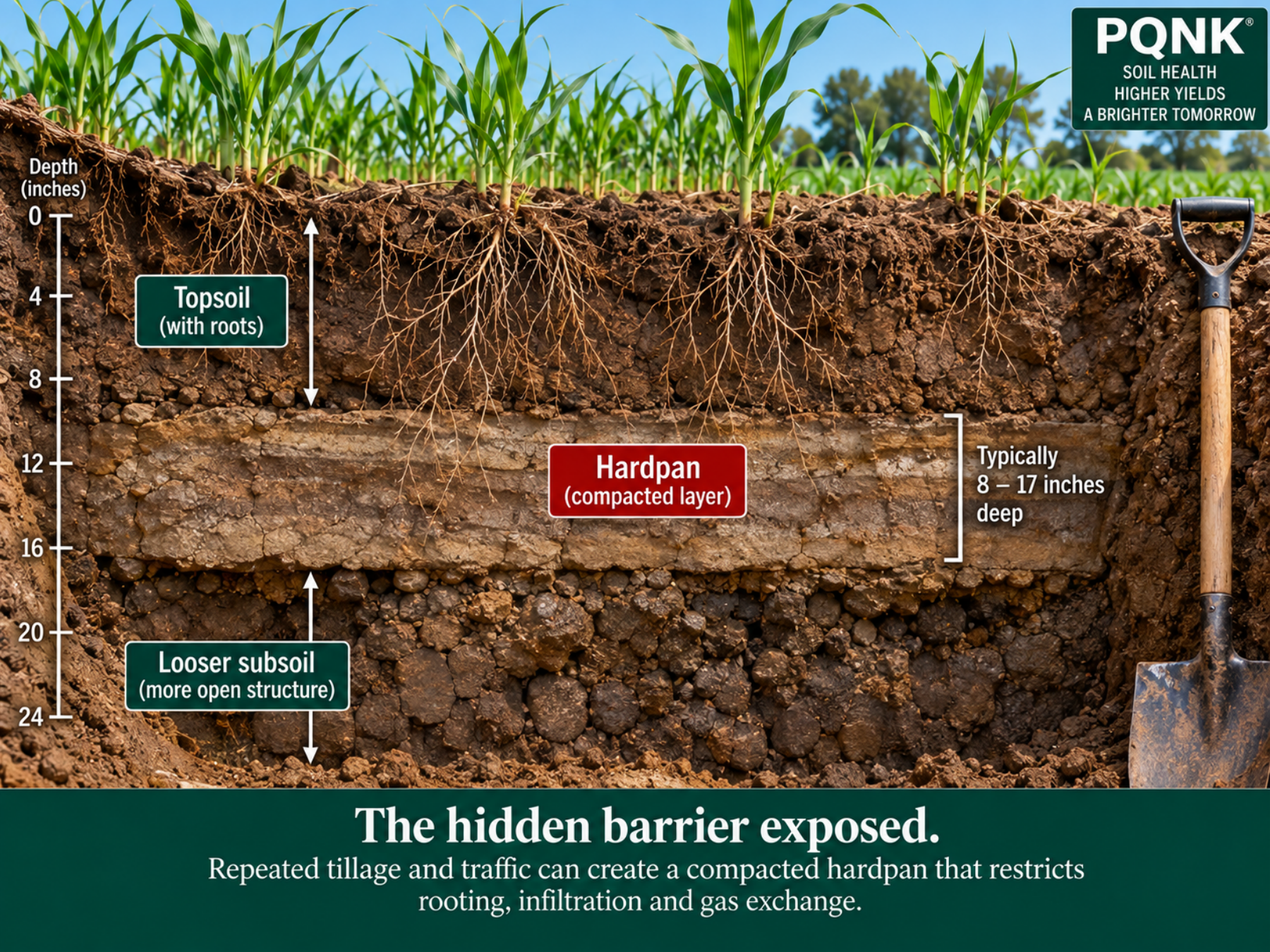
A soil profile cross-section showing the hardpan, the compacted layer typically 8 to 17 inches deep that restricts rooting, infiltration and gas exchange, between the topsoil above and the looser, more open subsoil below.
“Every farmer knows the plough. Almost no farmer knows what the plough leaves behind. The hardpan is the plough’s shadow: invisible, permanent, and the single physical barrier between the farmer and everything that the natural system has waiting for him underground.”
Asif Sharif, Lahore, 2019
In many conventionally managed fields, repeated tillage at similar depths and repeated machinery traffic create a dense compacted layer beneath the cultivated soil. In PQNK this compacted layer is called the hardpan, also known as the plough pan. Its exact depth and severity vary with soil texture, moisture at the time of traffic, axle load, tyre pressure, tillage history and field management. In the fields on which the PQNK conversion protocol was developed, the compacted zone is commonly encountered within roughly 8 to 17 inches of the surface. It may be invisible from above, yet it can strongly restrict root penetration, water movement and soil aeration.
PQNK treats hardpan correction as a foundational conversion operation because a compacted layer can limit the deeper soil functions on which the later biological system depends. Hardpan is not the sole cause of every fertility, water, pest or yield problem, but where it is present it can intensify several of them at the same time. This chapter explains how hardpan forms, how it affects the root zone, how a farmer can identify it, how PQNK fractures it once during conversion, and how permanent beds, controlled traffic, retained roots, mulch and Soil Moisture Management protect the restored profile thereafter.
HOW HARDPAN FORMS: A HISTORY OF COMPACTION
Soil is a porous medium rather than a solid block. Its pores carry air and water, provide pathways for roots, and create habitat for soil organisms. Repeated pressure can reduce the volume and continuity of these pores, particularly when machinery travels on moist soil or tillage is repeatedly performed to the same depth. The result can be a compacted layer beneath the cultivated zone.
Bulk density is one useful indicator of compaction, but there is no single universal number at which every soil becomes a hardpan. Root restriction depends strongly on texture: a bulk density tolerated by a sandy soil may severely restrict a clayey soil. The practical PQNK question is therefore not whether a field matches one numerical threshold, but whether a dense layer is restricting roots, infiltration and gas exchange. The field assessment described later combines resistance, profile observation and water behaviour to answer that question.
The Tillage Paradox
The original purpose of tillage was to loosen soil. The digging stick loosened a narrow channel. The wooden plough opened a shallow furrow. The iron plough went deeper and turned the soil. Each generation’s tillage implement was more powerful than the last, and each created compaction at a slightly greater depth. When the same field is tilled to the same depth season after season, as virtually all conventional agriculture has done for generations, the compaction layer beneath the plough depth grows progressively denser. The tillage that was supposed to loosen the soil was simultaneously building the wall that prevents the soil from being permanently loose.
The Machinery Acceleration
Mechanisation increased the potential for subsoil compaction because tractors and implements place concentrated loads on the field, especially when soils are wet. The effect cannot be reduced to one universal tyre-pressure comparison: axle load, tyre size, inflation pressure, soil moisture, number of passes and traffic pattern all matter. The important management lesson is clear. Repeated uncontrolled traffic can compress the same soil profile again and again; controlled traffic confines that pressure to permanent lanes.
The Flood Irrigation Contribution
Flood irrigation does not create every hardpan, but it can worsen the consequences of an already compacted profile. Where infiltration and drainage are restricted, large surface applications can keep the upper soil saturated for longer, increase runoff or ponding, and encourage surface sealing in susceptible soils. Fine-particle movement and salt redistribution also depend on soil and water chemistry. PQNK therefore separates two issues that are often confused: the mechanical hardpan created mainly by repeated tillage and traffic, and the water-management problems that become more severe when that hardpan restricts drainage.
The Bare Soil Contribution
Bare soil adds another form of structural stress. Raindrop impact can disperse surface aggregates and form a crust that reduces infiltration and gas exchange. This surface crust is not the same as the deeper hardpan, but both reduce the continuity of the pore system. PQNK addresses them differently: the hardpan is fractured once during conversion, while permanent organic mulch protects the surface thereafter.
WHAT HARDPAN DOES: THE FULL CASCADE OF CONSEQUENCES
Hardpan matters because one physical restriction can influence several processes at once. A dense layer may restrict rooting depth, slow infiltration and drainage, reduce gas exchange, alter the distribution of water and salts, and limit the volume of soil explored by the crop. These effects then interact with fertility, plant stress and management costs. They should be understood as a connected cascade, without assuming that hardpan is the only cause of every field problem.
Roots may be deflected sideways or concentrated above a hardpan rather than penetrating freely into deeper soil. This reduces the effective rooting volume and can limit access to deeper water and nutrients. Some roots may exploit cracks or old biopores, so the barrier is not literally impermeable in every field. The agronomic problem is the degree to which the compacted layer restricts normal root exploration.
Water movement is also restricted by compaction. When infiltration through the profile is slower than rainfall or irrigation input, water can accumulate above the compacted layer, pond at the surface or run off. Breaking the barrier can improve vertical movement and increase the portion of rainfall or irrigation that enters deeper soil, although recharge to an aquifer depends on the entire soil profile, geology and water balance below the field.
Waterlogging and salinity can become more severe where drainage is restricted. If water remains in the upper profile and then evaporates, dissolved salts may be left behind and concentrated in the root zone. Hardpan is therefore one important structural contributor in susceptible fields, but salinity also depends on irrigation-water quality, groundwater depth, drainage and soil chemistry.
Compaction changes the biological environment rather than eliminating all life below the hardpan. Reduced pore space and poor aeration can suppress roots and many aerobic organisms, while water-filled microsites favour organisms adapted to low-oxygen conditions. The subsoil below a compacted layer is not automatically sterile or oxygen-free. PQNK seeks to reconnect the profile so roots, air, water and biological activity can extend more freely through it.
For the farmer, the practical consequence is a smaller and less functional root zone. A crop exploring less soil may depend more heavily on surface irrigation and applied nutrients and may be less buffered against heat, drought or temporary waterlogging. Hardpan correction therefore removes a structural limitation; the later PQNK biological system must then rebuild and maintain function.
NUTRIENT DENSITY, PEST PRESSURE, AND CROP QUALITY
Root-zone restriction can influence crop quality indirectly by limiting water and nutrient acquisition and by increasing plant stress. It would be too strong, however, to claim that hardpan alone determines the mineral, vitamin or secondary-metabolite content of food. Nutritional composition also depends on crop genetics, soil nutrient status, biological activity, weather, maturity, harvest and post-harvest handling. PQNK therefore treats deeper rooting and biological nutrient cycling as part of the production environment that supports crop quality, not as a guarantee of a fixed nutritional outcome.
Compaction-related stress can also make crops less resilient to pests and disease, but pest pressure is governed by many interacting factors: host susceptibility, weather, pest populations, natural enemies, nutrition and crop management among them. The PQNK objective is to reduce avoidable plant stress and rebuild biological regulation. It does not assume that every pest outbreak is caused by hardpan or that hardpan removal alone eliminates pest risk.
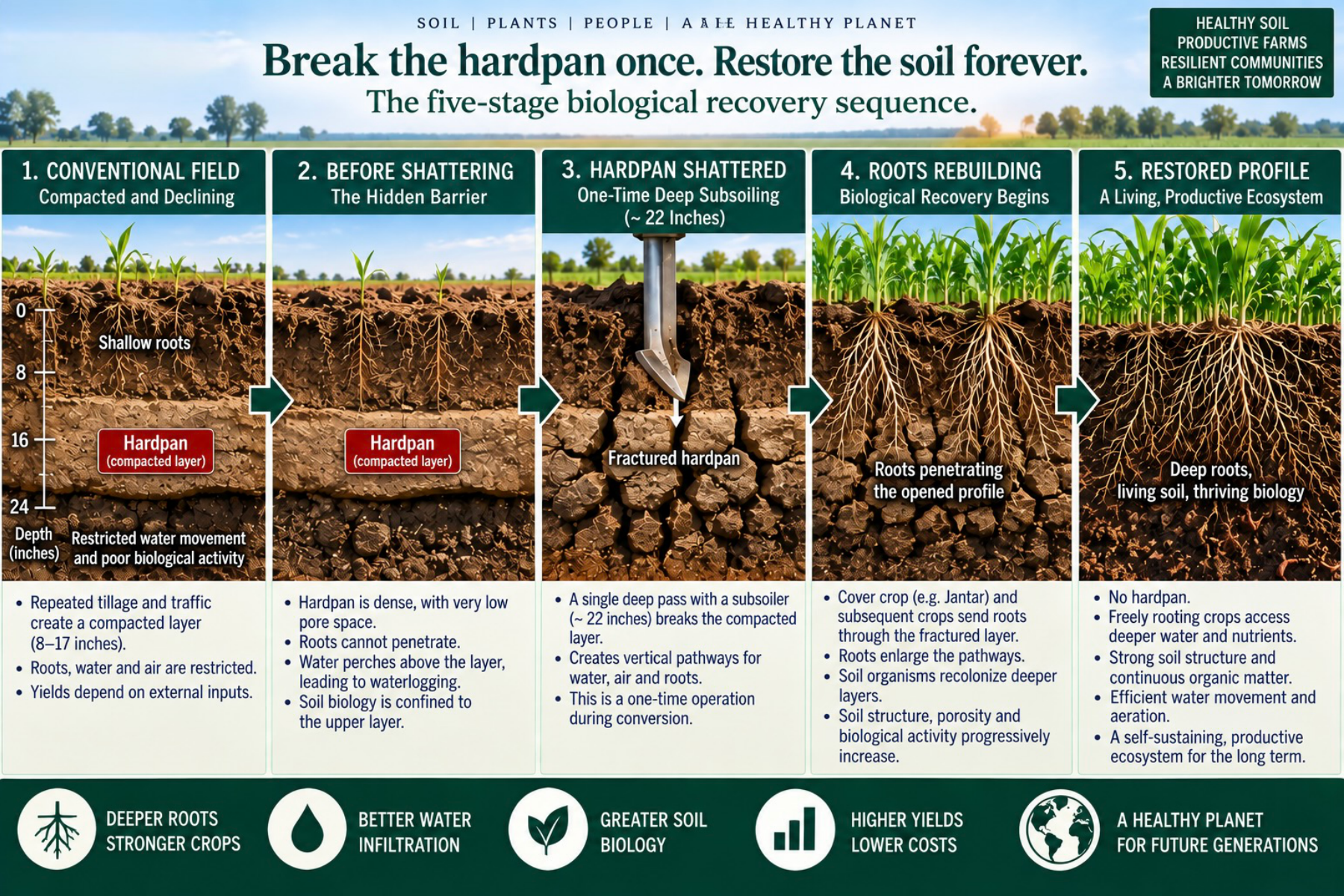
The five-stage biological recovery sequence: a conventional, compacted field; the hidden hardpan barrier; the one-time deep subsoiler fracture at approximately 22 inches; roots rebuilding through the opened profile; and a restored, living profile.
WEEDS AND SALTS: THE SOIL SPEAKING
Before discussing the protocol for restoration, it is important to understand two phenomena that appear on the surface of hardpan-constrained fields and are routinely misread as separate problems requiring separate interventions.
Weeds as Soil Diagnosticians
Weed communities can provide useful clues about field conditions, but no weed species should be treated as a single-variable soil test. Species occurrence reflects seedbank history, disturbance, moisture, fertility, competition, climate and management. Deep-rooted or moisture-tolerant weeds may alert the farmer to investigate compaction or drainage, but the diagnosis should be confirmed by probing the soil profile rather than inferred from the weed alone.
PQNK therefore uses weeds as observations, not verdicts. During transition, severe weed pressure may still require temporary control, including herbicide where necessary to protect crop establishment. The long-term strategy is to change the environment that favours repeated weed flushes: stop tillage, maintain mulch, retain roots, increase crop competition and correct the physical restrictions in the soil.
Surface Crusting and Salt Accumulation
Surface crusting is distinct from hardpan. It develops at the soil surface when aggregates are dispersed and pores become sealed, often under bare soil exposed to rainfall or irrigation impact. Salinity is also a separate process, although restricted drainage can aggravate it. Breaking hardpan, protecting the surface with mulch and managing water correctly can improve the physical environment, but saline or sodic soils must still be understood in relation to water quality, groundwater, drainage and soil chemistry.
IDENTIFYING THE HARDPAN: THE FIELD ASSESSMENT
A farmer can make a practical field assessment with simple tools, but no single quick test proves the presence or severity of hardpan. Use several observations together: resistance to a probe, a visible soil profile, rooting pattern and water behaviour. Where possible, compare several locations because compaction varies with traffic and field history.
The probe test: push a smooth metal rod vertically into moist soil at several representative locations. Note any depth at which resistance increases sharply and remains high. Repeat the observation across the field. A consistent resistance layer can indicate hardpan, but stones, dry soil or natural textural changes can give similar resistance. Confirm the finding by opening the profile.
The profile assessment: dig a pit deep enough to expose the suspected compacted zone. Look for an abrupt dense or plate-like layer, reduced pore space, horizontal or deflected roots, and roots concentrated above the layer or following isolated cracks through it. In Ancient Conventional Industrial fields the compacted layer has commonly been found within about 8 to 17 inches, but the actual depth must be read from the field.
The infiltration observation: compare how rainfall or a measured water application enters representative areas of the field. Persistent ponding or slow infiltration may support a compaction diagnosis, but infiltration is also affected by surface crusting, texture, antecedent moisture and soil structure. Use water behaviour as supporting evidence, not as a fixed seconds-per-litre test.
THE PQNK PROTOCOL: SHATTERING AND RESTORING
Step One: Deep Subsoil Fracture
The one-time mechanical correction in the standard PQNK conversion is a deep subsoiler pass to approximately 22 inches. The objective is to pass through the compacted hardpan and fracture it without inverting the entire soil profile. This is a traction-demanding conversion operation, so a heavy tractor with normal wide agricultural tyres may be used before the permanent beds are formed.
The 22-inch setting is the standard PQNK conversion depth developed for the usual hardpan encountered in these fields; it is not a claim that every hardpan begins or ends at the same depth. Where field assessment shows an unusual profile, engineering judgement is required. The operation is performed once. After fracture, the soil is not ploughed or repeatedly subsoiled. The permanent system that follows must protect the opened profile from renewed compaction.
Step Two: Deep Water Wash and Conditional pH Correction
Immediately after hardpan fracturing, give the opened profile a deep water wash. In the PQNK transition protocol this wash is a standard conversion operation, not an optional treatment. Where soil pH is 8 or above, approximately 8 kg of sulfuric acid per acre is recommended with the irrigation water, subject to local soil and water conditions and strict safe-handling practice. The water wash is required; the sulfuric acid is conditional. The purpose is to move soluble salts and accumulated materials downward through the newly opened profile and prepare the root zone for permanent biological management. It is a one-time transition operation rather than a recurring fertiliser programme.
Step Three: Permanent Raised Beds
After fracture and the deep wash, form permanent raised beds. The regional PQNK reference profile is a 42-inch bed top with an 18-inch furrow at the top, approximately 8 inches at the furrow bottom, and about 8 inches furrow depth. This geometry is designed around the wheel track of the 45–65 HP tractors commonly used in the region, with rear tyre centres around 58–60 inches. In other regions, adjust the bed-furrow profile according to the track of the tractor and, where necessary, soil characteristics. The fixed engineering rule is controlled traffic: tyres remain in the furrows and never run over the production beds.
Step Four: Grow the First Biological Cover Crop
The first crop after bed formation is a vigorous, deep-rooted cover crop, such as Jantar (Sesbania) where agronomically appropriate. Its living roots enter the fractured profile, open and occupy pores, feed soil organisms and begin rebuilding biological structure. When the cover crop is terminated, retain the roots undisturbed in the beds and use the above-ground biomass as the first organic mulch. The first mulch is therefore grown in the same field. In later production crops, properly managed crop residues become the continuing source of surface mulch.
Step Five: Permanent Mulch Cover
Continuous organic mulch protects the soil surface from direct sun, raindrop impact and rapid moisture loss while supplying organic material to decomposer organisms. After the first cover crop establishes the initial mulch, succeeding crop residues should be managed so that the soil remains covered. Mulch is not a separate imported-input programme; it is increasingly generated by the crop sequence itself.
Step Six: Root Retention After Every Harvest
Every crop grown on a PQNK bed contributes roots to the developing soil architecture. At harvest, remove the economic produce but retain roots in the soil and useful residues on the surface. Do not plough the beds to prepare for the next crop. New roots then enter a profile already containing old root channels, organic residues and biological activity. Root retention is an implementation practice that supports the four governing PQNK rules; it is not a separate fifth rule.
WHAT HAPPENS AFTER SHATTERING: THE BIOLOGICAL RECOVERY
The subsoiler creates the initial physical opening. Biological recovery then develops through roots, residues, wetting and drying, soil organisms and repeated crop cycles. The direction of change can be observed from the first crop, but PQNK does not assign a universal number of weeks, months or seasons to biological recovery. The field, not the calendar, determines the rate.
Early response: where compaction was a major hydraulic restriction, infiltration and drainage may improve soon after fracture and the deep wash. The magnitude of change depends on soil texture, moisture, the continuity of the fractured zone and the condition of the layers below it.
First cover crop: deep roots begin occupying the fracture network and adding biological structure to the opened profile. Retained roots become channels and carbon sources after the cover crop is terminated, while its above-ground biomass becomes the first mulch.
Succeeding crops: crop-after-crop management adds new roots without destroying the old architecture. Mulch protects the surface, controlled traffic protects the beds, and the root-microbe system progressively occupies more of the profile. Earthworms and other soil organisms may increase where habitat, moisture and organic resources become favourable.
Sustained PQNK: the objective is a progressively stronger, better-aerated and more biologically regulated profile with declining dependence on corrective inputs and disturbance. There is no fixed second-year, third-year or fifth-year threshold. Transition speed depends on starting degradation, soil, climate, water quality, crop sequence and management.
CAPILLARITY: THE EARTH’S NATURAL WATER MANAGEMENT
Capillary movement is one component of soil-water behaviour. Water can move through connected pores in response to matric forces, while gravity moves water downward and roots remove water from the profile. Compaction can disrupt pore continuity and reduce both infiltration and the effective movement of water through the root zone. A restored pore network does not create water, but it can allow the soil profile to store and redistribute available moisture more effectively.
PQNK therefore uses the broader term Soil Moisture Management. Rainfall, irrigation, stored subsoil moisture and upward or lateral redistribution all contribute to the water available to roots. Hardpan fracture can reconnect parts of the profile that compaction had restricted, while permanent mulch and undisturbed structure reduce avoidable losses. The practical goal is not irrigation independence; it is a moist, aerated root zone supplied with only the water deficit that the field actually requires.
CARBON, CLIMATE, AND THE UNDERGROUND RESERVE
A deeper, continuously rooted soil profile can also influence carbon storage because roots, microbial products and organic residues place carbon below and within the soil. The amount and persistence of that carbon vary with soil, climate, crop, management and time. Hardpan correction is therefore best understood as enabling deeper biological occupation of the profile rather than guaranteeing a fixed sequestration rate.
Agrifood systems are a major contributor to global greenhouse-gas emissions, but their emissions arise from many sources, including livestock, fertiliser use, energy, land-use change, processing, transport and waste. It would be inaccurate to say that most agricultural emissions come from hardpan or tillage alone. PQNK addresses one important part of the climate problem by reducing repeated soil disturbance, protecting residues, supporting deeper rooting, lowering avoidable energy and input use, and improving water efficiency. These mechanisms should be measured rather than converted into unsupported universal carbon claims.
CONTROLLED TRAFFIC: KEEPING THE HARDPAN FROM RETURNING
The one-time fracture will not remain beneficial if the field is returned to the same traffic and tillage pattern that created compaction. After permanent beds are formed, tractor traffic is confined to the furrows. The beds become protected biological production zones and are never used as wheel tracks. No tillage after conversion, continuous mulch and retained roots then help preserve the structure created by the conversion.
For routine post-conversion operations in the regional 42–18 bed system, approximately 9–11 inch tyres are preferred so the tyres remain within the furrows and do not press the raised-bed sidewalls. Planting with SIPP or VIPP is a low-draft operation, so heavy traction is not required. This narrow-tyre rule applies after the beds are made; it does not restrict the heavy tractor used for the one-time hardpan-breaking and bed-forming operations.
HARDPAN IN RAIN-FED AND SLOPING LAND
On rain-fed sloping land, laser levelling and flatland geometry are not appropriate. Field design follows contour logic, and any mechanical hardpan correction should be aligned so that it improves infiltration without creating channels that accelerate downhill erosion. Permanent beds or planting zones, traffic routes and water-harvesting features must be adapted to slope, rainfall pattern and machinery access.
The biological objective remains the same in flat and sloping contexts: remove or progressively overcome the compacted barrier, protect the soil from renewed disturbance, maintain organic cover, retain roots and encourage biological occupation of the profile. The engineering changes with topography; the governing rules do not.
THE LIMITS OF FRACTURE ALONE
Hardpan fracture is a conversion operation, not the whole PQNK system. If the field is subsequently tilled, trafficked across the beds, left bare or repeatedly inundated, the benefits of fracture can be lost and compaction can return. Permanent raised beds, controlled traffic, continuous organic mulch, retained roots, biodiversity and SMM are the management architecture that protects the opened profile. These practices operate within the four governing PQNK rules: no inundation, no tillage after conversion, continuous organic mulch cover, and encourage biodiversity.
WHERE THE SUBSOILER IS NOT AVAILABLE: THE BIOLOGICAL-ONLY PATHWAY
Where a subsoiler is unavailable, the farmer can still begin a slower biological pathway. The objective is not to pretend that roots instantly reproduce a 22-inch mechanical fracture. It is to use long-rooted plants, retained roots, continuous cover and improved water movement to progressively create and occupy channels through the compacted profile.
For a small farmer, the PQNK pathway is to open the field hydraulically as far as practical, complete the deep water wash, apply approximately 8 kg sulfuric acid per acre where pH is 8 or above, broadcast suitable long-rooted cover-crop seed, and form the permanent beds or planting zones appropriate to the available equipment. The cover crop roots are retained. Over succeeding crops, roots and biology progressively work through the compacted layer.
This biological pathway is slower and its rate depends on the severity and thickness of compaction, species used, soil moisture, soil type and management. Root channels are then reused by later roots and soil organisms, while mulch protects the surface and the absence of tillage prevents the recovering structure from being repeatedly reset.
Where a suitable subsoiler can be hired or borrowed, the one-time mechanical 22-inch pass remains the preferred and more immediate conversion method. Where it cannot, biological recovery is still possible, but no fixed one-season or two-season completion claim should be made.
BEYOND EXTRACTION: THE FARMER’S RELATIONSHIP WITH THE EARTH
Beneath the technical problem of hardpan lies a management lesson. A field repeatedly rebuilt by tillage and crossed without traffic control accumulates the physical record of those operations. PQNK changes that relationship. Heavy engineering is used once where necessary to correct the inherited restriction; thereafter machinery is confined to traffic corridors and the biological production bed is protected. The aim is not to remove machinery from agriculture, but to make machinery serve the living soil system rather than repeatedly disturb it.
THE WALL MUST COME DOWN
Hardpan is not an inevitable feature of farmed land. Where it has been created by repeated tillage and traffic, it can be fractured mechanically and then protected from renewed compaction. The PQNK standard conversion uses one deep subsoiler pass to approximately 22 inches, followed by the deep water wash, permanent raised-bed formation and the first deep-rooted cover crop. From that point onward, roots, residues, mulch, controlled traffic and SMM maintain and develop the opened profile.
The important message is not that one subsoiler cures every agricultural problem. It is that a physical barrier should not be left in place while the farmer repeatedly treats symptoms above it. Where field assessment confirms hardpan, correct it once, establish the permanent architecture, and then stop recreating the conditions that caused it. The mechanical operation opens the door; the biological system must do the continuing work.
WHAT THIS CHAPTER HAS ESTABLISHED
Hardpan is a major physical constraint where repeated tillage and traffic have created a dense compacted layer beneath the cultivated soil. It can restrict roots, water movement, gas exchange and the volume of soil explored by the crop, and it can aggravate waterlogging, salinity and plant stress. Its importance should be diagnosed from the field rather than assumed from a universal depth, weed species or infiltration number.
The standard PQNK correction is one deep subsoiler pass to approximately 22 inches, followed by the required deep water wash; where soil pH is 8 or above, approximately 8 kg sulfuric acid per acre is recommended with the irrigation water. Permanent raised beds are then formed to the tractor track, using the regional 42-inch bed top and 18-inch furrow-top profile where that geometry fits. The first deep-rooted cover crop opens and occupies the soil biologically; its roots remain in the beds and its tops become the first mulch. Thereafter, controlled traffic, crop-after-crop planting, retained roots, properly managed residues and SMM protect the profile. The next chapter turns to Soil Moisture Management, the water discipline that this restored soil architecture makes possible.
Chapter Twenty-Six: Soil Moisture Management