
Industrial Devastation To Natural Abundance
The PQNK System · Chapter 31
The Closed-Loop Farm
One Acre Prosperity, Alley Cropping and Circular Production
Release 1.1 · 2026-09-29
If you use “Listen”, the text of the page may be sent to your browser or operating system’s speech provider, such as Apple, Google or Microsoft, depending on the voice your device uses. Pedaver does not process, transmit or store any audio.
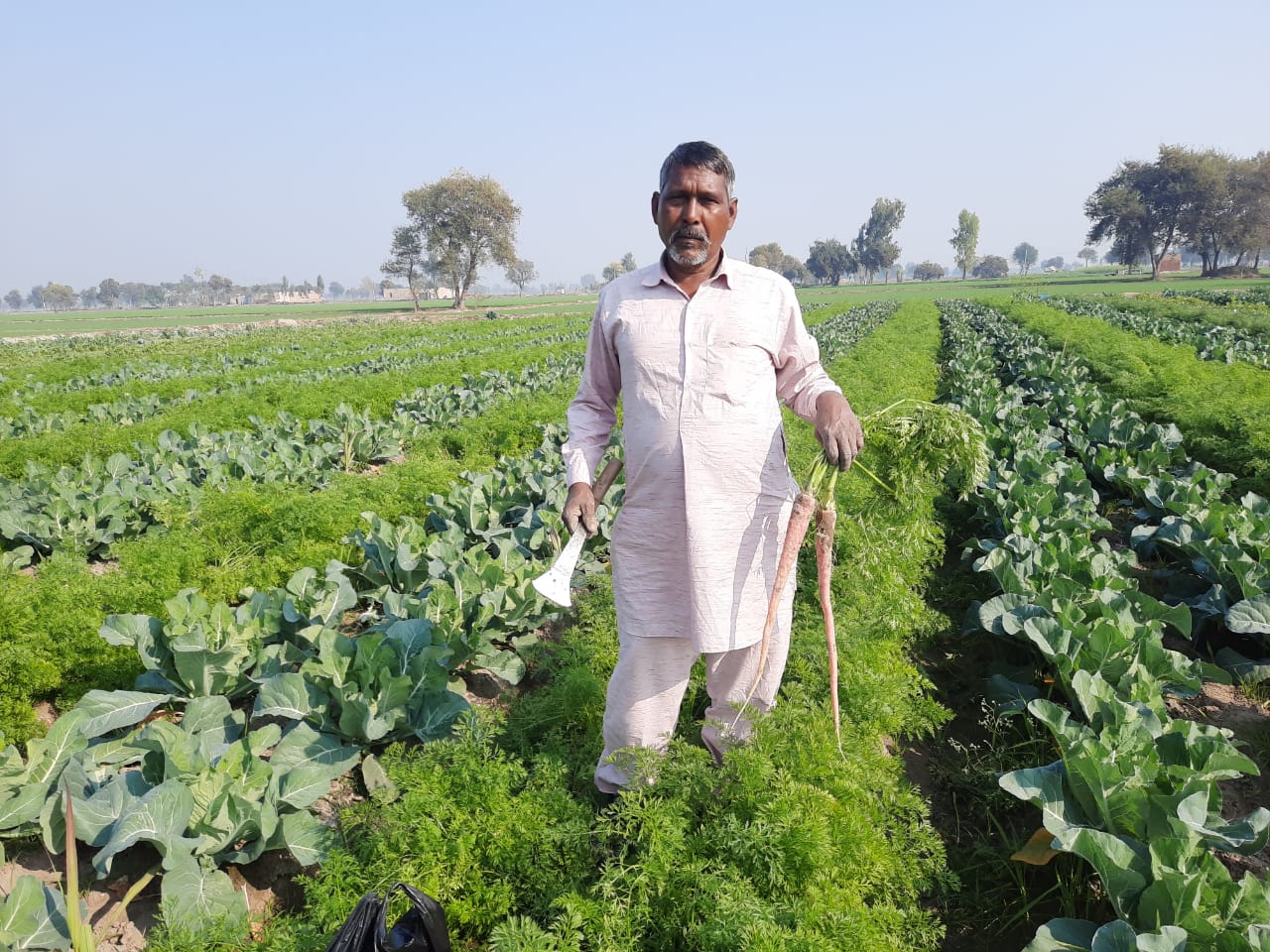
A diversified PQNK field turns biological continuity into nutrition, recurring harvests and livelihood.
“Prosperity is not one large harvest. It is a living field that keeps producing food, fertility and income without surrendering the farmer’s independence.”
Asif Sharif, Lahore, 2026
THE CHAPTER IN ONE VIEW
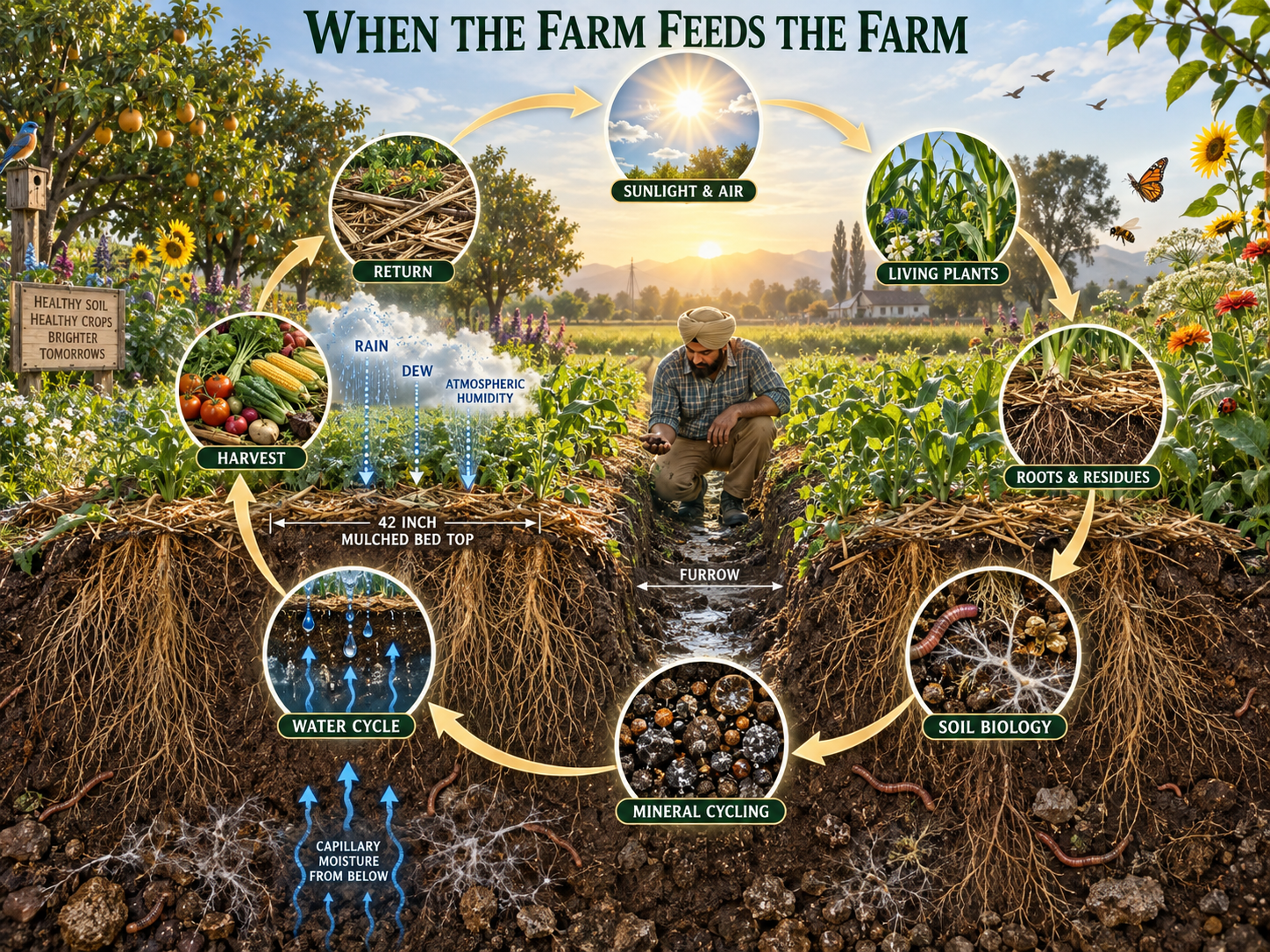
Chapter 31 brings three PQNK innovations together as one livelihood system. OAP gives the economic objective. Alley Cropping gives the spatial architecture. Circular Production gives the time architecture. The closed-loop supplies the biological power that lets all three mature.
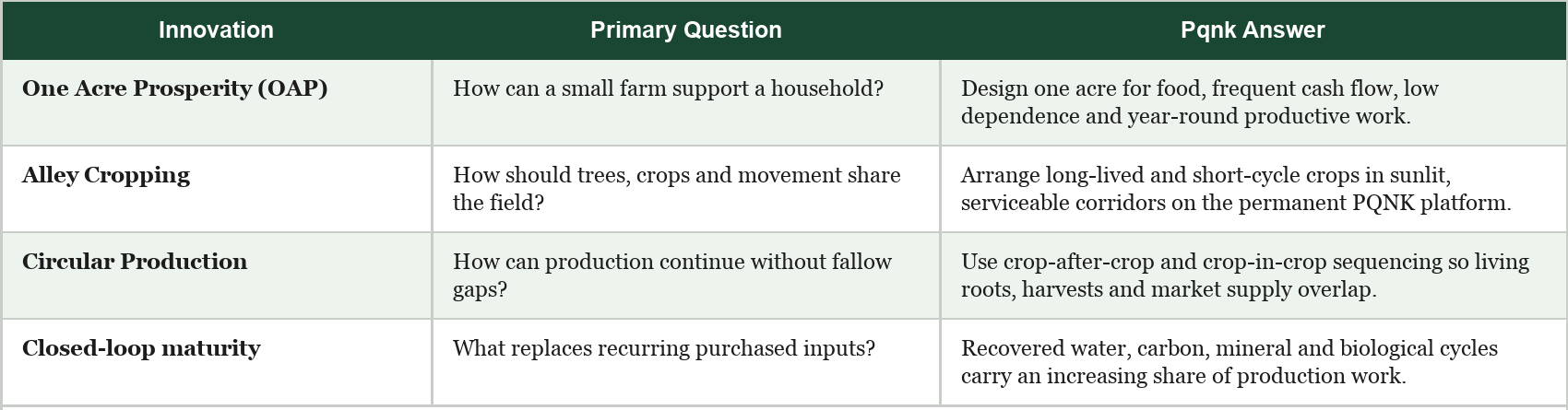
| INNOVATION | PRIMARY QUESTION | PQNK ANSWER |
|---|---|---|
| One Acre Prosperity (OAP) | How can a small farm support a household? | Design one acre for food, frequent cash flow, low dependence and year-round productive work. |
| Alley Cropping | How should trees, crops and movement share the field? | Arrange long-lived and short-cycle crops in sunlit, serviceable corridors on the permanent PQNK platform. |
| Circular Production | How can production continue without fallow gaps? | Use crop-after-crop and crop-in-crop sequencing so living roots, harvests and market supply overlap. |
| Closed-loop maturity | What replaces recurring purchased inputs? | Recovered water, carbon, mineral and biological cycles carry an increasing share of production work. |
The governing equation: OAP = productive space × productive time × retained cash. More output is useful only when it also strengthens household nutrition, market reliability, soil function and farmer independence.
WHY THIS CHAPTER MATTERS
For a smallholder, the central economic danger is not merely low yield. It is the combination of one or two payments a year, recurring input bills, idle land between crops, price exposure at a single harvest, and a production system that must be restarted with money every season. A field can look productive and still leave its farmer financially fragile.
PQNK changes the design question. It does not ask how to force the largest possible harvest from one crop. It asks how the same acre can continuously support food, income, fertility, water efficiency, biodiversity and future production. The answer is not a shopping list of inputs. It is an operating architecture in which the field remains biologically alive and economically active.
The One Acre Prosperity model is intended to make that architecture practical for households with limited land and capital. It does not promise that every acre will produce the same income. Climate, water, market access, skill, crop choice and household needs vary. OAP therefore works as a disciplined planning method: begin with the household and market, design the field, phase the establishment, record every harvest and cost, and improve the pattern from evidence.
A crucial distinction: Zero purchased agricultural inputs at mature PQNK does not mean zero business cost. Labour, transport, packaging, training, tools, tree establishment, market fees and risk reserves remain real. Prosperity must be measured as verified net household benefit—not headline gross sales.
1 THE PQNK FOUNDATION
OAP is not a separate farming method laid on top of PQNK. It is the livelihood expression of a mature PQNK field. Four rules keep the production platform functional:
No inundation. Water is supplementary, slow and limited; the root zone must retain air.
No disturbance or tillage. Permanent soil structure, fungal networks and root channels are protected.
Soil is always covered with organic mulch. The cover moderates heat and evaporation while feeding the surface biology.
Biodiversity is designed into time and space. Multiple plant forms, root depths, harvest windows and ecological functions reduce dependence on a single crop.
These rules recover continuity. Carbon enters through photosynthesis and retained biomass. Nitrogen is cycled through biological activity, diverse roots, residues and nitrogen-fixing plants. Minerals move through root exploration, microbial exchange and decomposition. Water is received, stored and released through protected structure rather than forced through compacted, exposed soil. Each cycle reinforces the others.
Maturity test: A field is not mature because inputs were stopped. It is mature when stable production, active structure, adequate nutrition, reduced water demand, manageable pest pressure and reliable residue cycling make those inputs unnecessary.
The closed-loop is therefore a maturity state, not an installation date. The Production Manager withdraws external inputs only when field evidence shows that the living system can carry the function. The third crop is an important management target in PQNK transition, but nature does not sign a calendar contract. Soil history, climate, mulch supply, crop choice and management accuracy determine the pace.
2 ONE ACRE PROSPERITY: BEGIN WITH THE HOUSEHOLD
OAP begins with people, not crops. The acre must first protect the household’s food and then create saleable surpluses in a rhythm that matches household expenditure. Education, health, transport and daily living cannot wait for one annual harvest. The model therefore favours a portfolio of short-, medium- and long-duration outputs, with direct or short-chain marketing wherever practical.
Before drawing the field, the household prepares a resource and livelihood audit.
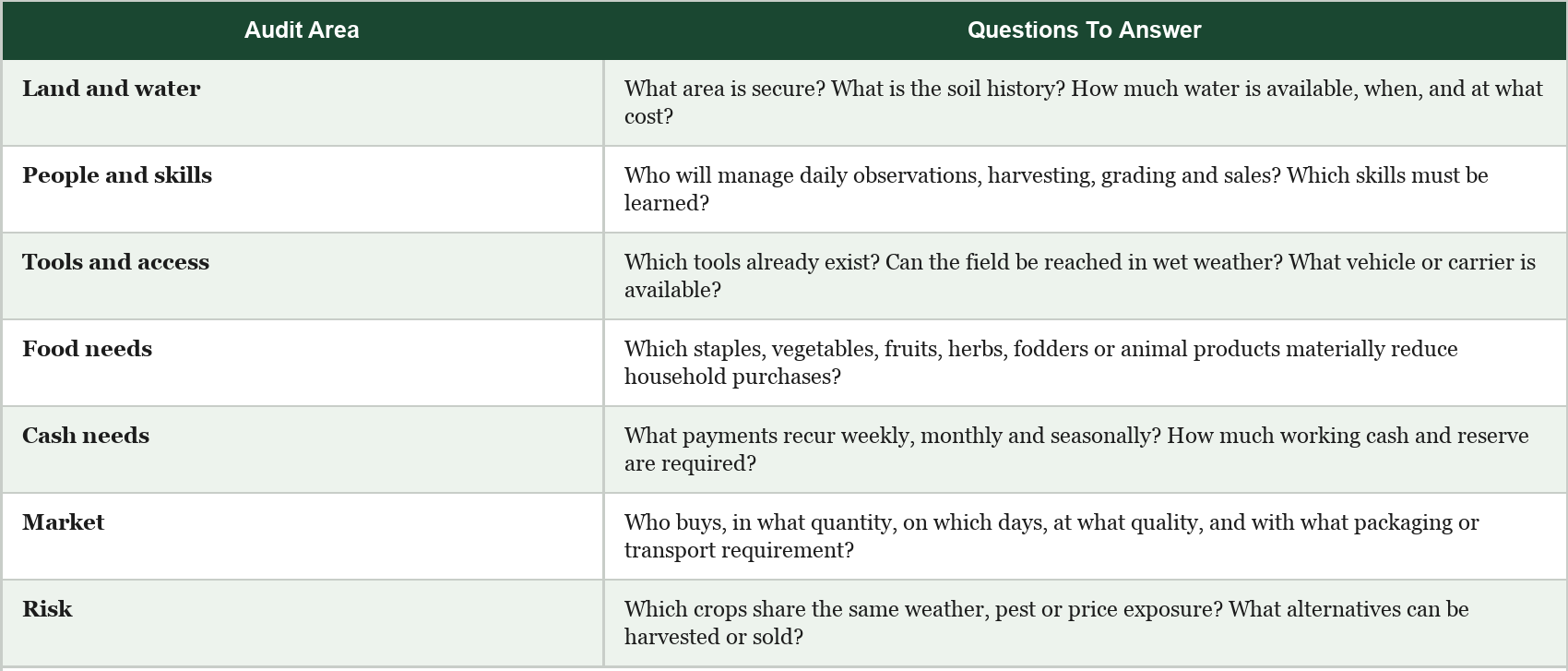
| AUDIT AREA | QUESTIONS TO ANSWER |
|---|---|
| Land and water | What area is secure? What is the soil history? How much water is available, when, and at what cost? |
| People and skills | Who will manage daily observations, harvesting, grading and sales? Which skills must be learned? |
| Tools and access | Which tools already exist? Can the field be reached in wet weather? What vehicle or carrier is available? |
| Food needs | Which staples, vegetables, fruits, herbs, fodders or animal products materially reduce household purchases? |
| Cash needs | What payments recur weekly, monthly and seasonally? How much working cash and reserve are required? |
| Market | Who buys, in what quantity, on which days, at what quality, and with what packaging or transport requirement? |
| Risk | Which crops share the same weather, pest or price exposure? What alternatives can be harvested or sold? |
Design principle: Diversity is arranged for access, light, harvest and succession—not mixed without a plan.
Field demonstration: OAP – One Acre Prosperity model
MARKET-BACK PLANNING
The farmer should not grow a crop merely because it can grow. OAP asks four commercial questions before planting: What will sell? When will it command a useful price? What quantity can the household harvest, carry and sell without waste? What quality will make the buyer return? A bicycle, motorcycle or small pickup can be a design constraint as important as the soil. A daily harvest larger than the available transport or market is not prosperity; it is loss waiting in the field.
This leads to a practical preference for high-value, manageable-volume products; staggered sowing; dependable quality; and several market windows. Direct supply can retain more value, but only if grading, punctuality, relationships and food safety are managed well. Wholesale channels may move volume with less selling time. OAP can use both, but the channel must be chosen before the planting calendar is fixed.
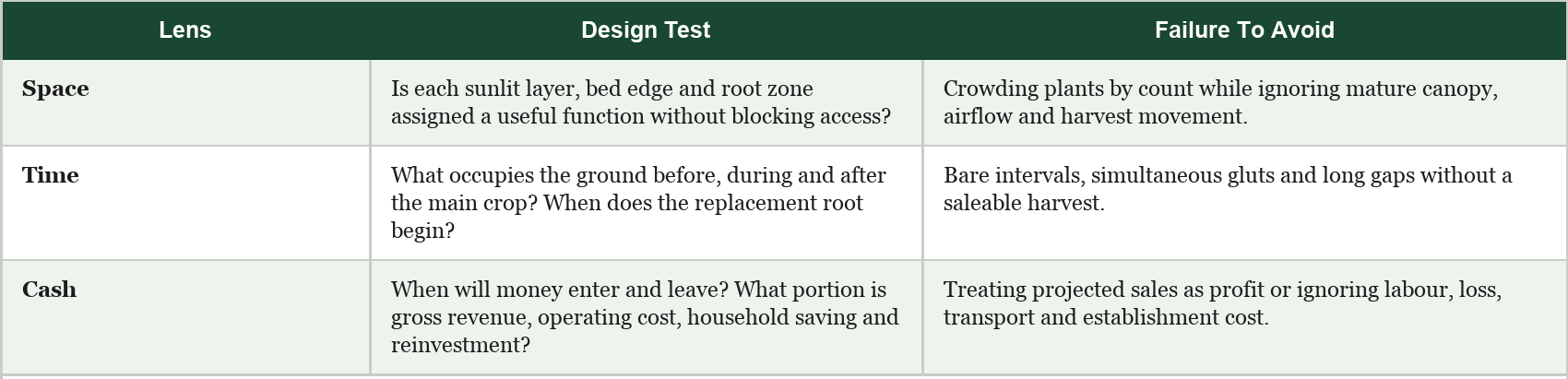
| LENS | DESIGN TEST | FAILURE TO AVOID |
|---|---|---|
| Space | Is each sunlit layer, bed edge and root zone assigned a useful function without blocking access? | Crowding plants by count while ignoring mature canopy, airflow and harvest movement. |
| Time | What occupies the ground before, during and after the main crop? When does the replacement root begin? | Bare intervals, simultaneous gluts and long gaps without a saleable harvest. |
| Cash | When will money enter and leave? What portion is gross revenue, operating cost, household saving and reinvestment? | Treating projected sales as profit or ignoring labour, loss, transport and establishment cost. |
THE SPACE–TIME–CASH TEST
Every proposed crop must pass all three tests. A high-value crop may fail if it monopolises labour at the same time as another harvest. A tree may fail if its mature shade closes the alley. A rapid crop may fail if the market takes only a small volume. The OAP plan is a coordinated portfolio, not a crowded catalogue.
3 THE PERMANENT FIELD PLATFORM
The standard PQNK platform gives OAP a repeatable physical grammar. The bed remains permanent, covered and biologically active. The furrow is the traffic and supplementary-water lane. Crop patterns can change; the soil architecture does not have to be rebuilt each season.
Water is admitted only when field conditions require it. Rain and atmospheric humidity remain primary contributors; mulch, aggregation, roots and permanent channels protect what arrives. The furrow carries a shallow, slow flow. It is not filled to the bed top. Tractor or implement wheels remain in designated furrow lanes so the bed is not compacted.
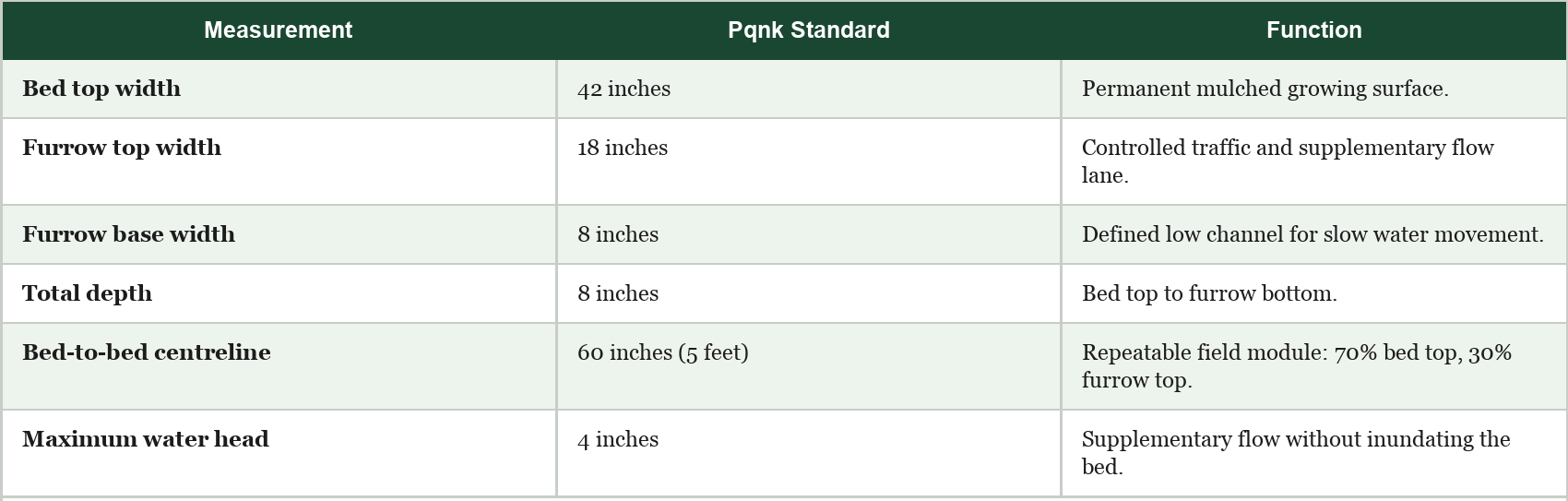
| MEASUREMENT | PQNK STANDARD | FUNCTION |
|---|---|---|
| Bed top width | 42 inches | Permanent mulched growing surface. |
| Furrow top width | 18 inches | Controlled traffic and supplementary flow lane. |
| Furrow base width | 8 inches | Defined low channel for slow water movement. |
| Total depth | 8 inches | Bed top to furrow bottom. |
| Bed-to-bed centreline | 60 inches (5 feet) | Repeatable field module: 70% bed top, 30% furrow top. |
| Maximum water head | 4 inches | Supplementary flow without inundating the bed. |
Design discipline: Do not resize the mature field platform to fit a crop diagram. Adapt row number, within-row spacing, trellis position and succession to the 42-inch bed and 18-inch furrow while protecting light, airflow, access and roots.
4 ALLEY CROPPING: THE SPACE ARCHITECTURE
Alley Cropping integrates long-lived fruit or multipurpose trees with annual crops and vegetables in serviceable corridors. In PQNK it is not simply trees planted beside crops. It is a negotiated architecture among sunlight, mature canopy, roots, water, harvest access and time. The alleys must remain useful as the trees grow.
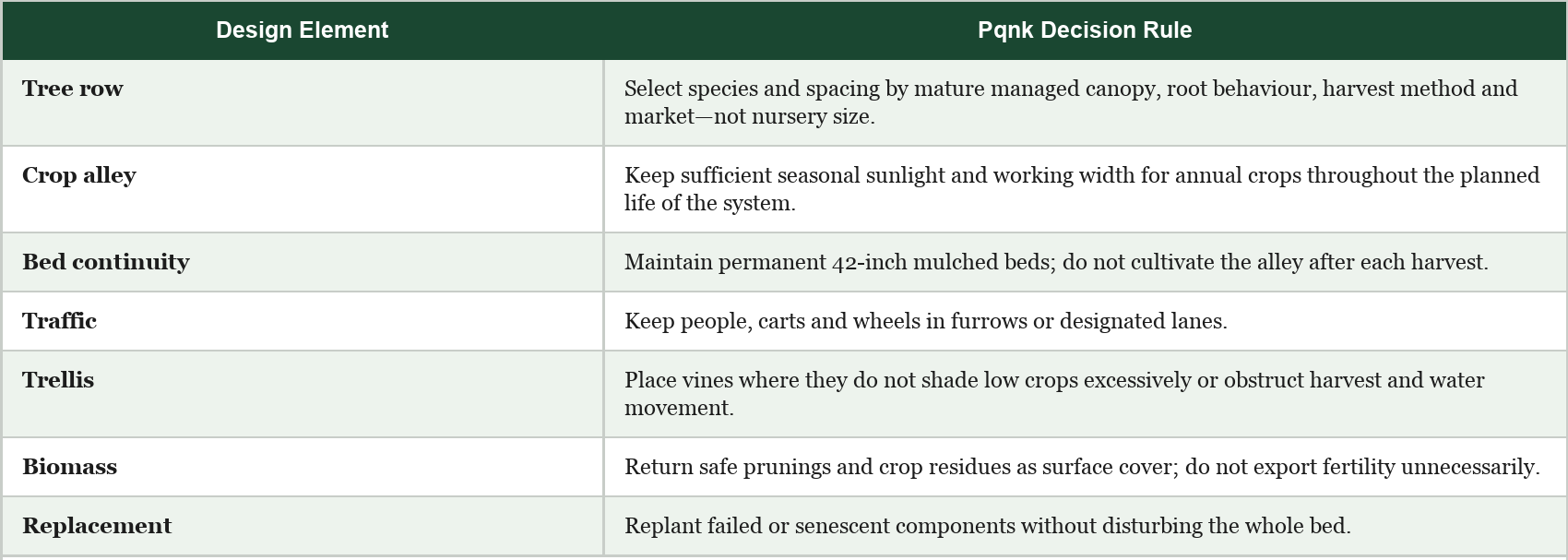
| DESIGN ELEMENT | PQNK DECISION RULE |
|---|---|
| Tree row | Select species and spacing by mature managed canopy, root behaviour, harvest method and market—not nursery size. |
| Crop alley | Keep sufficient seasonal sunlight and working width for annual crops throughout the planned life of the system. |
| Bed continuity | Maintain permanent 42-inch mulched beds; do not cultivate the alley after each harvest. |
| Traffic | Keep people, carts and wheels in furrows or designated lanes. |
| Trellis | Place vines where they do not shade low crops excessively or obstruct harvest and water movement. |
| Biomass | Return safe prunings and crop residues as surface cover; do not export fertility unnecessarily. |
| Replacement | Replant failed or senescent components without disturbing the whole bed. |
Where site shape and terrain allow, a north–south arrangement often distributes light more evenly across the day. It is not a universal command. Slope, erosion risk, prevailing wind, water movement, access roads and existing trees can take priority. The Production Manager designs from the actual site and observes seasonal shadows before fixing a permanent line.
A REPEATABLE OAP ALLEY MODULE
A practical module contains a tree line or narrow tree zone, adjacent permanent crop beds, and protected furrow lanes. Rather than promising a fixed number of trees per acre, the design uses mature canopy diameter as the governing measurement. Species, rootstock, pruning system and climate determine how many tree positions the acre can support while preserving productive crop corridors.
CANOPY SUCCESSION
The first years of an orchard offer abundant light. Short-cycle vegetables, pulses, grains, oilseeds or fodders can occupy the alleys while trees establish. As canopies expand, the portfolio must change. Sun-demanding crops move to the brightest corridors; shade-tolerant or shorter-duration crops occupy moderated light; tree height and spread are managed; and unproductive tree positions are reconsidered. Early yields must never be used to justify a density that will destroy the alley later.
This phased design also spreads income. Vegetables and herbs can create early receipts. Medium-duration shrubs, berries or vines add another window where suitable. Fruit trees become a long-duration asset. The pattern should be diverse enough that one price fall or crop failure does not stop the household’s cash flow, yet simple enough to manage accurately.
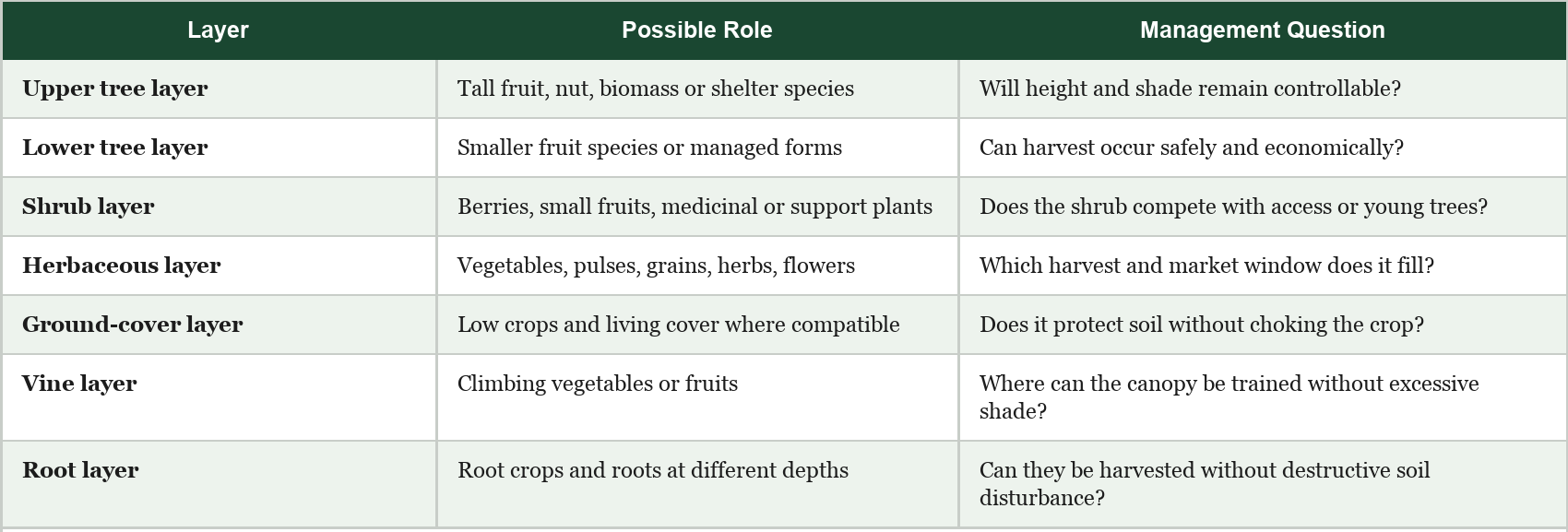
| LAYER | POSSIBLE ROLE | MANAGEMENT QUESTION |
|---|---|---|
| Upper tree layer | Tall fruit, nut, biomass or shelter species | Will height and shade remain controllable? |
| Lower tree layer | Smaller fruit species or managed forms | Can harvest occur safely and economically? |
| Shrub layer | Berries, small fruits, medicinal or support plants | Does the shrub compete with access or young trees? |
| Herbaceous layer | Vegetables, pulses, grains, herbs, flowers | Which harvest and market window does it fill? |
| Ground-cover layer | Low crops and living cover where compatible | Does it protect soil without choking the crop? |
| Vine layer | Climbing vegetables or fruits | Where can the canopy be trained without excessive shade? |
| Root layer | Root crops and roots at different depths | Can they be harvested without destructive soil disturbance? |
SEVEN PRODUCTIVE LAYERS
The layer concept is a design checklist, not a requirement to fill every layer at every point. A harvestable root crop that requires digging may be unsuitable beside a young tree. A vigorous vine can overwhelm a fruit canopy. Ecological diversity becomes productive only when each component has a defined position, function and removal or renewal plan.
OPEN-FIELD VERTICAL CROP TRAINING
Tomato, cucumber, gourds, beans and other climbing crops can be trained upward in the open field. Vertical training can improve air movement, keep fruit cleaner, make harvest easier and release bed surface for compatible lower growth. It must still pass the economics test: local poles, cord or reusable supports should earn their cost, survive wind, and not block furrows.
A documented demonstration on approximately one quarter acre combined ridge gourd and bitter gourd on vertical support. The farmer reported no fertiliser, pesticide, fungicide or spray and described frequent receipts of roughly Rs 3,500–4,000 per day, sometimes higher with the market. These are the farmer’s reported observations, not a universal income promise. A publishable farm record must also state the harvest period, total harvested weight, price, rejected produce, labour, transport, support cost and net return.
5 CIRCULAR PRODUCTION: THE TIME ARCHITECTURE
Circular Production means that productive time is treated as carefully as productive land. Every suitable inch should remain biologically occupied and economically purposeful. This is achieved through two linked practices: crop-after-crop and crop-in-crop.
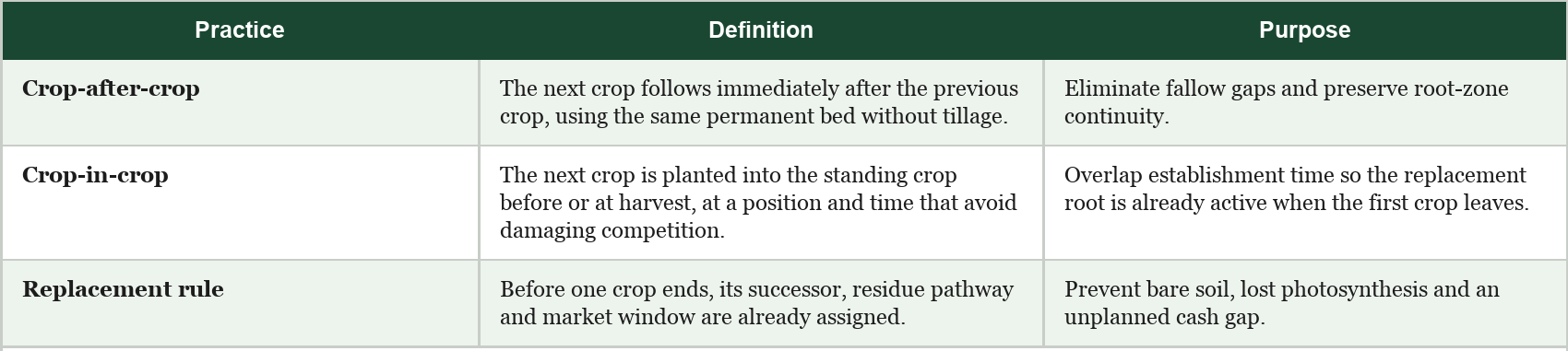
| PRACTICE | DEFINITION | PURPOSE |
|---|---|---|
| Crop-after-crop | The next crop follows immediately after the previous crop, using the same permanent bed without tillage. | Eliminate fallow gaps and preserve root-zone continuity. |
| Crop-in-crop | The next crop is planted into the standing crop before or at harvest, at a position and time that avoid damaging competition. | Overlap establishment time so the replacement root is already active when the first crop leaves. |
| Replacement rule | Before one crop ends, its successor, residue pathway and market window are already assigned. | Prevent bare soil, lost photosynthesis and an unplanned cash gap. |
Circular does not mean chaotic or simultaneous planting of everything. It means deliberately closing the biological and commercial gap. The Production Manager knows which plant will occupy the space next, when it will be introduced, how much light it needs, where its roots will develop, and which harvest will finance the next household requirement.
SIPP AND VIPP
PQNK uses precision establishment and vertical training to make overlap workable. The SIPP—Slit Insertion Precision Planter—places seed or planting material through retained residues with minimal disturbance, allowing the next crop to be established in the permanent bed at its assigned horizontal position. The VIPP—Vertical Insertion Precision Planter—places individual seed or planting material accurately with its cone opener. Vertical crop training then assigns productive height by guiding compatible crops upward. Neither precision planting nor vertical training means maximum plant count. The objective is maximum sustained function per unit of space and time.
A CLIMATE-ADJUSTED SEQUENCE
The following is a planning example, not a universal calendar. Exact months, varieties and market windows must be rebuilt for the local climate.
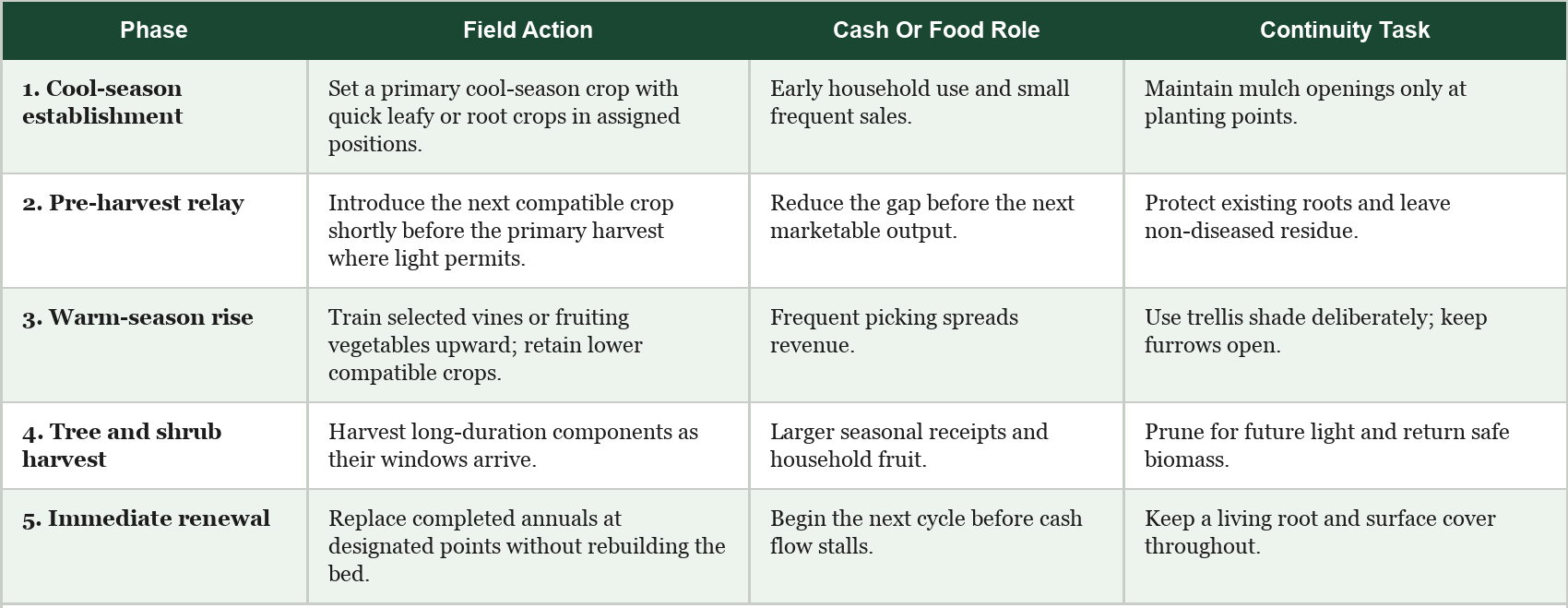
| PHASE | FIELD ACTION | CASH OR FOOD ROLE | CONTINUITY TASK |
|---|---|---|---|
| 1. Cool-season establishment | Set a primary cool-season crop with quick leafy or root crops in assigned positions. | Early household use and small frequent sales. | Maintain mulch openings only at planting points. |
| 2. Pre-harvest relay | Introduce the next compatible crop shortly before the primary harvest where light permits. | Reduce the gap before the next marketable output. | Protect existing roots and leave non-diseased residue. |
| 3. Warm-season rise | Train selected vines or fruiting vegetables upward; retain lower compatible crops. | Frequent picking spreads revenue. | Use trellis shade deliberately; keep furrows open. |
| 4. Tree and shrub harvest | Harvest long-duration components as their windows arrive. | Larger seasonal receipts and household fruit. | Prune for future light and return safe biomass. |
| 5. Immediate renewal | Replace completed annuals at designated points without rebuilding the bed. | Begin the next cycle before cash flow stalls. | Keep a living root and surface cover throughout. |
The overlap test: Plant the next crop early only when it can establish without stealing the light, water, air or working access needed by the crop being harvested. If overlap weakens both crops, succession should be immediate rather than simultaneous.
6 BUILDING THE ONE-ACRE PLAN
The acre should be drawn as modules, not as a single undifferentiated plot. A household-food zone can sit close to the home or access point. Sale crops can be grouped by harvest and handling needs. Tree alleys can carry long-duration value. A nursery and propagation area can supply replacements. Compostable biomass and clean residues can be staged without creating waste piles. Water entry, drainage, tool movement and collection points must be visible on the plan.
A percentage allocation such as 40:30:20:10 may be useful during discussion, but it should never harden into doctrine. The correct allocation is the one supported by household needs, markets, canopy development, soil condition and management capacity. The same acre may change its portfolio each year while retaining the permanent PQNK platform.
DESIGN SEQUENCE
• Map boundaries, slope, water entry and exit, existing trees, shade, compacted zones, access and hazards. • Fix permanent beds, furrows and controlled traffic using the PQNK standard profile. • Mark long-lived tree positions from mature canopy and service access, not from the desire to maximise initial tree count. • Assign household food, recurring cash, seasonal cash, fodder or livestock-support, pollinator and biomass functions. • Build a twelve-month harvest calendar and identify weeks with no expected output. • Use crop-after-crop or crop-in-crop to close feasible gaps, then check light, labour and market capacity again. • Cost establishment and operations; separate gross revenue, paid cost, imputed household labour and net household benefit. • Begin at manageable scale, record results, and expand the pattern that works.
CROP SELECTION MATRIX
Examples are prompts, not prescriptions. A crop belongs in OAP only if it is agronomically suitable, marketable or useful to the household, compatible with the system, and manageable by the available people.
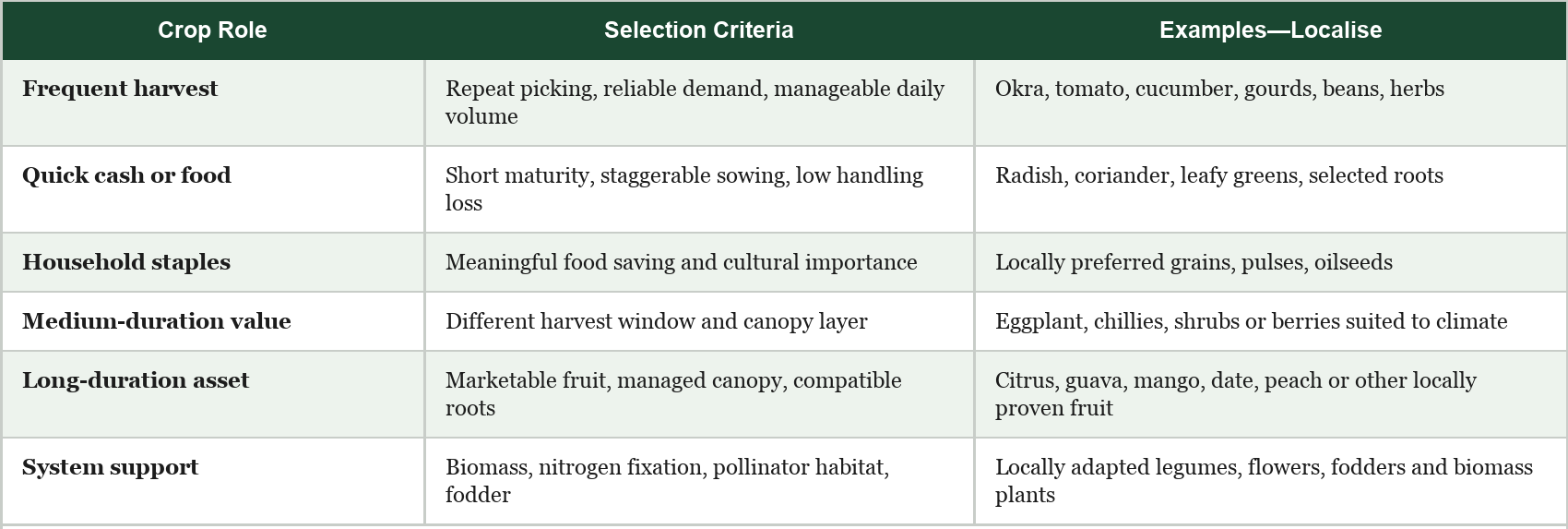
| CROP ROLE | SELECTION CRITERIA | EXAMPLES—LOCALISE |
|---|---|---|
| Frequent harvest | Repeat picking, reliable demand, manageable daily volume | Okra, tomato, cucumber, gourds, beans, herbs |
| Quick cash or food | Short maturity, staggerable sowing, low handling loss | Radish, coriander, leafy greens, selected roots |
| Household staples | Meaningful food saving and cultural importance | Locally preferred grains, pulses, oilseeds |
| Medium-duration value | Different harvest window and canopy layer | Eggplant, chillies, shrubs or berries suited to climate |
| Long-duration asset | Marketable fruit, managed canopy, compatible roots | Citrus, guava, mango, date, peach or other locally proven fruit |
| System support | Biomass, nitrogen fixation, pollinator habitat, fodder | Locally adapted legumes, flowers, fodders and biomass plants |
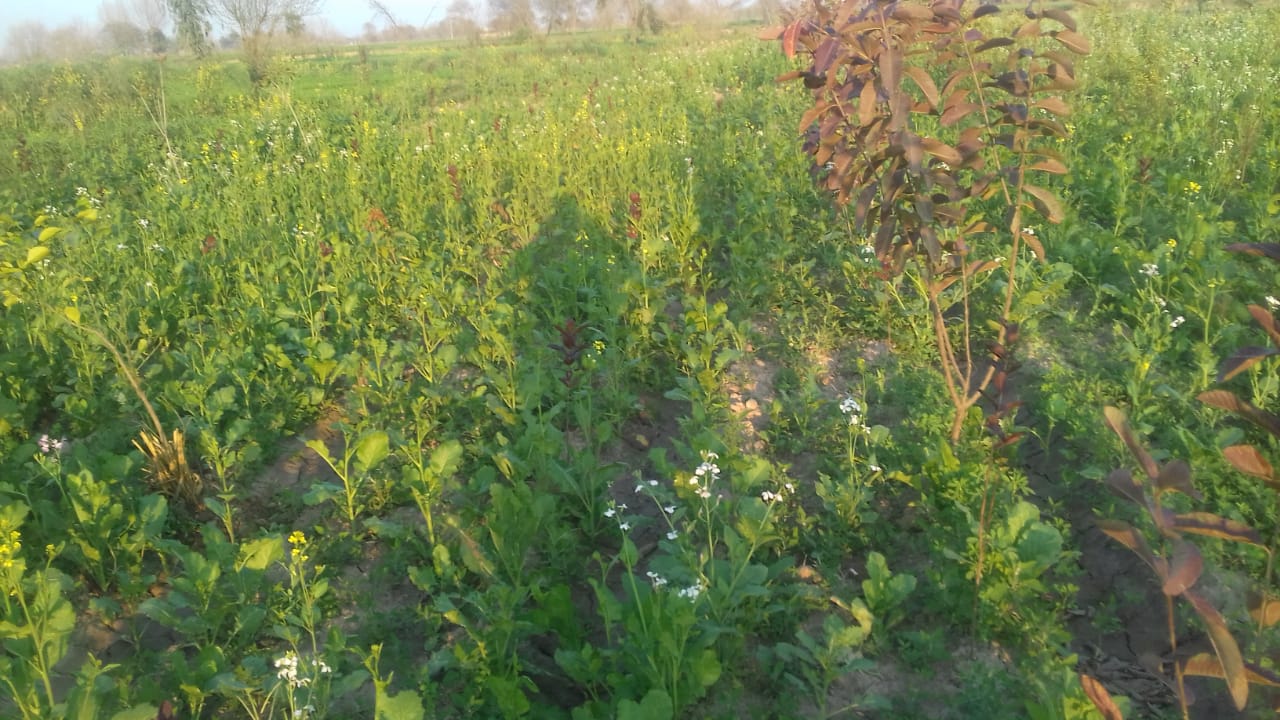
A young permanent-bed system. The economic model should grow with management skill and biological maturity rather than outrun them.
7 PHASED IMPLEMENTATION
Tree establishment deserves particular caution. A dense young plantation can appear highly efficient because canopies are small. By the time competition becomes visible, removal may be emotionally and financially difficult. The correct question is not “How many trees fit today?” but “How many managed canopies will leave productive alleys in ten years?” Temporary fillers can be used only when their planned removal date and economics are explicit.
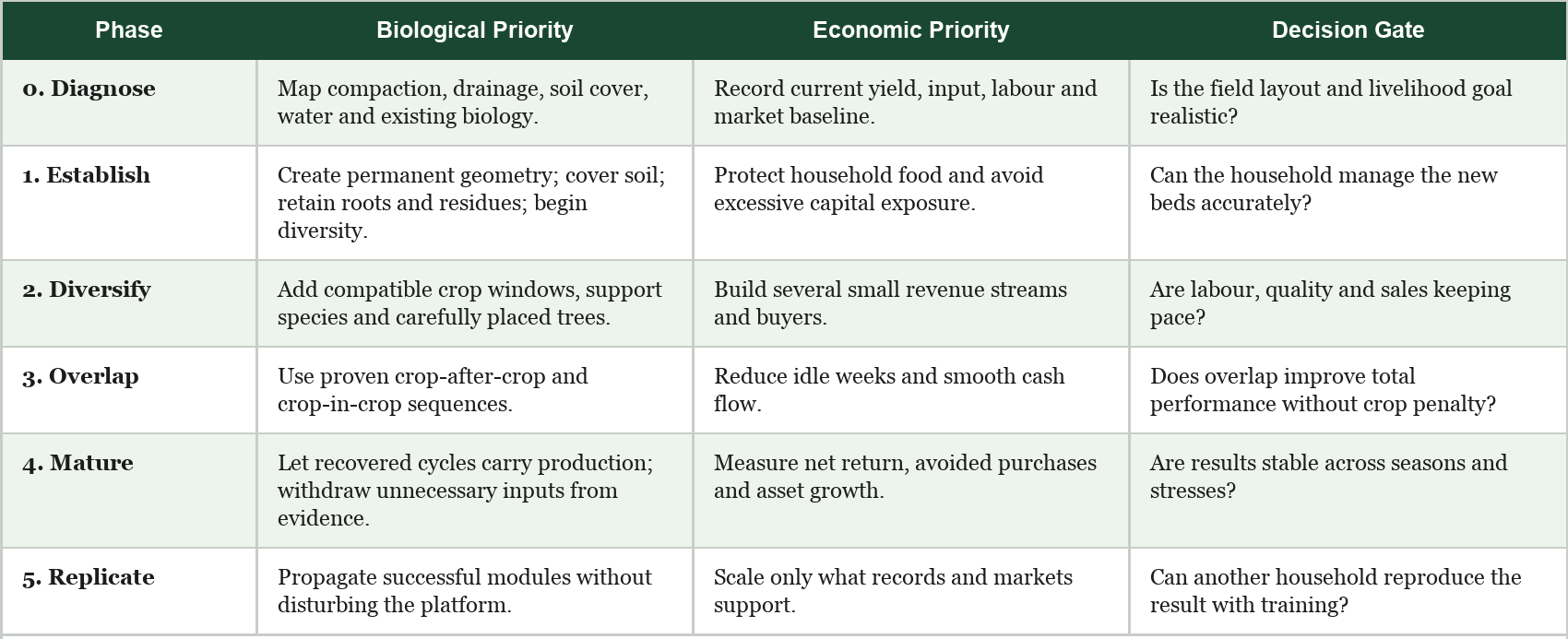
| PHASE | BIOLOGICAL PRIORITY | ECONOMIC PRIORITY | DECISION GATE |
|---|---|---|---|
| 0. Diagnose | Map compaction, drainage, soil cover, water and existing biology. | Record current yield, input, labour and market baseline. | Is the field layout and livelihood goal realistic? |
| 1. Establish | Create permanent geometry; cover soil; retain roots and residues; begin diversity. | Protect household food and avoid excessive capital exposure. | Can the household manage the new beds accurately? |
| 2. Diversify | Add compatible crop windows, support species and carefully placed trees. | Build several small revenue streams and buyers. | Are labour, quality and sales keeping pace? |
| 3. Overlap | Use proven crop-after-crop and crop-in-crop sequences. | Reduce idle weeks and smooth cash flow. | Does overlap improve total performance without crop penalty? |
| 4. Mature | Let recovered cycles carry production; withdraw unnecessary inputs from evidence. | Measure net return, avoided purchases and asset growth. | Are results stable across seasons and stresses? |
| 5. Replicate | Propagate successful modules without disturbing the platform. | Scale only what records and markets support. | Can another household reproduce the result with training? |
8 THE PRODUCTION MANAGER
The closed-loop does not remove management; it raises the value of management. The Production Manager reads the field and coordinates biology, harvest and cash. Decisions are based on evidence rather than routine input schedules.
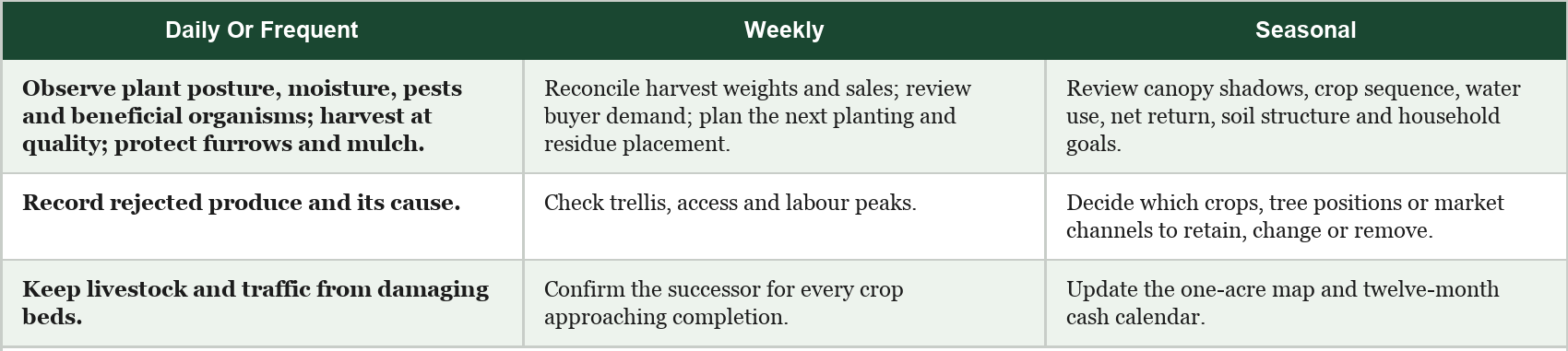
| DAILY OR FREQUENT | WEEKLY | SEASONAL |
|---|---|---|
| Observe plant posture, moisture, pests and beneficial organisms; harvest at quality; protect furrows and mulch. | Reconcile harvest weights and sales; review buyer demand; plan the next planting and residue placement. | Review canopy shadows, crop sequence, water use, net return, soil structure and household goals. |
| Record rejected produce and its cause. | Check trellis, access and labour peaks. | Decide which crops, tree positions or market channels to retain, change or remove. |
| Keep livestock and traffic from damaging beds. | Confirm the successor for every crop approaching completion. | Update the one-acre map and twelve-month cash calendar. |
THE OAP FIELD LEDGER
Each harvest should create a usable record. At minimum: date; bed or module; crop and variety; planted area or plant count; harvest weight; grade; quantity consumed at home; quantity sold; selling price; buyer; unpaid and paid labour; transport; packaging; establishment cost; loss; water event; and notes on crop health. Tree products should also record pruning and canopy dimensions. Without this ledger, a striking field remains a story rather than a transferable model.
Verification rule: Never publish “income per acre” without the measured area, production period, gross sales, all paid costs, household labour treatment, crop losses and resulting net return. Where the evidence is a farmer statement, label it as reported evidence.
9 ECONOMICS: FROM YIELD TO HOUSEHOLD PROSPERITY
OAP economics has four components. First, saleable production creates cash. Second, food retained by the household replaces purchases. Third, declining agricultural inputs and water use reduce recurring outflow. Fourth, trees, soil function, seed, knowledge and market relationships build productive assets. A conventional gross-margin sheet captures only part of this value, but every claimed benefit must still be recorded honestly.
A planning ambition of Rs 1 million or more per acre per year has been used in OAP development, and higher scenarios have been explored. These figures are targets to test, not entitlements produced by the label OAP. Revenue depends on crop portfolio, price, establishment stage, harvest duration, post-harvest loss, market reach and skill. The responsible path is to publish auditable cases and improve the model from them.
The economic case is strengthened by PQNK’s cost trajectory. In a wheat comparison associated with NARC/PNARD, the reported PQNK production cost was Rs 11,660 against Rs 26,236 under the comparison system—a reduction of about 56%. Such trial results support the principle that recovered ecological functions can reduce recurring cost, but they should not be treated as the automatic budget of every OAP farm. Local baseline, crop mix and transition stage still matter.
A SIMPLE ANNUAL DASHBOARD
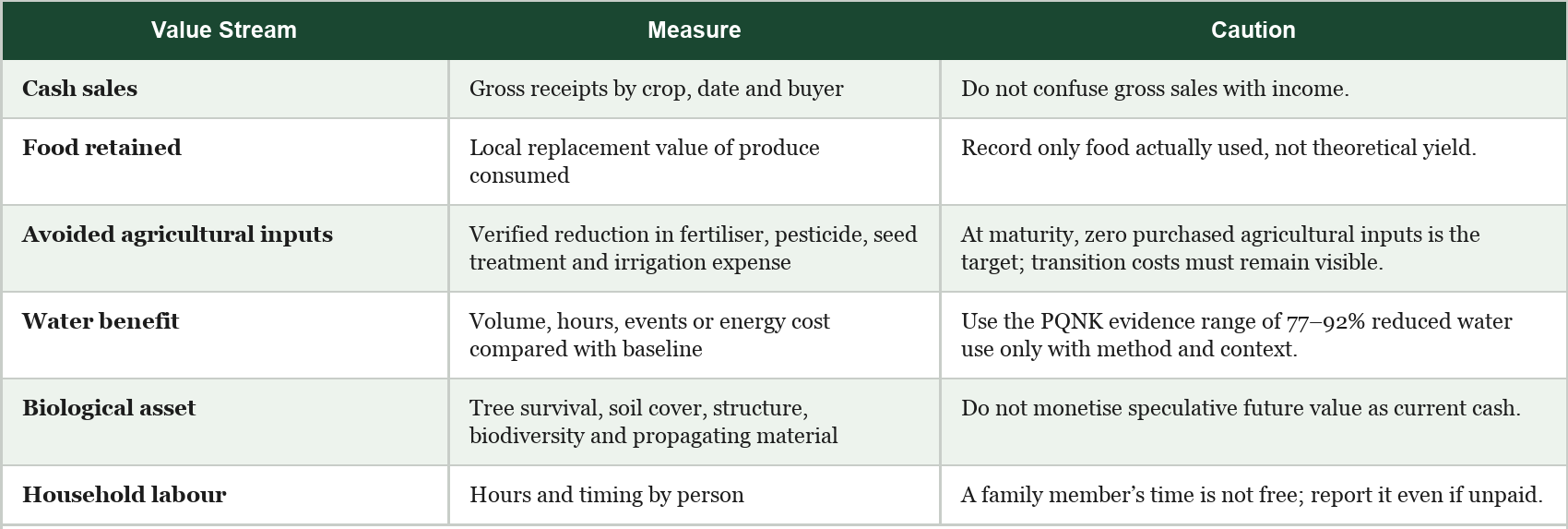
| VALUE STREAM | MEASURE | CAUTION |
|---|---|---|
| Cash sales | Gross receipts by crop, date and buyer | Do not confuse gross sales with income. |
| Food retained | Local replacement value of produce consumed | Record only food actually used, not theoretical yield. |
| Avoided agricultural inputs | Verified reduction in fertiliser, pesticide, seed treatment and irrigation expense | At maturity, zero purchased agricultural inputs is the target; transition costs must remain visible. |
| Water benefit | Volume, hours, events or energy cost compared with baseline | Use the PQNK evidence range of 77–92% reduced water use only with method and context. |
| Biological asset | Tree survival, soil cover, structure, biodiversity and propagating material | Do not monetise speculative future value as current cash. |
| Household labour | Hours and timing by person | A family member’s time is not free; report it even if unpaid. |
10 RISK IS MANAGED BY DESIGN
Diversity reduces dependence, but only purposeful diversity reduces risk. Ten crops sold to the same buyer on the same day can still fail together. OAP distributes exposure across biological families, root depths, canopy levels, maturity periods, harvest frequencies and market channels. It also protects a minimum household-food portfolio so a price shock does not immediately become a food shock.
Key safeguards include:
• Keep seed and planting material for proven crops while testing new crops on a limited area. • Stagger sowing and planting to avoid one harvest glut. • Maintain more than one buyer or outlet where feasible. • Separate crops that share severe pest or disease risk rather than calling their proximity diversity. • Preserve access for observation and rapid removal of diseased material. • Hold a cash reserve for household emergencies, repair, transport and extreme weather. • Do not borrow against projected high-value harvests until local production and sales records justify the exposure.
Climate resilience arises from the same architecture: covered soil moderates heat and evaporation; permanent roots and channels improve infiltration; shallow supplementary furrow flow protects the water–air balance; tree and crop diversity distribute weather risk; and continuous photosynthesis rebuilds the system after stress. Resilience is not immunity. Flood, drought, heat, wind and market disruption still require contingency plans.
11 HOW TO RECOGNISE A MATURE CLOSED-LOOP OAP
A closed-loop acre is not visually defined by maximum density. It is defined by continuity and control: continuous cover, roots, photosynthesis, harvest opportunity, learning and cash discipline. The field may look different in different climates, but the governing relationships remain the same.
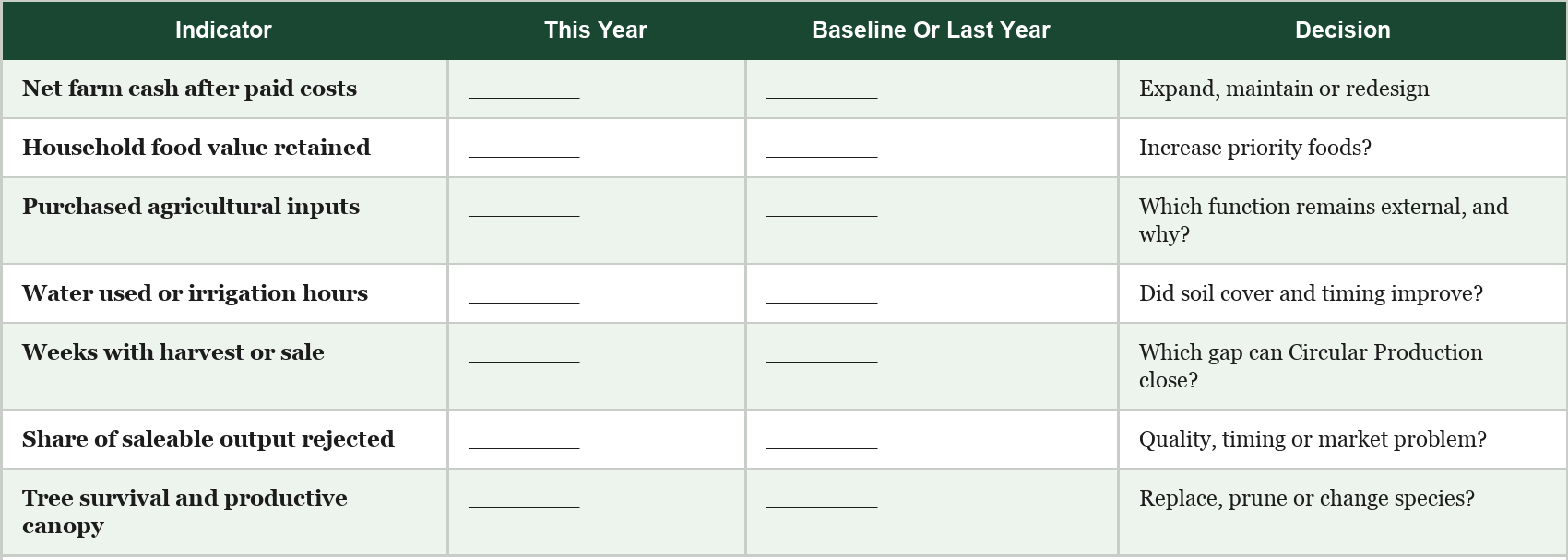
| INDICATOR | THIS YEAR | BASELINE OR LAST YEAR | DECISION |
|---|---|---|---|
| Net farm cash after paid costs | ________ | ________ | Expand, maintain or redesign |
| Household food value retained | ________ | ________ | Increase priority foods? |
| Purchased agricultural inputs | ________ | ________ | Which function remains external, and why? |
| Water used or irrigation hours | ________ | ________ | Did soil cover and timing improve? |
| Weeks with harvest or sale | ________ | ________ | Which gap can Circular Production close? |
| Share of saleable output rejected | ________ | ________ | Quality, timing or market problem? |
| Tree survival and productive canopy | ________ | ________ | Replace, prune or change species? |
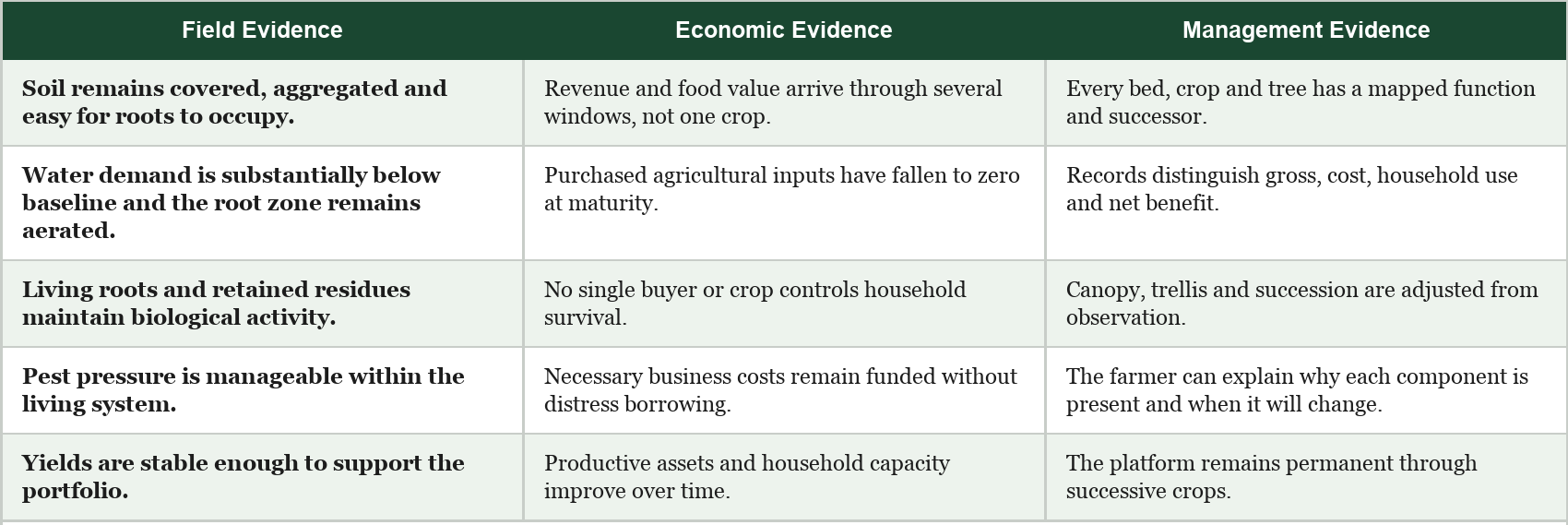
| FIELD EVIDENCE | ECONOMIC EVIDENCE | MANAGEMENT EVIDENCE |
|---|---|---|
| Soil remains covered, aggregated and easy for roots to occupy. | Revenue and food value arrive through several windows, not one crop. | Every bed, crop and tree has a mapped function and successor. |
| Water demand is substantially below baseline and the root zone remains aerated. | Purchased agricultural inputs have fallen to zero at maturity. | Records distinguish gross, cost, household use and net benefit. |
| Living roots and retained residues maintain biological activity. | No single buyer or crop controls household survival. | Canopy, trellis and succession are adjusted from observation. |
| Pest pressure is manageable within the living system. | Necessary business costs remain funded without distress borrowing. | The farmer can explain why each component is present and when it will change. |
| Yields are stable enough to support the portfolio. | Productive assets and household capacity improve over time. | The platform remains permanent through successive crops. |
12 REPLICATION WITHOUT DEPENDENCE
OAP can support landowners, tenants and landless young people working through transparent lease or profit-sharing arrangements. The model is especially suited to management-intensive, capital-light production, but agreements must be explicit about land security, tree ownership, water, tools, losses, labour, record access and the division of both revenue and long-term assets. No household should build soil and trees under an arrangement that can be withdrawn without fair protection.
Training should therefore combine field technique with enterprise literacy. A capable OAP Production Manager can read soil moisture, maintain mulch, position crops, train vines, manage canopy, record harvests, calculate net return, negotiate with buyers and teach the pattern to another farmer. Economic liberation comes from that integrated capability—not from dependency on a branded package.
THE ONE-ACRE PROSPERITY COMMITMENT
The One Acre Prosperity model is a promise of design discipline, not guaranteed wealth. It commits the Production Manager to keep the soil alive, water supplementary, beds permanent, biodiversity functional, the household nourished, the market understood, and every claim measurable. Alley Cropping ensures that long- and short-duration crops share space intelligently. Circular Production ensures that one crop’s ending becomes another crop’s beginning. The closed-loop ensures that the farm increasingly works from its own recovered life.
When these three innovations operate together, the acre stops behaving like a seasonal plot waiting for the next purchase. It becomes a perpetual abundance machine: receiving sunlight, rain and atmospheric resources; converting them through living plants; returning biomass to the soil; producing food and saleable harvests; and increasing the farmer’s freedom to decide what happens next.
SOURCE AND EVIDENCE NOTE
• The OAP framework, PQNK geometry and closed-loop maturity criteria are system design standards developed through PQNK field practice and observation. • The quarter-acre ridge-gourd and bitter-gourd receipts are farmer-reported field observations. They are retained as reported evidence, not presented as an independently audited income guarantee. • The NARC/PNARD wheat cost figures—Rs 11,660 for PQNK and Rs 26,236 for the comparison system—are retained as a reported historical comparison. Any separate technical edition should append the underlying trial record, season, location and cost schedule. • The 77–92% water-use reduction is a PQNK evidence range across crops. Any crop-specific use of the figure should identify the crop, baseline irrigation practice and measurement method. • All income projections, crop combinations and calendars in this chapter are planning tools. Local records determine what can be replicated.
OAP DESIGN WORKSHEET
Use these pages before fixing the crop plan. Continue the working tables in the farm ledger.
HOUSEHOLD AND MARKET
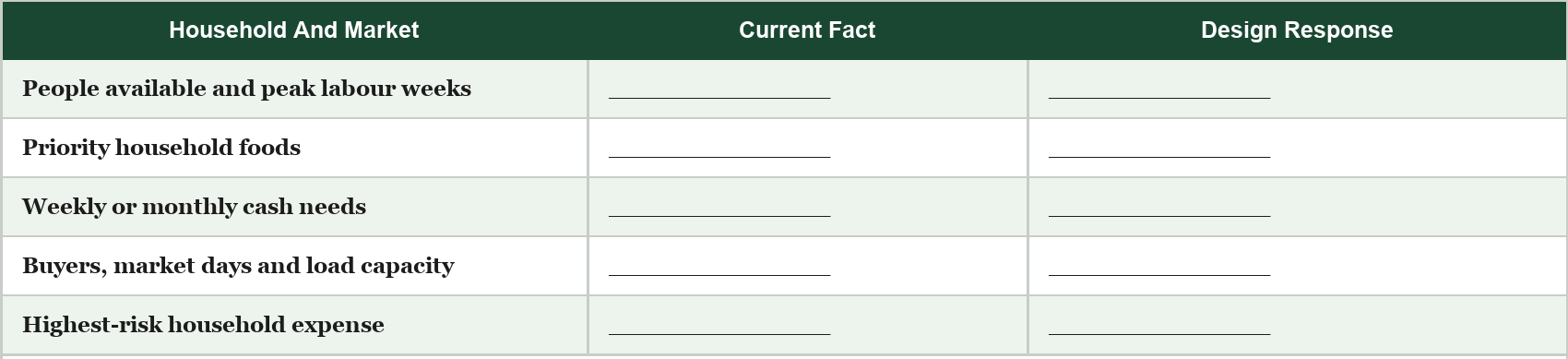
| HOUSEHOLD AND MARKET | CURRENT FACT | DESIGN RESPONSE |
|---|---|---|
| People available and peak labour weeks | ________________ | ________________ |
| Priority household foods | ________________ | ________________ |
| Weekly or monthly cash needs | ________________ | ________________ |
| Buyers, market days and load capacity | ________________ | ________________ |
| Highest-risk household expense | ________________ | ________________ |
FIELD AND WATER
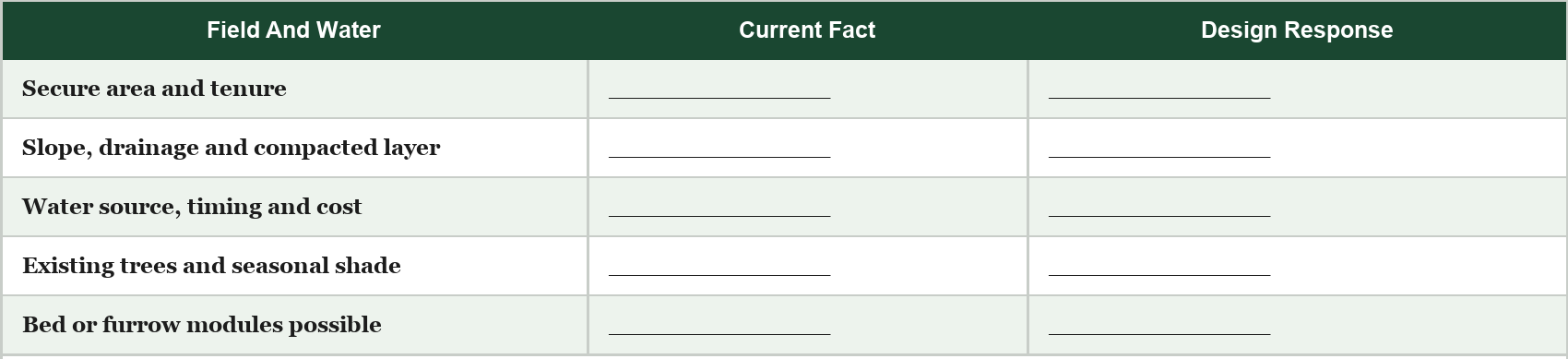
| FIELD AND WATER | CURRENT FACT | DESIGN RESPONSE |
|---|---|---|
| Secure area and tenure | ________________ | ________________ |
| Slope, drainage and compacted layer | ________________ | ________________ |
| Water source, timing and cost | ________________ | ________________ |
| Existing trees and seasonal shade | ________________ | ________________ |
| Bed or furrow modules possible | ________________ | ________________ |
PORTFOLIO CHECK
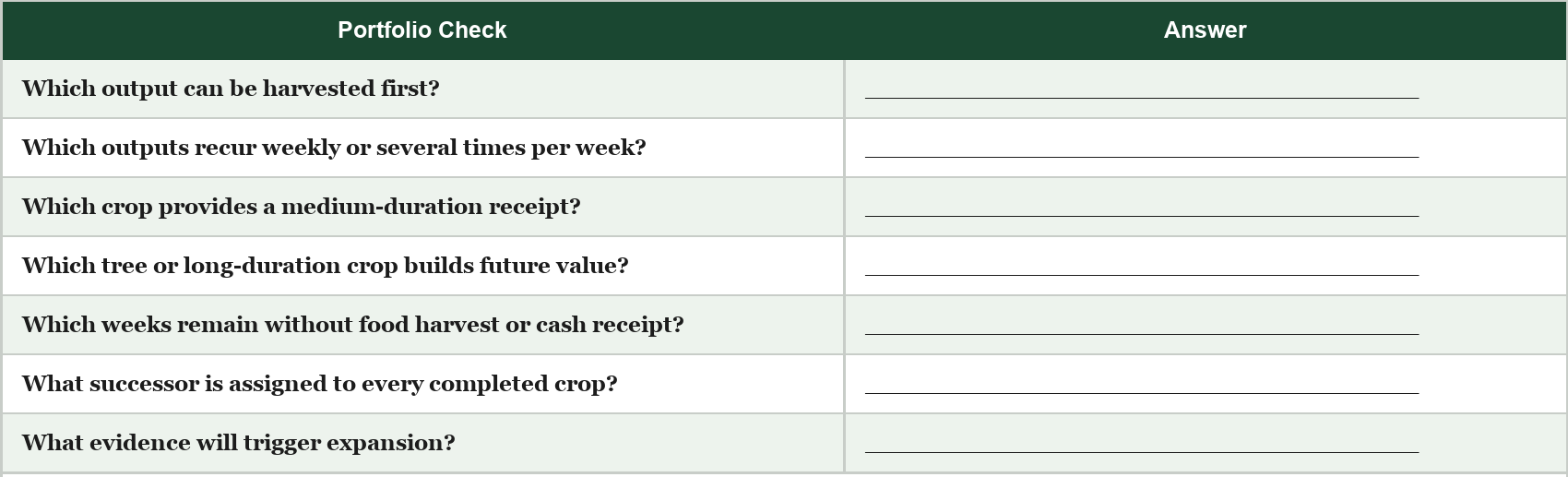
| PORTFOLIO CHECK | ANSWER |
|---|---|
| Which output can be harvested first? | ________________________________________ |
| Which outputs recur weekly or several times per week? | ________________________________________ |
| Which crop provides a medium-duration receipt? | ________________________________________ |
| Which tree or long-duration crop builds future value? | ________________________________________ |
| Which weeks remain without food harvest or cash receipt? | ________________________________________ |
| What successor is assigned to every completed crop? | ________________________________________ |
| What evidence will trigger expansion? | ________________________________________ |
Final measure: The success of Chapter 31 is visible when a smallholder can say, with records: my soil is improving, my water use is lower, my household eats better, my harvests and receipts are more frequent, my agricultural input dependence has ended, and this acre is becoming more valuable every season.
Chapter Thirty-Two: Field Evidence and the Authority of Living Ecosystems