
Industrial Devastation To Natural Abundance
The PQNK System · Chapter 32
Field Evidence and the Authority of Living Ecosystems
PQNK compared with organic, conservation, regenerative and natural-farming approaches
Release 1.0 · 2026-09-25
If you use “Listen”, the text of the page may be sent to your browser or operating system’s speech provider, such as Apple, Google or Microsoft, depending on the voice your device uses. Pedaver does not process, transmit or store any audio.
“The purpose of comparison is not to diminish sincere efforts to improve agriculture. It is to identify what each system actually requires, what it leaves optional, and what a farmer can verify in the field.”
Asif Sharif, Lahore, 2022

| Does the farming system restore the soil as a living production system—and can that restoration be demonstrated through crop performance, water behaviour, biodiversity, declining intervention and farmer control? |
THE AUTHORITY OF THE FIELD
Agricultural labels are useful only when they describe a functioning production system. A certificate can confirm compliance with a standard. A philosophy can guide better choices. A practice can reduce one form of damage. None of these, by itself, proves that the whole field has recovered its capacity to regulate water, cycle nutrients, support diverse life, resist disturbance and produce a reliable crop.
PQNK therefore begins comparison at the level of the living ecosystem. The field is not treated as an inert platform to which fertility and protection must repeatedly be added. It is treated as a biological production system whose structure, energy flow, water relations and food web can be rebuilt. The authority of PQNK does not rest on a label. It rests on observable function.
This distinction matters because several agricultural approaches share important intentions with PQNK. Organic agriculture seeks to avoid many synthetic materials. Conservation agriculture protects cover and reduces soil disturbance. Regenerative agriculture aims to restore ecological function. Natural-farming traditions seek a closer partnership with nature. PQNK respects these contributions. Its distinct claim is narrower and more demanding: the necessary ecological and engineering conditions must operate together, in the same field, through a reproducible protocol, until routine purchased crop inputs are no longer required.
A FAIR BASIS FOR COMPARISON
A fair comparison cannot be built from slogans or from the best example of one system against the weakest example of another. It must distinguish between what a framework requires, what it permits, what farmers commonly do, and what a particular field has demonstrated. The comparison in this chapter therefore uses system-level questions rather than brand-level judgments.
The first question is soil integrity. Does the system prevent further mechanical destruction after conversion? The second is biological continuity. Is the soil continuously protected and fed by organic mulch, living roots and crop diversity? The third is water behaviour. Does management rebuild infiltration, storage, aeration and capillary movement, or merely deliver more water? The fourth is dependence. Does the farm progressively eliminate routine purchased fertiliser and pesticide inputs, or only replace one purchased product with another? The fifth is reproducibility. Can a trained production manager execute the system with defined machinery, timing, geometry and field records? The sixth is evidence. Are claims confirmed through yield, crop quality, soil function, water use, biodiversity and economic performance under the conditions in which the crop is actually grown?
No single observation proves restoration. Earthworms alone do not establish nutrient balance. A residue-covered surface does not by itself establish deep aeration. A low-input season does not prove durable independence. PQNK maturity is a converging body of field evidence, not a date on a calendar.
THE FOUR NON-NEGOTIABLE PQNK RULES
PQNK is governed by four non-negotiable rules. They are simple to state, but they acquire their power only when applied together:
• No inundation. Water must not displace the air that living soil requires.
• No soil disturbance after conversion. The rebuilt architecture and biological networks must remain intact.
• Continuous organic mulch. The soil surface remains protected, buffered and biologically supplied.
• Biodiversity. Planned diversity above and below ground stabilises the food web and production system.
These rules are implemented through the PQNK field architecture and operating protocol: correction of restrictive soil layers during conversion where necessary; permanent raised beds and controlled traffic; thick organic mulch; precision establishment using the Slit Insertion Precision Planter (SIPP) or Vertical Insertion Precision Planter (VIPP), as appropriate; supplementary furrow irrigation only when field conditions require it; crop diversity; and disciplined observation. Machinery is not an accessory to this method. The production manager must master its calibration and proper use so that precision farming protects the soil architecture rather than disturbing it.
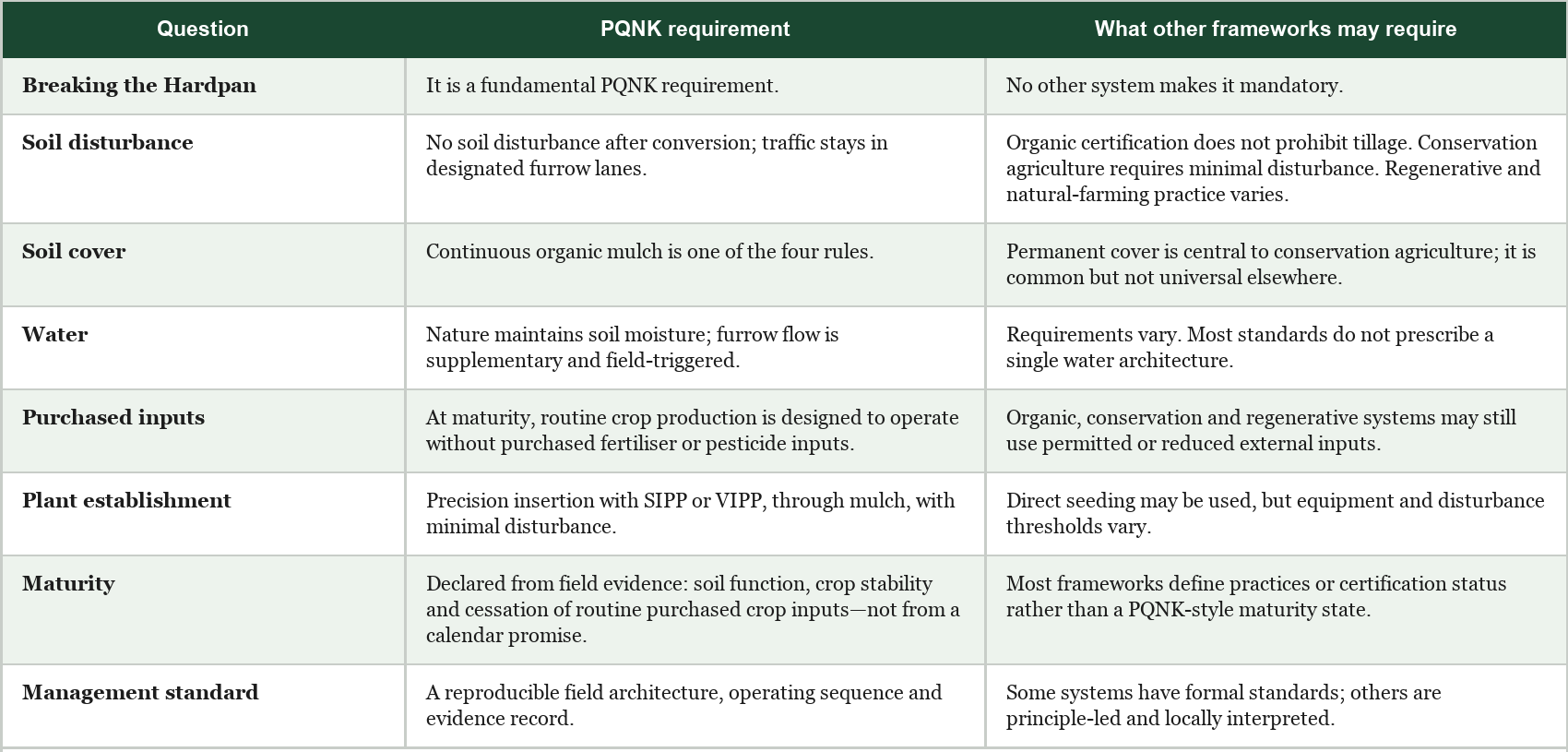
THE COMPARISON AT A GLANCE
The table compares system requirements, not every farm that uses a particular label. Individual farms may perform better or worse than the framework suggests. “PQNK requirement” describes the intended mature operating state and must be supported by field records; it is not a universal prediction for every site.
| Question | PQNK requirement | What other frameworks may require |
|---|---|---|
| Breaking the Hardpan | It is a fundamental PQNK requirement. | No other system makes it mandatory. |
| Soil disturbance | No soil disturbance after conversion; traffic stays in designated furrow lanes. | Organic certification does not prohibit tillage. Conservation agriculture requires minimal disturbance. Regenerative and natural-farming practice varies. |
| Soil cover | Continuous organic mulch is one of the four rules. | Permanent cover is central to conservation agriculture; it is common but not universal elsewhere. |
| Water | Nature maintains soil moisture; furrow flow is supplementary and field-triggered. | Requirements vary. Most standards do not prescribe a single water architecture. |
| Purchased inputs | At maturity, routine crop production is designed to operate without purchased fertiliser or pesticide inputs. | Organic, conservation and regenerative systems may still use permitted or reduced external inputs. |
| Plant establishment | Precision insertion with SIPP or VIPP, through mulch, with minimal disturbance. | Direct seeding may be used, but equipment and disturbance thresholds vary. |
| Maturity | Declared from field evidence: soil function, crop stability and cessation of routine purchased crop inputs—not from a calendar promise. | Most frameworks define practices or certification status rather than a PQNK-style maturity state. |
| Management standard | A reproducible field architecture, operating sequence and evidence record. | Some systems have formal standards; others are principle-led and locally interpreted. |
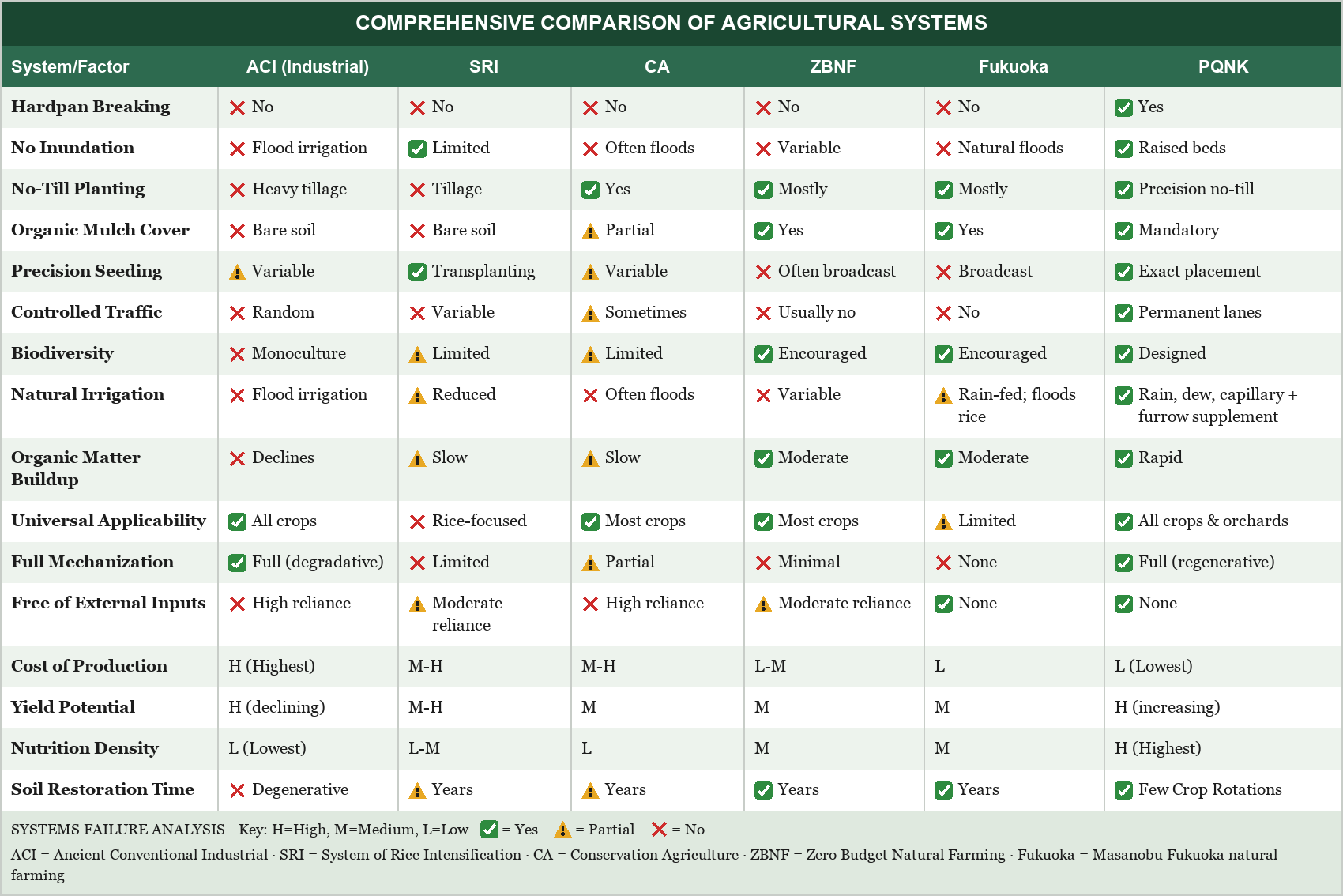
| System/Factor | ACI (Industrial) | SRI | CA | ZBNF | Fukuoka | PQNK |
|---|---|---|---|---|---|---|
| Hardpan Breaking | ❌ No | ❌ No | ❌ No | ❌ No | ❌ No | ✅ Yes |
| No Inundation | ❌ Flood irrigation | ✅ Limited | ❌ Often floods | ❌ Variable | ❌ Natural floods | ✅ Raised beds |
| No-Till Planting | ❌ Heavy tillage | ❌ Tillage | ✅ Yes | ✅ Mostly | ✅ Mostly | ✅ Precision no-till |
| Organic Mulch Cover | ❌ Bare soil | ❌ Bare soil | ⚠️ Partial | ✅ Yes | ✅ Yes | ✅ Mandatory |
| Precision Seeding | ⚠️ Variable | ✅ Transplanting | ⚠️ Variable | ❌ Often broadcast | ❌ Broadcast | ✅ Exact placement |
| Controlled Traffic | ❌ Random | ❌ Variable | ⚠️ Sometimes | ❌ Usually no | ❌ No | ✅ Permanent lanes |
| Biodiversity | ❌ Monoculture | ⚠️ Limited | ⚠️ Limited | ✅ Encouraged | ✅ Encouraged | ✅ Designed |
| Natural Irrigation | ❌ Flood irrigation | ⚠️ Reduced | ❌ Often floods | ❌ Variable | ⚠️ Rain-fed; floods rice | ✅ Rain, dew, capillary + furrow supplement |
| Organic Matter Buildup | ❌ Declines | ⚠️ Slow | ⚠️ Slow | ✅ Moderate | ✅ Moderate | ✅ Rapid |
| Universal Applicability | ✅ All crops | ❌ Rice-focused | ✅ Most crops | ✅ Most crops | ⚠️ Limited | ✅ All crops & orchards |
| Full Mechanization | ✅ Full (degradative) | ❌ Limited | ⚠️ Partial | ❌ Minimal | ❌ None | ✅ Full (regenerative) |
| Free of External Inputs | ❌ High reliance | ⚠️ Moderate reliance | ❌ High reliance | ⚠️ Moderate reliance | ✅ None | ✅ None |
| Cost of Production | H (Highest) | M-H | M-H | L-M | L | L (Lowest) |
| Yield Potential | H (declining) | M-H | M | M | M | H (increasing) |
| Nutrition Density | L (Lowest) | L-M | L | M | M | H (Highest) |
| Soil Restoration Time | ❌ Degenerative | ⚠️ Years | ⚠️ Years | ✅ Years | ✅ Years | ✅ Few Crop Rotations |
| SYSTEMS FAILURE ANALYSIS - Key: H=High, M=Medium, L=Low | ✅=Yes, ⚠️=Partial, ❌=No | ||||||
| ACI = Ancient Conventional Industrial · SRI = System of Rice Intensification · CA = Conservation Agriculture · ZBNF = Zero Budget Natural Farming · Fukuoka = Masanobu Fukuoka natural farming |
CERTIFIED ORGANIC AGRICULTURE
Organic certification has made an important contribution by restricting many synthetic fertilisers and pesticides and by creating traceability around production practices. It should be represented accurately: organic agriculture is not simply conventional agriculture with different packaging, and certified producers often make substantial efforts to protect soil and biodiversity.
The boundary is nevertheless clear. Organic certification primarily regulates which materials and practices are permitted. It does not, by itself, require permanent no-disturbance beds, continuous mulch, controlled traffic, a particular water architecture, or the elimination of all purchased crop inputs at ecological maturity. A certified farm may till, purchase approved fertility products and use permitted crop-protection materials. Another certified farm may be biologically sophisticated and use very few inputs. Both may comply with the same certification framework.
PQNK asks a different question: has the living system recovered enough function that routine fertiliser and pesticide purchases are unnecessary? Substituting an approved input for a prohibited input may reduce particular risks, but substitution is not the same as restoring the production system. Under PQNK, compost, manure or other organic materials may contribute to rebuilding where locally appropriate, especially during transition; they are not intended to become a permanent purchased-input dependency.
Nor does certification, by itself, make food more nutritious. Organic standards regulate how a crop is produced; they do not measure, or require, higher nutrient density or broader nutritional diversity in the harvest. Systematic reviews comparing organic and conventional produce have not found consistent nutritional superiority. Differences reported for particular compounds have varied by crop, site, season and study, and a label cannot tell a consumer which case applies. Nutrient density follows from the functioning soil-plant system in which the crop was grown, the same principle Chapter Thirty sets out for seed: the seed carries potential, and the living soil determines how much of it is expressed. A certified field with compacted, disturbed or biologically poor soil offers no nutritional guarantee simply because its inputs are permitted.
The greater hazard often lies outside certification altogether. Much produce sold as organic or natural, particularly in informal markets, is grown with farm-made or locally traded inputs that no standard governs: uncomposted or partially composted manure, untreated slurry, material derived from municipal or industrial waste, and botanical or microbial preparations of unknown composition and strength. Such inputs have no defined dose, no tested composition and no withholding period before harvest. They can carry pathogens such as E. coli O157:H7, Salmonella and Listeria, heavy metals such as cadmium and lead, veterinary drug residues and mycotoxins, none of which is monitored on the way to the consumer.
This is why an unstandardised “natural” input can pose a greater risk to consumer health than a registered agrochemical used within its label. A registered fertiliser or pesticide, whatever its ecological cost, is defined in composition, applied at stated rates, bound by a pre-harvest interval and subject to maximum residue limits and residue testing. An unregulated input carries none of these safeguards. Permitted organic materials also need honest description: copper fungicides, for example, are allowed in organic production yet persist and accumulate in soil. Permitted is a regulatory status, not a certificate of ecological harmlessness.
Food-safety distinctions must also remain precise. Properly managed compost is not equivalent to raw manure. Certified organic standards specify treatment and timing requirements intended to reduce pathogen risk, and those safeguards deserve credit rather than dismissal. PQNK’s stronger long-term objective is to build fertility through continuous biological cycling within the field, reducing the need to import concentrated materials at all, and with them the contamination risks that accompany poorly handled or untested inputs. During transition, any organic material brought onto a PQNK field should come from a known source and be fully processed; an input the farmer cannot verify is not a safe input.
CONSERVATION AGRICULTURE AND NO-TILL
Conservation agriculture, as defined by the Food and Agriculture Organization of the United Nations, rests on three connected principles: minimum mechanical soil disturbance, permanent organic soil cover and diversification of plant species. These principles overlap substantially with PQNK and represent a major advance over repeated inversion tillage and exposed soil.
The difference lies in the operating boundary. Minimum disturbance is not always the same as no disturbance after conversion. Conservation agriculture may allow narrow strip disturbance, and mechanised no-till systems in some regions use herbicides to terminate vegetation or control weeds. Herbicide use is not an inherent requirement of conservation agriculture, and many farmers reduce or avoid it; neither, however, does the framework itself guarantee its elimination.
PQNK integrates the overlapping ecological principles into a more prescriptive production architecture. The bed is permanent. Traffic is controlled. Mulch is continuous. Seed is inserted through the mulch with purpose-built precision equipment. Water, when needed, is confined to the furrow and applied as supplementary flow rather than inundation. Crop diversity is designed to perform multiple functions. The comparison is therefore not “cover versus no cover” or “tillage versus no-till.” It is whether all the required functions are organised as one field system and whether dependence declines as that system matures.
REGENERATIVE AGRICULTURE
Regenerative agriculture has directed welcome attention toward soil health, carbon, biodiversity, water infiltration, livestock integration and farmer resilience. It is a broad movement rather than one universally binding protocol. Published reviews show that definitions vary: some are practice-based, some outcome-based, and many combine both. That openness encourages innovation, but it also means the word alone cannot establish what happened in a field.
A regenerative farmer may be fully committed to reducing tillage and inputs; another operation may adopt a smaller set of beneficial practices while retaining substantial external-input dependence. The correct response is not to reject the term. It is to ask for the operating standard and the evidence: What is mandatory? What remains optional? How are outcomes measured? When is a claim of regeneration justified?
PQNK answers those questions with defined rules, field geometry, machinery, operating sequences and a maturity test. Its claim is not that every PQNK field instantly outperforms every regenerative farm. Its claim is that a field should not be declared restored merely because selected regenerative practices have been introduced. Restoration must become visible in the combined behaviour of soil, water, crops, biodiversity, intervention and farm economics.
NATURAL FARMING
Natural farming includes several traditions and modern programmes. They differ in their use of seed preparations, botanical or microbial formulations, livestock-derived materials, tillage, mulch, water management and machinery. It would therefore be inaccurate to treat natural farming as a single uniform method. Its enduring contribution is the insistence that agriculture should cooperate with living processes rather than attempt to replace them.
PQNK shares that philosophical direction but adds an explicit engineering discipline. A living ecosystem is not restored by admiration alone. Restrictive soil layers may first need physical correction. Permanent bed and furrow geometry must then be protected. Mulch must be placed and retained. Seeds must be established accurately without reopening the soil. Irrigation must preserve aeration. Crop combinations must be designed for function. The production manager must understand both biological signals and machine behaviour.
This is where PQNK separates principle from protocol. Nature supplies the productive intelligence; management creates and protects the conditions in which that intelligence can operate. SIPP, VIPP, permanent traffic lanes, furrow geometry and precision timing are not attempts to dominate nature. They are tools for avoiding repeated disturbance while making ecosystem-based production workable at commercial field scale.
MATURITY IS A FIELD CONDITION, NOT A DEADLINE
Earlier descriptions of PQNK sometimes reduced transition to a fixed number of seasons or years. That shorthand is a management target, not a guarantee. Fields begin from different states of compaction, salinity, organic matter, biological activity, contamination, drainage, climate and management history. Crops also differ in rooting pattern, residue production and sensitivity. A calendar cannot honestly absorb that variation.
The direction of transition is consistent: disturbance stops, the soil remains covered, biodiversity increases, water behaviour improves, biological cycling strengthens and routine purchased crop inputs decline. The speed is field-specific. A production manager must read the field rather than chase a promised date.

| A field may be treated as mature only when repeated observation shows stable production without routine purchased fertiliser or pesticide inputs; effective infiltration and moisture retention without inundation; durable soil aggregation and porosity; active roots and biological cycling; manageable weed, pest and disease pressure; and economic performance that is not being sustained by hidden external subsidies or deferred soil damage. |
Maturity is not perfection. Exceptional weather, a new biological invasion or another shock may require a considered response. The defining condition is that the farm’s normal production no longer depends on a seasonal purchase-and-application cycle. Any intervention should be recorded, explained and evaluated against the objective of restoring system function—not normalised as a permanent crutch.
WHAT COUNTS AS EVIDENCE
PQNK claims should be tested at field scale and reported with enough context to be understood. A photograph can document visible cover, crop condition or root architecture, but it cannot establish yield, water use or profitability. A yield figure without area, harvest method and moisture basis is incomplete. A water-saving percentage without a conventional baseline, measurement boundary and weather record is not reproducible. A soil-carbon result without depth, bulk density, sampling design and laboratory method cannot support a stock-change claim.
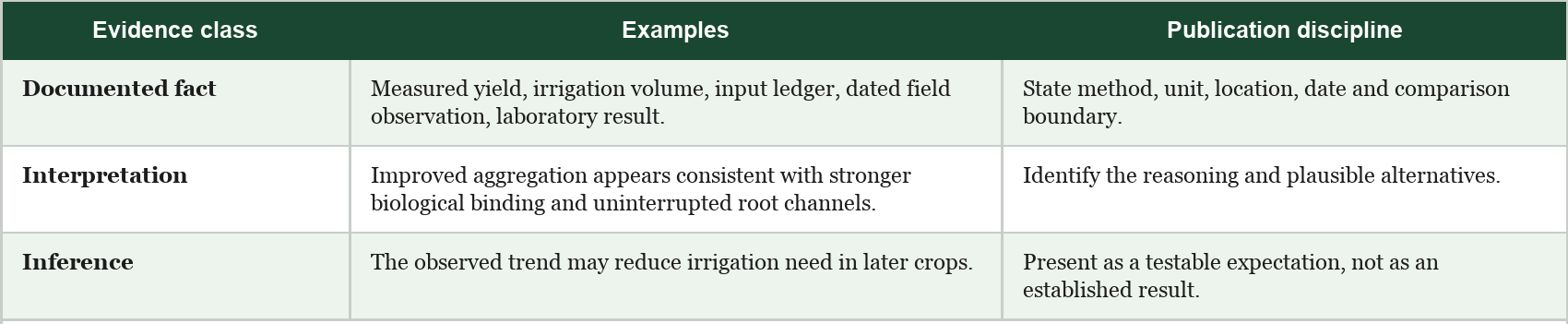
For that reason, the PQNK evidence record should distinguish three levels. The first is documented fact: a measurement, dated field record, laboratory result or independently verifiable observation. The second is interpretation: a reasoned explanation of what the observation may mean within the system. The third is inference: a proposition that should guide further observation but has not yet been demonstrated. Keeping these categories separate strengthens PQNK; it does not weaken it.
| Evidence class | Examples | Publication discipline |
|---|---|---|
| Documented fact | Measured yield, irrigation volume, input ledger, dated field observation, laboratory result. | State method, unit, location, date and comparison boundary. |
| Interpretation | Improved aggregation appears consistent with stronger biological binding and uninterrupted root channels. | Identify the reasoning and plausible alternatives. |
| Inference | The observed trend may reduce irrigation need in later crops. | Present as a testable expectation, not as an established result. |
A PRACTICAL FIELD-AUDIT FRAMEWORK
A farmer, researcher or visitor can evaluate a PQNK field without accepting the name on trust. The audit begins with boundaries: field area, crop, soil type, climate, previous management and date of conversion. It then examines the four rules and the production architecture. Are there signs of inundation? Has the bed been disturbed? Is mulch continuous and sufficiently protective? Is biodiversity planned and functional? Are wheels confined to traffic lanes? Is planting precise? Are irrigation events justified by field conditions?
The audit then follows flows of material and money. Every fertiliser, pesticide, amendment, fuel use and external biological product should be recorded. A zero-input claim applies to purchased crop-production inputs at maturity; it must not be confused with zero labour, zero machinery, zero seed management or zero operating cost. Transparent boundaries prevent a meaningful systems claim from becoming an advertising slogan.
Finally, the audit examines outcomes across time: marketable yield, crop quality, irrigation volume, rainfall, soil cover, rooting, aggregation, biodiversity observations, pest and disease pressure, labour, machinery performance, purchased-input expenditure and net return. The correct comparison is same field or well-matched fields, with methods stated. Where evidence is incomplete, the publication should say so.
THE HONEST SUMMARY
Organic agriculture, conservation agriculture, regenerative agriculture and natural farming each contain ideas and practices that can improve agriculture. Their names, however, do not guarantee the same operating conditions or outcomes. Organic certification can restrict materials without requiring a closed-loop mature field. Conservation agriculture can protect cover and reduce disturbance without requiring the elimination of herbicide or purchased fertility. Regenerative agriculture can focus strongly on outcomes while leaving the protocol variable. Natural farming can provide a profound ecological philosophy while differing widely in engineering detail and commercial implementation.
PQNK is distinguished by the simultaneous integration of four non-negotiable rules, a permanent field architecture, precision machinery, field-triggered water management, biodiversity and an evidence-based maturity condition. Its strongest claim is not that every field carrying the PQNK name must outperform every alternative. It is that agricultural restoration must be evaluated as a complete production system, and that the field—not the label—must decide whether the system is working.
This standard also applies inward. If a PQNK field is tilled after conversion, inundated, left without continuous organic mulch, simplified biologically, or kept productive through routine purchased fertiliser and pesticide inputs, it has not met the mature PQNK condition. The name cannot substitute for compliance, and compliance cannot substitute for evidence.
FROM SYSTEM CLAIM TO FIELD PROOF
The chapters that follow move from architecture to evidence. Crop records, field observations and measured outcomes must now carry the argument. Each case should state its conditions, methods and limits so that farmers can learn from it without mistaking a local result for a universal guarantee.
That is the proper authority of a living ecosystem: not a promise that nature will remove every risk, but a demonstrated capacity to perform more of the work of production as soil structure, roots, organisms, water and management become aligned. PQNK succeeds when that capacity is visible, measurable, repeatable and economically meaningful to the farmer.
SOURCES AND EVIDENCE NOTE
• Food and Agriculture Organization of the United Nations. “Conservation Agriculture” and “Conservation Agriculture Principles.” FAO describes minimum mechanical soil disturbance, permanent organic soil cover and species diversification as the three linked principles.
• United States Electronic Code of Federal Regulations, 7 CFR §205.203. Soil fertility and crop nutrient management practice standard, including requirements for raw animal manure and compost in certified organic production.
• Newton, P. et al. (2020). “What Is Regenerative Agriculture? A Review of Scholar and Practitioner Definitions Based on Processes and Outcomes.” Frontiers in Sustainable Food Systems 4:577723.
• Dangour, A. D. et al. (2009). “Nutritional quality of organic foods: a systematic review.” American Journal of Clinical Nutrition 90(3):680–685.
• Smith-Spangler, C. et al. (2012). “Are organic foods safer or healthier than conventional alternatives? A systematic review.” Annals of Internal Medicine 157(5):348–366.
• Barański, M. et al. (2014). “Higher antioxidant and lower cadmium concentrations and lower incidence of pesticide residues in organically grown crops: a systematic literature review and meta-analyses.” British Journal of Nutrition 112(5):794–811.
• United States Environmental Protection Agency (2006; updated 2009). Reregistration Eligibility Decision for Coppers. Used here only to support the careful distinction between permitted materials and ecological harmlessness—not to characterise every organic farm.
• PQNK-specific performance and maturity claims in this chapter are system claims that require crop-, field- and site-level evidence. They should be published with methods, boundaries and records, and should not be read as universal guarantees.
Chapter Thirty-Three: Rice as Proof of Concept