

Industrial Devastation To Natural Abundance
The Original System · Chapter 3
The 0.083% Paradox
Plants Eat Air, Not Soil, and the Case for Perpetual Abundance
Release 1.1 · 2026-09-29
If you use “Listen”, the text of the page may be sent to your browser or operating system’s speech provider, such as Apple, Google or Microsoft, depending on the voice your device uses. Pedaver does not process, transmit or store any audio.
“The fertiliser salesman has built his entire business on one lie: that the soil is empty. It is not empty. It has never been empty. What is empty is the biological system that accesses what is there. And he emptied it.”
Asif Sharif, Lahore, 2022
In the year 2024, the global synthetic fertiliser market was worth approximately two hundred billion US dollars. Farmers across the world spent that money on nitrogen, phosphorus, and potassium, the ‘NPK’ that modern agronomy has taught them their crops cannot survive without. In Pakistan alone, the annual fertiliser import bill runs to hundreds of billions of rupees, a sum extracted year after year from farmers who can often barely afford it, in exchange for a product that degrades the very soil it is applied to.
This expenditure rests on a single foundational claim: that agricultural soils are nutrient-deficient, that crops cannot obtain adequate nutrition from the soil alone, and that external fertilisation is therefore necessary for productive farming. Without this claim, the fertiliser industry has no justification for its existence. Without this claim, the last seventy years of agricultural policy, the Green Revolution, the NPK paradigm, the entire apparatus of modern agronomy, requires fundamental re-examination.
This claim is false. Not partially false. Not overstated. False at its foundation, contradicted by the most basic facts of plant biology and soil chemistry, and demonstrably so, in numbers that anyone can verify, on any farm, with any soil. This chapter presents those numbers and explains precisely what they mean for every farmer, every policymaker, and every scientist who has accepted the fertiliser industry’s premise without examining it.
WHERE PLANTS ACTUALLY COME FROM
Begin with the most basic question in agriculture: what is a plant made of? Where does its mass come from? A full-grown sugarcane stalk, three metres tall and weighing several kilograms, where was that material before the plant existed? A wheat crop producing two tonnes of grain per acre, what was the source of that two tonnes?
The intuitive answer, the one that the fertiliser industry depends upon, is that the plant’s mass comes from the soil, that the crop extracts nutrients from the ground and builds itself from what it finds there. This intuition is wrong. It was wrong when the seventeenth-century Flemish scientist Jan Baptiste van Helmont demonstrated it in his famous willow tree experiment, and it remains wrong today, confirmed by every measurement that plant biochemistry has ever made.
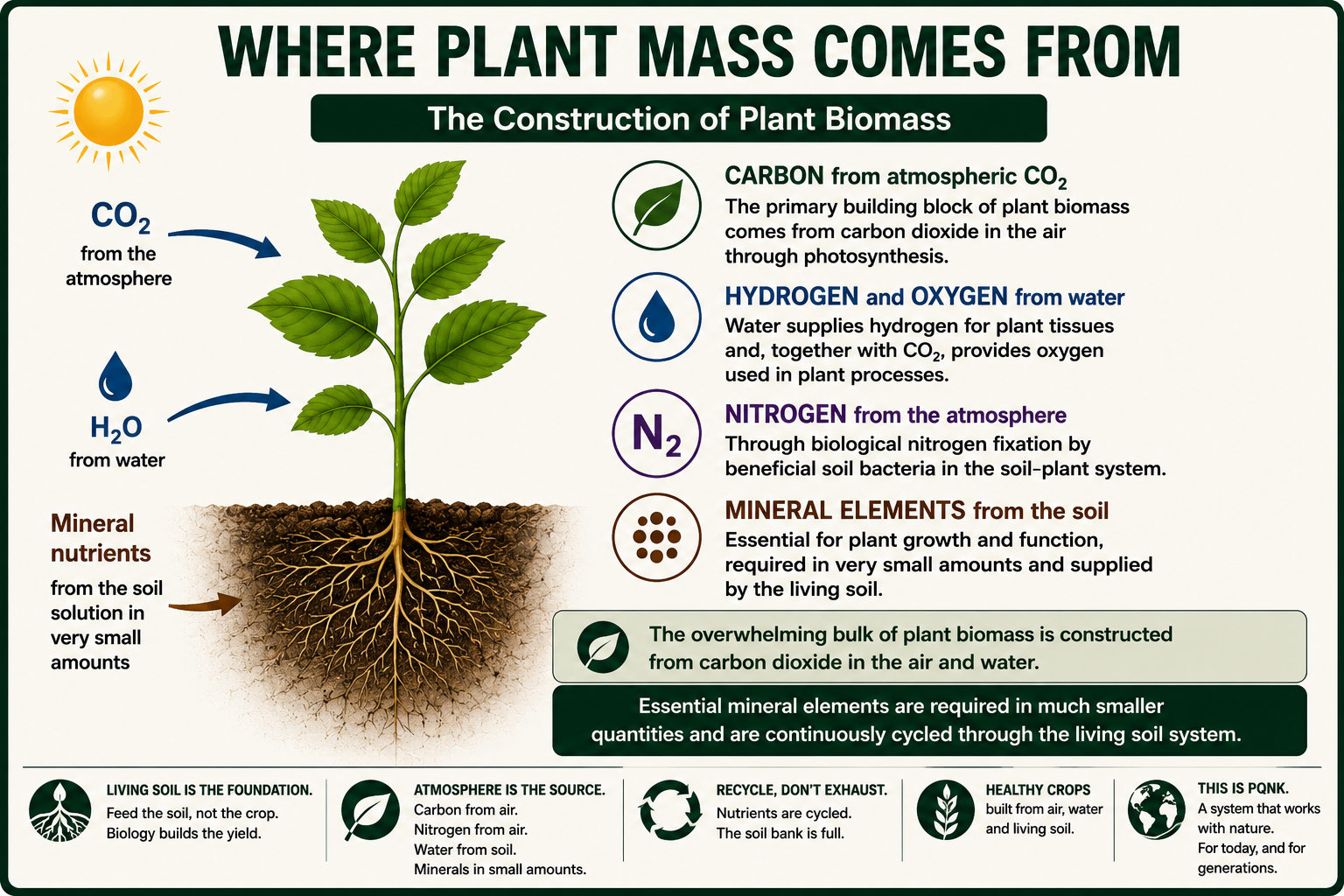
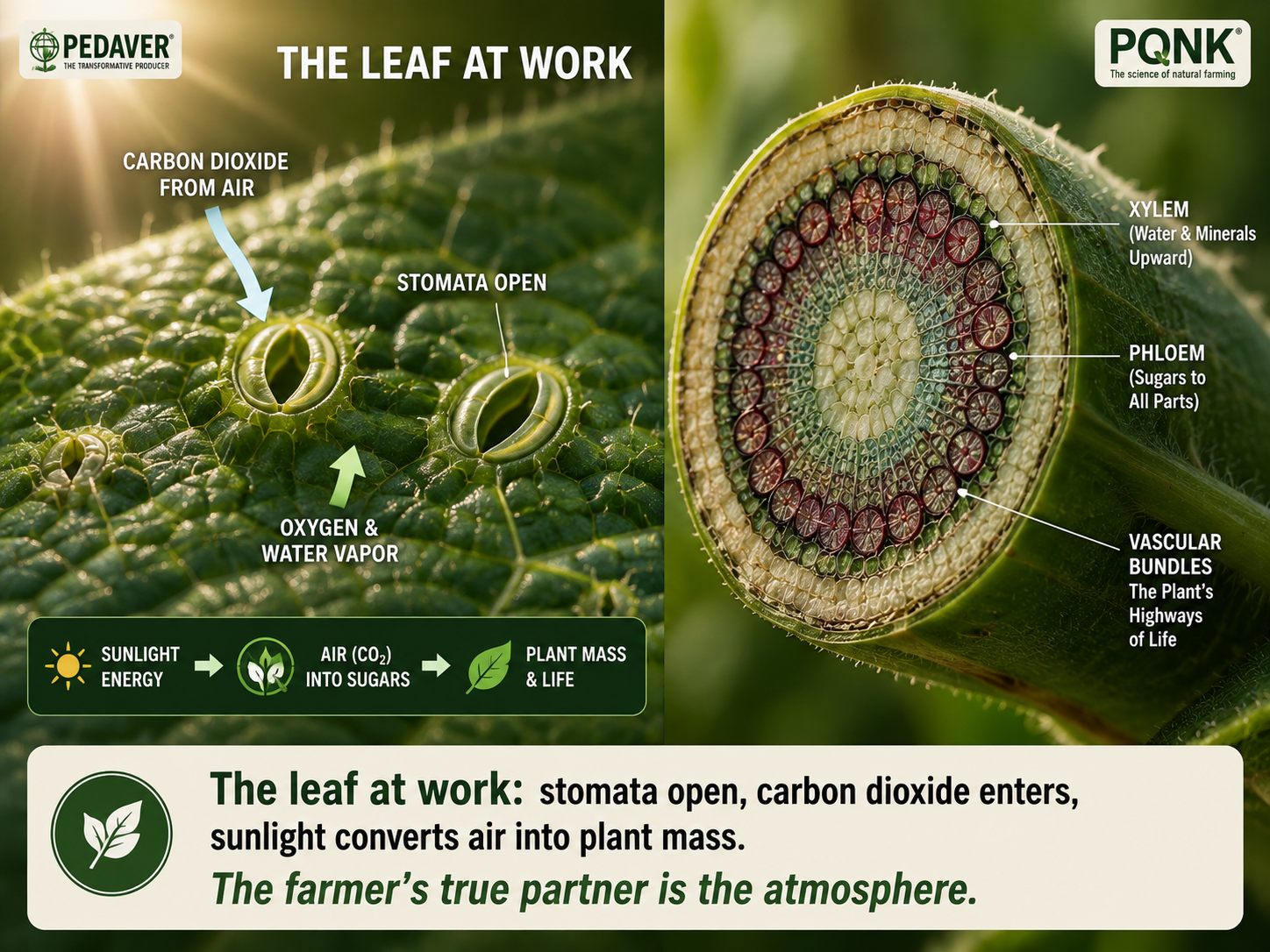
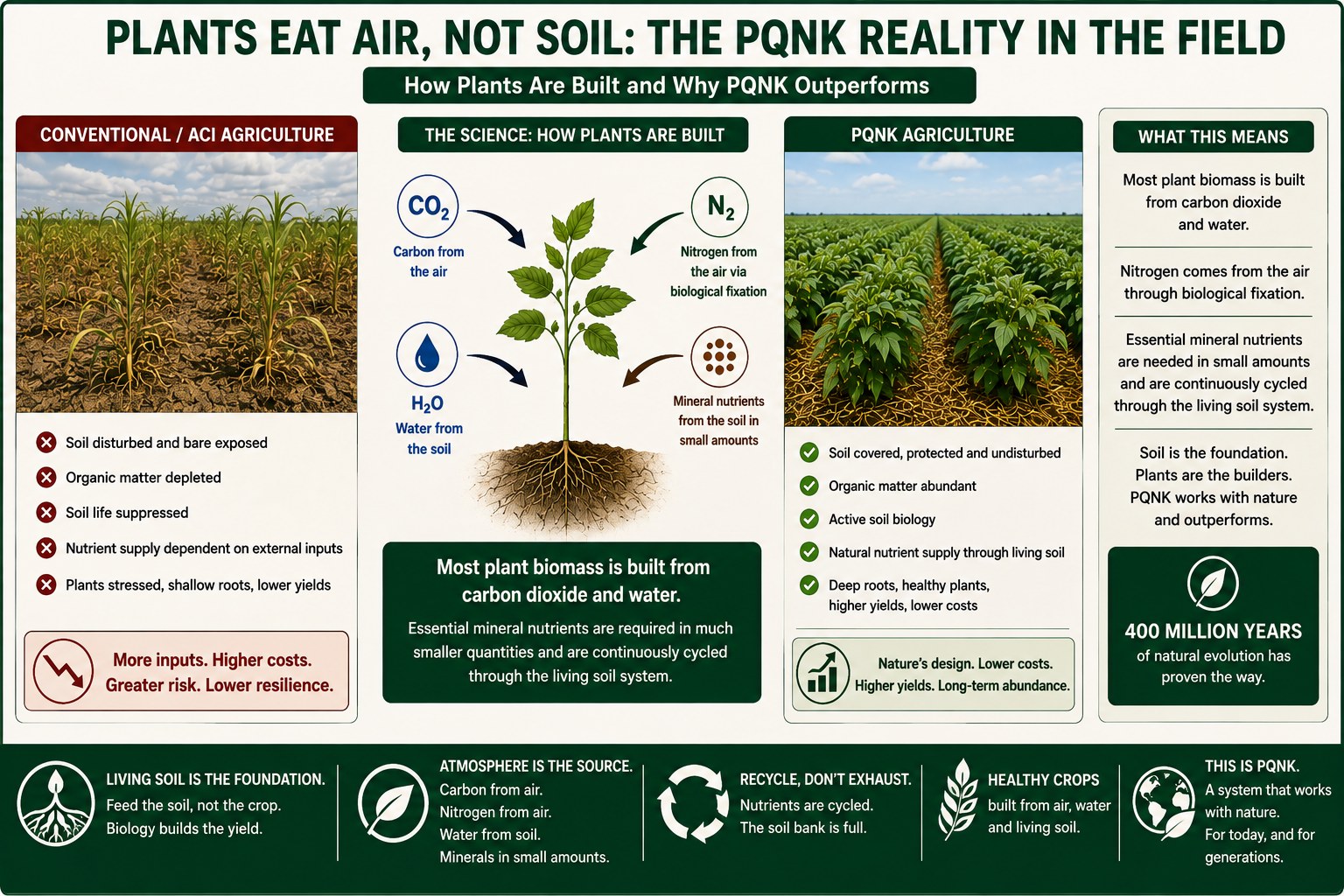
The correct answer is that a plant is made, overwhelmingly, of air. More precisely, a plant constructs its physical mass from three elements: carbon, hydrogen, and oxygen. Carbon is sourced from carbon dioxide in the atmosphere, absorbed through the leaf surfaces and fixed through the process of photosynthesis. Hydrogen and oxygen are sourced from water, split apart during the light reactions of photosynthesis and reassembled into carbohydrates, proteins, and lipids. The energy that drives the entire construction process comes from sunlight.
Together, carbon, hydrogen, and oxygen account for the overwhelming majority of a plant’s dry mass. Carbon is obtained primarily from atmospheric carbon dioxide, while hydrogen and much of the oxygen incorporated into plant compounds are derived through water and carbon dioxide. The remaining fraction includes nitrogen and the essential mineral elements required for plant structure, metabolism, reproduction, and regulation. Their concentrations vary among species, tissues, growth stages, and growing conditions.
Nitrogen is a special case. Its ultimate natural reservoir is the atmosphere, but plants cannot use atmospheric nitrogen gas directly. It must first be converted into biologically available forms, including through nitrogen-fixing microorganisms, and nitrogen already contained in organic matter is continually recycled through decomposition and mineralisation.
The 0.083 percent figure used in this chapter therefore does not describe the total mineral content of plant biomass. It is an illustrative estimate of net mineral export from the field in harvested produce under the stated PQNK production and recycling assumptions. The distinction is fundamental: minerals may be essential to the plant without representing the bulk material from which plant biomass is constructed.
The fertiliser industry has built a two-hundred-billion-dollar annual market on a false premise. The elements a plant is built from all have natural, non-purchased sources in a soil whose biology remains intact: carbon, hydrogen, and oxygen from the atmosphere and water; nitrogen entering the soil through biological fixation and the recycling of organic matter; and phosphorus, potassium, calcium, magnesium, sulfur, and trace minerals released from the geological reserve by the mycorrhizal network and mineral-solubilising organisms. The farmer who purchases fertiliser is not simply supplementing what nature provides. He is paying to replace biological functions that industrial management has degraded.
THE 0.083% IN PRACTICE: WHAT THE NUMBERS SAY
Abstract percentages become concrete when applied to a specific field on a specific farm. Let us take a wheat crop in Pakistan, a typical small farm in Punjab, with average soil, average rainfall, and a yield of two tonnes per acre. This is an ordinary farm, not an exceptional one. The calculation that follows is an illustrative soil-reserve comparison using the stated assumptions for this example. Actual total nutrient reserves and crop removal vary with soil parent material, soil depth, organic matter, crop, yield and location.
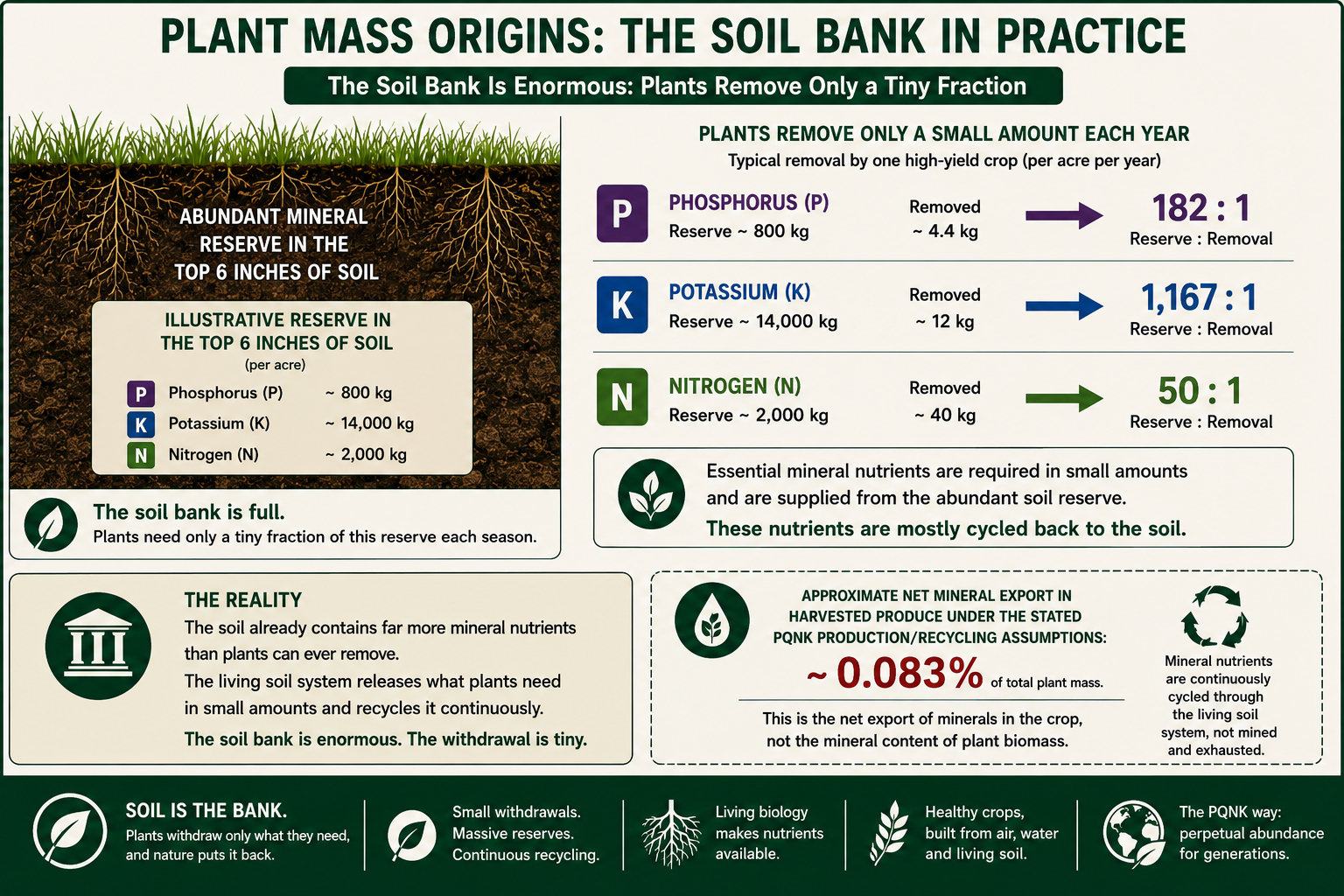
The top six inches of soil beneath that one acre weigh approximately one million kilograms, one thousand tonnes of mineral material, organic matter, water, and biological life. Within that million kilograms, the total elemental phosphorus content, based on average subcontinental soil measurements, is approximately eight hundred kilograms. The two-tonne wheat crop growing above it will remove, over its entire growing season, approximately 4.4 kilograms of phosphorus in the harvested grain and straw combined. The ratio of what the soil bank holds to what the crop withdraws is one hundred and eighty-two to one.
For potassium, the numbers are even more striking. The same acre of average soil holds approximately fourteen thousand kilograms of total potassium. The two-tonne wheat crop removes approximately twelve kilograms. The ratio is one thousand, one hundred and sixty-seven to one. For nitrogen, the soil organic matter of that acre contains approximately two thousand kilograms of total nitrogen, while the crop removes approximately forty kilograms, a ratio of fifty to one.
These ratios represent only the topsoil, the upper six inches. Below this layer lies the subsoil, containing additional mineral reserves in quantities that dwarf even the topsoil figures. Below the subsoil lies weathered bedrock, and below that, the parent rock from which all soil minerals ultimately derive, reserves that would take millions of years of farming at any conceivable intensity to exhaust. For nitrogen, the ultimate reservoir is the atmosphere, which is seventy-eight percent nitrogen gas. Plants cannot use that gas directly; it becomes available through biological nitrogen fixation and the subsequent cycling of nitrogen through organic matter, and the amount supplied this way varies substantially with the ecosystem, the crop and the microbial community.
These figures point to a distinction that the fertiliser debate usually blurs. A soil’s total mineral reserve, the pool that is chemically or biologically available at any given moment, the rate at which soil biology can mobilise more, and the amount removed in each harvest are four different quantities. Many agricultural soils contain total mineral reserves far larger than the quantity removed by a single crop. The practical question is therefore not merely how much of an element exists in the soil, but how much becomes biologically accessible, at what rate, and whether that rate can meet crop demand while harvested nutrients are continually exported from the field. A large reserve does not, by itself, guarantee that the available pool and the rate of mobilisation will keep pace with demand; nutrient limitation can still occur where biological accessibility or mobilisation rate falls short. The premise that the soil is simply empty and must be refilled is, at best, an incomplete account of soil chemistry.
The soil is not empty. It contains, in the top six inches alone, one hundred and eighty-two times more phosphorus than the wheat crop above it will remove this season. The bank is full. The farmer is being sold a withdrawal slip for his own account.
WHY DEFICIENCY HAPPENS: THE BROKEN ACCESS MECHANISM
If the minerals are present in such overwhelming abundance, the obvious question is: why do crops show nutrient deficiencies? Why do farmers see yellow leaves, stunted growth, and poor yields when they reduce or remove their fertiliser applications? The answer is not that the minerals are absent. It is that the biological machinery required to access them has been destroyed, and the destruction was caused by the very practices that fertiliser was supposed to supplement.
In a biologically active soil, mineral acquisition occurs through interacting physical, chemical and biological processes. Root exudates, mineral-weathering microorganisms, nutrient-solubilising organisms, decomposition, soil water and mycorrhizal associations can all contribute to converting nutrients from less accessible pools into forms that plants can acquire. One such function is mineral weathering: lithotrophic bacteria and mycorrhizal fungi attack the mineral crystal structures of rock and soil particles, secreting organic acids and chelating compounds that dissolve the bonds holding minerals in insoluble form. This weathering converts locked geological material into soluble ions that can move through soil water.
Other organisms, including phosphate-solubilising bacteria, potassium-releasing bacteria, and nitrogen-fixing diazotrophs, further transform dissolved minerals, converting them from forms that are soluble but not yet readily plant-available into ionic forms that plant roots can absorb and metabolise. This biological processing can help supply nutrients in balanced proportions as conditions allow.
In addition, the mycorrhizal fungal network, the biological infrastructure described in the previous chapter, can transport plant-available minerals to the root surfaces of the crop. The fungal threads penetrate pore spaces in the soil that root hairs cannot reach, extending the plant’s effective foraging radius by a factor of ten to a hundred. Root exudates and plant-microbe signalling can influence microbial activity and nutrient acquisition in the rhizosphere, allowing nutrient mobilisation to respond dynamically to biological and environmental conditions.
These biological functions can be disrupted by ACI practices, particularly in combination. Repeated tillage breaks up the mycorrhizal network. Prolonged flooding and waterlogging suppress the aerobic bacteria that help transform minerals into plant-available forms. Heavy, repeated applications of soluble fertiliser can reduce the plant’s investment in root exudates, weakening the signalling that recruits and sustains this biology. Where several of these pressures act together over successive seasons, the biological pathways that mobilise minerals can become impaired even though the minerals in the geological bank remain present in the quantities they have always been. The result can be a soil that is full of minerals the crop can no longer readily reach.
The conventional response is to apply more fertiliser. This provides short-term relief, and where the soil biology is already weakened it can deepen the underlying problem. Sustained high applications of soluble nutrients tend to reduce root exudate production, which can lower microbial activity and biological access to the geological reserve, increasing reliance on the next application.
Where soluble fertiliser is used season after season to bypass a weakened soil biology, it can stop being a supplement and become part of why the deficiency persists.
THE VAN HELMONT EXPERIMENT: FOUR CENTURIES OF IGNORED EVIDENCE
The evidence that plant mass is not drawn primarily from the soil is not new. In 1648, Jan Baptiste van Helmont, a Flemish scientist, planted a willow tree weighing five pounds in a carefully measured amount of dry soil, covered the pot to prevent material from entering or leaving, and watered the tree with only rainwater for five years. At the end of the experiment the willow had grown to one hundred and sixty-nine pounds, while the soil in the pot had lost less than two ounces of weight. Van Helmont’s experiment provided an early quantitative challenge to the belief that the increase in plant mass came primarily from depletion of the soil. His own conclusion, that the increase came from water alone, was incomplete. Later discoveries of photosynthesis established the central role of atmospheric carbon dioxide.
The discovery of photosynthesis in the eighteenth and nineteenth centuries completed the picture: the mass came from carbon dioxide in the atmosphere, fixed by the plant’s chlorophyll using the energy of sunlight, with water as the hydrogen source. By the mid-nineteenth century, the basic biochemistry was understood. By the late nineteenth century, it was established science, incorporated into every chemistry textbook in the world.
And yet, within a few decades of this scientific understanding being consolidated, an agricultural paradigm emerged that contradicted it in practice. Justus von Liebig, the German chemist who identified the role of nitrogen, phosphorus, and potassium in plant nutrition, inadvertently provided the theoretical foundation for synthetic fertilisers, even though Liebig himself understood that the minerals he identified were micro-quantities needed in balance, not the primary raw material of plant growth. The industry that grew up around his work converted a nuanced scientific insight into a commercial product: the NPK package that told farmers their soil was empty and that they needed to fill it, repeatedly and at continuing cost, from an external source.
The irony is long-standing: nearly four centuries after Van Helmont’s experiment first questioned the idea that plant mass comes mainly from soil, and more than a century after photosynthesis explained where most of that mass does come from, input-dependent agriculture is still organised around the older assumption. The underlying science has been available for a long time. The economics have been more persuasive.
NITROGEN: THE SPECIAL CASE AND THE ATMOSPHERIC BANK
Of the three primary fertiliser elements, nitrogen deserves special attention because it is the most commercially significant, the most energetically expensive to produce synthetically, and the one for which the natural biological alternative is most completely developed and most comprehensively ignored.
The atmosphere is seventy-eight percent nitrogen gas. Every acre of farmland is covered by a column of air containing, at any given moment, tens of thousands of kilograms of nitrogen. This atmospheric nitrogen is unavailable to plants directly, plants cannot absorb nitrogen gas through their leaves or roots. But it is available through biology: a class of bacteria called diazotrophs, which includes the well-known Rhizobium species that colonise legume roots as well as a range of free-living soil bacteria, possess the enzymatic machinery to convert atmospheric nitrogen gas into ammonium, a form that plants can absorb and incorporate into proteins.
This process, biological nitrogen fixation, is one of the most important chemical reactions on Earth. It has been operating, in soil ecosystems, for hundreds of millions of years. It requires no fossil fuel input, produces no greenhouse gas emissions, and costs the farmer nothing, provided the soil biological community that performs it is kept alive. PQNK seeks to create soil conditions favourable to biological nitrogen cycling, including nitrogen fixation, decomposition, mineralisation and recycling of plant residues. The contribution of biological nitrogen fixation varies with crop, microbial community and environmental conditions and should be measured rather than assumed.
Synthetic nitrogen fertiliser, produced through the Haber-Bosch process, which uses natural gas and high pressure to convert atmospheric nitrogen to ammonia, is an industrial imitation of this biological process. It is vastly more expensive, both in financial cost and in energy consumption. It is also, in some agricultural systems, far less efficient: fifty to seventy percent of applied synthetic nitrogen can be lost through volatilisation, leaching, or conversion to nitrous oxide, a greenhouse gas with a 100-year global warming potential hundreds of times greater than carbon dioxide. The remainder is applied to the crop in a soluble form that stimulates rapid vegetative growth but bypasses the biological nutrient-cycling system and further degrades it.
The Haber-Bosch process is often celebrated as one of the great technical achievements of the twentieth century, credited with feeding the world’s growing population. It is rarely noted that the world’s growing population was fed, in its first ten thousand years of agriculture, without any synthetic nitrogen at all, by the biological fixation process that Haber-Bosch was designed to replace, and that has been progressively destroyed by the management practices that synthetic nitrogen adoption encouraged.
The atmosphere above every farm is seventy-eight percent nitrogen. That reservoir reaches crops through biological nitrogen fixation and nitrogen cycling, in amounts that vary by ecosystem, crop and microbial community. Synthetic nitrogen fertiliser is a two-hundred-billion-dollar annual charge for a function that a living soil can, in large part, perform without it.
WHAT FERTILISER ACTUALLY DOES TO THE SOIL
The effects of synthetic fertiliser on soil biology have been extensively studied. Where fertiliser use is heavy and sustained, especially alongside tillage, flooding and loss of organic matter, several pathways can act together to weaken the soil’s biological self-sufficiency.
Suppression of root exudate production. When a plant has adequate soluble nutrients in its immediate root zone, it tends to reduce its production of the root exudates that recruit and reward the mycorrhizal fungi and beneficial bacteria that would otherwise mine the geological mineral bank. The plant, receiving what it needs from the fertiliser, stops investing in its biological infrastructure. The microbial community, deprived of its carbon food source, declines. The mycorrhizal network contracts. Over repeated seasons this can leave the plant more dependent on external supply as the biological alternative weakens.
Disruption of mycorrhizal colonisation. High concentrations of soluble phosphorus in the root zone suppress the formation of mycorrhizal associations. The plant does not initiate the chemical signals that invite fungal colonisation when phosphorus is already abundantly available. This means that phosphorus fertiliser application not only supplies phosphorus directly but also prevents the establishment of the biological system that would supply it permanently and freely. The more phosphorus fertiliser is applied, the weaker the mycorrhizal network becomes, and the greater the dependence on continued fertiliser application.
Soil acidification. Many nitrogen fertilisers, particularly ammonium-based compounds, acidify the soil as they break down. Soil acidification alters the chemical availability of multiple mineral elements simultaneously, making some more soluble (aluminium and manganese, which are toxic to plants at elevated concentrations) and others less available (phosphorus, calcium, magnesium). Acidification also shifts the microbial community away from the diverse, balanced assemblages that characterise healthy soil and toward the simplified, often pathogen-dominated communities of degraded soil. Repeated applications of acidifying fertilisers accelerate this process.
Disruption of soil electrical balance. Healthy soil carries a net negative electrical charge, what soil scientists call Cation Exchange Capacity (CEC). This negative charge holds positively charged mineral ions (cations: potassium, calcium, magnesium) on soil particle surfaces, making them available to plant roots without being leached away by rainfall. Synthetic fertilisers, particularly in combination with the tillage and flooding that accompany them, progressively deplete the organic matter and biological life that generate and maintain this negative charge. The result can be a soil that holds applied nutrients poorly, so that they leach away with the next rainfall, polluting groundwater and requiring yet more application.
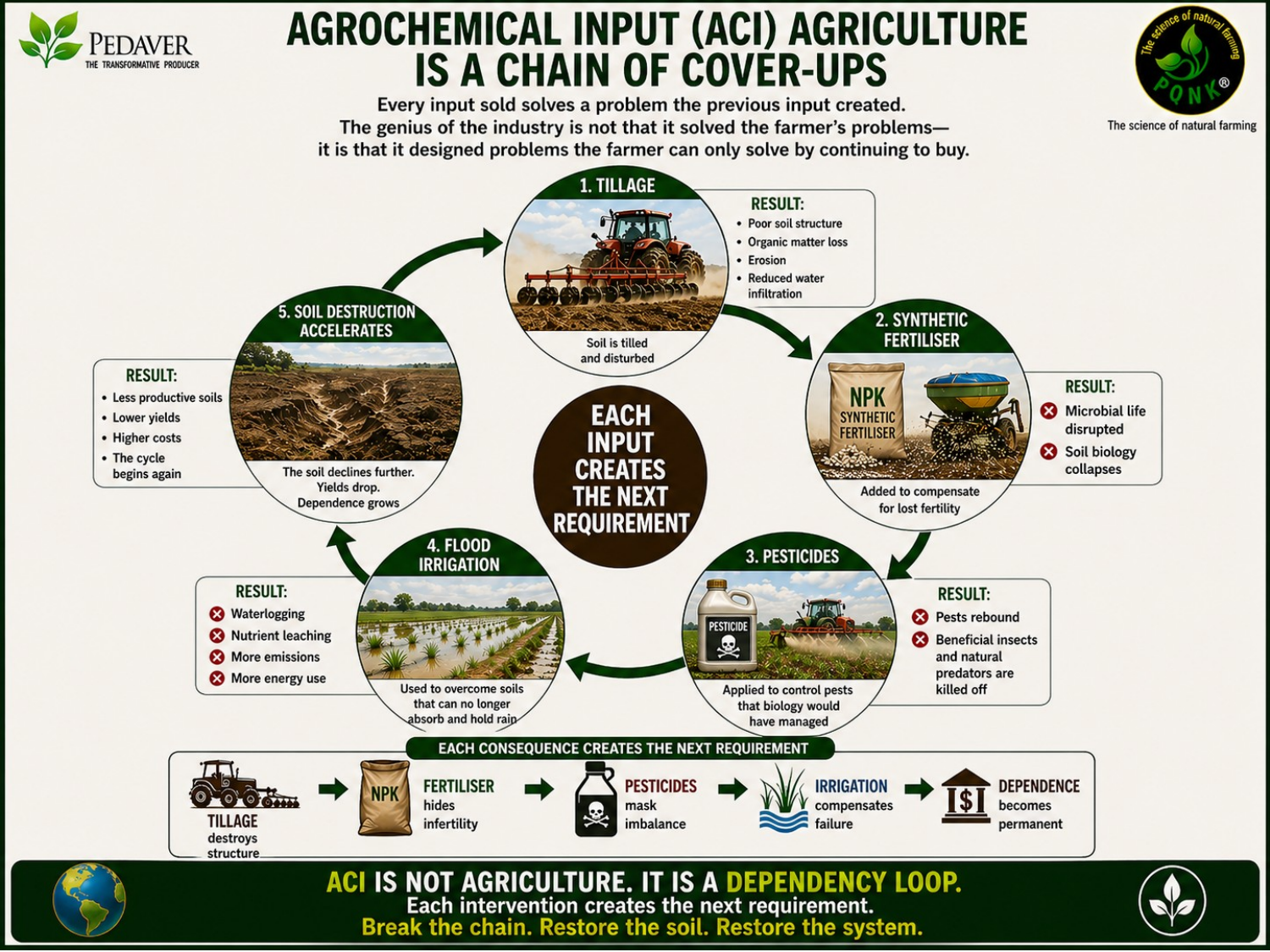
Where these pathways act together over time, the result can be a soil that still holds large mineral reserves but accesses them poorly, holds applied nutrients poorly, and supports less of the biological life that would otherwise supply them. These are recognised risks of heavy, sustained high-input management combined with other disturbances, not merely incidental effects.
THE GREEN REVOLUTION’S HIDDEN COST
The Green Revolution of the 1960s and 1970s is credited with averting famine in South Asia and other food-insecure regions by introducing high-yielding, fertiliser-responsive crop varieties. This credit is partially deserved: the new varieties did produce higher yields under high-input conditions, and in the short term, food production in affected regions increased substantially. But the accounting of the Green Revolution has always been incomplete, because it measured only what it produced and not what it consumed in producing it.
What it consumed was the biological capital of the soil, the accumulated fertility of millennia, the mycorrhizal networks, the soil food web, the organic matter, the aggregate structure, converted into short-term yield and sold at the farmer’s expense and at the expense of future generations. In the Punjab region of Pakistan, where Green Revolution varieties were most intensively adopted, the soil organic matter content that was 3-4% in the 1950s has declined to below 1% in many areas. Groundwater tables that sat twenty feet below the surface have dropped to two hundred feet and are still falling. The nutritional content of the food produced on this soil has measurably declined in every decade since the transition.
The Green Revolution varieties were also specifically bred to respond to synthetic nitrogen with rapid vegetative growth. PQNK observations suggest that varieties selected primarily for high response to soluble nitrogen may rely less on the soil biological community for their nutrition, performing well when fed from outside and less well when required to draw on soil biology alone. This is offered as a working hypothesis: it is consistent with reports that some Green Revolution varieties yield poorly when fertiliser is withdrawn abruptly, but it requires controlled comparison against the traditional varieties they replaced.
Heirloom and traditional varieties were selected over long periods in conditions of biologically active soil. In PQNK field observations, several traditional varieties have shown strong root systems, good performance under limited irrigation, and good grain quality under PQNK management. Whether traditional varieties as a class have deeper mycorrhizal associations, or greater drought and pest tolerance, than modern varieties is a question for direct comparative testing rather than a settled result. The revival of varieties like ‘Sona-Moti’ wheat, a pre-Green Revolution Pakistani variety reported to have good nutritional density, lower gluten content, and strong performance under PQNK management, reflects this interest in recovering genetic material suited to biologically active soils.
A question follows logically from this distinction, and it is one that farmers who have grown accustomed to thinking within the conventional framework frequently raise: what happens to a high-yielding variety, specifically bred for synthetic nitrogen response, when it is placed in a fully developed PQNK ecosystem where no external nutrient is applied? Will the variety’s higher nutritional demand exceed what the soil biology can supply? The answer requires understanding why Green Revolution varieties were bred the way they were in the first place. The Mexican cross dwarf wheat, the variety at the centre of the Green Revolution, was not bred because wheat biologically requires more nitrogen. It was bred because the conventional system was applying nitrogen in quantities that full-height wheat varieties could not structurally withstand. The tall stems lodged: collapsed under the weight of nitrogen-stimulated vegetative growth, particularly in waterlogged, hardpan-bound, poorly aerated soil where roots could not anchor deeply. The dwarfing gene solved an engineering problem created entirely by the conventional system itself. It was a structural compensation for a management failure, not a biological advancement.
In a properly adopted PQNK ecosystem, the conditions that produced lodging do not exist. The hardpan has been shattered. Roots penetrate deeply. The soil is permanently aerated. The plant is physically anchored in ways that conventional compacted and frequently disturbed soil often restricts.
As for the higher yield potential of modern varieties, a higher-yielding variety carries a higher nutrient demand. In a biologically active soil, higher demand is associated with greater root exudation, which can stimulate microbial activity in the rhizosphere and increase the rate at which nutrients are mobilised from soil reserves and delivered to roots. How closely this response can track demand varies with the soil, the crop and the season. A biologically restored soil can greatly improve nutrient cycling and access to existing reserves. Whether biological mobilisation can fully meet the demand of a particular high-yielding crop depends on the soil, crop, nutrient balance, biological activity and the rate at which nutrients are exported in harvest. PQNK proposes that this capacity can become sufficient under a mature system; that proposition should continue to be tested crop by crop and soil by soil.
The Green Revolution did not discover that crops need more nitrogen. It discovered that crops grown in biologically collapsed soil, force-fed with soluble nitrogen, collapse structurally without engineering intervention. PQNK removes the cause. The engineering intervention becomes unnecessary.
THE PQNK PROOF: ABUNDANCE WITHOUT PURCHASE
The argument so far has been primarily analytical, demonstrating through the chemistry of soil and the biology of plants that the premise of automatic fertiliser dependence is weaker than it is usually presented. PQNK does not rest on analysis alone. Pedaver holds field records and case documentation from farmers who have grown crops on their own land, under their own conditions, without purchased inputs, and in documented cases have reached commercial yields at reduced cost.
The NARC wheat trial at PARC farms in Islamabad provides one of the most rigorous institutional data points. Treatment One, the PQNK approach, with no-till raised beds, precision planting, and zero purchased inputs, used 4.24 kilograms of seed per acre against the conventional treatment’s fifty kilograms, received three furrow irrigations against the conventional treatment’s flood irrigation regime, and applied no fertiliser at any stage. The cost of production in Treatment One was Rs. 11,660 per acre. In the conventional drill treatment, it was Rs. 26,236. In the broadcast treatment, Rs. 22,036. The PQNK treatment’s profit margin, projected at eighty percent planting precision, exceeded Rs. 130,000 per acre, more than double the conventional alternatives.
In the fields of Sindh, farmers who have been on PQNK for multiple seasons report wheat crops grown with three furrow irrigations, no fertiliser, no pesticides, and no tillage since the initial transition. In Punjab, farmer Afzal Bodla of Arifwala documented a wheat crop that received no irrigation from September through to harvest, no fertiliser at any point, and no agrochemicals of any kind, and produced a commercial yield on a field whose soil had been restored through PQNK management. Farmer Ali Raza Kharal produced a similar crop with ten kilograms of seed per acre and three furrow irrigations. These are not exceptional farms. They are ordinary farms managed by ordinary farmers who understood and applied a principle that soil science has known for decades: the soil is not empty.
Q If the net mineral export represented by harvested produce can be small relative to the total mineral reserve of the soil, why does conventional agriculture spend so much on mineral fertiliser?
A Because in many degraded soils the biological processes that make reserve minerals available have been weakened. In the illustrative example used in this chapter, the top six inches hold about 800 kg of phosphorus per acre against an annual crop removal of about 4.4 kg; there the constraint is access, not total supply. Actual reserves and removal vary by soil and crop.
Q What does a soil test actually measure?
A Routine soil tests estimate particular pools of nutrients using defined chemical extraction methods. They are useful indicators of nutrient availability under the assumptions of the test, but they do not measure the entire geological nutrient reserve or all biological processes governing nutrient acquisition.
Q What restores the biological machinery that releases mineral abundance?
A Mycorrhizal fungi that extend the plant’s root reach, mineral-weathering and nutrient-solubilising microorganisms that release minerals from soil particles, and the wider soil fauna, including earthworms, that fragment and mix organic and mineral material, build soil structure and support microbial activity. Restore the community; restore the access.
The sugarcane records tell a similar story at a different scale. In recorded PQNK sugarcane cases, farms have reported yields in the region of two thousand maunds per acre, without purchased inputs beyond the initial transition investment, while comparable conventional farms report higher input costs. Comparable results have been reported for corn, cotton, garlic and rice under PQNK management. In these cases the constraint was not the size of the geological reserve but the biological access to it, which improved once soil function was restored.
The farmer who switches to PQNK does not reduce his crop’s access to nutrients. He restores it. For the first time in decades, his crop is eating from a bank that contains one hundred and eighty-two times more phosphorus than it will ever remove, and delivering it free of charge.
PERPETUAL ABUNDANCE: THE NATURAL STATE OF SOIL
‘Perpetual Abundance’ is the PQNK term for a functioning soil ecosystem in which biological cycling continually mobilises and recycles nutrients from soil, organic residues and atmospheric pathways, reducing dependence on externally purchased nutrients while maintaining productive crop growth. It is not an aspirational ideal. It is a description of the condition that prevailed on this planet for four hundred million years before human agriculture began, and that prevails wherever human agriculture has not yet reached.
In an old-growth forest, in an undisturbed grassland, in a river margin that has never been plowed, the soil biological community is maintaining Perpetual Abundance without any external input and without any human management. The trees are not yellow-leaved. The grasses are not deficient. The vegetation does not wait for a farmer to arrive with a bag of fertiliser before it grows. It grows because the system it inhabits has been designed, by four hundred million years of evolutionary selection, to supply everything it needs from resources that are already present and continuously renewable.
PQNK is the intentional replication of this condition on a farm. It does not add anything to the soil that the natural system does not already contain. It removes the obstacles, the hardpan, the chemical contamination, the biological impoverishment, the bare soil, that prevent the natural system from functioning. And then it steps back and allows the system that has been producing abundance for four hundred million years to do what it has always done.
The transition from ACI depletion to PQNK abundance is not instantaneous. The biological community must rebuild. The mycorrhizal network must re-establish. The aggregate structure must re-form. The first and sometimes second crop after the PQNK transition may require some reduced inputs as the system recovers. In the transitions Pedaver has documented, biological improvement is often measurable within the first season and more marked by the second, with many farms reaching low or zero purchased-input operation within about three crops. The time this takes varies with the starting condition of the soil, the pace of biological recovery, the crop, the climate and the management.
This is not a promise. PQNK has been applied by farmers in Pakistan and in a number of other countries, across a range of soils and climates, and Pedaver holds field records and case documentation for many of these. Where the approach has been followed and recorded, farmers have reported restored soil function and crops grown without purchased inputs. How consistent this pattern is across sites is a question that Pedaver’s records should be able to address case by case.
WHAT THIS CHAPTER HAS ESTABLISHED
The argument of this chapter can be stated simply, because the underlying science is simple, it has been known, and largely ignored, for nearly four centuries.
The central proposition of this chapter is simple. The overwhelming majority of plant dry mass is constructed from carbon dioxide and water, using energy from sunlight. Essential mineral nutrients are indispensable, but they constitute a much smaller part of plant dry matter and participate in continuing cycles between soil, organisms, plants and residues. Agriculture must therefore distinguish between the total mineral reserve of a soil, the fraction biologically or chemically available at a particular moment, and the amount actually exported when a crop is harvested.
Synthetic fertiliser does not solve this problem. It deepens it by suppressing the biological access mechanisms, acidifying the soil, destroying the mycorrhizal network, and creating a chemical dependency that intensifies with every application. The fertiliser industry has built two hundred billion dollars of annual revenue on a premise that plant biology refutes and soil chemistry demolishes.
PQNK restores and strengthens the biological processes that cycle nutrients between soil, organisms, plants and residues. It does so through a precise, sequential protocol that is the subject of later chapters. In documented PQNK cases, farmers have reached commercial yields without purchased nutrients within a few crop cycles of transition. Pedaver presents this as a repeatable outcome of restoring soil biological function; the scale, the timing, and the nutritional-quality claims should be read against Pedaver’s field records rather than as universal law.
The next chapter turns to carbon, the currency in which every one of these biological transactions is settled. If the mineral argument is that the bank is full, the carbon argument is that the farm can keep refilling it, from the air, through its own crop residues and living roots, at no cost, for as long as tillage and burning are not there to draw it back down.
Chapter Four: Carbon, The Currency of Life